
An overview and comparison of free Python libraries
An overview and comparison of free Python libraries for data mining and big data analysis Igor Stančin, Alan Jović E-mail to: {igor. stancin, alan. jovic}@fer. hr University of Zagreb Faculty of Electrical Engineering and Computing, Zagreb, Croatia
CONTENT �Motivation & goal �Core libraries �Data preparation �Data visualization �Machine learning �Deep learning �Big data �Conclusion 2/13

Motivation & goal �Python’s massive growth in usage why? �Many open-source libraries and tools 20+ are examined �Many options/algorithms for machine learning / deep learning Compare and use the most appropriate 3 3/13
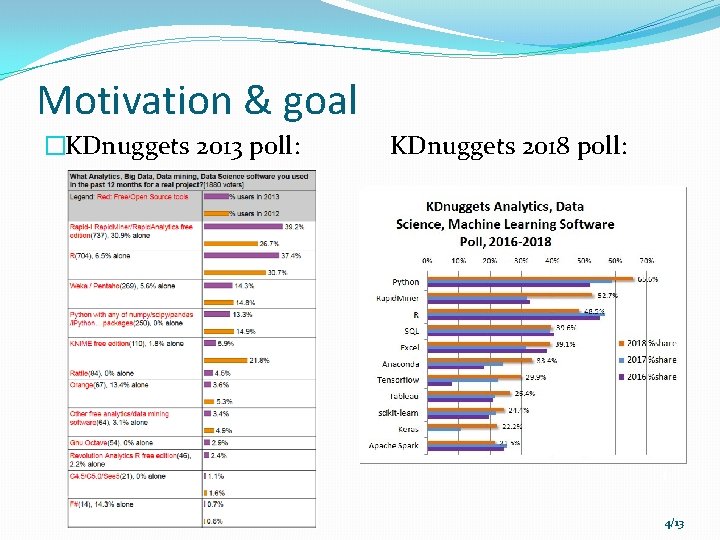
Motivation & goal �KDnuggets 2013 poll: KDnuggets 2018 poll: 4 4/13
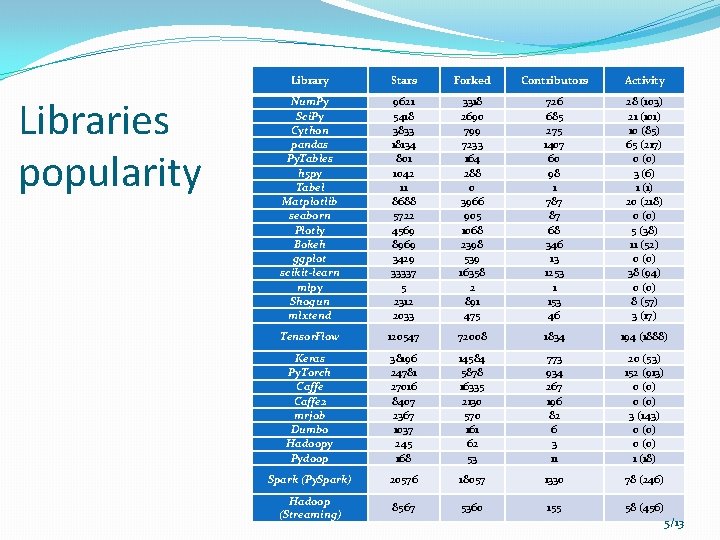
Libraries popularity Library Stars Forked Contributors Activity Num. Py Sci. Py Cython pandas Py. Tables h 5 py Tabel Matplotlib seaborn Plotly Bokeh ggplot scikit-learn mlpy Shogun mlxtend 9621 5418 3833 18134 801 1042 11 8688 5722 4569 8969 3429 33337 5 2312 2033 3318 2690 799 7233 164 288 0 3966 905 1068 2398 539 16358 2 891 475 726 685 275 1407 60 98 1 787 87 68 346 13 1253 1 153 46 28 (103) 21 (101) 10 (85) 65 (217) 0 (0) 3 (6) 1 (1) 20 (218) 0 (0) 5 (38) 11 (52) 0 (0) 38 (94) 0 (0) 8 (57) 3 (17) Tensor. Flow 120547 72008 1834 194 (1888) Keras Py. Torch Caffe 2 mrjob Dumbo Hadoopy Pydoop 38196 24781 27016 8407 2367 1037 245 168 14584 5878 16335 2130 570 161 62 53 773 934 267 196 82 6 3 11 20 (53) 152 (913) 0 (0) 3 (143) 0 (0) 1 (18) Spark (Py. Spark) 20576 18057 1330 78 (246) Hadoop (Streaming) 8567 5360 155 58 (456) 5/13
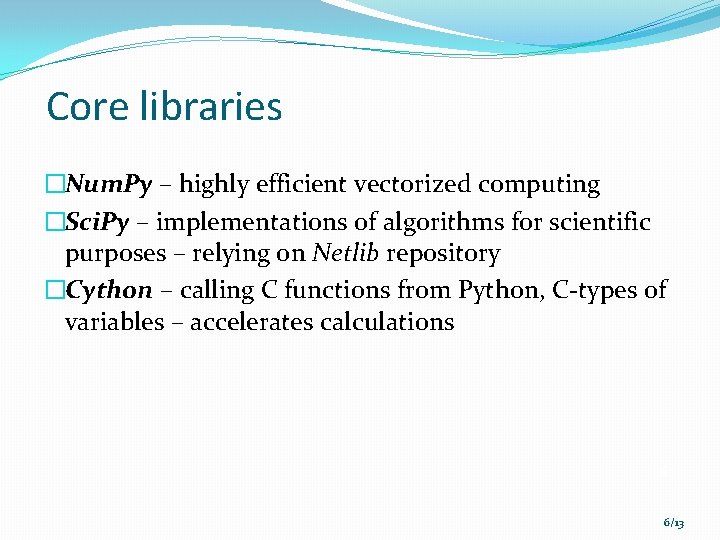
Core libraries �Num. Py – highly efficient vectorized computing �Sci. Py – implementations of algorithms for scientific purposes – relying on Netlib repository �Cython – calling C functions from Python, C-types of variables – accelerates calculations 6 6/13
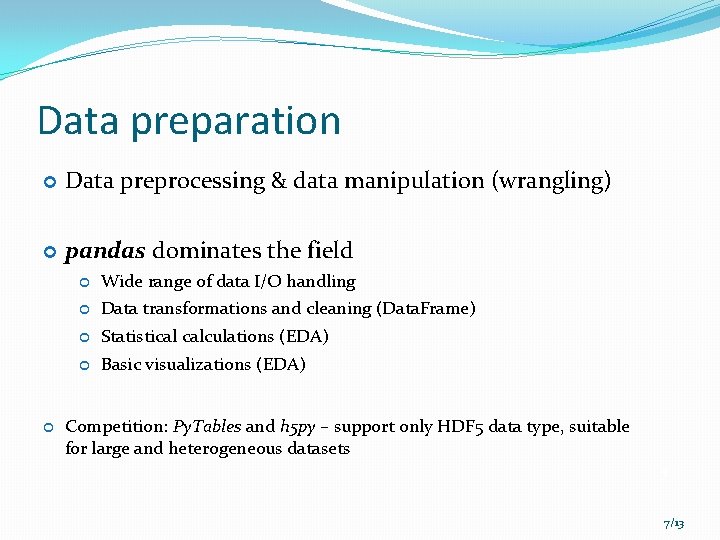
Data preparation Data preprocessing & data manipulation (wrangling) pandas dominates the field Wide range of data I/O handling Data transformations and cleaning (Data. Frame) Statistical calculations (EDA) Basic visualizations (EDA) Competition: Py. Tables and h 5 py – support only HDF 5 data type, suitable for large and heterogeneous datasets 7 7/13
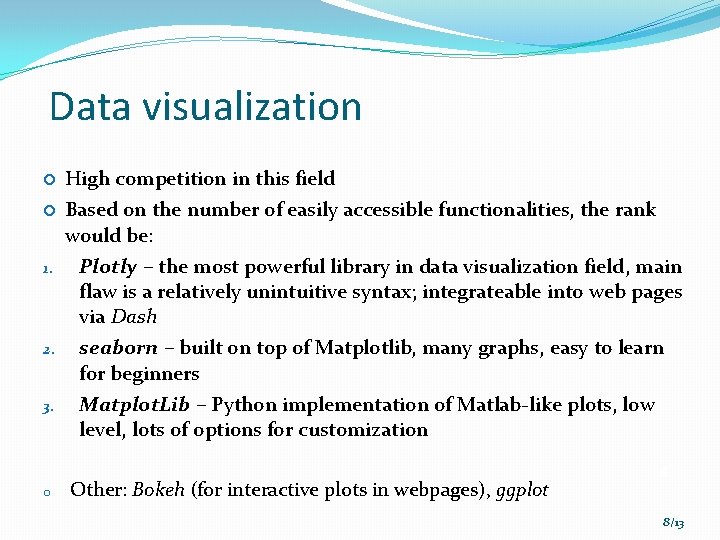
Data visualization 1. 2. 3. o High competition in this field Based on the number of easily accessible functionalities, the rank would be: Plotly – the most powerful library in data visualization field, main flaw is a relatively unintuitive syntax; integrateable into web pages via Dash seaborn – built on top of Matplotlib, many graphs, easy to learn for beginners Matplot. Lib – Python implementation of Matlab-like plots, low level, lots of options for customization Other: Bokeh (for interactive plots in webpages), ggplot 8 8/13
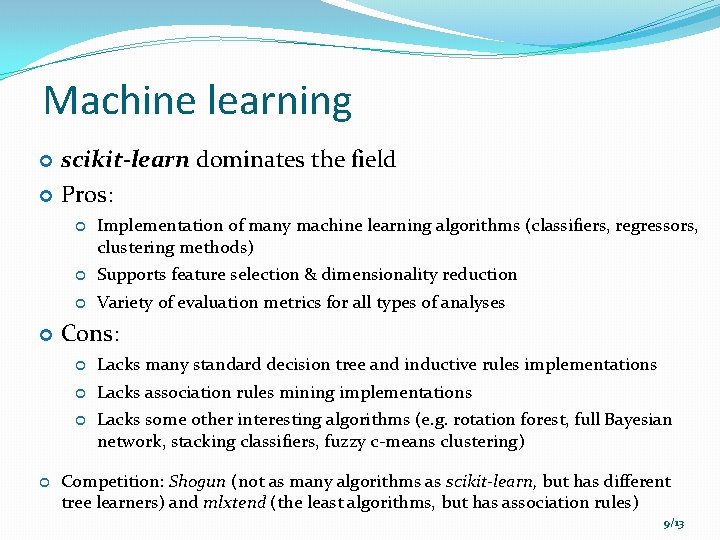
Machine learning scikit-learn dominates the field Pros: Implementation of many machine learning algorithms (classifiers, regressors, clustering methods) Supports feature selection & dimensionality reduction Variety of evaluation metrics for all types of analyses Cons: Lacks many standard decision tree and inductive rules implementations Lacks association rules mining implementations Lacks some other interesting algorithms (e. g. rotation forest, full Bayesian network, stacking classifiers, fuzzy c-means clustering) 9 Competition: Shogun (not as many algorithms as scikit-learn, but has different tree learners) and mlxtend (the least algorithms, but has association rules) 9/13
Deep learning �Very popular in Python – high competition �Tensor. Flow, Keras and Py. Torch are currently the most popular libraries (Caffe/2, Theano and others not as much) �Tensor. Flow (Google) – low level, detailed, supports most options �Keras – built on top of Tensor. Flow and other libraries (high level ANN API), easy to learn, runs seamlessly on CPU and GPU, a bit fewer functionalities than Tensor. Flow �Py. Torch (Facebook) - runs code in a more procedural fashion, unlike Tensor. Flow, where one first needs to design the whole model and then run it within a Session, easy to learn and debug, number of functionalities comparable to Tensor. Flow 10/13
Big data � Not specifically designed to Python, but most big data tools support Python (R, Java and Scala are equally popular here) � Two most popular: � Py. Spark (Python specific) for Spark, may use Spark-internal Mllib for machine learning � Hadoop Streaming (any language) for Hadoop Map. Reduce � Several Python libraries for running Hadoop: � mrjob – multi-step Map. Reduce jobs in pure Python, good documentation, does not support complex tasks, a bit slow � Dumbo – has advanced functionalities, not rich documentation, wrapper around Hadoop Streaming, not maintained � Hadoopy – similar to Dumbo, better documentation, not maintained � Pydoop - wrapper around Hadoop pipes (C++ API for Hadoop) 11/13
Conclusion Recommended Python stack for data mining / data science: Core: Num. Py, Sci. Py, Cython Data preparation: pandas Visualization: Plotly, seaborn or Matplot. Lib Machine learning: scikit-learn Deep learning: Tensor. Flow, Keras, Py. Torch Big data: Spark, Hadoop Streaming Community support is vital for survival of Python opensource libraries, especially in a fast-evolving area such as 12 data science 12/13
Thank you! �Questions?
- Slides: 13