
An Orientation to Lifespan Development Chapter 1 What

















- Slides: 60
An Orientation to Lifespan Development Chapter 1
What is Human Development? n It is a pattern of movement and change Some things change n Some things stay the same n n Movement & change include growth, transition, and decline.
The Lifespan Perspective n n History n Studied child development since about 1900. n Studied adult development since about 1960. The reason for the difference is cultural change & increased longevity (life expectancy).
Life Expectancy Changes n n Lifespan, the maximum number of years a human being could live (about 120 years) remains relatively constant. Life expectancy, the number of years a person can expect to live when born in a certain place in a certain year, changes. U. S. , 1900 47 years n U. S. , 2005, 77 years (30 year increase) n
What types of influences form the context of development? n Normative age-graded (cultural) n n Normative history-graded (historical) n n e. g. , puberty, graduation, retirement e. g. , war, famine, earthquakes, terrorism Non-normative life events & conditions (personal) n Individual experiences, biology, personality
Historical Views of Human Nature n Prevailing views of children (human nature) throughout history? Preformationism n Original Sin n Tabula Rasa n Innate Goodness n n How does each view affect child-rearing practices?
Historical View: Preformationism n n n Time: 6 th 15 th Centuries View: Children are basically small adults without unique needs and characteristics. Effect: Little or no need for special treatment
Historical View - Original Sin n Time: 16 th Century (Puritan) View: Children are born sinful and more apt to grow up to do evil than good. Effect: Parents must discipline children to ensure morality and ultimate salvation.
Historical View - Tabula Rasa n n n Time: 17 th Century, philosopher John Locke (behaviorist) View: Children are born “blank slates” and parents can train them in any direction they wish (with little resistance). Effect: Shaping children’s behavior by reward and punishment.
Historical View – Innate Goodness n n n Time: 18 th Century, philosopher Jean Jacque Rousseau (humanist) View: Children are “noble savages” who are born with an innate sense of morality. Effect: Parents should not try to mold them at all.
Issue: Nature vs. Nurture n Nature = biological inheritance (genetics) n n Nurture = all experience n n Rousseau (humanists) Locke (tabula rasa) Is that all there is? (Is it neither? ) Are they separable? Is it both? What is epigenetic theory? n Interaction of nature and nurture
What does age have to do with it? n How many ways can we conceptualize (think about) age? n Chronological age: years since birth n Biological age: health; vital organ capacity n Psychological age: adaptable; learning; flexible; good judgment n Social age: roles, expectations
What are the periods (age groups) of development? These are not standard across textbooks. However, they roughly agree. n n n Prenatal - conception to birth Infancy – birth to about 2 years Early childhood – about ages 2 -6 (preschool) Middle & late childhood – about ages 6 -11 Adolescence – ages 10 -12 or puberty until about ages 18 -22 or independence
What are the periods (age groups) of development? n Early adulthood – ages 20/25 – 40/45 n Middle adulthood – ages 40/45 – 60/65 n Late adulthood – ages 60/65 on n Young old: 65 -84 n Oldest old: 85+
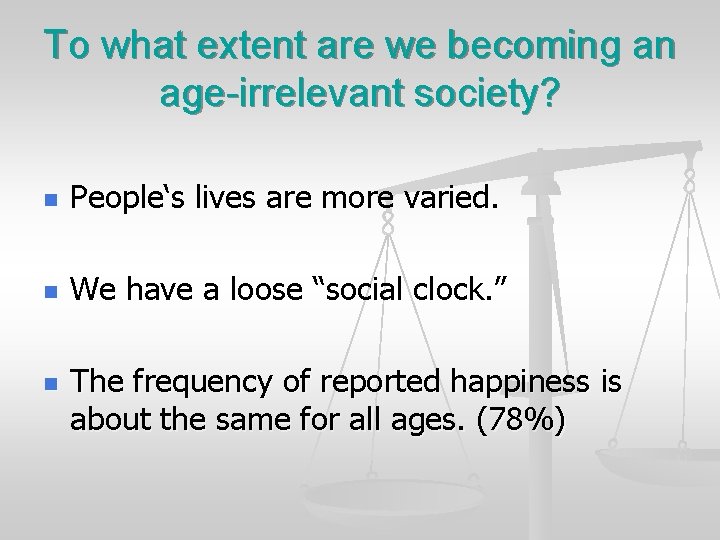
To what extent are we becoming an age-irrelevant society? n People‘s lives are more varied. n We have a loose “social clock. ” n The frequency of reported happiness is about the same for all ages. (78%)
What theories will we explore? First, let's look at and learn the six major perspectives: • Psychodynamic • Behavioral • Cognitive • Humanistic • Contextual
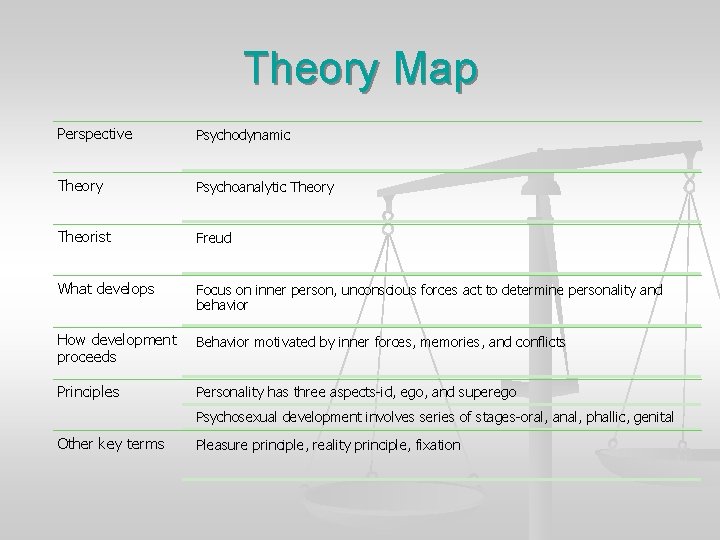
Theory Map Perspective Psychodynamic Theory Psychoanalytic Theory Theorist Freud What develops Focus on inner person, unconscious forces act to determine personality and behavior How development proceeds Behavior motivated by inner forces, memories, and conflicts Principles Personality has three aspects-id, ego, and superego Psychosexual development involves series of stages-oral, anal, phallic, genital Other key terms Pleasure principle, reality principle, fixation
Theory Map Perspective Psychodynamic Theory Psychosocial Theory Theorist Erikson Primary focus Focus on social interaction with others How development proceeds Development occurs through changes in interactions with and understanding of others and in self knowledge and understanding of members of society Principles Psychosocial development involves eight distinct, fixed, universal stages. Each stage presents crisis/conflict to be resolved; growth and change are lifelong Other key terms trust vs. mistrust, autonomy vs. shame and doubt, initiative vs. guilt, industry vs. inferiority, identity vs. role diffusion, intimacy vs. isolation, generativity vs. stagnation, ego-integrity vs. despair
Psychoanalytic Theory: Erikson (1902 -1994) Eight psychosocial stages in the lifespan 1. Trust v. mistrust: + trust from environmental support; - fear/concern about others 2. Autonomy v. shame/doubt: +self-sufficiency; - selfdoubt, lack of independence 3. Initiative v. guilt: +discovery of ways to initiate actions; - guilt from thoughts/actions 4. Industry v. inferiority: + development of sense of competence; - feelings of inferiority 5. Identity v. confusion: + awareness of selfuniqueness, knowledge of role to be followed; - inability to identify appropriate roles in life
Psychoanalytic Theory: Erikson (1902 -1994) 6. Intimacy v. isolation: +Development of loving sexual relationships and close friendships; - fear of relationships 7. Generativity v. stagnation: + sense of contribution to continuity of life; - trivialization of one’s activities 8. Integrity v. despair: + sense of unity in life’s accomplishments; - regret over life’s lost opportunities
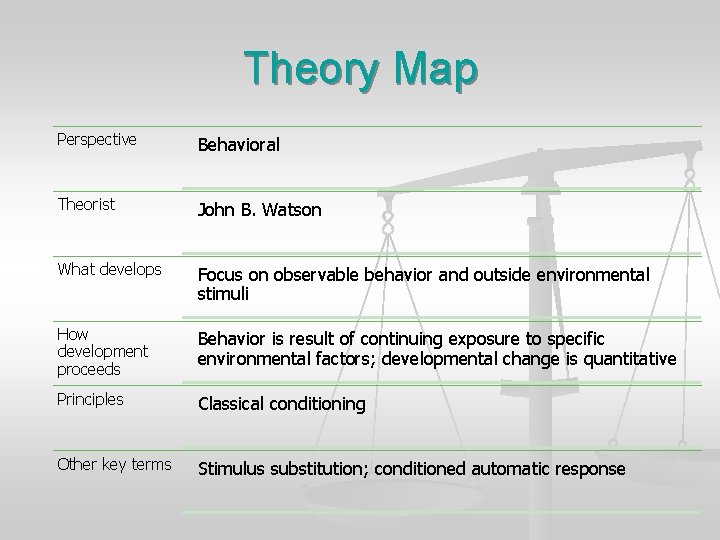
Theory Map Perspective Behavioral Theorist John B. Watson What develops Focus on observable behavior and outside environmental stimuli How development proceeds Behavior is result of continuing exposure to specific environmental factors; developmental change is quantitative Principles Classical conditioning Other key terms Stimulus substitution; conditioned automatic response
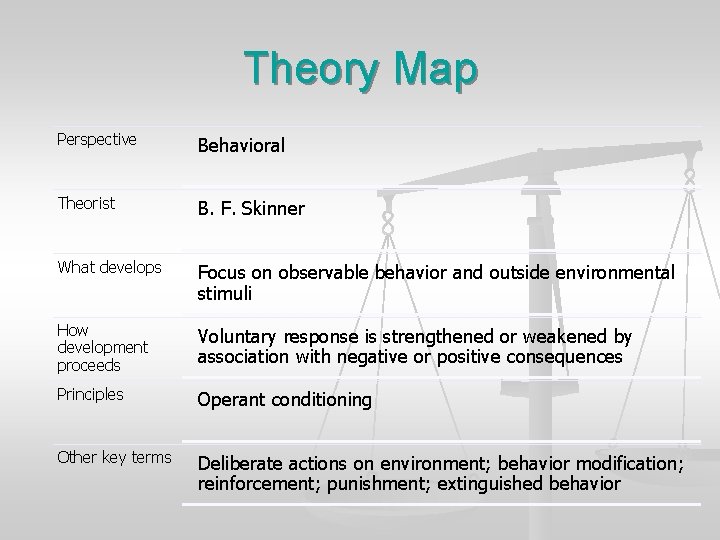
Theory Map Perspective Behavioral Theorist B. F. Skinner What develops Focus on observable behavior and outside environmental stimuli How development proceeds Voluntary response is strengthened or weakened by association with negative or positive consequences Principles Operant conditioning Other key terms Deliberate actions on environment; behavior modification; reinforcement; punishment; extinguished behavior
Theory Map Perspective Behavioral Theorist Albert Bandura and colleagues What develops Focus on learning through imitation How development proceeds Behavior is learned through observation Principles Social-cognitive learning occurs through four steps: attend/perceive, recall, accurately reproduce, motivated to carry out behavior Other key terms Model; reward; “Fearless Peter”
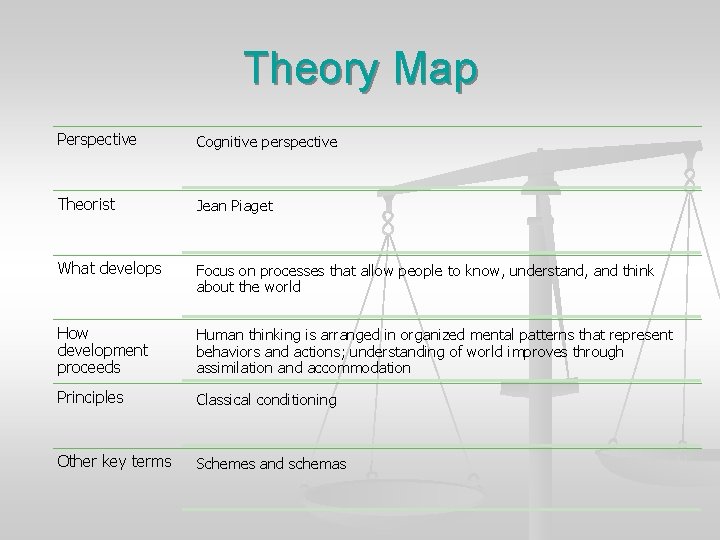
Theory Map Perspective Cognitive perspective Theorist Jean Piaget What develops Focus on processes that allow people to know, understand, and think about the world How development proceeds Human thinking is arranged in organized mental patterns that represent behaviors and actions; understanding of world improves through assimilation and accommodation Principles Classical conditioning Other key terms Schemes and schemas
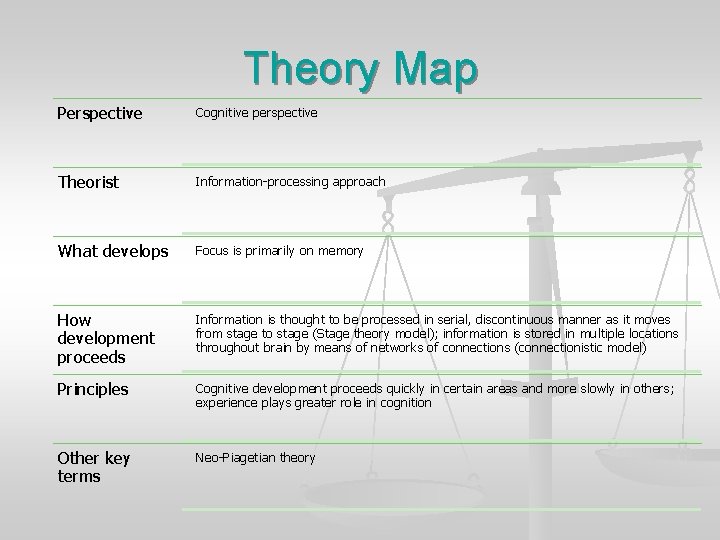
Theory Map Perspective Cognitive perspective Theorist Information-processing approach What develops Focus is primarily on memory How development proceeds Information is thought to be processed in serial, discontinuous manner as it moves from stage to stage (Stage theory model); information is stored in multiple locations throughout brain by means of networks of connections (connectionistic model) Principles Cognitive development proceeds quickly in certain areas and more slowly in others; experience plays greater role in cognition Other key terms Neo-Piagetian theory
Theory Map Perspective Cognitive perspective Theorist Cognitive neuroscience approach What develops Focus on cognitive development through lens of brain How development proceeds Approach considers internal, mental processes, but focuses specifically on the neurological activity that underlies thinking, problem solving, and other cognitive behavior Principles Associations between specific genes and wide range of disorders are identified Other key terms Autism; schizophrenia
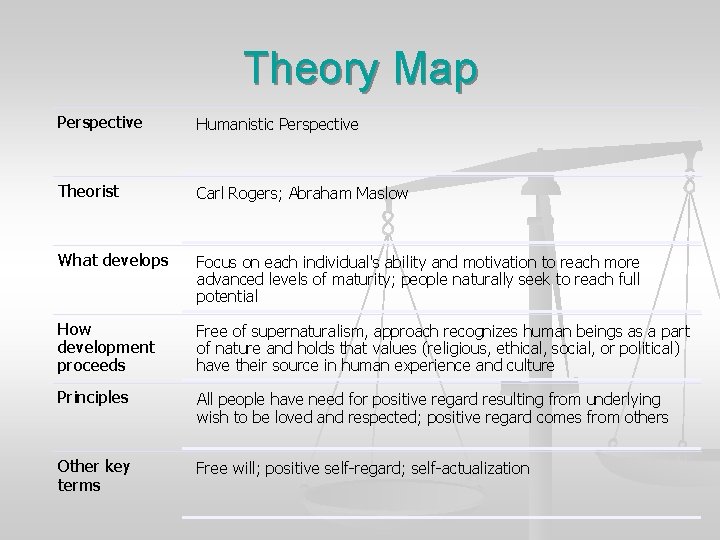
Theory Map Perspective Humanistic Perspective Theorist Carl Rogers; Abraham Maslow What develops Focus on each individual's ability and motivation to reach more advanced levels of maturity; people naturally seek to reach full potential How development proceeds Free of supernaturalism, approach recognizes human beings as a part of nature and holds that values (religious, ethical, social, or political) have their source in human experience and culture Principles All people have need for positive regard resulting from underlying wish to be loved and respected; positive regard comes from others Other key terms Free will; positive self-regard; self-actualization
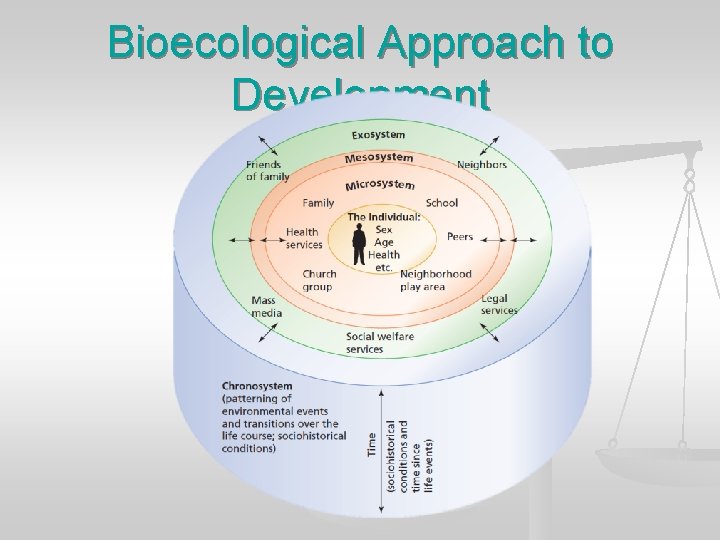
Theory Map Perspective Contextual Perspective Theorist Urie Bronfenbrenner/Bioecological Approach What develops Focus relationship between individuals and their physical, cognitive, personality, and social worlds How development proceeds Development is unique and intimately tied to person's social and cultural context; four levels of environment simultaneously influence individuals Principles Each system contains roles, norms, and rules that can powerfully shape development Other key terms Microsystem; ecosystem; exosystem; macrosystem; chronosystem
Bioecological Approach to Development
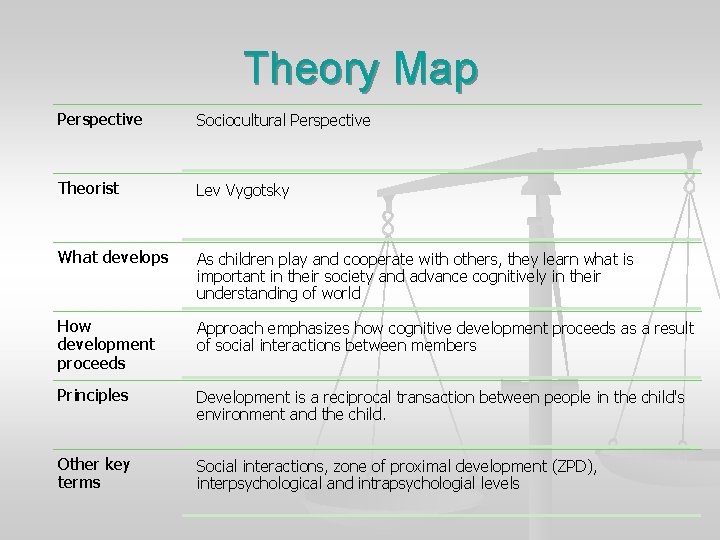
Theory Map Perspective Sociocultural Perspective Theorist Lev Vygotsky What develops As children play and cooperate with others, they learn what is important in their society and advance cognitively in their understanding of world How development proceeds Approach emphasizes how cognitive development proceeds as a result of social interactions between members Principles Development is a reciprocal transaction between people in the child's environment and the child. Other key terms Social interactions, zone of proximal development (ZPD), interpsychological and intrapsychologial levels
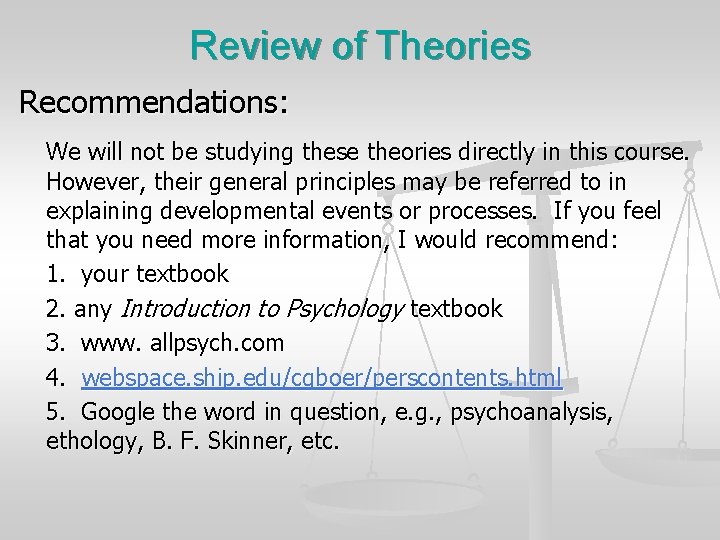
Review of Theories Recommendations: We will not be studying these theories directly in this course. However, their general principles may be referred to in explaining developmental events or processes. If you feel that you need more information, I would recommend: 1. your textbook 2. any Introduction to Psychology textbook 3. www. allpsych. com 4. webspace. ship. edu/cgboer/perscontents. html 5. Google the word in question, e. g. , psychoanalysis, ethology, B. F. Skinner, etc.
MODULE 1. 3 RESEARCH METHODS
Posing Developmental Questions What is a theory? How can a theory be tested?
Data n Where do we get our data? n What information are we going to believe?
What do you know about…? n Experimental studies n Hypotheses n Independent and dependent variables
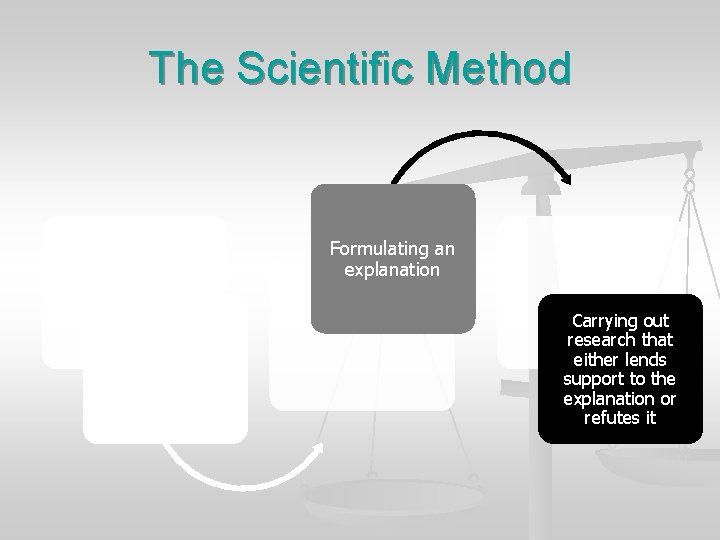
The Scientific Method Formulating an explanation Identifying questions of interest Carrying out research that either lends support to the explanation or refutes it
Choosing a Research Strategy: Answering Questions n Correlational research n Experimental research
What are the techniques of collecting data? n n n Observation Survey/interview: asking questions Standardized Tests Physiological Measures Case Study Life-history records
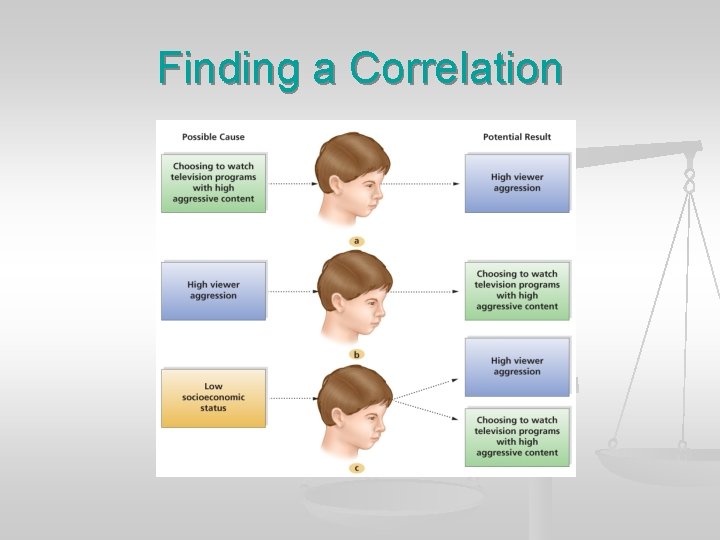
Research Designs n n Descriptive – includes more detail Correlational – numbers show strength & direction of relationship Used for prediction n Ranges from -1. 00 to +1. 00 (+ is direct; - is inverse); Remember: correlation does not equal causation n n Experimental
Experiments n Manipulation in experiments means there is different treatment in different groups. The experimental group experiences the “real” treatment or manipulation. n Control groups do not; they are for comparison. (“Placebo” controls get a fake treatment. ) n Random assignment of participants to groups ensures that groups start out the same. n
Experiments Provide Evidence of Cause-Effect Relationships n n n This is because of control and manipulation. One situational factor (Independent Variable) is manipulated. A behavior (Dependent Variable) is measured. All other factors are “held constant” or the same in all groups. (This is control. ) A change in the dependent variable (behavior) could only be caused by manipulation of the independent variable because all else was controlled.
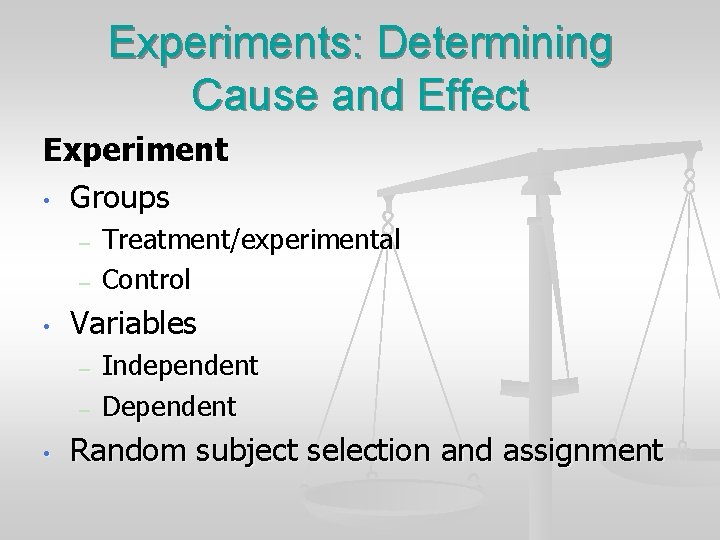
Experiments: Determining Cause and Effect Experiment • Groups – – • Variables – – • Treatment/experimental Control Independent Dependent Random subject selection and assignment
Why aren't experiments always used? n Logically impossible n Ethically impossible
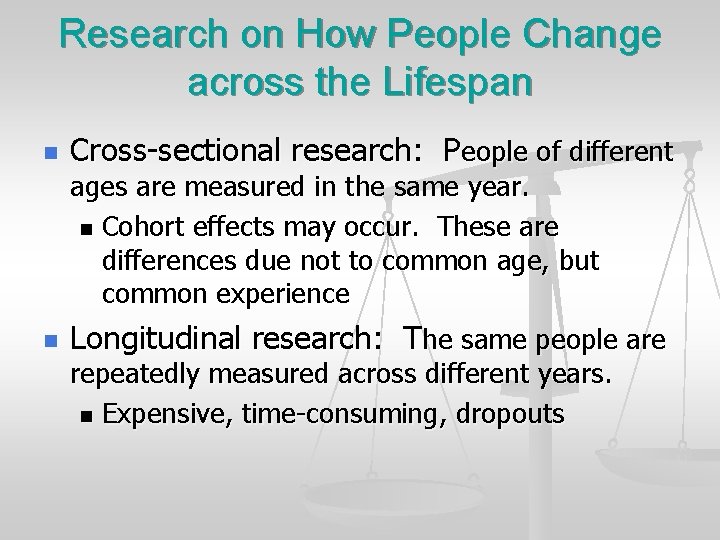
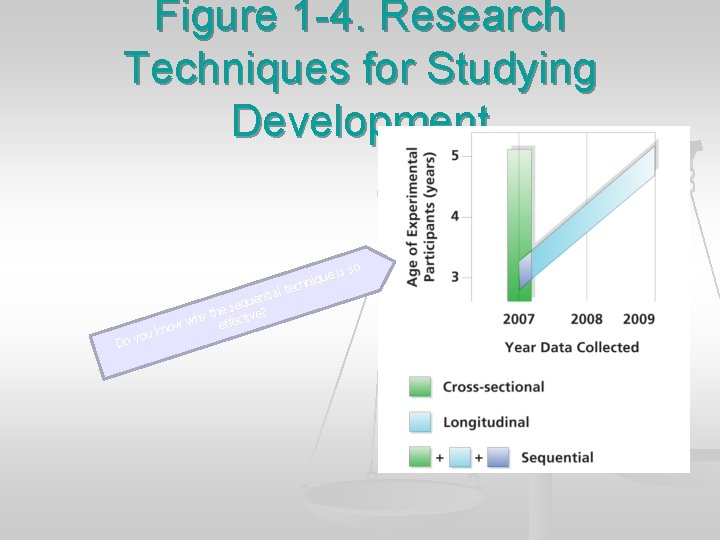
Research on How People Change across the Lifespan n Cross-sectional research: People of different ages are measured in the same year. n Cohort effects may occur. These are differences due not to common age, but common experience n Longitudinal research: The same people are repeatedly measured across different years. n Expensive, time-consuming, dropouts
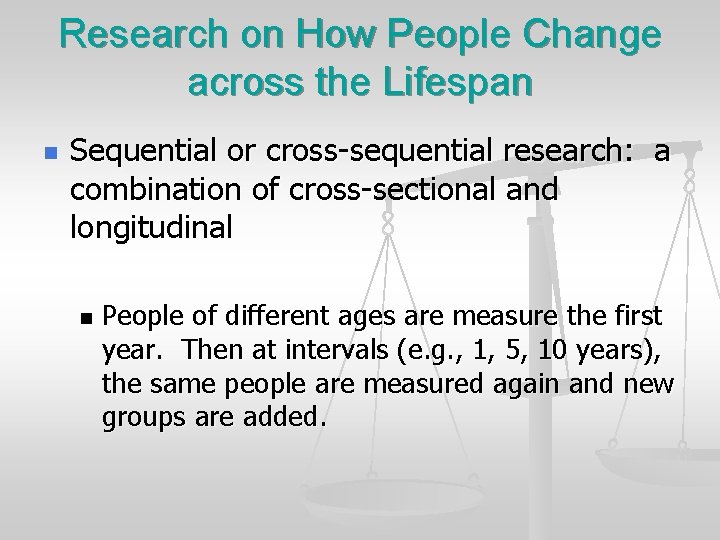
Research on How People Change across the Lifespan n Sequential or cross-sequential research: a combination of cross-sectional and longitudinal n People of different ages are measure the first year. Then at intervals (e. g. , 1, 5, 10 years), the same people are measured again and new groups are added.
Figure 1 -4. Research Techniques for Studying Development uk o Do y l te ntia e u seq the tive? y h c w effe now is que chni so
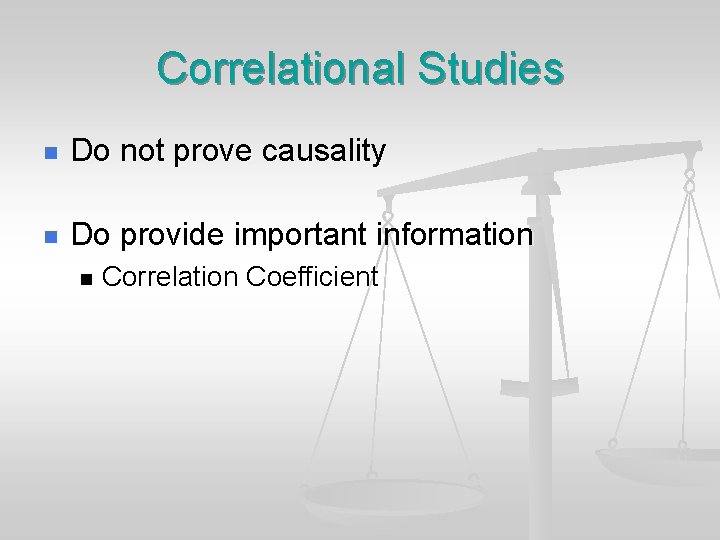
Correlational Studies n Do not prove causality n Do provide important information n Correlation Coefficient
Finding a Correlation
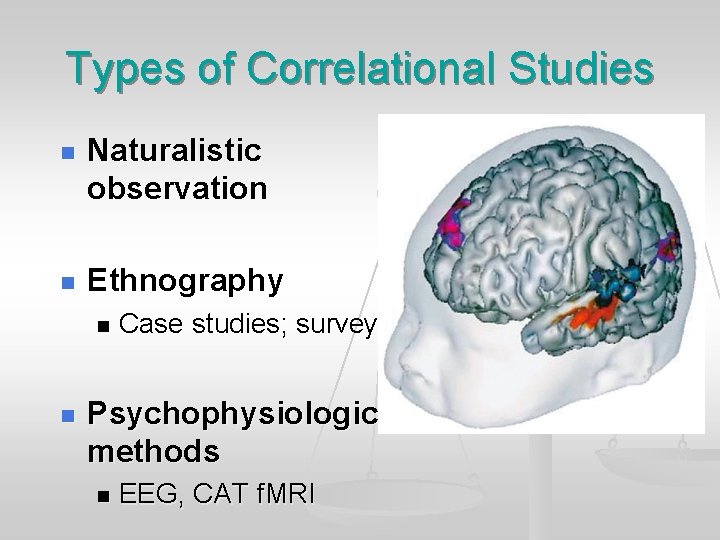
Types of Correlational Studies n Naturalistic observation n Ethnography n n Case studies; surveys Psychophysiological methods n EEG, CAT f. MRI
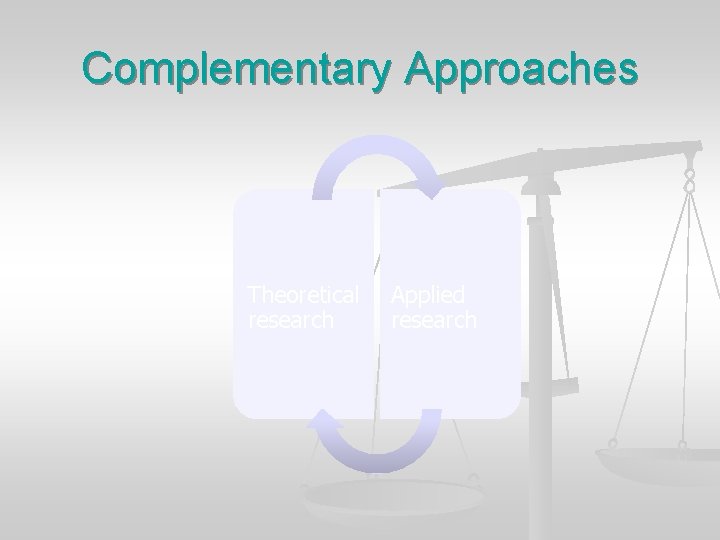
Complementary Approaches Theoretical research Applied research
Thinking Critically about “Expert” Advice n Who are the “experts” in your life? n What expert advice have you received about going to college? n Why (or why not) did you value or use this advice?
Becoming an expert about experts! n n n Consider the source. Evaluate credentials. Understand difference between anecdotal and scientific evidence. Find details of research-based advice. Do not overlook cultural context of information. Recognize that popular consensus does not guarantee scientific validity.
It is better to have data, but. . n Data is no guarantee of accuracy. Did you do it right? n Did you interpret it right? n Did you fudge the results on purpose? n Could anyone replicate it? n Was it correlational? n Can it even be researched? n
So what do we do with other information? n n Ancient aliens: Do we discount as mythology? Does archeology count? Piaget & Freud – mere observation
How do we use data? n n Don’t use it to turn your mind off. Don’t ignore it Stop to think why you accept information or not Question yourself as to why you believe it n Logic, evidence, want to?
Ways to be Confused n n n Too little information Too much information Deliberately sowing false information or irrelevant information
Becoming an expert about experts! n n n Consider the source. Evaluate credentials. Understand difference between anecdotal and scientific evidence. Find details of research-based advice. Do not overlook cultural context of information. Recognize that popular consensus does not guarantee scientific validity.
How Do We Know? Or Do We Just Believe? n Robyn Dawes n Why believe that for which there is no good evidence? n n n http: //www. fmsonline. org/dawes. html (Or possibly evidence to the contrary? ) Most of what we know, we actually believe that we know from authority and consensus.
How Do We Know? Or Do We Just Believe? n Authority implies that the knowledge is reliable Source is trustworthy n No ulterior motives n In position to have this type of knowledge n n n However, we often attribute this to consistency of report/public exposure (media). Consensus means that no one questions it.
Ethics and Research Ethical Guidelines for Researchers (SRCD) n. Researchers must protect participants from physical and psychological harm. n. Researchers must obtain informed consent from participants before their involvement in a study. n. The use of deception in research must be justified and cause no harm. n. Participants’ privacy must be maintained.