
An organizational structure is a mostly hierarchical concept
- Slides: 12
An organizational structure is a mostly hierarchical concept of subordination of entities that collaborate and contribute to serve one common aim. . . Organizational structure refers to the way that an organization arranges people and jobs so that its work can be performed and its goals can be met Line of bussiness A particular kind of product or merchandise A particular kind of commercial enterprise Merchandise Commodities offered for sale
PROJECT ORGANIZATIONS AND RESPONSIBILITIES Organizational structures form the architecture of the team. Organizations engaged in a software line of business need to support projects with the infrastructure necessary to use a common process. Software lines of business are motivated by ROI, new business discriminators, market diversification, and profitability. Project teams are motivated by the cost, schedule, and quality of specific deliverables. Software professionals in both types of organizations are motivated by career growth, job satisfaction, and the opportunity to make a difference. This chapter recommends and describes organizations for a line of business and for a project.
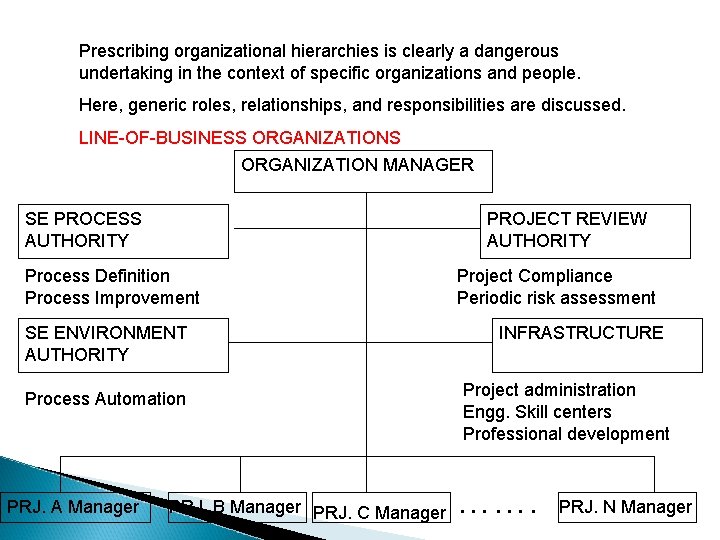
Prescribing organizational hierarchies is clearly a dangerous undertaking in the context of specific organizations and people. Here, generic roles, relationships, and responsibilities are discussed. LINE-OF-BUSINESS ORGANIZATION MANAGER SE PROCESS AUTHORITY PROJECT REVIEW AUTHORITY Process Definition Process Improvement SE ENVIRONMENT AUTHORITY Process Automation PRJ. A Manager PRJ. B Manager PRJ. C Manager Project Compliance Periodic risk assessment INFRASTRUCTURE Project administration Engg. Skill centers Professional development ……. PRJ. N Manager
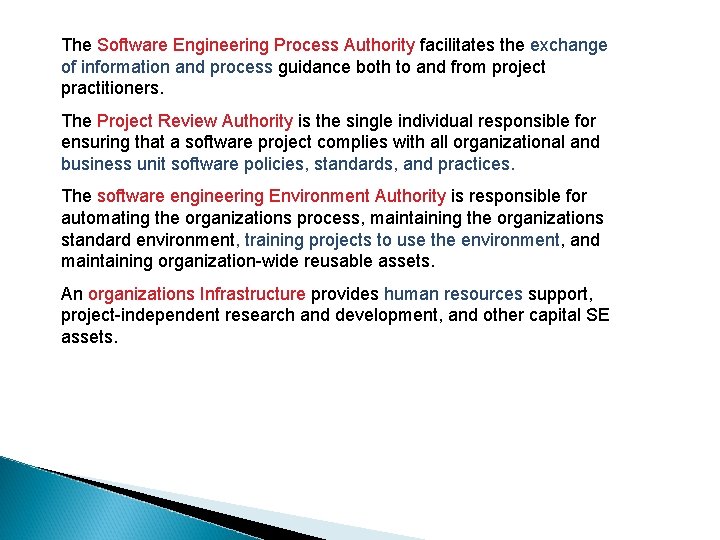
The Software Engineering Process Authority facilitates the exchange of information and process guidance both to and from project practitioners. The Project Review Authority is the single individual responsible for ensuring that a software project complies with all organizational and business unit software policies, standards, and practices. The software engineering Environment Authority is responsible for automating the organizations process, maintaining the organizations standard environment, training projects to use the environment, and maintaining organization-wide reusable assets. An organizations Infrastructure provides human resources support, project-independent research and development, and other capital SE assets.
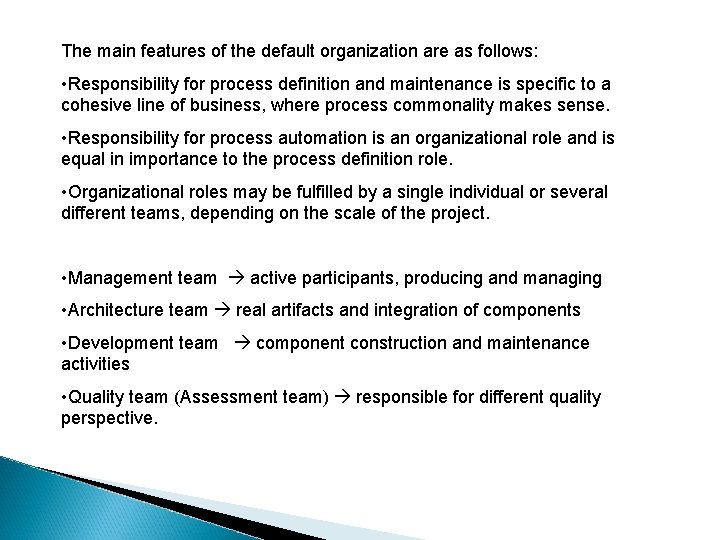
The main features of the default organization are as follows: • Responsibility for process definition and maintenance is specific to a cohesive line of business, where process commonality makes sense. • Responsibility for process automation is an organizational role and is equal in importance to the process definition role. • Organizational roles may be fulfilled by a single individual or several different teams, depending on the scale of the project. • Management team active participants, producing and managing • Architecture team real artifacts and integration of components • Development team component construction and maintenance activities • Quality team (Assessment team) responsible for different quality perspective.
Project organization s
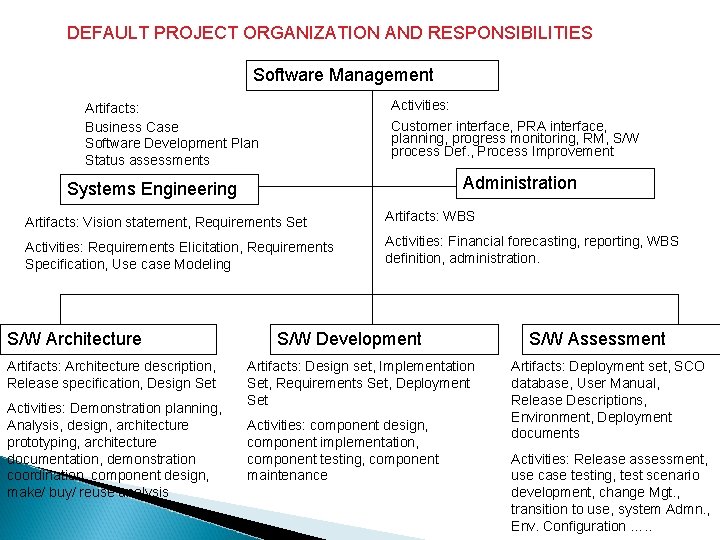
DEFAULT PROJECT ORGANIZATION AND RESPONSIBILITIES Software Management Activities: Artifacts: Business Case Software Development Plan Status assessments Customer interface, PRA interface, planning, progress monitoring, RM, S/W process Def. , Process Improvement Administration Systems Engineering Artifacts: Vision statement, Requirements Set Artifacts: WBS Activities: Requirements Elicitation, Requirements Specification, Use case Modeling Activities: Financial forecasting, reporting, WBS definition, administration. S/W Architecture Artifacts: Architecture description, Release specification, Design Set Activities: Demonstration planning, Analysis, design, architecture prototyping, architecture documentation, demonstration coordination, component design, make/ buy/ reuse analysis S/W Development Artifacts: Design set, Implementation Set, Requirements Set, Deployment Set Activities: component design, component implementation, component testing, component maintenance S/W Assessment Artifacts: Deployment set, SCO database, User Manual, Release Descriptions, Environment, Deployment documents Activities: Release assessment, use case testing, test scenario development, change Mgt. , transition to use, system Admn. , Env. Configuration …. .
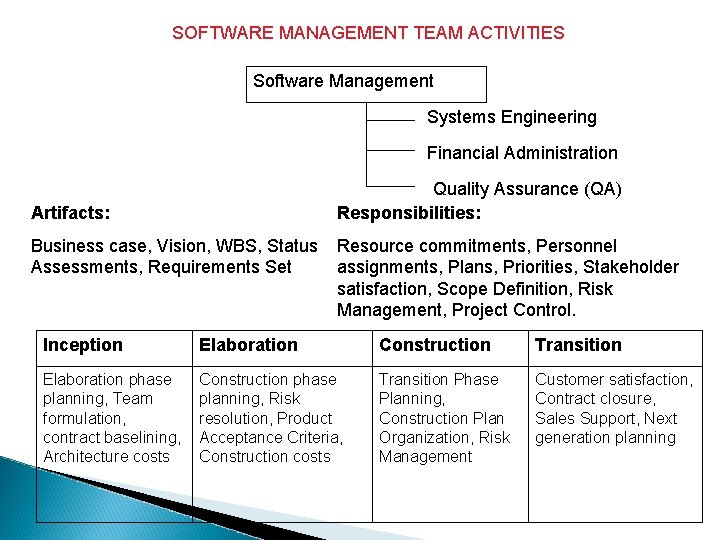
SOFTWARE MANAGEMENT TEAM ACTIVITIES Software Management Systems Engineering Financial Administration Quality Assurance (QA) Responsibilities: Artifacts: Business case, Vision, WBS, Status Assessments, Requirements Set Resource commitments, Personnel assignments, Plans, Priorities, Stakeholder satisfaction, Scope Definition, Risk Management, Project Control. Inception Elaboration Construction Transition Elaboration phase planning, Team formulation, contract baselining, Architecture costs Construction phase planning, Risk resolution, Product Acceptance Criteria, Construction costs Transition Phase Planning, Construction Plan Organization, Risk Management Customer satisfaction, Contract closure, Sales Support, Next generation planning
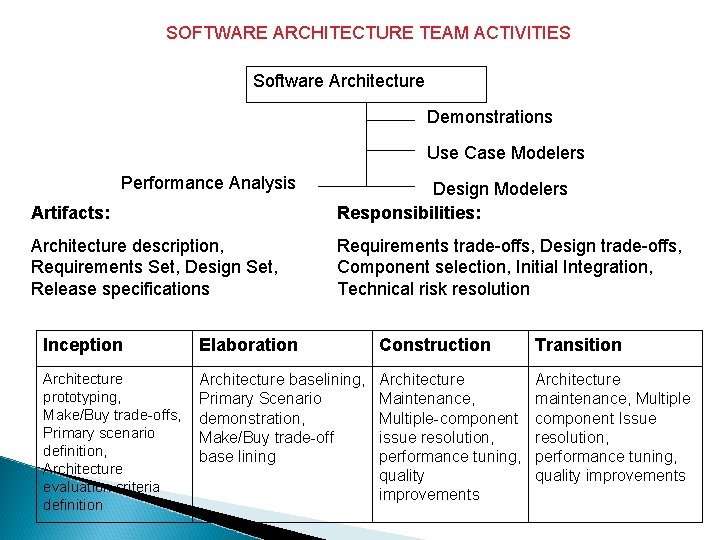
SOFTWARE ARCHITECTURE TEAM ACTIVITIES Software Architecture Demonstrations Use Case Modelers Performance Analysis Artifacts: Design Modelers Responsibilities: Architecture description, Requirements Set, Design Set, Release specifications Requirements trade-offs, Design trade-offs, Component selection, Initial Integration, Technical risk resolution Inception Elaboration Construction Transition Architecture prototyping, Make/Buy trade-offs, Primary scenario definition, Architecture evaluation criteria definition Architecture baselining, Primary Scenario demonstration, Make/Buy trade-off base lining Architecture Maintenance, Multiple-component issue resolution, performance tuning, quality improvements Architecture maintenance, Multiple component Issue resolution, performance tuning, quality improvements
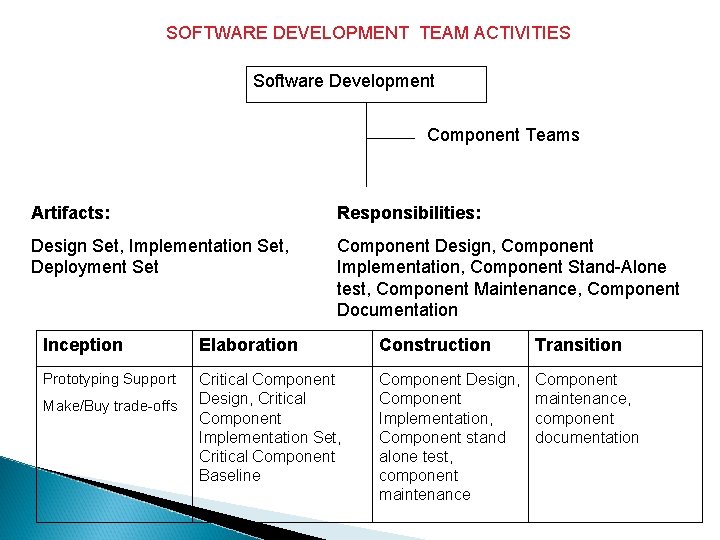
SOFTWARE DEVELOPMENT TEAM ACTIVITIES Software Development Component Teams Artifacts: Responsibilities: Design Set, Implementation Set, Deployment Set Component Design, Component Implementation, Component Stand-Alone test, Component Maintenance, Component Documentation Inception Elaboration Construction Transition Prototyping Support Critical Component Design, Critical Component Implementation Set, Critical Component Baseline Component Design, Component Implementation, Component stand alone test, component maintenance Component maintenance, component documentation Make/Buy trade-offs
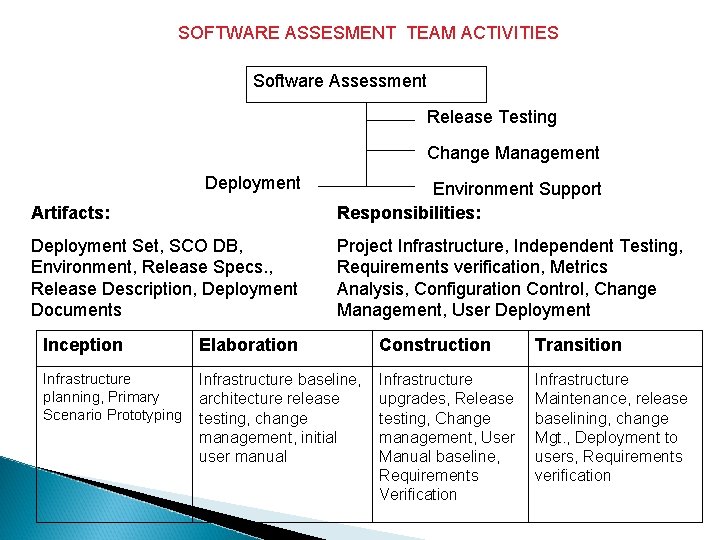
SOFTWARE ASSESMENT TEAM ACTIVITIES Software Assessment Release Testing Change Management Deployment Artifacts: Environment Support Responsibilities: Deployment Set, SCO DB, Environment, Release Specs. , Release Description, Deployment Documents Project Infrastructure, Independent Testing, Requirements verification, Metrics Analysis, Configuration Control, Change Management, User Deployment Inception Elaboration Construction Transition Infrastructure planning, Primary Scenario Prototyping Infrastructure baseline, architecture release testing, change management, initial user manual Infrastructure upgrades, Release testing, Change management, User Manual baseline, Requirements Verification Infrastructure Maintenance, release baselining, change Mgt. , Deployment to users, Requirements verification
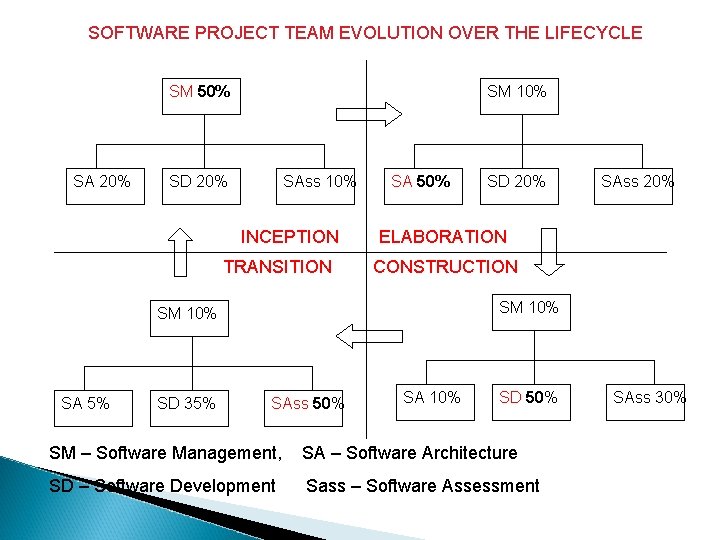
SOFTWARE PROJECT TEAM EVOLUTION OVER THE LIFECYCLE SM 50% SA 20% SM 10% SD 20% SAss 10% INCEPTION TRANSITION SA 50% SD 35% SAss 20% ELABORATION CONSTRUCTION SM 10% SA 5% SD 20% SAss 50% SA 10% SD 50% SM – Software Management, SA – Software Architecture SD – Software Development Sass – Software Assessment SAss 30%