
AN OBJECT PROGRAMMING APPROACH TO INTRODUCE ADVANCED CONTROL
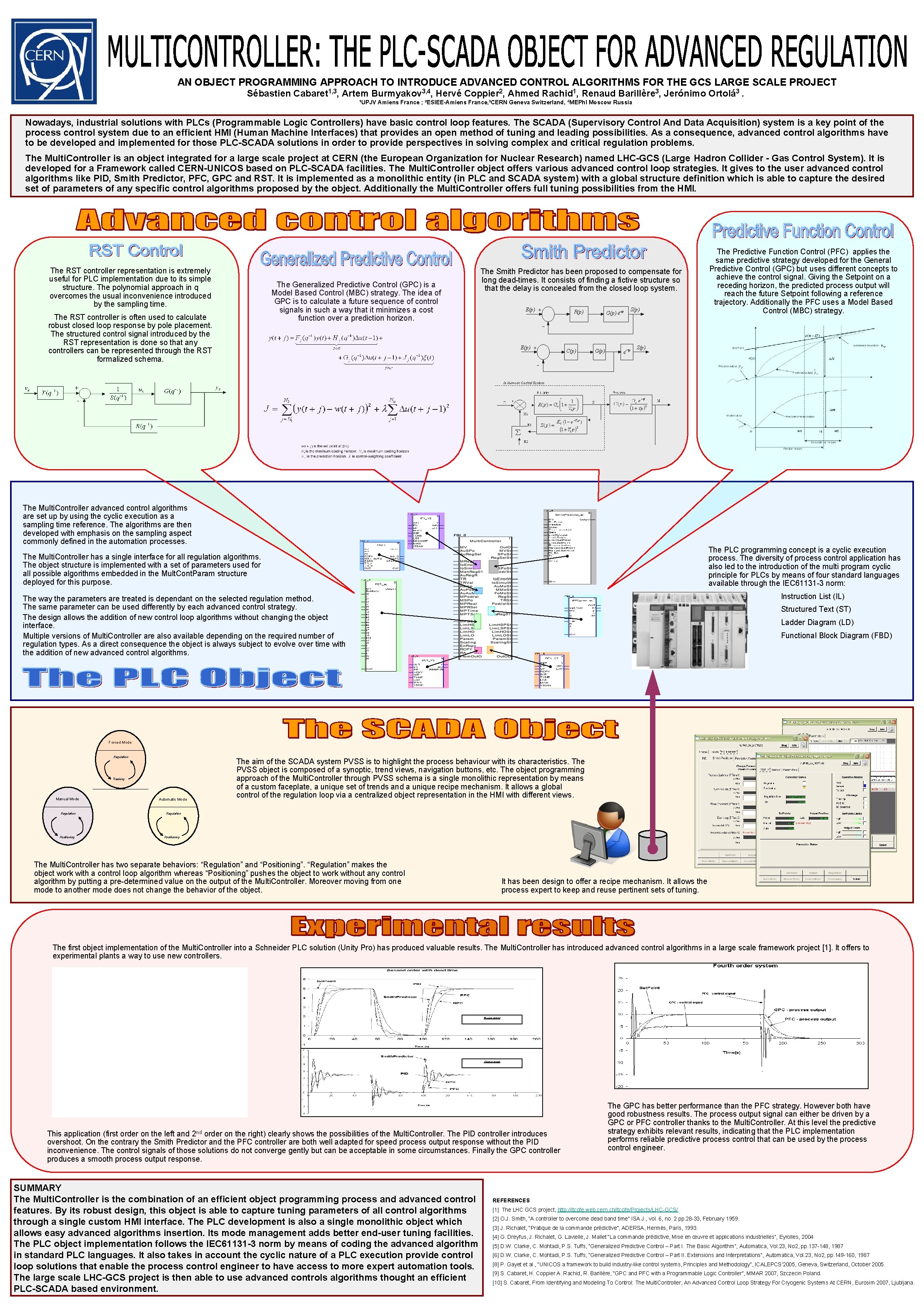
AN OBJECT PROGRAMMING APPROACH TO INTRODUCE ADVANCED CONTROL ALGORITHMS FOR THE GCS LARGE SCALE PROJECT Sébastien Cabaret 1, 3, Artem Burmyakov 3, 4, Hervé Coppier 2, Ahmed Rachid 1, Renaud Barillère 3, Jerónimo Ortolá 3. ¹UPJV Amiens France ; ²ESIEE-Amiens France, ³CERN Geneva Switzerland, 4 MEPh. I Moscow Russia Nowadays, industrial solutions with PLCs (Programmable Logic Controllers) have basic control loop features. The SCADA (Supervisory Control And Data Acquisition) system is a key point of the process control system due to an efficient HMI (Human Machine Interfaces) that provides an open method of tuning and leading possibilities. As a consequence, advanced control algorithms have to be developed and implemented for those PLC-SCADA solutions in order to provide perspectives in solving complex and critical regulation problems. The Multi. Controller is an object integrated for a large scale project at CERN (the European Organization for Nuclear Research) named LHC-GCS (Large Hadron Collider - Gas Control System). It is developed for a Framework called CERN-UNICOS based on PLC-SCADA facilities. The Multi. Controller object offers various advanced control loop strategies. It gives to the user advanced control algorithms like PID, Smith Predictor, PFC, GPC and RST. It is implemented as a monolithic entity (in PLC and SCADA system) with a global structure definition which is able to capture the desired set of parameters of any specific control algorithms proposed by the object. Additionally the Multi. Controller offers full tuning possibilities from the HMI. The RST controller representation is extremely useful for PLC implementation due to its simple structure. The polynomial approach in q overcomes the usual inconvenience introduced by the sampling time. The Generalized Predictive Control (GPC) is a Model Based Control (MBC) strategy. The idea of GPC is to calculate a future sequence of control signals in such a way that it minimizes a cost function over a prediction horizon. The RST controller is often used to calculate robust closed loop response by pole placement. The structured control signal introduced by the RST representation is done so that any controllers can be represented through the RST formalized schema. The Smith Predictor has been proposed to compensate for long dead-times. It consists of finding a fictive structure so that the delay is concealed from the closed loop system. E(p) + R(p) S(p) G(p) e-t p The Predictive Function Control (PFC) applies the same predictive strategy developed for the General Predictive Control (GPC) but uses different concepts to achieve the control signal. Giving the Setpoint on a receding horizon, the predicted process output will reach the future Setpoint following a reference trajectory. Additionally the PFC uses a Model Based Control (MBC) strategy. - E(p) + C(p) G(p) -t p e S(p) - The Multi. Controller advanced control algorithms are set up by using the cyclic execution as a sampling time reference. The algorithms are then developed with emphasis on the sampling aspect commonly defined in the automation processes. The PLC programming concept is a cyclic execution process. The diversity of process control application has also led to the introduction of the multi program cyclic principle for PLCs by means of four standard languages available through the IEC 61131 -3 norm: The Multi. Controller has a single interface for all regulation algorithms. The object structure is implemented with a set of parameters used for all possible algorithms embedded in the Mult. Cont. Param structure deployed for this purpose. Instruction List (IL) The way the parameters are treated is dependant on the selected regulation method. The same parameter can be used differently by each advanced control strategy. The design allows the addition of new control loop algorithms without changing the object interface. Multiple versions of Multi. Controller are also available depending on the required number of regulation types. As a direct consequence the object is always subject to evolve over time with the addition of new advanced control algorithms. Structured Text (ST) Ladder Diagram (LD) Functional Block Diagram (FBD) Forced Mode Regulation Tracking Manual Mode Automatic Mode Regulation Positioning The aim of the SCADA system PVSS is to highlight the process behaviour with its characteristics. The PVSS object is composed of a synoptic, trend views, navigation buttons, etc. The object programming approach of the Multi. Controller through PVSS schema is a single monolithic representation by means of a custom faceplate, a unique set of trends and a unique recipe mechanism. It allows a global control of the regulation loop via a centralized object representation in the HMI with different views. Positioning The Multi. Controller has two separate behaviors: “Regulation” and “Positioning”. “Regulation” makes the object work with a control loop algorithm whereas “Positioning” pushes the object to work without any control algorithm by putting a pre-determined value on the output of the Multi. Controller. Moreover moving from one mode to another mode does not change the behavior of the object. It has been design to offer a recipe mechanism. It allows the process expert to keep and reuse pertinent sets of tuning. The first object implementation of the Multi. Controller into a Schneider PLC solution (Unity Pro) has produced valuable results. The Multi. Controller has introduced advanced control algorithms in a large scale framework project [1]. It offers to experimental plants a way to use new controllers. Process output Control signal This application (first order on the left and 2 nd order on the right) clearly shows the possibilities of the Multi. Controller. The PID controller introduces overshoot. On the contrary the Smith Predictor and the PFC controller are both well adapted for speed process output response without the PID inconvenience. The control signals of those solutions do not converge gently but can be acceptable in some circumstances. Finally the GPC controller produces a smooth process output response. SUMMARY The Multi. Controller is the combination of an efficient object programming process and advanced control features. By its robust design, this object is able to capture tuning parameters of all control algorithms through a single custom HMI interface. The PLC development is also a single monolithic object which allows easy advanced algorithms insertion. Its mode management adds better end-user tuning facilities. The PLC object implementation follows the IEC 61131 -3 norm by means of coding the advanced algorithm in standard PLC languages. It also takes in account the cyclic nature of a PLC execution provide control loop solutions that enable the process control engineer to have access to more expert automation tools. The large scale LHC-GCS project is then able to use advanced controls algorithms thought an efficient PLC-SCADA based environment. The GPC has better performance than the PFC strategy. However both have good robustness results. The process output signal can either be driven by a GPC or PFC controller thanks to the Multi. Controller. At this level the predictive strategy exhibits relevant results, indicating that the PLC implementation performs reliable predictive process control that can be used by the process control engineer. REFERENCES [1] The LHC GCS project, http: //itcofe. web. cern. ch/itcofe/Projects/LHC-GCS/ [2] O. J. Smith, “A controller to overcome dead band time” ISA J. , vol. 6, no. 2 pp. 28 -33, February 1959. [3] J. Richalet, “Pratique de la commande prédictive”, ADERSA, Hermès, Paris, 1993. [4] G. Dreyfus, J. Richalet, G. Lavielle, J. Mallet “La commande prédictive, Mise en œuvre et applications industrielles”, Eyrolles, 2004 [5] D. W. Clarke, C. Mohtadi, P. S. Tuffs, “Generalized Predictive Control – Part I. The Basic Algorithm”, Automatica, Vol. 23, No 2, pp. 137 -148, 1987 [6] D. W. Clarke, C. Mohtadi, P. S. Tuffs, “Generalized Predictive Control – Part II. Extensions and Interpretations”, Automatica, Vol. 23, No 2, pp. 149 -160, 1987 [8] P. Gayet et al. , “UNICOS a framework to build industry-like control systems, Principles and Methodology”, ICALEPCS’ 2005, Geneva, Switzerland, October 2005. [9] S. Cabaret, H. Coppier A. Rachid, R. Barillère, “GPC and PFC with a Programmable Logic Controller”, MMAR 2007, Szczecin Poland. [10] S. Cabaret, From Identifying and Modeling To Control: The Multi. Controller, An Advanced Control Loop Strategy For Cryogenic Systems At CERN, Eurosim 2007, Ljubljana.
- Slides: 1