
An MCDA framework for evaluating and appraising government
- Slides: 19
An MCDA framework for evaluating and appraising government policy for psychoactive drugs Professor Larry Phillips London School of Economics and Facilitations Limited OR 58 Annual Conference 7 September 2016
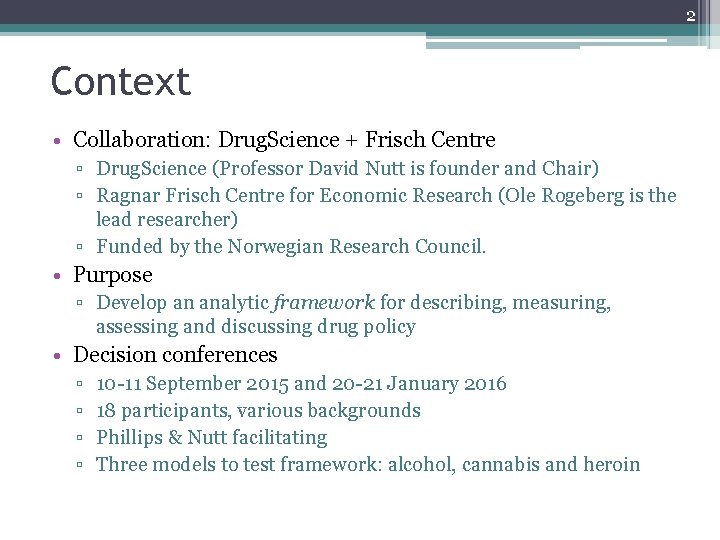
2 Context • Collaboration: Drug. Science + Frisch Centre ▫ Drug. Science (Professor David Nutt is founder and Chair) ▫ Ragnar Frisch Centre for Economic Research (Ole Rogeberg is the lead researcher) ▫ Funded by the Norwegian Research Council. • Purpose ▫ Develop an analytic framework for describing, measuring, assessing and discussing drug policy • Decision conferences ▫ ▫ 10 -11 September 2015 and 20 -21 January 2016 18 participants, various backgrounds Phillips & Nutt facilitating Three models to test framework: alcohol, cannabis and heroin
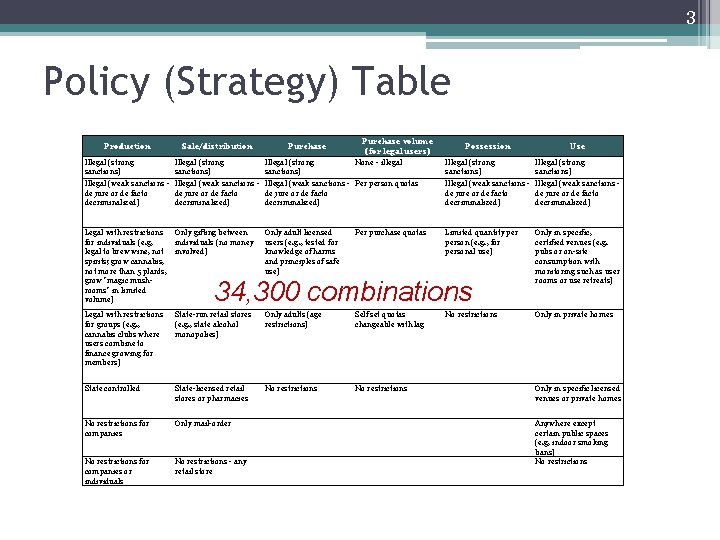
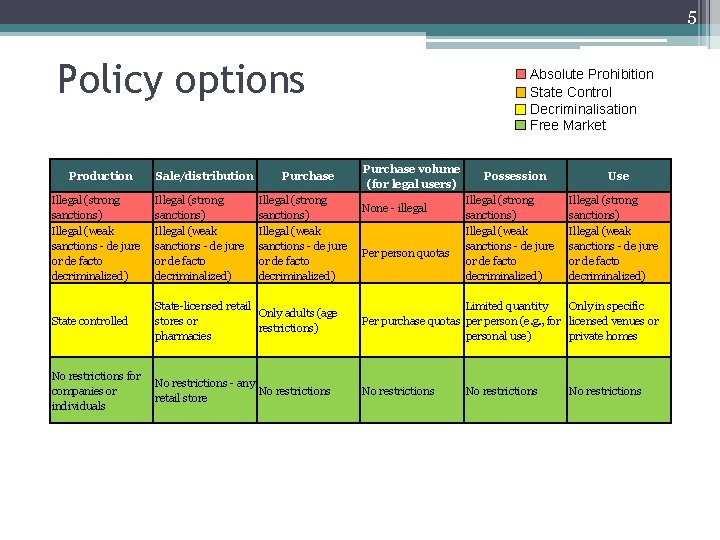
3 Policy (Strategy) Table Production Sale/distribution Illegal (strong sanctions) Illegal (weak sanctions de jure or de facto decriminalized) Purchase volume (for legal users) None - illegal Possession Use Illegal (strong sanctions) Illegal (weak sanctions - Per person quotas de jure or de facto decriminalized) Illegal (strong sanctions) Illegal (weak sanctions de jure or de facto decriminalized) Legal with restrictions Only gifting between for individuals (e. g, individuals (no money legal to brew wine, not involved) spirits; grow cannabis, not more than 5 plants, grow "magic mushrooms" in limited volume) Only adult licensed users (e. g. , tested for knowledge of harms and principles of safe use) Limited quantity person (e. g. , for personal use) Only in specific, certified venues (e. g. pubs or on-site consumption with monitoring such as user rooms or use retreats) Legal with restrictions for groups (e. g. , cannabis clubs where users combine to finance growing for members) State-run retail stores (e. g. , state alcohol monopolies) Only adults (age restrictions) Self set quotas changeable with lag State controlled State-licensed retail stores or pharmacies No restrictions for companies Only mail-order No restrictions for companies or individuals No restrictions - any retail store Per purchase quotas 34, 300 combinations No restrictions Only in private homes Only in specific licensed venues or private homes Anywhere except certain public spaces (e. g, indoor smoking bans) No restrictions
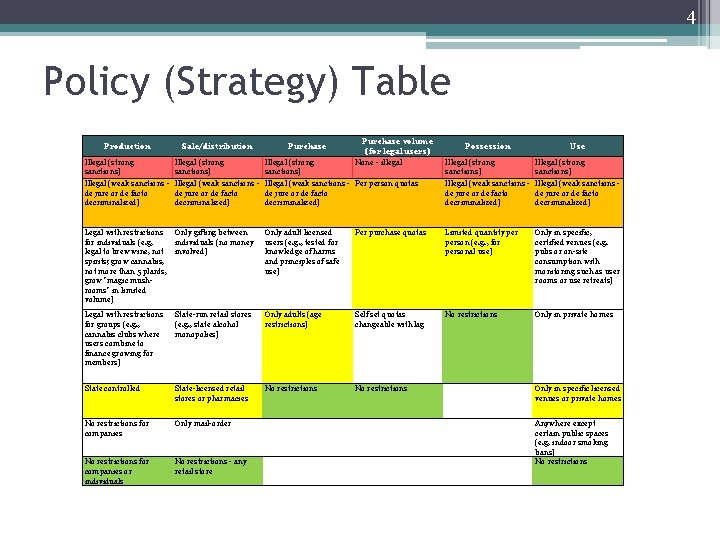
4 Policy (Strategy) Table Production Sale/distribution Illegal (strong sanctions) Illegal (weak sanctions de jure or de facto decriminalized) Purchase volume (for legal users) None - illegal Possession Use Illegal (strong sanctions) Illegal (weak sanctions - Per person quotas de jure or de facto decriminalized) Illegal (strong sanctions) Illegal (weak sanctions de jure or de facto decriminalized) Legal with restrictions Only gifting between for individuals (e. g, individuals (no money legal to brew wine, not involved) spirits; grow cannabis, not more than 5 plants, grow "magic mushrooms" in limited volume) Only adult licensed users (e. g. , tested for knowledge of harms and principles of safe use) Per purchase quotas Limited quantity person (e. g. , for personal use) Only in specific, certified venues (e. g. pubs or on-site consumption with monitoring such as user rooms or use retreats) Legal with restrictions for groups (e. g. , cannabis clubs where users combine to finance growing for members) State-run retail stores (e. g. , state alcohol monopolies) Only adults (age restrictions) Self set quotas changeable with lag No restrictions Only in private homes State controlled State-licensed retail stores or pharmacies No restrictions for companies Only mail-order No restrictions for companies or individuals No restrictions - any retail store Only in specific licensed venues or private homes Anywhere except certain public spaces (e. g, indoor smoking bans) No restrictions
5 Policy options Production Sale/distribution Purchase Illegal (strong sanctions) Illegal (weak sanctions - de jure or de facto decriminalized) Absolute Prohibition State Control Decriminalisation Free Market Purchase volume (for legal users) Possession Illegal (strong sanctions) Illegal (weak sanctions - de jure or de facto decriminalized) State controlled State-licensed retail Only adults (age stores or restrictions) pharmacies Limited quantity Only in specific Per purchase quotas person (e. g. , for licensed venues or personal use) private homes No restrictions for companies or individuals No restrictions - any No restrictions retail store No restrictions None - illegal Per person quotas Illegal (strong sanctions) Illegal (weak sanctions - de jure or de facto decriminalized) Use No restrictions Illegal (strong sanctions) Illegal (weak sanctions - de jure or de facto decriminalized) No restrictions
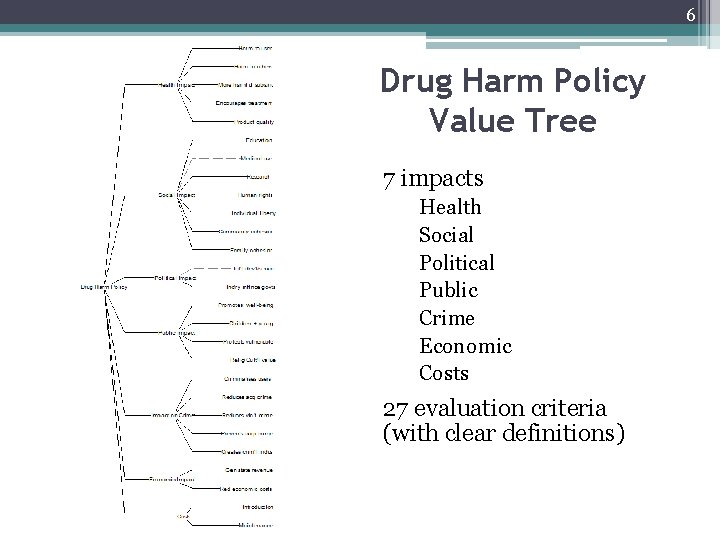
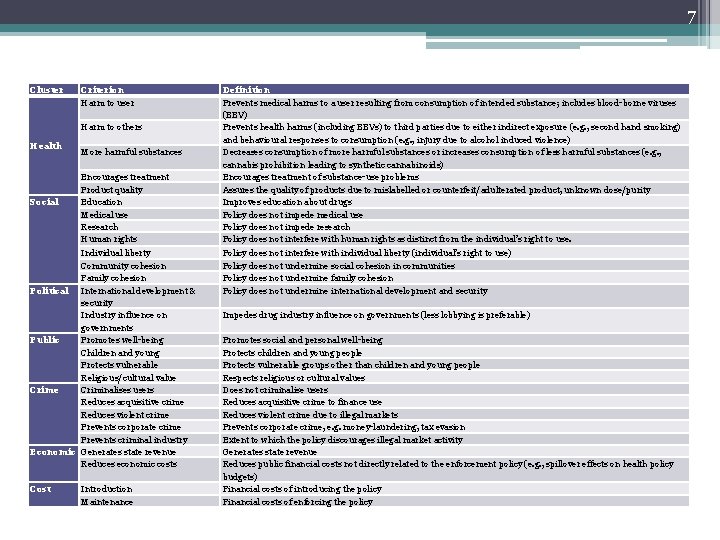
6 Drug Harm Policy Value Tree 7 impacts Health Social Political Public Crime Economic Costs 27 evaluation criteria (with clear definitions)
7 Cluster Criterion Harm to user Harm to others Health More harmful substances Encourages treatment Product quality Social Education Medical use Research Human rights Individual liberty Community cohesion Family cohesion Political International development & security Industry influence on governments Public Promotes well-being Children and young Protects vulnerable Religious/cultural value Criminalises users Reduces acquisitive crime Reduces violent crime Prevents corporate crime Prevents criminal industry Economic Generates state revenue Reduces economic costs Cost Introduction Maintenance Definition Prevents medical harms to a user resulting from consumption of intended substance; includes blood-borne viruses (BBV) Prevents health harms (including BBVs) to third parties due to either indirect exposure (e. g. , second hand smoking) and behavioural responses to consumption (e. g. , injury due to alcohol induced violence) Decreases consumption of more harmful substances or increases consumption of less harmful substances (e. g. , cannabis prohibition leading to synthetic cannabinoids) Encourages treatment of substance-use problems Assures the quality of products due to mislabelled or counterfeit/adulterated product, unknown dose/purity Improves education about drugs Policy does not impede medical use Policy does not impede research Policy does not interfere with human rights as distinct from the individual’s right to use. Policy does not interfere with individual liberty (individual’s right to use) Policy does not undermine social cohesion in communities Policy does not undermine family cohesion Policy does not undermine international development and security Impedes drug industry influence on governments (less lobbying is preferable) Promotes social and personal well-being Protects children and young people Protects vulnerable groups other than children and young people Respects religious or cultural values Does not criminalise users Reduces acquisitive crime to finance use Reduces violent crime due to illegal markets Prevents corporate crime, e. g. money-laundering, tax evasion Extent to which the policy discourages illegal market activity Generates state revenue Reduces public financial costs not directly related to the enforcement policy (e. g. , spillover effects on health policy budgets) Financial costs of introducing the policy Financial costs of enforcing the policy
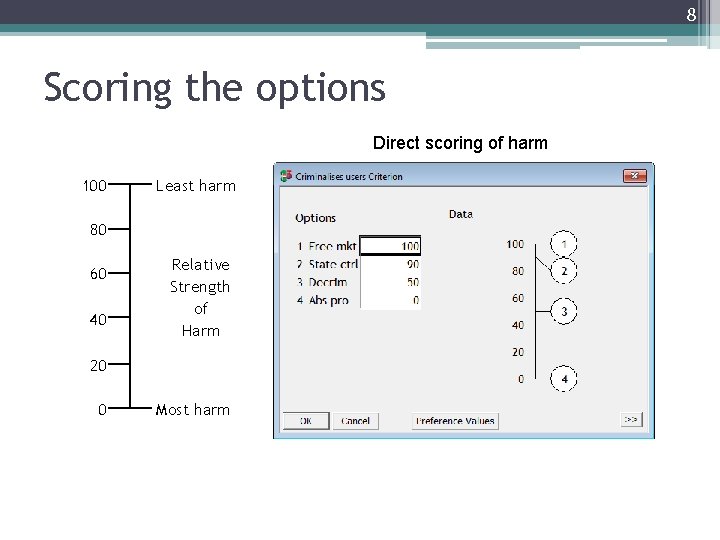
8 Scoring the options Direct scoring of harm 80 60 40 100 0 20 Least harm Relative Strength of Harm Most harm
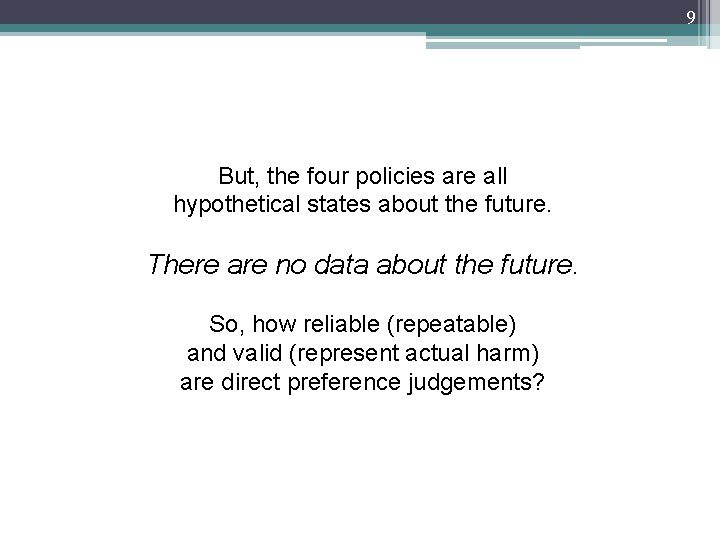
9 But, the four policies are all hypothetical states about the future. There are no data about the future. So, how reliable (repeatable) and valid (represent actual harm) are direct preference judgements?
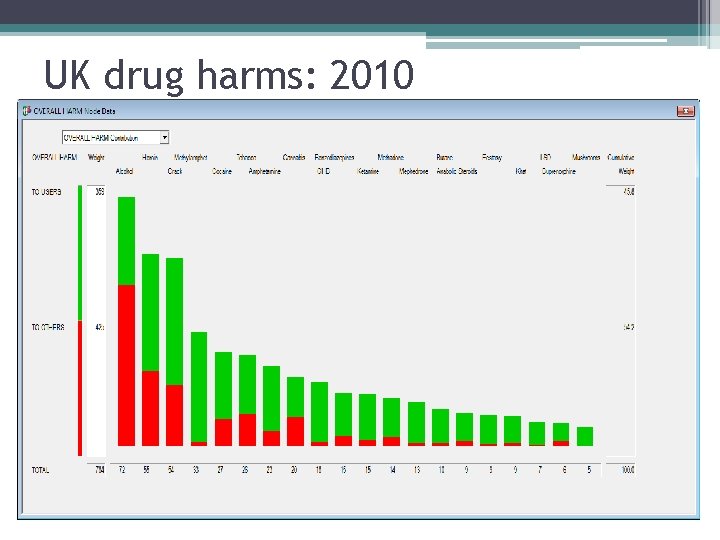
UK drug harms: 2010 ISCD results 2010
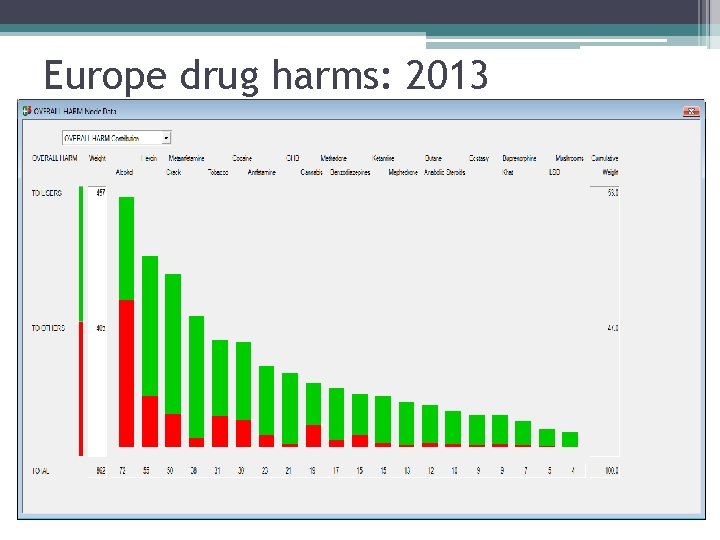
Europe drug harms: 2013 Europe results 2013
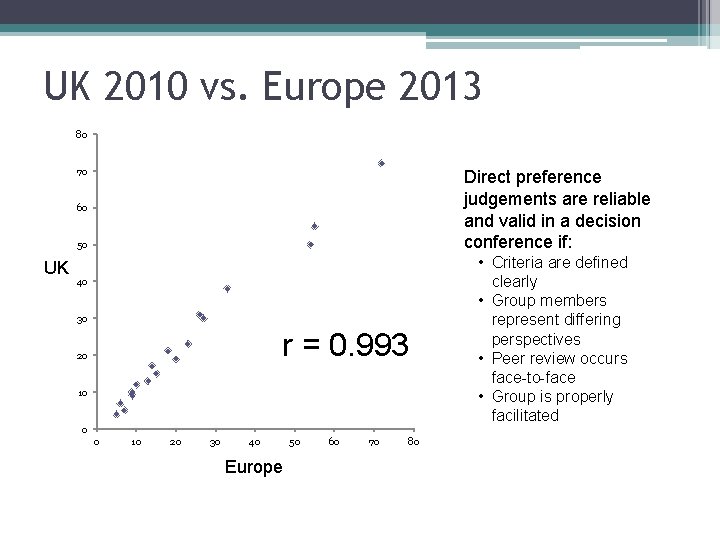
UK 2010 vs. Europe 2013 80 70 Direct preference judgements are reliable and valid in a decision conference if: 60 50 UK 40 30 r = 0. 993 20 10 0 0 10 20 30 40 Europe 50 60 70 80 • Criteria are defined clearly • Group members represent differing perspectives • Peer review occurs face-to-face • Group is properly facilitated
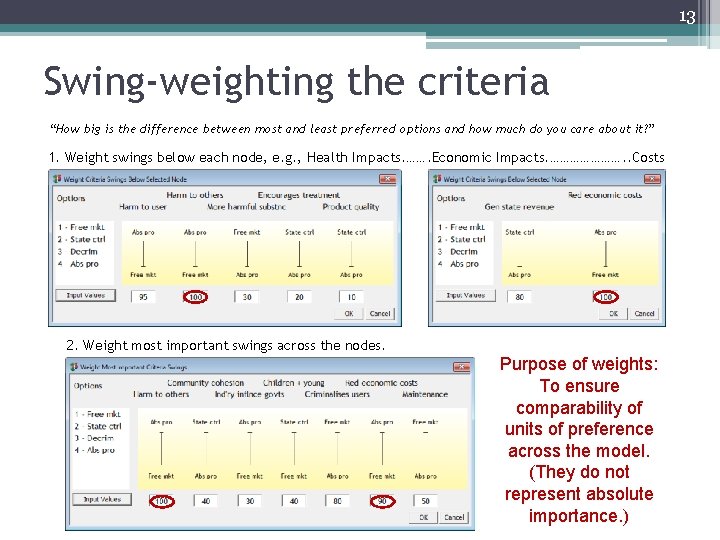
13 Swing-weighting the criteria “How big is the difference between most and least preferred options and how much do you care about it? ” 1. Weight swings below each node, e. g. , Health Impacts. ……. Economic Impacts. …………………. . Costs 2. Weight most important swings across the nodes. Purpose of weights: To ensure comparability of units of preference across the model. (They do not represent absolute importance. )
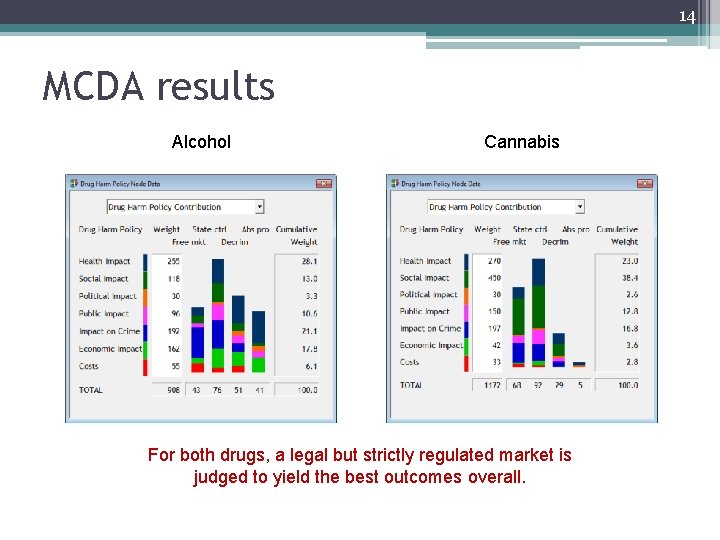
14 MCDA results Alcohol Cannabis For both drugs, a legal but strictly regulated market is judged to yield the best outcomes overall.
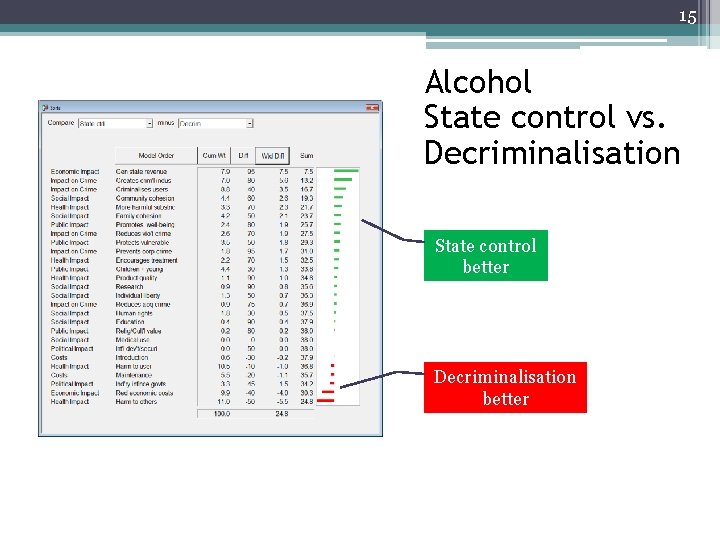
15 Alcohol State control vs. Decriminalisation State control better Decriminalisation better
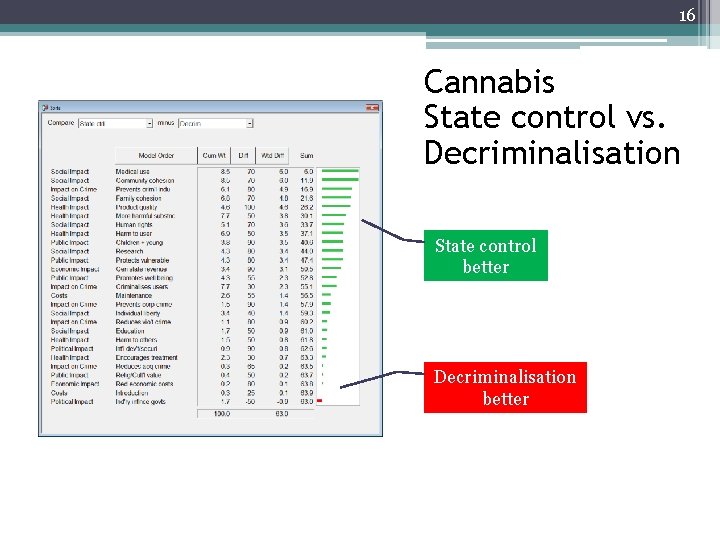
16 Cannabis State control vs. Decriminalisation State control better Decriminalisation better
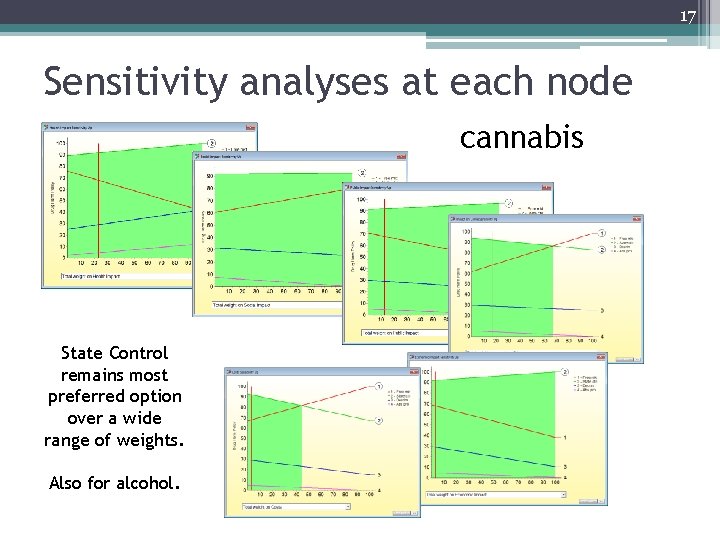
17 Sensitivity analyses at each node cannabis State Control remains most preferred option over a wide range of weights. Also for alcohol.
18 Current state 1. Alcohol results confirm current public health and medical opinion. Not so for cannabis. 2. For both substances, a legal but strictly regulated market is judged to yield the best outcomes overall. 3. Was there a ‘reformist bias’ in the group? 4. Need further research by other teams. 5. We now have the beginnings of a coherent analytic framework for describing, measuring, assessing and discussing drug policy
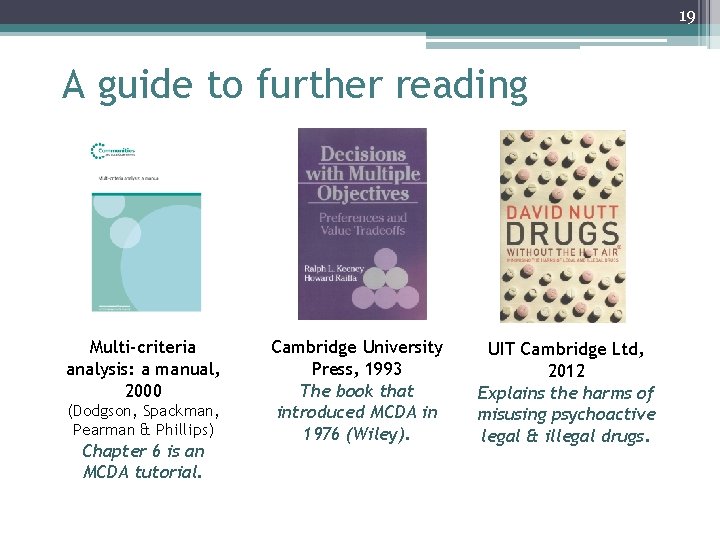
19 A guide to further reading Multi-criteria analysis: a manual, 2000 (Dodgson, Spackman, Pearman & Phillips) Chapter 6 is an MCDA tutorial. Cambridge University Press, 1993 The book that introduced MCDA in 1976 (Wiley). UIT Cambridge Ltd, 2012 Explains the harms of misusing psychoactive legal & illegal drugs.