
An MBEE and an Executable MBSE Method ESEM
An MBEE and an Executable MBSE Method (ESEM) to Support Requirements Analysis and Verification June 21, 2016, Robert Karban Jet Propulsion Laboratory, California Institute of Technology © 2016 California Institute of Technology. Government sponsorship acknowledged. 1
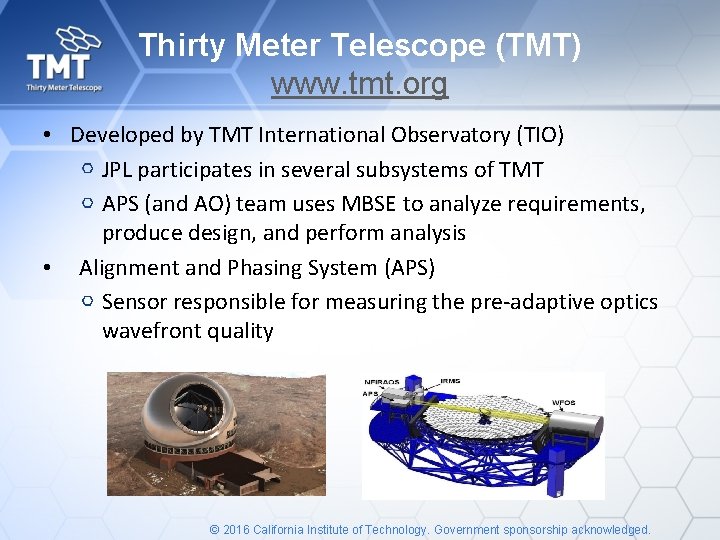
Thirty Meter Telescope (TMT) www. tmt. org • Developed by TMT International Observatory (TIO) JPL participates in several subsystems of TMT APS (and AO) team uses MBSE to analyze requirements, produce design, and perform analysis • Alignment and Phasing System (APS) Sensor responsible for measuring the pre-adaptive optics wavefront quality © 2016 California Institute of Technology. Government sponsorship acknowledged.
TMT MBSE Objectives • • Use MBSE to define executable Sys. ML model that captures requirements, operational scenarios (use cases), system decomposition, relationships and between subsystems, etc. Use the model to analyze the system design for power consumption, mass, and duration Produce engineering documents Requirement Flow Down Document Operational Scenario Document Design Description Document Interface Control Documents Uses standard languages and techniques where practical to avoid custom software development © 2016 California Institute of Technology. Government sponsorship acknowledged.
Proposed Approach • Emphasizes executable models to enhance understanding , precision, and verification of requirements • Executable Systems Engineering Method (ESEM) augments the OOSEM activities by enabling executable models ESEM produces executable Sys. ML models that verify requirements Includes a set of analysis patterns that are specified with various Sys. ML structural, behavioral and parametric diagrams Also enables integration of supplier/customer models © 2016 California Institute of Technology. Government sponsorship acknowledged.

Executing OOSEM Systems Requirements & Design Models with ESEM Analyze Stakeholder Needs • Causal analysis • Mission use cases • Domain model Analyze System Requirements Optimize & Evaluate Alternatives Manage Requirements Traceability Major SE Development Activities • System context • System scenarios • Critical parameters • Trade studies & analysis • Reqt’s Trace Support Validation & Verification Define Logical Architecture • Test cases • Test procedures Leverage executable project and system models - ESEM • Logical decomposition • Logical scenarios • Logical interconnection Synthesize Physical Architecture • System nodes • HW/SW/Data architecture • Physical interconnection • Component specs Common Subactivities Credit: Friedenthal S, Moore A. , and Steiner R. , [A Practical Guide to Sys. ML 3 rd Ed. ] Morgan Kaufmann OMG Press, 2014 © 2016 California Institute of Technology. Government sponsorship acknowledged.
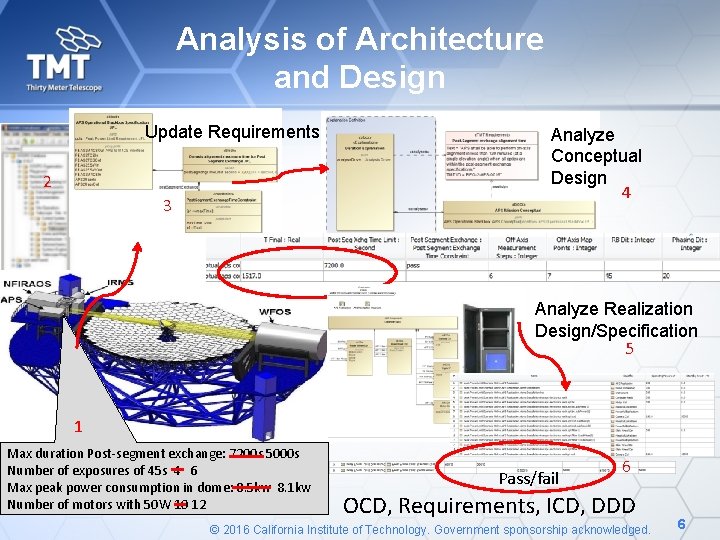
Analysis of Architecture and Design Update Requirements 2 3 Analyze Conceptual Design 4 Analyze Realization Design/Specification 5 1 Max duration Post-segment exchange: 7200 s 5000 s Number of exposures of 45 s 4 6 Max peak power consumption in dome: 8. 5 kw 8. 1 kw Number of motors with 50 W 10 12 Pass/fail 6 OCD, Requirements, ICD, DDD © 2016 California Institute of Technology. Government sponsorship acknowledged. 6
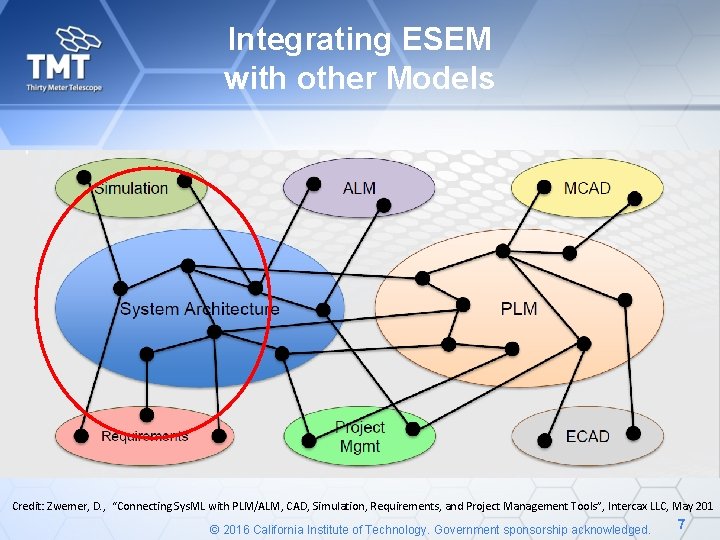
Integrating ESEM with other Models Credit: Zwemer, D. , “Connecting Sys. ML with PLM/ALM, CAD, Simulation, Requirements, and Project Management Tools”, Intercax LLC, May 201 © 2016 California Institute of Technology. Government sponsorship acknowledged. 7
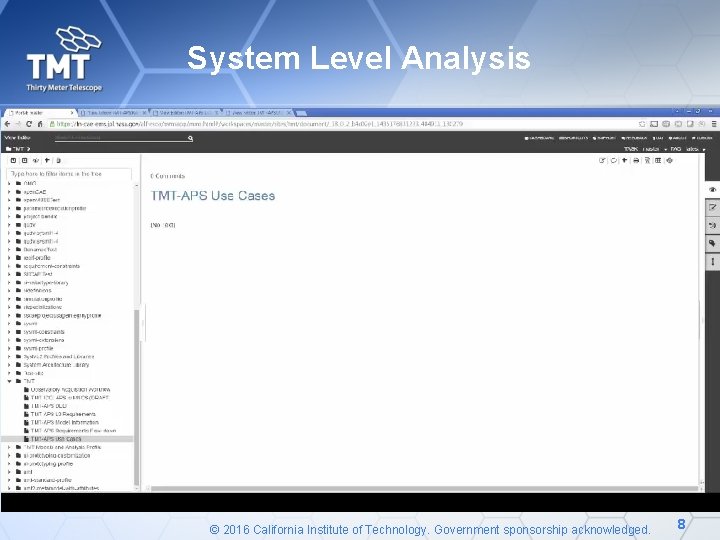
System Level Analysis © 2016 California Institute of Technology. Government sponsorship acknowledged. 8
Open. MBEE https: //github. com/Open-MBEE • • Provides a platform for modeling that integrates JPL’s mission environment Open. CAE, by incorporating a model repository that can be accessed for example with a rich Sys. ML desktop client (Magic. Draw) and a light-weight webbased client (View. Editor) The model repository provides the following features: Basic Infrastructure for Version, Workflow, Access Control Flexibility of content Support for Web Applications and Web-based API access Multi-tool and multi-repository integration across engineering and management disciplines © 2016 California Institute of Technology. Government sponsorship acknowledged.
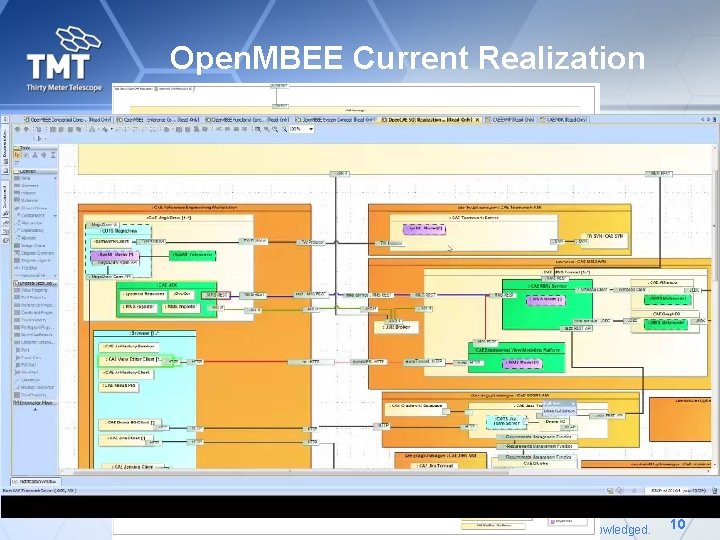
Open. MBEE Current Realization © 2016 California Institute of Technology. Government sponsorship acknowledged. 10
Typical Analysis Activities Using ESEM • Capture operational use cases with estimated durations of actions, e. g. Post segment-exchange alignment: requirement: 2 h; CBE 1 h 19 m • • Capture power and mass characteristics of components Identify involved subsystems, e. g. Telescope Control System (TCS), M 1 Control System (M 1 CS) Identify interfaces and interactions among subsystems Analyze associated scenarios Automatically verify system requirements are met Derive requirements for TMT subsystems Develop/refine timing requirements for algorithms, internal and external interface commands © 2016 California Institute of Technology. Government sponsorship acknowledged.
Acknowledgments The research was carried out at the Jet Propulsion Laboratory, California Institute of Technology, under a contract with the National Aeronautics and Space Administration and No. Magic. The TMT Project gratefully acknowledges the support of the TMT collaborating institutions. They are the Association of Canadian Universities for Research in Astronomy (ACURA), the California Institute of Technology, the University of California, the National Astronomical Observatory of Japan, the National Astronomical Observatories of China and their consortium partners, and the Department of Science and Technology of India and their supported institutes. This work was supported as well by the Gordon and Betty Moore Foundation, the Canada Foundation for Innovation, the Ontario Ministry of Research and Innovation, the National Research Council of Canada, the Natural Sciences and Engineering Research Council of Canada, the British Columbia Knowledge Development Fund, the Association of Universities for Research in Astronomy (AURA) and the U. S. National Science Foundation. © 2016 California Institute of Technology. Government sponsorship acknowledged. 12
- Slides: 12