
An Iterative Design Process for Early Spatial Reasoning
- Slides: 1
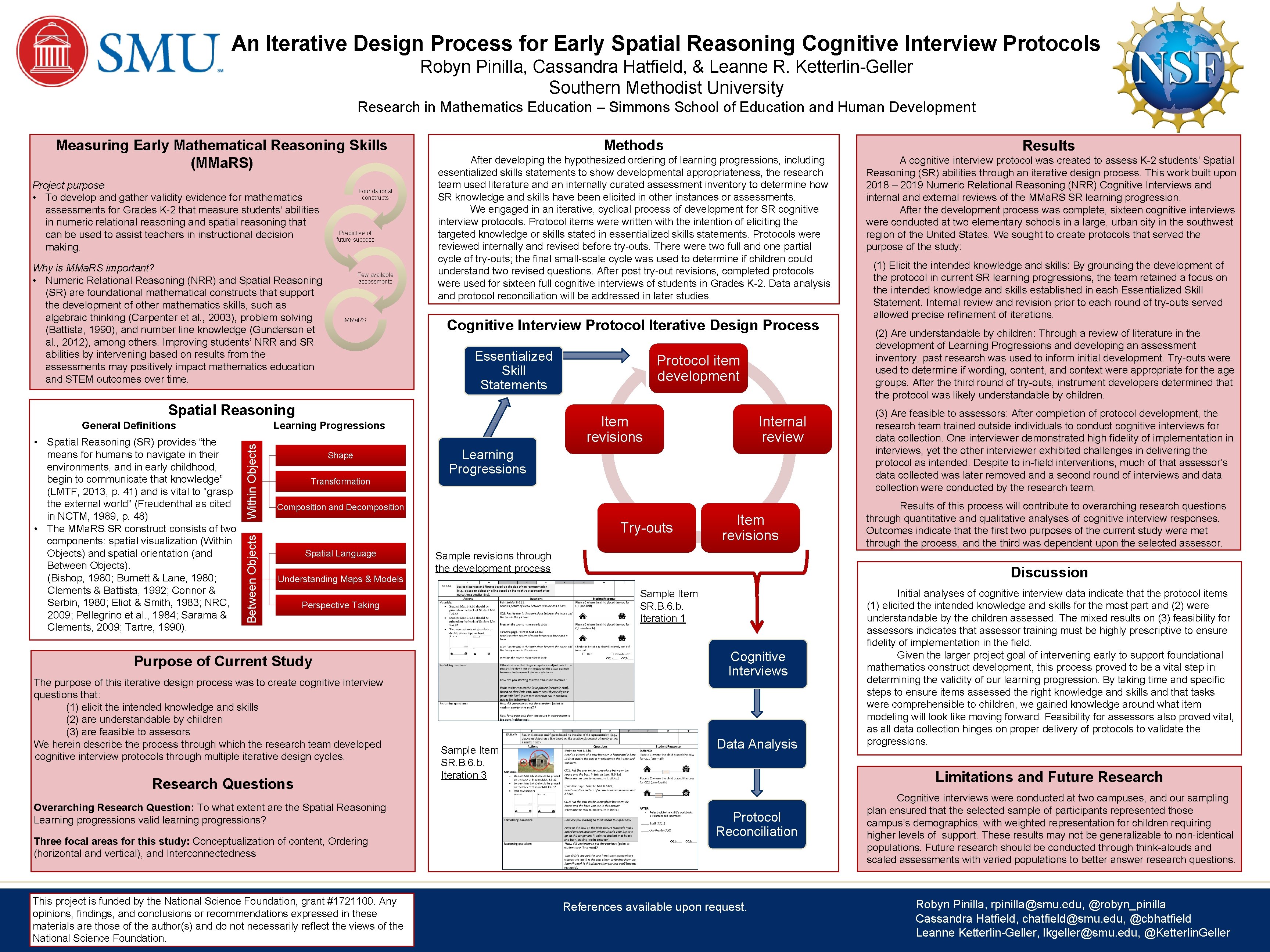
An Iterative Design Process for Early Spatial Reasoning Cognitive Interview Protocols Robyn Pinilla, Cassandra Hatfield, & Leanne R. Ketterlin-Geller Southern Methodist University Research in Mathematics Education – Simmons School of Education and Human Development Measuring Early Mathematical Reasoning Skills (MMa. RS) Project purpose • To develop and gather validity evidence for mathematics assessments for Grades K-2 that measure students' abilities in numeric relational reasoning and spatial reasoning that can be used to assist teachers in instructional decision making. Why is MMa. RS important? • Numeric Relational Reasoning (NRR) and Spatial Reasoning (SR) are foundational mathematical constructs that support the development of other mathematics skills, such as algebraic thinking (Carpenter et al. , 2003), problem solving (Battista, 1990), and number line knowledge (Gunderson et al. , 2012), among others. Improving students’ NRR and SR abilities by intervening based on results from the assessments may positively impact mathematics education and STEM outcomes over time. Foundational constructs Predictive of future success Few available assessments MMa. RS Methods Results After developing the hypothesized ordering of learning progressions, including essentialized skills statements to show developmental appropriateness, the research team used literature and an internally curated assessment inventory to determine how SR knowledge and skills have been elicited in other instances or assessments. We engaged in an iterative, cyclical process of development for SR cognitive interview protocols. Protocol items were written with the intention of eliciting the targeted knowledge or skills stated in essentialized skills statements. Protocols were reviewed internally and revised before try-outs. There were two full and one partial cycle of try-outs; the final small-scale cycle was used to determine if children could understand two revised questions. After post try-out revisions, completed protocols were used for sixteen full cognitive interviews of students in Grades K-2. Data analysis and protocol reconciliation will be addressed in later studies. A cognitive interview protocol was created to assess K-2 students’ Spatial Reasoning (SR) abilities through an iterative design process. This work built upon 2018 – 2019 Numeric Relational Reasoning (NRR) Cognitive Interviews and internal and external reviews of the MMa. RS SR learning progression. After the development process was complete, sixteen cognitive interviews were conducted at two elementary schools in a large, urban city in the southwest region of the United States. We sought to create protocols that served the purpose of the study: Cognitive Interview Protocol Iterative Design Process Essentialized Skill Statements Spatial Reasoning Between Objects • Spatial Reasoning (SR) provides “the means for humans to navigate in their environments, and in early childhood, begin to communicate that knowledge” (LMTF, 2013, p. 41) and is vital to “grasp the external world” (Freudenthal as cited in NCTM, 1989, p. 48) • The MMa. RS SR construct consists of two components: spatial visualization (Within Objects) and spatial orientation (and Between Objects). (Bishop, 1980; Burnett & Lane, 1980; Clements & Battista, 1992; Connor & Serbin, 1980; Eliot & Smith, 1983; NRC, 2009; Pellegrino et al. , 1984; Sarama & Clements, 2009; Tartre, 1990). Item revisions Learning Progressions Within Objects General Definitions Shape Protocol item development Internal review Learning Progressions Transformation Composition and Decomposition Try-outs Spatial Language Understanding Maps & Models Sample revisions through the development process Cognitive Interviews Purpose of Current Study Research Questions Overarching Research Question: To what extent are the Spatial Reasoning Learning progressions valid learning progressions? Three focal areas for this study: Conceptualization of content, Ordering (horizontal and vertical), and Interconnectedness This project is funded by the National Science Foundation, grant #1721100. Any opinions, findings, and conclusions or recommendations expressed in these materials are those of the author(s) and do not necessarily reflect the views of the National Science Foundation. Sample Item SR. B. 6. b. Iteration 3 (2) Are understandable by children: Through a review of literature in the development of Learning Progressions and developing an assessment inventory, past research was used to inform initial development. Try-outs were used to determine if wording, content, and context were appropriate for the age groups. After the third round of try-outs, instrument developers determined that the protocol was likely understandable by children. (3) Are feasible to assessors: After completion of protocol development, the research team trained outside individuals to conduct cognitive interviews for data collection. One interviewer demonstrated high fidelity of implementation in interviews, yet the other interviewer exhibited challenges in delivering the protocol as intended. Despite to in-field interventions, much of that assessor’s data collected was later removed and a second round of interviews and data collection were conducted by the research team. Results of this process will contribute to overarching research questions through quantitative and qualitative analyses of cognitive interview responses. Outcomes indicate that the first two purposes of the current study were met through the process, and the third was dependent upon the selected assessor. Discussion Sample Item SR. B. 6. b. Iteration 1 Perspective Taking The purpose of this iterative design process was to create cognitive interview questions that: (1) elicit the intended knowledge and skills (2) are understandable by children (3) are feasible to assesors We herein describe the process through which the research team developed cognitive interview protocols through multiple iterative design cycles. Item revisions (1) Elicit the intended knowledge and skills: By grounding the development of the protocol in current SR learning progressions, the team retained a focus on the intended knowledge and skills established in each Essentialized Skill Statement. Internal review and revision prior to each round of try-outs served allowed precise refinement of iterations. Data Analysis Initial analyses of cognitive interview data indicate that the protocol items (1) elicited the intended knowledge and skills for the most part and (2) were understandable by the children assessed. The mixed results on (3) feasibility for assessors indicates that assessor training must be highly prescriptive to ensure fidelity of implementation in the field. Given the larger project goal of intervening early to support foundational mathematics construct development, this process proved to be a vital step in determining the validity of our learning progression. By taking time and specific steps to ensure items assessed the right knowledge and skills and that tasks were comprehensible to children, we gained knowledge around what item modeling will look like moving forward. Feasibility for assessors also proved vital, as all data collection hinges on proper delivery of protocols to validate the progressions. Limitations and Future Research Protocol Reconciliation References available upon request. Cognitive interviews were conducted at two campuses, and our sampling plan ensured that the selected sample of participants represented those campus’s demographics, with weighted representation for children requiring higher levels of support. These results may not be generalizable to non-identical populations. Future research should be conducted through think-alouds and scaled assessments with varied populations to better answer research questions. Robyn Pinilla, rpinilla@smu. edu, @robyn_pinilla Cassandra Hatfield, chatfield@smu. edu, @cbhatfield Leanne Ketterlin-Geller, lkgeller@smu. edu, @Ketterlin. Geller