
An Investigation of the AVAcore Core Control Glove
- Slides: 1
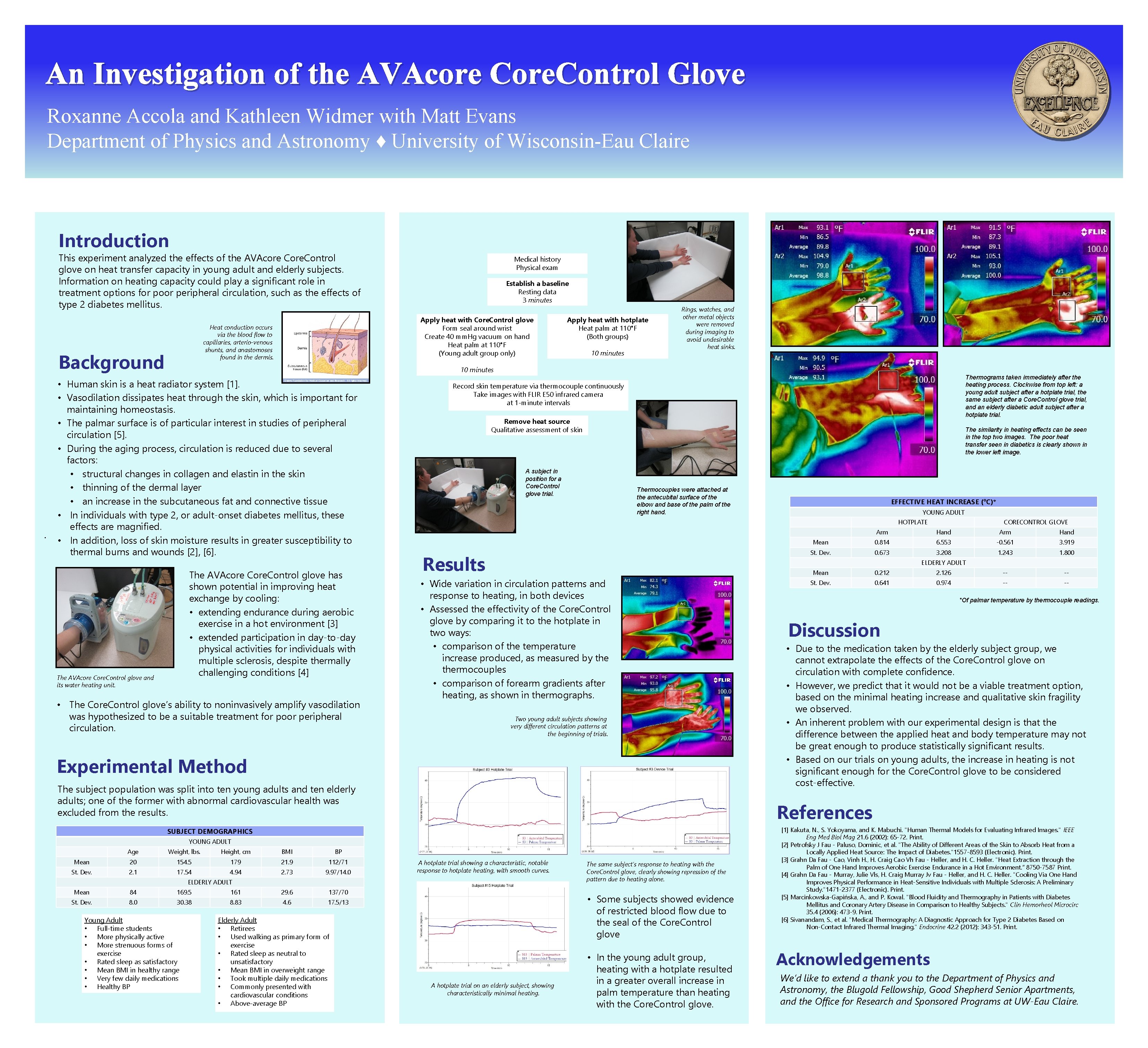
An Investigation of the AVAcore Core. Control Glove Roxanne Accola and Kathleen Widmer with Matt Evans Department of Physics and Astronomy ♦ University of Wisconsin-Eau Claire Introduction This experiment analyzed the effects of the AVAcore Core. Control glove on heat transfer capacity in young adult and elderly subjects. Information on heating capacity could play a significant role in treatment options for poor peripheral circulation, such as the effects of type 2 diabetes mellitus. . Establish a baseline Resting data 3 minutes Apply heat with Core. Control glove Form seal around wrist Create 40 mm. Hg vacuum on hand Heat palm at 110°F (Young adult group only) Heat conduction occurs via the blood flow to capillaries, arterio-venous shunts, and anastomoses found in the dermis. Background Medical history Physical exam Apply heat with hotplate Heat palm at 110°F (Both groups) 10 minutes Rings, watches, and other metal objects were removed during imaging to avoid undesirable heat sinks. 10 minutes • Human skin is a heat radiator system [1]. • Vasodilation dissipates heat through the skin, which is important for maintaining homeostasis. • The palmar surface is of particular interest in studies of peripheral circulation [5]. • During the aging process, circulation is reduced due to several factors: • structural changes in collagen and elastin in the skin • thinning of the dermal layer • an increase in the subcutaneous fat and connective tissue • In individuals with type 2, or adult-onset diabetes mellitus, these effects are magnified. • In addition, loss of skin moisture results in greater susceptibility to thermal burns and wounds [2], [6]. The AVAcore Core. Control glove has shown potential in improving heat exchange by cooling: • extending endurance during aerobic exercise in a hot environment [3] • extended participation in day-to-day physical activities for individuals with multiple sclerosis, despite thermally challenging conditions [4] The AVAcore Core. Control glove and its water heating unit. • The Core. Control glove’s ability to noninvasively amplify vasodilation was hypothesized to be a suitable treatment for poor peripheral circulation. Thermograms taken immediately after the heating process. Clockwise from top left: a young adult subject after a hotplate trial, the same subject after a Core. Control glove trial, and an elderly diabetic adult subject after a hotplate trial. Record skin temperature via thermocouple continuously Take images with FLIR E 50 infrared camera at 1 -minute intervals Remove heat source Qualitative assessment of skin The similarity in heating effects can be seen in the top two images. The poor heat transfer seen in diabetics is clearly shown in the lower left image. A subject in position for a Core. Control glove trial. Thermocouples were attached at the antecubital surface of the elbow and base of the palm of the right hand. Results • Wide variation in circulation patterns and response to heating, in both devices • Assessed the effectivity of the Core. Control glove by comparing it to the hotplate in two ways: • comparison of the temperature increase produced, as measured by thermocouples • comparison of forearm gradients after heating, as shown in thermographs. Two young adult subjects showing very different circulation patterns at the beginning of trials. YOUNG ADULT BMI BP Mean 20 154. 5 179 21. 9 112/71 St. Dev. 2. 1 17. 54 4. 94 2. 73 9. 97/14. 0 A hotplate trial showing a characteristic, notable response to hotplate heating, with smooth curves. ELDERLY ADULT Mean 84 169. 5 161 29. 6 137/70 St. Dev. 8. 0 30. 38 8. 83 4. 6 17. 5/13 Young Adult • Full-time students • More physically active • More strenuous forms of exercise • Rated sleep as satisfactory • Mean BMI in healthy range • Very few daily medications • Healthy BP Elderly Adult • Retirees • Used walking as primary form of exercise • Rated sleep as neutral to unsatisfactory • Mean BMI in overweight range • Took multiple daily medications • Commonly presented with cardiovascular conditions • Above-average BP Arm Hand Mean 0. 814 6. 553 -0. 561 3. 919 St. Dev. 0. 673 3. 208 1. 243 1. 800 Mean 0. 212 2. 126 -- -- St. Dev. 0. 641 0. 974 -- -- *Of palmar temperature by thermocouple readings. Discussion • Due to the medication taken by the elderly subject group, we cannot extrapolate the effects of the Core. Control glove on circulation with complete confidence. • However, we predict that it would not be a viable treatment option, based on the minimal heating increase and qualitative skin fragility we observed. • An inherent problem with our experimental design is that the difference between the applied heat and body temperature may not be great enough to produce statistically significant results. • Based on our trials on young adults, the increase in heating is not significant enough for the Core. Control glove to be considered cost-effective. References SUBJECT DEMOGRAPHICS Height, cm CORECONTROL GLOVE ELDERLY ADULT The subject population was split into ten young adults and ten elderly adults; one of the former with abnormal cardiovascular health was excluded from the results. Weight, lbs. YOUNG ADULT HOTPLATE Experimental Method Age EFFECTIVE HEAT INCREASE (°C)* The same subject’s response to heating with the Core. Control glove, clearly showing repression of the pattern due to heating alone. • Some subjects showed evidence of restricted blood flow due to the seal of the Core. Control glove A hotplate trial on an elderly subject, showing characteristically minimal heating. • In the young adult group, heating with a hotplate resulted in a greater overall increase in palm temperature than heating with the Core. Control glove. [1] Kakuta, N. , S. Yokoyama, and K. Mabuchi. "Human Thermal Models for Evaluating Infrared Images. " IEEE Eng Med Biol Mag 21. 6 (2002): 65 -72. Print. [2] Petrofsky J Fau - Paluso, Dominic, et al. "The Ability of Different Areas of the Skin to Absorb Heat from a Locally Applied Heat Source: The Impact of Diabetes. "1557 -8593 (Electronic). Print. [3] Grahn Da Fau - Cao, Vinh H. , H. Craig Cao Vh Fau - Heller, and H. C. Heller. "Heat Extraction through the Palm of One Hand Improves Aerobic Exercise Endurance in a Hot Environment. “ 8750 -7587 Print. [4] Grahn Da Fau - Murray, Julie Vls, H. Craig Murray Jv Fau - Heller, and H. C. Heller. "Cooling Via One Hand Improves Physical Performance in Heat-Sensitive Individuals with Multiple Sclerosis: A Preliminary Study. "1471 -2377 (Electronic). Print. [5] Marcinkowska-Gapińska, A. , and P. Kowal. "Blood Fluidity and Thermography in Patients with Diabetes Mellitus and Coronary Artery Disease in Comparison to Healthy Subjects. " Clin Hemorheol Microcirc 35. 4 (2006): 473 -9. Print. [6] Sivanandam, S. , et al. "Medical Thermography: A Diagnostic Approach for Type 2 Diabetes Based on Non-Contact Infrared Thermal Imaging. " Endocrine 42. 2 (2012): 343 -51. Print. Acknowledgements We’d like to extend a thank you to the Department of Physics and Astronomy, the Blugold Fellowship, Good Shepherd Senior Apartments, and the Office for Research and Sponsored Programs at UW-Eau Claire.