
An investigation into the factors that contribute to
An investigation into the factors that contribute to low learner performance in Communication in English at GETC: ABET Level 4 Frank Chinyamakobvu 12 th SAAEA Conference, Pretoria, South Africa 16 May 2018
Presentation Outline • Umalusi Legislative mandate & sub-framework • Purpose & Structure of the GETC • GETC pass requirements & Rules of combination • Characteristics of the GETC • Research purpose & question • Data collection methods • Sector’s staffing (public) • Learner performance • Discussion • Recommendations
Umalusi: Legislative mandate Constituted by an Act of Parliament in 2001 as a Quality Council, the Council for Quality Assurance in General and Further Education & Training carries out its mandate by ensuring the development of qualifications & associated curricula as are required for the sub-framework accrediting providers to offer such qualifications & quality assuring provision quality assuring assessment & certifying learner achievements conducting research which constitutes the basis for the advice provided to the relevant Minister Umalusi undertakes its work in collaboration with SAQA, the QCTO & the CHE
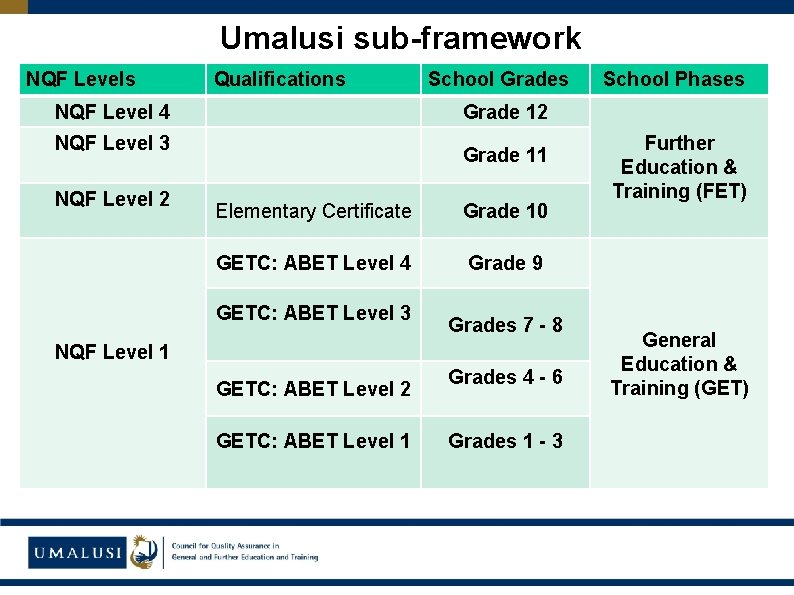
Umalusi sub-framework NQF Levels Qualifications NQF Level 4 School Phases Grade 12 NQF Level 3 NQF Level 2 School Grades Grade 11 Elementary Certificate Grade 10 GETC: ABET Level 4 Grade 9 GETC: ABET Level 3 Grades 7 - 8 NQF Level 1 GETC: ABET Level 2 GETC: ABET Level 1 Grades 4 - 6 Grades 1 - 3 Further Education & Training (FET) General Education & Training (GET)
Purpose of GETC The GETC is designed to, amongst others, prepare learners to become literate and numerate citizens provide basic learning tools, knowledge and skills and provide participants with a nationally recognised qualification Develop occupational skills and impart knowledge to start own enterprises Enable participants to study further
Structure of GETC There are 26 subjects on offer from which learners choose five – of which three are compulsory (Official Lang. ; Maths Lit. or Mathematics &Mathematical Sciences-Not both & LO) Exams are administered twice in each year: June & Nov Additionally, there are exams which are offered on request (EORs) by one of the three assessment bodies. For admission into ABET Level 4, a candidate must have completed ABET Level 3 and been registered four to six months prior to sitting the exam Alternatively, a learner may be admitted through RPL
GETC pass requirements Pass requirements are that: learners must have both school-based assessment (SBA) + examination marks - SBA contributes 50% and exam 50%. Pass mark is 40%. Obtain a minimum of 120 credits Unit standards-based qualification (120 credits)
Rules of subject combination Fundamental subjects Core subject Official Lang. (23); Mathematical Literacy (16) or Mathematics &Mathematical Sciences (16)-Not both Life Orientation (23) Electives subjects Academic: Any one from six academic subjects (with credits ranging between 11 – 23) Vocational subjects: Any subject from seven vocational subjects (with credits ranging between 17 – 45)
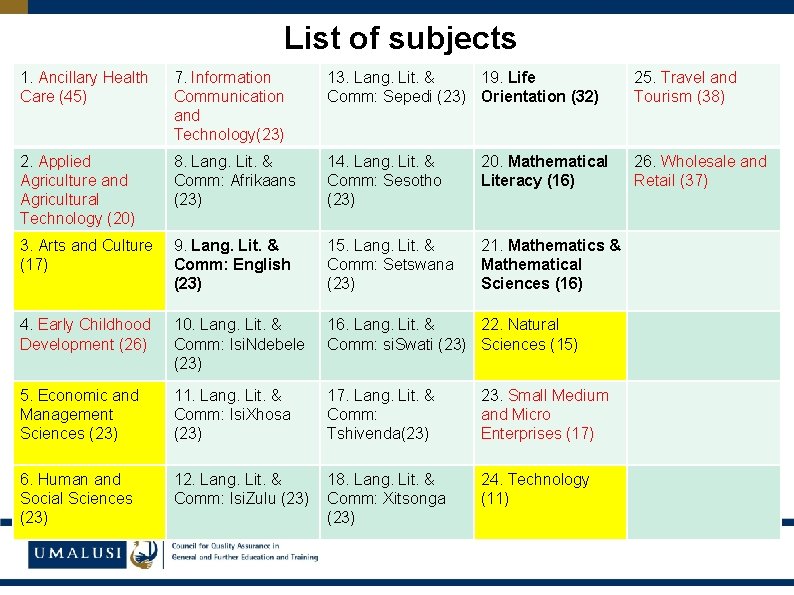
List of subjects 1. Ancillary Health Care (45) 7. Information Communication and Technology(23) 13. Lang. Lit. & 19. Life Comm: Sepedi (23) Orientation (32) 25. Travel and Tourism (38) 2. Applied Agriculture and Agricultural Technology (20) 8. Lang. Lit. & Comm: Afrikaans (23) 14. Lang. Lit. & Comm: Sesotho (23) 20. Mathematical Literacy (16) 26. Wholesale and Retail (37) 3. Arts and Culture (17) 9. Lang. Lit. & Comm: English (23) 15. Lang. Lit. & Comm: Setswana (23) 21. Mathematics & Mathematical Sciences (16) 4. Early Childhood Development (26) 10. Lang. Lit. & Comm: Isi. Ndebele (23) 16. Lang. Lit. & 22. Natural Comm: si. Swati (23) Sciences (15) 5. Economic and Management Sciences (23) 11. Lang. Lit. & Comm: Isi. Xhosa (23) 17. Lang. Lit. & Comm: Tshivenda(23) 23. Small Medium and Micro Enterprises (17) 6. Human and Social Sciences (23) 12. Lang. Lit. & Comm: Isi. Zulu (23) 18. Lang. Lit. & Comm: Xitsonga (23) 24. Technology (11)
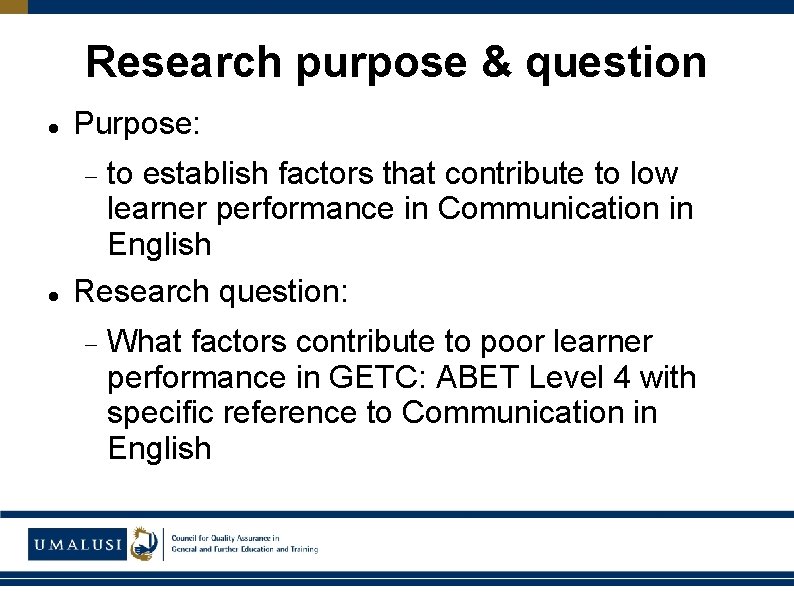
Research purpose & question Purpose: to establish factors that contribute to low learner performance in Communication in English Research question: What factors contribute to poor learner performance in GETC: ABET Level 4 with specific reference to Communication in English
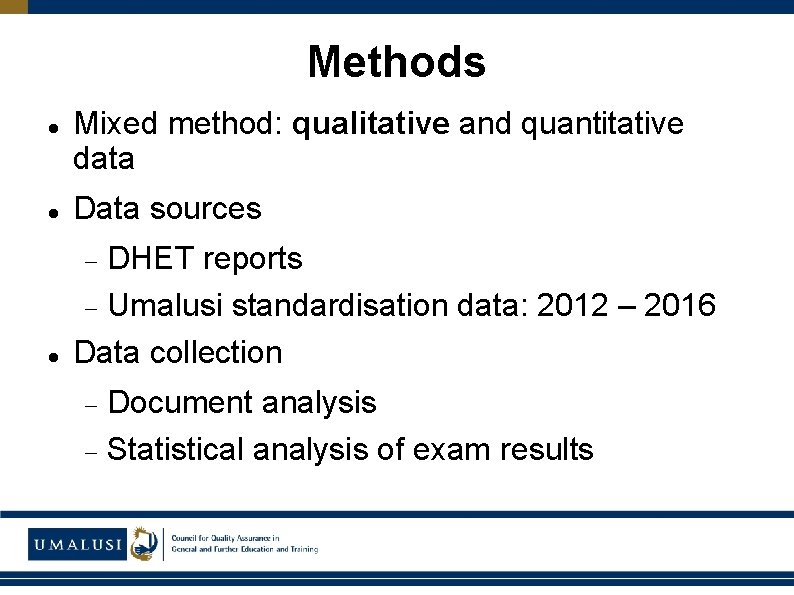
Methods Mixed method: qualitative and quantitative data Data sources DHET reports Umalusi standardisation data: 2012 – 2016 Data collection Document analysis Statistical analysis of exam results
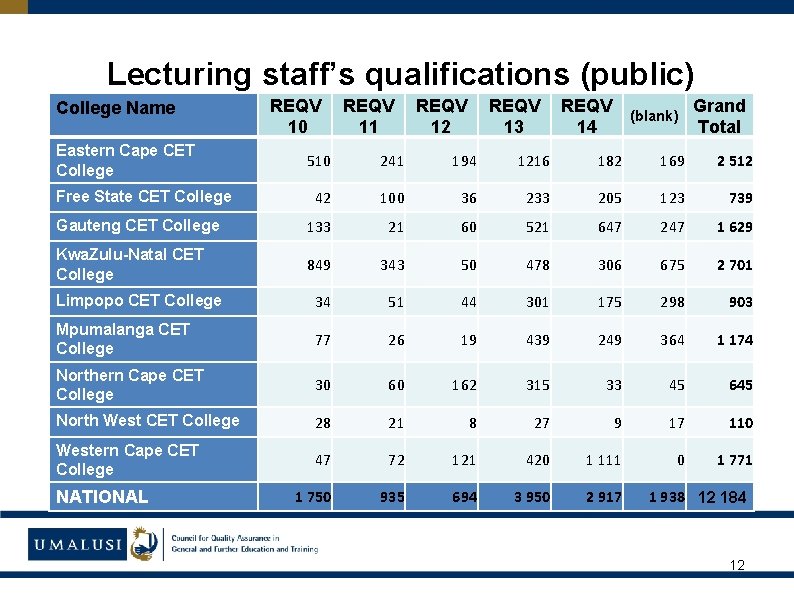
Lecturing staff’s qualifications (public) College Name Eastern Cape CET College REQV 10 REQV 11 REQV 12 REQV 13 REQV Grand (blank) 14 Total 510 241 194 1216 182 169 2 512 42 100 36 233 205 123 739 Gauteng CET College 133 21 60 521 647 247 1 629 Kwa. Zulu-Natal CET College 849 343 50 478 306 675 2 701 Limpopo CET College 34 51 44 301 175 298 903 Mpumalanga CET College 77 26 19 439 249 364 1 174 Northern Cape CET College 30 60 162 315 33 45 645 North West CET College 28 21 8 27 9 17 110 Western Cape CET College 47 72 121 420 1 111 0 1 771 1 750 935 694 3 950 2 917 Free State CET College NATIONAL 1 938 12 184 12
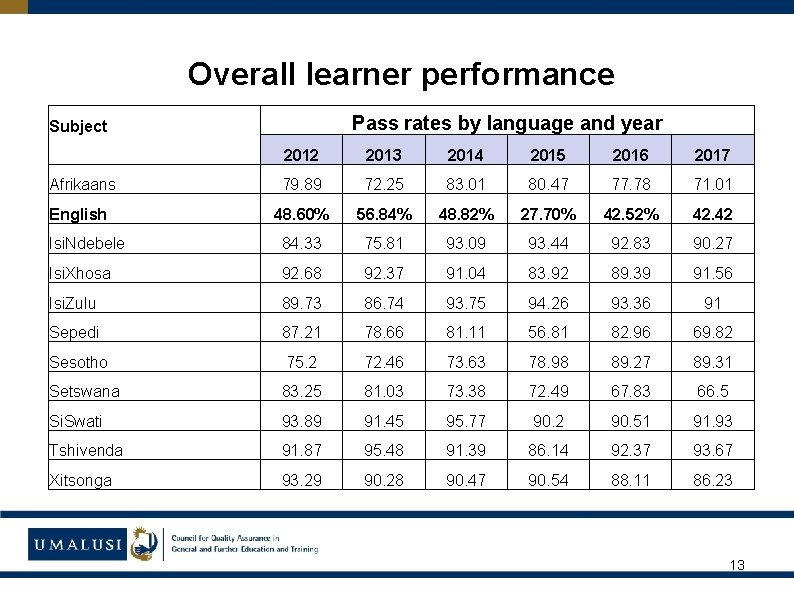
Overall learner performance Pass rates by language and year Subject 2012 2013 2014 2015 2016 2017 Afrikaans 79. 89 72. 25 83. 01 80. 47 77. 78 71. 01 English 48. 60% 56. 84% 48. 82% 27. 70% 42. 52% 42. 42 Isi. Ndebele 84. 33 75. 81 93. 09 93. 44 92. 83 90. 27 Isi. Xhosa 92. 68 92. 37 91. 04 83. 92 89. 39 91. 56 Isi. Zulu 89. 73 86. 74 93. 75 94. 26 93. 36 91 Sepedi 87. 21 78. 66 81. 11 56. 81 82. 96 69. 82 Sesotho 75. 2 72. 46 73. 63 78. 98 89. 27 89. 31 Setswana 83. 25 81. 03 73. 38 72. 49 67. 83 66. 5 Si. Swati 93. 89 91. 45 95. 77 90. 2 90. 51 91. 93 Tshivenda 91. 87 95. 48 91. 39 86. 14 92. 37 93. 67 Xitsonga 93. 29 90. 28 90. 47 90. 54 88. 11 86. 23 13
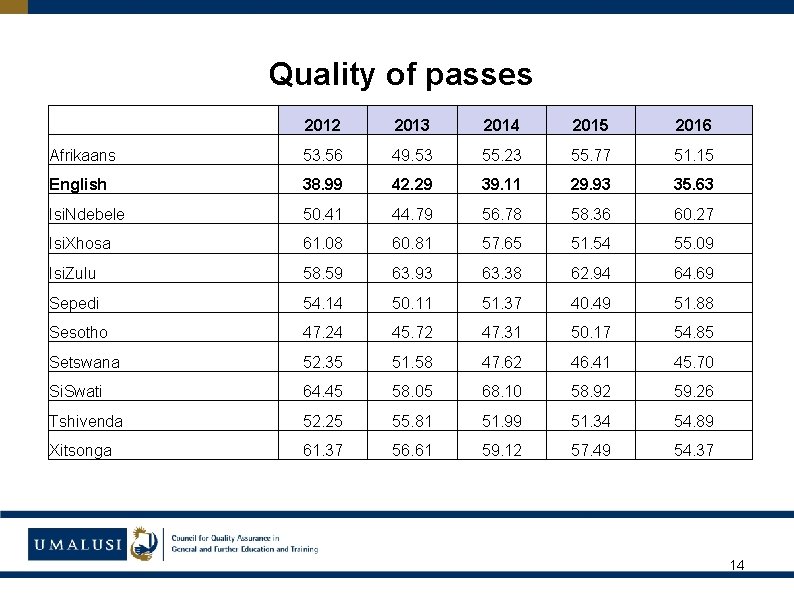
Quality of passes 2012 2013 2014 2015 2016 Afrikaans 53. 56 49. 53 55. 23 55. 77 51. 15 English 38. 99 42. 29 39. 11 29. 93 35. 63 Isi. Ndebele 50. 41 44. 79 56. 78 58. 36 60. 27 Isi. Xhosa 61. 08 60. 81 57. 65 51. 54 55. 09 Isi. Zulu 58. 59 63. 93 63. 38 62. 94 64. 69 Sepedi 54. 14 50. 11 51. 37 40. 49 51. 88 Sesotho 47. 24 45. 72 47. 31 50. 17 54. 85 Setswana 52. 35 51. 58 47. 62 46. 41 45. 70 Si. Swati 64. 45 58. 05 68. 10 58. 92 59. 26 Tshivenda 52. 25 55. 81 51. 99 51. 34 54. 89 Xitsonga 61. 37 56. 61 59. 12 57. 49 54. 37 14
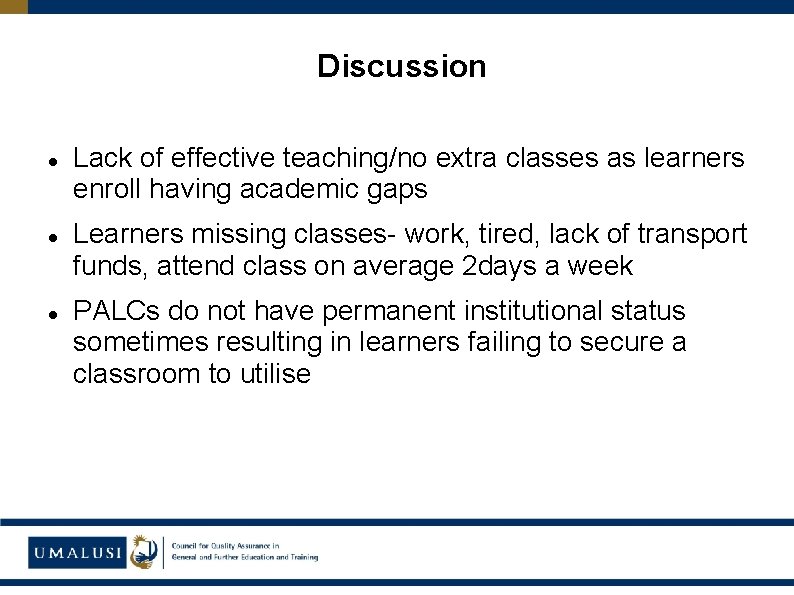
Discussion Lack of effective teaching/no extra classes as learners enroll having academic gaps Learners missing classes- work, tired, lack of transport funds, attend class on average 2 days a week PALCs do not have permanent institutional status sometimes resulting in learners failing to secure a classroom to utilise
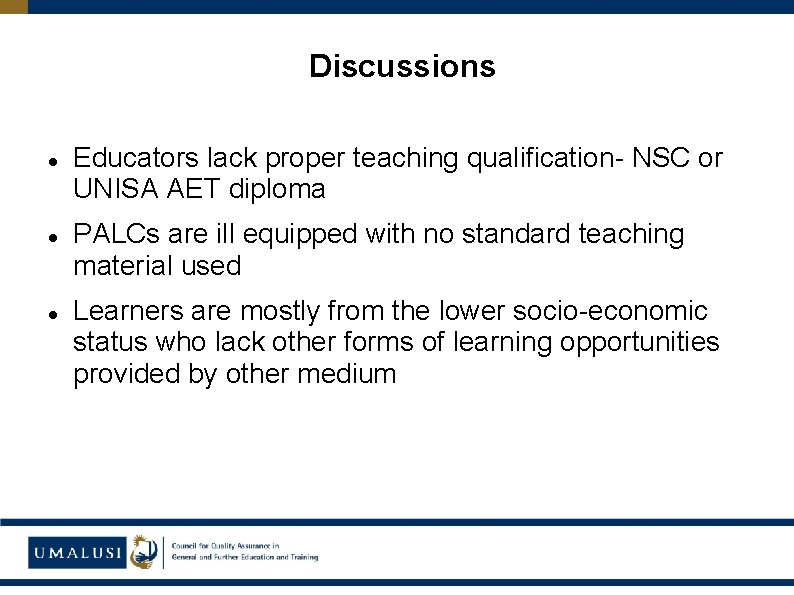
Discussions Educators lack proper teaching qualification- NSC or UNISA AET diploma PALCs are ill equipped with no standard teaching material used Learners are mostly from the lower socio-economic status who lack other forms of learning opportunities provided by other medium
Recommendations Develop relevant curricula that teaches concepts related to Andragogy Develop monitoring and support systems for both educators and learners
Thank You!
- Slides: 18