
An Inverse Model Reduction Method for Finite Element




- Slides: 14
An Inverse Model Reduction Method for Finite Element Model Updating in Structural Health Monitoring Benedikt Hofmeister 1, Marlene Bruns 1, Tanja Grießmann 1, Ingo Gebauer 2 and Raimund Rolfes 1 [1] Leibniz University Hannover/For. Wind, Germany – Institute of Structural Analysis [2] Fraunhofer-Institut für Windenergiesysteme IWES, Germany © For. Wind @For. Wind_DE 1
Contents • Motivation • State of the Art – Cross-Sectional Analysis • Inverse Model Reduction • Application • Summary and Outlook © For. Wind @For. Wind_DE 2
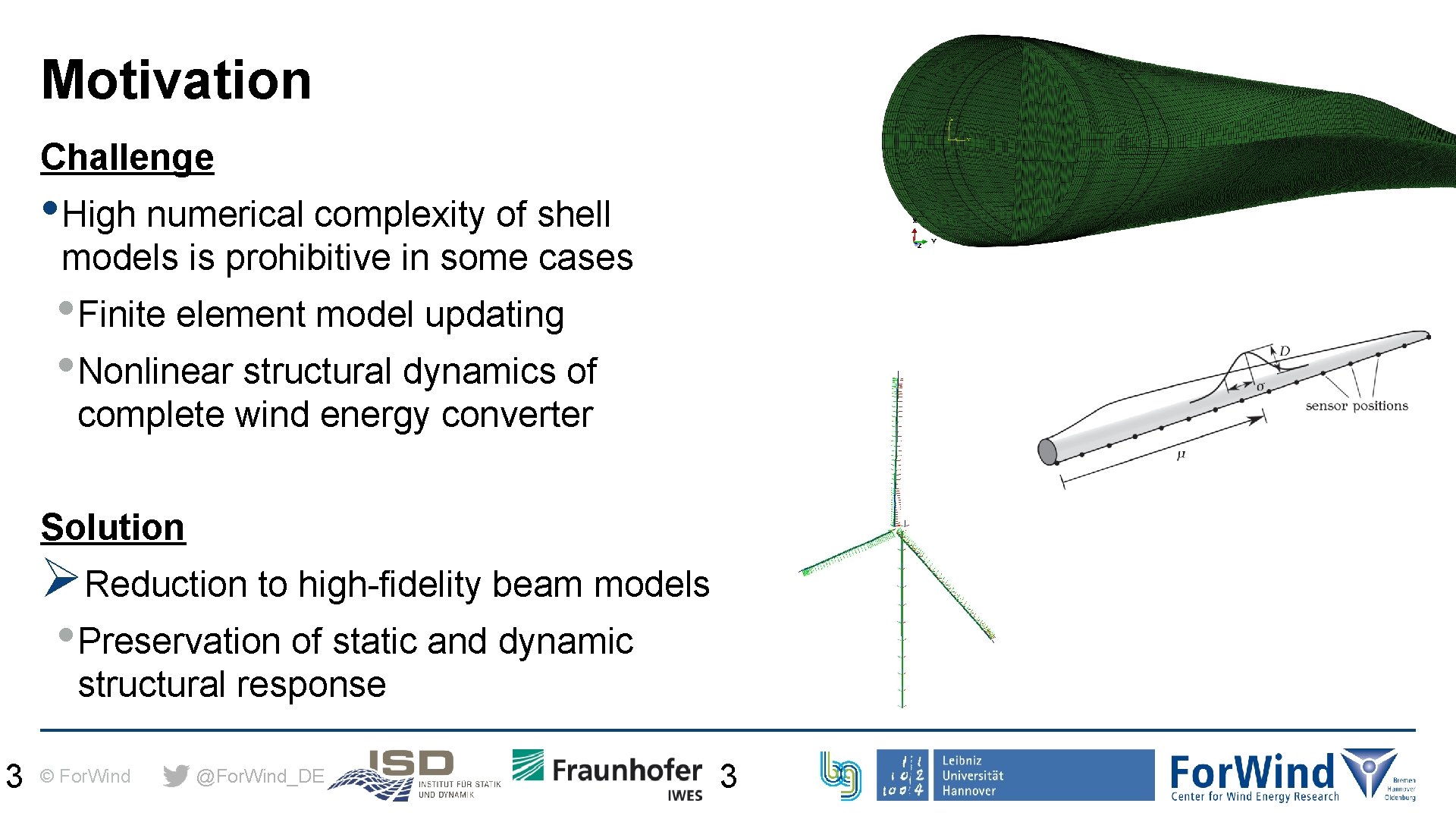
Motivation Challenge • High numerical complexity of shell models is prohibitive in some cases • Finite element model updating • Nonlinear structural dynamics of complete wind energy converter Solution ØReduction to high-fidelity beam models • Preservation of static and dynamic structural response 3 © For. Wind @For. Wind_DE 3
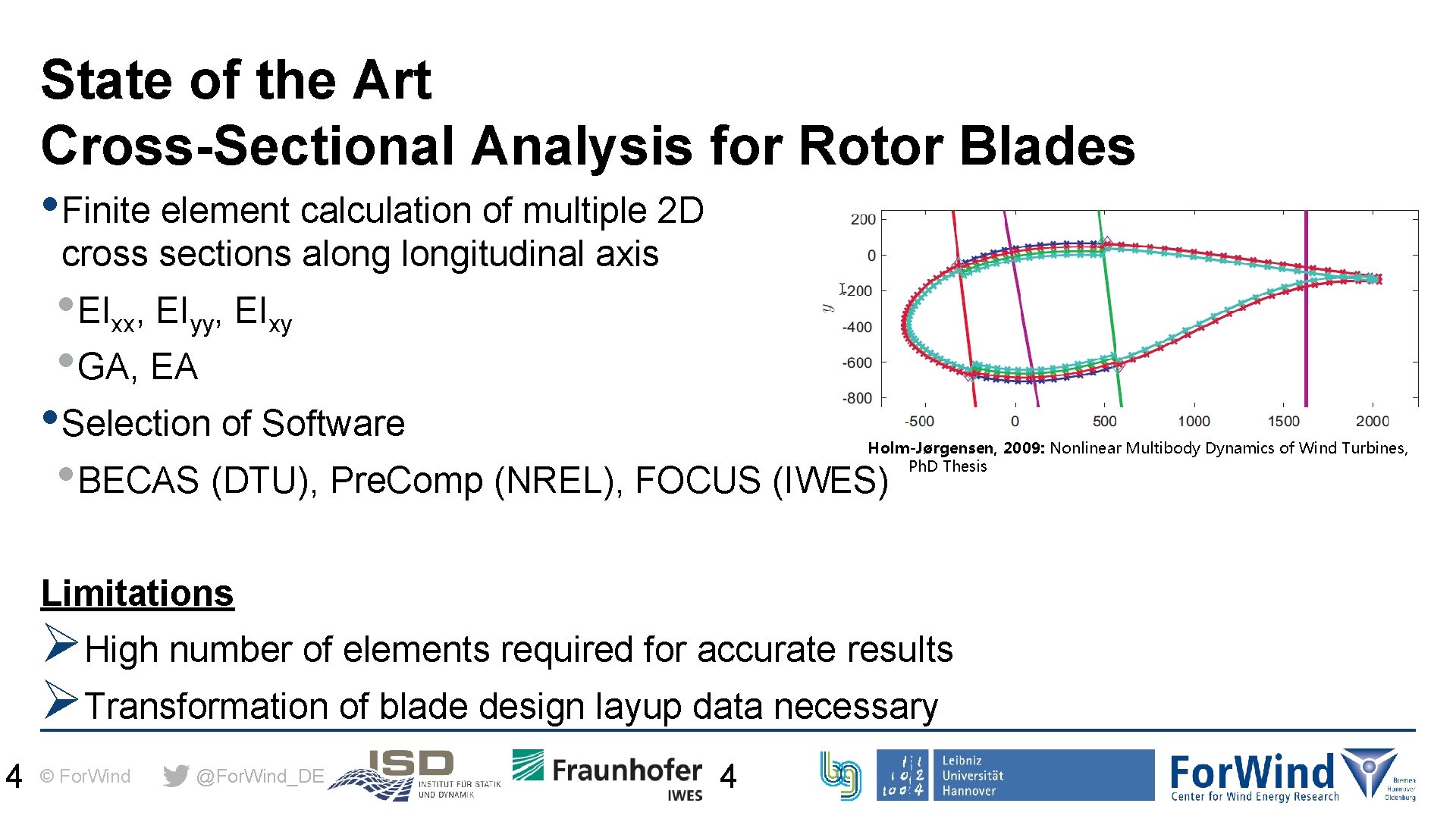
State of the Art Cross-Sectional Analysis for Rotor Blades • Finite element calculation of multiple 2 D cross sections alongitudinal axis • EIxx, EIyy, EIxy • GA, EA • Selection of Software • BECAS (DTU), Pre. Comp (NREL), FOCUS (IWES) Holm-Jørgensen, 2009: Nonlinear Multibody Dynamics of Wind Turbines, Ph. D Thesis Limitations ØHigh number of elements required for accurate results ØTransformation of blade design layup data necessary 4 © For. Wind @For. Wind_DE 4
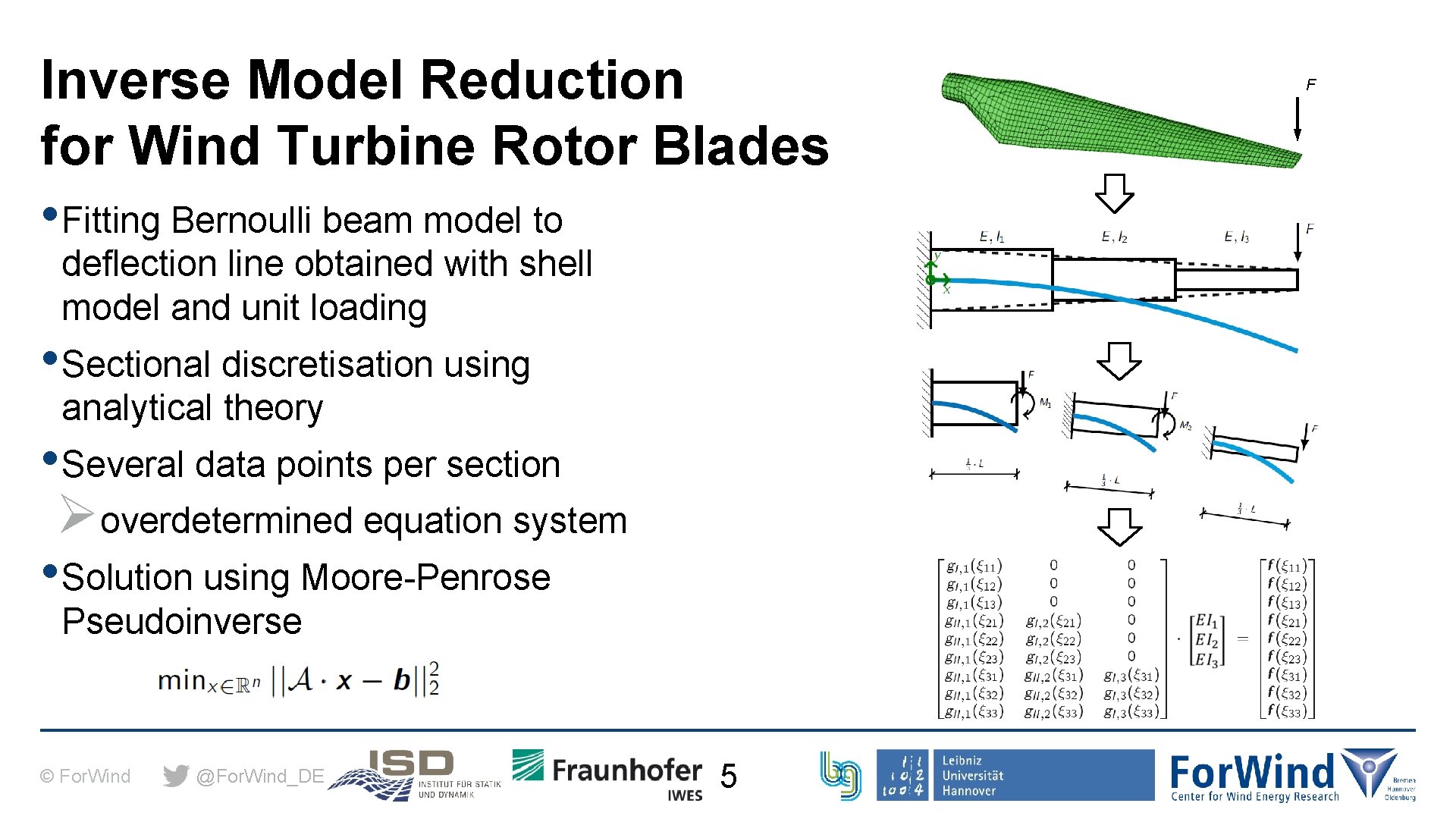
Inverse Model Reduction for Wind Turbine Rotor Blades • Fitting Bernoulli beam model to F deflection line obtained with shell model and unit loading • Sectional discretisation using analytical theory • Several data points per section Øoverdetermined equation system • Solution using Moore-Penrose Pseudoinverse © For. Wind @For. Wind_DE 5
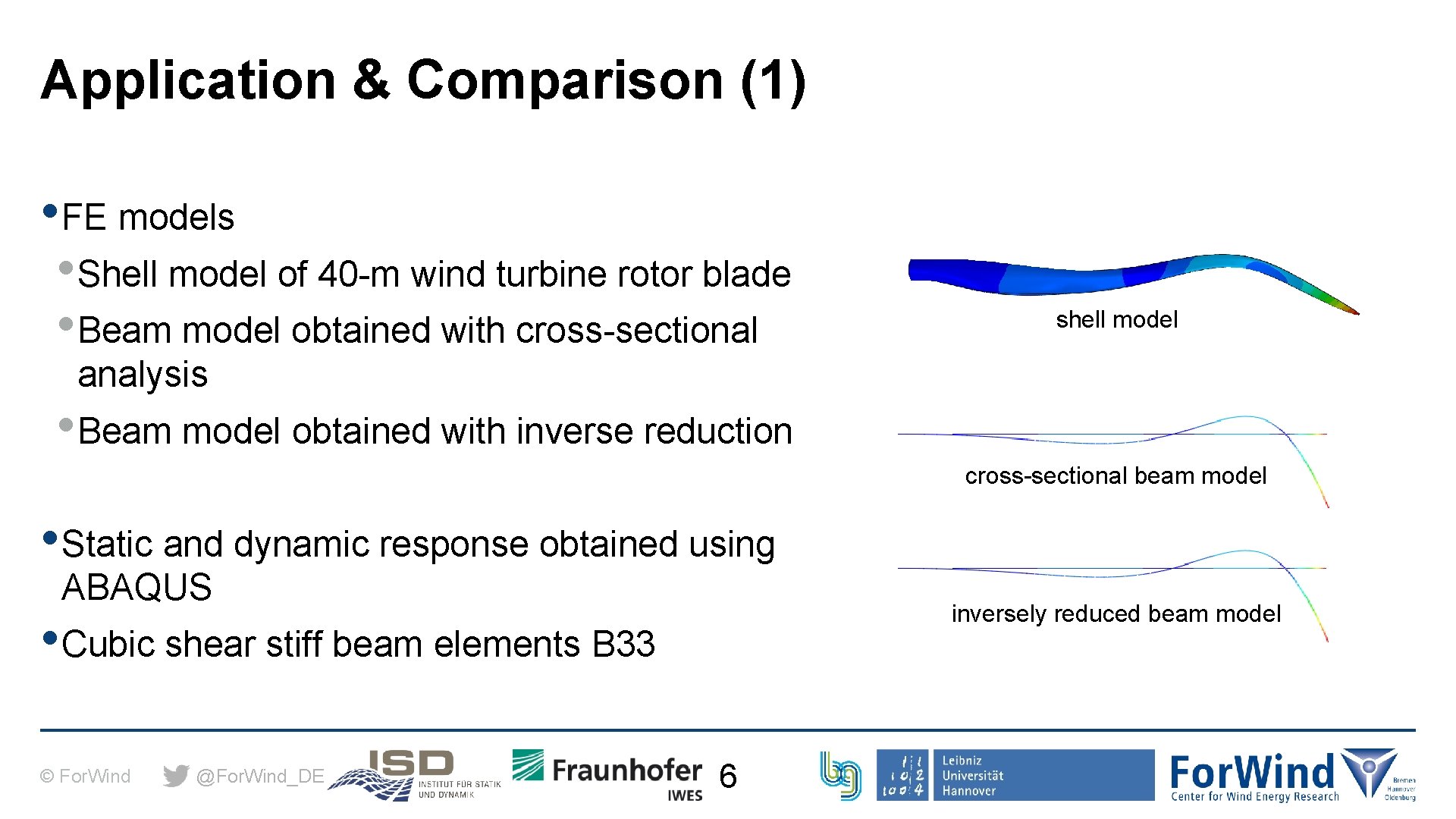
Application & Comparison (1) • FE models • Shell model of 40 -m wind turbine rotor blade • Beam model obtained with cross-sectional shell model analysis • Beam model obtained with inverse reduction cross-sectional beam model • Static and dynamic response obtained using ABAQUS inversely reduced beam model • Cubic shear stiff beam elements B 33 © For. Wind @For. Wind_DE 6
Application & Comparison (2) Static Behavior • Accurate static deflection curves • Obtained using curve fitting ØOften better match to shell model than cross-sectional approach • Cross-bending hard to identify © For. Wind @For. Wind_DE 7
Application & Comparison (3) Identified Stiffness Values • Very good match of both methods • Inverse model reduction may be used to verify cross-sectional calculation tools © For. Wind @For. Wind_DE 8
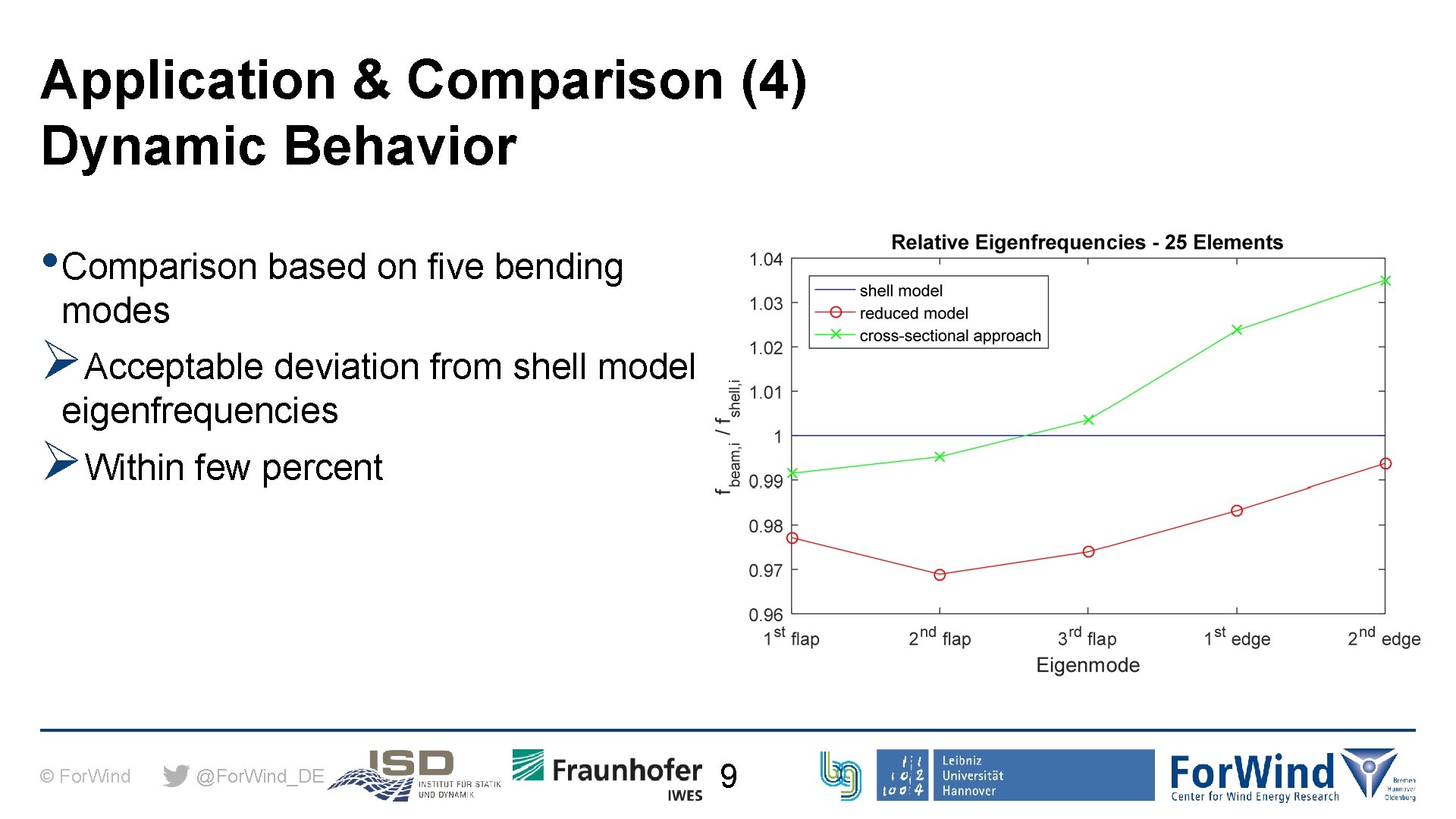
Application & Comparison (4) Dynamic Behavior • Comparison based on five bending modes ØAcceptable deviation from shell model eigenfrequencies ØWithin few percent © For. Wind @For. Wind_DE 9
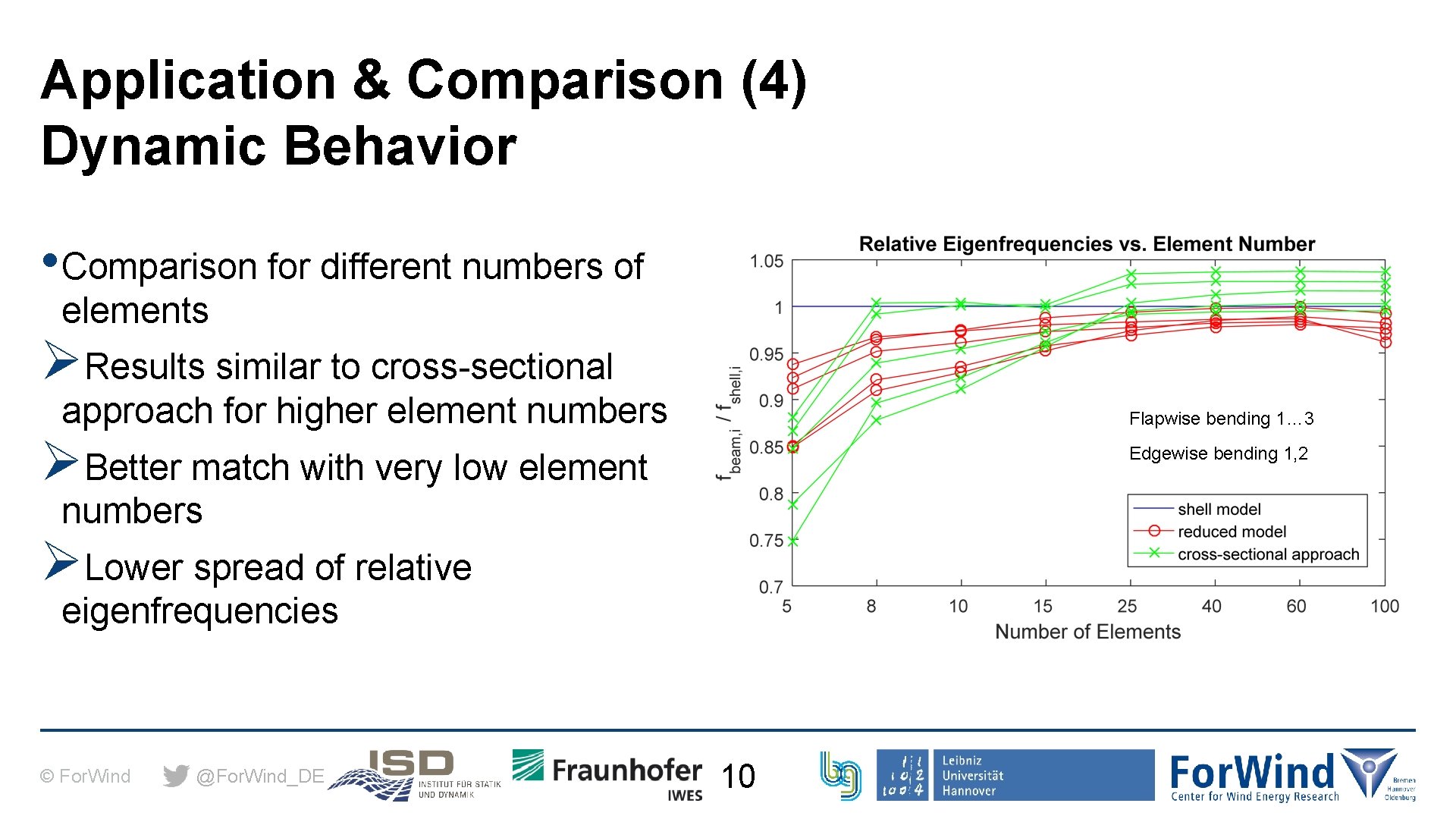
Application & Comparison (4) Dynamic Behavior • Comparison for different numbers of elements ØResults similar to cross-sectional approach for higher element numbers Flapwise bending 1… 3 ØBetter match with very low element Edgewise bending 1, 2 numbers ØLower spread of relative eigenfrequencies © For. Wind @For. Wind_DE 10
Summary • Inverse model reduction on basis of deflection curves ØReduction to very few elements possible ØPreservation of global static and dynamic behavior • Better fidelity than cross-sectional approach with low element counts ØPotential speedup for numerical models ØTransformation of blade design layup data can be avoided © For. Wind @For. Wind_DE 11
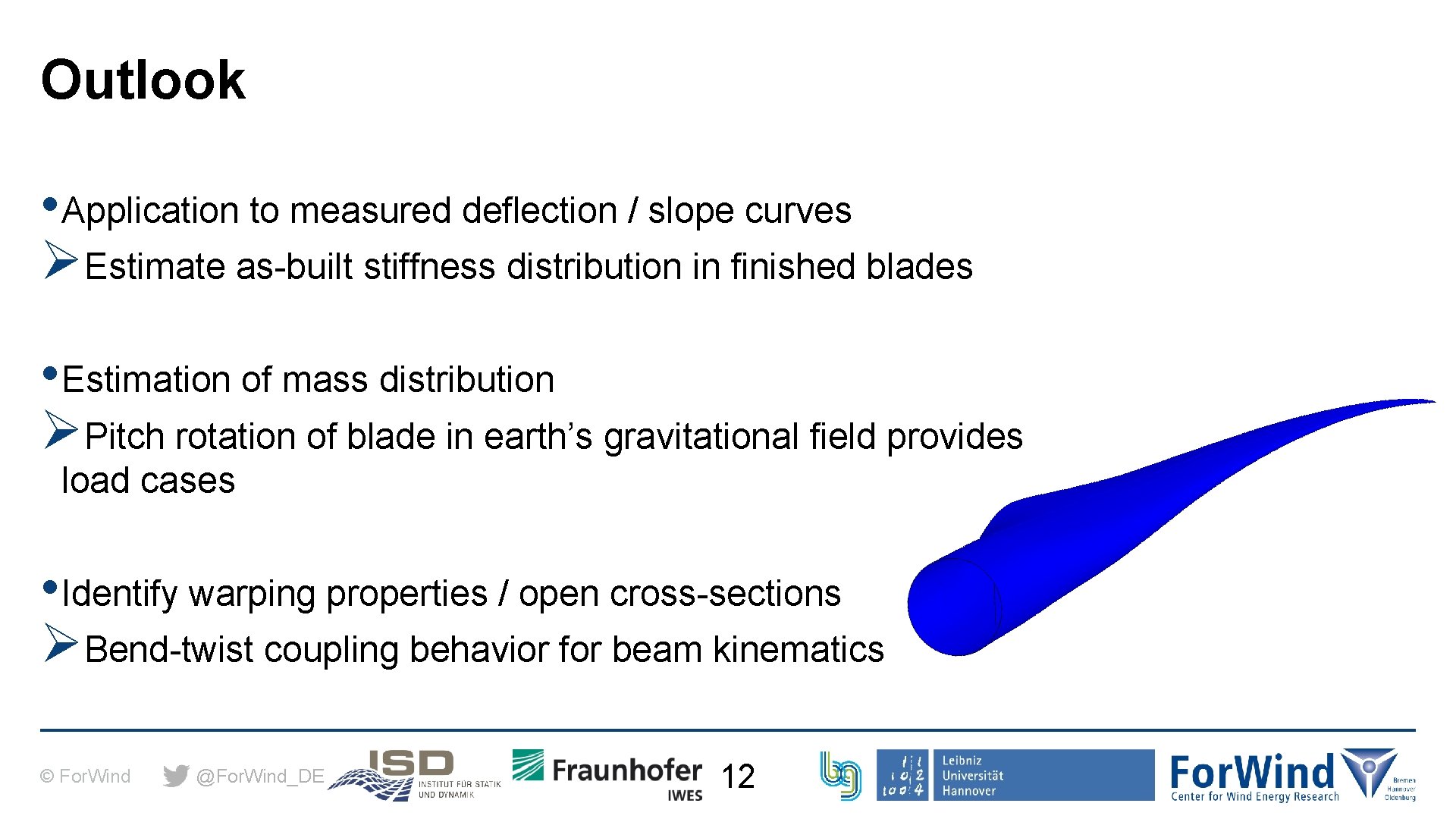
Outlook • Application to measured deflection / slope curves ØEstimate as-built stiffness distribution in finished blades • Estimation of mass distribution ØPitch rotation of blade in earth’s gravitational field provides load cases • Identify warping properties / open cross-sections ØBend-twist coupling behavior for beam kinematics © For. Wind @For. Wind_DE 12
Questions to you all • Anyone in audience interested in this method? ØDo you know someone who might be? ØResearch paper • Applicable in practice? • Further applications I did not think of? © For. Wind @For. Wind_DE 13
Thank you for your attention! © For. Wind @For. Wind_DE 14