
An Introductory Lecture to Environmental Epidemiology Part 4

- Slides: 15
An Introductory Lecture to Environmental Epidemiology Part 4. Some Issues in Exposure Assessment Mark S. Goldberg INRS-Institut Armand-Frappier, University of Quebec, and Mc. Gill University July 2000
• This lecture is a continuation of Part-3, and discusses some advanced methods for the assessment of exposure.
Biological Monitoring • Cellular, biological or molecular measures obtained from biological media (human tissues, cells, fluids) that are indicative of exposure (referred to as markers for exposure) – Exogenous substance – Metabolite – Interaction of xenobiotic substance and molecule
• Measures of dose – Temporal issues: • from current or previous exposures? • from integrated or point exposures? • Examples: – Exogenous agents (lead, asbestos, nicotine) – Metabolized chemicals (phenol, cotinine) – Endogenously produced (hydroxol radicals after ionizing radiation exposure)
– Molecular changes (benzoapyrene DNA adducts) – Cellular or tissue damage (sperm mobility) – Pulmonary response (challenge tests) – Skin response (chloracne after DDT exposure) – Gastrointestinal response (diarrhea) – Biological fluids (urinary cotinine after exposure to environmental tobacco smoke)
• Issues – Response rates – Poorly understood relationships between biomarkers and exposures and outcome – Cost, resources – Between and within person variability – Reference period for exposure
Improving on Exposure • Pharmacokinetic models – Used to calculate doses to target tissues from exposures • Pharmacodynamic models – Used to describe dynamic processes that relate doses and effects in tissues to ultimate health effects
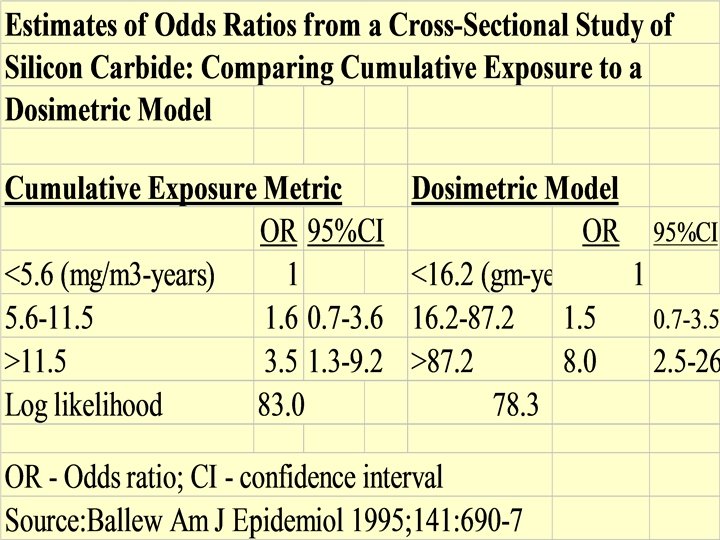
Example: Modelling Pulmonary Doses from Occupational Exposure to Silicon Carbide • Cross-sectional study of pulmonary function and radiographs for pulmonary pneumoconioses • Dust exposures assessed in detail by job • Lung clearance of dust efficient at low doses
• “Overload” occurs when clearance mechanisms become saturated – Lung dose is assumed to be proportional to cumulative exposure
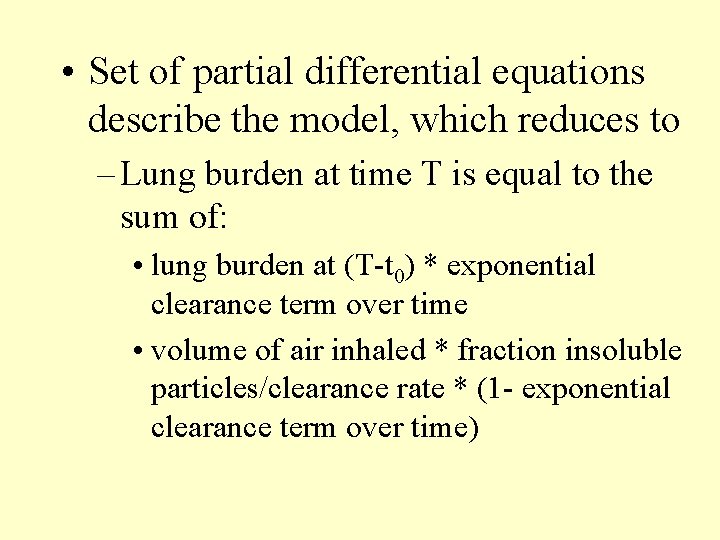
• Set of partial differential equations describe the model, which reduces to – Lung burden at time T is equal to the sum of: • lung burden at (T-t 0) * exponential clearance term over time • volume of air inhaled * fraction insoluble particles/clearance rate * (1 - exponential clearance term over time)
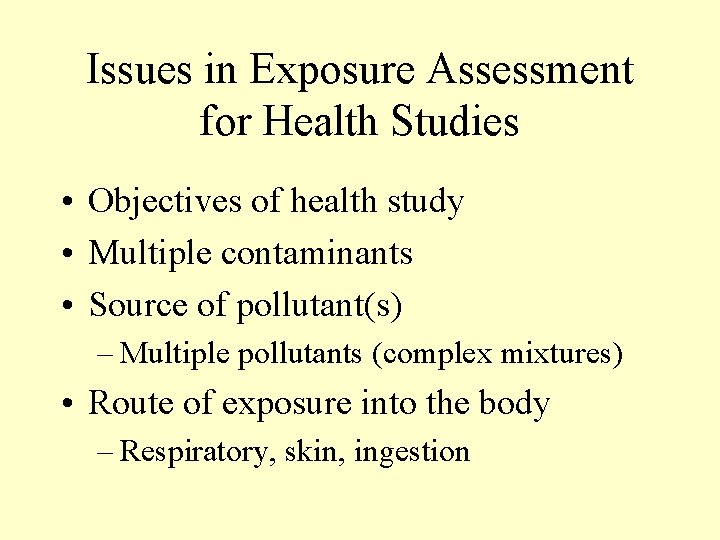
Issues in Exposure Assessment for Health Studies • Objectives of health study • Multiple contaminants • Source of pollutant(s) – Multiple pollutants (complex mixtures) • Route of exposure into the body – Respiratory, skin, ingestion
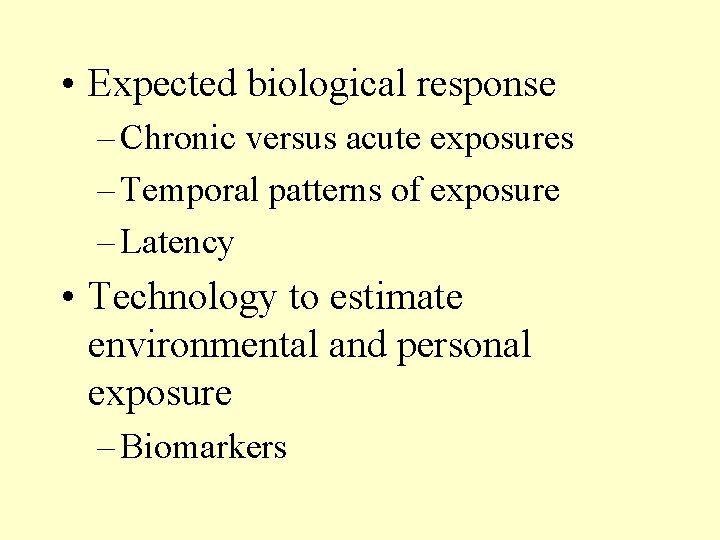
• Expected biological response – Chronic versus acute exposures – Temporal patterns of exposure – Latency • Technology to estimate environmental and personal exposure – Biomarkers
• Exposure misclassification – Spatial and temporal variability – Between-person variability within “exposure areas” • Sampling period in relation to expected biological effects • Frequency and intensity of exposure
• Reliability and validity of estimates – Validation and reliability sub-studies – Within-person variability for biological markers • Costs, resources • Expected response rates