
An Introductory Information about Optical Tweezers Mustafa Yorulmaz
An Introductory Information about Optical Tweezers Mustafa Yorulmaz Koç University, Material Science and Engineering February 20, 2008 Koç University, Material Science and Engineering
Outline n n n n History of optical tweezers Basics of optical tweezers Physics beyond optical trapping Types of optical tweezers Possible uses and research areas A typical setup of optical tweezers Illustrative examples from our laboratory February 20, 2008 Koç University, Material Science and Engineering 2
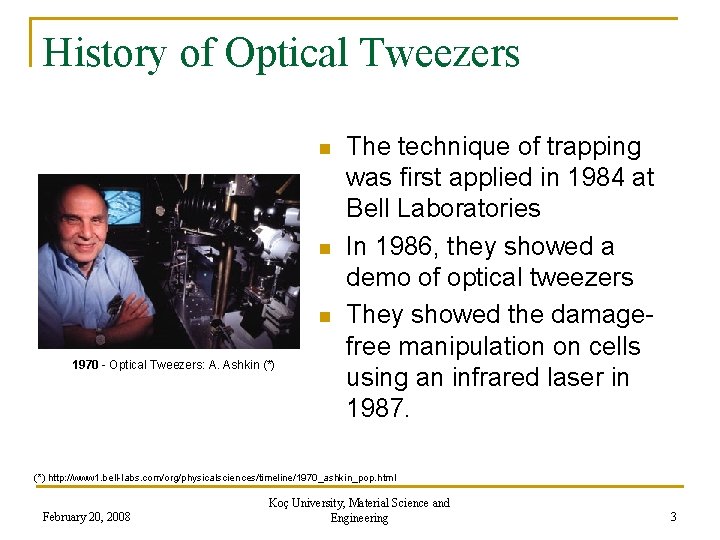
History of Optical Tweezers n n n 1970 - Optical Tweezers: A. Ashkin (*) The technique of trapping was first applied in 1984 at Bell Laboratories In 1986, they showed a demo of optical tweezers They showed the damagefree manipulation on cells using an infrared laser in 1987. (*) http: //www 1. bell-labs. com/org/physicalsciences/timeline/1970_ashkin_pop. html February 20, 2008 Koç University, Material Science and Engineering 3
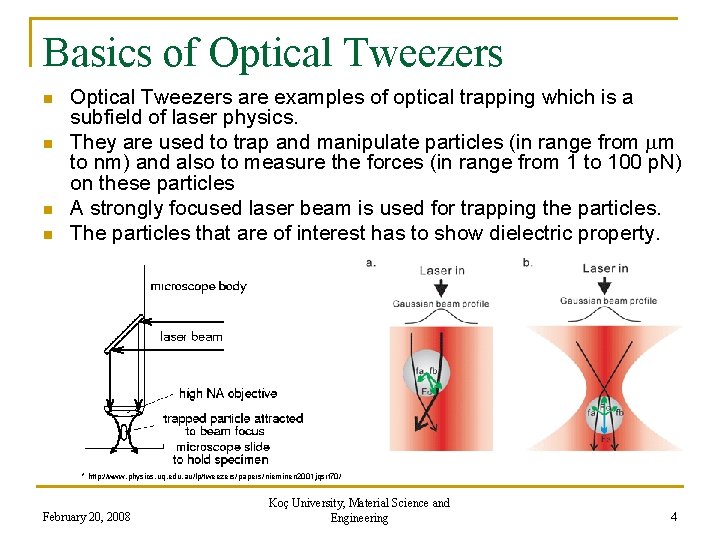
Basics of Optical Tweezers n n Optical Tweezers are examples of optical trapping which is a subfield of laser physics. They are used to trap and manipulate particles (in range from mm to nm) and also to measure the forces (in range from 1 to 100 p. N) on these particles A strongly focused laser beam is used for trapping the particles. The particles that are of interest has to show dielectric property. * http: //www. physics. uq. edu. au/lp/tweezers/papers/nieminen 2001 jqsrt 70/ February 20, 2008 Koç University, Material Science and Engineering 4
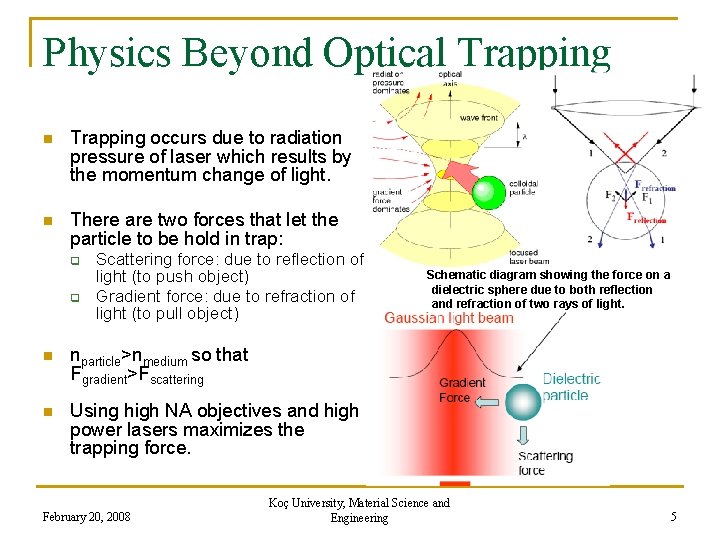
Physics Beyond Optical Trapping n Trapping occurs due to radiation pressure of laser which results by the momentum change of light. n There are two forces that let the particle to be hold in trap: q q Scattering force: due to reflection of light (to push object) Gradient force: due to refraction of light (to pull object) n nparticle>nmedium so that Fgradient>Fscattering n Using high NA objectives and high power lasers maximizes the trapping force. February 20, 2008 Schematic diagram showing the force on a dielectric sphere due to both reflection and refraction of two rays of light. Koç University, Material Science and Engineering 5
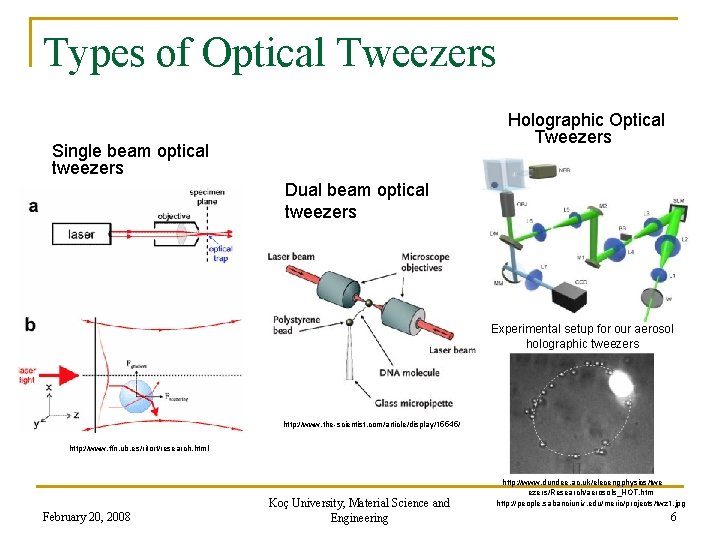
Types of Optical Tweezers Holographic Optical Tweezers Single beam optical tweezers Dual beam optical tweezers Experimental setup for our aerosol holographic tweezers http: //www. the-scientist. com/article/display/15545/ http: //www. ffn. ub. es/ritort/research. html February 20, 2008 Koç University, Material Science and Engineering http: //www. dundee. ac. uk/elecengphysics/twe ezers/Research/aerosols_HOT. htm http: //people. sabanciuniv. edu/meric/projects/twz 1. jpg 6
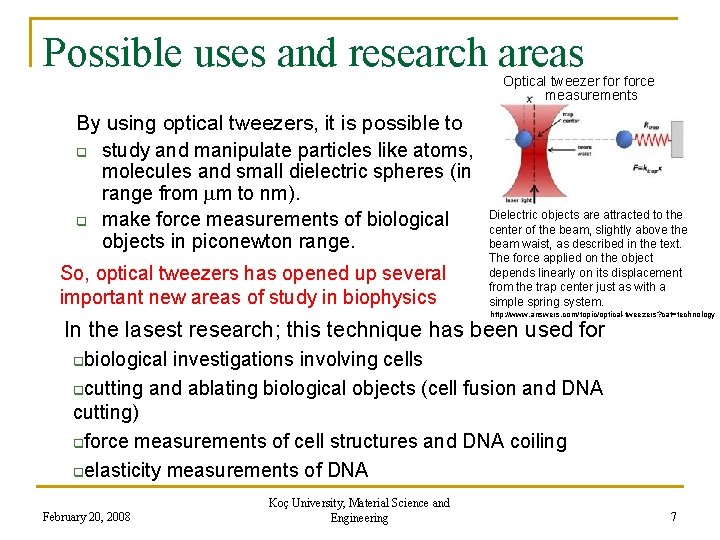
Possible uses and research areas Optical tweezer force measurements By using optical tweezers, it is possible to q study and manipulate particles like atoms, molecules and small dielectric spheres (in range from mm to nm). q make force measurements of biological objects in piconewton range. So, optical tweezers has opened up several important new areas of study in biophysics Dielectric objects are attracted to the center of the beam, slightly above the beam waist, as described in the text. The force applied on the object depends linearly on its displacement from the trap center just as with a simple spring system. http: //www. answers. com/topic/optical-tweezers? cat=technology In the lasest research; this technique has been used for biological investigations involving cells qcutting and ablating biological objects (cell fusion and DNA cutting) qforce measurements of cell structures and DNA coiling qelasticity measurements of DNA q February 20, 2008 Koç University, Material Science and Engineering 7
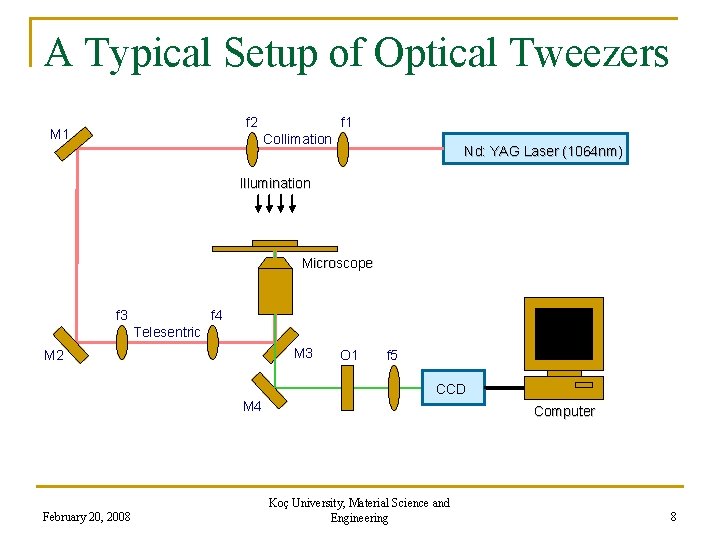
A Typical Setup of Optical Tweezers f 2 M 1 f 1 Collimation Nd: YAG Laser (1064 nm) Illumination Microscope f 3 f 4 Telesentric M 3 M 2 O 1 f 5 CCD M 4 February 20, 2008 Computer Koç University, Material Science and Engineering 8
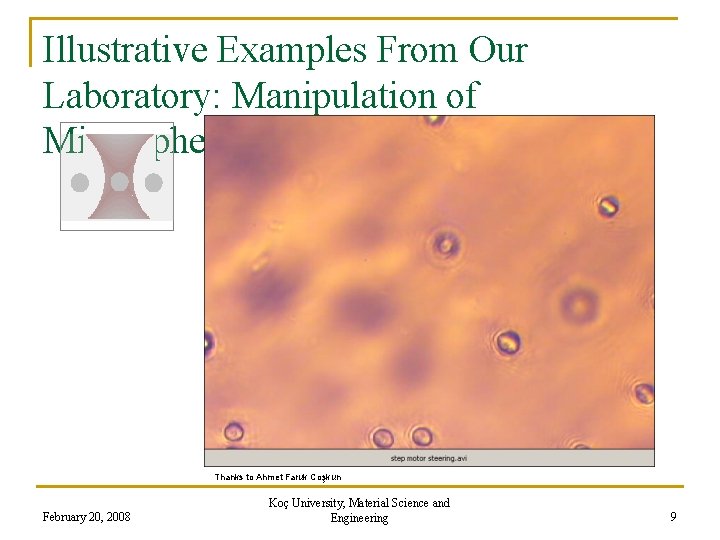
Illustrative Examples From Our Laboratory: Manipulation of Microspheres Thanks to Ahmet Faruk Coşkun February 20, 2008 Koç University, Material Science and Engineering 9
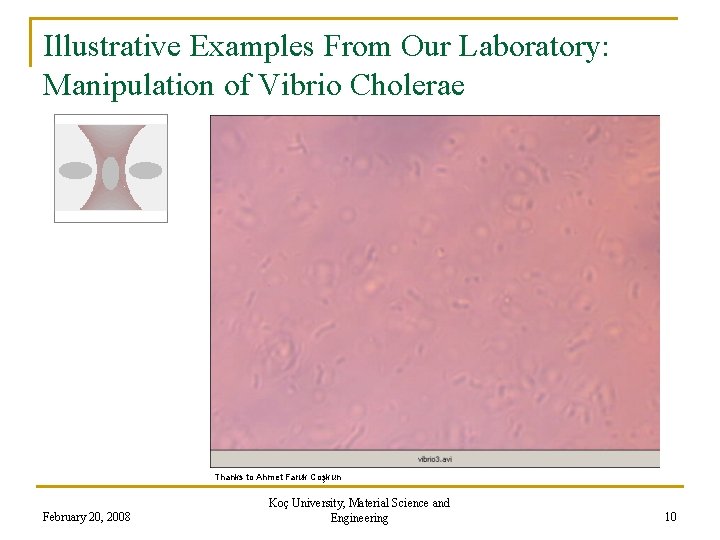
Illustrative Examples From Our Laboratory: Manipulation of Vibrio Cholerae Thanks to Ahmet Faruk Coşkun February 20, 2008 Koç University, Material Science and Engineering 10
Thanks. . n Questions? February 20, 2008 Koç University, Material Science and Engineering 11
- Slides: 11