
An introduction to Ultrasound and the Body Metrix
An introduction to Ultrasound and the Body. Metrix System Luiz Da Silva, Ph. D. Chief Technology Officer Intela. Metrix, Inc
Ultrasound technology • • Ultrasound imaging is used routinely in medicine and has a long history of safety and accuracy. Conventional Imaging is B-mode ultrasound. Body. Metrix is A-mode ultrasound, single “Beam”. Large volume of literature showing that ultrasound can be effective in measuring fat thickness and %BF. Beyond %BF ultrasound can be used to measure muscle thickness and “quality”. The Lancet - 12/17/03
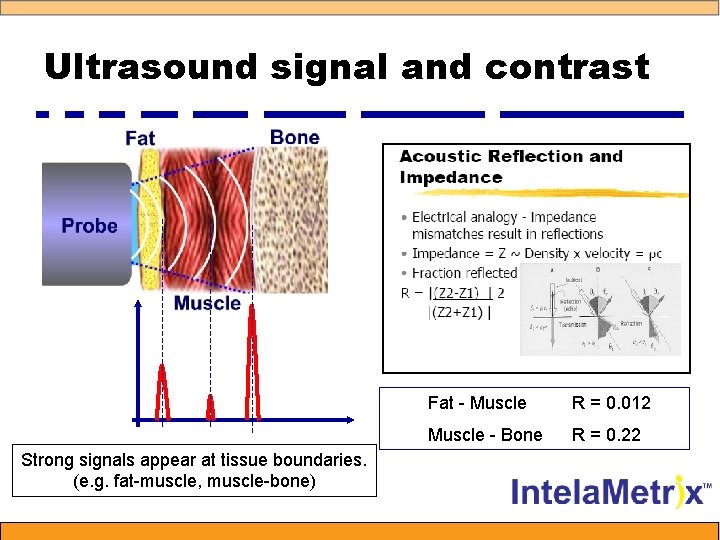
Ultrasound signal and contrast Strong signals appear at tissue boundaries. (e. g. fat-muscle, muscle-bone) Fat - Muscle R = 0. 012 Muscle - Bone R = 0. 22
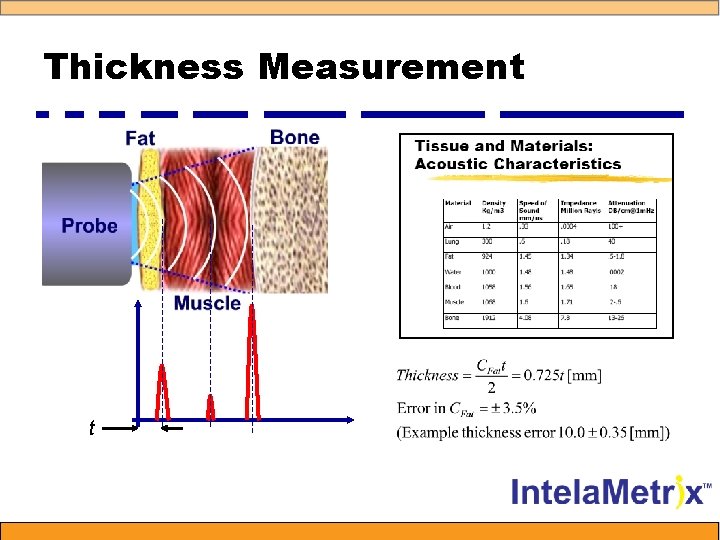
Thickness Measurement t
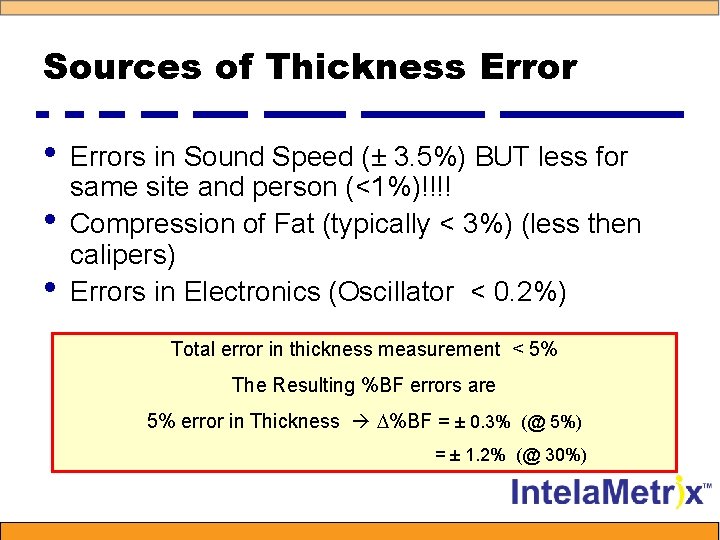
Sources of Thickness Error • • • Errors in Sound Speed (± 3. 5%) BUT less for same site and person (<1%)!!!! Compression of Fat (typically < 3%) (less then calipers) Errors in Electronics (Oscillator < 0. 2%) Total error in thickness measurement < 5% The Resulting %BF errors are 5% error in Thickness %BF = ± 0. 3% (@ 5%) = ± 1. 2% (@ 30%)
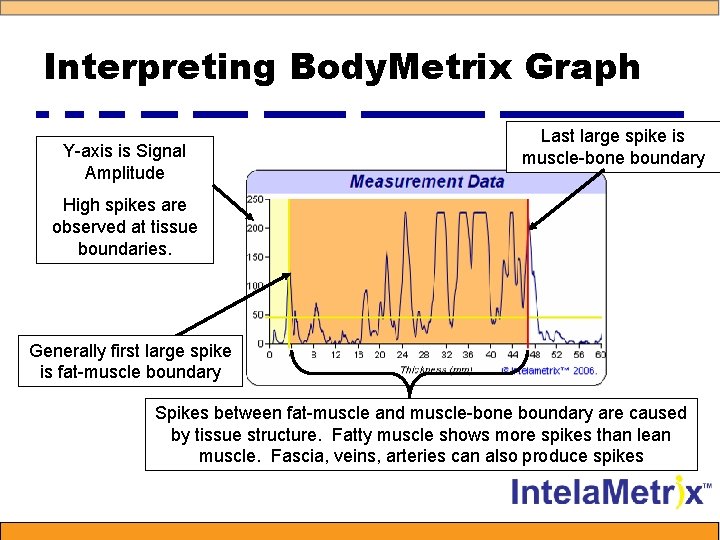
Interpreting Body. Metrix Graph Y-axis is Signal Amplitude Last large spike is muscle-bone boundary High spikes are observed at tissue boundaries. Generally first large spike is fat-muscle boundary Spikes between fat-muscle and muscle-bone boundary are caused by tissue structure. Fatty muscle shows more spikes than lean muscle. Fascia, veins, arteries can also produce spikes
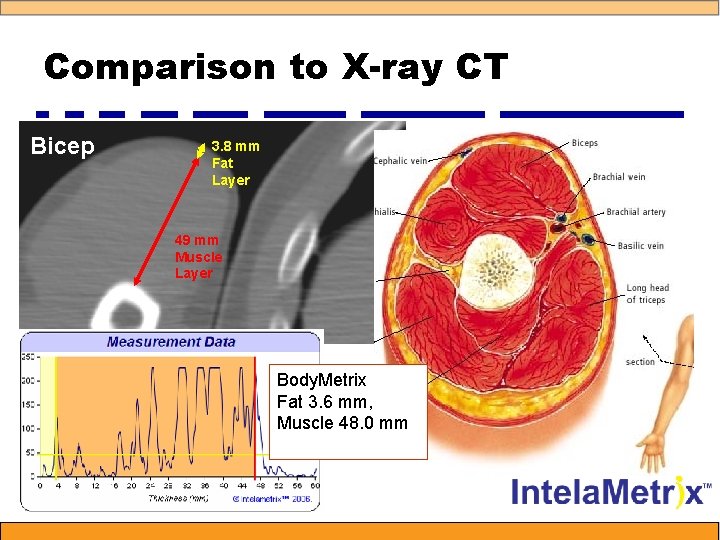
Comparison to X-ray CT Bicep 3. 8 mm Fat Layer 49 mm Muscle Layer Body. Metrix Fat 3. 6 mm, Muscle 48. 0 mm
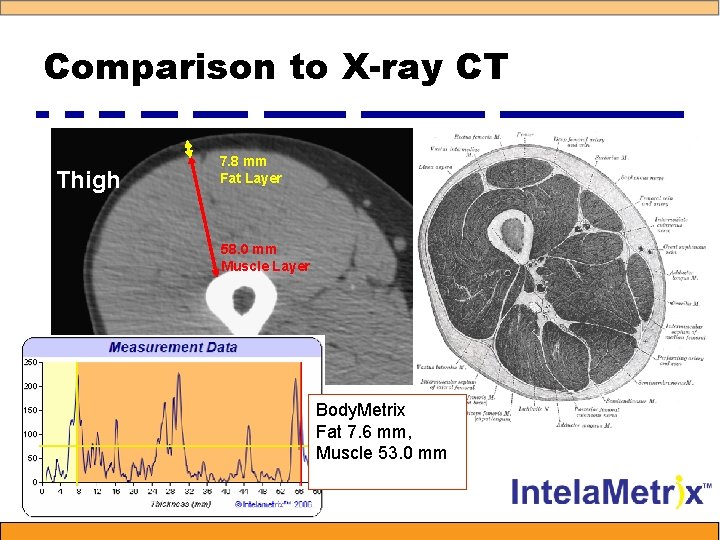
Comparison to X-ray CT Thigh 7. 8 mm Fat Layer 58. 0 mm Muscle Layer Body. Metrix Fat 7. 6 mm, Muscle 53. 0 mm
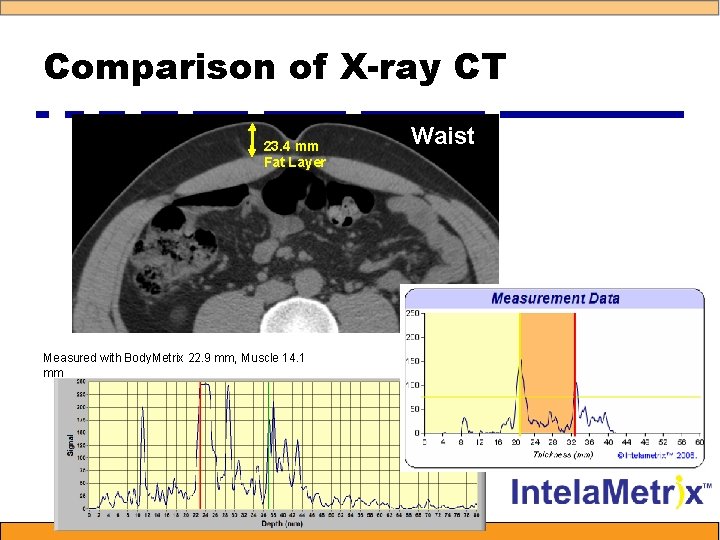
Comparison of X-ray CT 23. 4 mm Fat Layer Measured with Body. Metrix 22. 9 mm, Muscle 14. 1 mm Waist
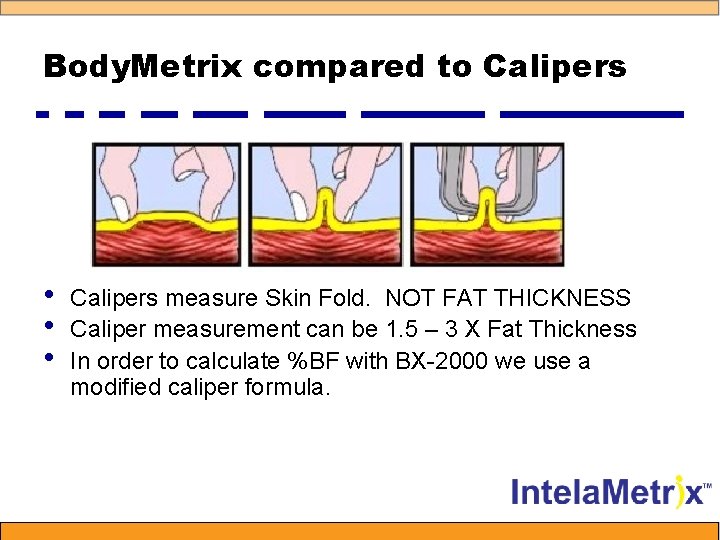
Body. Metrix compared to Calipers • • • Calipers measure Skin Fold. NOT FAT THICKNESS Caliper measurement can be 1. 5 – 3 X Fat Thickness In order to calculate %BF with BX-2000 we use a modified caliper formula.
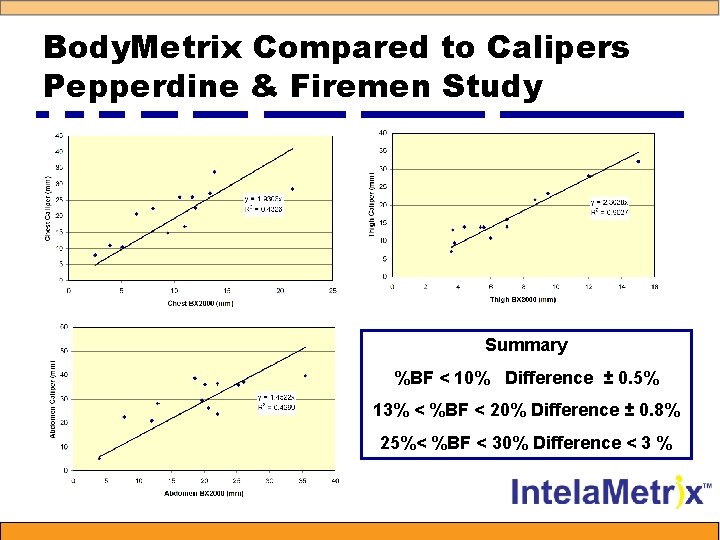
Body. Metrix Compared to Calipers Pepperdine & Firemen Study Summary %BF < 10% Difference ± 0. 5% 13% < %BF < 20% Difference ± 0. 8% 25%< %BF < 30% Difference < 3 %
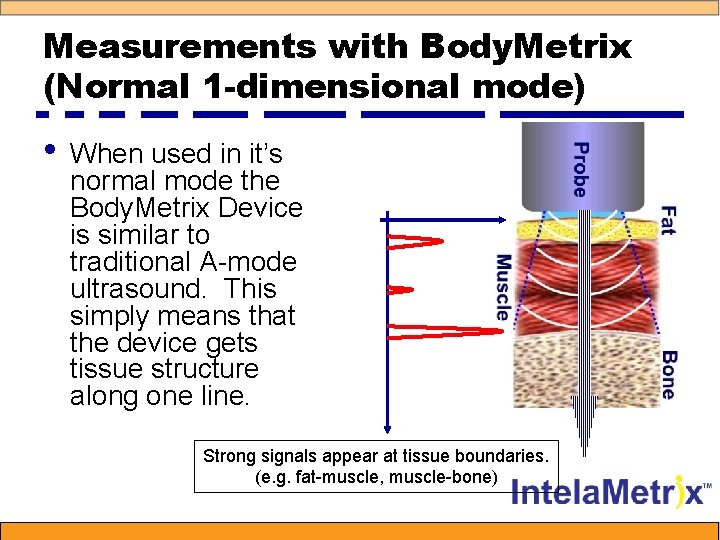
Measurements with Body. Metrix (Normal 1 -dimensional mode) • When used in it’s normal mode the Body. Metrix Device is similar to traditional A-mode ultrasound. This simply means that the device gets tissue structure along one line. Strong signals appear at tissue boundaries. (e. g. fat-muscle, muscle-bone)
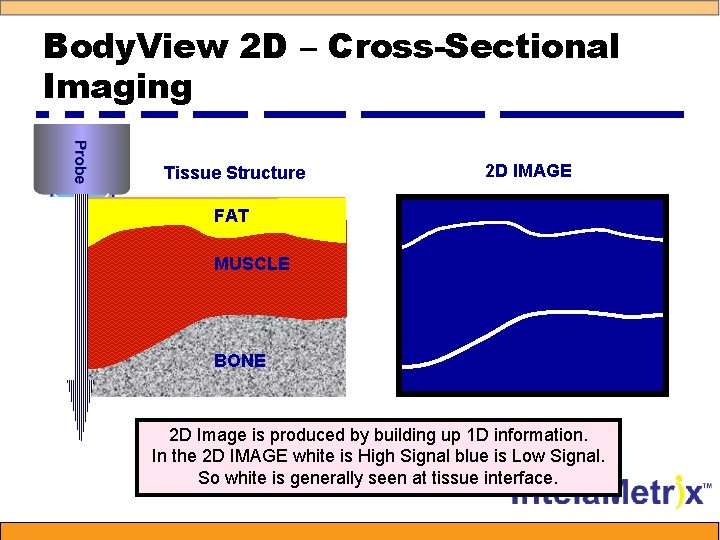
Body. View 2 D – Cross-Sectional Imaging Tissue Structure 2 D IMAGE FAT MUSCLE BONE 2 D Image is produced by building up 1 D information. In the 2 D IMAGE white is High Signal blue is Low Signal. So white is generally seen at tissue interface.
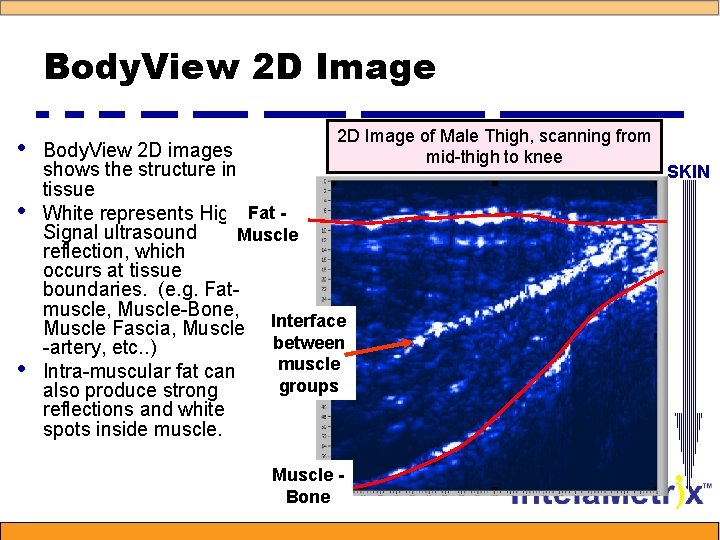
Body. View 2 D Image • • • 2 D Image of Male Thigh, scanning from mid-thigh to knee Body. View 2 D images shows the structure in tissue White represents High Fat Signal ultrasound Muscle reflection, which occurs at tissue boundaries. (e. g. Fatmuscle, Muscle-Bone, Muscle Fascia, Muscle Interface between -artery, etc. . ) muscle Intra-muscular fat can groups also produce strong reflections and white spots inside muscle. Muscle Bone SKIN
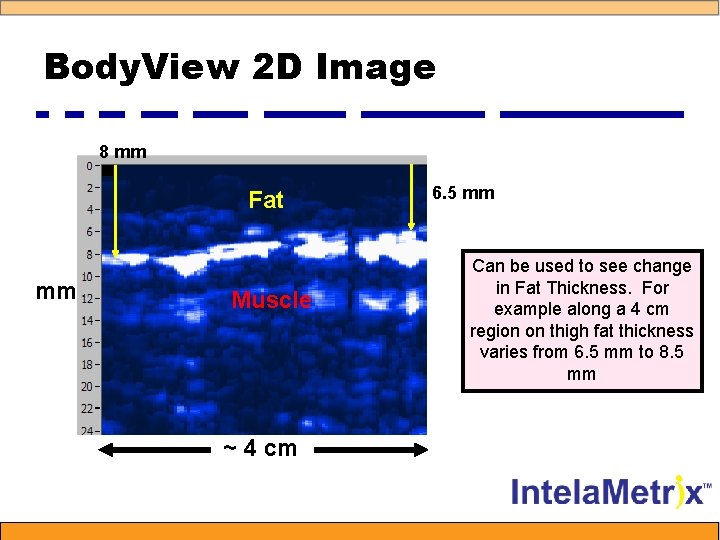
Body. View 2 D Image 8 mm Fat mm Muscle ~ 4 cm 6. 5 mm Can be used to see change in Fat Thickness. For example along a 4 cm region on thigh fat thickness varies from 6. 5 mm to 8. 5 mm
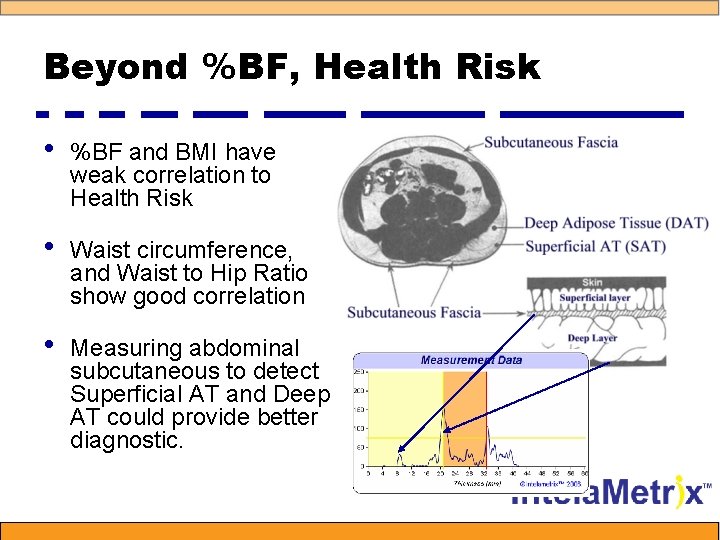
Beyond %BF, Health Risk • %BF and BMI have weak correlation to Health Risk • Waist circumference, and Waist to Hip Ratio show good correlation • Measuring abdominal subcutaneous to detect Superficial AT and Deep AT could provide better diagnostic.
Validation Studies • Studies performed at Pepperdine • University and Appalachian State University have shown the BX 2000 ultrasound measurements to be accurate when compared to Hydrostatic and Bod. Pod measurement. Ultrasound has the unique potential to evaluate fat-muscle structure and muscle quality.
- Slides: 17