
An Introduction to Treasury Management Topics covered Legal

- Slides: 39
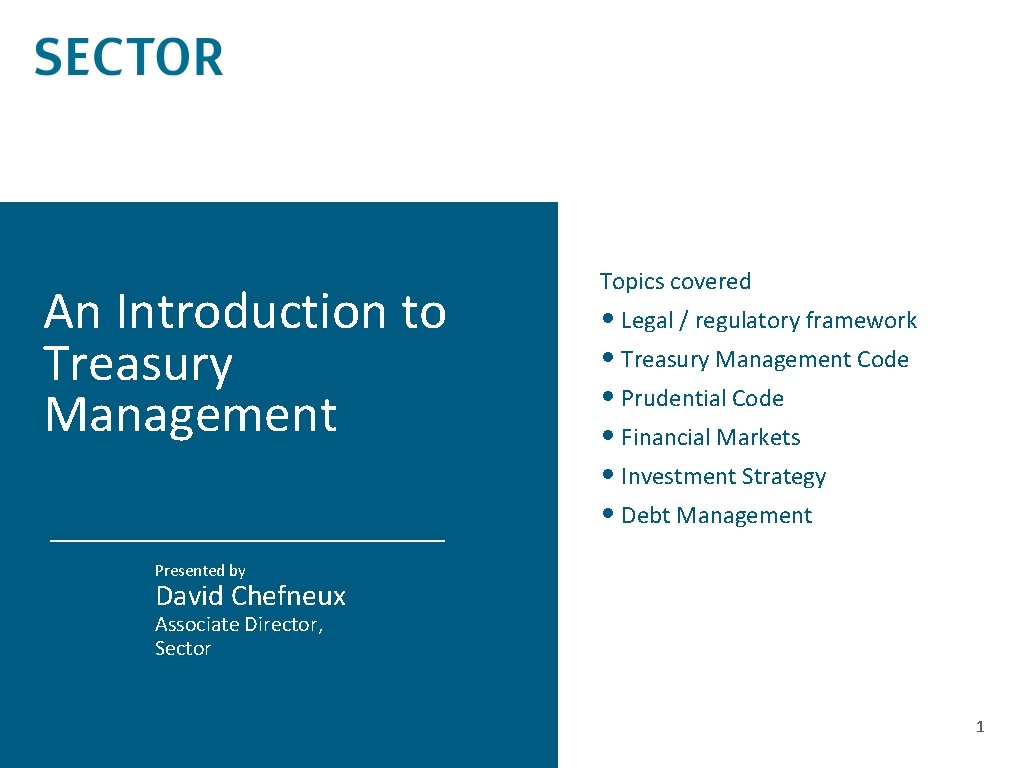
An Introduction to Treasury Management Topics covered • Legal / regulatory framework • Treasury Management Code • Prudential Code • Financial Markets • Investment Strategy • Debt Management Presented by David Chefneux Associate Director, Sector 1
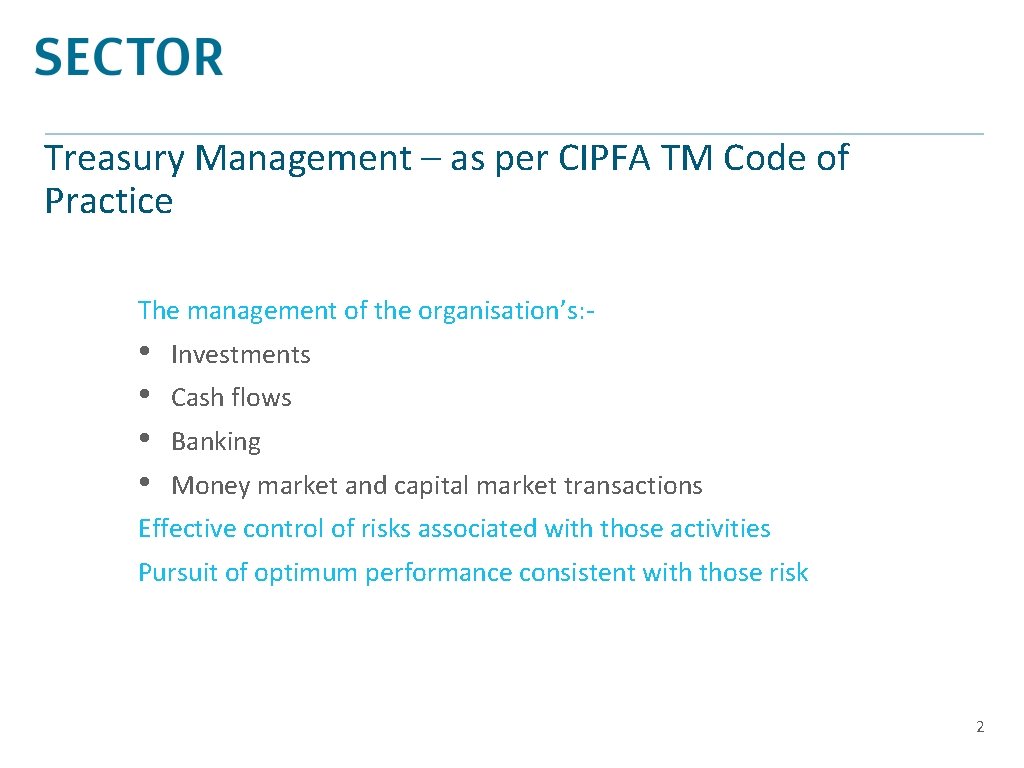
Treasury Management – as per CIPFA TM Code of Practice The management of the organisation’s: - • • Investments Cash flows Banking Money market and capital market transactions Effective control of risks associated with those activities Pursuit of optimum performance consistent with those risk 2
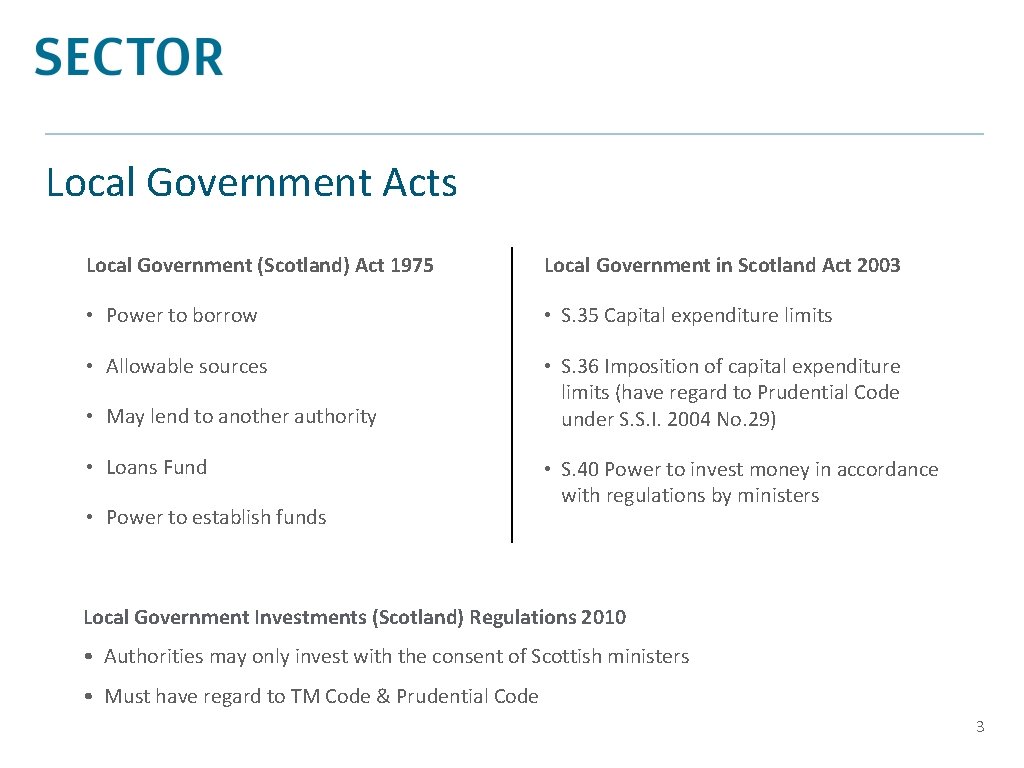
Local Government Acts Local Government (Scotland) Act 1975 Local Government in Scotland Act 2003 • Power to borrow • S. 35 Capital expenditure limits • Allowable sources • S. 36 Imposition of capital expenditure limits (have regard to Prudential Code under S. S. I. 2004 No. 29) • May lend to another authority • Loans Fund • Power to establish funds • S. 40 Power to invest money in accordance with regulations by ministers Local Government Investments (Scotland) Regulations 2010 • Authorities may only invest with the consent of Scottish ministers • Must have regard to TM Code & Prudential Code 3
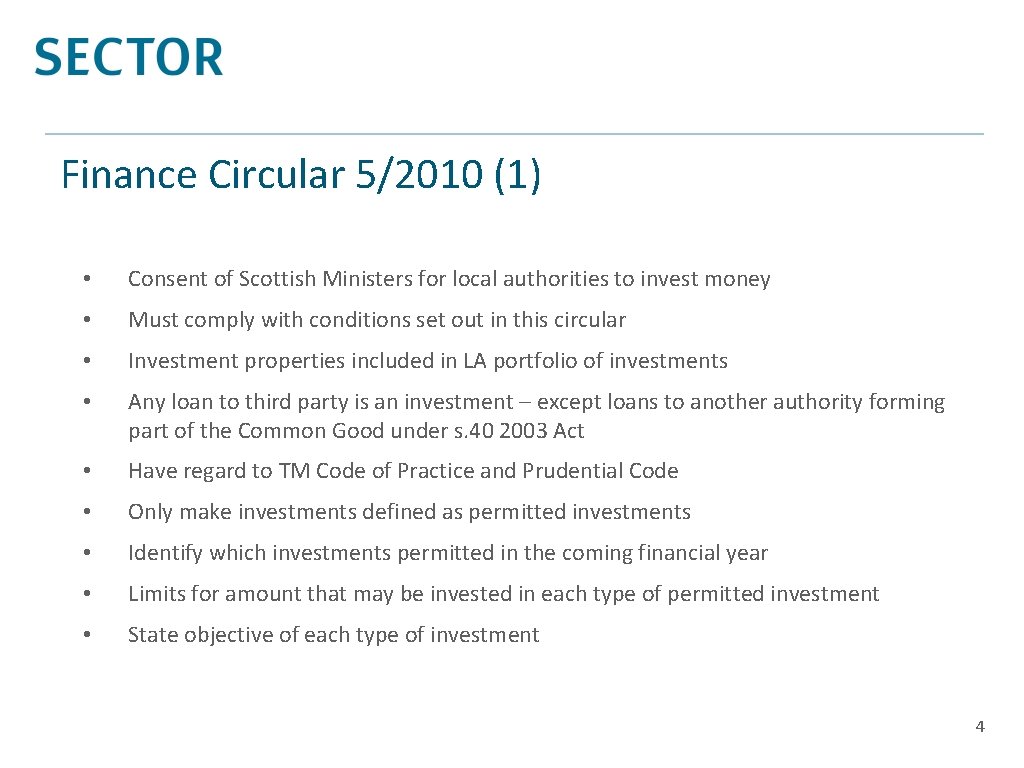
Finance Circular 5/2010 (1) • Consent of Scottish Ministers for local authorities to invest money • Must comply with conditions set out in this circular • Investment properties included in LA portfolio of investments • Any loan to third party is an investment – except loans to another authority forming part of the Common Good under s. 40 2003 Act • Have regard to TM Code of Practice and Prudential Code • Only make investments defined as permitted investments • Identify which investments permitted in the coming financial year • Limits for amount that may be invested in each type of permitted investment • State objective of each type of investment 4
Finance Circular 5/2010 (2) • Identify risks for each type of investment • Annual Investment Strategy for each year –approved by full board or Council before the start of each financial year • Recommend Investment strategy part of wider TM strategy • Max value and period for investments • Must not borrow more in advance of needs to make a profit • Policy for borrowing in advance of need and justification for any taken • Annual Investment Report within 6 months of end of year 5
CIPFA Treasury Management Code Why? • High profile losses of investments with banks that defaulted in 1990 s • Breakdown of confidence between City financial institutions and local authorities • Inappropriate increase in risk exposure • Maintain high and consistent standards in looking after public funds and debt • Large cash balances held by local authorities and new investment instruments 6
CIPFA Treasury Management Code – three key principles 1. Formal and comprehensive objectives, policies, practices, strategies, & reporting arrangements for effective management and control of TM activities 2. Control of risk: security, liquidity, yield 3. Value for money within context of effective risk management 7
CIPFA Treasury Management Code – Clause 1 Treasury Management Practices • Working documents for officers • How policies and objectives in the Treasury Management Policy Statement will be achieved • How it will manage and control those activities • Do not have to be formally approved by Council but subject to scrutiny 8
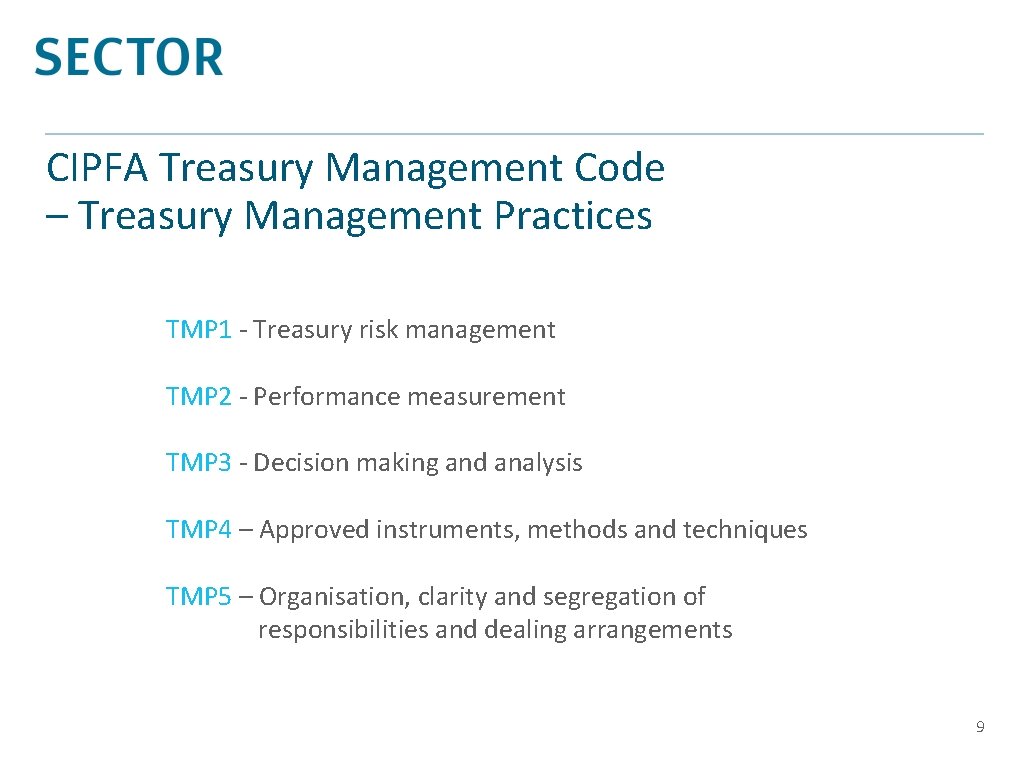
CIPFA Treasury Management Code – Treasury Management Practices TMP 1 - Treasury risk management TMP 2 - Performance measurement TMP 3 - Decision making and analysis TMP 4 – Approved instruments, methods and techniques TMP 5 – Organisation, clarity and segregation of responsibilities and dealing arrangements 9
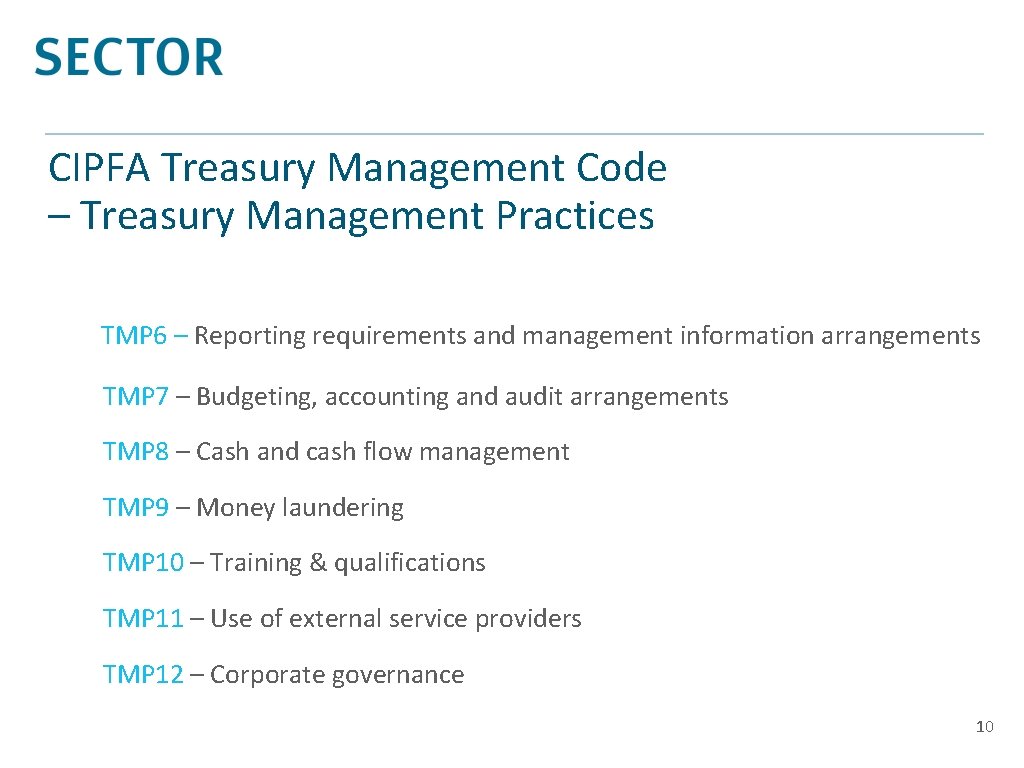
CIPFA Treasury Management Code – Treasury Management Practices TMP 6 – Reporting requirements and management information arrangements TMP 7 – Budgeting, accounting and audit arrangements TMP 8 – Cash and cash flow management TMP 9 – Money laundering TMP 10 – Training & qualifications TMP 11 – Use of external service providers TMP 12 – Corporate governance 10
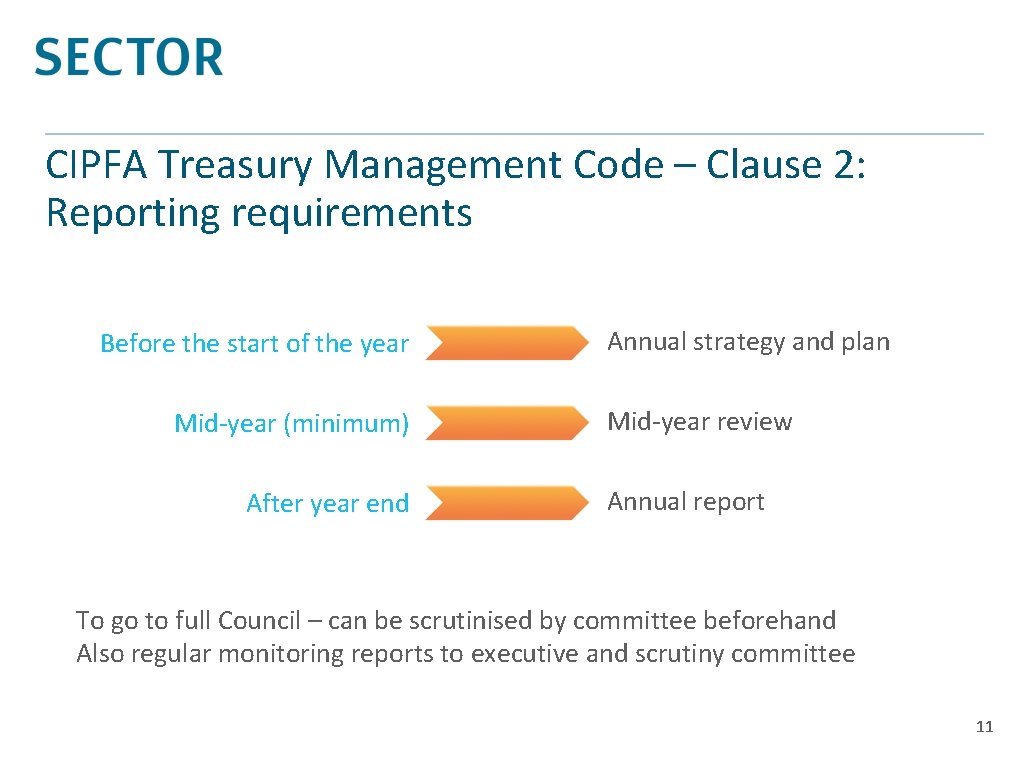
CIPFA Treasury Management Code – Clause 2: Reporting requirements Before the start of the year Mid-year (minimum) After year end Annual strategy and plan Mid-year review Annual report To go to full Council – can be scrutinised by committee beforehand Also regular monitoring reports to executive and scrutiny committee 11
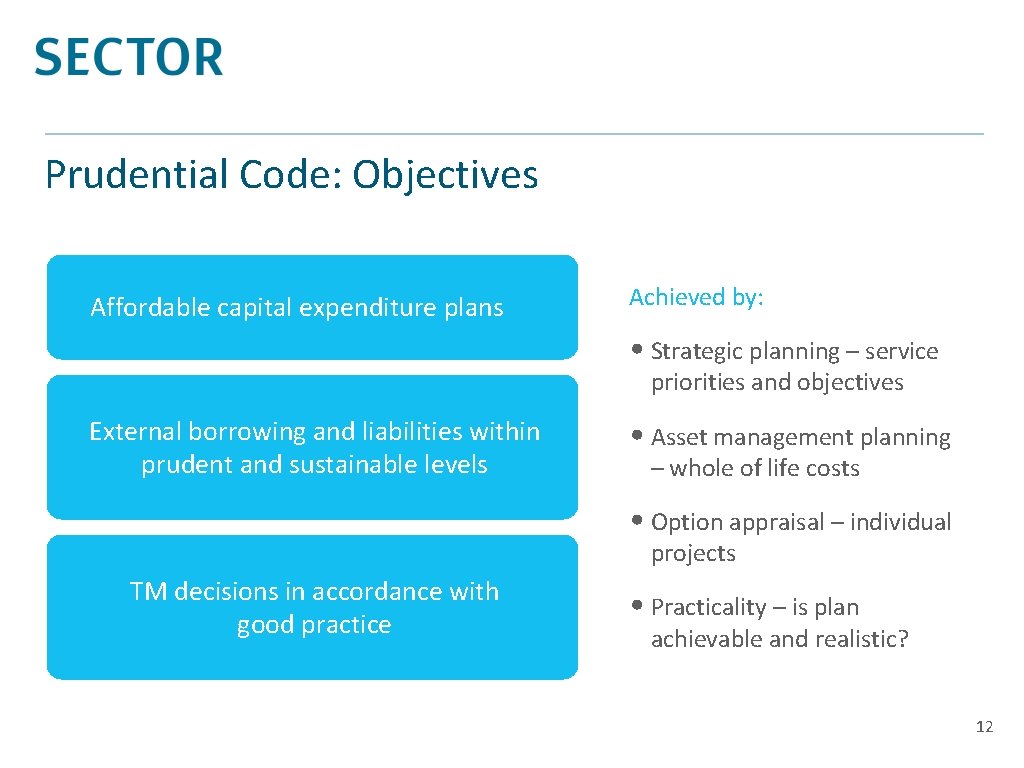
Prudential Code: Objectives Affordable capital expenditure plans Achieved by: • Strategic planning – service priorities and objectives External borrowing and liabilities within prudent and sustainable levels • Asset management planning – whole of life costs • Option appraisal – individual projects TM decisions in accordance with good practice • Practicality – is plan achievable and realistic? 12
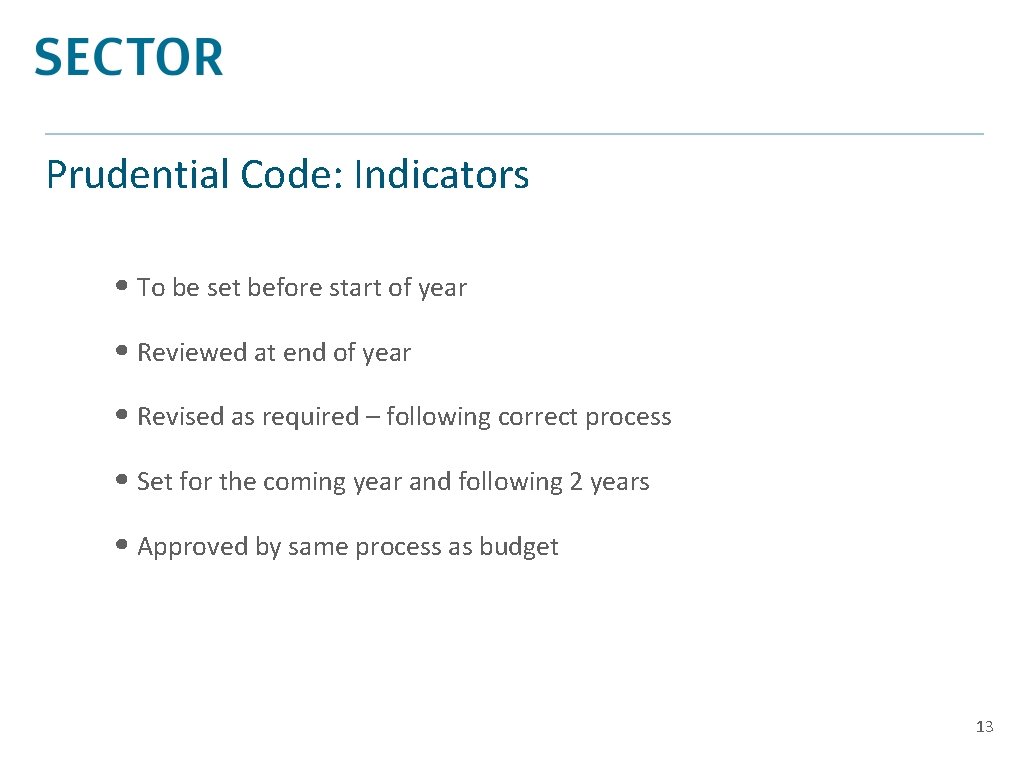
Prudential Code: Indicators • To be set before start of year • Reviewed at end of year • Revised as required – following correct process • Set for the coming year and following 2 years • Approved by same process as budget 13
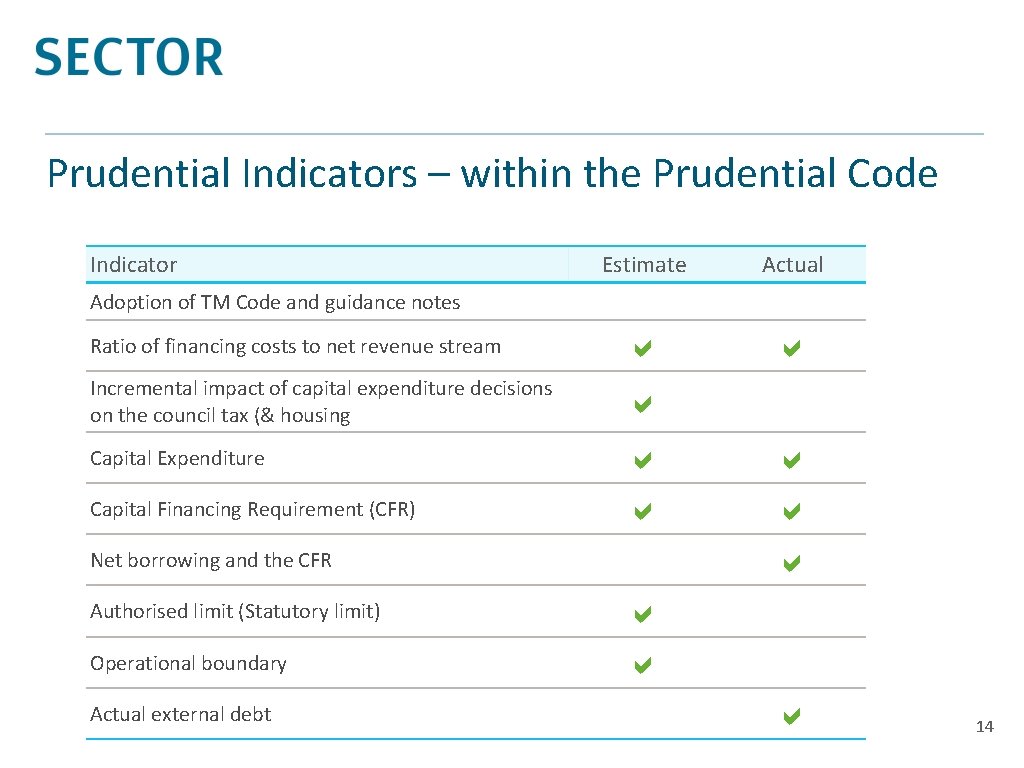
Prudential Indicators – within the Prudential Code Indicator Estimate Actual Ratio of financing costs to net revenue stream a a Incremental impact of capital expenditure decisions on the council tax (& housing a Capital Expenditure a a Adoption of TM Code and guidance notes Capital Financing Requirement (CFR) Net borrowing and the CFR Authorised limit (Statutory limit) Operational boundary Actual external debt a a a 14
Financial Markets 15
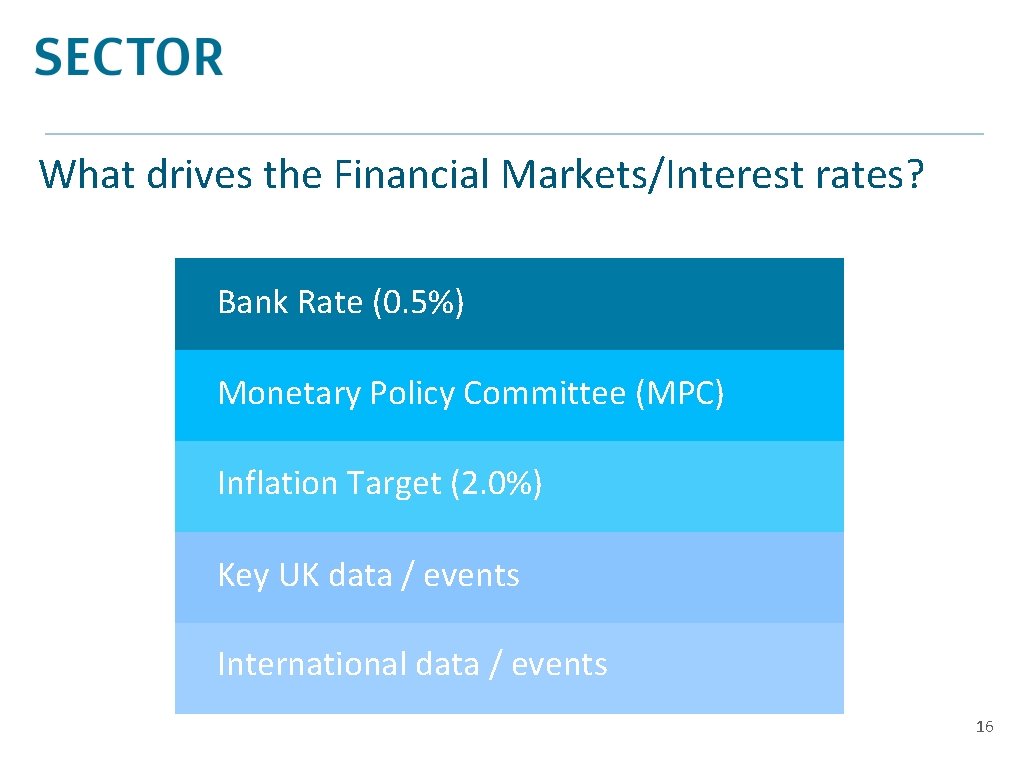
What drives the Financial Markets/Interest rates? Bank Rate (0. 5%) Monetary Policy Committee (MPC) Inflation Target (2. 0%) Key UK data / events International data / events 16
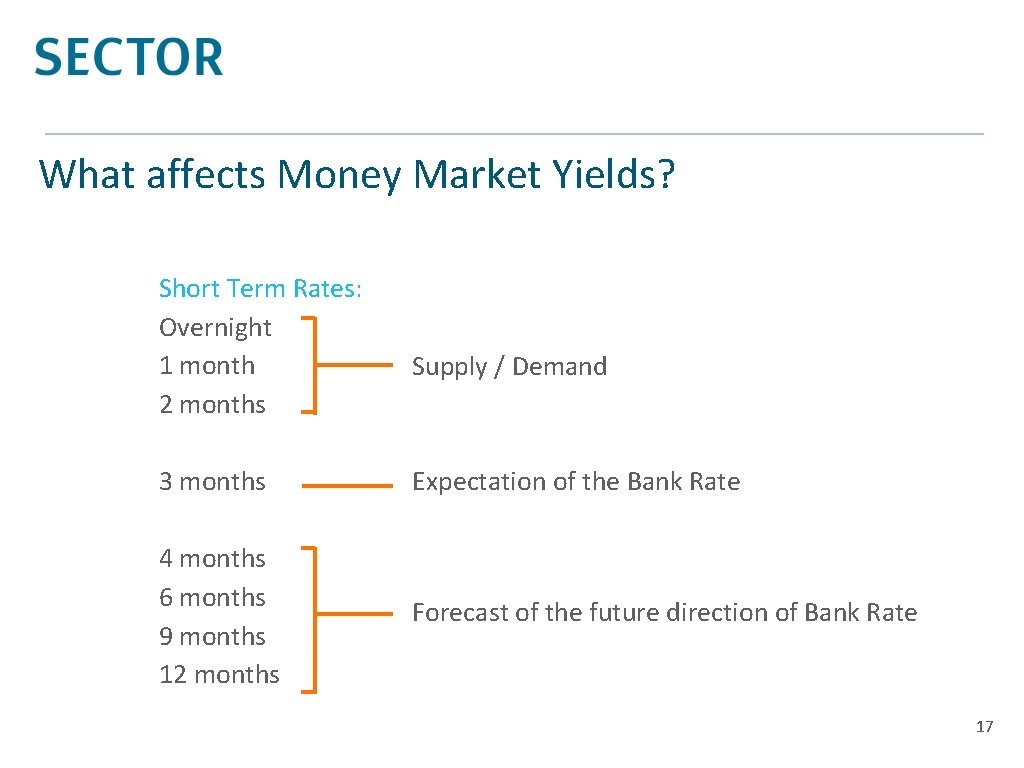
What affects Money Market Yields? Short Term Rates: Overnight 1 month 2 months Supply / Demand High 3 months Expectation of the Bank Rate 4 months 6 months 9 months 12 months Forecast Low of the future direction of Bank Rate 17
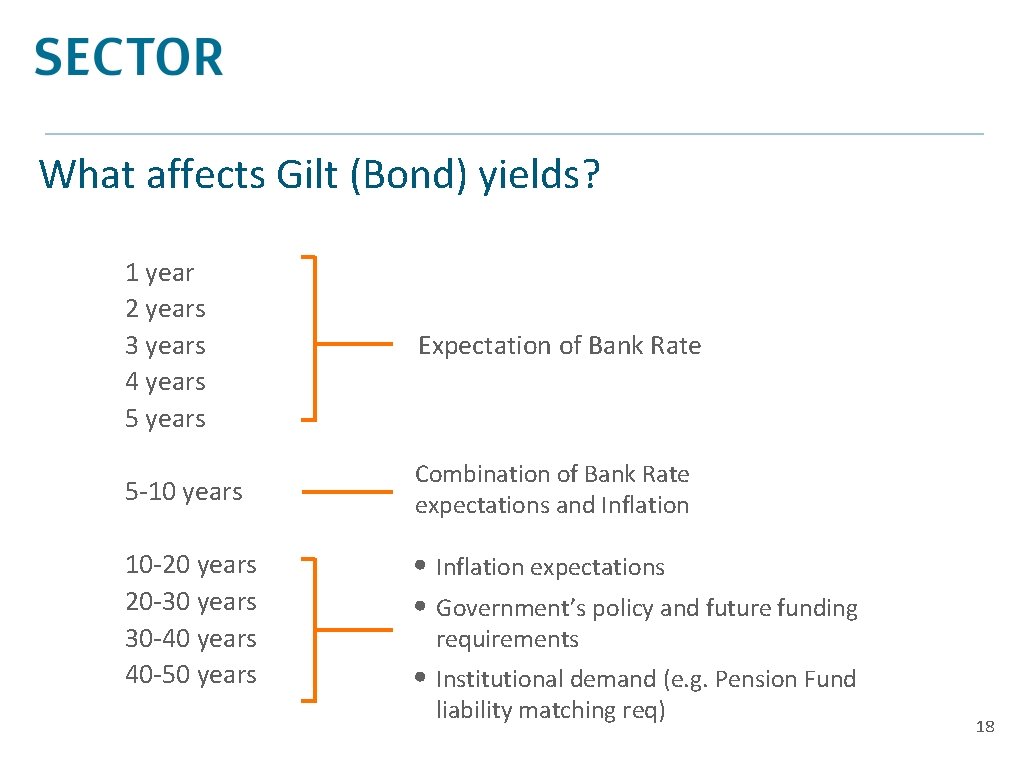
What affects Gilt (Bond) yields? 1 year 2 years 3 years 4 years 5 years Expectation of Bank Rate 5 -10 years Combination of Bank Rate expectations and Inflation 10 -20 years 20 -30 years 30 -40 years 40 -50 years • Inflation Low expectations • Government’s policy and future funding requirements • Institutional demand (e. g. Pension Fund liability matching req) 18
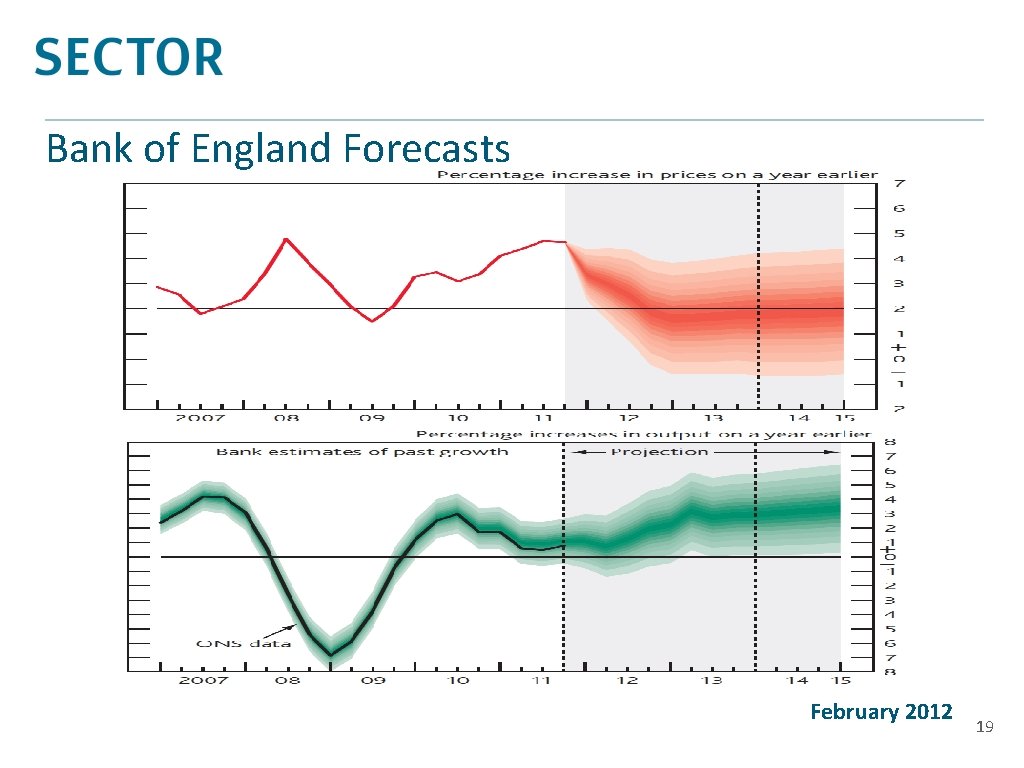
Bank of England Forecasts February 2012 19
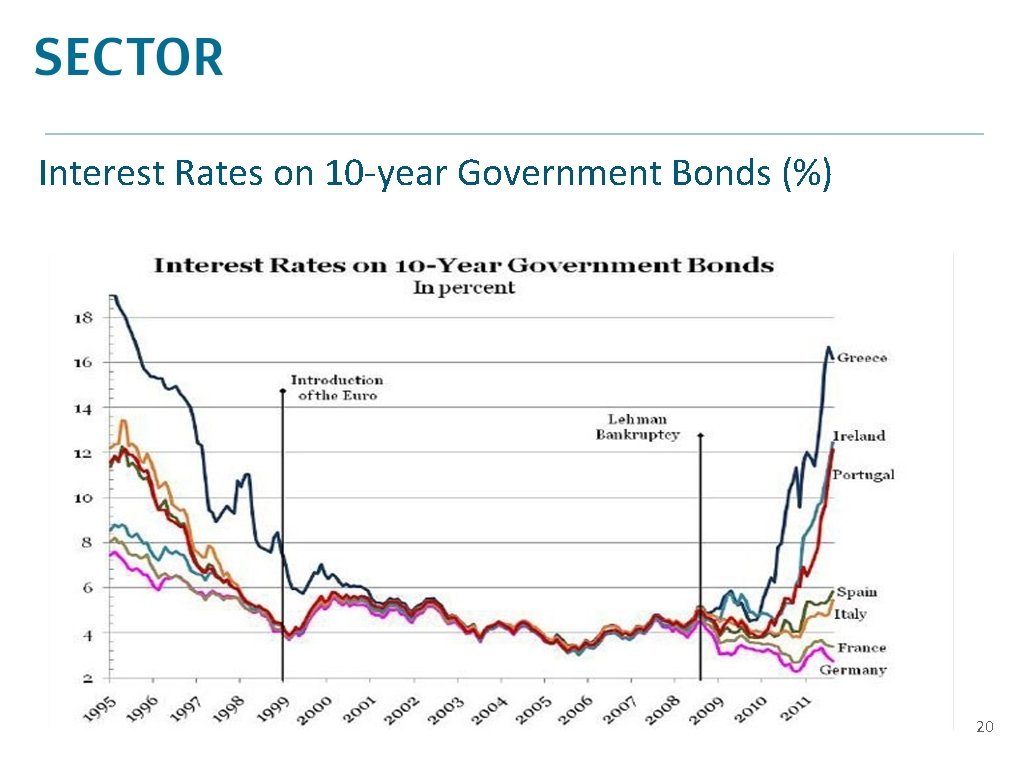
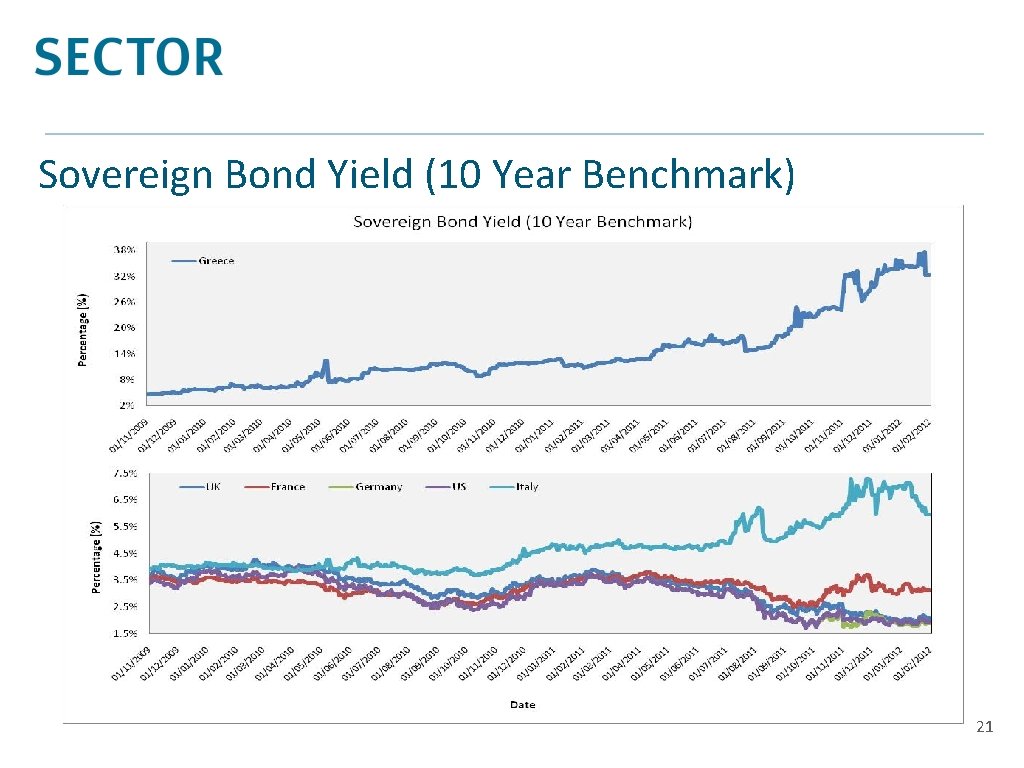
Interest Rates on 10 -year Government Bonds (%) 20 20
Sovereign Bond Yield (10 Year Benchmark) 21
Investment Strategy 22
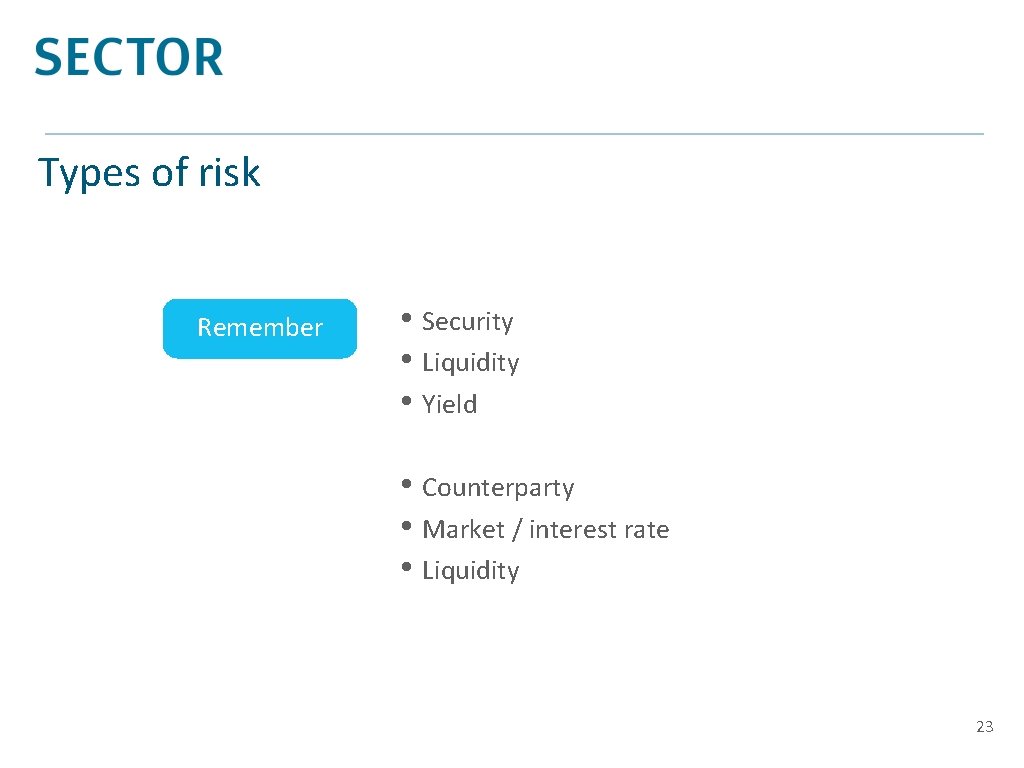
Types of risk Remember • Security • Liquidity • Yield • Counterparty • Market / interest rate • Liquidity 23
Counterparty Risk • Credit ratings – Bank and Sovereign • Credit Default Swaps • Equities • Market Rates • Market analysis and information 24
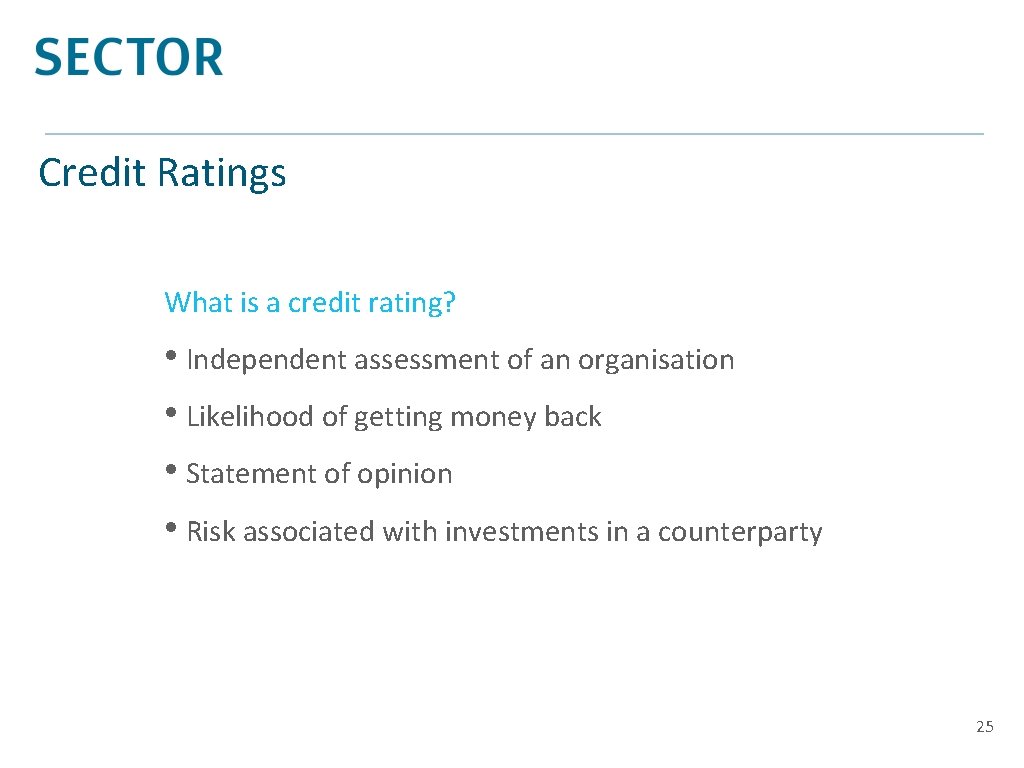
Credit Ratings What is a credit rating? • Independent assessment of an organisation • Likelihood of getting money back • Statement of opinion • Risk associated with investments in a counterparty 25
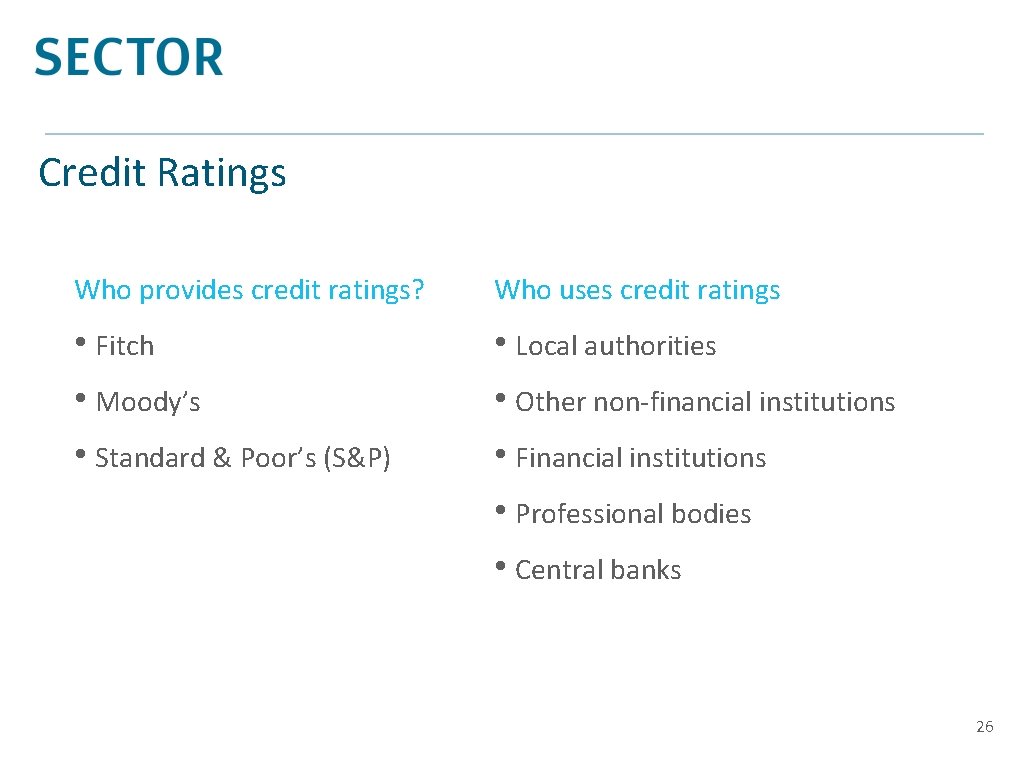
Credit Ratings Who provides credit ratings? Who uses credit ratings • Fitch • Moody’s • Standard & Poor’s (S&P) • Local authorities • Other non-financial institutions • Financial institutions • Professional bodies • Central banks 26
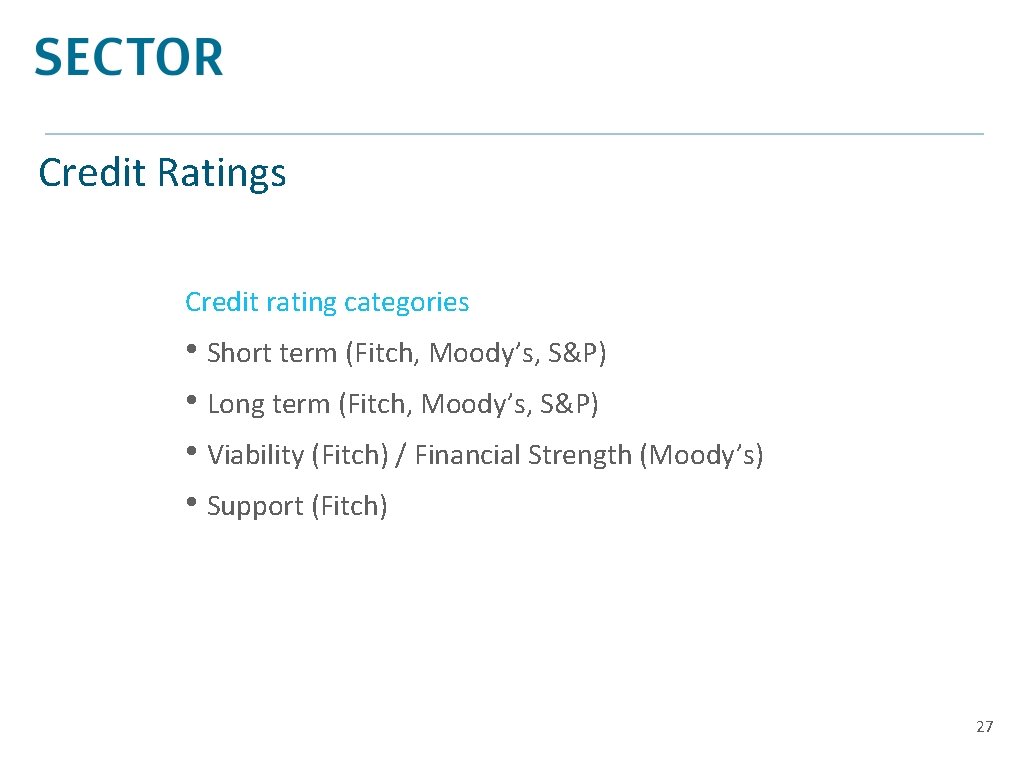
Credit Ratings Credit rating categories • Short term (Fitch, Moody’s, S&P) • Long term (Fitch, Moody’s, S&P) • Viability (Fitch) / Financial Strength (Moody’s) • Support (Fitch) 27
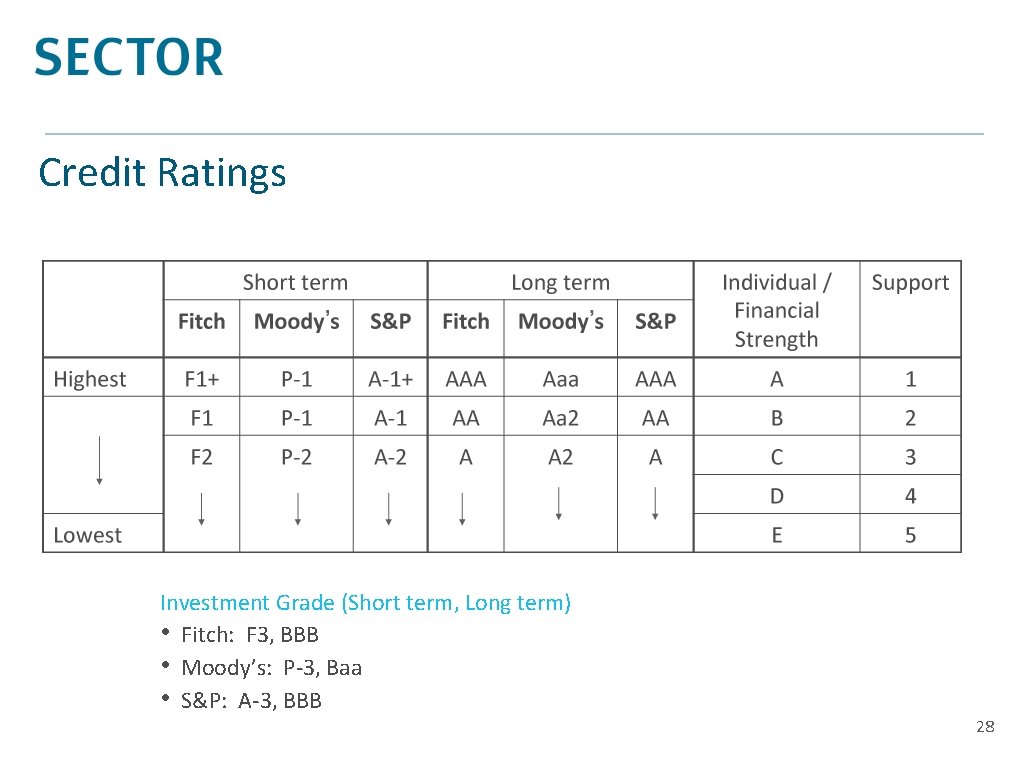
Credit Ratings Investment Grade (Short term, Long term) • Fitch: F 3, BBB • Moody’s: P-3, Baa • S&P: A-3, BBB 28
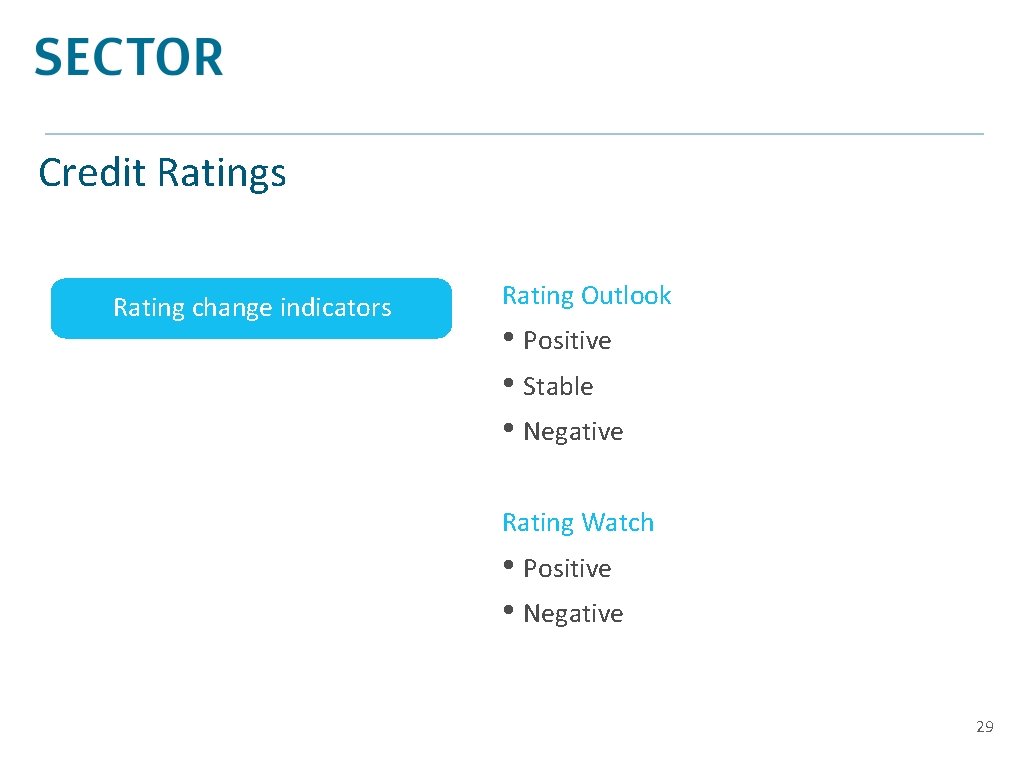
Credit Ratings Rating change indicators Rating Outlook • Positive • Stable • Negative Rating Watch • Positive • Negative 29
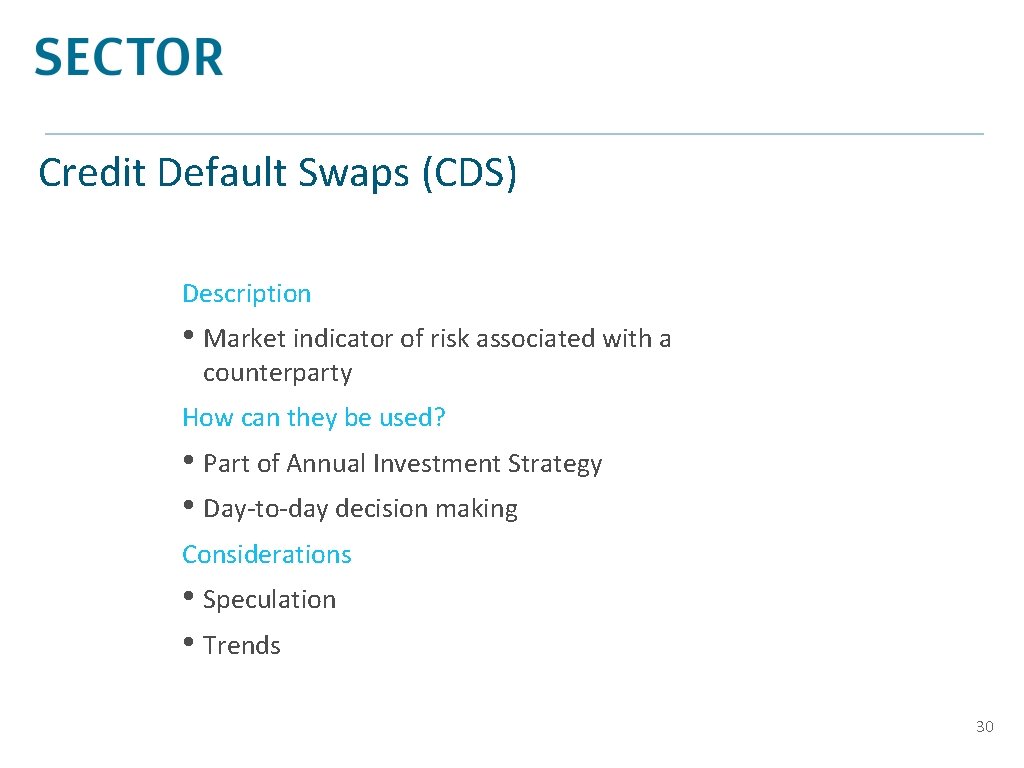
Credit Default Swaps (CDS) Description • Market indicator of risk associated with a counterparty How can they be used? • Part of Annual Investment Strategy • Day-to-day decision making Considerations • Speculation • Trends 30
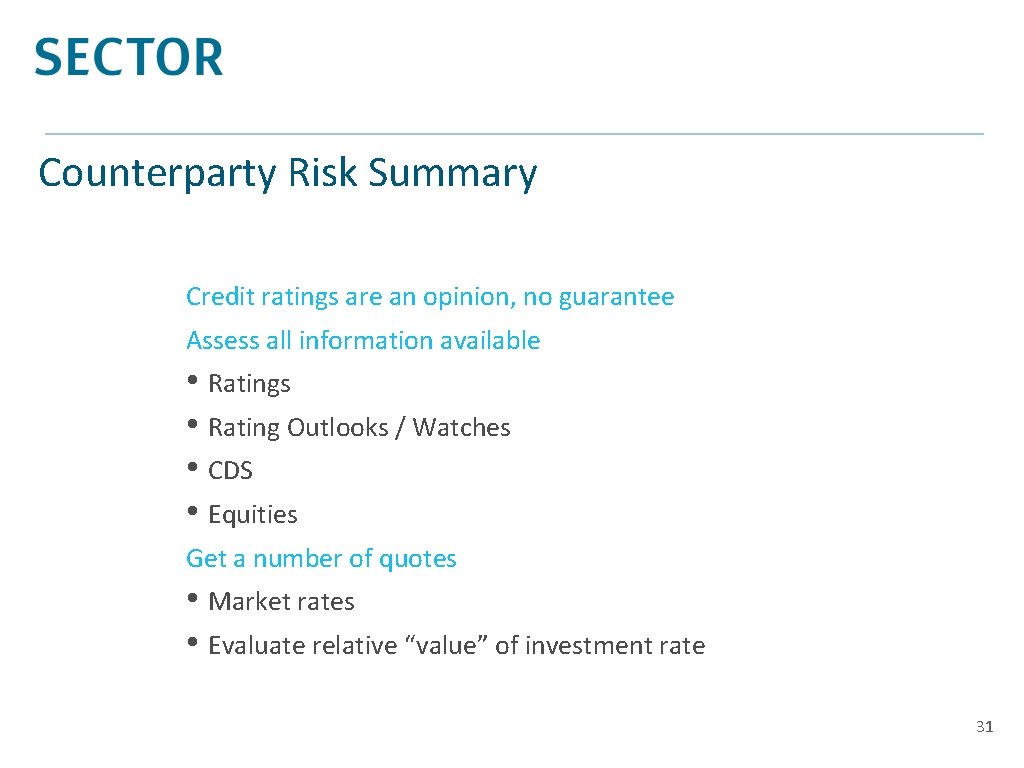
Counterparty Risk Summary Credit ratings are an opinion, no guarantee Assess all information available • Ratings • Rating Outlooks / Watches • CDS • Equities Get a number of quotes • Market rates • Evaluate relative “value” of investment rate 31
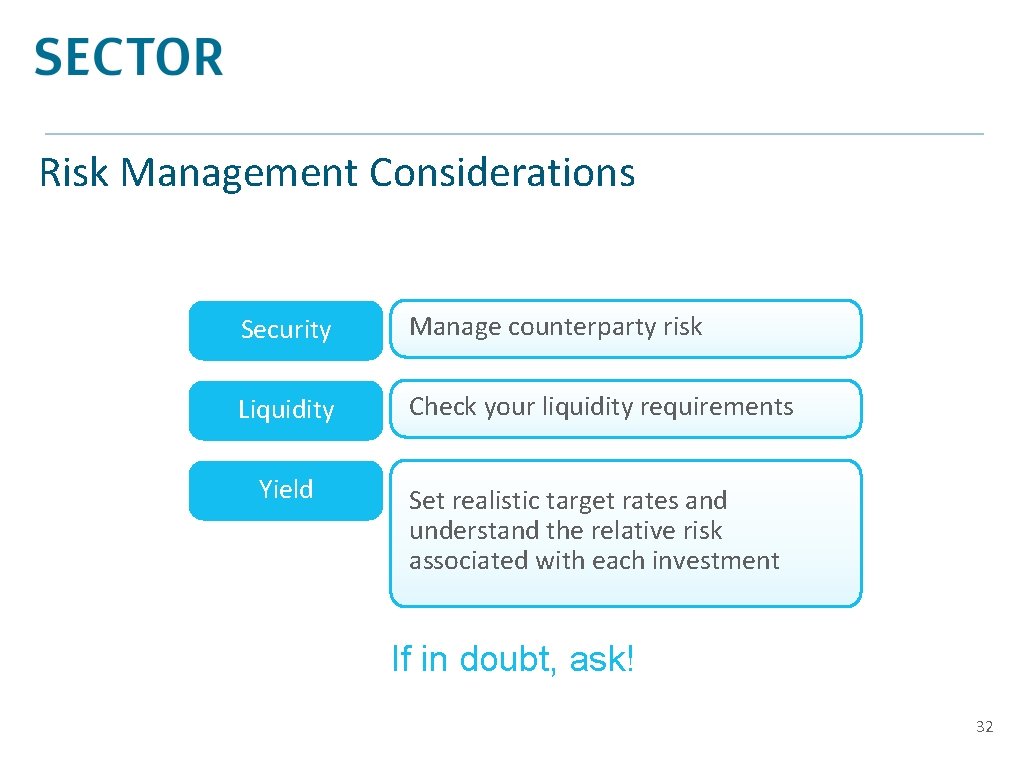
Risk Management Considerations Security Manage counterparty risk Liquidity Check your liquidity requirements Yield Set realistic target rates and understand the relative risk associated with each investment If in doubt, ask! 32
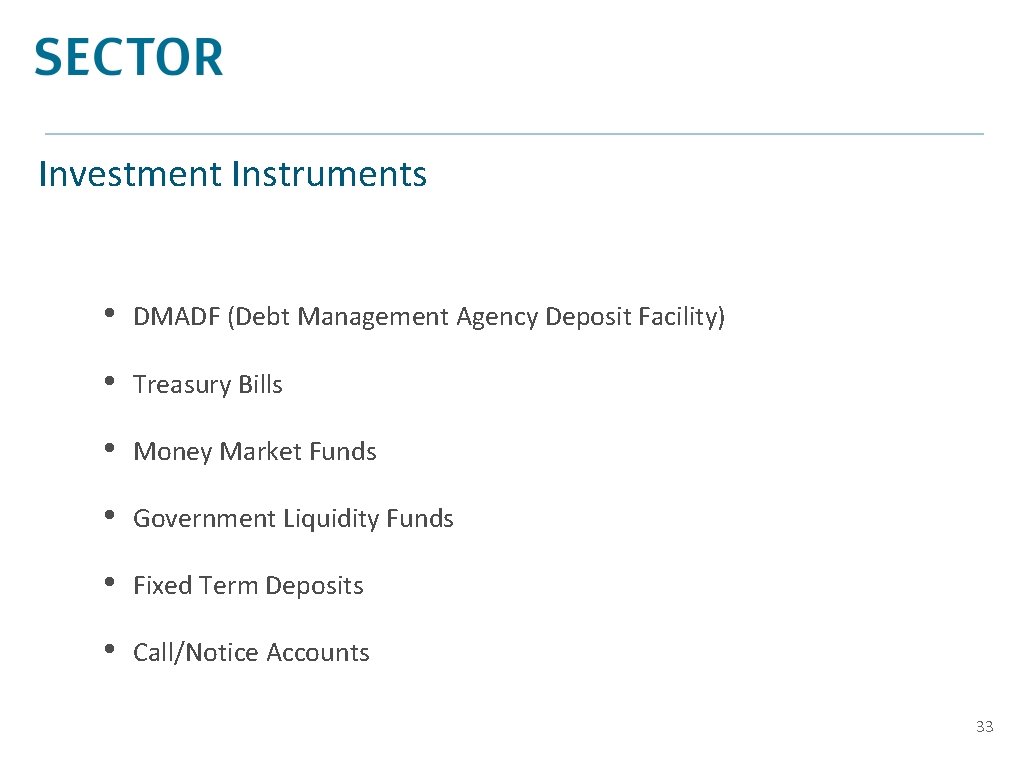
Investment Instruments • DMADF (Debt Management Agency Deposit Facility) • Treasury Bills • Money Market Funds • Government Liquidity Funds • Fixed Term Deposits • Call/Notice Accounts 33
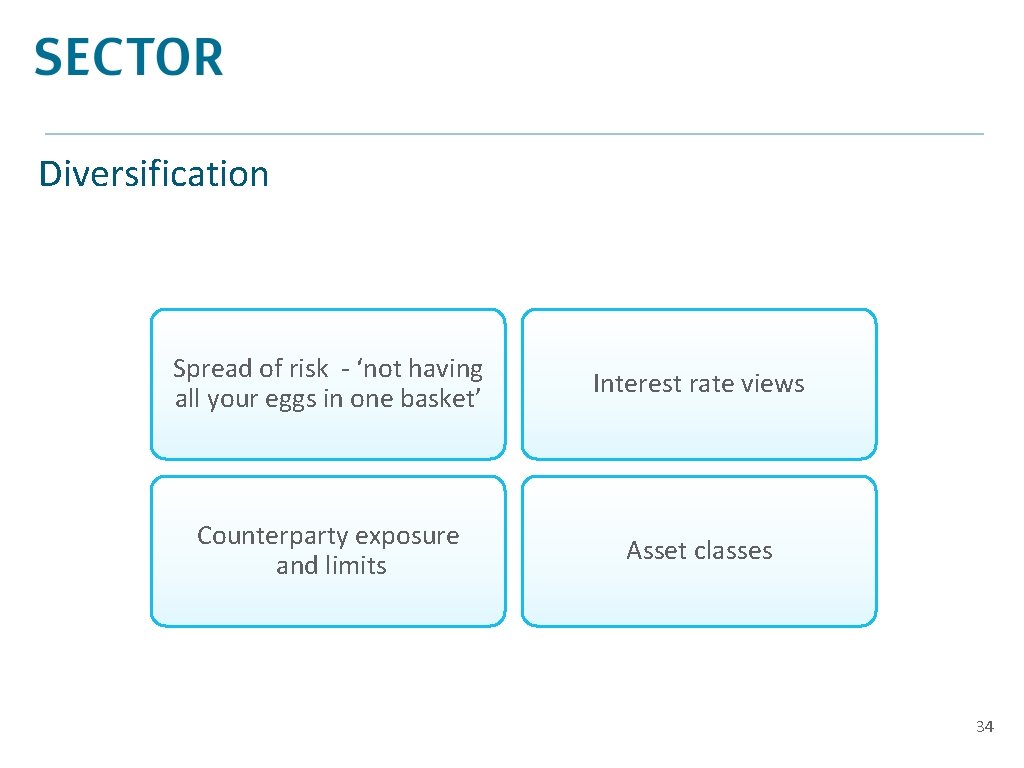
Diversification Spread of risk - ‘not having all your eggs in one basket’ Interest rate views Counterparty exposure and limits Asset classes 34
Debt Management 35
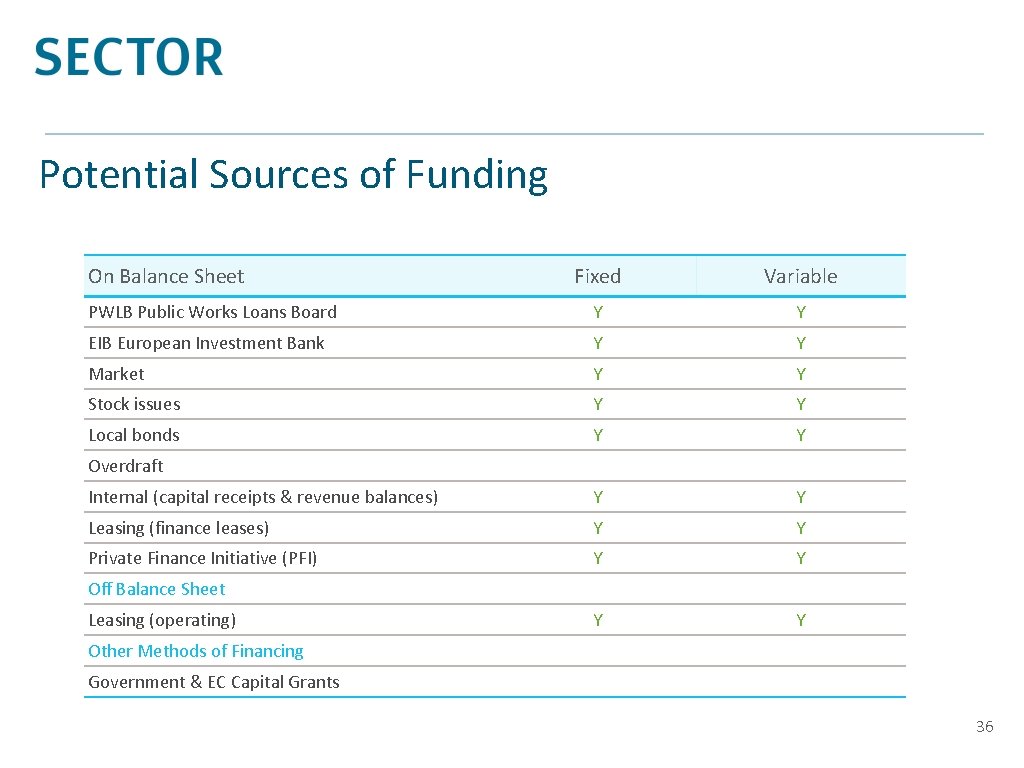
Potential Sources of Funding On Balance Sheet Fixed Variable PWLB Public Works Loans Board Y Y EIB European Investment Bank Y Y Market Y Y Stock issues Y Y Local bonds Y Y Internal (capital receipts & revenue balances) Y Y Leasing (finance leases) Y Y Private Finance Initiative (PFI) Y Y Overdraft Off Balance Sheet Leasing (operating) Other Methods of Financing Government & EC Capital Grants 36
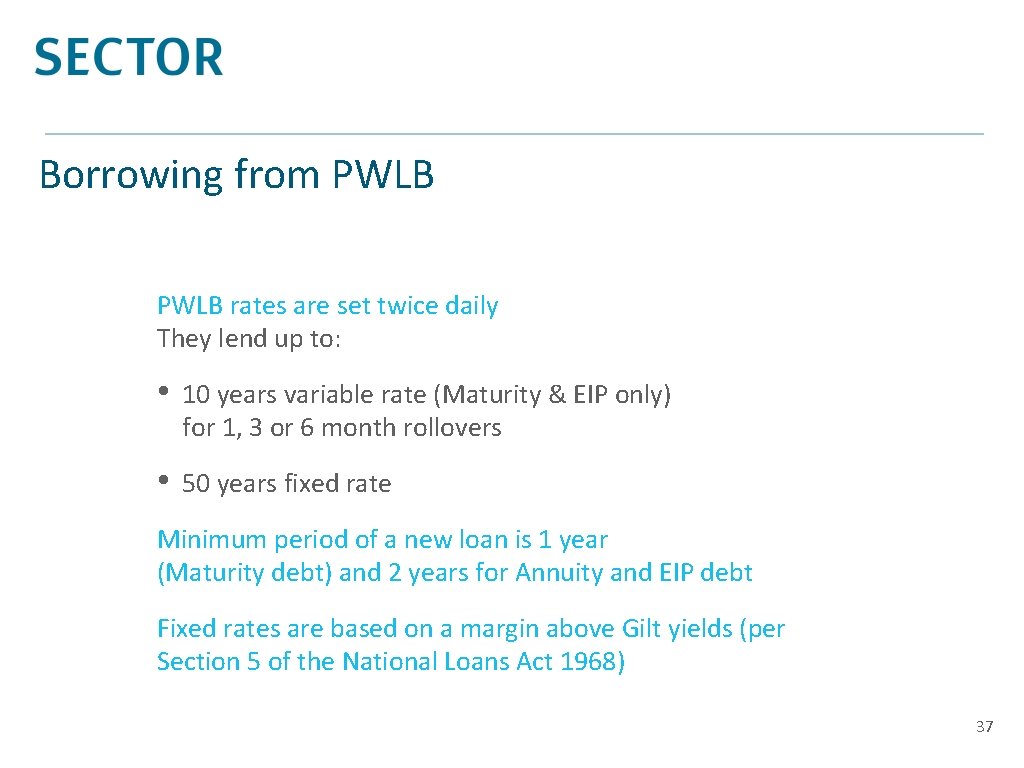
Borrowing from PWLB rates are set twice daily They lend up to: • 10 years variable rate (Maturity & EIP only) for 1, 3 or 6 month rollovers • 50 years fixed rate Minimum period of a new loan is 1 year (Maturity debt) and 2 years for Annuity and EIP debt Fixed rates are based on a margin above Gilt yields (per Section 5 of the National Loans Act 1968) 37
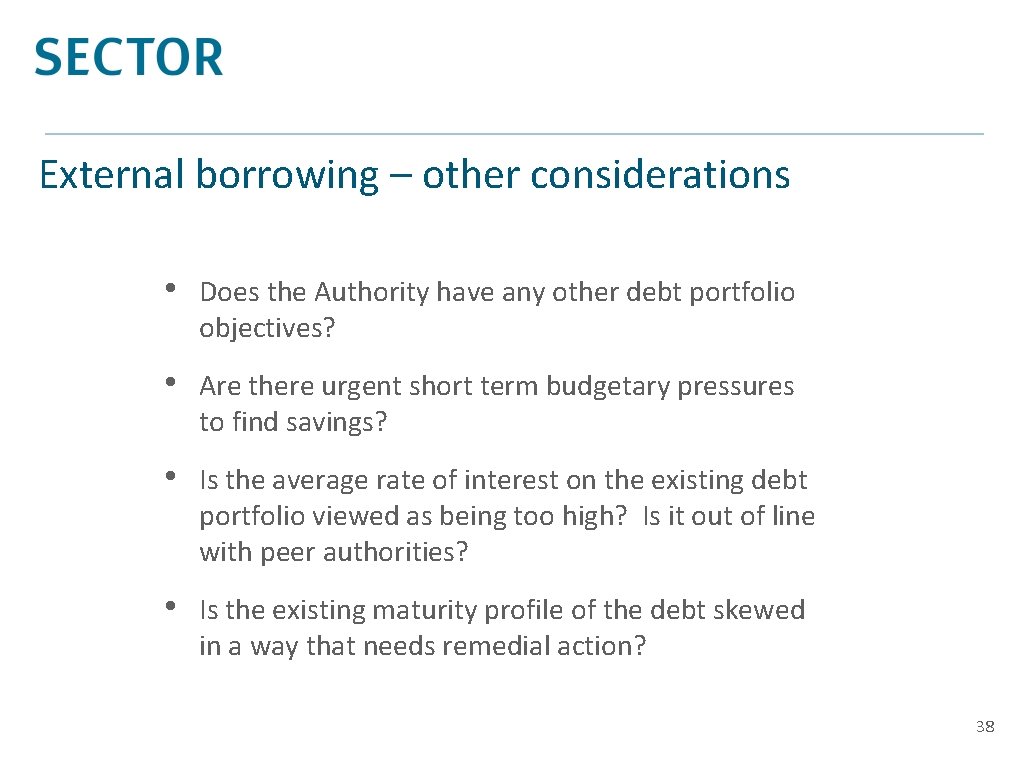
External borrowing – other considerations • Does the Authority have any other debt portfolio objectives? • Are there urgent short term budgetary pressures to find savings? • Is the average rate of interest on the existing debt portfolio viewed as being too high? Is it out of line with peer authorities? • Is the existing maturity profile of the debt skewed in a way that needs remedial action? 38
Any Questions? 39