
An Introduction to the Wisconsin Standards for Science
- Slides: 26
An Introduction to the Wisconsin Standards for Science Kevin Anderson WI DPI Science Consultant kevin. anderson@dpi. wi. gov Slides can be found here: dpi. wi. gov/science/standards Recording will also be posted on that website
Establishing a Vision for Science Education “[By] the end of 12 th grade, all students have some appreciation of the beauty and wonder of science; possess sufficient knowledge of science and engineering to engage in public discussions on related issues; are careful consumers of scientific and technological information related to their everyday lives; are able to continue to learn about science outside school; and have the skills to enter careers of their choice, including (but not limited to) careers in science, engineering, and technology. ”
Goals for this webinar Goal: • Work through elements of a WSS/NGSS-based lesson to build an understanding of these standards. • Build on that science work to review the dimensions of the standards.
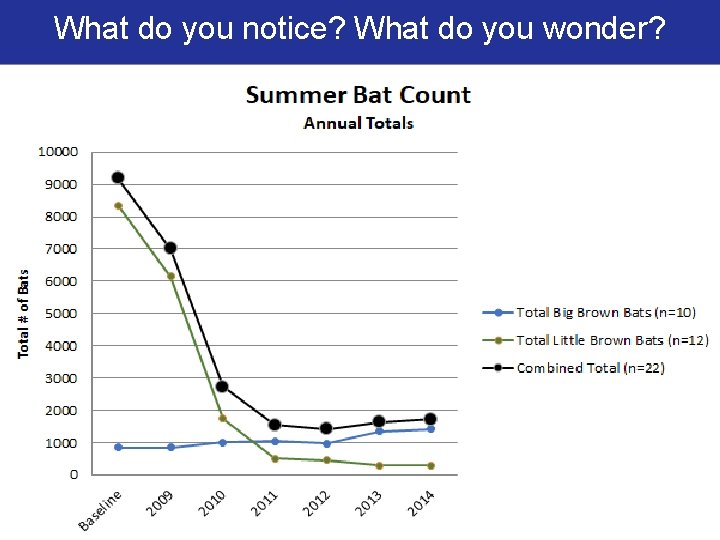
What do you notice? What do you wonder? Make observations and ask questions. Notice? Wonder?
Scientific Thinking… Goal: building up an explanations of this phenomenon w/ evidence. *NOT starting with vocabulary (inertia) but layering that vocabulary onto our shared experiences to support scientific explanations.
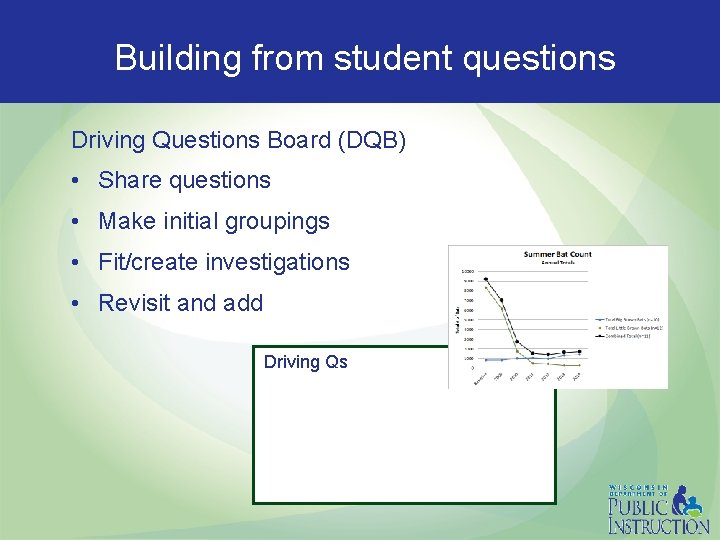
Building from student questions Driving Questions Board (DQB) • Share questions • Make initial groupings • Fit/create investigations • Revisit and add Driving Qs
Eliciting understanding - modeling • Create a scientific model of this phenomenon: Explain this phenomenon (changing bat populations) through the lens of systems.
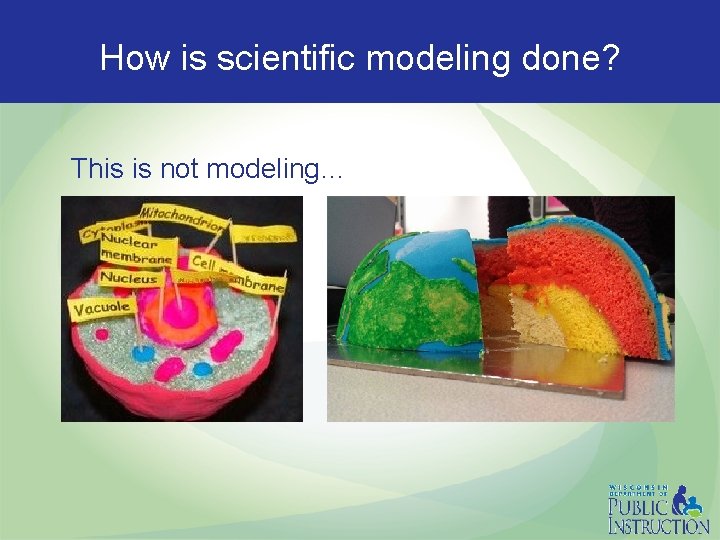
How is scientific modeling done? This is not modeling…
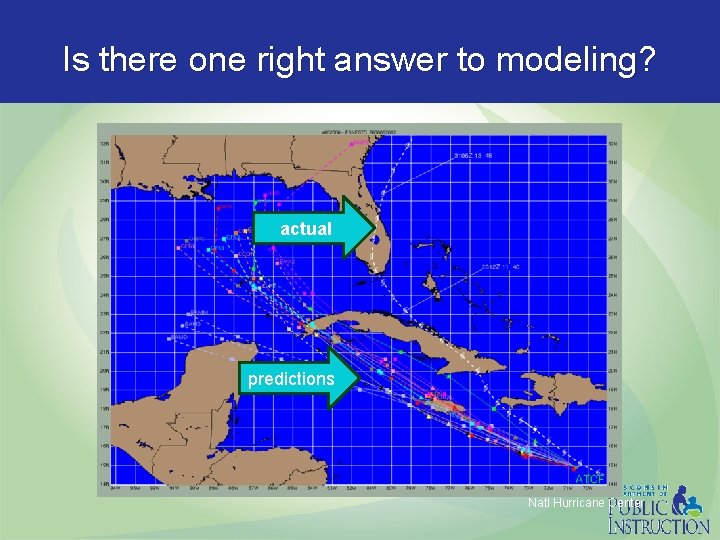
Is there one right answer to modeling? actual predictions Natl Hurricane Center
Building toward explaining interesting phenomena Key idea - Is it a “model of” or a “model for”? What is the phenomenon? Examples - Create a model of the rock cycle, of the phases of the moon, of an animal cell, of mitosis, of a water molecule. . . vs. Create a model to explain how organic matter changes into coal, to predict what will happen with a different surface, to compare life cycles of singlecellular and multicellular organisms. . . Cynthia Passmore and Jennifer Horton webinar: bit. ly/2 p. DVH 2 e
Scientists develop models to explain phenomena. Models – a way to tell a story. In science, you work toward a more an more accurate story. • Pictures, props can help a story. • We often get hints of what can’t be seen. • A story shows relationships, connections. In this case, it also evolves over time. • The story might be words, thoughts – mental, or it might be extremely technical with data and equations (e. g. a child’s conception of where the sun goes or a meteorologist’s prediction tools). • With a detailed story, you can use it to make predictions as to what would happen next.
Further Exploring and Notebooking • Students have opportunities to further explore ecosystems, animal interactions, habitat, survival, change over different scales of time, biodiversity, chemicals in the environment, disease/fungus, and human impacts. • They’re notebooking the whole time (scaffolded). • They work through the lens of their questions!
Effective Explanations: Claims, Evidence, and Reasoning Example: https: //www. youtube. com/watch? v=REejry 8 w 8 y. I
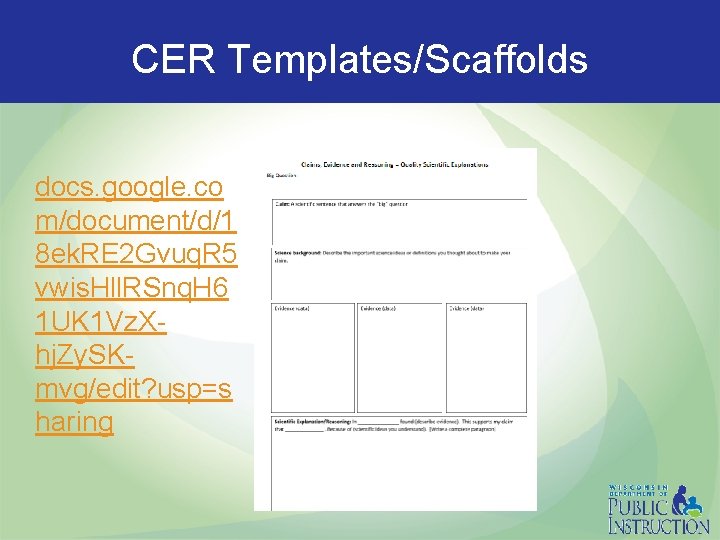
CER Templates/Scaffolds docs. google. co m/document/d/1 8 ek. RE 2 Gvuq. R 5 vwis. Hll. RSnq. H 6 1 UK 1 Vz. Xhj. Zy. SKmvg/edit? usp=s haring
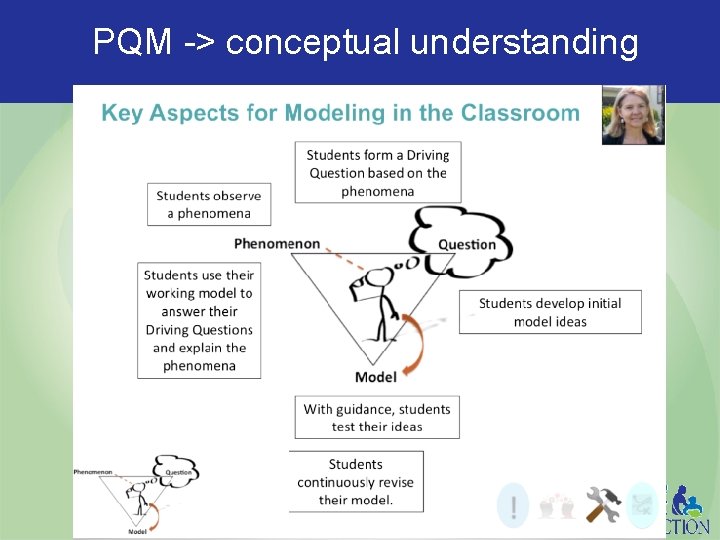
PQM -> conceptual understanding
Lessons: Use practices, not the “Scientific Method” Clarification of the practices 1. Discuss - what’s wrong with the “scientific method”? 2. Practices do clarify what scientific inquiry means 3. They’re not meant to represent a sequence 4. They aren’t the “scientific method” 5. Students should be using them throughout a school year, not all at once 6. Recent reports/resources: goo. gl/nz 3 fw 0 (a zero) a. goo. gl/Ea 9 tlg (a lower case L) b. undsci. berkeley. edu/article/scienceflowchart
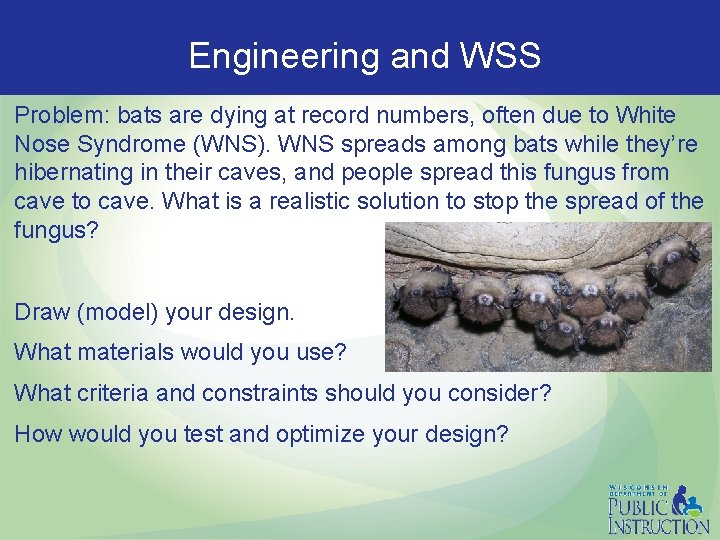
Engineering and WSS Problem: bats are dying at record numbers, often due to White Nose Syndrome (WNS). WNS spreads among bats while they’re hibernating in their caves, and people spread this fungus from cave to cave. What is a realistic solution to stop the spread of the fungus? Draw (model) your design. What materials would you use? What criteria and constraints should you consider? How would you test and optimize your design?
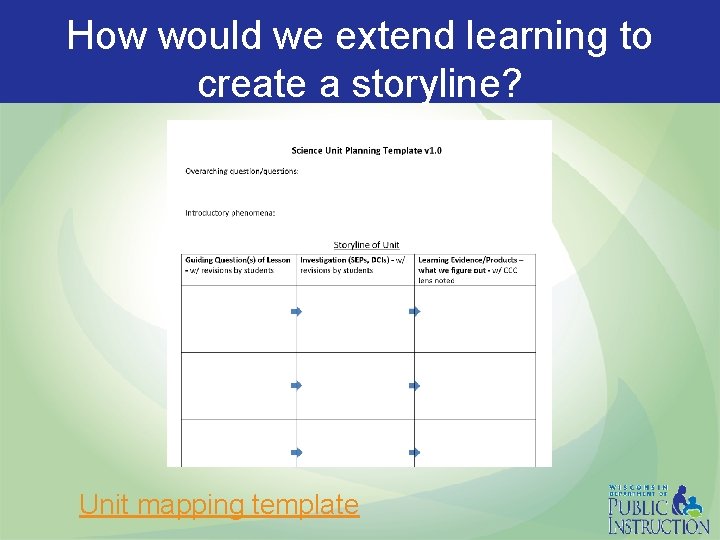
How would we extend learning to create a storyline? Unit mapping template
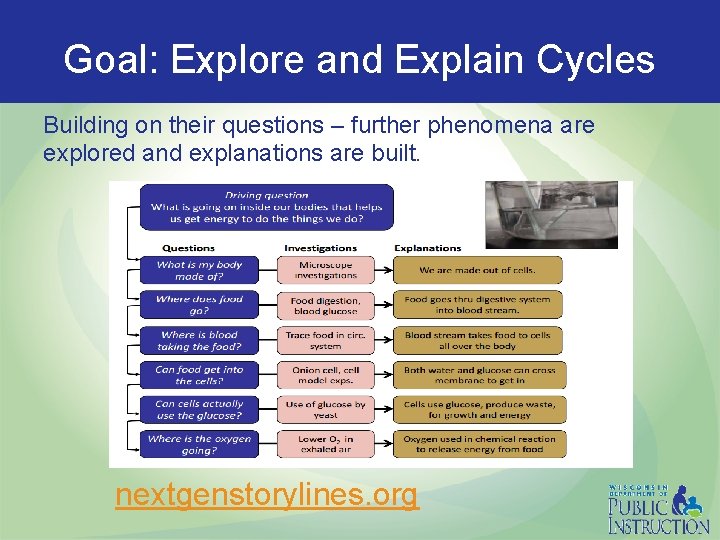
Goal: Explore and Explain Cycles Building on their questions – further phenomena are explored and explanations are built. nextgenstorylines. org
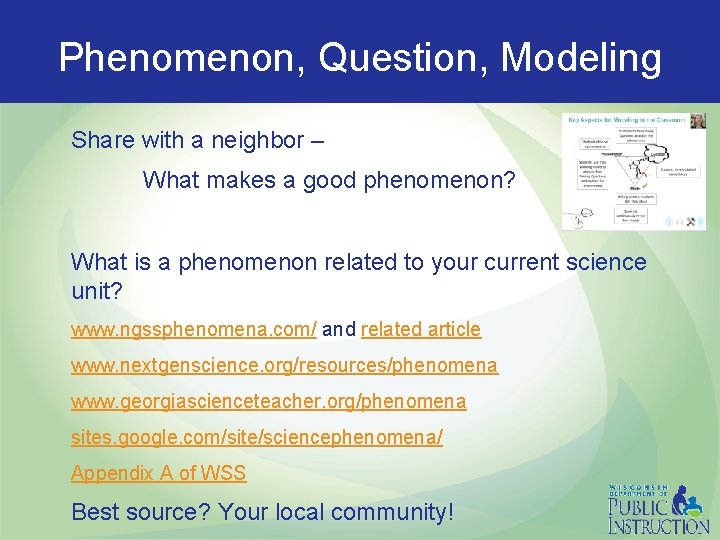
Phenomenon, Question, Modeling Share with a neighbor – What makes a good phenomenon? What is a phenomenon related to your current science unit? www. ngssphenomena. com/ and related article www. nextgenscience. org/resources/phenomena www. georgiascienceteacher. org/phenomena sites. google. com/site/sciencephenomena/ Appendix A of WSS Best source? Your local community!
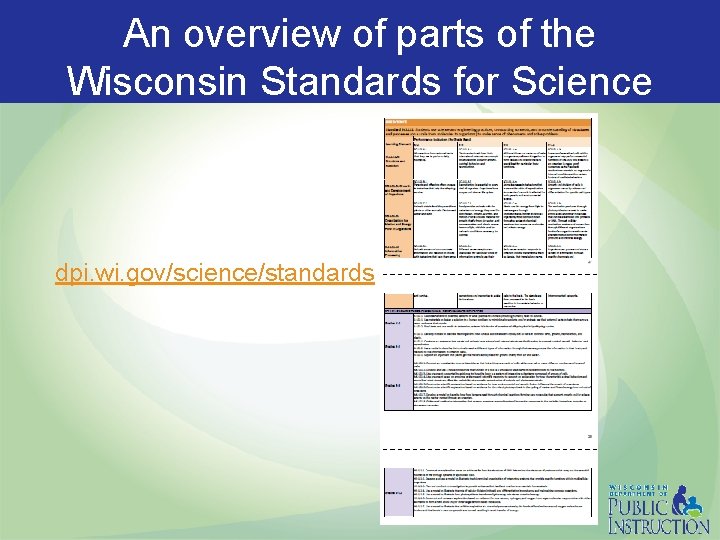
An overview of parts of the Wisconsin Standards for Science dpi. wi. gov/science/standards
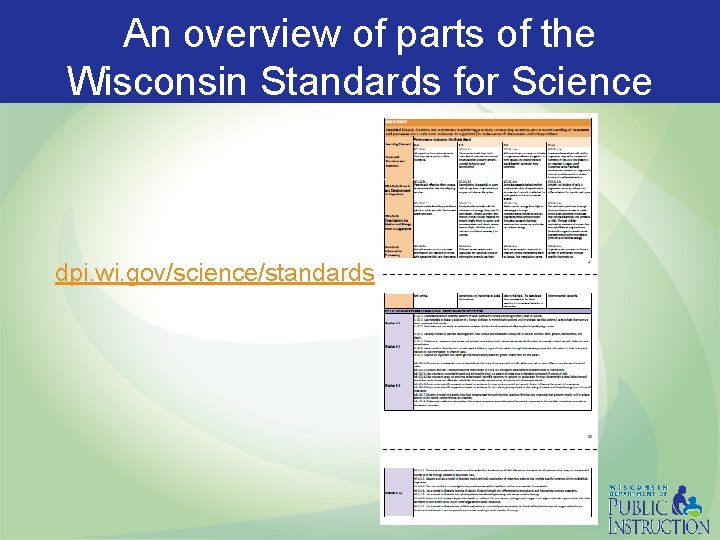
An overview of parts of the Wisconsin Standards for Science dpi. wi. gov/science/standards
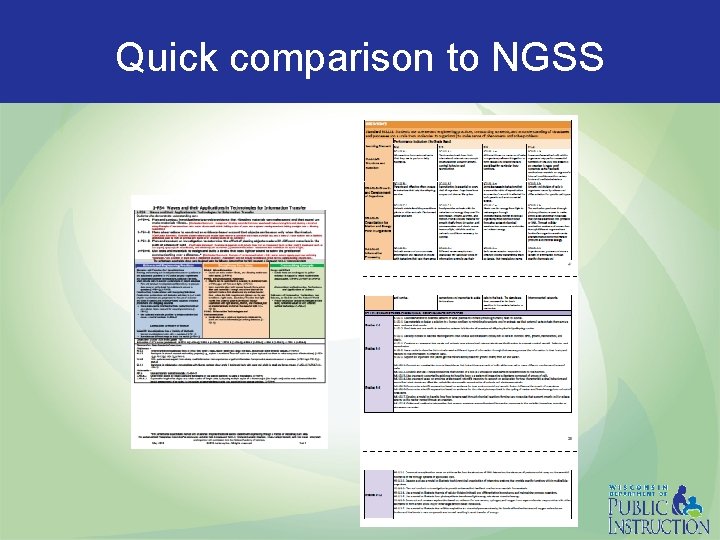
Quick comparison to NGSS
Creating Learning Targets 3 D – Explain with evidence how changing environmental factors can affect some species of bats more than others. 2 D – Draw a model showing all of the relevant elements of the bat ecosystem for your study. 1 D – Define an ecosystem.
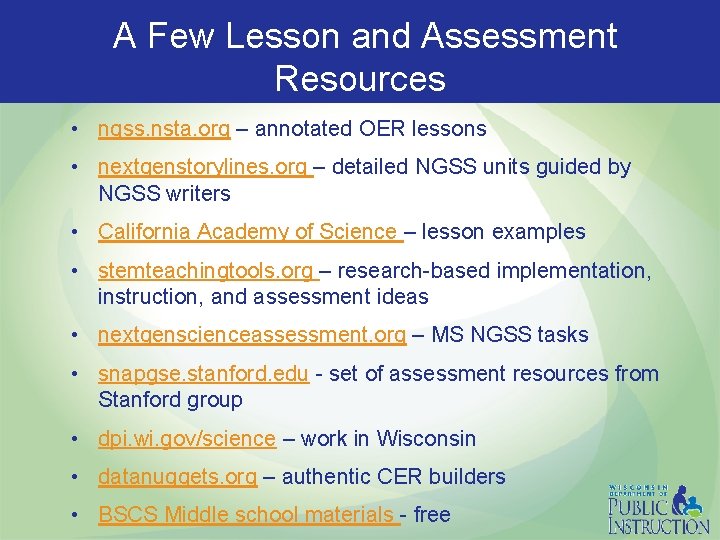
A Few Lesson and Assessment Resources • ngss. nsta. org – annotated OER lessons • nextgenstorylines. org – detailed NGSS units guided by NGSS writers • California Academy of Science – lesson examples • stemteachingtools. org – research-based implementation, instruction, and assessment ideas • nextgenscienceassessment. org – MS NGSS tasks • snapgse. stanford. edu - set of assessment resources from Stanford group • dpi. wi. gov/science – work in Wisconsin • datanuggets. org – authentic CER builders • BSCS Middle school materials - free
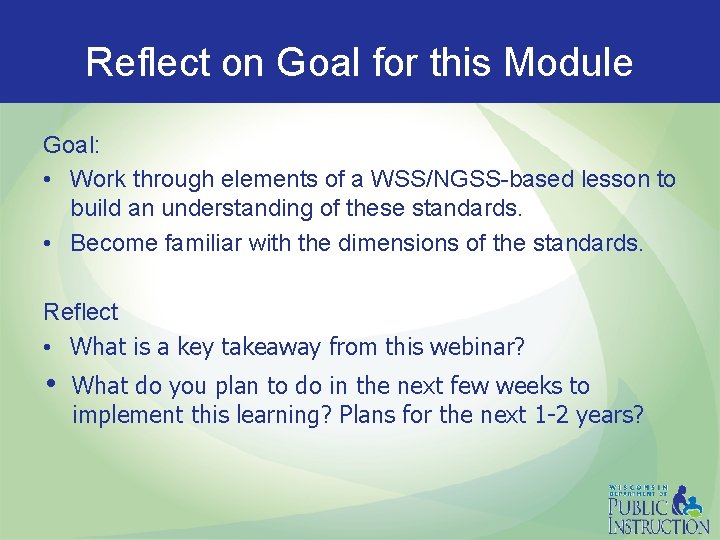
Reflect on Goal for this Module Goal: • Work through elements of a WSS/NGSS-based lesson to build an understanding of these standards. • Become familiar with the dimensions of the standards. Reflect • What is a key takeaway from this webinar? • What do you plan to do in the next few weeks to implement this learning? Plans for the next 1 -2 years?