
An Introduction to the Rapid Rehousing Performance Benchmarks
An Introduction to the Rapid Re-housing Performance Benchmarks and Program Standards Samantha Batko, National Alliance to End Homelessness
Session Overview I. II. Overview of Rapid Re-housing Introduction to Rapid Re-housing Performance Benchmarks & Program Standards III. Program Philosophy & Design Standards IV. Housing Identification Standards V. Rent and Move-In Assistance Standards VI. Case Management and Service Standards VII. Performance Benchmarks VIII. Questions
POLL Who Is In The Room? q. Rapid Re-housing Provider q Provider interested in or imminently starting an RRH Project q Private or local government funding agency q Technical Assistance Provider
POLL What is your familiarity with Rapid Re-housing? q. I am a new staff person/agency to RRH q. I have provided RRH services for about 1 year q. I have provided RRH services for 2+ years
An Overview of Rapid Re-housing
Why Rapid Re-housing? • What we know about causes and dynamics of homelessness • What we know about shelter and transitional housing • What we’ve learned so far about RRH National Alliance to End Homelessness 7
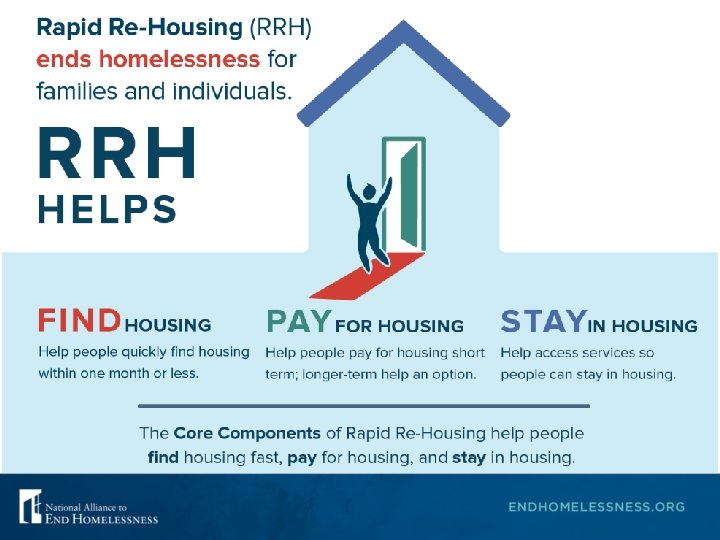
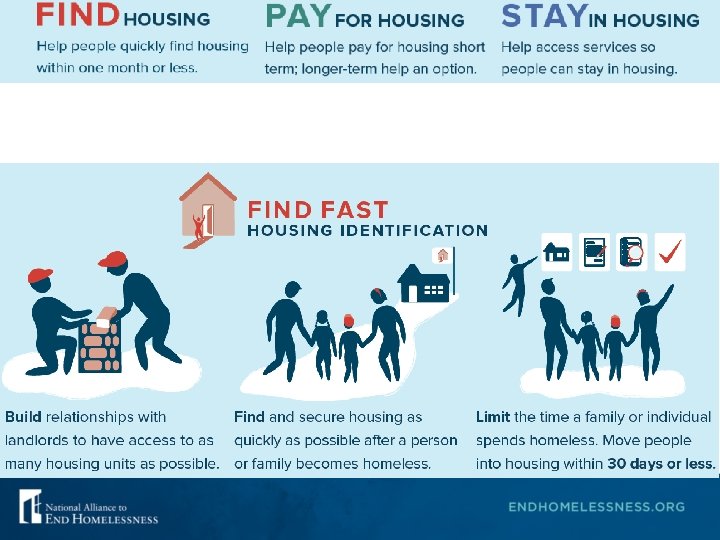
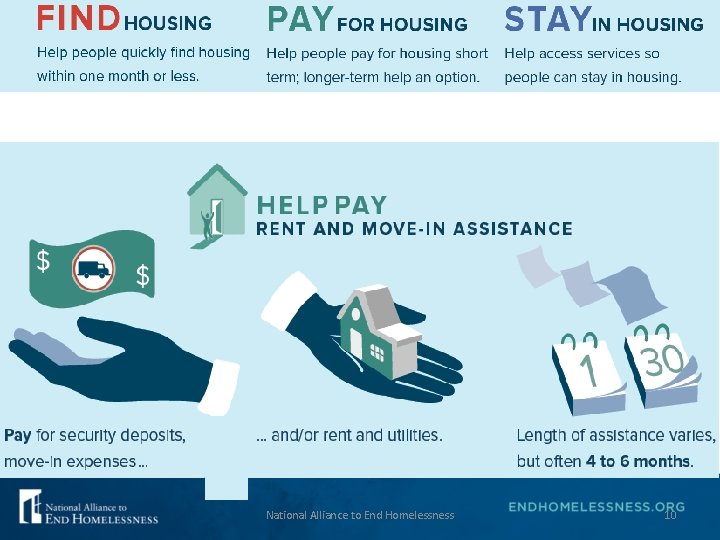
National Alliance to End Homelessness 10
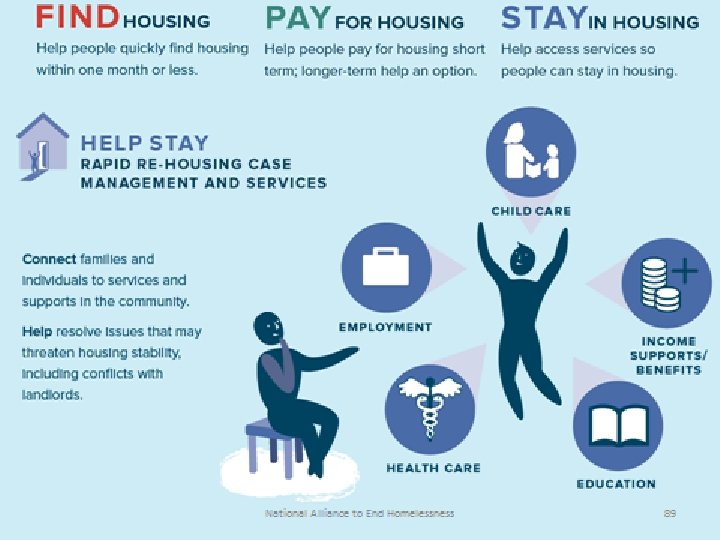
National Alliance to End Homelessness 11
Goals of the Design of Rapid Re. Housing Rapid re-housing is designed to help individuals and families: ü quickly exit homelessness ü return to permanent housing in the community ü not become homeless again in the near term
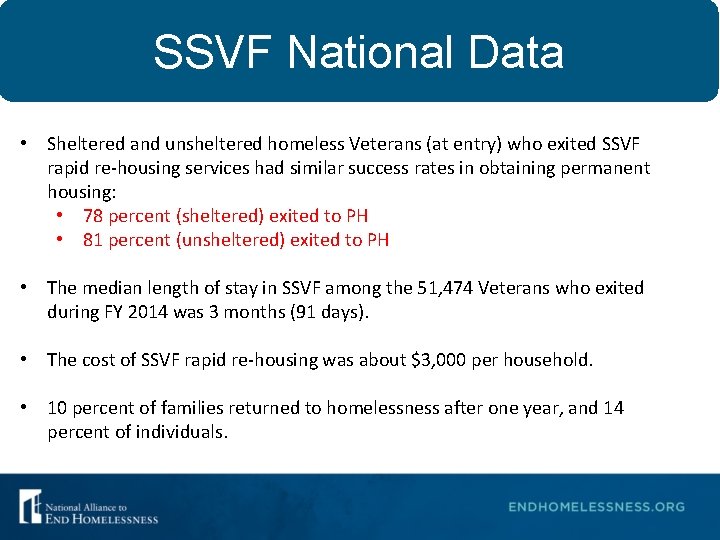
SSVF National Data • Sheltered and unsheltered homeless Veterans (at entry) who exited SSVF rapid re-housing services had similar success rates in obtaining permanent housing: • 78 percent (sheltered) exited to PH • 81 percent (unsheltered) exited to PH • The median length of stay in SSVF among the 51, 474 Veterans who exited during FY 2014 was 3 months (91 days). • The cost of SSVF rapid re-housing was about $3, 000 per household. • 10 percent of families returned to homelessness after one year, and 14 percent of individuals.
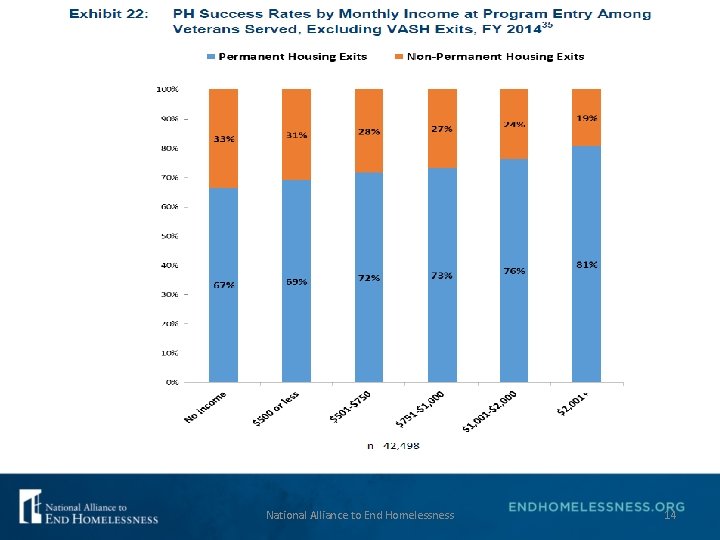
National Alliance to End Homelessness 14
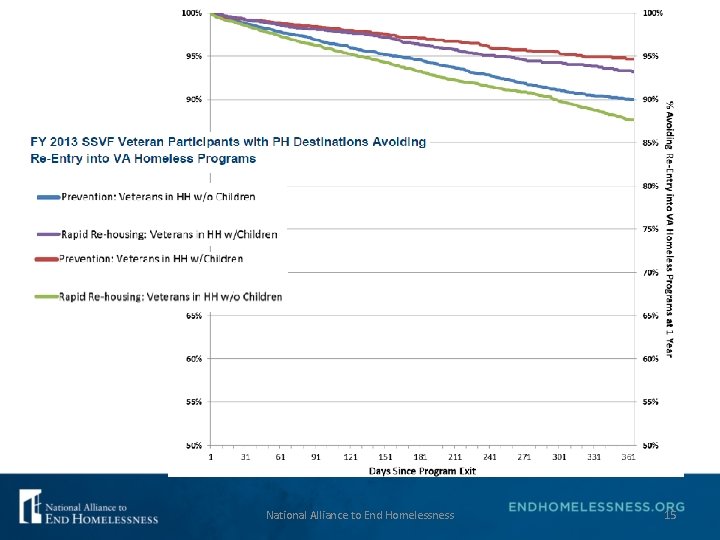
National Alliance to End Homelessness 15
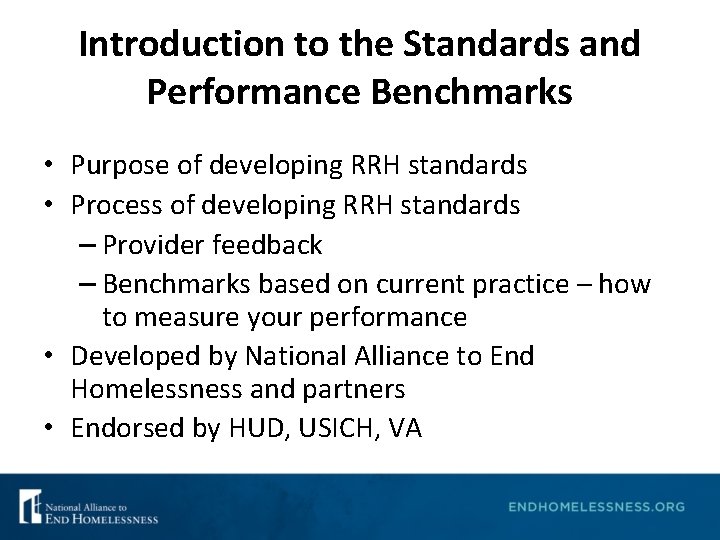
Introduction to the Standards and Performance Benchmarks • Purpose of developing RRH standards • Process of developing RRH standards – Provider feedback – Benchmarks based on current practice – how to measure your performance • Developed by National Alliance to End Homelessness and partners • Endorsed by HUD, USICH, VA
How to Use the Standards Funder, State Leaders, and Coalitions • Use standards to increase the effective implementation of rapid rehousing – – development of Requests For Proposals (RFPs) for a variety of funding streams set performance and outcome goals for program evaluate applications for new rapid re-housing programs review current program performance. SSVF Providers • Use standards to improve their own rapid re-housing practice and to evaluate possible rapid re-housing partner agencies Continuums of Care (Co. Cs) • Use standards during the process of developing written standards for how they plan to administer assistance through coordinated assessment
Rapid Re-Housing Performance Benchmarks and Program Standards • 3 Benchmarks – 30 days from enrollment in rapid re-housing to move into permanent housing – 80% of exits from rapid re-housing are to permanent housing – 85% of households do not become homelessness again within a year • 53 Standards – 3 Core Components – Program Design and Philosophy
How to Use the Standards P = Program Philosophy and Design Standards H = Housing Identification Standards R = Rent and Move-in Assistance Standards C = Case Management and Services Standards
How to Use the Standards • Principles • Rationale • Standards – Program Staff – Program Policies – Program Activities
Program Philosophy and Design
Program Philosophy and Design: Principles • Programs should take a Housing First approach and should not screen out households based on a score on an assessment tool or criteria that are assumed, but not shown, to predict successful outcomes, such as a minimum income threshold, employment, absence of a criminal history, evidence of “motivation, ” etc. • Participants have all the rights and responsibilities of typical tenants and should sign a standard lease agreement.
Program Philosophy and Design: Policies & Activities • P 1. Staff regularly trained to basic program philosophy of RRH • P 3. Well-defined, written screening process using consistent and transparent decision criteria • P 4. Eligibility criteria does not require: sobriety, commitment to participate, or other “predictive” criteria • P 8. Participate in local HMIS • P 9. Participate in and accept referrals from Coordinated Entry
Core Components Standards Housing Identification
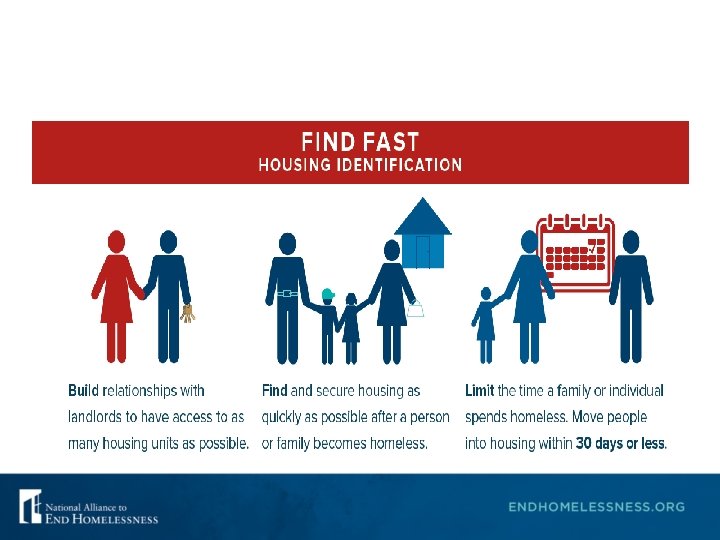
Housing Identification: Standards • A rapid re-housing program’s staff should help households access units that are desirable and sustainable. • Program staff should actively recruit and retain landlords and property managers willing to rent to program participants who may otherwise fail to pass typical tenant screening criteria. • Program staff should help participants to secure shared housing including, including negotiating landlord approval, shared rent, etc.
Tenant Screening Barriers Why do landlords screen tenants out? 27
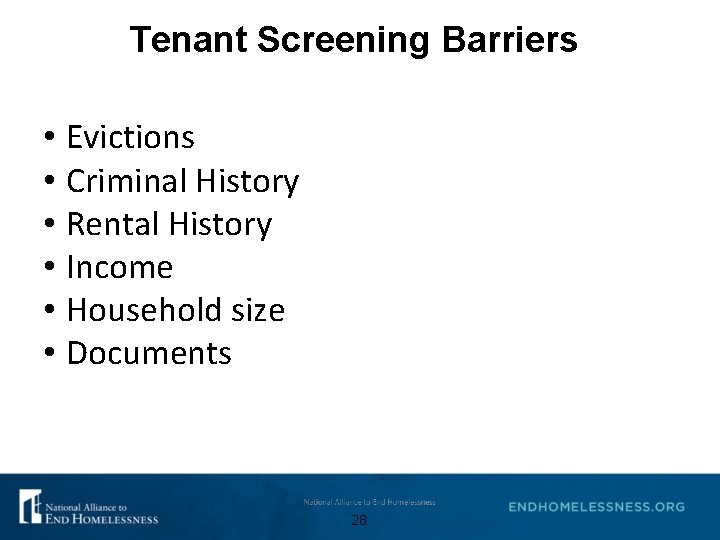
Tenant Screening Barriers • Evictions • Criminal History • Rental History • Income • Household size • Documents 28
Housing Identification: Standards • The landlord is a vital partner to a RRH program. • The RRH provider must be responsive to landlords to preserve and develop those partnerships for the purposes future housing placements. • The RRH provider should incentivize landlords to rent to program participants by offering tenancy supports that will make the landlord overlook barriers to tenancy such as evictions, poor rental history, zero to low income, criminal records, and poor credit histories.
Housing Identification: Standards • Designate staff whose responsibility is to identify and recruit landlords and encourage them to rent to homeless households served by the program. • Staff should have the knowledge, skills, and agency resources to understand landlords’ perspectives, understand landlord and tenant rights and responsibilities, and negotiate landlord supports. • Ideally, a program has dedicated staff for whom housing identification and landlord engagement is the primary responsibility rather than making this the case manager’s responsibility.
Housing Identification: Standards Program Policies q. H 4. Program offers a standard, basic level of support to all landlords who lease to program participants…. Program can negotiate additional supports, as needed, on a case-by-case basis. At a minimum… H 4 a. Respond quickly (within one business day)… H 4 b. Seek to resolve conflicts… H 4 c. Whenever possible, negotiate move-out terms…
Core Components Standards Rent and Move-In Assistance (Financial)
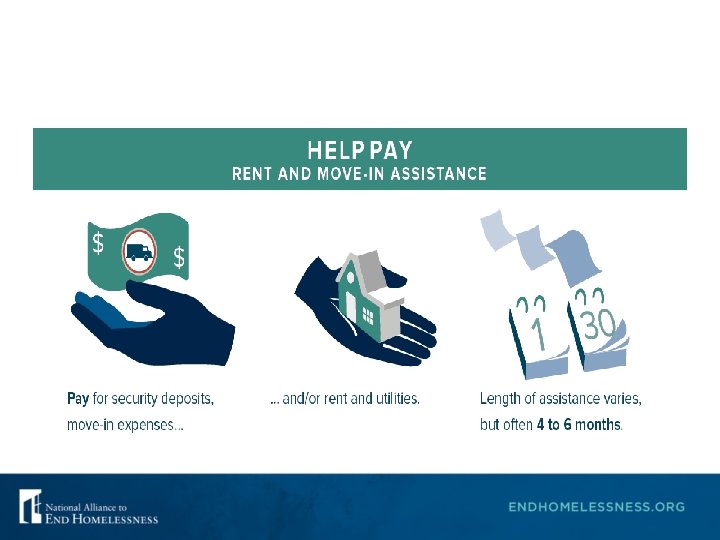
Rent and Move-in Assistance: Standards Principles • Rent and move-in assistance should be flexible, individualized, and tailored to the varying and changing needs of a household while providing the assistance necessary for households to move immediately out of homelessness and to stabilize in permanent housing.
Rent and Move-in Assistance: Standards q. Provide assistance necessary for participants to move immediately out of homelessness and to stabilize in permanent housing. q. Provide participants with the minimum necessary to maximize the number of households able to be served. National Alliance to End Homelessness 35
Rent and Move-in Assistance: Standards Program Staff q R 4. A progressive approach is used to determine the duration and amount of rent assistance. Financial assistance is not a standard “package” and is flexible enough to adjust to households’ unique needs and resources, especially as participants’ financial circumstances or housing costs change.
Rent and Move-in Assistance: Standards Program Activities q R 5. Program provides when needed financial assistance for housing costs, which may include rental deposits, first month’s rent, last month’s rent, temporary rental assistance, and/or utility assistance.
Rent and Move-in Assistance: Standards Program Activities q. R 8. Program helps participants meet basic needs at move-in, such as securing basic furnishings for an apartment, including mattresses and basic kitchen items such as a pot for cooking and utensils. q. R 9. Transition off financial assistance coordinated with case management to assume and sustain their housing costs
Core Components Standards Housing Rapid Re-Housing Case. Identification Management and Services
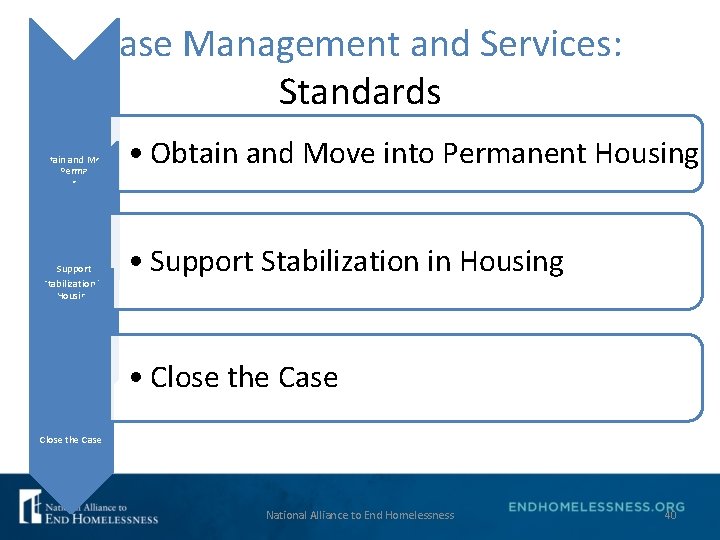
Case Management and Services: Standards Obtain and Move into Permanent Housing Support Stabilization in Housing • Obtain and Move into Permanent Housing • Support Stabilization in Housing • Close the Case National Alliance to End Homelessness 40
Case Management and Services: Standards • RRH case management should be client-driven and voluntary. • RRH case management should be flexible in intensity— offering only essential assistance until or unless the participant demonstrates the need for or requests additional help. • RRH case management uses a strengths-based approach to empower clients. • RRH case management reflects the short-term nature of the rapid re-housing assistance…
Case Management and Services: Standards Program Staff q C 1. Case manager’s job descriptions direct case managers to focus on housing and to use strengthsbased practices focused on participant engagement and meeting the unique needs of each household. q C 2. In programs that have specialized staff that conduct housing location, case managers work closely with housing locator staff to match the client to an appropriate unit as quickly as possible.
Case Management and Services Standards Program Policies q C 4. Except where dictated by the funder, program participants direct when, where, and how often case management meetings occur. Meetings occur in a participant’s home and/or in a location of the participant’s choosing whenever possible. q C 9. Program has clearly defined policies and objective standards for when case management should continue and end. These guidelines are flexible…
Performance Benchmarks
Performance Benchmarks • It is important to remember that rapid re-housing is a Housing First intervention and programs should not be screening out households based on criteria that are assumed to predict successful outcomes, such as income, employment, criminal history, mental health history, medical history, or evidence of “motivation. ” • The benchmarks are based on performance data of programs that do not screen households out on the basis of the above barriers. • Measure performance using HMIS
Performance Benchmarks Reminder: A community may not yet have any programs that meets these benchmarks. • Set alternate performance goals for the purposes of comparison between programs • Set alternative goals for performance improvement, while programs work to achieve these benchmarks
Performance Benchmarks RRH’s three primary goals: 1. Reduce the length of time program participants spend homeless, 2. Exit households to permanent housing, and 3. Limit returns to homelessness within a year of program exit.
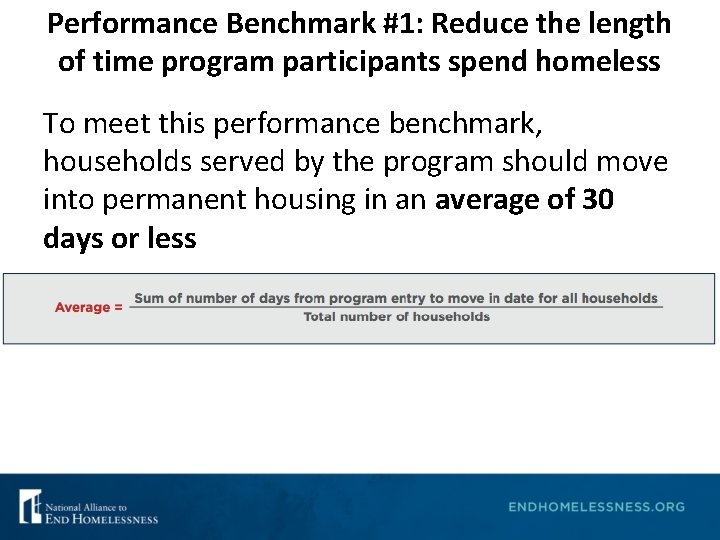
Performance Benchmark #1: Reduce the length of time program participants spend homeless To meet this performance benchmark, households served by the program should move into permanent housing in an average of 30 days or less
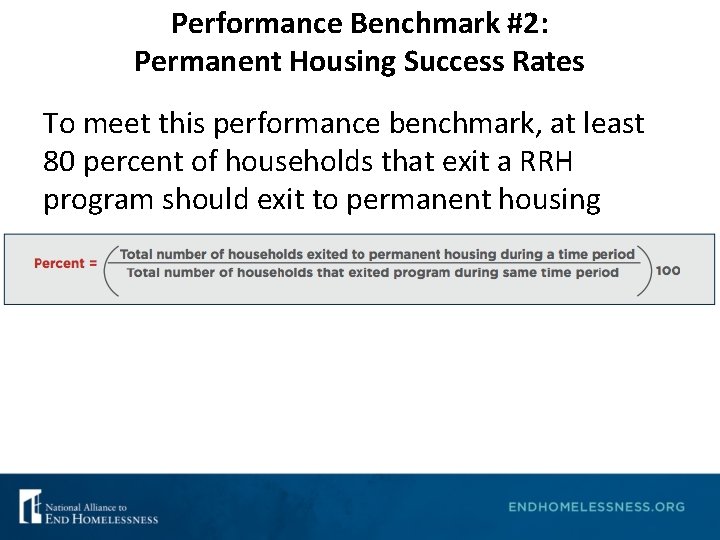
Performance Benchmark #2: Permanent Housing Success Rates To meet this performance benchmark, at least 80 percent of households that exit a RRH program should exit to permanent housing
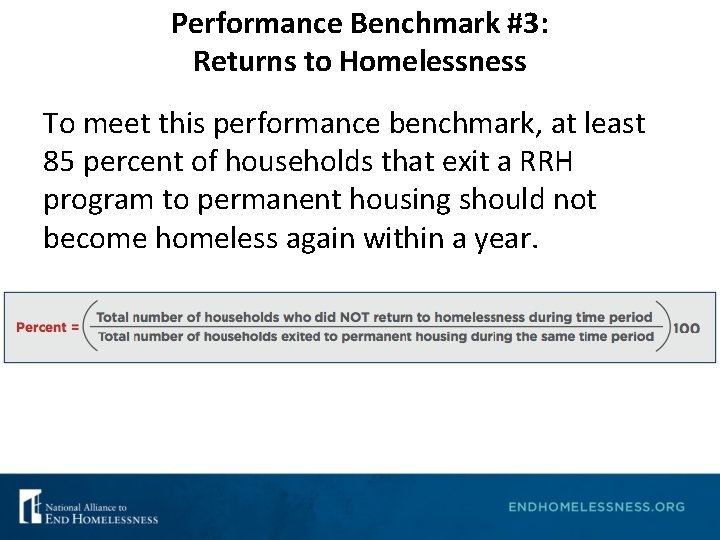
Performance Benchmark #3: Returns to Homelessness To meet this performance benchmark, at least 85 percent of households that exit a RRH program to permanent housing should not become homeless again within a year.
RESOURCES Rapid Re-housing Performance Benchmarks and Program Standards http: //www. endhomelessness. org/library/entry/rapid-rehousing-performance-benchmarks-and-program-standards Rapid Re-housing “Know-How” Series http: //www. endhomelessness. org/library/entry/rrh-know-how Rapid Re-housing: A History and Core Components http: //www. endhomelessness. org/page//files/RRH%20 Core%20 Elements%20 Brief. pdf
Questions Center for Capacity Building thecenter@naeh. org Samantha Batko sbatko@naeh. org
- Slides: 52