
An Introduction to the National Child Development Study

- Slides: 13
An Introduction to the National Child Development Study (NCDS, or the 1958 British birth cohort study) David Bann
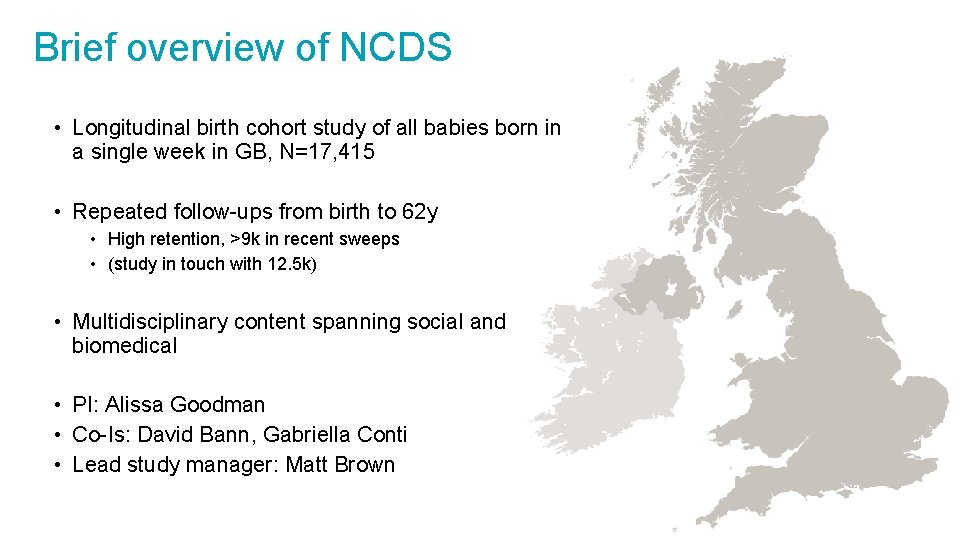
Brief overview of NCDS • Longitudinal birth cohort study of all babies born in a single week in GB, N=17, 415 • Repeated follow-ups from birth to 62 y • High retention, >9 k in recent sweeps • (study in touch with 12. 5 k) • Multidisciplinary content spanning social and biomedical • PI: Alissa Goodman • Co-Is: David Bann, Gabriella Conti • Lead study manager: Matt Brown
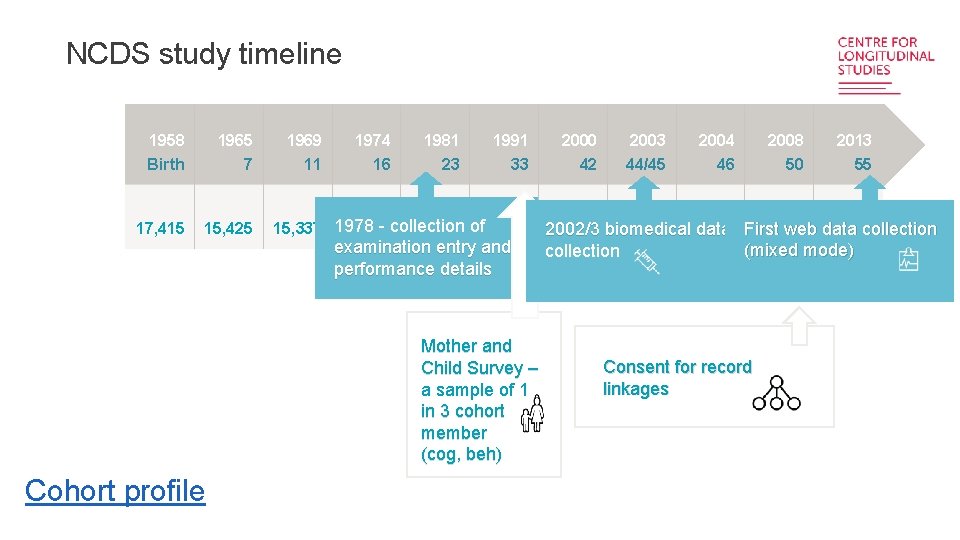
NCDS study timeline 1958 1965 1969 1974 1981 1991 2000 2003 2004 2008 2013 Birth 7 11 16 23 33 42 44/45 46 50 55 17, 415 15, 425 - collection 15, 337 1978 14, 654 12, 537 of 11, 469 examination entry and performance details Mother and Child Survey – a sample of 1 in 3 cohort member (cog, beh) Cohort profile 11, 419 biomedical 9, 377 9, 534 9, 790 9, 137 web data collection 2002/3 data First (mixed mode) collection Consent for record linkages
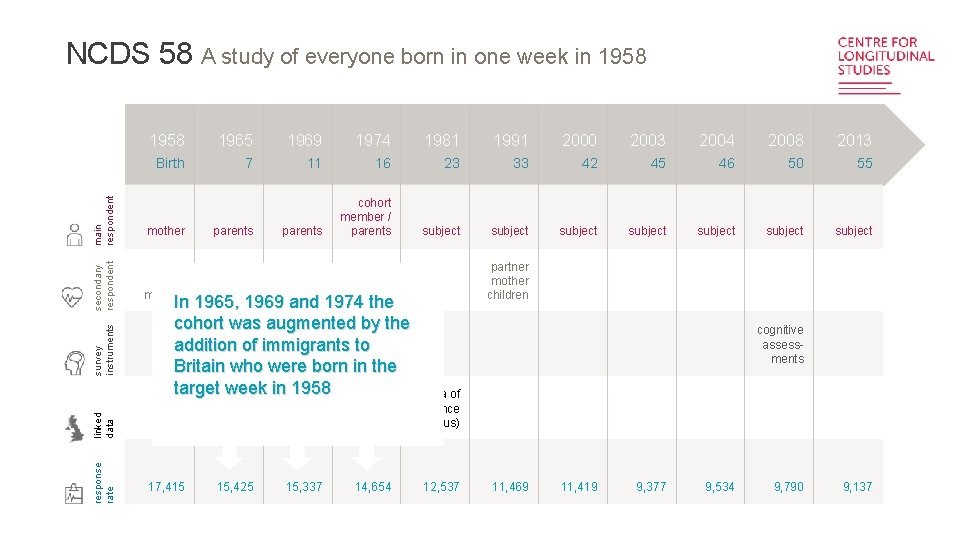
1958 1965 1969 1974 1981 1991 2000 2003 2004 2008 2013 Birth 7 11 16 23 33 42 45 46 50 55 parents cohort member / parents subject subject mother medical parents medical / school response rate partner mother children medical / school In 1965, 1969 and 1974 the cohort was augmented by the cognitive assessassessaddition of immigrants to ments Britain who were born in the target week in 1958 area of linked data survey instruments secondary respondent main respondent NCDS 58 A study of everyone born in one week in 1958 17, 415 15, 425 15, 337 cognitive assessments residence (census) area of residence (census) 14, 654 12, 537 11, 469 11, 419 9, 377 9, 534 9, 790 9, 137
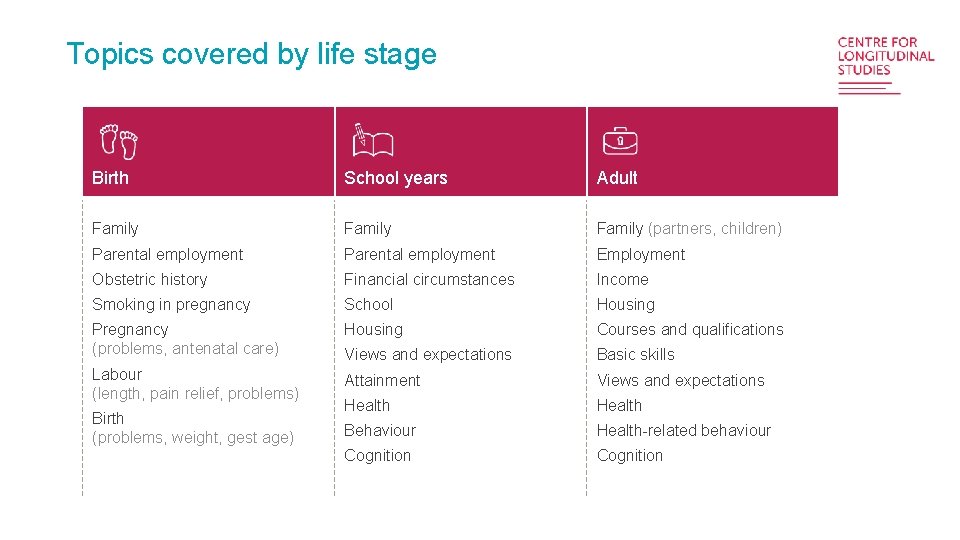
Topics covered by life stage Birth School years Adult Family (partners, children) Parental employment Employment Obstetric history Financial circumstances Income Smoking in pregnancy School Housing Pregnancy (problems, antenatal care) Housing Courses and qualifications Views and expectations Basic skills Labour (length, pain relief, problems) Attainment Views and expectations Birth (problems, weight, gest age) Health Behaviour Health-related behaviour Cognition
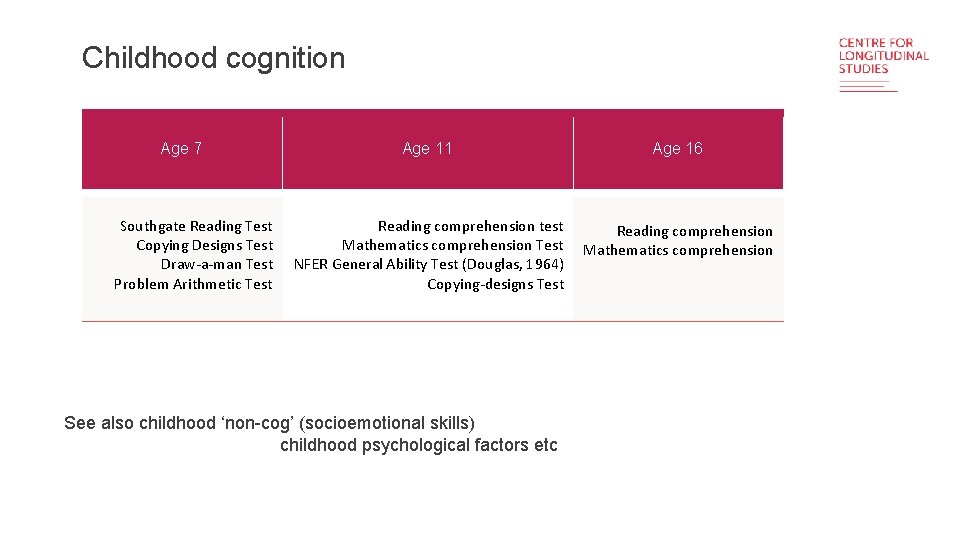
Childhood cognition Age 7 Age 11 Age 16 age Southgate Reading Test Copying Designs Test Draw-a-man Test Problem Arithmetic Test Reading comprehension test Mathematics comprehension Test NFER General Ability Test (Douglas, 1964) Copying-designs Test See also childhood ‘non-cog’ (socioemotional skills) childhood psychological factors etc Reading comprehension Mathematics comprehension
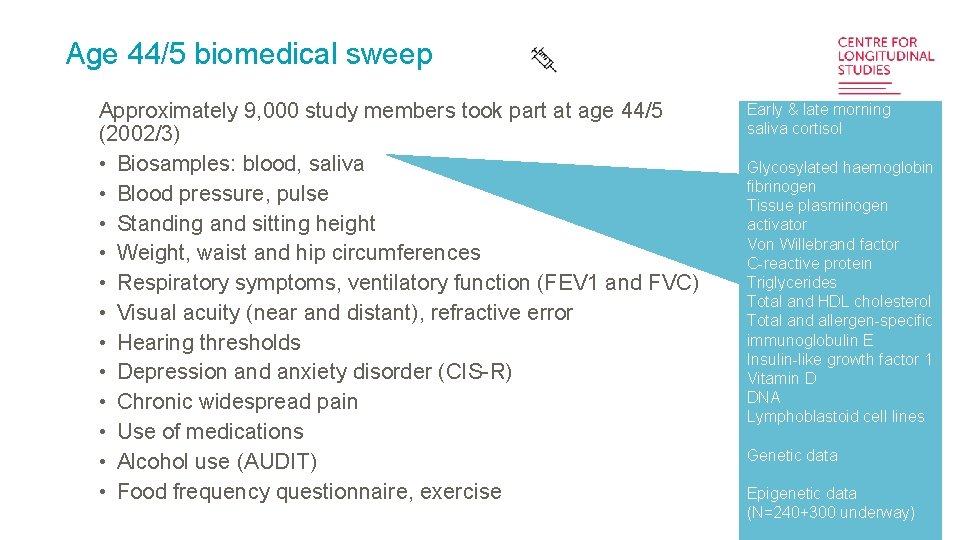
Age 44/5 biomedical sweep Approximately 9, 000 study members took part at age 44/5 (2002/3) • Biosamples: blood, saliva • Blood pressure, pulse • Standing and sitting height • Weight, waist and hip circumferences • Respiratory symptoms, ventilatory function (FEV 1 and FVC) • Visual acuity (near and distant), refractive error • Hearing thresholds • Depression and anxiety disorder (CIS-R) • Chronic widespread pain • Use of medications • Alcohol use (AUDIT) • Food frequency questionnaire, exercise Early & late morning saliva cortisol Glycosylated haemoglobin fibrinogen Tissue plasminogen activator Von Willebrand factor C-reactive protein Triglycerides Total and HDL cholesterol Total and allergen-specific immunoglobulin E Insulin-like growth factor 1 Vitamin D DNA Lymphoblastoid cell lines Genetic data Epigenetic data (N=240+300 underway)
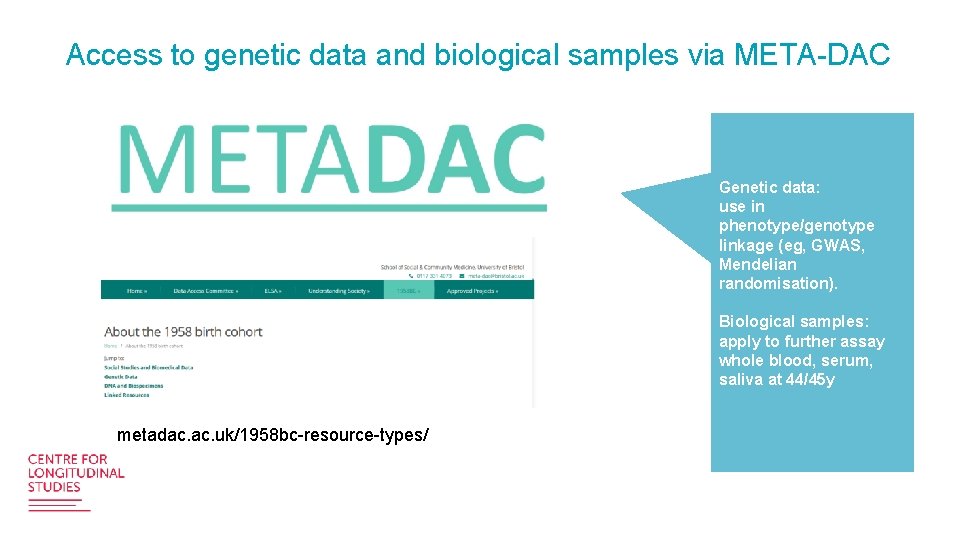
Access to genetic data and biological samples via META-DAC Genetic data: use in phenotype/genotype linkage (eg, GWAS, Mendelian randomisation). Biological samples: apply to further assay whole blood, serum, saliva at 44/45 y metadac. uk/1958 bc-resource-types/
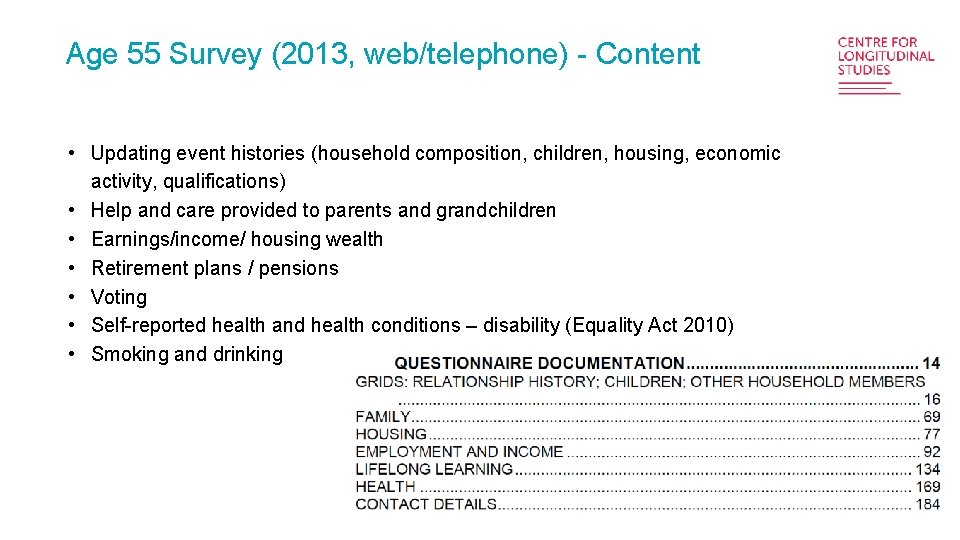
Age 55 Survey (2013, web/telephone) - Content • Updating event histories (household composition, children, housing, economic activity, qualifications) • Help and care provided to parents and grandchildren • Earnings/income/ housing wealth • Retirement plans / pensions • Voting • Self-reported health and health conditions – disability (Equality Act 2010) • Smoking and drinking
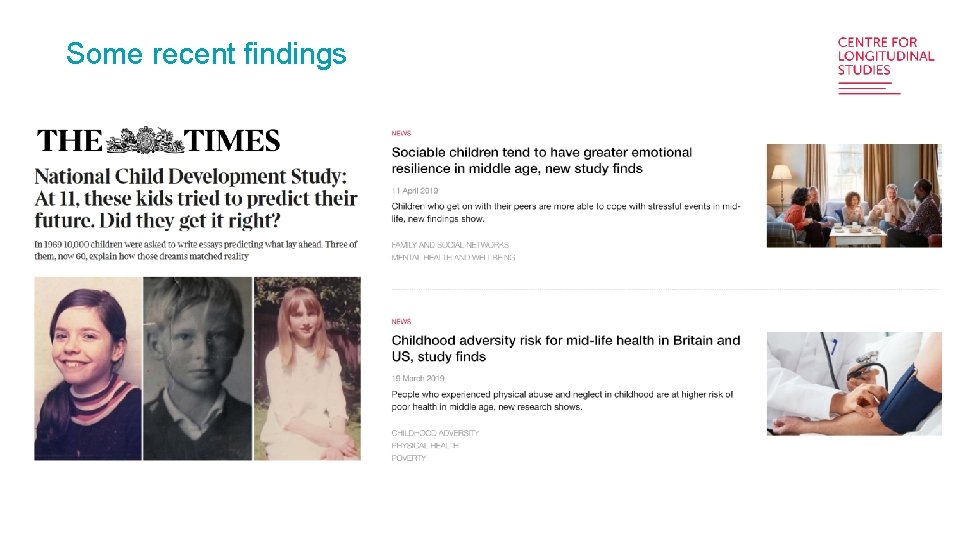
Some recent findings
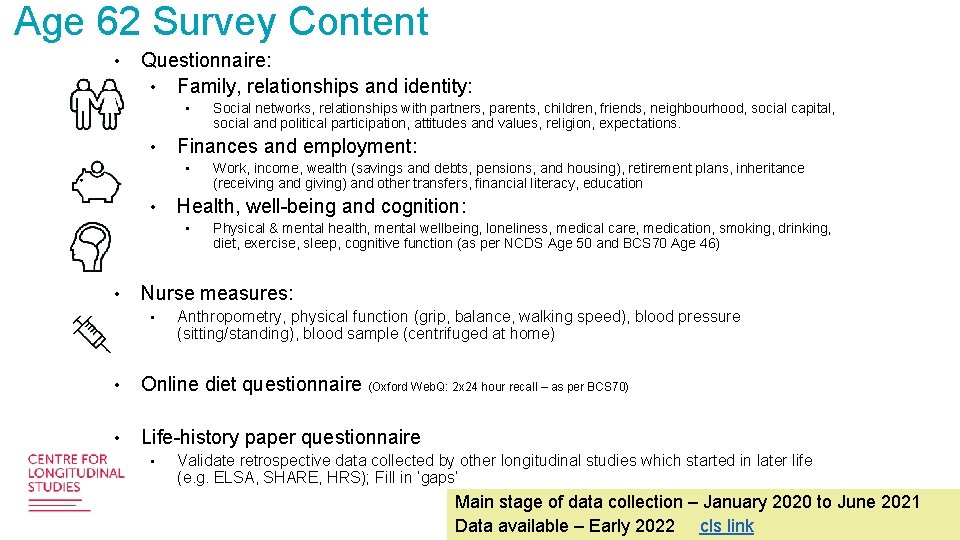
Age 62 Survey Content • Questionnaire: • Family, relationships and identity: • • Finances and employment: • • Work, income, wealth (savings and debts, pensions, and housing), retirement plans, inheritance (receiving and giving) and other transfers, financial literacy, education Health, well-being and cognition: • • Social networks, relationships with partners, parents, children, friends, neighbourhood, social capital, social and political participation, attitudes and values, religion, expectations. Physical & mental health, mental wellbeing, loneliness, medical care, medication, smoking, drinking, diet, exercise, sleep, cognitive function (as per NCDS Age 50 and BCS 70 Age 46) Nurse measures: • Anthropometry, physical function (grip, balance, walking speed), blood pressure (sitting/standing), blood sample (centrifuged at home) • Online diet questionnaire (Oxford Web. Q: 2 x 24 hour recall – as per BCS 70) • Life-history paper questionnaire • Validate retrospective data collected by other longitudinal studies which started in later life (e. g. ELSA, SHARE, HRS); Fill in ‘gaps’ Main stage of data collection – January 2020 to June 2021 Data available – Early 2022 cls link
Scientific questions and contribution of NCDS § Long term effects of early life circumstances § Intergenerational transmission of advantage and disadvantage and the processes involved § Returns to choices and investments made across life § Drivers & consequences of life trajectories – health, SES, family § Cross-cohort comparative research eg, social mobility, health inequality
Thanks to our funders and host institution Funded by Hosted by www. esrc. ac. uk www. ioe. ac. uk