
AN INTRODUCTION TO THE INITIAL ASSESSMENT OF WILDLIFE
- Slides: 31
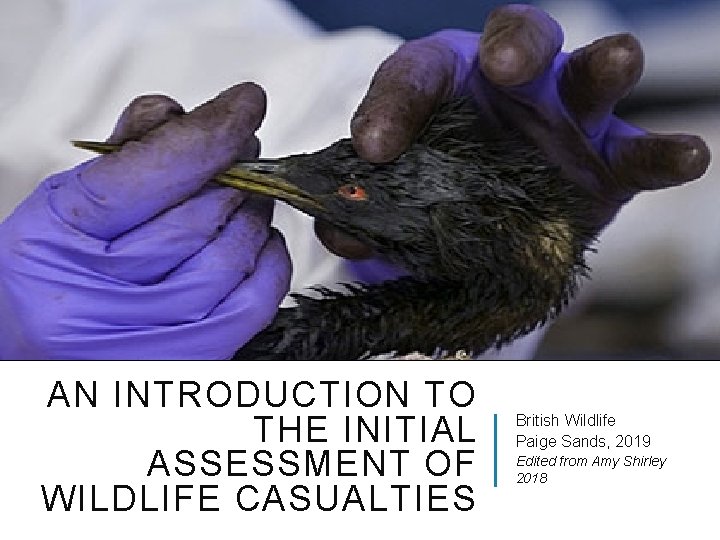
AN INTRODUCTION TO THE INITIAL ASSESSMENT OF WILDLIFE CASUALTIES British Wildlife Paige Sands, 2019 Edited from Amy Shirley 2018
LEARNING OBJECTIVES Set Task C. Define what wildlife rehabilitation is. Outline what initial assessment is and the role it plays in the wildlife rehabilitation process. Identify, using common examples, the physical signs of injury and other indicators used in initial assessment of wildlife casualties.
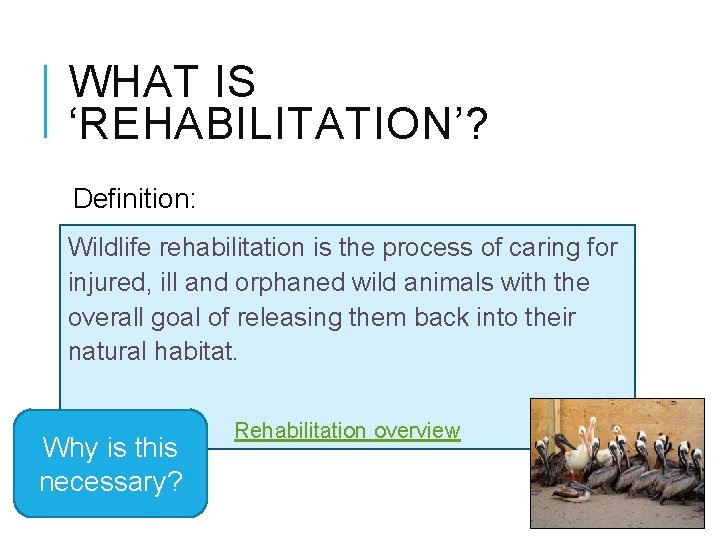
WHAT IS ‘REHABILITATION’? Definition: Wildlife rehabilitation is the process of caring for injured, ill and orphaned wild animals with the overall goal of releasing them back into their natural habitat. Why is this necessary? Rehabilitation overview
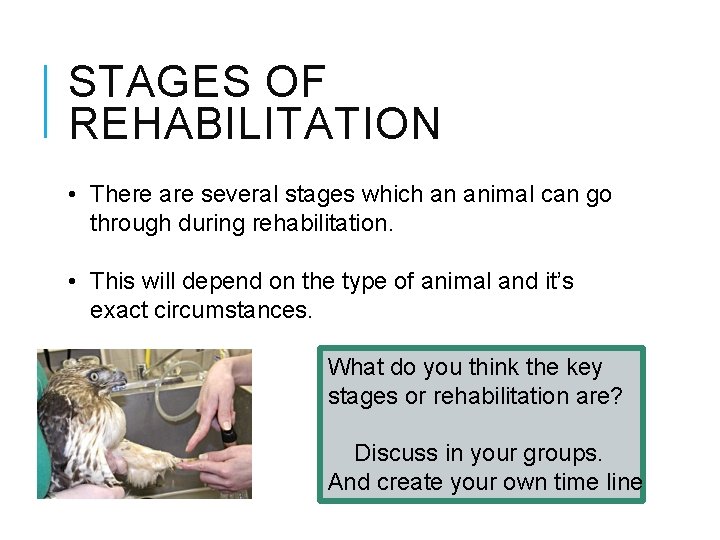
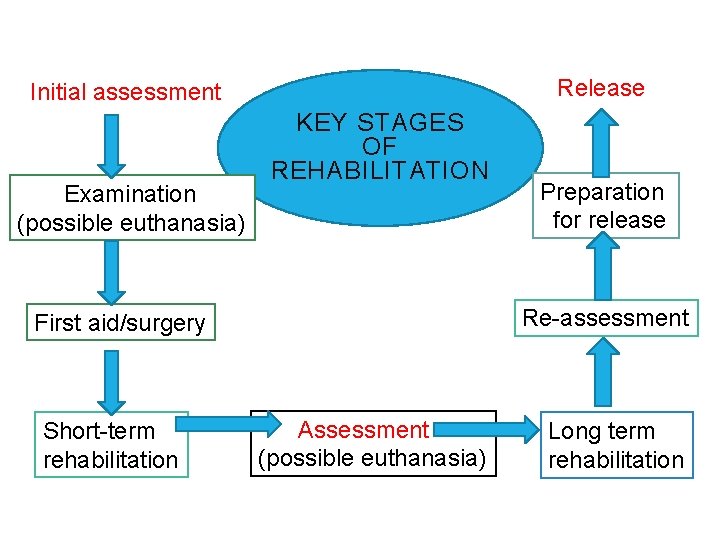
STAGES OF REHABILITATION • There are several stages which an animal can go through during rehabilitation. • This will depend on the type of animal and it’s exact circumstances. What do you think the key stages or rehabilitation are? Discuss in your groups. And create your own time line
Release Initial assessment Examination (possible euthanasia) KEY STAGES OF REHABILITATION Re-assessment First aid/surgery Short-term rehabilitation Preparation for release Assessment (possible euthanasia) Long term rehabilitation
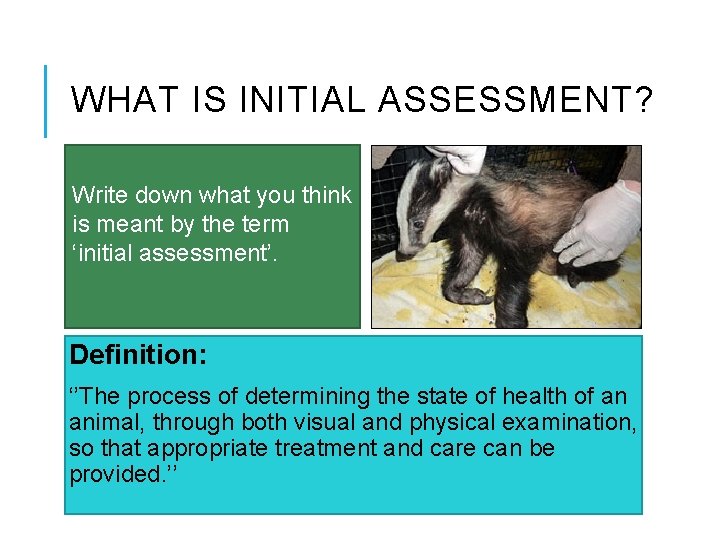
WHAT IS INITIAL ASSESSMENT? Write down what you think is meant by the term ‘initial assessment’. Definition: ‘’The process of determining the state of health of an animal, through both visual and physical examination, so that appropriate treatment and care can be provided. ’’
THE PURPOSE OF INITIAL ASSESSMENT Why do you think we need to carry out initial assessment of wildlife casualties?
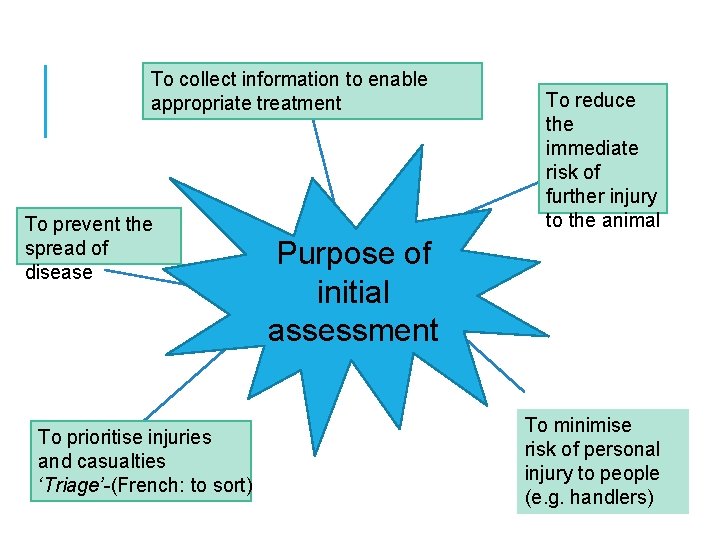
To collect information to enable appropriate treatment To prevent the spread of disease To prioritise injuries and casualties ‘Triage’-(French: to sort) To reduce the immediate risk of further injury to the animal Purpose of initial assessment To minimise risk of personal injury to people (e. g. handlers)
SOME COMMON SITUATIONS LEADING TO ANIMAL RESCUE IN THE UK The following videos from Wildlife Aid on You. Tube demonstrate some good examples of initial assessment. When watching these videos, note down the good and bad points relating to each rescue. Take note of how the rescuer decides whether the animal can be directly released or not. Fox cub casualty-rescue-release Squirrel casualty- rescue-rehab-release
INITIAL ASSESSMENT OF PHYSICAL SIGNS Wild animals can suffer from many different types of injury and health problems. During initial assessment, we identify injuries through visual and physical examinations. Correctly identifying such injuries is crucial for appropriate and effective treatment of the animal.
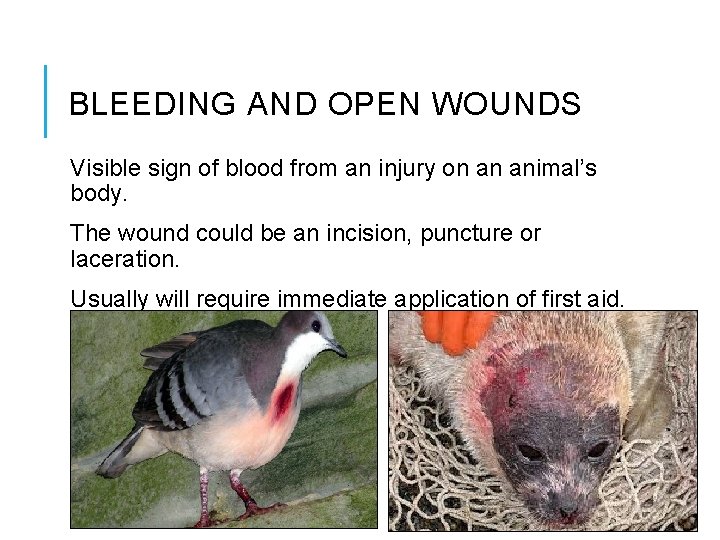
BLEEDING AND OPEN WOUNDS Visible sign of blood from an injury on an animal’s body. The wound could be an incision, puncture or laceration. Usually will require immediate application of first aid.
TYPES OF BLEEDING Arterial - Blood under direct pressure from the heart pumping and spurts in time with the heart beat. Blood loss is rapid and can be lifethreatening in just 2 mins. Venous – Veins are not under direct pressure from heart, however the blood will still be Oozing in high volume Capillary – Occurs in all wounds, fast flow at first Haemophilia – blood fails to clot – lacking in proteins in but easily controlled. platelets
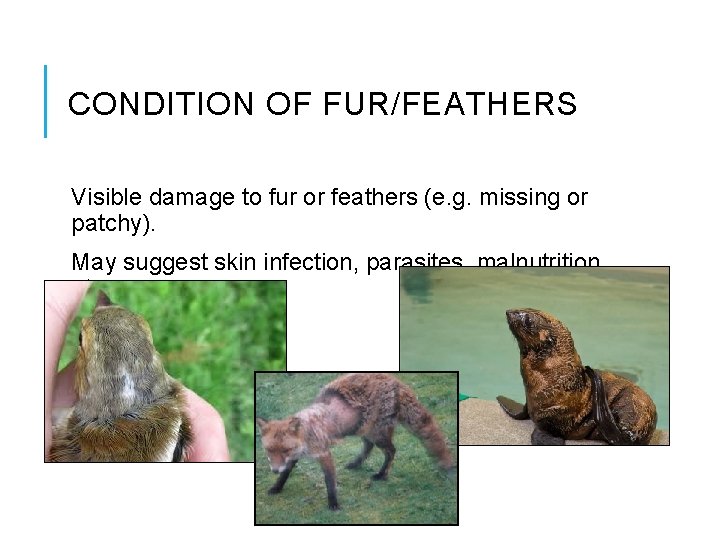
CONDITION OF FUR/FEATHERS Visible damage to fur or feathers (e. g. missing or patchy). May suggest skin infection, parasites, malnutrition etc.
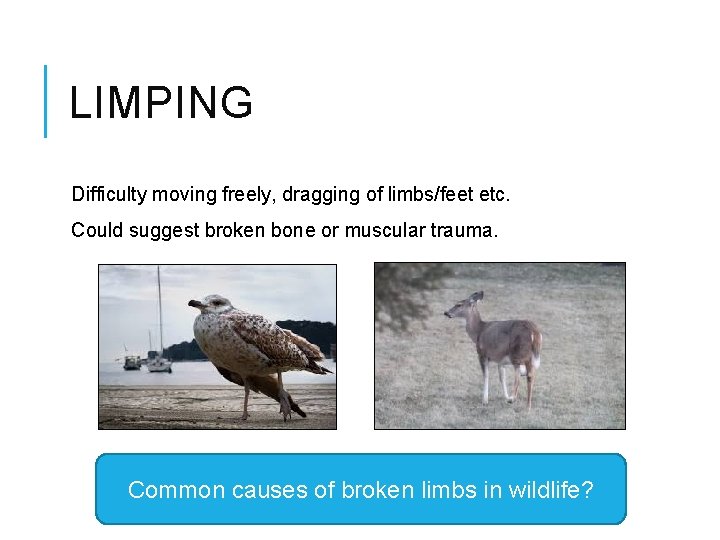
LIMPING Difficulty moving freely, dragging of limbs/feet etc. Could suggest broken bone or muscular trauma. Common causes of broken limbs in wildlife?
INITIAL ASSESSMENT OF CLINICAL SIGNS Clinical signs vary slightly from physical indicators in that they can be directly used to diagnose a medical condition. This usually involves taking readings or some kind of measurement in the field to inform the diagnosis
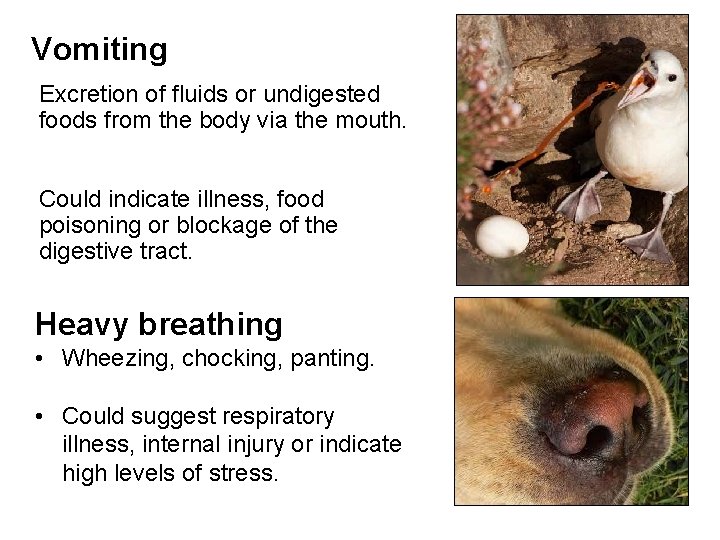
Vomiting Excretion of fluids or undigested foods from the body via the mouth. Could indicate illness, food poisoning or blockage of the digestive tract. Heavy breathing • Wheezing, chocking, panting. • Could suggest respiratory illness, internal injury or indicate high levels of stress.
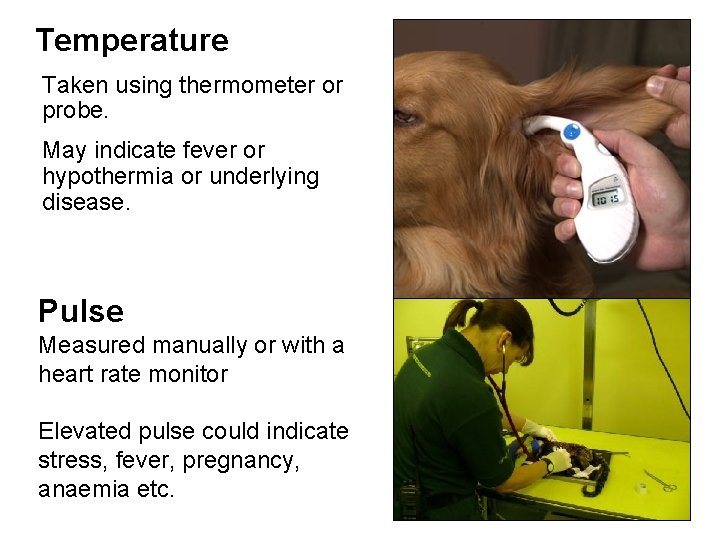
Temperature Taken using thermometer or probe. May indicate fever or hypothermia or underlying disease. Pulse Measured manually or with a heart rate monitor Elevated pulse could indicate stress, fever, pregnancy, anaemia etc.
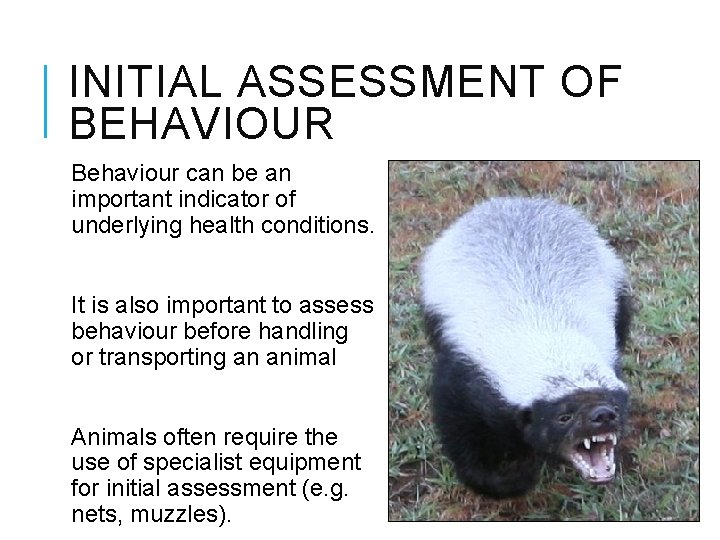
INITIAL ASSESSMENT OF BEHAVIOUR Behaviour can be an important indicator of underlying health conditions. It is also important to assess behaviour before handling or transporting an animal Animals often require the use of specialist equipment for initial assessment (e. g. nets, muzzles).
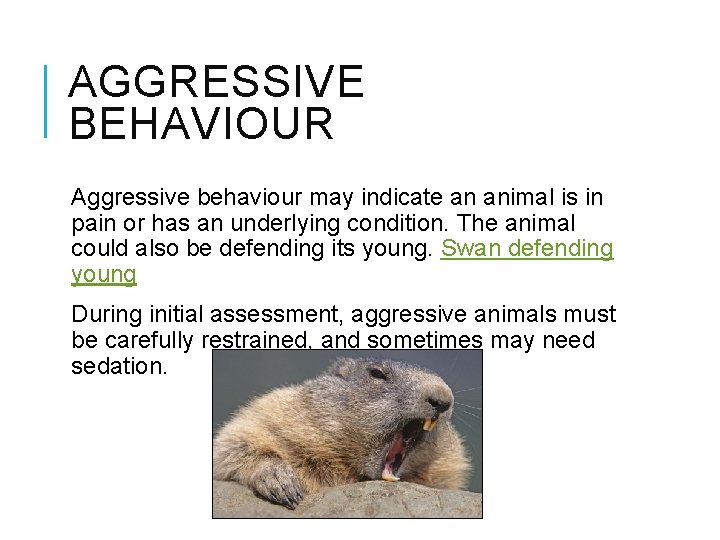
AGGRESSIVE BEHAVIOUR Aggressive behaviour may indicate an animal is in pain or has an underlying condition. The animal could also be defending its young. Swan defending young During initial assessment, aggressive animals must be carefully restrained, and sometimes may need sedation.
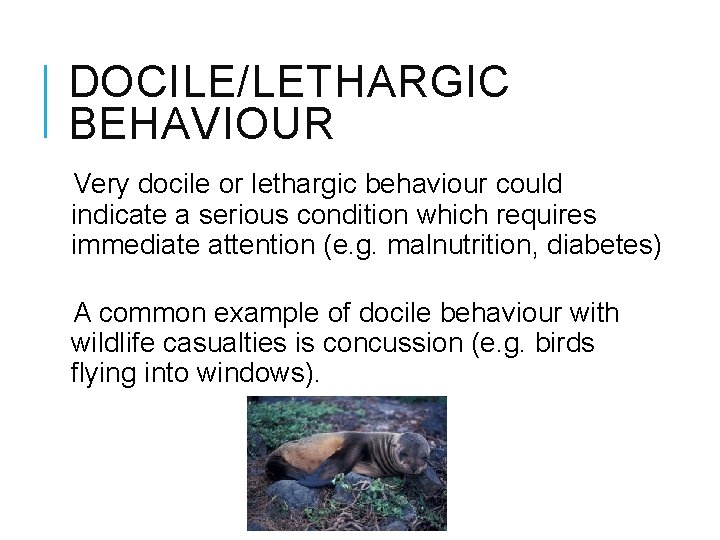
DOCILE/LETHARGIC BEHAVIOUR Very docile or lethargic behaviour could indicate a serious condition which requires immediate attention (e. g. malnutrition, diabetes) A common example of docile behaviour with wildlife casualties is concussion (e. g. birds flying into windows).
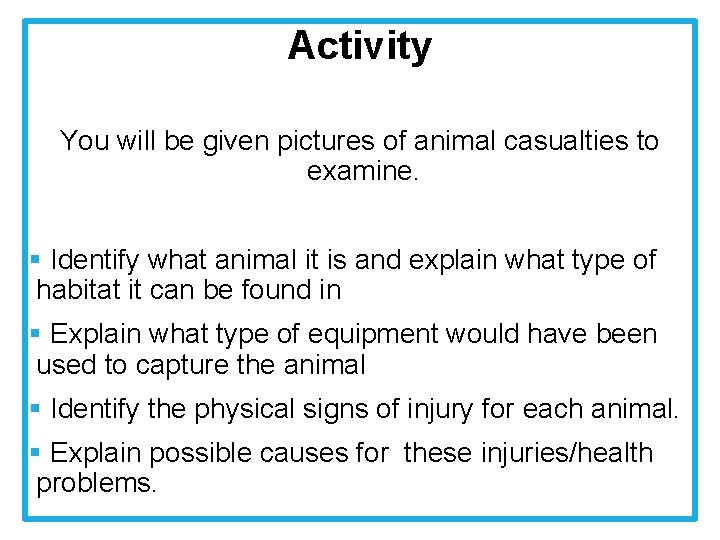
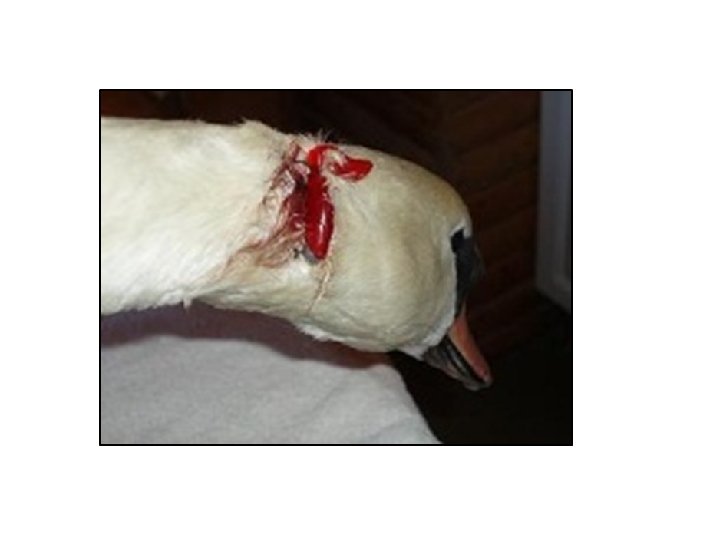
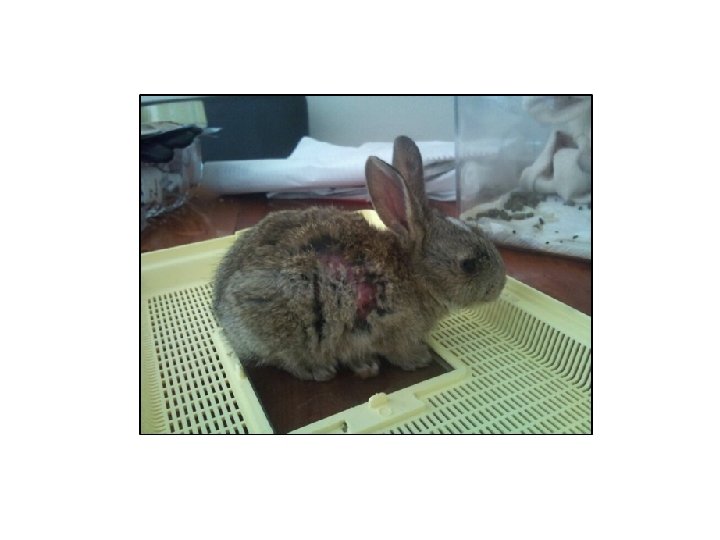
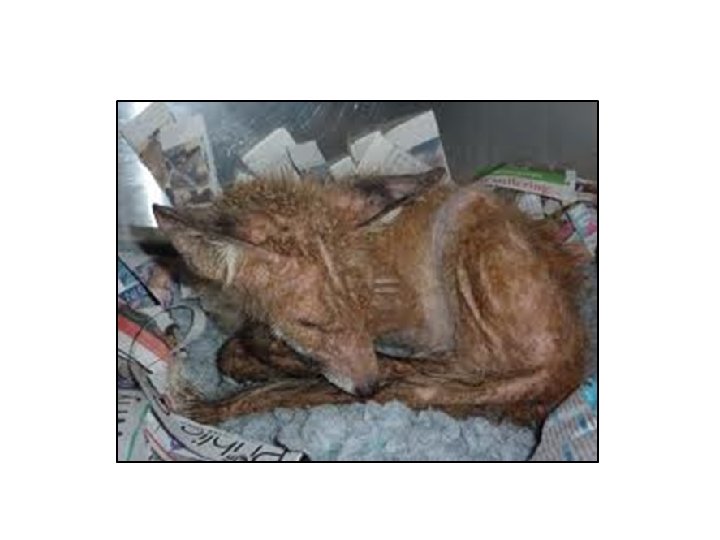
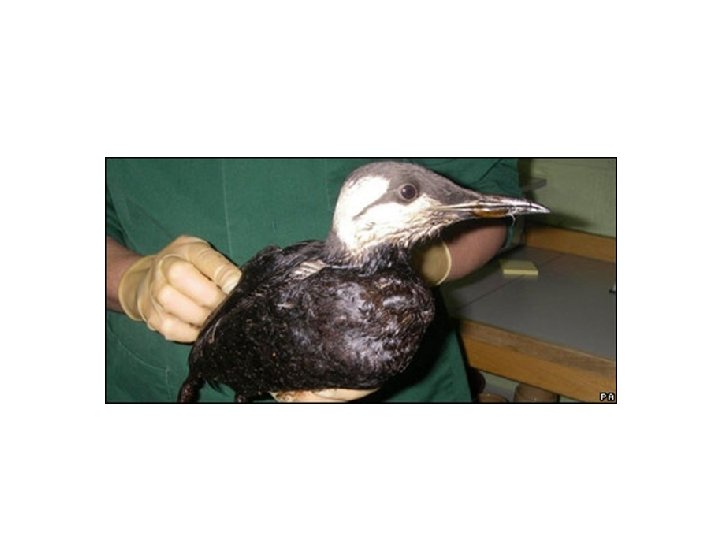
Activity You will be given pictures of animal casualties to examine. § Identify what animal it is and explain what type of habitat it can be found in § Explain what type of equipment would have been used to capture the animal § Identify the physical signs of injury for each animal. § Explain possible causes for these injuries/health problems.
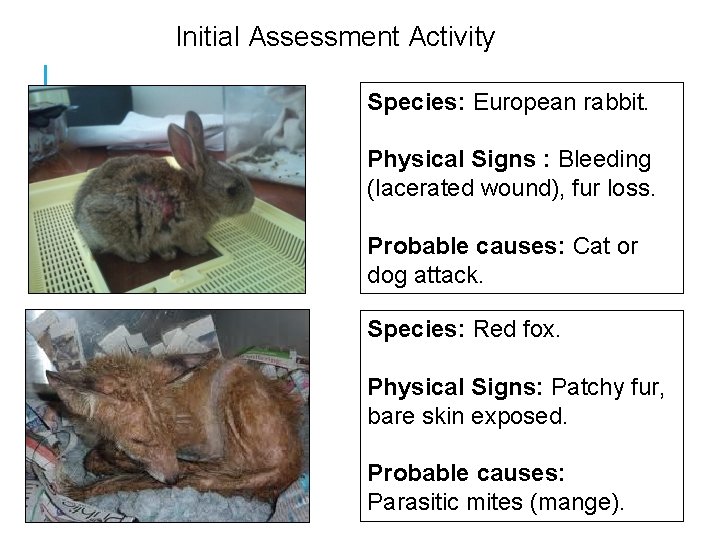
Initial Assessment Activity Species: European rabbit. Physical Signs : Bleeding (lacerated wound), fur loss. Probable causes: Cat or dog attack. Species: Red fox. Physical Signs: Patchy fur, bare skin exposed. Probable causes: Parasitic mites (mange).
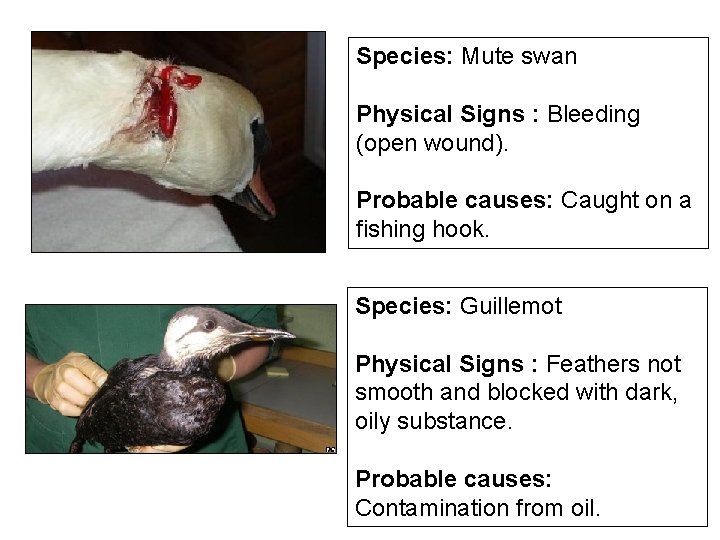
Species: Mute swan Physical Signs : Bleeding (open wound). Probable causes: Caught on a fishing hook. Species: Guillemot Physical Signs : Feathers not smooth and blocked with dark, oily substance. Probable causes: Contamination from oil.
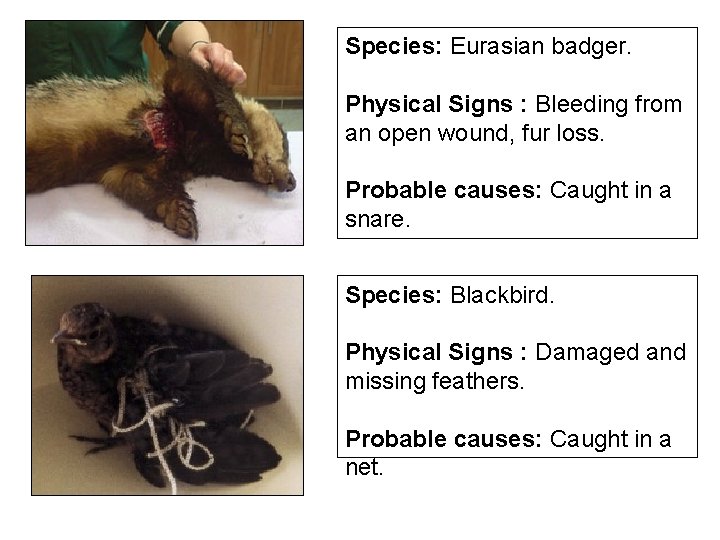
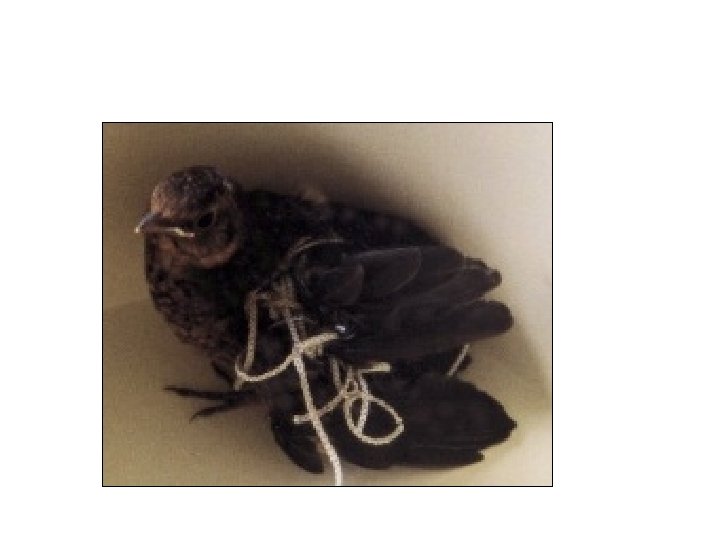
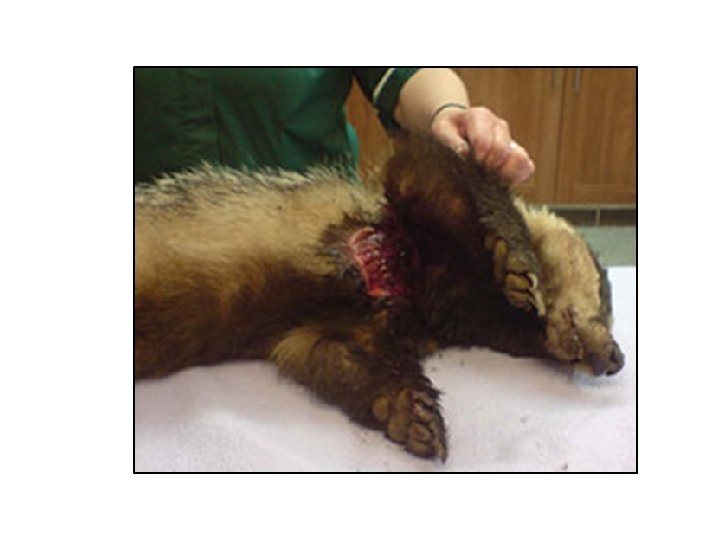
Species: Eurasian badger. Physical Signs : Bleeding from an open wound, fur loss. Probable causes: Caught in a snare. Species: Blackbird. Physical Signs : Damaged and missing feathers. Probable causes: Caught in a net.
FURTHER READING Meredith, A & Keeble, E, (2011) Wildlife Medicine and Rehabilitation: Self-Assessment Colour Review. Thieme. BSVA Manual of Wildlife Casualties (2003).