
An introduction to the ILO Radiological Classification of


- Slides: 28
An introduction to the ILO Radiological Classification of the Pneumoconioses Professor Neil White
Objective of the session • To provide an introduction to the radiology of pneumoconioses; • Background reading material – Guidelines for the use of the ILO International Classification of Radiographs of Pneumoconioses • Home Study material – Guidelines for the use of the ILO International Classification of Radiographs of Pneumoconioses – ROLDS CD-ROM • “The Symposium” • “The Simulation”
The “ILO Classification” • ILO International Classification of Radiographs of Pneumoconioses (1980) • Primarily an epidemiological tool. • ILO Classification not intended to define pathological entities, take into account working capacity, nor imply a definition of pneumoconiosis for compensation purposes.
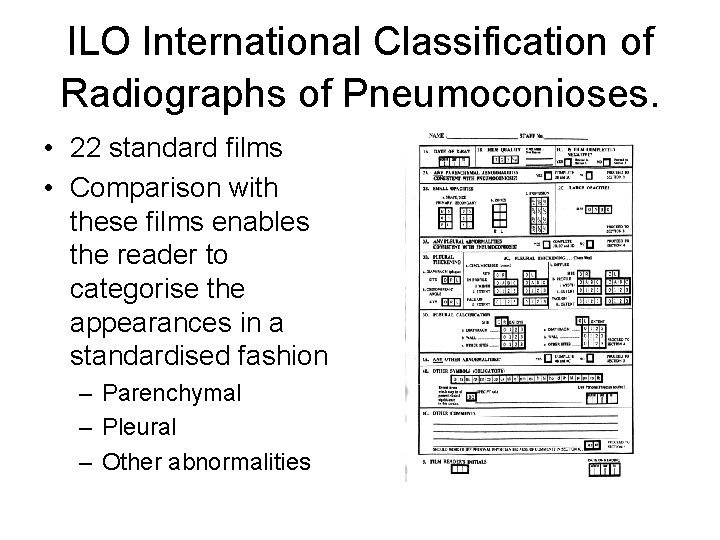
ILO International Classification of Radiographs of Pneumoconioses. • 22 standard films • Comparison with these films enables the reader to categorise the appearances in a standardised fashion – Parenchymal – Pleural – Other abnormalities
ILO Classification: Quality • • 1 = acceptable 2 = minor defect 3 = major defect but still interpretable 4 = unreadable
ILO Classification: Abnormal? • If any appearances of pleura or parenchyma are consistent with pneumoconiosis proceed. Use symbols and comments for any appearances that are definitely not pneumoconiosis. • If it is probable that all appearances are the result of other aetiology do not classify. • If the appearances might be due to pneumoconiosis record, but note what other aetiology was considered.
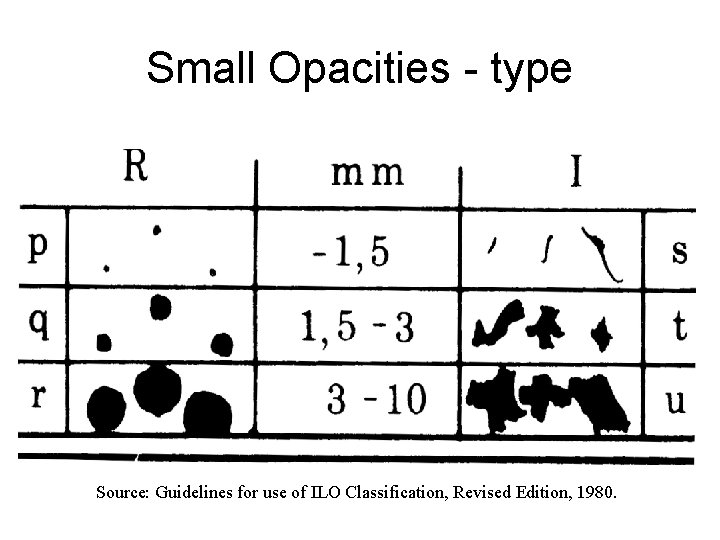
Small Opacities - type Rounded Irregular • p < 1. 5 mm • q 1. 5 to < 3 mm • r 3 to < 10 mm • s < 1. 5 mm • t 1. 5 to < 3 mm • u 3 to < 10 mm An opacity is rounded if its greatest diameter is less than 1. 5 times its smallest diameter.
Small Opacities - type Source: Guidelines for use of ILO Classification, Revised Edition, 1980.
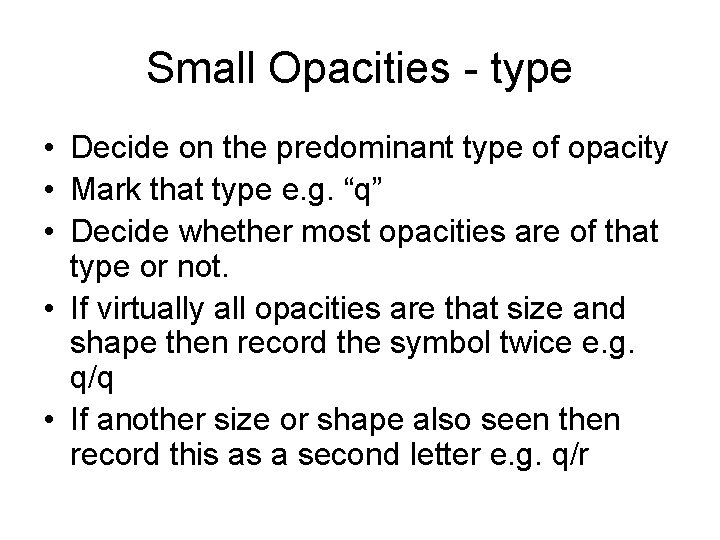
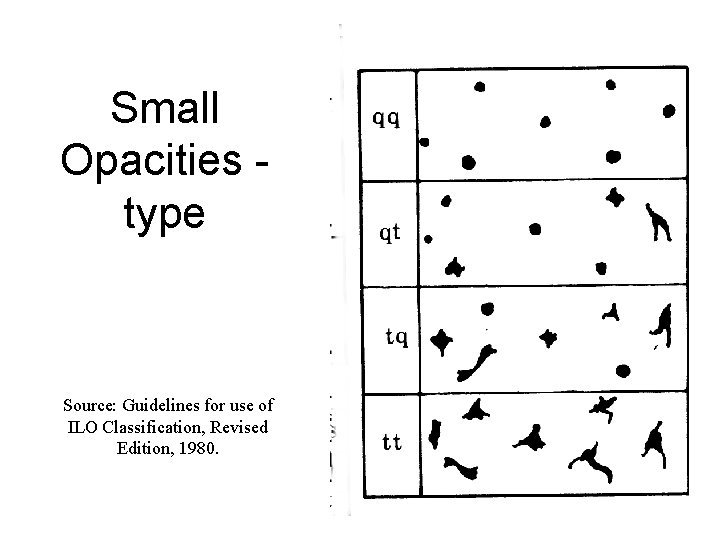
Small Opacities - type • Decide on the predominant type of opacity • Mark that type e. g. “q” • Decide whether most opacities are of that type or not. • If virtually all opacities are that size and shape then record the symbol twice e. g. q/q • If another size or shape also seen then record this as a second letter e. g. q/r
Small Opacities type Source: Guidelines for use of ILO Classification, Revised Edition, 1980.
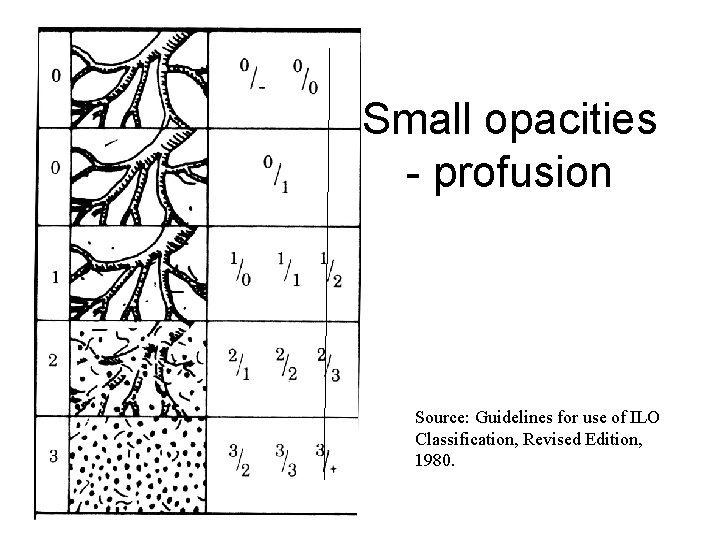
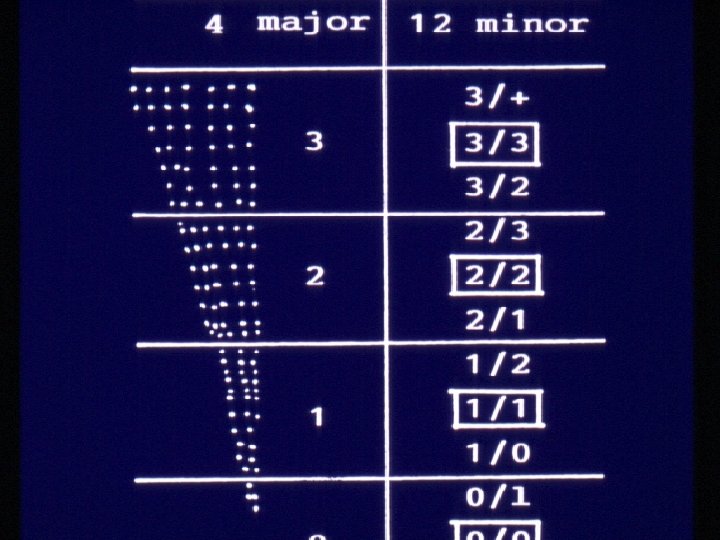
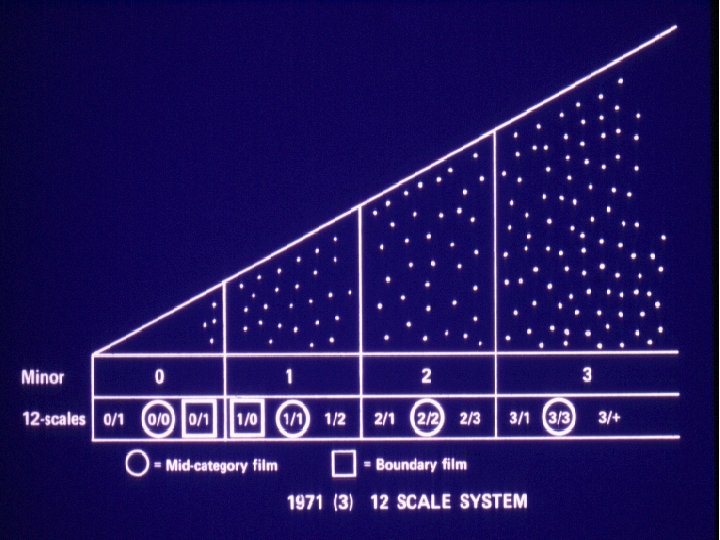
Small Opacities - profusion • Four point scale 0 = normal 1, 2, 3 = abnormal (increasing numbers of small opacities) • Four point scale extended to a 12 point scale. 0/- 0/0 0/1 = normal 1/0 1/1 1/2 2/1 2/2 2/3 3/2 3/3 3/+
Small opacities - profusion Source: Guidelines for use of ILO Classification, Revised Edition, 1980.
Small Opacities – profusion • Visually integrate the small opacities seen. • The distinction between 0/1 and 1/0 crucial – 0/1 is normal, 1/0 is not. • Select out the closest standard film. If the film corresponds closely to a standard film, then use that full category e. g. 2/2. If less profuse 2/1, if more profuse 2/3.
Small Opacities – profusion • Pneumoconiosis is usually, but not always symmetrical. • If there is significant regional difference in profusion apply the following: – If any zone is 3 or more sub-categories less profuse than the most profuse zone then do not include that zone in the decision on recording profusion.
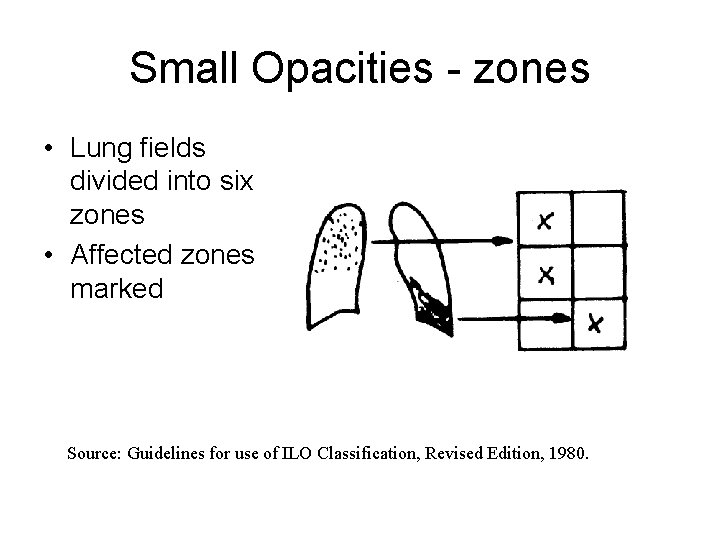
Small Opacities - zones • Lung fields divided into six zones • Affected zones marked Source: Guidelines for use of ILO Classification, Revised Edition, 1980.
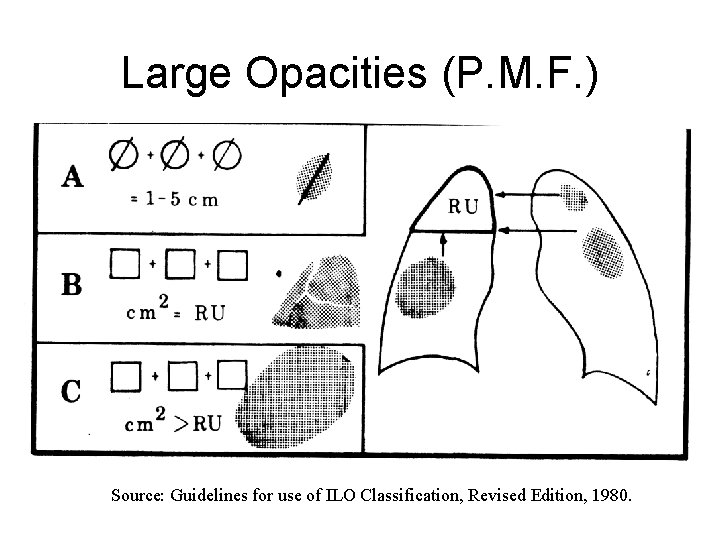
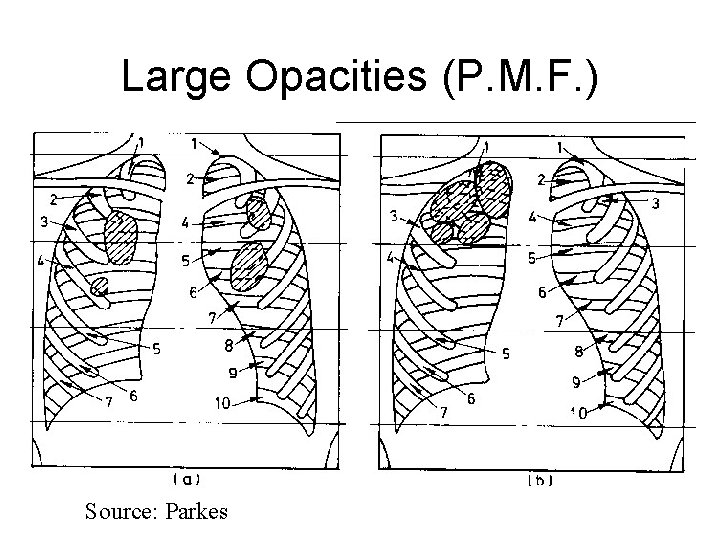
Large opacities (P. M. F. ) • A = greatest diameter >10 mm but < 50 mm or several opacities > 10 mm but sum of greatest diameters < 50 mm • B = one or more opacities with sum of greatest diameter > 50 mm but < area of right upper zone • C = combined area > right upper zone (Note: the lower border of the RUZ is at the lower margin of the anterior end of the second rib on a non- lordotic or kyphotic film. )
Large Opacities (P. M. F. ) Source: Guidelines for use of ILO Classification, Revised Edition, 1980.
Large Opacities (P. M. F. ) Source: Parkes
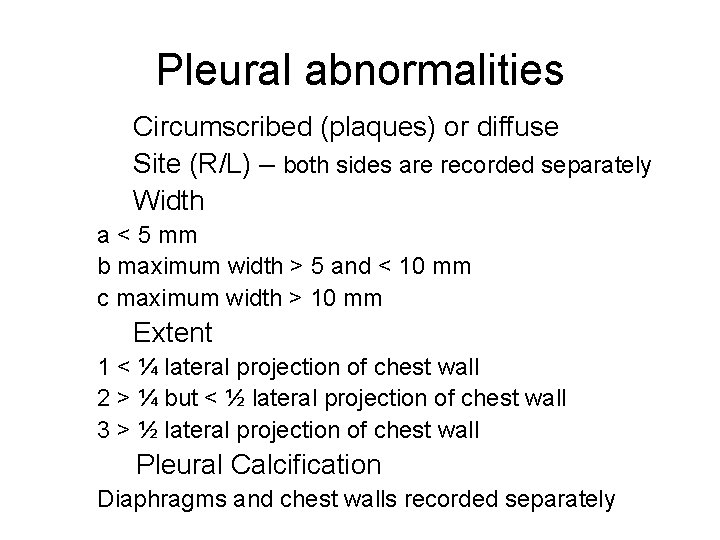
Pleural abnormalities Circumscribed (plaques) or diffuse Site (R/L) – both sides are recorded separately Width a < 5 mm b maximum width > 5 and < 10 mm c maximum width > 10 mm Extent 1 < ¼ lateral projection of chest wall 2 > ¼ but < ½ lateral projection of chest wall 3 > ½ lateral projection of chest wall Pleural Calcification Diaphragms and chest walls recorded separately
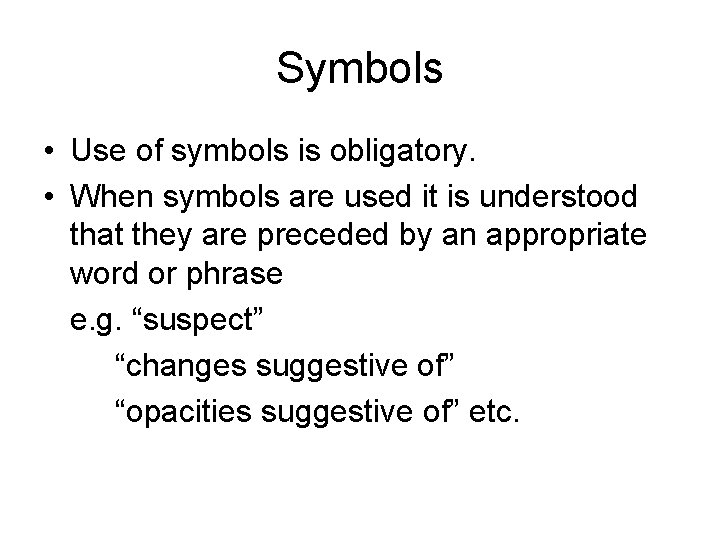
Symbols • Use of symbols is obligatory. • When symbols are used it is understood that they are preceded by an appropriate word or phrase e. g. “suspect” “changes suggestive of” “opacities suggestive of” etc.
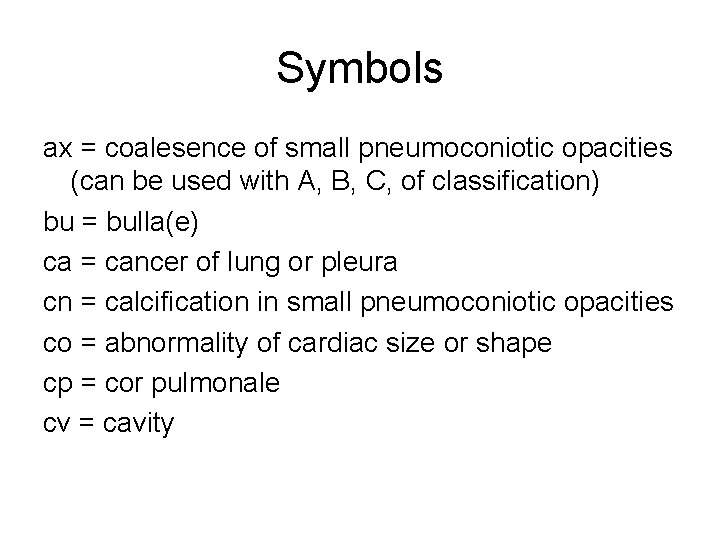
Symbols ax = coalesence of small pneumoconiotic opacities (can be used with A, B, C, of classification) bu = bulla(e) ca = cancer of lung or pleura cn = calcification in small pneumoconiotic opacities co = abnormality of cardiac size or shape cp = cor pulmonale cv = cavity
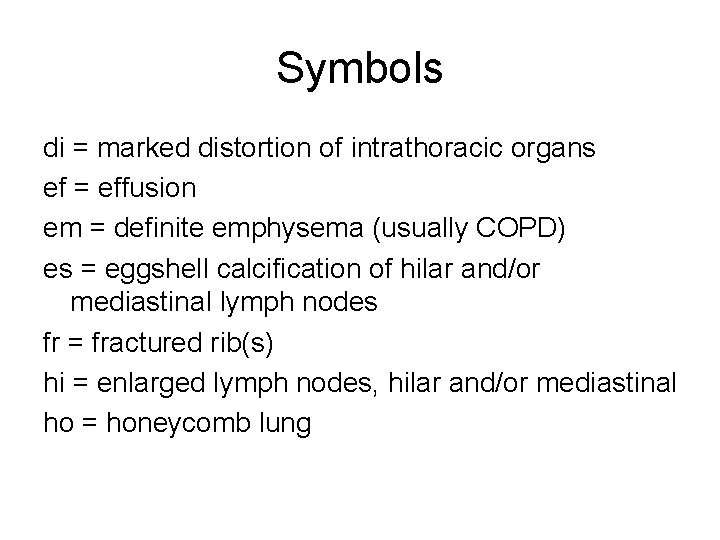
Symbols di = marked distortion of intrathoracic organs ef = effusion em = definite emphysema (usually COPD) es = eggshell calcification of hilar and/or mediastinal lymph nodes fr = fractured rib(s) hi = enlarged lymph nodes, hilar and/or mediastinal ho = honeycomb lung
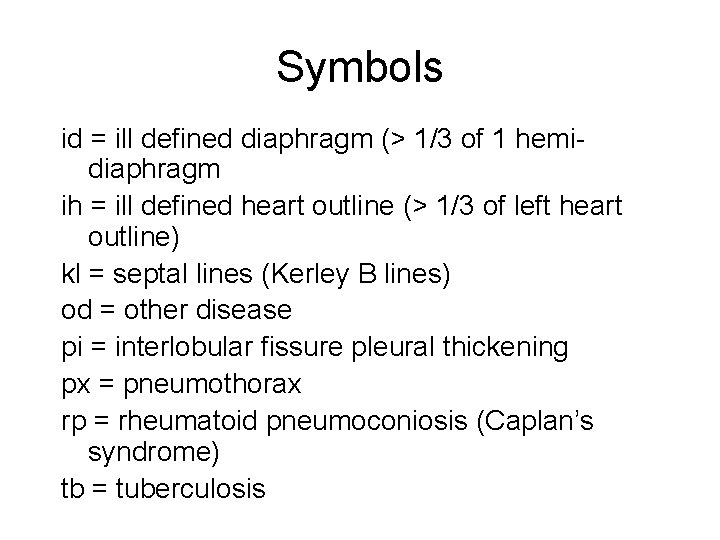
Symbols id = ill defined diaphragm (> 1/3 of 1 hemidiaphragm ih = ill defined heart outline (> 1/3 of left heart outline) kl = septal lines (Kerley B lines) od = other disease pi = interlobular fissure pleural thickening px = pneumothorax rp = rheumatoid pneumoconiosis (Caplan’s syndrome) tb = tuberculosis
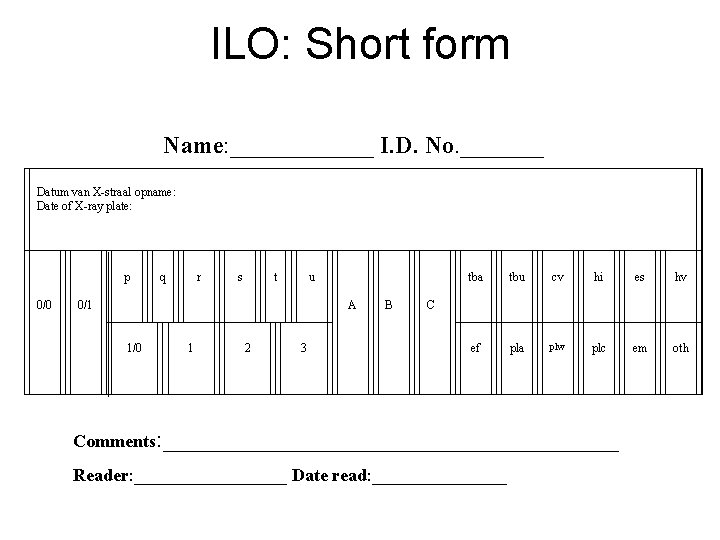
ILO: Short form Name: ______ I. D. No. _______ Datum van X-straal opname: Date of X-ray plate: 0/0 0/1 p 1/0 q r 1 s t 2 u 3 A B C tba tbu cv hi es hv ef pla plw plc em oth Comments: ___________________ Reader: _________ Date read: ________
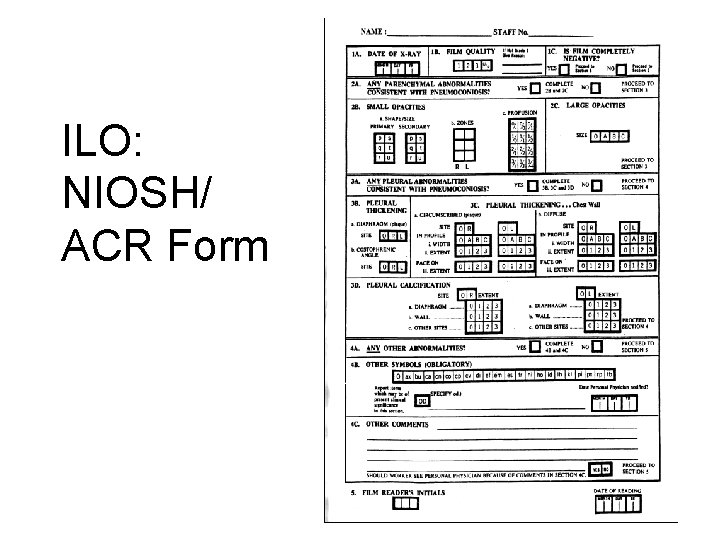
ILO: NIOSH/ ACR Form
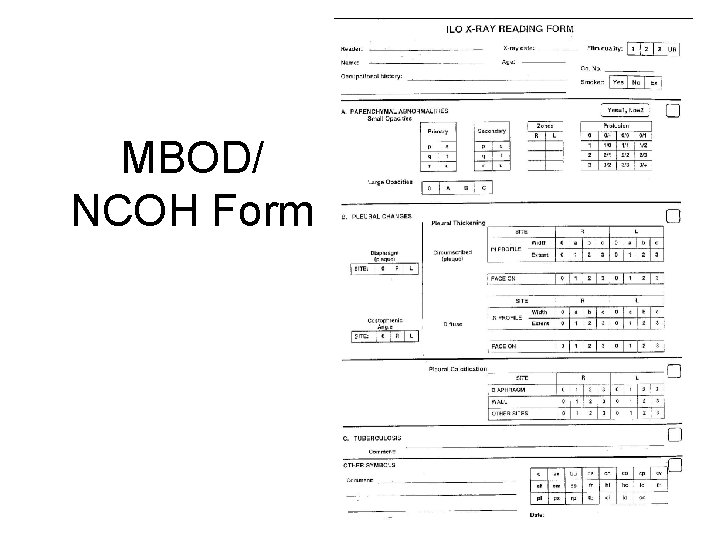
MBOD/ NCOH Form