
AN INTRODUCTION TO THE ICF SYSTEM INTERNATIONAL CLASSIFICATION

- Slides: 22
AN INTRODUCTION TO THE ICF SYSTEM INTERNATIONAL CLASSIFICATION OF FUNCTIONING, DISABILITY AND HEALTH Patricia Welch Saleeby, Ph. D. , M. S. S. A. Bradley University Social Work Program Council on Social Work Education Educator Resources July 2020
Introduction • There is a greater need for social workers who are effectively trained and prepared to address issues related to disability and health. • This situation continues to be complex and challenging since the meanings of disability and health continue to evolve in our society.
Changing Perception of Disability • Disability has become increasingly recognized as the dynamic interaction of the individual and his/her environment. • More realistically, disability may be viewed as the demands of an impairment or health condition, society's interpretation of it, and the broader societal context of disability.
Case Comparison • Consider Susie and Bob who both have recently been diagnosed with COVID-19 (coronavirus). • Prior to infection, Susie was quite healthy. In fact, she exhibited only mild symptoms due to COVID 19 – a slight fever and some coughing. • Bob, who has a history of asthma, has been much more compromised. He has experienced significant respiratory distress and now needs help to breathe from a ventilator.
Are These Cases the Same? • These individuals have the same diagnosis (COVID-19) but the impact has been very different on their respective functioning levels. • Consequently, their needs are not the same and their life situations require different types of interventions (not only medical but also social work and other interventions). • Unfortunately, a diagnostic-driven system cannot account for these differences.
Another Case Example • Consider a child who complains about some pain in her chest. Despite multiple tests and specialist examinations, a conclusive diagnosis has not been achieved. • Yet, the child continues to exhibit symptoms, and her functioning increasingly is impacted in multiple life areas. • Without a formal diagnosis, this child may not be able to get necessary treatment.
Justification for a Better System • We need a better system – one that does not rely on diagnosis alone, but rather one that includes functional status information. • We need a system that considers an individual’s functioning over time (dynamic, not static). • We need assessment that is multi-dimensional including information about the person (medical and social histories) as well as the environments (home, work, school, and community).
The ICF • Developed by the World Health Organization (2001), the International Classification of Functioning, Disability and Health (or, ICF) provides a useful framework, terminology, and classification to facilitate an enhanced understanding of disability, health, mental health, and functioning.
What is the ICF? • The ICF is a classification of health and health related domains. • It describes how people live with their health condition. • It represents a shift in thinking about disability and functioning.
Not Just Diagnosis, But Functioning • The ICF focuses on human functioning and provides a system to enable description of the components of functioning that are impacted by a health condition. • It is a tool that enables the collection of data as to how people with a health condition function in daily life, not only their diagnosis or the presence/ absence of any specific disease.
Unique Features of the ICF • It integrates the social and environmental aspects of disability and health. • It allows for the identification of factors at both individual and system levels. • It provides a framework for both mental and physical disorders. • It has great potential as a common global framework for organizing and communicating information on human functioning.
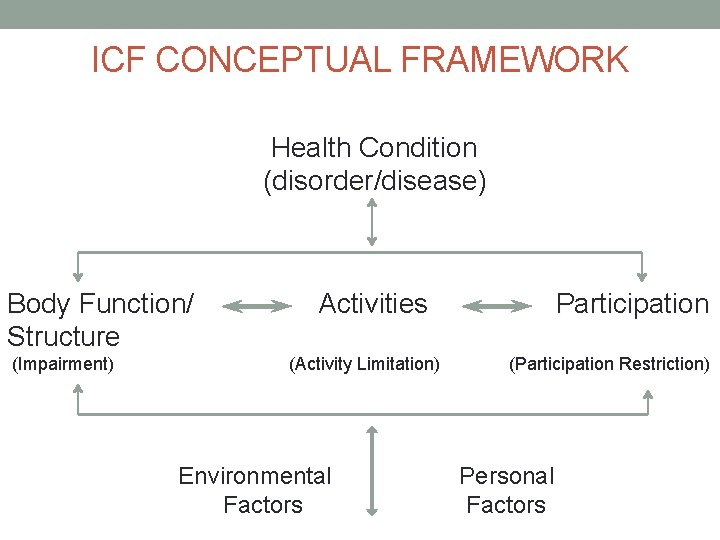
ICF CONCEPTUAL FRAMEWORK Health Condition (disorder/disease) Body Function/ Structure (Impairment) Activities (Activity Limitation) Environmental Factors Participation (Participation Restriction) Personal Factors
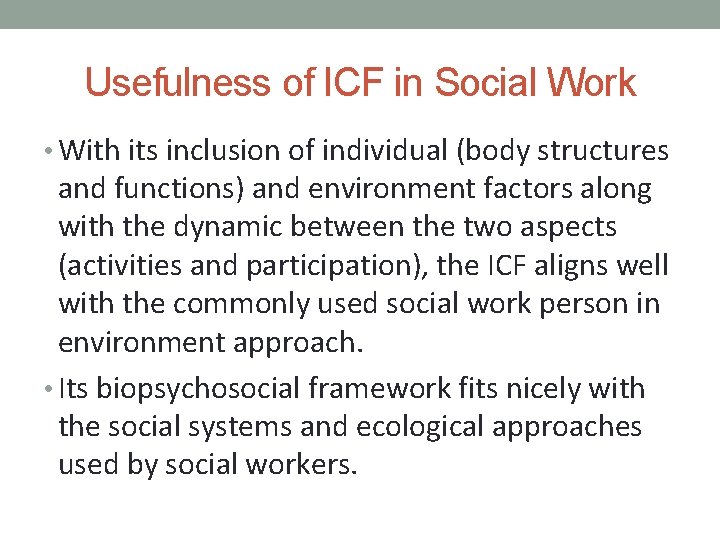
Usefulness of ICF in Social Work • With its inclusion of individual (body structures and functions) and environment factors along with the dynamic between the two aspects (activities and participation), the ICF aligns well with the commonly used social work person in environment approach. • Its biopsychosocial framework fits nicely with the social systems and ecological approaches used by social workers.
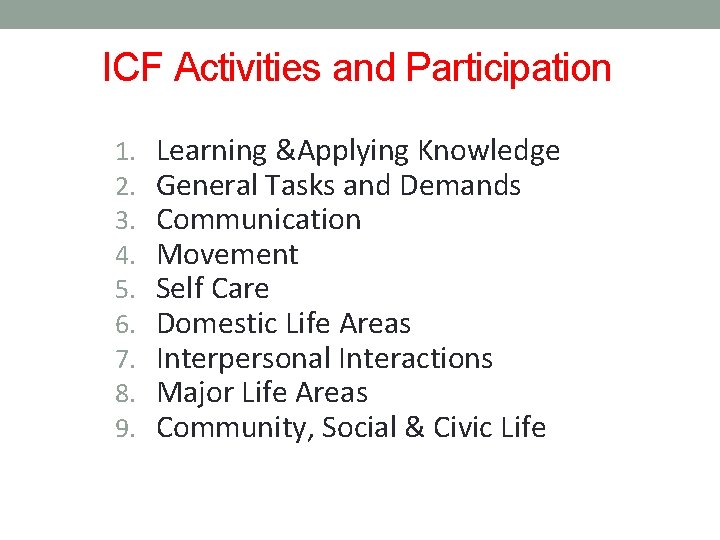
ICF Activities and Participation 1. 2. 3. 4. 5. 6. 7. 8. 9. Learning &Applying Knowledge General Tasks and Demands Communication Movement Self Care Domestic Life Areas Interpersonal Interactions Major Life Areas Community, Social & Civic Life
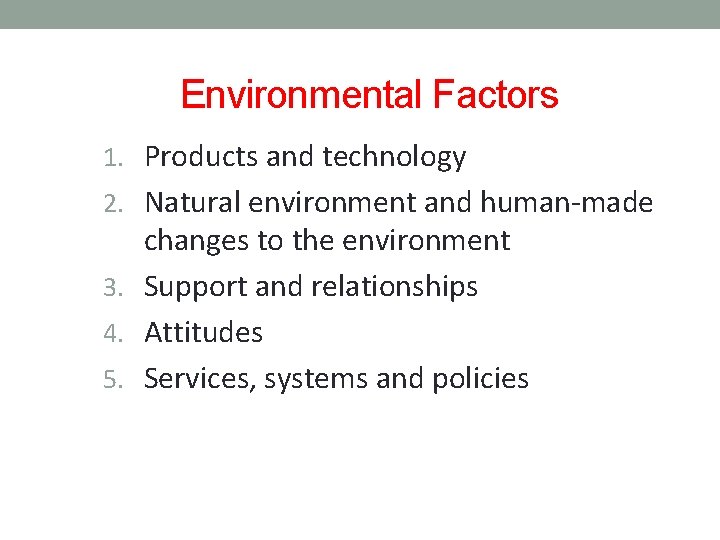
Environmental Factors 1. Products and technology 2. Natural environment and human-made changes to the environment 3. Support and relationships 4. Attitudes 5. Services, systems and policies
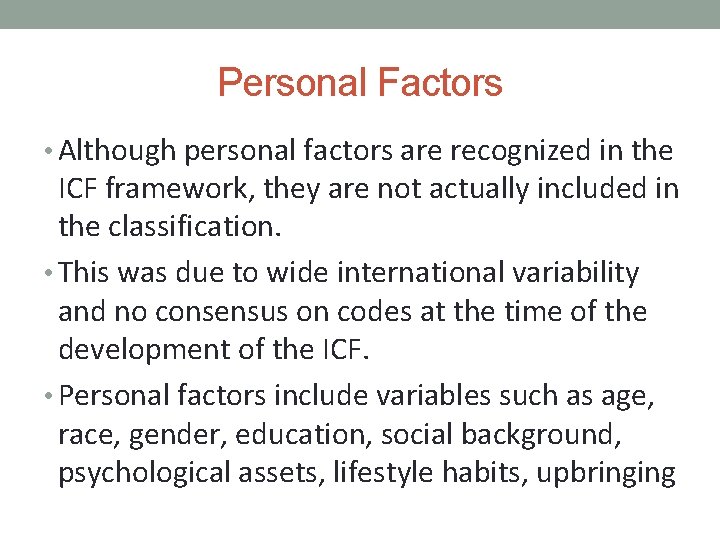
Personal Factors • Although personal factors are recognized in the ICF framework, they are not actually included in the classification. • This was due to wide international variability and no consensus on codes at the time of the development of the ICF. • Personal factors include variables such as age, race, gender, education, social background, psychological assets, lifestyle habits, upbringing
Qualifiers • ICF qualifiers can be used with the domains to record the presence and severity of a problem in functioning. • The use of qualifiers can occur at the body, person, and/or societal level, which works with social work’s different levels of practice (individual and system along with micro, mezzo, and macro practice levels).
Qualifiers • For body functions and structures, the main qualifier indicates the presence and the magnitude of some type of impairment. • For environment, the qualifier indicates the presence of a barrier or facilitator along with the magnitude of that environmental factor.
Qualifiers • For the Activity and Participation domains, the qualifiers are capacity and performance. • Capacity describes an individual’s ability to complete a task or action in a standard environment (e. g. clinical test setting). • Performance describes what an individual does in his/her current environment. • This includes the use of assistive technology.
Context of the Social Work Profession • Social workers practice in various settings with other clinicians and on inter-disciplinary teams. • Therefore, the use of a common language and system like the ICF would be beneficial for data sharing and collaboration. • Additionally, social workers regularly conduct assessment, intervention, and evaluation in professional practice. ICF-based assessment tools can be used.
ICF Resources ICF home page www. who. int/classifications/icf/ - ICF Training Beginner’s Guide, ICF Checklist, WHO-DAS, ICF Practical Manual - ICF Online: interactive ICF Browser tool http: //apps. who. int/classifications/icfbrowser/ ICF Research Branch www. icf-research-branch. org - E-Learning tool, case studies, and ICF-based core set documentation form