
An Introduction to the Holy Bible St Sarkis
An Introduction to the Holy Bible St. Sarkis Armenian Church Charlotte, NC http: //stsarkis. net
The Breath of God • The English word “Bible” comes from the Greek word βιβλια, which means “books. ” The Bible is a collection of books. • The Armenian word for the Bible is ԱՍՏՈՒԱԾԱՇՈՒՆՉ which means Breath of God. Introduction to the Holy Bible • St. Sarkis Armenian Church • Charlotte, NC
The Holy Bible • 73 books (46 + 27) • More than forty writers from all parts of the world over three thousand years. • Many writings, stories, tales, biographies, poems, and proverbs. • One message—our salvation by the Messiah. Introduction to the Holy Bible • St. Sarkis Armenian Church • Charlotte, NC
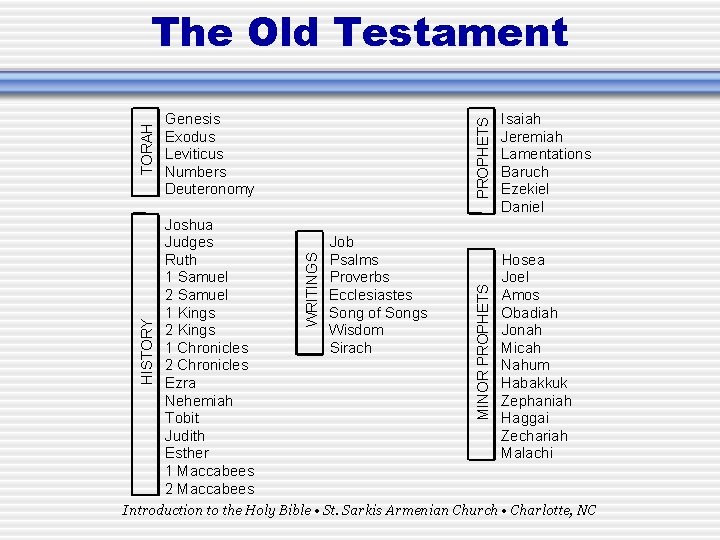
PROPHETS Job Psalms Proverbs Ecclesiastes Song of Songs Wisdom Sirach Isaiah Jeremiah Lamentations Baruch Ezekiel Daniel MINOR PROPHETS Joshua Judges Ruth 1 Samuel 2 Samuel 1 Kings 2 Kings 1 Chronicles 2 Chronicles Ezra Nehemiah Tobit Judith Esther 1 Maccabees 2 Maccabees WRITINGS TORAH Genesis Exodus Leviticus Numbers Deuteronomy HISTORY The Old Testament Hosea Joel Amos Obadiah Jonah Micah Nahum Habakkuk Zephaniah Haggai Zechariah Malachi Introduction to the Holy Bible • St. Sarkis Armenian Church • Charlotte, NC
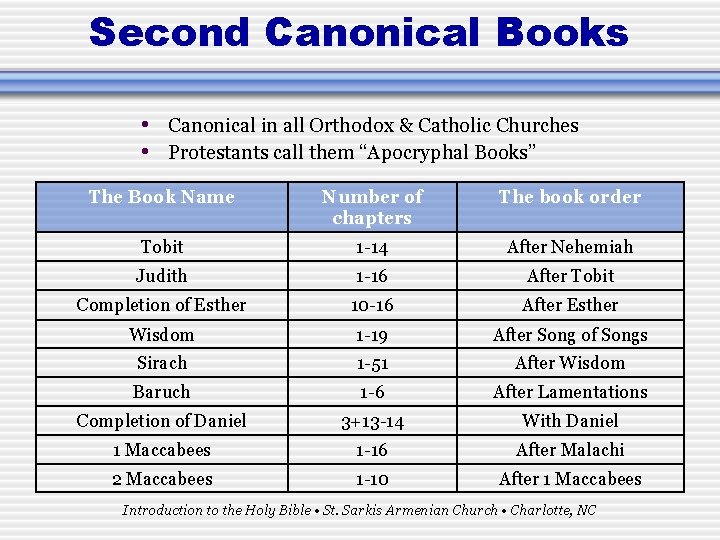
Second Canonical Books • Canonical in all Orthodox & Catholic Churches • Protestants call them “Apocryphal Books” The Book Name Number of chapters The book order Tobit 1 -14 After Nehemiah Judith 1 -16 After Tobit Completion of Esther 10 -16 After Esther Wisdom 1 -19 After Song of Songs Sirach 1 -51 After Wisdom Baruch 1 -6 After Lamentations Completion of Daniel 3+13 -14 With Daniel 1 Maccabees 1 -16 After Malachi 2 Maccabees 1 -10 After 1 Maccabees Introduction to the Holy Bible • St. Sarkis Armenian Church • Charlotte, NC
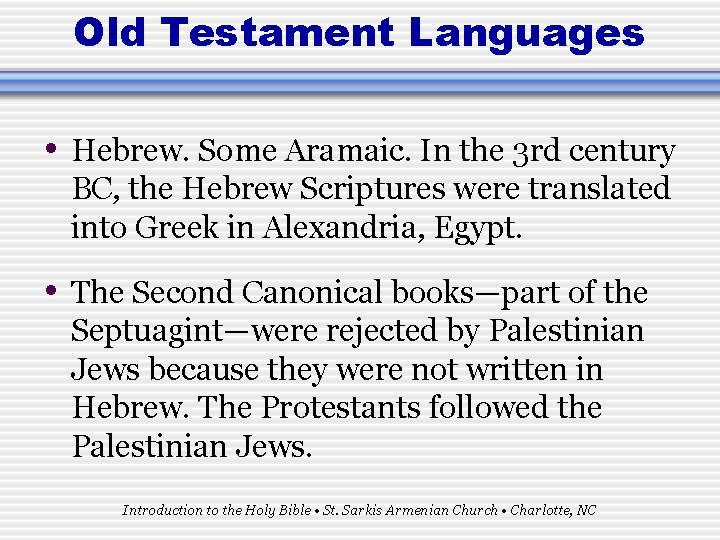
Old Testament Languages • Hebrew. Some Aramaic. In the 3 rd century BC, the Hebrew Scriptures were translated into Greek in Alexandria, Egypt. • The Second Canonical books—part of the Septuagint—were rejected by Palestinian Jews because they were not written in Hebrew. The Protestants followed the Palestinian Jews. Introduction to the Holy Bible • St. Sarkis Armenian Church • Charlotte, NC
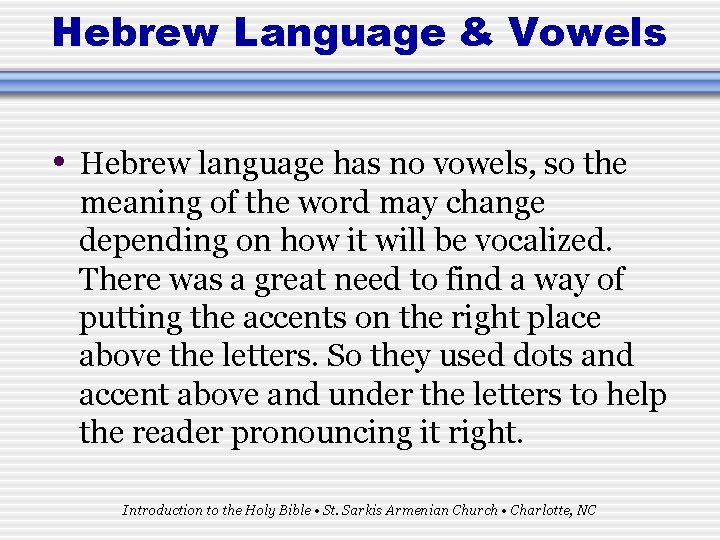
Hebrew Language & Vowels • Hebrew language has no vowels, so the meaning of the word may change depending on how it will be vocalized. There was a great need to find a way of putting the accents on the right place above the letters. So they used dots and accent above and under the letters to help the reader pronouncing it right. Introduction to the Holy Bible • St. Sarkis Armenian Church • Charlotte, NC

The Scribes • Teachers of the law, the wise men, registrars and writers. • Scribes were from the Levi’s tribe and Aaron’s children. • Important role in interpreting the law (Nehemiah 8: 8), to write, understand, interpret and count the letters of the books. • They reserved the meaning and the reading of the scripture. They had authority (Matthew 23: 2). Introduction to the Holy Bible • St. Sarkis Armenian Church • Charlotte, NC
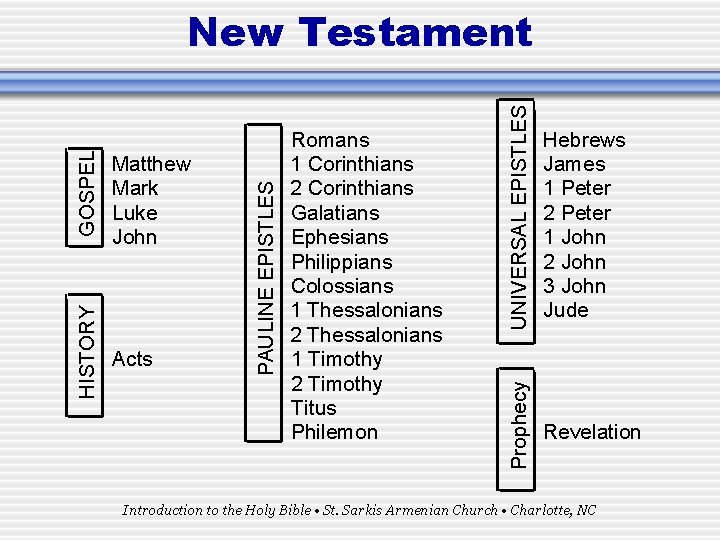
UNIVERSAL EPISTLES Romans 1 Corinthians 2 Corinthians Galatians Ephesians Philippians Colossians 1 Thessalonians 2 Thessalonians 1 Timothy 2 Timothy Titus Philemon Hebrews James 1 Peter 2 Peter 1 John 2 John 3 John Jude Prophecy Acts PAULINE EPISTLES GOSPEL Matthew Mark Luke John HISTORY New Testament Revelation Introduction to the Holy Bible • St. Sarkis Armenian Church • Charlotte, NC
New Testament Languages • The New Testament was mostly written in Greek. • Greek was commonly used among the Jews. Introduction to the Holy Bible • St. Sarkis Armenian Church • Charlotte, NC
Canon of the Bible • In the first century, the church gathered the books that were inspired by the Holy Spirit and put them together in one book. • The Apostolic Fathers refer to these books. • A document written between 150 – 170 AD includes a list of all the same New Testament books that we have now. Introduction to the Holy Bible • St. Sarkis Armenian Church • Charlotte, NC
Facts About the Four Gospels • They are four dimensions of one gospel. • They are not historical books (John 20: 3031) and (John 21: 25). • Each Gospel has a purpose that is in harmony with the purposes of the other Gospel. Introduction to the Holy Bible • St. Sarkis Armenian Church • Charlotte, NC
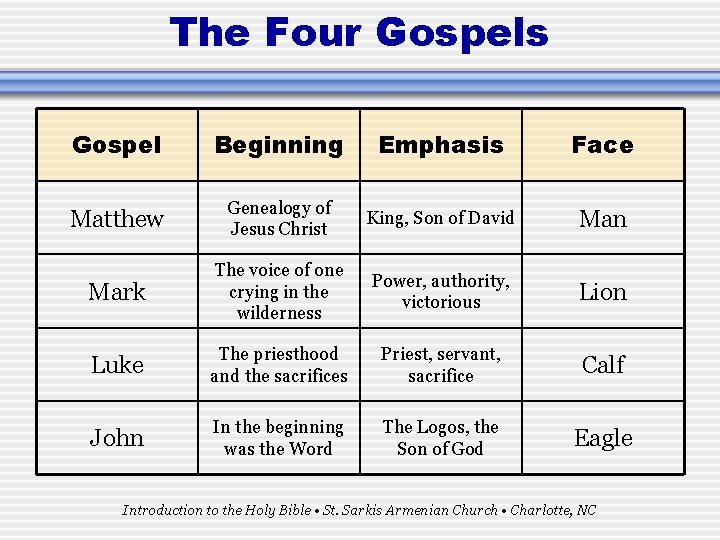
The Four Gospels Gospel Beginning Emphasis Face Matthew Genealogy of Jesus Christ King, Son of David Man Mark The voice of one crying in the wilderness Power, authority, victorious Lion Luke The priesthood and the sacrifices Priest, servant, sacrifice Calf John In the beginning was the Word The Logos, the Son of God Eagle Introduction to the Holy Bible • St. Sarkis Armenian Church • Charlotte, NC
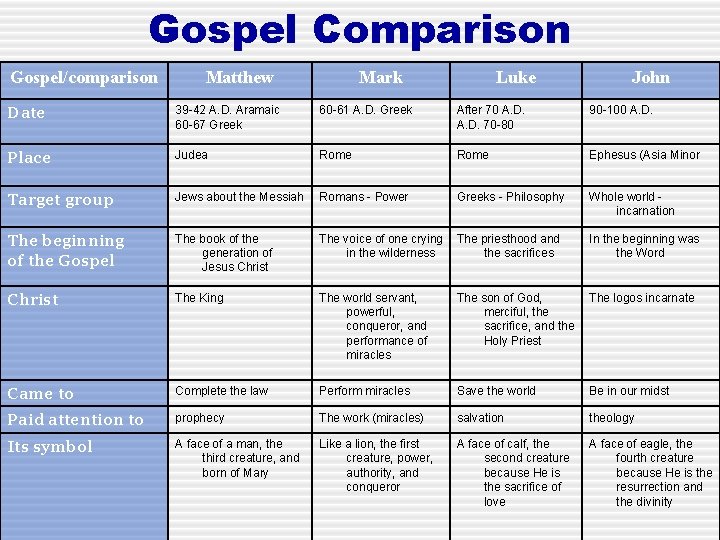
Gospel Comparison Gospel/comparison Matthew Mark Luke John Date 39 -42 A. D. Aramaic 60 -67 Greek 60 -61 A. D. Greek After 70 A. D. 70 -80 90 -100 A. D. Place Judea Rome Ephesus (Asia Minor Target group Jews about the Messiah Romans - Power Greeks - Philosophy Whole world incarnation The beginning of the Gospel The book of the generation of Jesus Christ The voice of one crying in the wilderness The priesthood and the sacrifices In the beginning was the Word Christ The King The world servant, powerful, conqueror, and performance of miracles The son of God, merciful, the sacrifice, and the Holy Priest The logos incarnate Came to Complete the law Perform miracles Save the world Be in our midst Paid attention to prophecy The work (miracles) salvation theology Its symbol A face of a man, the third creature, and born of Mary Like a lion, the first creature, power, authority, and conqueror A face of calf, the second creature because He is the sacrifice of love A face of eagle, the fourth creature because He is the resurrection and the divinity
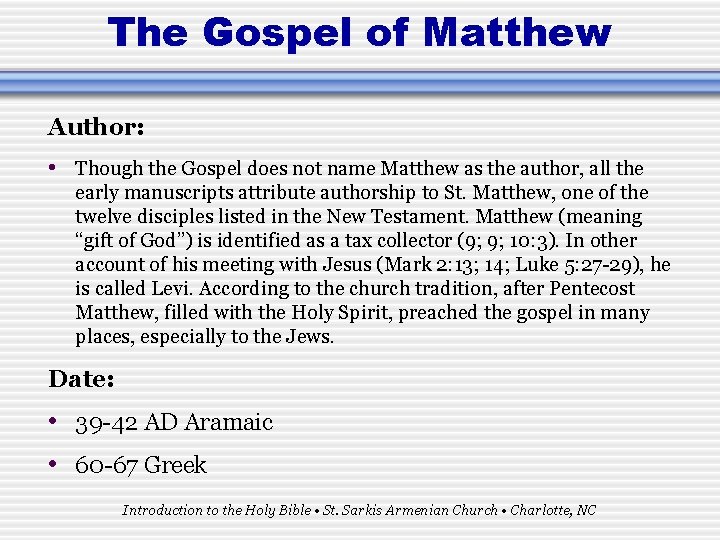
The Gospel of Matthew Author: • Though the Gospel does not name Matthew as the author, all the early manuscripts attribute authorship to St. Matthew, one of the twelve disciples listed in the New Testament. Matthew (meaning “gift of God”) is identified as a tax collector (9; 9; 10: 3). In other account of his meeting with Jesus (Mark 2: 13; 14; Luke 5: 27 -29), he is called Levi. According to the church tradition, after Pentecost Matthew, filled with the Holy Spirit, preached the gospel in many places, especially to the Jews. Date: • 39 -42 AD Aramaic • 60 -67 Greek Introduction to the Holy Bible • St. Sarkis Armenian Church • Charlotte, NC
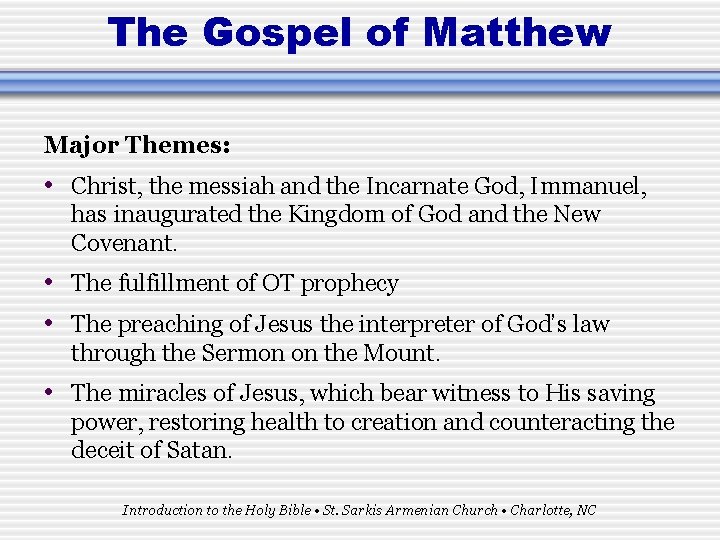
The Gospel of Matthew Major Themes: • Christ, the messiah and the Incarnate God, Immanuel, has inaugurated the Kingdom of God and the New Covenant. • The fulfillment of OT prophecy • The preaching of Jesus the interpreter of God’s law through the Sermon on the Mount. • The miracles of Jesus, which bear witness to His saving power, restoring health to creation and counteracting the deceit of Satan. Introduction to the Holy Bible • St. Sarkis Armenian Church • Charlotte, NC
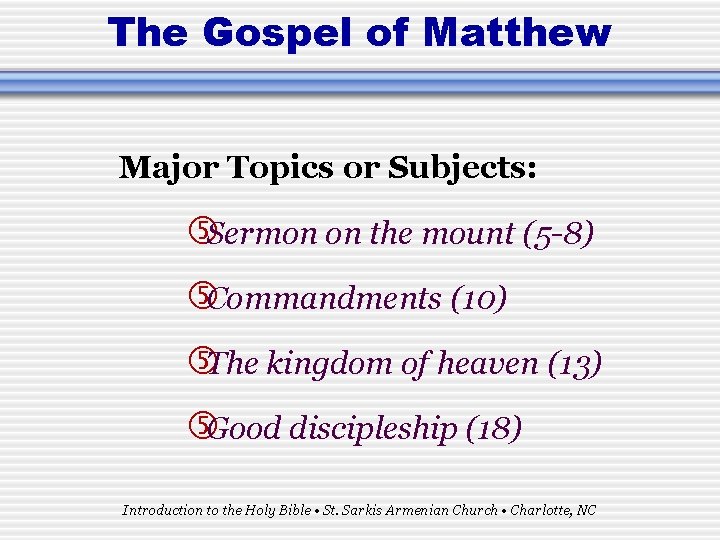
The Gospel of Matthew Major Topics or Subjects: Sermon on the mount (5 -8) Commandments (10) The kingdom of heaven (13) Good discipleship (18) Introduction to the Holy Bible • St. Sarkis Armenian Church • Charlotte, NC
The Gospel of Matthew For whom it was written? • For the Jewish believers in Christ Evidence: • Beginning the Gospel with the generation of Christ to prove that He is the son of David and Abraham and He is from Jewish race. • It has a Hebrew style, Aramaic expressions and forms, numerous quotations and arguments from the OT. Matthew gives details of Jewish religious observances, and often uses Jewish techniques of argument. God’s final judgment, pictured in apocalyptic images common in Jewish writings, is emphasized. (See 5: 30; 23: 1, 5, 21; 24: 15). Introduction to the Holy Bible • St. Sarkis Armenian Church • Charlotte, NC
The Gospel of Matthew Written for the Jewish believers in Christ: • He did not explain or give interpretation of the Jewish customs because it was written for the Jews who know these customs. Examples: ü Elders’ traditions: compare Matthew 15: 1 -13 and Mark 7: 1 -9 ü Passover: compare Matthew 26: 17 and Mark 14: 12 • He did not interpret the Aramaic words that were mentioned. ü Example: raca (Matthew 5: 22) Introduction to the Holy Bible • St. Sarkis Armenian Church • Charlotte, NC
The Gospel of Matthew Written for the Jewish believers in Christ: • The New Testament is the fulfillment of the Old Testament (5: 17). • Christ declares, “I am not sent but unto the lost sheep of the house of Israel” (15: 24). • He addressed good works: fasting (9: 14 -16), prayers (6: 5 -13), giving alms (6: 1 -4). • Only Matthew noted that Pilate washed his hands (27: 24). Introduction to the Holy Bible • St. Sarkis Armenian Church • Charlotte, NC
The Gospel of Mark Author: • Mark the Apostle, also known as John Mark, is widely attested by the ancient Church as the author of this Gospel. Mark, according to the Church Tradition, was the young man in the linen wrap (14: 51, 52). His mother’s house was a meeting place for Christians in Jerusalem (Acts: 12). Paul and Barnabas took John Mark with them to Antioch when they returned from Jerusalem famine relief effort (acts 12: 25). He briefly assisted Paul and Barnabas on their first missionary journey (Acts 13: 5), departed from them (Acts 13: 13), then helped Barnabas (Acts 15: 37 -39; see Col. 4: 10, 11), and eventually was reconciled to Paul (Philm. 24). Later he also aided Peter (1 Pet. 5: 13). • St. Mark preached Christianity in Egypt and founded the Coptic Church, our sister. Date: • As with the other Gospels, the exact date of writing is uncertain. Because of its connection with Rome and its lack of any clear reference to the destruction of Jerusalem (13: 2), the Gospel of Mark may be dated shortly before the fall of Jerusalem in A. D. 70. Many believe this was the first of the four Gospels to be written. Introduction to the Holy Bible • St. Sarkis Armenian Church • Charlotte, NC
The Gospel of Mark Theme: • Power, authority, and also a suffering Messiah. He has come to serve and give His life for many (10: 45). Jesus is clearly the Son of God (1: 1, 11; 9: 7; 14: 61, 62), who has power over demons, heals the sick and forgives sins (1: 23 -25; 2: 10, 11). He also possesses a full humanity expressed through the agony of Gethsemane and the suffering on the Cross. Other facts: • It is the shortest of the Gospels. Simple language and rapid pace of narration. By the end of the first chapter, Christ has been baptized by John the Baptist and performed numerous miracles. • St. Mark is writing for the Christian community of Rome, which either was experiencing the great persecution by Nero (beginning in A. D. 64), or was caught up in the apocalyptic fervor occasioned by the Jewish war (Jerusalem was destroyed in A. D. 70). St. Mark tells the story of Jesus so his readers may see their own suffering as a prelude to the glorious Second Coming of Jesus, and may discern the reward of those who endure to the end. The suffering and the glory are equally real: this was true for Jesus and will be true for all believers. Introduction to the Holy Bible • St. Sarkis Armenian Church • Charlotte, NC
The Gospel of Luke Author: • All the early sources emphasize that the third Gospel was written by Luke, who is mentioned in Colossians 4: 14; 2 Timothy 4: 11, and Philemon 24. Luke was a Gentile from Antioch by birth, and a physician by profession. He was a fellow worker of Paul’s: the plural “we” (Acts 20: 6) indicates Luke was with Paul as he traveled the coast of Asia Minor on his way to Jerusalem. Luke has left us two New Testament books: this Gospel and the Acts of the Apostles. Date: • In his preface to the Gospel (1: 1), Luke indicates knowledge of other written sources. Most scholars believe he used mark as a source. He probably wrote his Gospel either from Greece or from Asia Minor in A. D. 70 -80. Theme: • Salvation: the availability of salvation for all people. Luke proclaimed this message by showing Jesus’ involvement with people who are poor, needy, and on the fringes of society. Luke has been called a “historian” because he dates biblical events by reference to secular history (2: 1, 2; 3: 1). Salvation is described as “alight to bring revelation to the Gentiles” (2: 32. at the end of the Gospel, the risen Lord instructs His disciples to preach repentance and the forgiveness of sins “to all nations” (24: 47). Introduction to the Holy Bible • St. Sarkis Armenian Church • Charlotte, NC
The Gospel of Luke Other facts: Three aspects of the Christian life are emphasized throughout Luke: 1. Prayer. The early chapters lift up the example of righteous men and women offering gifts, hymns, and prayers to God (1: 10, 13, 46 -55; 2: 20, 28 -32). Jesus, to Him the Glory, is portrayed frequently at prayer, especially before every important step in His ministry (3: 21; 5: 16; 6: 12; 9: 18, 28; 11: 1; 22: 32, 41; 23: 46). The Gospel ends with the disciples “continually in the temple praising and blessing God” (24: 53). 2. The activity of the Holy Spirit. The inspirational work of the Holy Spirit is everywhere evident in the Gospel. St. Mary is “overshadowed” by the Spirit (1: 35). The Spirit leads Zachariah, the priest, to prophecy (1: 67), and prompts Simeon’s actions (2: 25 -27). Jesus conducts His ministry in the fullness of the Spirit (3: 22; 4: 1, 18; 10: 21). The disciples were to embark upon their world mission after receiving “power from on high” (24: 49), the gift of the Holy Spirit. 3. A deep concern for sinners. Luke reports Jesus’ concern and love for sinners, with a confident hope of their repentance and forgiveness (5: 1 -11; 7: 3650; 9: 51 -56; 10: 29 -37; 19: 1 -10; 23: 39 -43). Introduction to the Holy Bible • St. Sarkis Armenian Church • Charlotte, NC
The Gospel of John Author: • St. John was one of Our Lord Jesus’ twelve disciples. He is believed to be the youngest disciple and also “the beloved disciple” of Christ (13: 23; 2: 7, 20). On the cross, Jesus entrusted His mother, the Virgin Mary, to John’s care (19: 26, 27). St. John was a pillar of the church in Jerusalem, and later moved to Ephesus. He served as the leading authority (2 John: 1) of Ephesus for the remainder of his ministry. During the reign of the oppressive Roman Emperor Domitian (A. D. 81 -96), St. John was exiled to the nearby island of Patmos, where he wrote the Revelation. Upon the emperor’s death he returned to Ephesus to resume his episcopacy and to write his Gospel. • St. John is the first of only few saints in history to be named by the church “the Theologian, ” because of the profundity of his Gospel, which has been called “the spiritual Gospel”. The New Testament contains four other books attributed to John: three letters, written about A. D. 90, and the Book of Revelation, written about A. D. 95. • St. John was about one hundred years old when he died, about A. D. 96 -100. Date: • A. D. 96. It is considered the last of the four Gospels to be written. Introduction to the Holy Bible • St. Sarkis Armenian Church • Charlotte, NC
The Gospel of John Theme: • The eternal Son of God has come in the flesh (20: 31) • Redemption of the World. The Divine Word, the Son of God, came into the world to save the world and, through the life of the Church, to offer the whole world up to God. Christ and His Church begin this transformation now. • The Trinity: John is quite explicit about the persons of the Trinity and their relationships. (1: 1; 1: 18; 3: 16; 13; 17, 34; 3: 35; 4: 26; 6: 20; 8: 24, 28; 10: 14; 10: 15; 10: 30; 13: 3; 13: 19; 14: 10, 11, 20; 14: 26; 15: 26; 16: 13 -15; 17: 2; 17: 3, 18, 21, 25; 17: 21 -23; 18: 6) • Glory: Glorification is a prominent theme in St. John’s theology. ü We behold Christ’s glory through the Incarnation (1: 14) ü Jesus, Our Lord, manifests His glory to us so we might believe (2: 11; 11: 40) ü Jesus, Our Lord, seeks glory for the Father (7: 18), but not for himself (8: 50) ü The Father’s glory is given to us by the Son (17: 22) ü We will behold God’s glory when we are with Him in eternity (17: 24) • The spiritual dimension: Everything in life is conditioned by the realm and activity of God the Trinity, whose eternal glory, life and light is shared with those who believe. The Christians receives heavenly birth and beholds heavenly things (1: 12, 14, 51; 3: 3, 5, 12; 14: 12). Introduction to the Holy Bible • St. Sarkis Armenian Church • Charlotte, NC
The Acts Author: • Luke Date: • A. D. 75 -85. after the composition of the Gospel of Luke. Theme: • • The spread of the gospel by the Apostles, from Jerusalem to the whole world (1: 8). Immanuel, “God with us. ” In Luke’s Gospel, God is with us in His incarnate Son. In Acts, the Incarnate Son of God, ascended into heaven and is seated at the right hand of the Father, is yet present in the Church by the power of the Holy Spirit. Other facts: • A record of the Church growth. The Acts of the Apostles is a spiritual and theological record as well as a historical one. It is of great importance for understanding the organization and structure of the Church: its method of resolving controversies; the role of apostles, bishops, priests, and deacon; and the spiritual life of the Church. The organization of Acts: • Chapters 1 -12 focus largely on the ministry of St. Peter, while chapters 13 -28 concentrate almost exclusively on St. Paul. With St. Peter we see the Church being established. With St. Paul we se the expansion of the Church throughout the Roman world. Introduction to the Holy Bible • St. Sarkis Armenian Church • Charlotte, NC
Romans Author: • St. Paul Date: • Romans was probably written in A. D. 55 -57 during the last part of St. Paul’s third missionary journey (Acts 20: 3; 21: 16). Theme: • God’s righteousness revealed in Christ for our salvation. Righteousness is the basis of a faithful relationship between God and humanity. • The natural mortality and actual sinfulness of all (1: 18; 3: 20) • Salvation through Christ apart from the Mosaic Law (3: 21; 4: 25): we live by faith in response to grace, rather than by the dead works of the law. Introduction to the Holy Bible • St. Sarkis Armenian Church • Charlotte, NC
Romans Theme, continued: • New life in Christ; freedom from sin, death and the law through our sacramental identity with Christ, established in Holy Baptism. (chs. 5 -7) • • • New life in the Holy Spirit: the power to be Godlike, established in chrismation (ch. 8) God’s plan for Jews and Gentiles, and their reconciliation in Christ (chs. 9 -11) Christian’s life in the Church and in the world (chs. 12 -16) Other facts: • Jew and Gentile. In Romans and Galatians, St. Paul deals extensively with the relation of the Old Covenant to belief in Christ, and how Gentiles can be full members of the New Covenant by grace through faith. • • • Romans is St. Paul’s most logical letter. He argues his case like a lawyer. Romans is the only letter St. Paul wrote to a church he had not yet visited (1: 11; 15: 22). Romans is St. Paul’s most doctrinally oriented letter. Introduction to the Holy Bible • St. Sarkis Armenian Church • Charlotte, NC
1 Corinthians Author: • St. Paul Date: • A. D. 55 Theme: • Communion with God vs. communion with darkness. We are created for communion with God and with each other. • St. Paul tried to answer specific problems or concerns in the church: 1. 2. 3. 4. 5. 6. 7. factionalism (1: 10 -3: 23) civil lawsuits (4: 1 -21; 6: 1 -8) sexual immorality (5: 1 -13; 6: 9 -7: 40) meat sacrificed to idols (8: 1 -9: 27) Eucharistic theology and practice (10: 1 - 11: 34) spiritual gifts (12: 1 -14: 40) resurrection life (15: 1 -1624) Introduction to the Holy Bible • St. Sarkis Armenian Church • Charlotte, NC
2 Corinthians Author: • St. Paul Date: • It was written the same year as 1 Corinthians Theme: • In this letter St. Paul wrote about his relationship with the church of Corinth and the effects of certain false apostles on his ministry. Introduction to the Holy Bible • St. Sarkis Armenian Church • Charlotte, NC
Galatians Author: • St. Paul. Date: • Uncertain Theme: • The true gospel vs. the false gospel. After believing in the gospel of Jesus Christ as a gift of God, many in Galatia had turned to the teaching of the Jewish legalizers; who claimed that Christians must also follow the laws of the Old Covenant. St. Paul writes to call them back to “the grace of Christ” (1: 6). • • A defense of St. Paul’s apostolic authority (1: 1 -2: 21) The gift of the Holy Spirit to the Church (5: 1 -6: 18) The Cross of Christ (6: 11 -15) The life of faith (2: 15 -4: 7) Introduction to the Holy Bible • St. Sarkis Armenian Church • Charlotte, NC
Ephesians Author: • St. Paul Date: • St. Paul probably wrote Ephesians from Rome during his imprisonment in A. D. 61 -63, as recorded in Acts 28: 16 -31. Theme: • The mystery of salvation in the Church, the body of Christ, is not only for all mankind but for all creation, affecting this age and the age to come. The body of Christ is the center and life of all. • The work of the Holy Trinity in our salvation (1: 3 -14, 17; 2: 18, 22; 3: 4, 5, 14 -17, 20, 21; 4: 3 -6; 5: 18 -21). He also writes of the sacraments of the Church. Baptism (1: 5, 6; 2: 1 -6; 4: 5, 22 -24; 5: 8 -14, 26 -32), chrismation (1: 13, 14; 4: 3, 4, 7; 5: 18), Eucharist (1: 7; 5: 2, 19, 20). Matrimony is treated in an eloquent discourse (5: 22 -33). Priesthood (2: 20 -22; 3: 5, 6, 9 -13; 4: 11 -16). • • The blessings of Christ to the Church (1: 1 -3: 21). Our response to God’s grace (4: 1 -6: 24). God’s strength for spiritual warfare (1: 19 -2: 10; 4: 17 -31; 6: 10 -18). Participation in the sacraments and the exercise of the spiritual gifts are key elements in the life of the Church. Introduction to the Holy Bible • St. Sarkis Armenian Church • Charlotte, NC
Philippians Author: • St. Paul Date: • St. Paul probably wrote this letter while he was under house arrest in Rome in about A. D. 61 -63. Theme: • Salvation is a dynamic, ongoing experience which is not merely personal, but shared among believers. St. Paul urges the believers in Philippi toward continued unity, humility, selfless generosity and joy in Christ. Introduction to the Holy Bible • St. Sarkis Armenian Church • Charlotte, NC
Colossians Author: • St. Paul Date: • It was written at the same time as Ephesians, Philippians, and Philemon. Theme: • Living by the will of God vs. dying by false human schemes. The primary purpose of this epistle was to combat a form of Gnosticism which was taking hold in the Colossian church. • True spiritual life. For St. Paul, true spirituality is life in Christ in the apostolic Church. Through Christ’s Incarnation, Passion, and resurrection, which we join in by means of baptism and grow into through transformation of life, we have direct access to God’s fullness and capable of becoming Godlike (2: 8 -15; 3: 1 -17). Introduction to the Holy Bible • St. Sarkis Armenian Church • Charlotte, NC
1 Thessalonians Author: • St. Paul Date: • It was written in Corinth in A. D. 50 -51, about six months after the church in Thessalonica was founded. Theme: • A holy life leads to eternal life. An encouragement to be holy (3: 13; 4: 3; 5: 23), with particular calls to: Continue as examples to others (1: 7). Walk worthy of God’s calling (2: 12). Stand fast in the faith (3: 8) Maintain moral purity (4: 3). Introduction to the Holy Bible • St. Sarkis Armenian Church • Charlotte, NC
2 Thessalonians Author: • St. Paul Date: • A. D. 51, probably from Corinth Theme: • Stand fast through apostolic teaching. St. Paul wrote this letter to encourage further endurance in persecution, to correct mistaken ideas concerning the Second Coming of Christ and improper life-styles arising from these ideas, and to offer assurance that his teaching is apostolic (2: 15). Introduction to the Holy Bible • St. Sarkis Armenian Church • Charlotte, NC
1 Timothy Author: • St Paul Date: • The Pastoral Epistles, 1 and 2 Timothy and Titus, appear to have been written after the events of Acts 28. If so, 1 Timothy was written in A. D. 64 -65, before St. Paul’s second imprisonment in Rome, perhaps from Macedonia (1: 3). Theme: • The role of the clergy, combating heresy, care for women, widows and slaves, and money and the ministry. Introduction to the Holy Bible • St. Sarkis Armenian Church • Charlotte, NC
2 Timothy Author: • St. Paul Date: • It was written from Rome (1: 17 in A. D. 65 -67. Theme: • Overcoming hardship in ministry. Introduction to the Holy Bible • St. Sarkis Armenian Church • Charlotte, NC
Titus Author: • St. Paul Date: • About the same time as 1 Timothy in A. D. 63 -65. Theme: • Overseeing the Church according to the true faith. As the Church grew, it naturally developed theology and structure, and encountered heresy and sub-Christians behavior among its members, as had been prophesied. St. Paul here advices Titus as he faces these issues. Introduction to the Holy Bible • St. Sarkis Armenian Church • Charlotte, NC
Philemon Author: • St. Paul Date: • It was written at the same time as Colossians in A. D. 6163. Most likely in Rome. Theme: • We are no longer slaves, but brothers and sisters in Christ. In this letter, Philemon is urged to forgive his runaway slave, Onesimus, and accept him as a friend in Christ. Introduction to the Holy Bible • St. Sarkis Armenian Church • Charlotte, NC
Hebrews Author: • St. Paul Date: • The content of the epistle and the witness of the early Church argue for a date of composition near A. D. 70. Theme: • Persevering faith in the incarnate Son. Jesus Christ is superior to the prophets, angels, Moses and Aaron. He offers a better priesthood, sanctuary, and sacrifice, for in worshiping Him we enter heaven. Therefore, we must faithfully hold fast to Him. • This letter challenges new Christians to move beyond their traditional rituals and ceremonies and believe that Christ has fulfilled them all. Introduction to the Holy Bible • St. Sarkis Armenian Church • Charlotte, NC
James Author: • The author identifies himself as “James, a bondservant of God and of the Lord Jesus Christ” (1: 1) Date: • St. James was martyred about A. D. 62, so some thinks it was written after the martyrdom of Stephen and the dispersion of Christians from Jerusalem. Theme: • The harmony of faith and works. St. James advises putting beliefs into practice and offers practical ways for Christians to live out their faith. Introduction to the Holy Bible • St. Sarkis Armenian Church • Charlotte, NC
1 Peter Author: • St. Peter the disciple and apostle. Date: • It was composed at Rome (5: 13). Theme: • Rejoice in sharing the suffering of Christ. It was written to comfort early Christians who were being persecuted for their faith. Introduction to the Holy Bible • St. Sarkis Armenian Church • Charlotte, NC
2 Peter Author • St Peter Date: • It is most likely A. D. 63067, during St. Peter’s imprisonment in Rome. Theme: • True Knowledge vs. false knowledge. In this letter St. Peter warned against false teachers and urged Christians to stay loyal to God. Introduction to the Holy Bible • St. Sarkis Armenian Church • Charlotte, NC
1 John Author: • St. John the Apostle Date: • It can not be dated with certainty. Some scholars suggest it was written at the same time as the Gospel of John. Theme: • Tests of true Christian life. Jesus Christ, the Incarnate God, reveals the light (1: 5 -7), love (4: 7 -11 and life (5: 11 -13) of the Father, as contrasted with the darkness (1: 6), hatred (2: 9 -11) and death (5: 12) of the present world. Thus 1 John can be read as a commentary on the reality of baptism, chrismation, and Eucharist in our lives. • This letter explains basic truths about the Christian life, with emphasis on the command to love one another. Introduction to the Holy Bible • St. Sarkis Armenian Church • Charlotte, NC
2 John Author: • St John the Apostle Date: • Around A. D. 90 -95 Theme: • This letter, addressed to “the lady, the chosen one, and to her children, ” warns against false teachers. • “The elect lady” is most likely a parish under St. John’s oversight. The Church elsewhere is called the “bride” of Christ the Lord (Gr. Kyrios). Thus it would be natural to refer to her as kyria (“lady”), the feminine of kyrios. Introduction to the Holy Bible • St. Sarkis Armenian Church • Charlotte, NC
3 John Author: • St. John the apostle Date: • About the same time like the other letters. Theme: • Genuine leadership vs. false leadership. It exhorts the Church to persevere in the true faith which she has received. True Christian leaders will adhere to that faith and respect those who passed it on to them. • • It has three practical purposes: To praise Gaius To confirm the condemnation of Diotrephes To commend Demetrius and ensure hospitality for him from Gaius. Introduction to the Holy Bible • St. Sarkis Armenian Church • Charlotte, NC
Jude Author: • St. Jude, the brother of James Date: • Sometime in the period A. D. 60 -80 Theme: • Jude is a polemic directed against false teachers within the Church who are jeopardizing the salvation of many. St. Jude supports his attack with examples from the OT, and the tradition of God’s dealing harshly with those who assault His people. • St. Jude’s purposes are: 1. 2. 3. 4. to rouse the Church to declare war on heterodoxy (v. 3) To exhort the Church to orthodox faith and practice (vv. 20, 21) To rescue the weak and fallen where possible (vv. 22, 23) To instill confidence that God is indeed the Lord of all (vv. 1, 24, 25) Introduction to the Holy Bible • St. Sarkis Armenian Church • Charlotte, NC
Revelation Author: • St. John the Apostle Date: • A. D. 81 -96. Theme: • Faithfulness in tribulation. Revelation means the uncovering of something which was previously been hidden, in this case the final triumph of the Kingdom of God. Since the final triumph of the Kingdom of God is assured, our faithfulness and loyalty now – before its full revelation – will lead to our ultimate victory. It was written to encourage persecuted believers and affirm their faith that God will care for them. Using visions and symbols, John illustrates the triumph of good over evil and the creation of a new heaven and new earth. Introduction to the Holy Bible • St. Sarkis Armenian Church • Charlotte, NC
- Slides: 50