
An Introduction to the High Luminosity LHC HLLHC
- Slides: 27
An Introduction to the High Luminosity LHC (HL-LHC) project Oliver Brüning HL-LHC Deputy Project Leader 1 st meeting of the CERN – TRIUMF Committee – CERN 27 April 2016
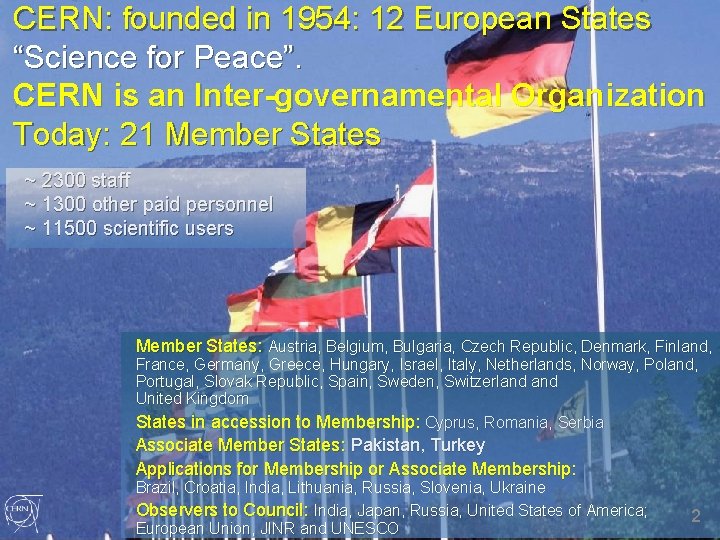
CERN: founded in 1954: 12 European States “Science for Peace”. CERN is an Inter-governamental Organization Today: 21 Member States ~ 2300 staff ~ 1300 other paid personnel ~ 11500 scientific users Member States: Austria, Belgium, Bulgaria, Czech Republic, Denmark, Finland, France, Germany, Greece, Hungary, Israel, Italy, Netherlands, Norway, Poland, Portugal, Slovak Republic, Spain, Sweden, Switzerland United Kingdom States in accession to Membership: Cyprus, Romania, Serbia Associate Member States: Pakistan, Turkey Applications for Membership or Associate Membership: Brazil, Croatia, India, Lithuania, Russia, Slovenia, Ukraine Observers to Council: India, Japan, Russia, United States of America; European Union, JINR and UNESCO 22
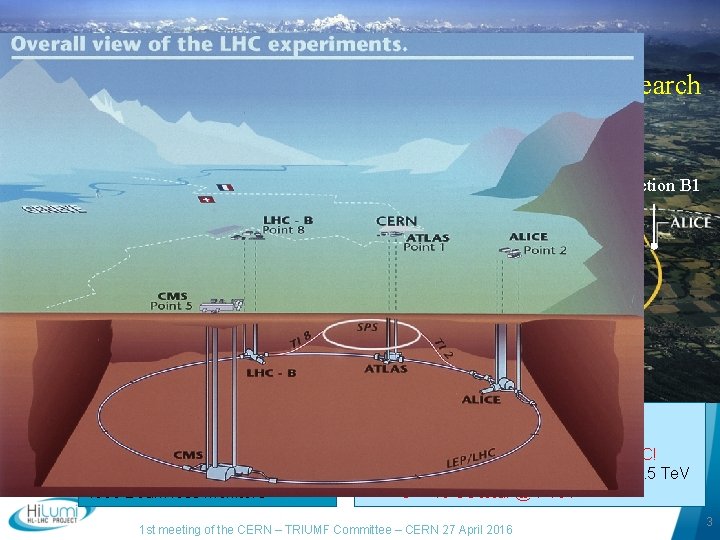
LHC: 27 km Circumference; 70 m to 100 m underground Largest Scientific Infrastructure in Fundamental Research Injection B 2 Beam dumps Injection B 1 RF 1720 Power converters > 9000 magnetic elements 7568 Quench detection systems 1088 Beam position monitors 4000 Beam loss monitors 150 tonnes Helium, ~90 tonnes at 1. 9 K 140 MJ stored beam energy in 2012 370 MJ design and > 500 MJ for HL-LHC! 830 MJ magnetic energy per sector at 6. 5 Te. V ≈ 10 GJ total @ 7 Te. V 1 st meeting of the CERN – TRIUMF Committee – CERN 27 April 2016 3
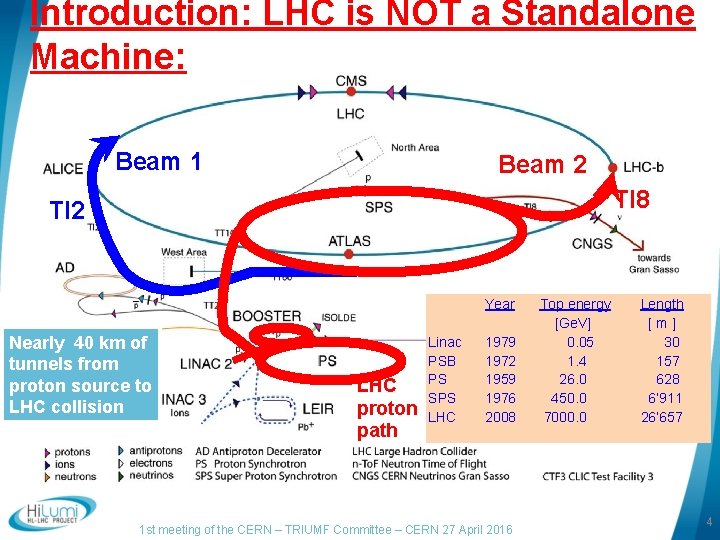
Introduction: LHC is NOT a Standalone Machine: Beam 1 Beam 2 TI 8 TI 2 Year Nearly 40 km of tunnels from proton source to LHC collision LHC proton path Linac PSB PS SPS LHC 1979 1972 1959 1976 2008 1 st meeting of the CERN – TRIUMF Committee – CERN 27 April 2016 Top energy [Ge. V] 0. 05 1. 4 26. 0 450. 0 7000. 0 Length [m] 30 157 628 6’ 911 26’ 657 4
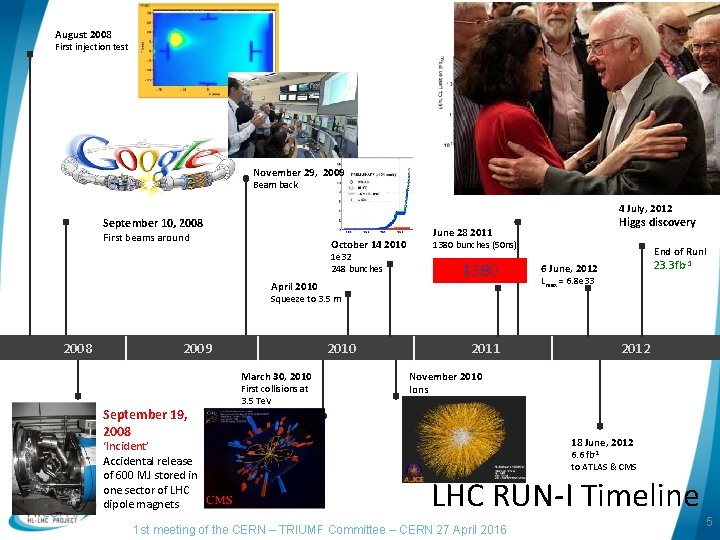
August 2008 First injection test August, 2011 November 29, 2009 2. 3 e 33, 2. 6 fb -1 1380 bunches Beam back 4 July, 2012 September 10, 2008 First beams around October 14 2010 1 e 32 248 bunches April 2010 Higgs discovery June 28 2011 1380 bunches (50 ns) 1380 End of Run. I 23. 3 fb-1 6 June, 2012 Lmax = 6. 8 e 33 Squeeze to 3. 5 m 2008 2009 2010 March 30, 2010 September 19, 2008 ‘Incident’ Accidental release of 600 MJ stored in one sector of LHC dipole magnets First collisions at 3. 5 Te. V 2011 2012 November 2010 Ions 18 June, 2012 6. 6 fb-1 to ATLAS & CMS LHC RUN-I Timeline 1 st meeting of the CERN – TRIUMF Committee – CERN 27 April 2016 5
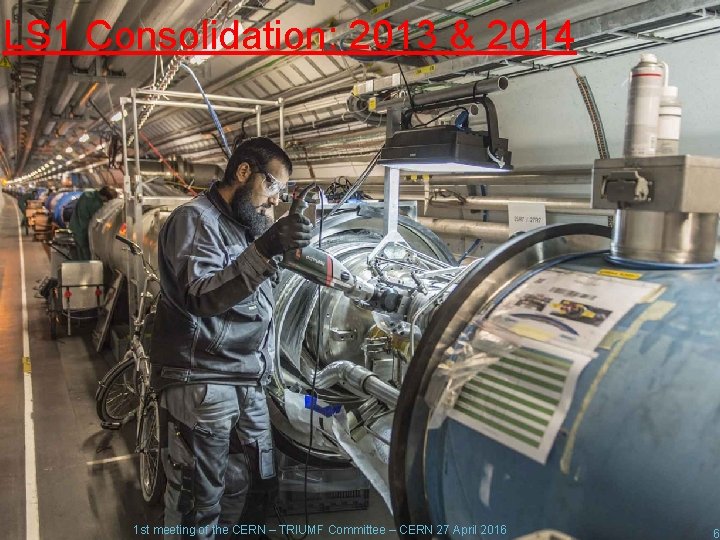
LS 1 Consolidation: 2013 & 2014 1 st meeting of the CERN – TRIUMF Committee – CERN 27 April 2016 6
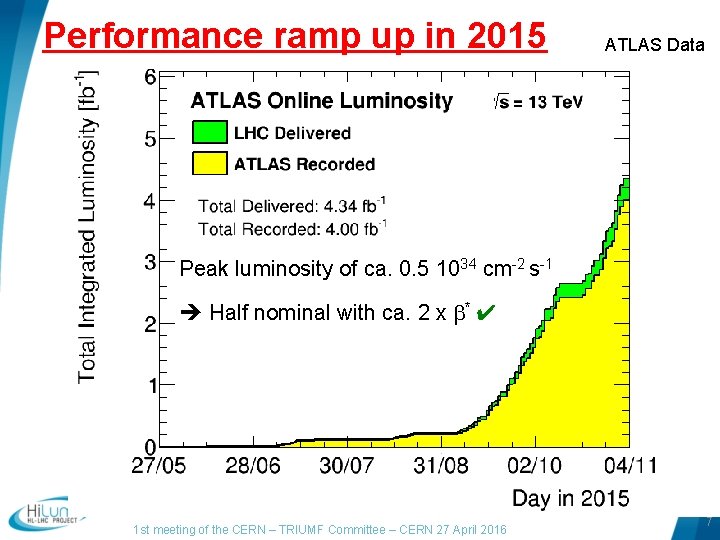
Performance ramp up in 2015 ATLAS Data Peak luminosity of ca. 0. 5 1034 cm-2 s-1 Half nominal with ca. 2 x b* ✔ 1 st meeting of the CERN – TRIUMF Committee – CERN 27 April 2016 7
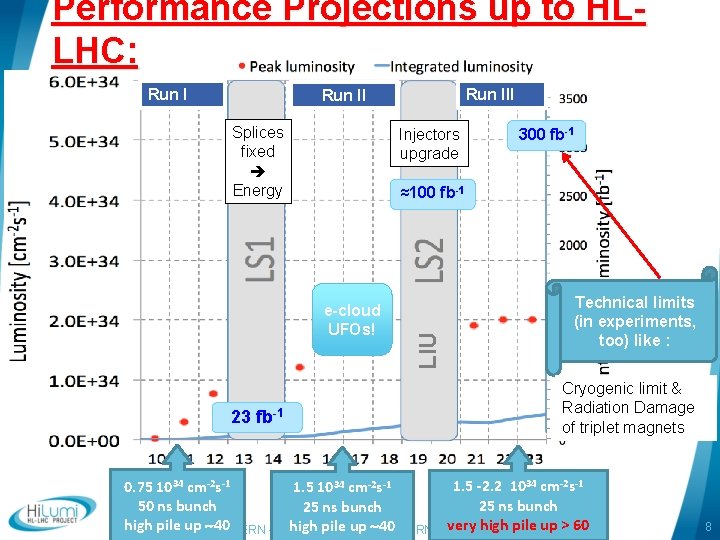
Performance Projections up to HLLHC: Run III Run II Splices fixed Energy Injectors upgrade LIU ≈100 fb-1 e-cloud UFOs! 23 fb-1 300 fb-1 Technical limits (in experiments, too) like : Cryogenic limit & Radiation Damage of triplet magnets 1. 5 -2. 2 1034 cm-2 s-1 0. 75 1034 cm-2 s-1 1. 5 1034 cm-2 s-1 25 ns bunch 50 ns bunch 25 ns bunch high pile upof 40 high pile up 40– CERN 27 very 1 st meeting the CERN – TRIUMF Committee April high 2016 pile up > 60 8
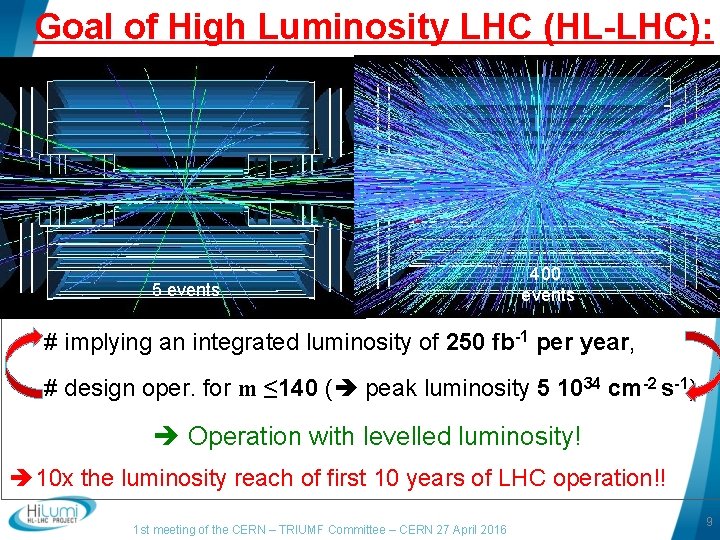
Goal of High Luminosity LHC (HL-LHC): The main objective of Hi. Lumi LHC Design Study is to determine a hardware configuration and a set of beam parameters that will allow the LHC to reach the following targets: Prepare machine for operation beyond 2025 and up to 2035 Devise beam parameters and operation scenarios for: 400 -1 # enabling 5 at total integrated luminosity of 3000 fb events # implying an integrated luminosity of 250 fb-1 per year, # design oper. for m ≤ 140 ( peak luminosity 5 1034 cm-2 s-1) Operation with levelled luminosity! 10 x the luminosity reach of first 10 years of LHC operation!! 1 st meeting of the CERN – TRIUMF Committee – CERN 27 April 2016 9
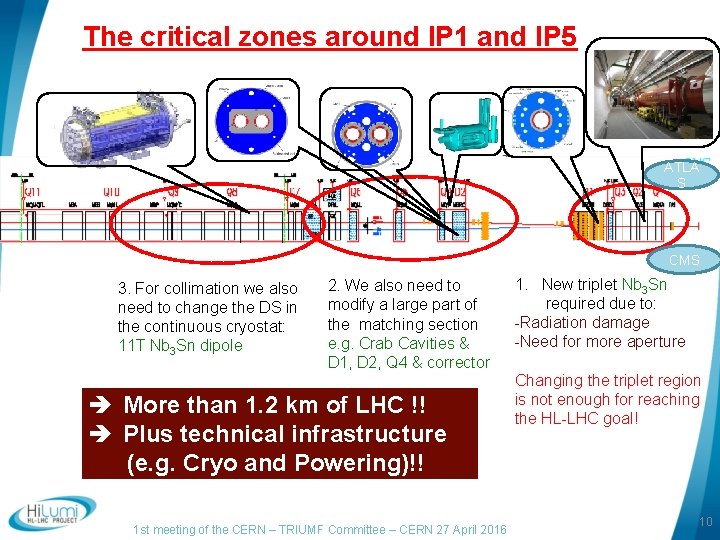
The critical zones around IP 1 and IP 5 ATLA S CMS 3. For collimation we also need to change the DS in the continuous cryostat: 11 T Nb 3 Sn dipole 2. We also need to modify a large part of the matching section e. g. Crab Cavities & D 1, D 2, Q 4 & corrector More than 1. 2 km of LHC !! Plus technical infrastructure (e. g. Cryo and Powering)!! 1 st meeting of the CERN – TRIUMF Committee – CERN 27 April 2016 1. New triplet Nb 3 Sn required due to: -Radiation damage -Need for more aperture Changing the triplet region is not enough for reaching the HL-LHC goal! 10
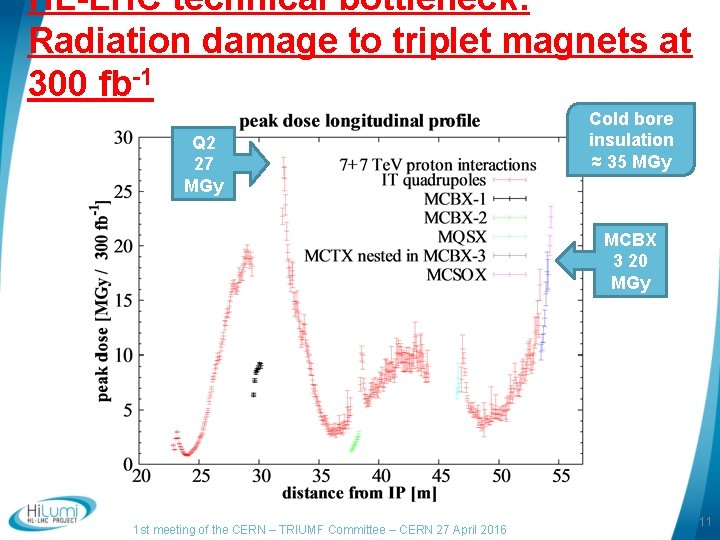
HL-LHC technical bottleneck: Radiation damage to triplet magnets at 300 fb-1 Q 2 27 MGy Cold bore insulation ≈ 35 MGy MCBX 3 20 MGy 1 st meeting of the CERN – TRIUMF Committee – CERN 27 April 2016 11
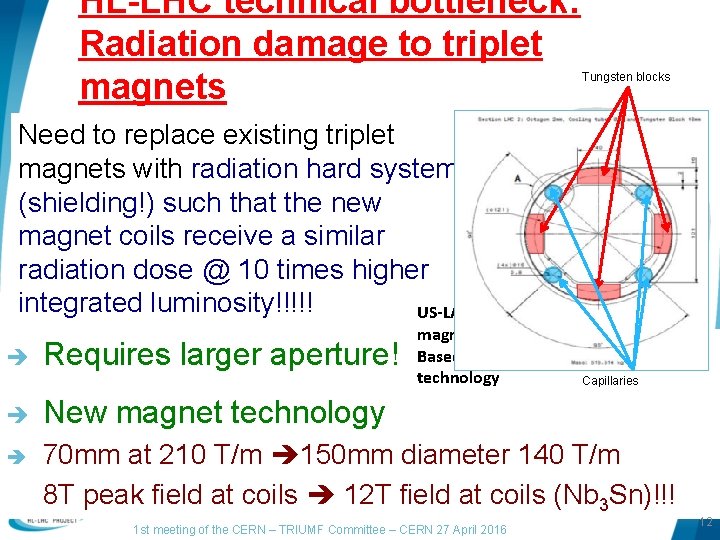
HL-LHC technical bottleneck: Radiation damage to triplet magnets Tungsten blocks Need to replace existing triplet magnets with radiation hard system (shielding!) such that the new magnet coils receive a similar radiation dose @ 10 times higher integrated luminosity!!!!! US-LARP MQXF Requires larger aperture! magnet design Based on Nb 3 Sn technology Capillaries New magnet technology 70 mm at 210 T/m 150 mm diameter 140 T/m 8 T peak field at coils 12 T field at coils (Nb 3 Sn)!!! 1 st meeting of the CERN – TRIUMF Committee – CERN 27 April 2016 12
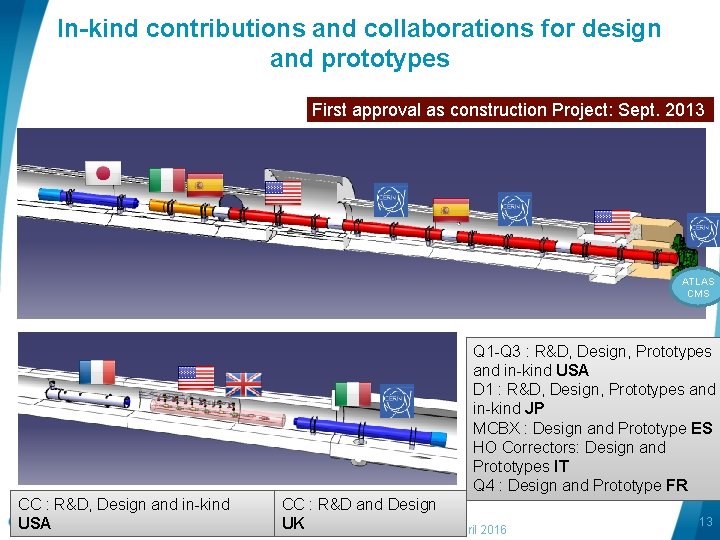
In-kind contributions and collaborations for design and prototypes First approval as construction Project: Sept. 2013 ATLAS CMS Q 1 -Q 3 : R&D, Design, Prototypes and in-kind USA D 1 : R&D, Design, Prototypes and in-kind JP MCBX : Design and Prototype ES HO Correctors: Design and Prototypes IT Q 4 : Design and Prototype FR CC : R&D and Design CC : R&D, Design and in-kind UK Committee – CERN 27 April 2016 USA 1 st meeting of the CERN – TRIUMF 13
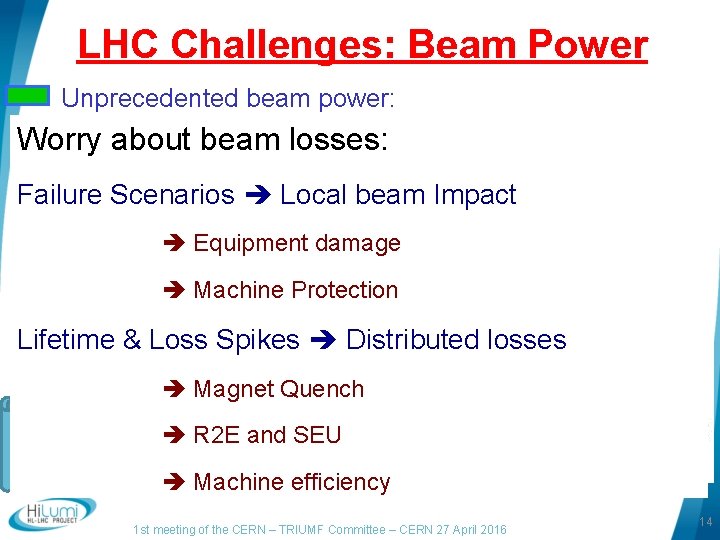
LHC Challenges: Beam Power Unprecedented beam power: potential equipment Worry about beam losses: damage in case of failures Failure during Scenarios operation In case of failure the beam must never reach Lifetime sensitive & equipment! Local beam Impact Equipment damage Machine Protection Loss Spikes Distributed losses Magnet Quench Stored Beam power: R 2 E and SEU HL-LHC > 500 MJ / beam Machine efficiency 1 st meeting of the CERN – TRIUMF Committee – CERN 27 April 2016 14
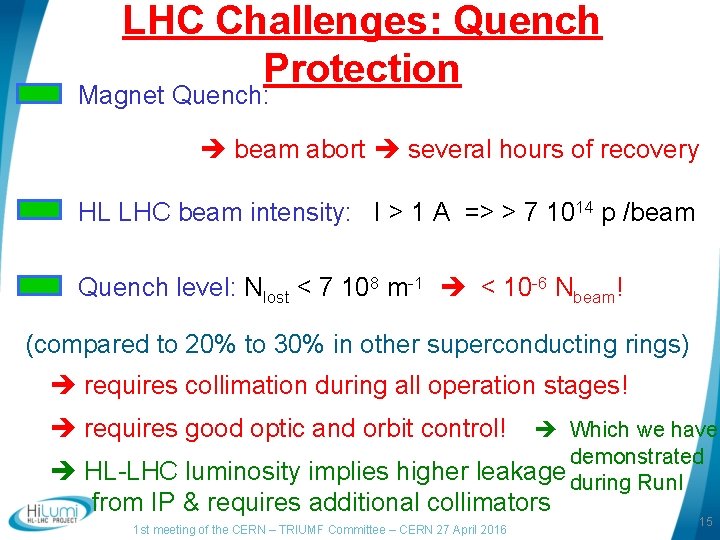
LHC Challenges: Quench Protection Magnet Quench: beam abort several hours of recovery HL LHC beam intensity: I > 1 A => > 7 1014 p /beam Quench level: Nlost < 7 108 m-1 < 10 -6 Nbeam! (compared to 20% to 30% in other superconducting rings) requires collimation during all operation stages! requires good optic and orbit control! Which we have demonstrated HL-LHC luminosity implies higher leakage during Run. I from IP & requires additional collimators 1 st meeting of the CERN – TRIUMF Committee – CERN 27 April 2016 15
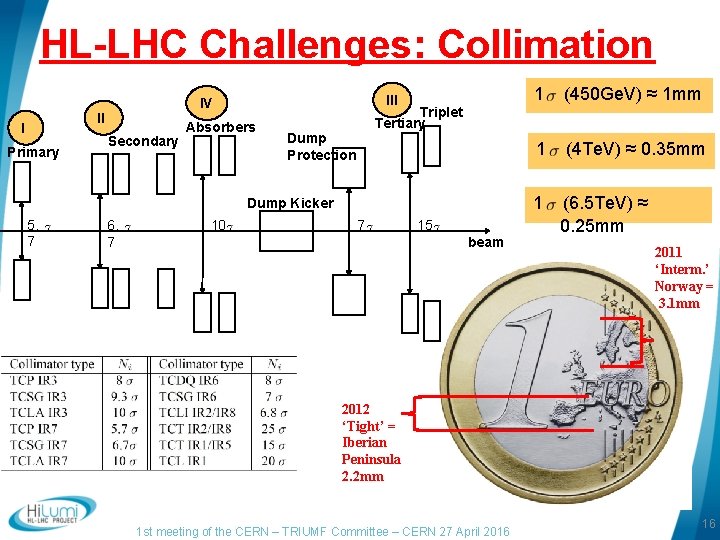
HL-LHC Challenges: Collimation II I Primary III IV Secondary Absorbers 6. 7 10 (450 Ge. V) ≈ 1 mm 1 (4 Te. V) ≈ 0. 35 mm Triplet Tertiary Dump Protection 1 Dump Kicker 5. 7 15 beam (6. 5 Te. V) ≈ 0. 25 mm 2011 ‘Interm. ’ Norway = 3. 1 mm 2012 ‘Tight’ = Iberian Peninsula 2. 2 mm 1 st meeting of the CERN – TRIUMF Committee – CERN 27 April 2016 16
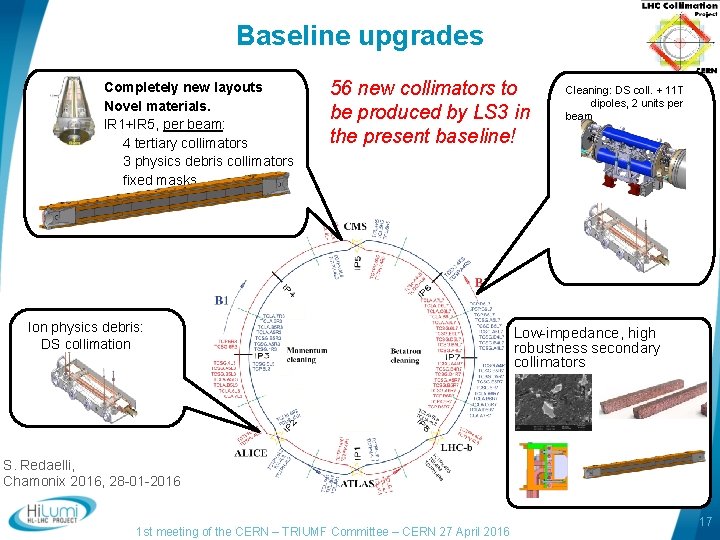
Baseline upgrades Completely new layouts Novel materials. IR 1+IR 5, per beam: 4 tertiary collimators 3 physics debris collimators fixed masks 56 new collimators to be produced by LS 3 in the present baseline! Ion physics debris: DS collimation Cleaning: DS coll. + 11 T dipoles, 2 units per beam Low-impedance, high robustness secondary collimators S. Redaelli, Chamonix 2016, 28 -01 -2016 1 st meeting of the CERN – TRIUMF Committee – CERN 27 April 2016 17
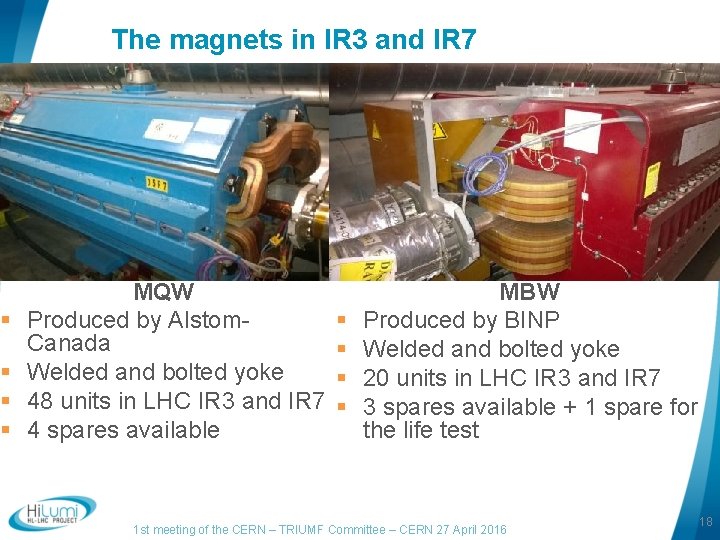
§ § The magnets in IR 3 and IR 7 MQW Produced by Alstom. Canada Welded and bolted yoke 48 units in LHC IR 3 and IR 7 4 spares available § § MBW Produced by BINP Welded and bolted yoke 20 units in LHC IR 3 and IR 7 3 spares available + 1 spare for the life test 1 st meeting of the CERN – TRIUMF Committee – CERN 27 April 2016 18
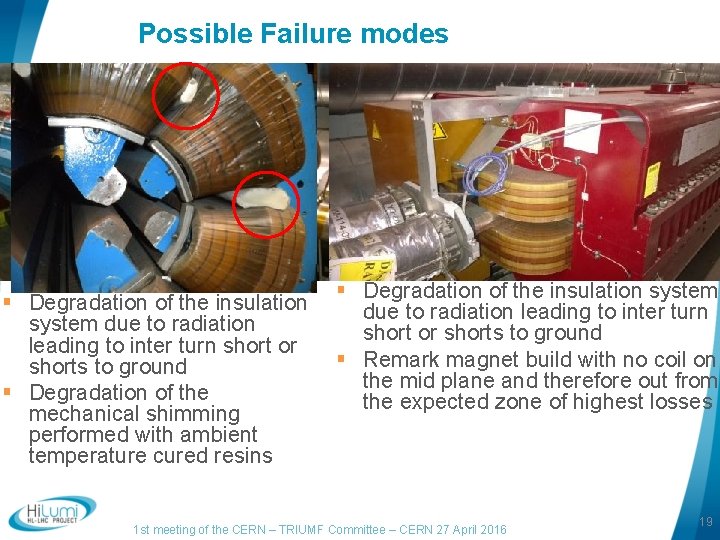
Possible Failure modes § Degradation of the insulation system due to radiation leading to inter turn short or shorts to ground § Degradation of the mechanical shimming performed with ambient temperature cured resins § Degradation of the insulation system due to radiation leading to inter turn short or shorts to ground § Remark magnet build with no coil on the mid plane and therefore out from the expected zone of highest losses 1 st meeting of the CERN – TRIUMF Committee – CERN 27 April 2016 19
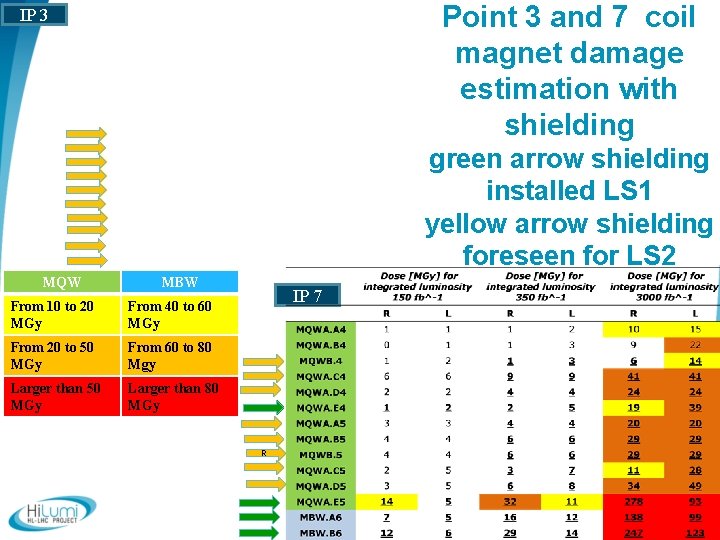
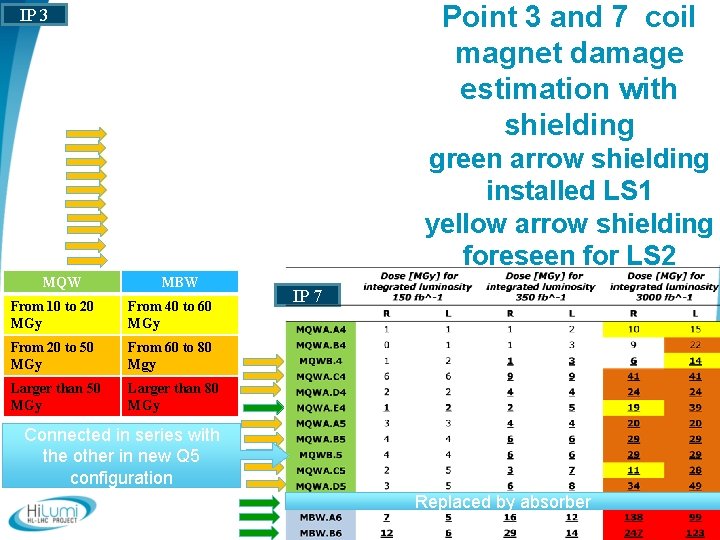
Point 3 and 7 coil magnet damage estimation with shielding IP 3 green arrow shielding installed LS 1 yellow arrow shielding foreseen for LS 2 MQW MBW From 10 to 20 MGy From 40 to 60 MGy From 20 to 50 MGy From 60 to 80 Mgy Larger than 50 MGy Larger than 80 MGy IP 7 R
Point 3 and 7 coil magnet damage estimation with shielding IP 3 green arrow shielding installed LS 1 yellow arrow shielding foreseen for LS 2 MQW MBW From 10 to 20 MGy From 40 to 60 MGy From 20 to 50 MGy From 60 to 80 Mgy Larger than 50 MGy Larger than 80 MGy Connected in series with the other in new Q 5 configuration IP 7 R Replaced by absorber
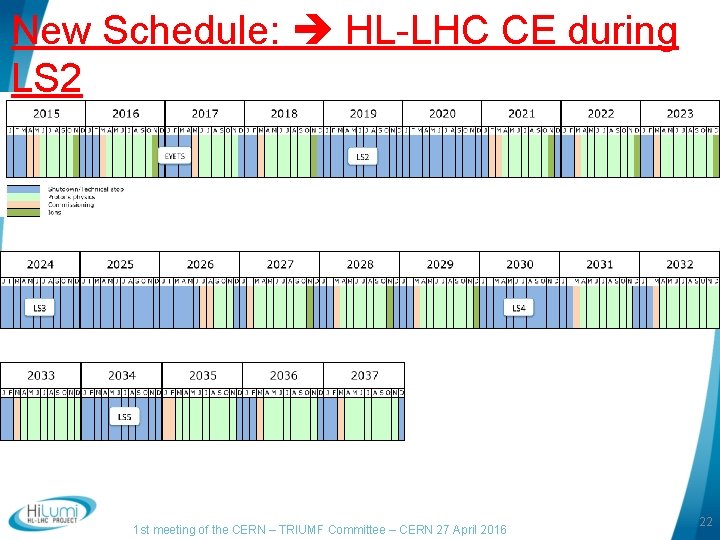
New Schedule: HL-LHC CE during LS 2 1 st meeting of the CERN – TRIUMF Committee – CERN 27 April 2016 22
1 st meeting of the CERN – TRIUMF Committee – CERN 27 April 2016 23
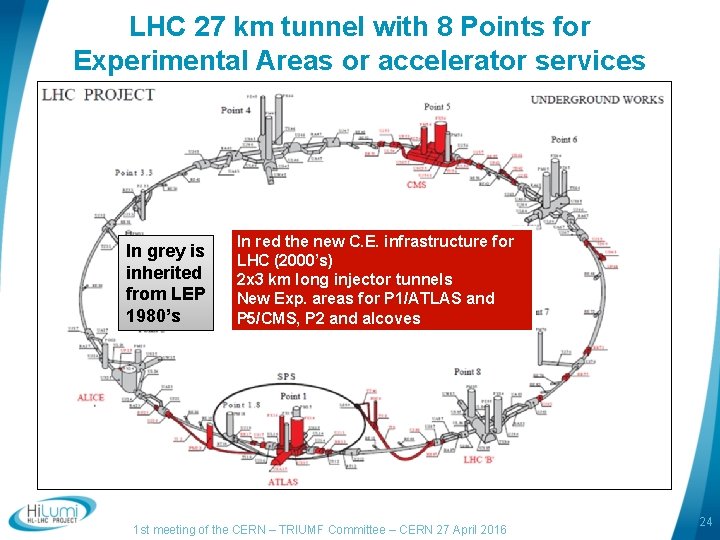
LHC 27 km tunnel with 8 Points for Experimental Areas or accelerator services In grey is inherited from LEP 1980’s In red the new C. E. infrastructure for LHC (2000’s) 2 x 3 km long injector tunnels New Exp. areas for P 1/ATLAS and P 5/CMS, P 2 and alcoves 1 st meeting of the CERN – TRIUMF Committee – CERN 27 April 2016 24
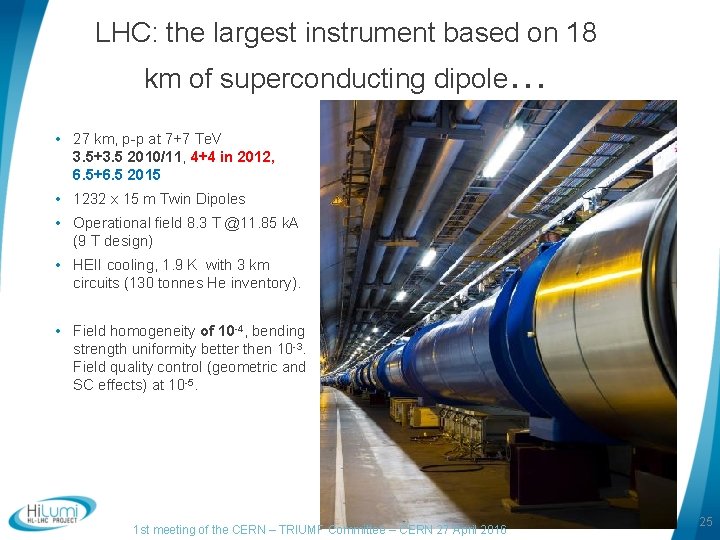
LHC: the largest instrument based on 18 km of superconducting dipole… • 27 km, p-p at 7+7 Te. V 3. 5+3. 5 2010/11, 4+4 in 2012, 6. 5+6. 5 2015 • 1232 x 15 m Twin Dipoles • Operational field 8. 3 T @11. 85 k. A (9 T design) • HEII cooling, 1. 9 K with 3 km circuits (130 tonnes He inventory). • Field homogeneity of 10 -4, bending strength uniformity better then 10 -3. Field quality control (geometric and SC effects) at 10 -5. 1 st meeting of the CERN – TRIUMF Committee – CERN 27 April 2016 25
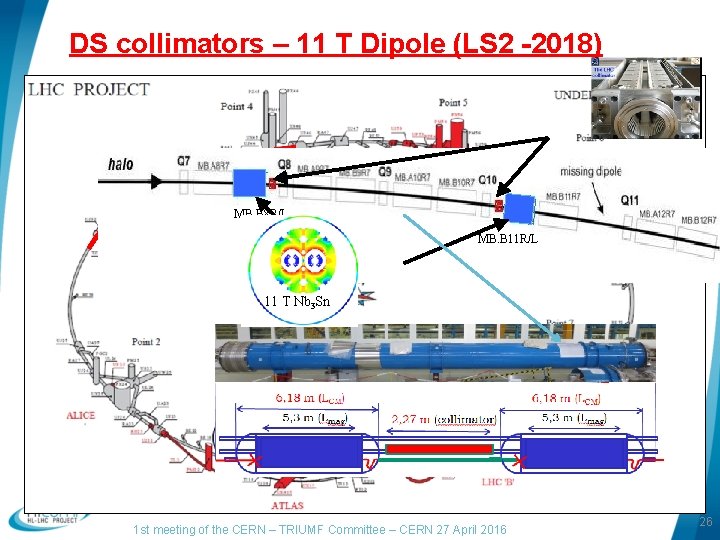
DS collimators – 11 T Dipole (LS 2 -2018) MB. B 8 R/L MB. B 11 R/L 11 T Nb 3 Sn 1 st meeting of the CERN – TRIUMF Committee – CERN 27 April 2016 26
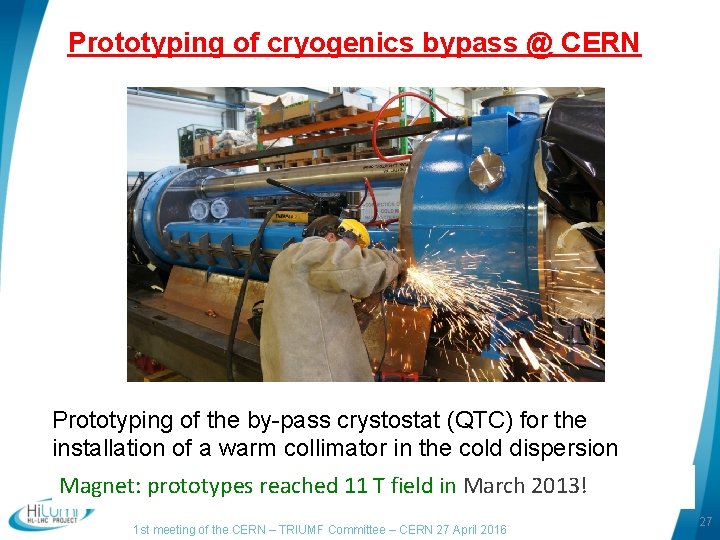
Prototyping of cryogenics bypass @ CERN Prototyping of the by-pass crystostat (QTC) for the installation of a warm collimator in the cold dispersion suppressors. Magnet: prototypes reached 11 T field in March 2013! 1 st meeting of the CERN – TRIUMF Committee – CERN 27 April 2016 27