
An Introduction to the Foundations of Academic Advising

- Slides: 42
An Introduction to the Foundations of Academic Advising 2019 NACADA Annual Conference Patrick Cate Lakes Region Community College Vice President of Academic and Student Affairs pcate@ccsnh. edu Marsha Miller NACADA Assistant Director Emerita Kansas State University miller@ksu. edu Session materials available at http: //www. nacada. ksu. edu/About-Us/Executive-Office/EO-Staff/Marsha-Miller. aspx
Workshop Objectives • Understand the three components of academic advising • Become familiar with advising history and theorists whose work lays the foundation for quality academic advising • Become familiar with approaches experienced advisors draw from when advising students • Get a chance to practice • Learn ways to effectively “work” a conference so you can make useful connections and take home and implement ideas learned.
WHO ARE WE? • How long have you advised? • Academic background? • Institution type & location? • What one thing do you want to learn this morning?
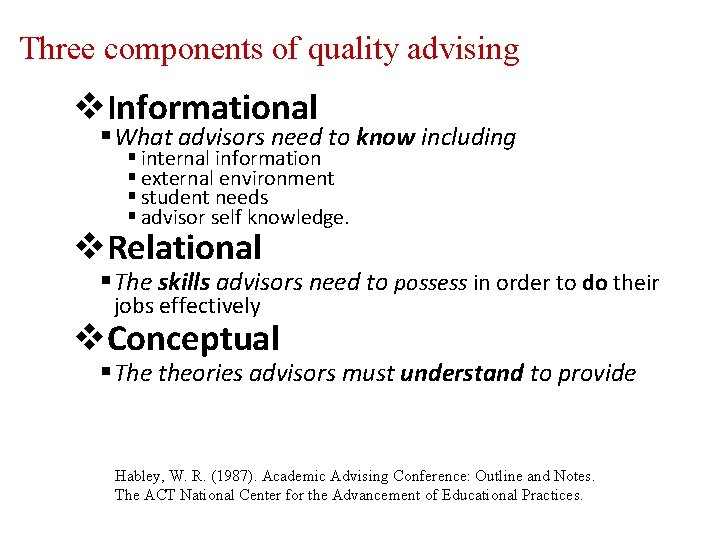
Three components of quality advising v. Informational § What advisors need to know including § internal information § external environment § student needs § advisor self knowledge. v. Relational § The skills advisors need to possess in order to do their jobs effectively v. Conceptual § The theories advisors must understand to provide quality academic advising Habley, W. R. (1987). Academic Advising Conference: Outline and Notes. The ACT National Center for the Advancement of Educational Practices.
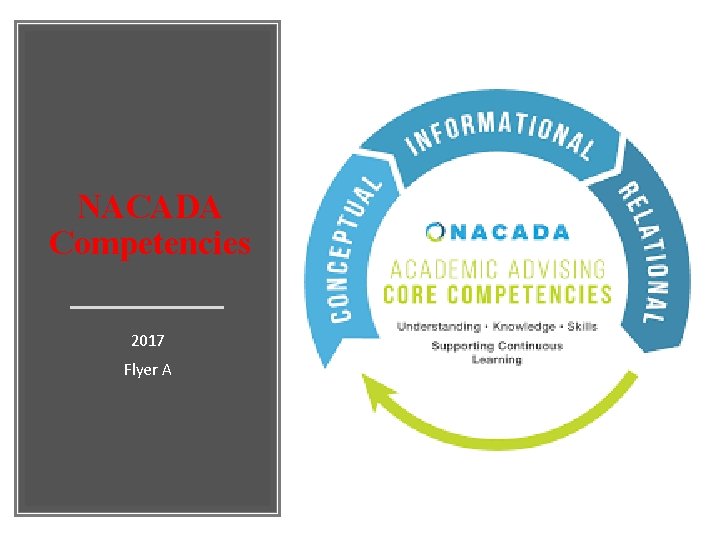
NACADA Competencies 2017 Flyer A
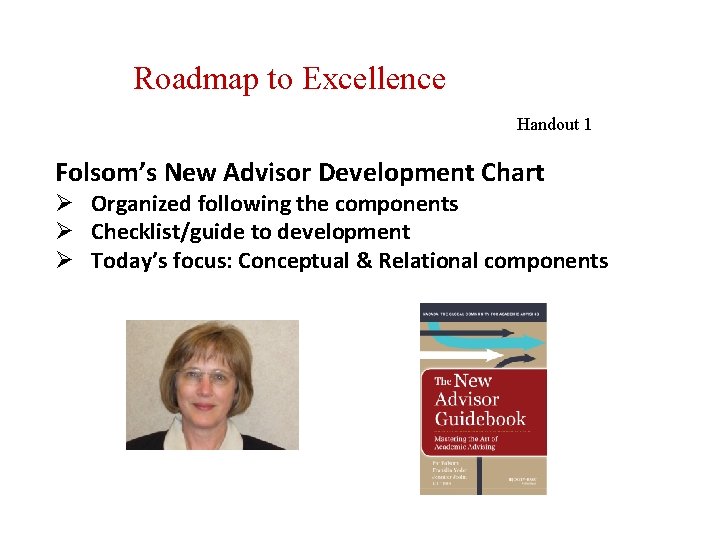
Roadmap to Excellence Handout 1 Folsom’s New Advisor Development Chart Ø Organized following the components Ø Checklist/guide to development Ø Today’s focus: Conceptual & Relational components
INTRODUCTION TO THE CONCEPTUAL COMPONENT It Always Has Been About Advising… • The ten generations of Higher Education • Sharpening the mind vs. vocational training • Public good vs. private control • Political vs. apolitical Altbach, P. , Berdahl, R. & Gumport, P. (Eds. ). (1999). American higher education in the twenty-first century: Social, political, and economic challenges. Baltimore: The Johns Hopkins University Press.
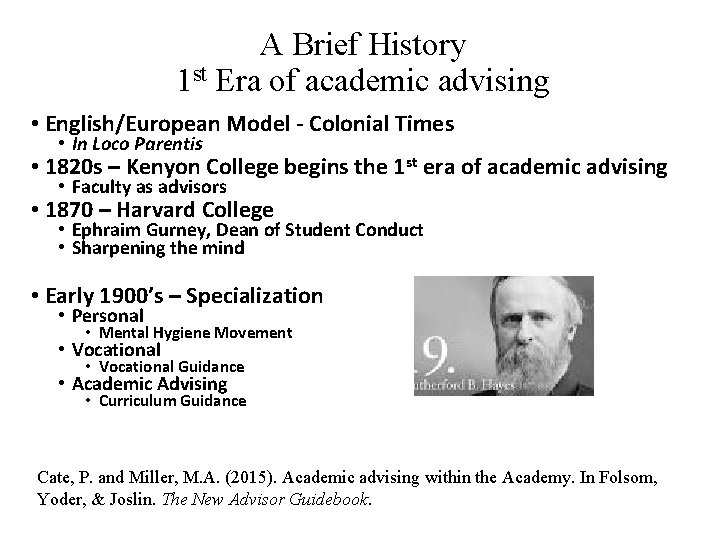
A Brief History 1 st Era of academic advising • English/European Model - Colonial Times • In Loco Parentis • 1820 s – Kenyon College begins the 1 st era of academic advising • Faculty as advisors • 1870 – Harvard College • Ephraim Gurney, Dean of Student Conduct • Sharpening the mind • Early 1900’s – Specialization • Personal • Mental Hygiene Movement • Vocational Guidance • Academic Advising • Curriculum Guidance Cate, P. and Miller, M. A. (2015). Academic advising within the Academy. In Folsom, Yoder, & Joslin. The New Advisor Guidebook.
Second Era of Advising • Post WWII – Curriculum Issues/ GI Issues • Many new and diverse curricular changes. • Specialist needed to provide guidance. • With changes in curriculum came the need for specialists. • Advisors were unclear in role • “Student Personnel Point of View” A. C. E 1949
Third Era of Advising • 1970 to 2002 • Crookston and O’Banion. (1972) • Burlington VT – 1977 – NACADA • Advising as an “examined activity. ” • Access; begin to tie theory to practice • Organization/Delivery models (Habley, 1983)
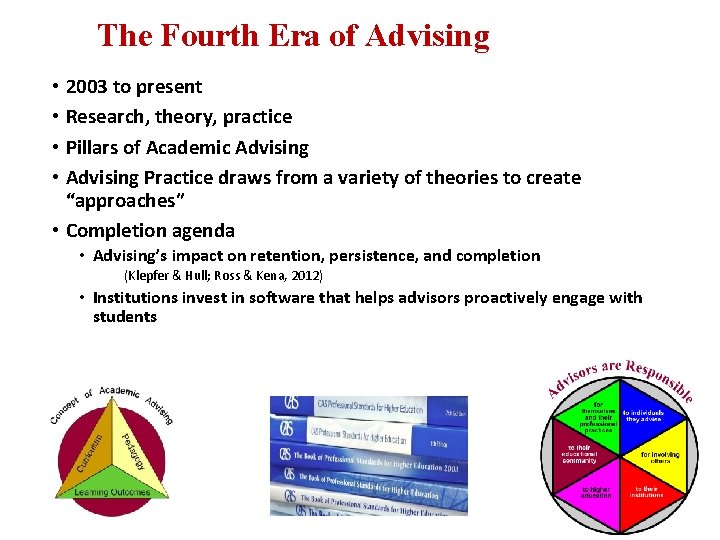
The Fourth Era of Advising • 2003 to present • Research, theory, practice • Pillars of Academic Advising • Advising Practice draws from a variety of theories to create “approaches” • Completion agenda • Advising’s impact on retention, persistence, and completion (Klepfer & Hull; Ross & Kena, 2012) • Institutions invest in software that helps advisors proactively engage with students
Theories That serve as foundations for advising The Conceptual Component
Why Theory Matters CAS Standards for Academic Advising Programs (AAP) must be: • integrated into the life of the institution • intentional and coherent • guided by theories and knowledge of learning and development • reflective to needs of individuals, diverse and special populations, and relevant constituencies
Crookston 1972 • Advising is “concerned with not only the specific personal or vocational decision but with facilitating the student’s rational processes, environmental and interpersonal interactions, behavioral awareness, and problem-solving, decision-making and evaluation skills. ” Crookson, B. B. (1972). A developmental view of academic advising as teaching. Journal of College Student Personnel, p. 13.
Terry O’Banion’s Model (1972) • Exploration of Life Goals • Exploration of Career/Educational Goals • Selection of Educational Programs • Selection of Courses • Scheduling of Classes O'Banion, T. (1972). An academic advising model. Junior College Journal, 42, 62 -69.
The Relational Component Handout 2
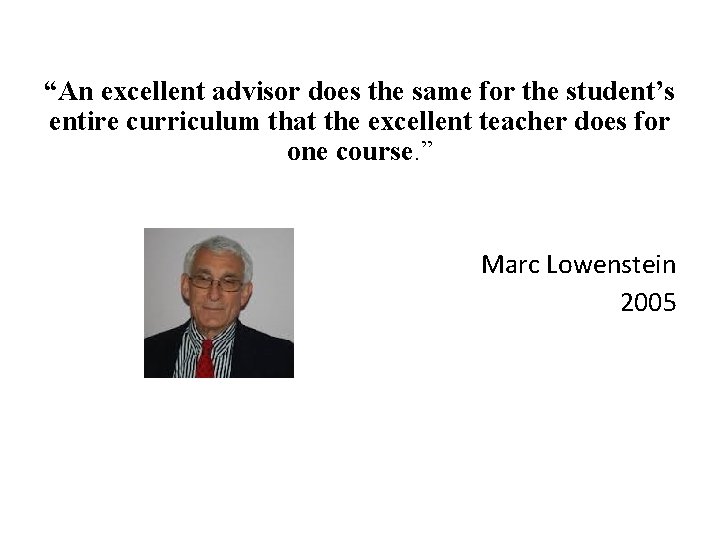
“An excellent advisor does the same for the student’s entire curriculum that the excellent teacher does for one course. ” Marc Lowenstein 2005
Advising as Teaching • Advisors teach students: • • • To value the learning process To apply decision-making strategies To put the college experience into perspective To set priorities and evaluate events To develop thinking & learning skills To make choices • NACADA Core Values (2005)
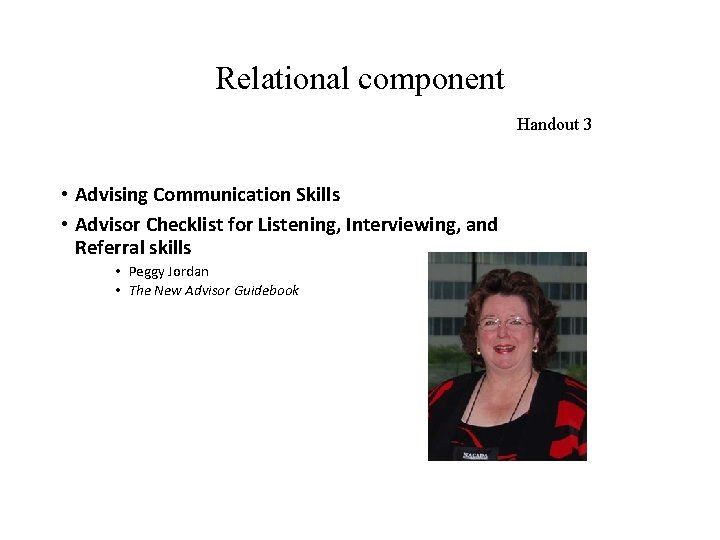
Relational component Handout 3 • Advising Communication Skills • Advisor Checklist for Listening, Interviewing, and Referral skills • Peggy Jordan • The New Advisor Guidebook
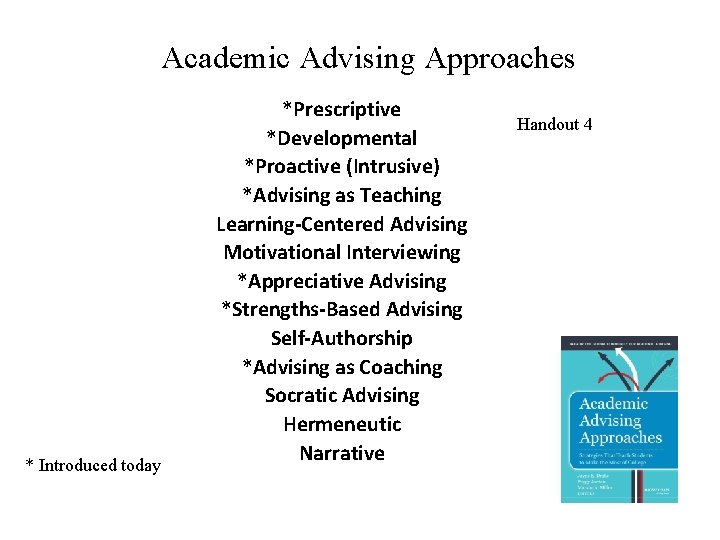
Academic Advising Approaches * Introduced today *Prescriptive *Developmental *Proactive (Intrusive) *Advising as Teaching Learning-Centered Advising Motivational Interviewing *Appreciative Advising *Strengths-Based Advising Self-Authorship *Advising as Coaching Socratic Advising Hermeneutic Narrative Handout 4 today
Traditional (Prescriptive) Vs. Developmental Advising Prescriptive Advising: • Authoritarian in Nature • Knowledge is one-sided. • There is a “right” answer.
Developmental Advising Approach Terry O’Banion (1972) 1. Exploration of life goals 2. Exploration of vocational goals 3. Program choice 4. Course choice 5. Scheduling courses O’Banion in Reverse Patrick Cate (2013) 1. Schedule 2. Course choice 3. Program choice 4. Exploration of vocational goals 5. Exploration of life goals ARE THE BUILDING BLOCKS OF DEVELOPMENTAL ADVISING UPSIDE DOWN?
Traditional (Prescriptive) Vs. Developmental Advising: • Dialogue rather than monologue. • Student driven. • There are “good” answers.
Handout 5 Case Study 1: • Lack of Academic Progress • Vignette 2: Scenes for Learning and Reflection, Vol. 1
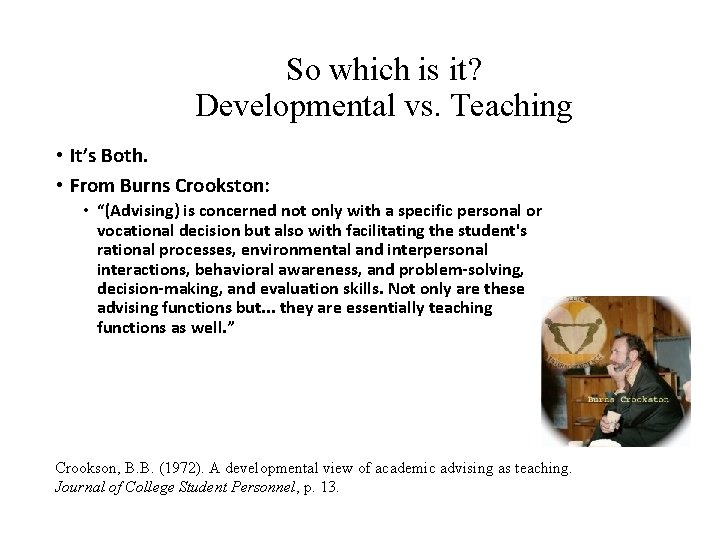
So which is it? Developmental vs. Teaching • It’s Both. • From Burns Crookston: • “(Advising) is concerned not only with a specific personal or vocational decision but also with facilitating the student's rational processes, environmental and interpersonal interactions, behavioral awareness, and problem-solving, decision-making, and evaluation skills. Not only are these advising functions but. . . they are essentially teaching functions as well. ” Crookson, B. B. (1972). A developmental view of academic advising as teaching. Journal of College Student Personnel, p. 13.
Advising Approaches Handout 4 Advising as Teaching • Lowenstein (2005): “If Advising is Teaching, What do Advisors Teach? ” • Madeline Hunter’s (1982) steps: • • Determine student needs (determine learning objectives) Set expectations Focus student attention on the objectives Provide information needed so student can meet objective Model steps to be taken Check for understanding Guided practice Independent practice
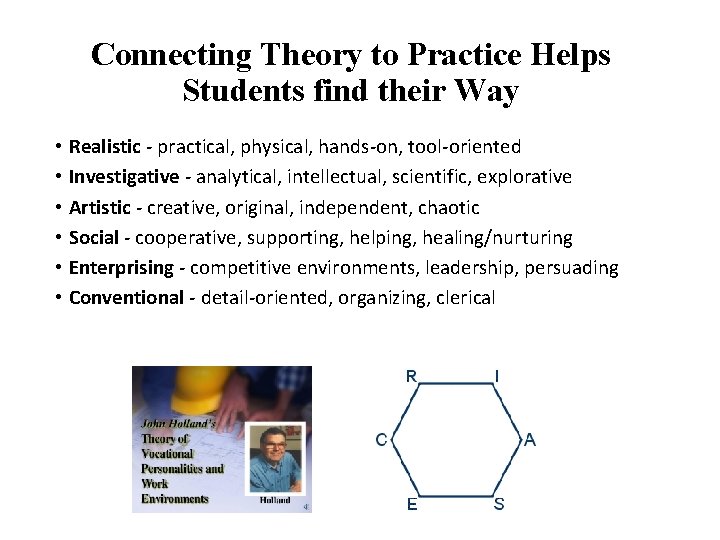
Connecting Theory to Practice Helps Students find their Way • Realistic - practical, physical, hands-on, tool-oriented • Investigative - analytical, intellectual, scientific, explorative • Artistic - creative, original, independent, chaotic • Social - cooperative, supporting, helping, healing/nurturing • Enterprising - competitive environments, leadership, persuading • Conventional - detail-oriented, organizing, clerical
Advising Approaches Proactive Advising Handout 4 • Robert Glennen (1975) Intrusive advising • Strategies for connecting with students prior to problems developing (Varney, 2013) • Data mine to determine ‘high risk’ student characteristics • Develop relationships with students (Schlossberg’s theory of mattering – see glossary) • Determine student strengths and deficits • Create positive, personalized messages • Determine critical outreach points. • Reach out at intervals beginning at 3 weeks • Vary delivery methods (e. g. , social media, email, etc. )
Advising Approaches Strengths-based advising Handout 4 & 6 • Schreiner (2013) Five Steps: • Identify Students’ Talents • Increase awareness of strengths • Envision future • Plan specific steps to reach goals • Apply students strengths to challenges • Martin (2011) Self-assessment questionnaire • Connects Proactive & Strengths • Handout 6
Advising Approaches Handout 4 Appreciative Advising • Bloom, Hutson, & He (2013) • Six Phases • Disarm • Discover • Dream • Design • Deliver • Don’t settle
Advising Approaches Advising as Coaching • Mc. Clellan, 2013 • Advising-as-Coaching questions used with active listening • • Identify dreams/specific problems Examine previous efforts Brainstorm ideas/solutions Goal setting & planning Seek support Implementation Follow-up Handout 7
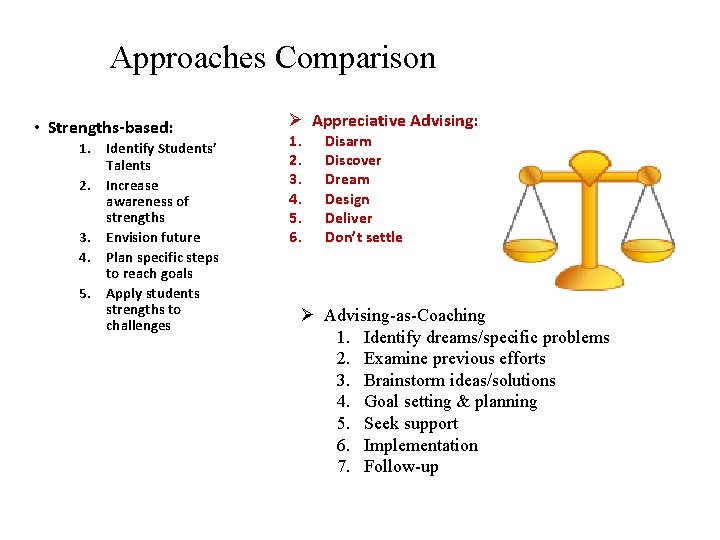
Approaches Comparison • Strengths-based: 1. Identify Students’ Talents 2. Increase awareness of strengths 3. Envision future 4. Plan specific steps to reach goals 5. Apply students strengths to challenges Ø Appreciative Advising: 1. 2. 3. 4. 5. 6. Disarm Discover Dream Design Deliver Don’t settle Ø Advising-as-Coaching 1. Identify dreams/specific problems 2. Examine previous efforts 3. Brainstorm ideas/solutions 4. Goal setting & planning 5. Seek support 6. Implementation 7. Follow-up
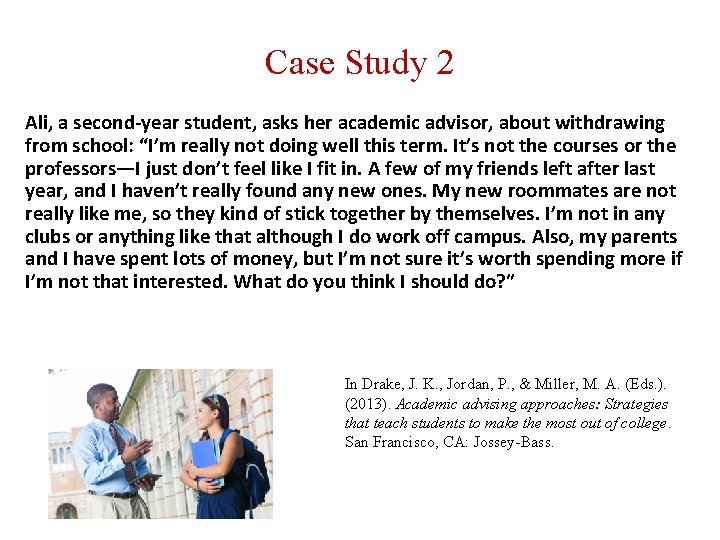
Case Study 2 Ali, a second-year student, asks her academic advisor, about withdrawing from school: “I’m really not doing well this term. It’s not the courses or the professors—I just don’t feel like I fit in. A few of my friends left after last year, and I haven’t really found any new ones. My new roommates are not really like me, so they kind of stick together by themselves. I’m not in any clubs or anything like that although I do work off campus. Also, my parents and I have spent lots of money, but I’m not sure it’s worth spending more if I’m not that interested. What do you think I should do? ” In Drake, J. K. , Jordan, P. , & Miller, M. A. (Eds. ). (2013). Academic advising approaches: Strategies that teach students to make the most out of college. San Francisco, CA: Jossey-Bass.
Future of Advising • What do we see as trends in our students? • What do we see as qualifications for advisors? • Who shapes the decisions on your campus?
During this conference … Who • V. Tinto • W. Habley • V. Gordon • J. Gardner • G. Kuh • J. Dewey … Check your glossary
During this conference … What • Other theories that serve as a foundation for practice • Other approaches • Advising Models (who advises, how advising delivered) • Predictive analytics / early alert software • Completion Agenda/ Performance-based funding
So What? Suggestions to manage this conference • There is much more to learn -- choosing your conference sessions. • Making the conference work for you – Executive Summary (Handout 8). • How do you find out more when you are home?
Resources
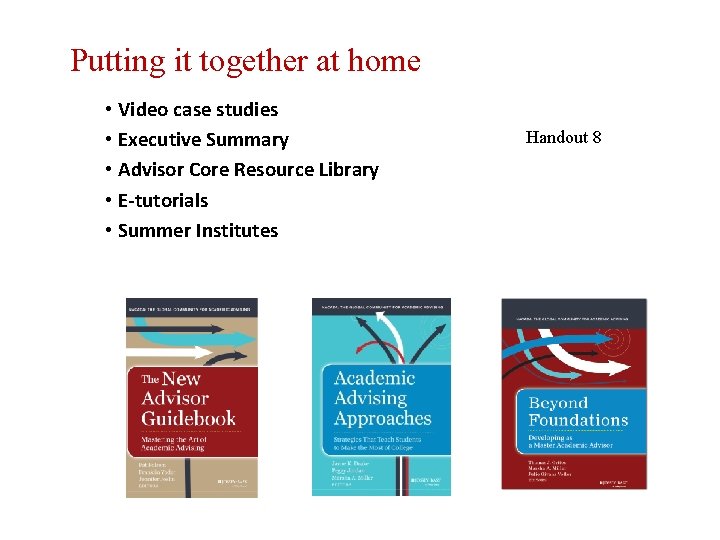
Putting it together at home • Video case studies • Executive Summary • Advisor Core Resource Library • E-tutorials • Summer Institutes Handout 8
Bibliography
Discussion Contact: Patrick Cate pcate@ccsnh. edu Marsha Miller miller@ksu. edu
Please evaluate this session Good Luck & learn a lot at the conference!