
An Introduction to the Creative Commons Welcome Heather
- Slides: 40
An Introduction to the Creative Commons
Welcome! Heather Crozier Carla Myers Electronic Resources Librarian Heterick Memorial Library Ohio Northern University h-crozier@onu. edu Coordinator of Scholarly Communications Miami University Libraries myersc 2@miamioh. edu
Overview • • Copyright Basics CC Licenses Using CC Licensed Works Using CC Licenses for Your Works
COPYRIGHT BASICS
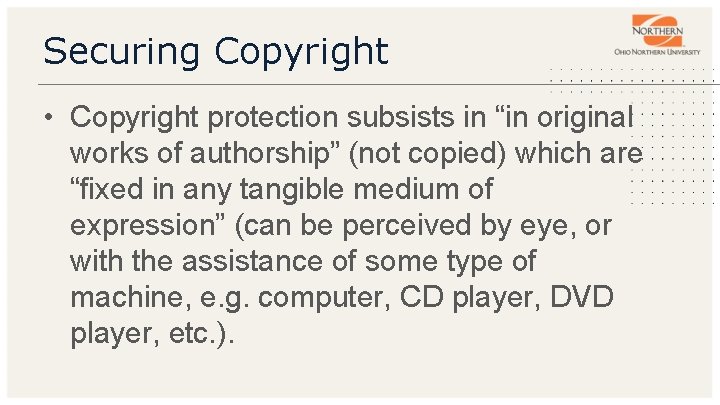
Securing Copyright • Copyright protection subsists in “in original works of authorship” (not copied) which are “fixed in any tangible medium of expression” (can be perceived by eye, or with the assistance of some type of machine, e. g. computer, CD player, DVD player, etc. ).
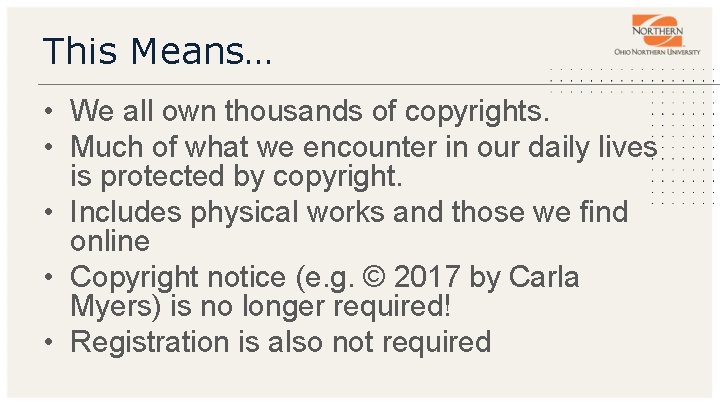
This Means… • We all own thousands of copyrights. • Much of what we encounter in our daily lives is protected by copyright. • Includes physical works and those we find online • Copyright notice (e. g. © 2017 by Carla Myers) is no longer required! • Registration is also not required
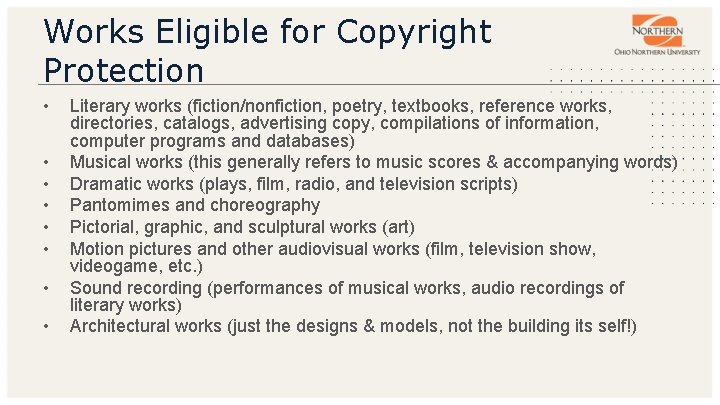
Works Eligible for Copyright Protection • • Literary works (fiction/nonfiction, poetry, textbooks, reference works, directories, catalogs, advertising copy, compilations of information, computer programs and databases) Musical works (this generally refers to music scores & accompanying words) Dramatic works (plays, film, radio, and television scripts) Pantomimes and choreography Pictorial, graphic, and sculptural works (art) Motion pictures and other audiovisual works (film, television show, videogame, etc. ) Sound recording (performances of musical works, audio recordings of literary works) Architectural works (just the designs & models, not the building its self!)
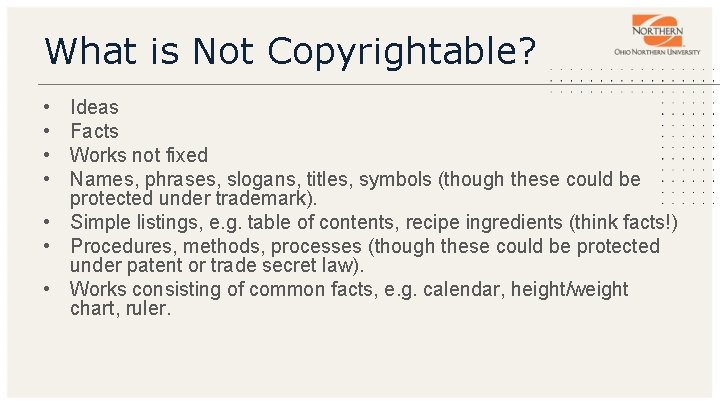
What is Not Copyrightable? • • Ideas Facts Works not fixed Names, phrases, slogans, titles, symbols (though these could be protected under trademark). • Simple listings, e. g. table of contents, recipe ingredients (think facts!) • Procedures, methods, processes (though these could be protected under patent or trade secret law). • Works consisting of common facts, e. g. calendar, height/weight chart, ruler.
Who Owns the Copyright in a Work? • Generally, the person who creates the work. • Joint Authorship-When two or more authors work together to create a work the copyright is shared between them. • Works Made for Hire
Authors’ Rights Owner of a protected work is provided with certain right…. • The right to reproduce (copy) the work • The right to distribute the work (share/publish/sell) • The right to create derivative works • The right to publicly perform or display a work
How Long Does Copyright Last? Works created after Jan. 1, 1978 are protected for the life of the author plus 70 years • Join authorship-life of last surviving author +70 years • Works for Hire-95 years from publication or 120 years from creation, whichever is shorter
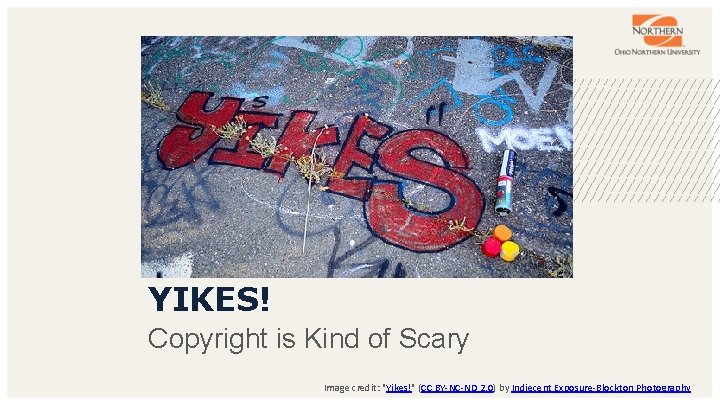
YIKES! Copyright is Kind of Scary Image credit: "Yikes!" (CC BY-NC-ND 2. 0) by Indiecent Exposure-Blockton Photography
Copyright Infringement • Copyright infringement occurs when we take advantage of one or more of the rights granted to rightsholders under US copyright law without their permission: – – Copying works Distributing works Making derivatives Making a public performance or display of a work
Copyright Exceptions • There are exceptions in US copyright law that may cover certain uses: – Fair Use (Section 107) – Face-to-Face Classroom Exception (Section 110(1)) – Library Exception (Section 108) • Useful, but come with some uncertainty
Reuse of Third Party Works • Many rightsholders are eager to share their works with others – Just enjoy creation – Looking to share knowledge – Looking for notoriety (fame/tenure) • How can we communicate this with others? – Rely on users knowledge of exceptions – Licensing!
THE CREATIVE COMMONS
About the CC • Founded in 2001 by Lawrence Lessig, Hal Abelson, and Eric Eldred with the support of Center for the Public Domain. • Released their first set of licenses in 2002. • Licenses provide rightsholders with a simple, standardized way to grant copyright permissions to their creative work. • Today its estimated that there are more than 1 billion works licensed under the various Creative Commons licenses. • https: //creativecommons. org/
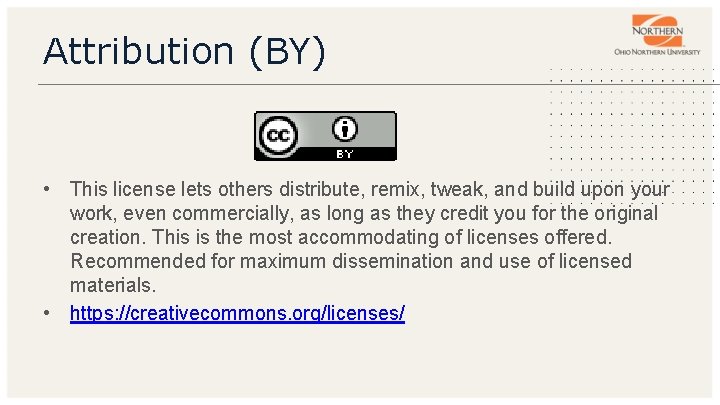
Attribution (BY) • This license lets others distribute, remix, tweak, and build upon your work, even commercially, as long as they credit you for the original creation. This is the most accommodating of licenses offered. Recommended for maximum dissemination and use of licensed materials. • https: //creativecommons. org/licenses/
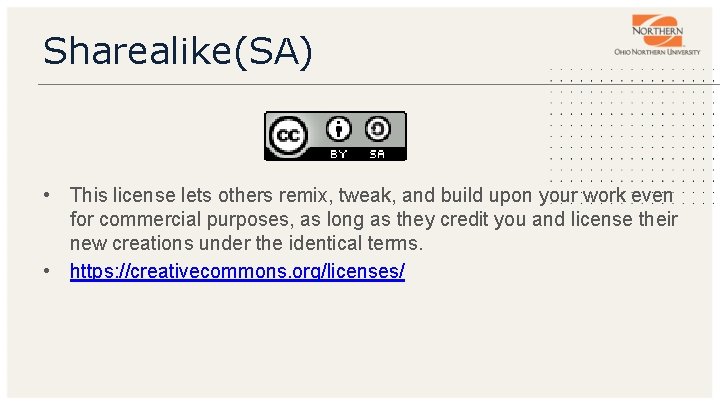
Sharealike(SA) • This license lets others remix, tweak, and build upon your work even for commercial purposes, as long as they credit you and license their new creations under the identical terms. • https: //creativecommons. org/licenses/
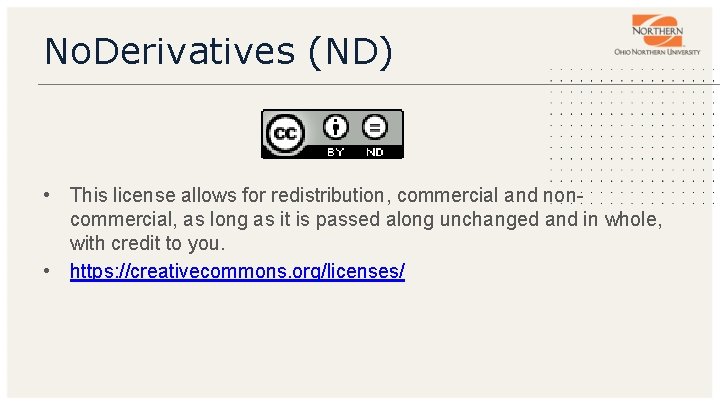
No. Derivatives (ND) • This license allows for redistribution, commercial and noncommercial, as long as it is passed along unchanged and in whole, with credit to you. • https: //creativecommons. org/licenses/
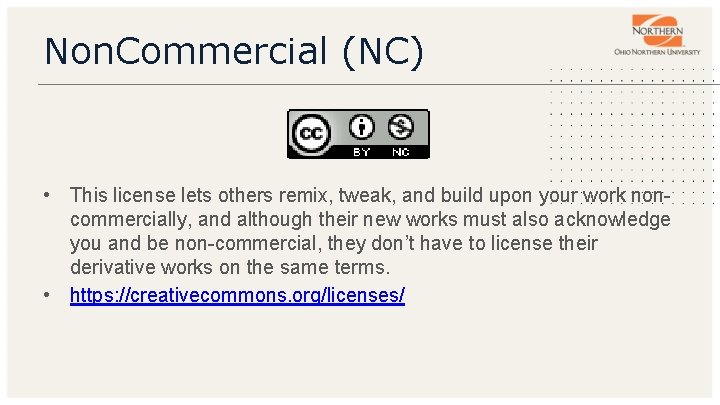
Non. Commercial (NC) • This license lets others remix, tweak, and build upon your work noncommercially, and although their new works must also acknowledge you and be non-commercial, they don’t have to license their derivative works on the same terms. • https: //creativecommons. org/licenses/
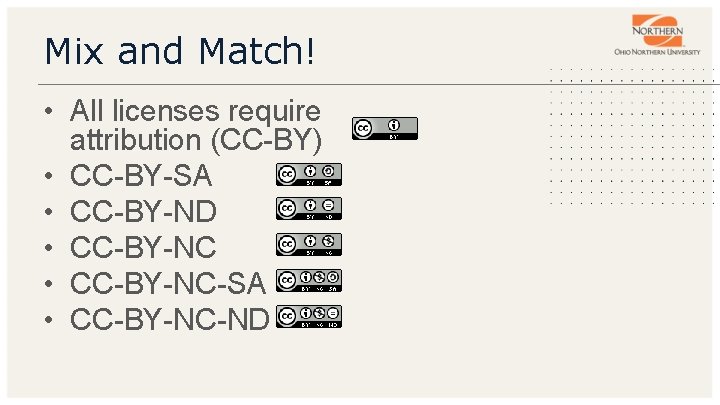
Mix and Match! • All licenses require attribution (CC-BY) • CC-BY-SA • CC-BY-ND • CC-BY-NC-SA • CC-BY-NC-ND
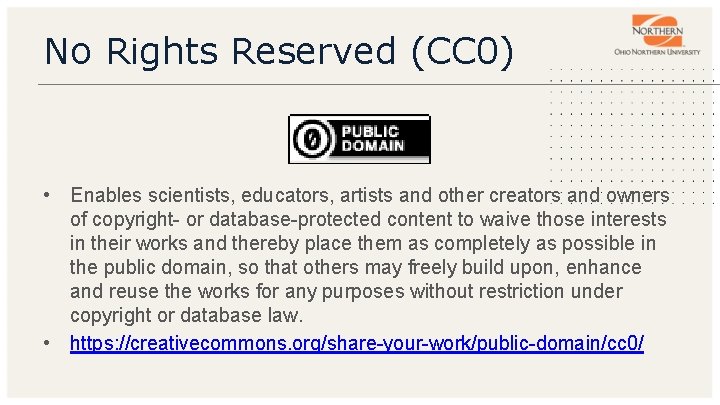
No Rights Reserved (CC 0) • Enables scientists, educators, artists and other creators and owners of copyright- or database-protected content to waive those interests in their works and thereby place them as completely as possible in the public domain, so that others may freely build upon, enhance and reuse the works for any purposes without restriction under copyright or database law. • https: //creativecommons. org/share-your-work/public-domain/cc 0/
Legal Code • By exercising the Licensed Rights (defined below), You accept and agree to be bound by the terms and conditions of this Creative Commons Attribution 4. 0 International Public License ("Public License"). To the extent this Public License may be interpreted as a contract, You are granted the Licensed Rights in consideration of Your acceptance of these terms and conditions, and the Licensor grants You such rights in consideration of benefits the Licensor receives from making the Licensed Material available under these terms and conditions…. .
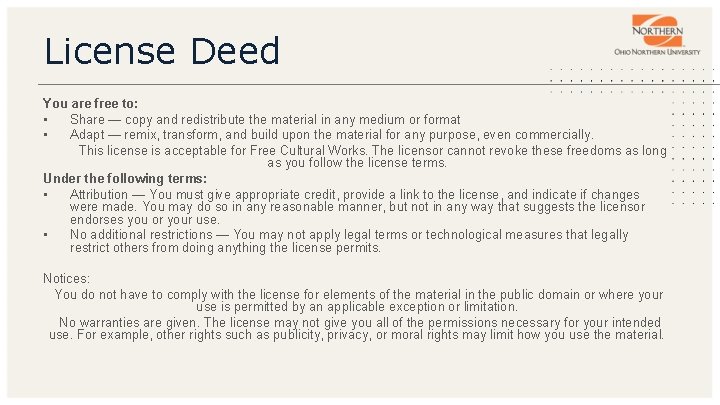
License Deed You are free to: • Share — copy and redistribute the material in any medium or format • Adapt — remix, transform, and build upon the material for any purpose, even commercially. This license is acceptable for Free Cultural Works. The licensor cannot revoke these freedoms as long as you follow the license terms. Under the following terms: • Attribution — You must give appropriate credit, provide a link to the license, and indicate if changes were made. You may do so in any reasonable manner, but not in any way that suggests the licensor endorses you or your use. • No additional restrictions — You may not apply legal terms or technological measures that legally restrict others from doing anything the license permits. Notices: You do not have to comply with the license for elements of the material in the public domain or where your use is permitted by an applicable exception or limitation. No warranties are given. The license may not give you all of the permissions necessary for your intended use. For example, other rights such as publicity, privacy, or moral rights may limit how you use the material.
CC Advantages • More options for the content creator • Increased opportunities for collaboration and innovation • Clear rights for reuse – No need to seek permission
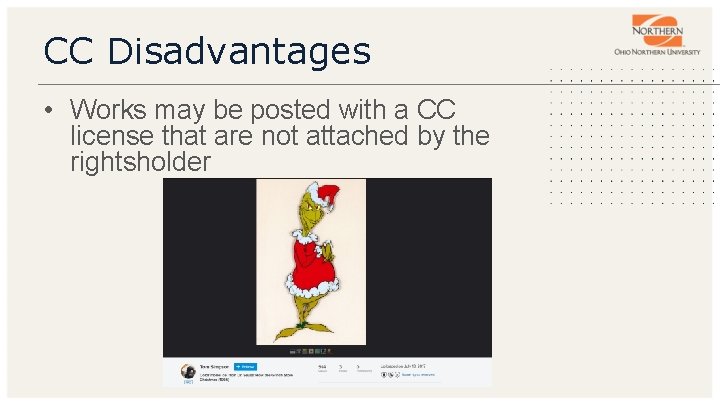
CC Disadvantages • Works may be posted with a CC license that are not attached by the rightsholder
Putting CC Licenses to Work USING CC LICENSED WORKS
Step #1—Explore Your Situation • What is your situation? – Noncommercial – Commercial • What do you want to do? – Simply reuse the work (e. g. quote, illustrate) – Change the work, or create an alternate version (build upon, translate, graphic novel, audio recording, video recording) • What are you willing to do? – Share. Alike?
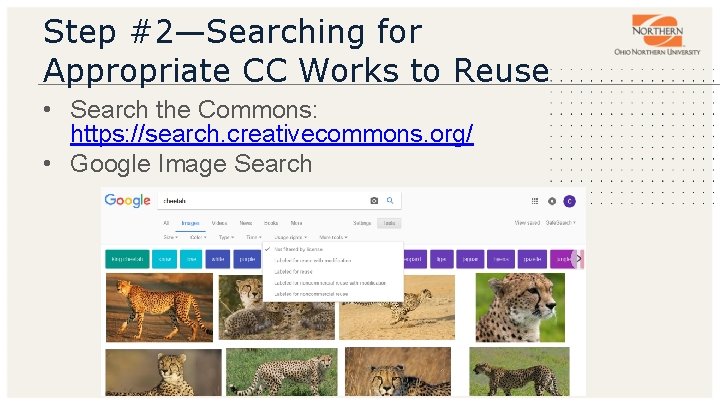
Step #2—Searching for Appropriate CC Works to Reuse • Search the Commons: https: //search. creativecommons. org/ • Google Image Search
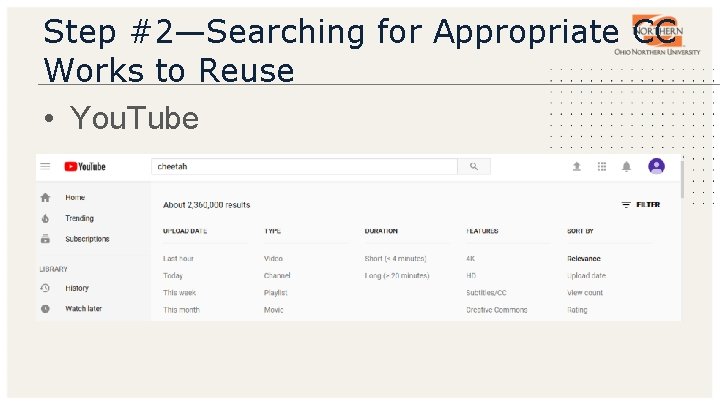
Step #2—Searching for Appropriate CC Works to Reuse • You. Tube
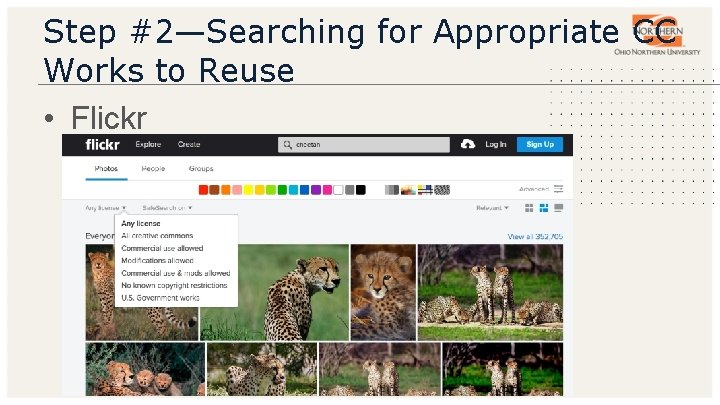
Step #2—Searching for Appropriate CC Works to Reuse • Flickr
Practice! • Perform a CC search based off the scenario presented to you…
Putting CC Licenses to Work LICENSING YOUR WORKS
Sharing Your Work with Others 1. Are you comfortable with others reusing your work? 2. How do you want to be attributed? (BY) 3. Commercial or Noncommercial (NC) 4. Are derivatives ok? (ND) 5. Should others share too? (SA)
Get Help • CC “Choose a License” tool can help you work through these decisions and identify the license that might be a good fit for you https: //creativecommons. org/choose/
Practice! • Select a CC license based off the scenario presented to you…
Considerations • Can go from strict (CC-BY-NC-ND) to more open (CC-BY), but not vice versa. • Provide clear attribution info. • In the case of NC and/or ND licenses, make contact info available so people can follow-up with you if they are interested in these uses.
Violations • If you find someone using a work of your in a way that falls outside the scope of your CC license… – Reach out to them to explain the situation – Be nice and assume the best! • In worst case scenarios – CC licenses have been held-up as valid contracts in court
QUESTIONS? This work is licensed under a Creative Commons Attribution-Non. Commercial 4. 0 International License.