
An Introduction to the Advanced Placement Program Shrewsbury
An Introduction to the Advanced Placement Program® Shrewsbury High School Susie Eriole, AP Coordinator Maureen Monopoli, Assistant Principal for Curriculum & Assessment
What We'll Cover • What are Advanced Placement® Courses? • The Benefits • AP® Exams • What Is It Like to Take AP? • Next Steps: Help Your Child Make the Best Choices • Q & A
What Are Advanced Placement® Courses?
Advanced Placement ®: The Basics • AP® courses are college-level courses offered in high school • Courses reflect what is taught in top introductory college courses • Students take AP Exams at the end of the course, measuring their mastery of college-level work. It is expected that all students take the exam • A score of 3 or higher on an AP exam can typically earn students college credit and/or placement into advanced courses in college
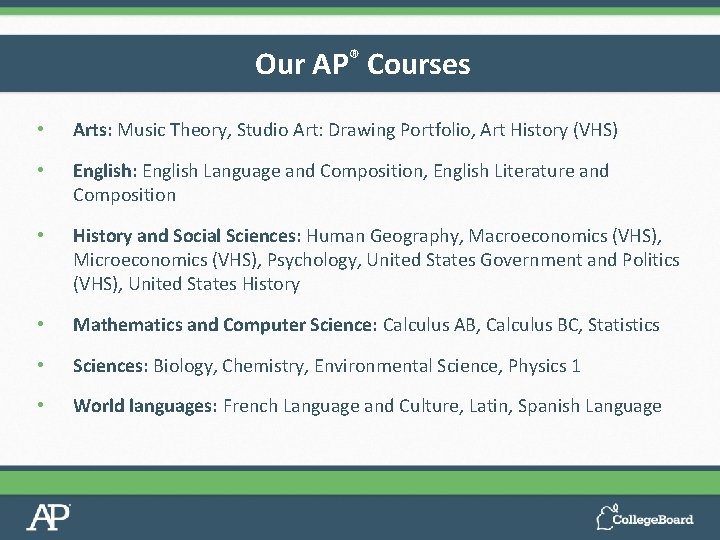
Our AP® Courses • Arts: Music Theory, Studio Art: Drawing Portfolio, Art History (VHS) • English: English Language and Composition, English Literature and Composition • History and Social Sciences: Human Geography, Macroeconomics (VHS), Microeconomics (VHS), Psychology, United States Government and Politics (VHS), United States History • Mathematics and Computer Science: Calculus AB, Calculus BC, Statistics • Sciences: Biology, Chemistry, Environmental Science, Physics 1 • World languages: French Language and Culture, Latin, Spanish Language
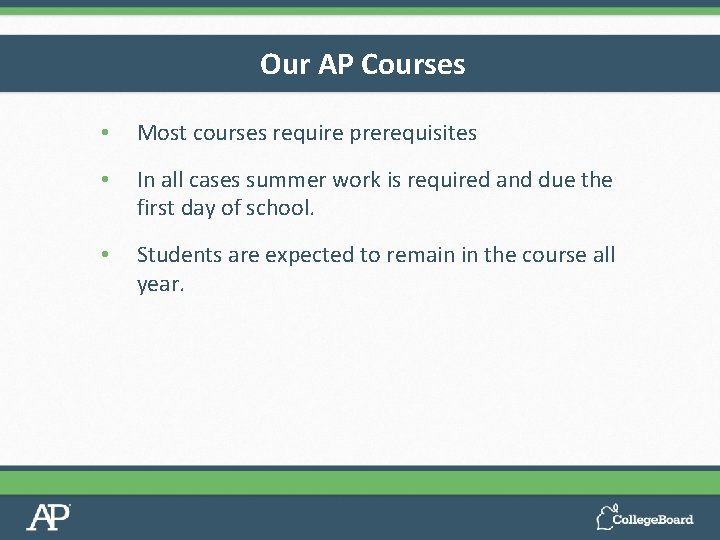
Our AP Courses • Most courses require prerequisites • In all cases summer work is required and due the first day of school. • Students are expected to remain in the course all year.
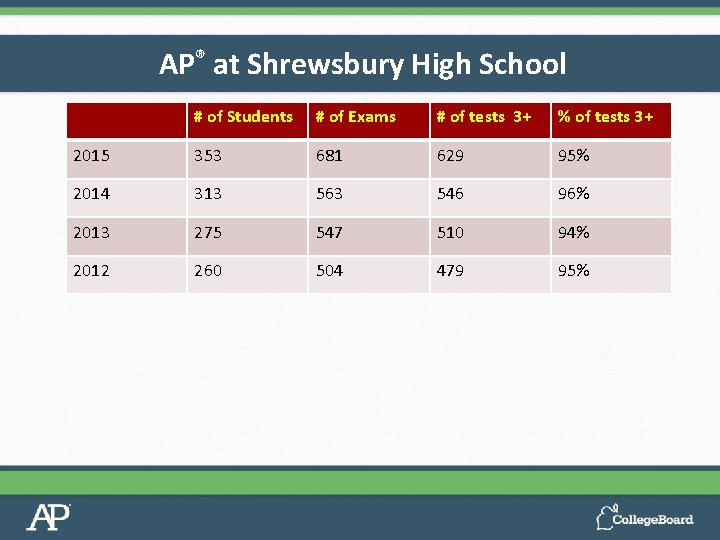
AP® at Shrewsbury High School # of Students # of Exams # of tests 3+ % of tests 3+ 2015 353 681 629 95% 2014 313 563 546 96% 2013 275 547 510 94% 2012 260 504 479 95%
AP®: The Benefits
AP®: The Benefits • Students learn rigorous college-level content and study skills • Builds critical thinking, confidence, essential time management skills • AP courses are interesting and rewarding academic experiences • Opportunity to earn valuable credit and placement in college
AP® Expands Students’ Options When students earn college credit through AP Exams, their options and opportunities expand: • Move to upper-level college courses sooner • Pursue a double major • Gain time to study and travel abroad
AP®: A More Engaging Learning Experience AP courses challenge students to work and participate at a higher level: • Opportunities to explore topics in depth • More time in and out of the classroom required to complete assignments and projects • High expectations for critical thinking, analysis, synthesis, evidence, multiple perspectives, and clear written and verbal communications
AP® Exams
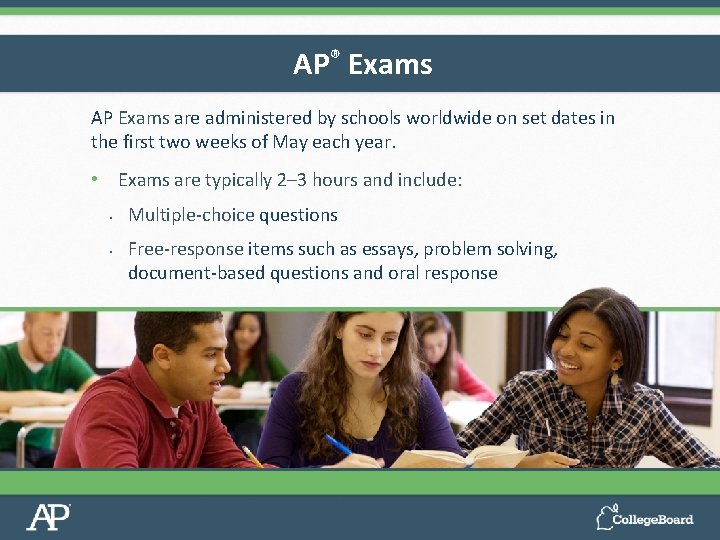
AP® Exams AP Exams are administered by schools worldwide on set dates in the first two weeks of May each year. • Exams are typically 2– 3 hours and include: • • Multiple-choice questions Free-response items such as essays, problem solving, document-based questions and oral response
AP® Exam Fees The exam fee for 2015 -2016 is $105 per exam. Assistance is available for eligible students with financial need on Free/Reduced Lunch • • • Please speak with Ms. Eriole for more details Each college and university has its own policies regarding AP® credit and placement. The College Board offers information about AP credit at thousands of college and universities at www. collegeboard. org/apcreditpolicy. Potential to save on college fees A typical 3 credit-hour course at a local state university is $1107
What is it like to take AP®?
Students…In Their Own Words • ‘AP was the best experience! A lot of work; but worth it!’ • ‘Expect to average a whole letter grade down than you’re used to. It’s typical to average B’s and C’s. ’ • ‘Yoga and copious amounts of tea worked for me!’ • ‘Choose AP because of interest, not the teacher you think will teach it because it could change from year to year. ’ • ‘You have to do a lot of work on your own that isn’t always covered in class but you’re expected to know it. ’
Next Steps: Help Your Child Make the Best Choices
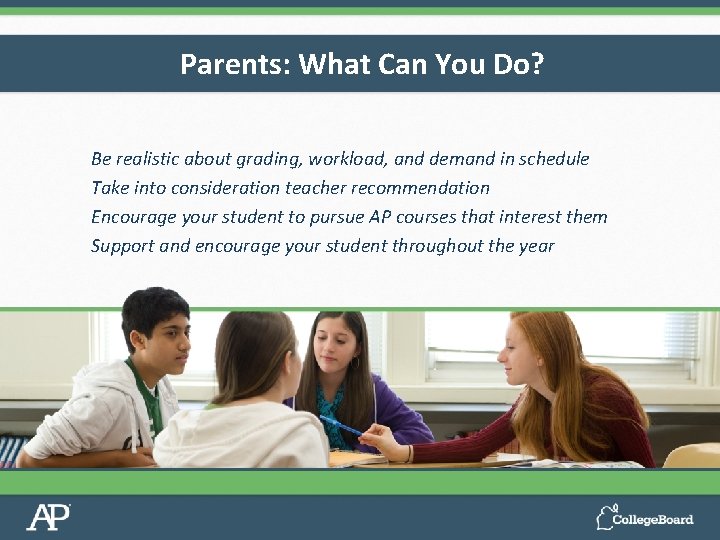
Parents: What Can You Do? Be realistic about grading, workload, and demand in schedule Take into consideration teacher recommendation Encourage your student to pursue AP courses that interest them Support and encourage your student throughout the year
AP®: Start the Conversation Help your child prepare to talk to a teacher or counselor about AP. Here are some questions to encourage your child to think about: What AP course is right for me? Before you talk to a teacher or counselor, think about what interests you: • Which courses do you enjoy most in school? In which subjects do you excel? • What college majors are you considering? What careers excite you? Ask your counselor or teacher the following questions: • In which AP courses at our school am I likely to do well? • Are there other courses that can help me succeed in AP or prepare me for college and careers?
AP®: Start the Conversation What steps do I need to take? • What is our school’s enrollment deadline? • May I speak with a student who has taken an AP course? • Are there study groups or people who can offer help if I need it? • What can I do next to help me prepare for AP?
Questions and Answers
- Slides: 21