
An Introduction to Teaching the Gifted Learner Who


- Slides: 48
An Introduction to Teaching the Gifted Learner
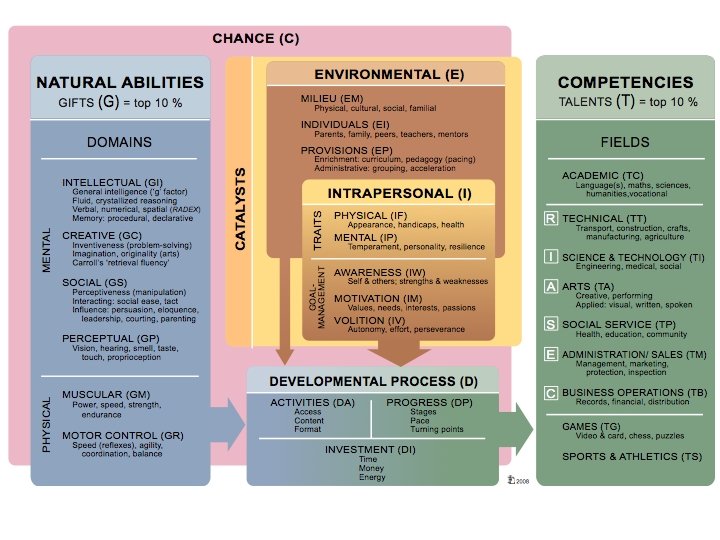
Who are the gifted and talented? (NSW DET definitions) Françoys Gagné’s differentiated model of giftedness and talent (DMGT) has been very influential in Australian education; indeed it has been adopted as policy by the NSW DET. “Gifted students are those whose potential is distinctly above average in one or more of the following domains of human ability: intellectual, creative, social and physical. Talented students are those whose skills are distinctly above average in one or more areas of human performance” (NSW DET, 2004, p. 8).
Who are the gifted and talented? (NSW DET definitions) What does ‘distinctly above average mean? ’ Issues with such a definition? “GIFTEDNESS designates the possession and use of untrained and spontaneously expressed natural abilities, called aptitudes or gifts, in at least one ability domain, to a degree that places an individual at least among the top 10% of age peers. TALENT designates the superior mastery of systematically developed abilities (or skills) and knowledge, in at least one field of human activity to a degree that places an individual at least among the top 10% of age peers who are or have been active in that field” (Gagné, 2003, p. 60).
Gagne’s Differentiated Model of Giftedness and Talent http: //nswagtc. org. au/images/stories/infocentre/dmgt_2. 0_en_overview. pdf
The importance of the teacher NSW DET “Policy and implementation strategies for the education of gifted and talented students” stated that: “All government schools have a responsibility to educate all students to their potential” (p. 7). Gross, et al. (2005) wrote: “By placing the student’s learning at the heart of his model, Gagné puts us, as teachers, in the driving seat. Gagné makes it clear that a child’s learning will not progress optimally unless he or she has the ongoing support of the school” (p. 11).
GAT Definition Discussion Questions Will gifted students always be talented? Can a student be talented but not gifted? Define underachievement. How common do you think it is amongst gifted students? What is the difference between having a relative strength in a subject and being gifted in a subject? Is everyone gifted at something? Define a genius.
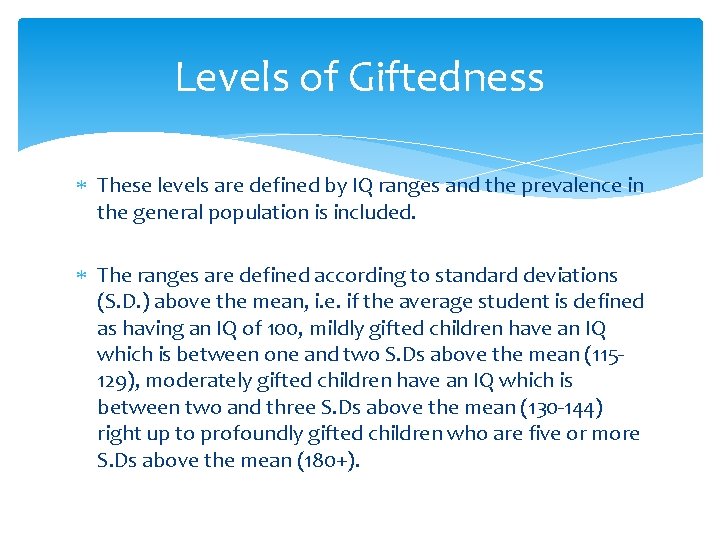
Levels of Giftedness There is a reluctance among teachers to acknowledge and respond to the different levels of giftedness within the gifted population, rather many educators work under the assumption that gifted students are a relatively homogenous population (Gross, 2003). Just as there are different levels of hearing impairment, for examples, there are different levels of giftedness: mildly; moderately; highly; exceptionally; and profoundly gifted.
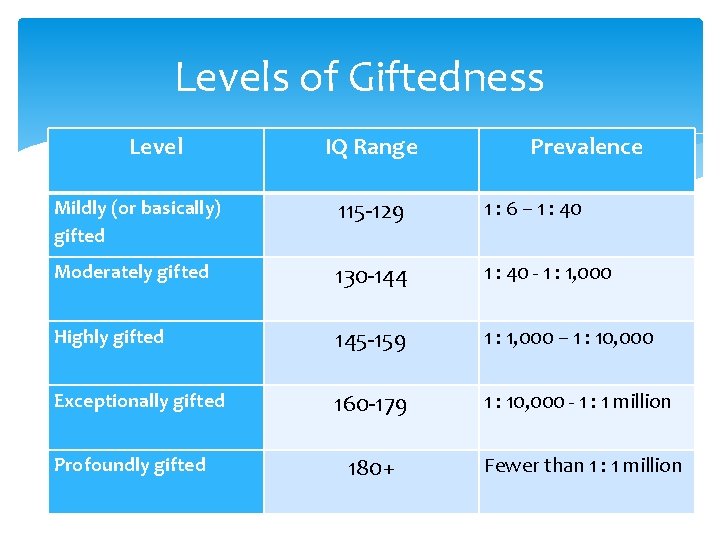
Levels of Giftedness These levels are defined by IQ ranges and the prevalence in the general population is included. The ranges are defined according to standard deviations (S. D. ) above the mean, i. e. if the average student is defined as having an IQ of 100, mildly gifted children have an IQ which is between one and two S. Ds above the mean (115129), moderately gifted children have an IQ which is between two and three S. Ds above the mean (130 -144) right up to profoundly gifted children who are five or more S. Ds above the mean (180+).
Levels of Giftedness Level IQ Range Prevalence Mildly (or basically) gifted 115 -129 1 : 6 – 1 : 40 Moderately gifted 130 -144 1 : 40 - 1 : 1, 000 Highly gifted 145 -159 1 : 1, 000 – 1 : 10, 000 Exceptionally gifted 160 -179 1 : 10, 000 - 1 : 1 million 180+ Fewer than 1 : 1 million Profoundly gifted
Characteristics of intellectually gifted and talented students List some gifted students you have taught What are some of their characteristics? Share and discuss
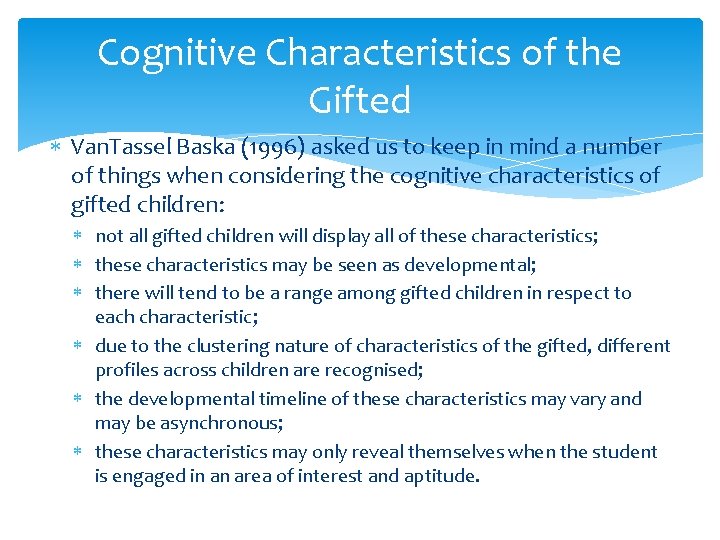
Cognitive Characteristics of the Gifted Van. Tassel Baska (1996) asked us to keep in mind a number of things when considering the cognitive characteristics of gifted children: not all gifted children will display all of these characteristics; these characteristics may be seen as developmental; there will tend to be a range among gifted children in respect to each characteristic; due to the clustering nature of characteristics of the gifted, different profiles across children are recognised; the developmental timeline of these characteristics may vary and may be asynchronous; these characteristics may only reveal themselves when the student is engaged in an area of interest and aptitude.
Cognitive Characteristics of the Gifted Gross et al. (2007) summarised the cognitive characteristics of gifted children: possess power of concentration (they can maintain focus on an area of interest for hours on end); possess an unusually well-developed memory, which includes the ability to learn and recall important details, concepts and principles; possess high levels of curiosity (they ask why all the time); grasp mathematical concepts quickly; show creative ability or imaginative expression in the performing arts; show sensitivity and finesse in rhythm, movement and control of their body;
Cognitive Characteristics of the Gifted possess a well-developed vocabulary, which can manifest as superiority in written and/or spoken vocabulary; possess an early and advanced reading ability and readily absorb books written for an audience well beyond their years; possess an interest in the subtleties of words and their uses; show an outstanding responsibility and independence in classroom work and may not ‘suffer fools’ well; be self-critical and readily evaluate and correct their own efforts; show initiative and originality in intellectual work;
Cognitive Characteristics of the Gifted show social poise and an ability to communicate with adults in a mature way; get excitement and pleasure from being challenged intellectually; reason beyond their age peers; learn at a rapid rate especially when the material is challenging and interesting and get bored very quickly and hence do not like slow paced instruction; have multiple and diverse interests; have superior reasoning and ability to handle abstract ideas; have the ability to be flexible in thinking and consider problems from a number of viewpoints; and show an alert and subtle sense of humour.
Cognitive Characteristics of the Gifted Activity: 1. Pick one famous person and justify why they are gifted in a particular domain. 2. Discussion and sharing.
Affective Characteristics of the Gifted “There is no more varied group of young people than the diverse group known as gifted children and adolescents. Not only do they come from every walk of life. . . they also exhibit an almost unlimited range of personal characteristics in temperament, risk taking and conservatism, introversion and extroversion, reticence and assertiveness, and degree of effort in reaching goals” (Robinson, 2002, p. xi).
Affective Characteristics of the Gifted This means that gifted students may: Be more sensitive and prone to take criticism and comments from others very much to heart; Be more empathetic showing a deeper understanding of how others feel; Be more perceptive at an earlier age and able to read between the lines of other people’s words or actions; Be over responsive to intellectual or emotional stimuli and become very passionate about things; Be highly motivated and show a single minded pursuit of goals, in particular the drive to develop one’s full potential (entelechy),
Affective Characteristics of the Gifted have a highly developed sense of moral reasoning; Show a strong sense of justice and fairness; Form strong attachments and commitments; Show high degrees of altruism and idealism; Show emotional intensity; and tend to associate with older children (Dabrowski cited in Silverman, 1993; Van. Tassel-Baska, 1995; Torrance, 1965 & Lovecky, 1986 cited in Gross et al. 2007).
Affective Characteristics of the Gifted These students may experience unusual “awareness, perceptions, emotional responses and life experiences” throughout their life span (Morelock, 1992, p. 14).
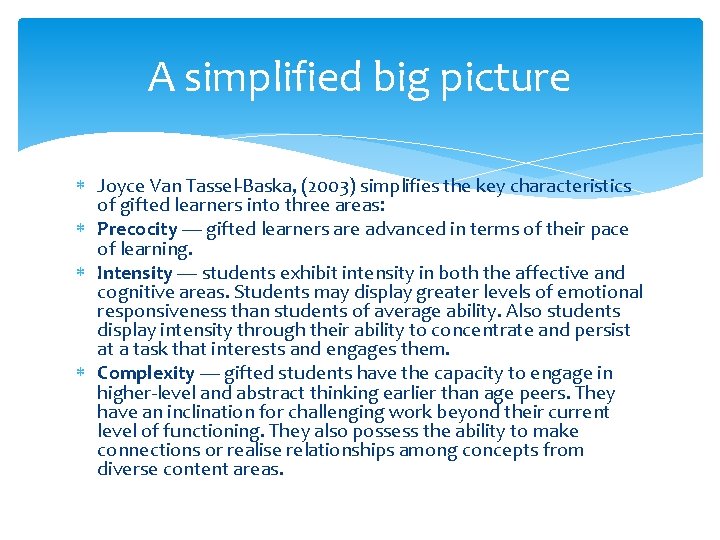
A simplified big picture Joyce Van Tassel-Baska, (2003) simplifies the key characteristics of gifted learners into three areas: Precocity — gifted learners are advanced in terms of their pace of learning. Intensity — students exhibit intensity in both the affective and cognitive areas. Students may display greater levels of emotional responsiveness than students of average ability. Also students display intensity through their ability to concentrate and persist at a task that interests and engages them. Complexity — gifted students have the capacity to engage in higher-level and abstract thinking earlier than age peers. They have an inclination for challenging work beyond their current level of functioning. They also possess the ability to make connections or realise relationships among concepts from diverse content areas.
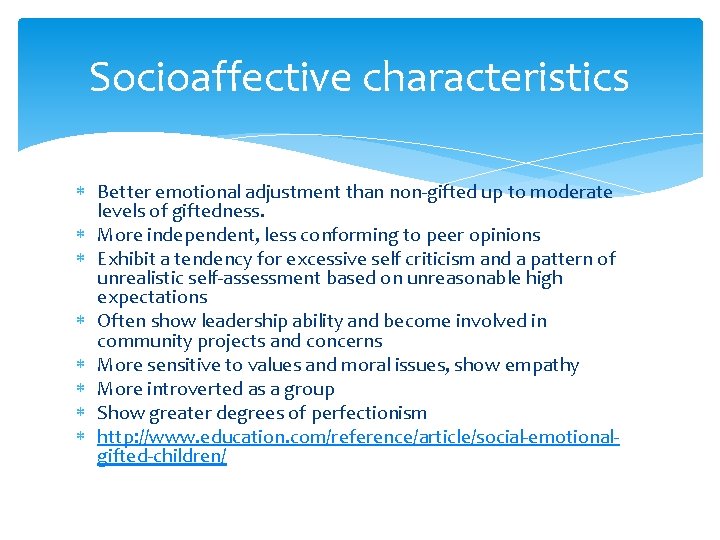
Socioaffective characteristics Better emotional adjustment than non-gifted up to moderate levels of giftedness. More independent, less conforming to peer opinions Exhibit a tendency for excessive self criticism and a pattern of unrealistic self-assessment based on unreasonable high expectations Often show leadership ability and become involved in community projects and concerns More sensitive to values and moral issues, show empathy More introverted as a group Show greater degrees of perfectionism http: //www. education. com/reference/article/social-emotionalgifted-children/
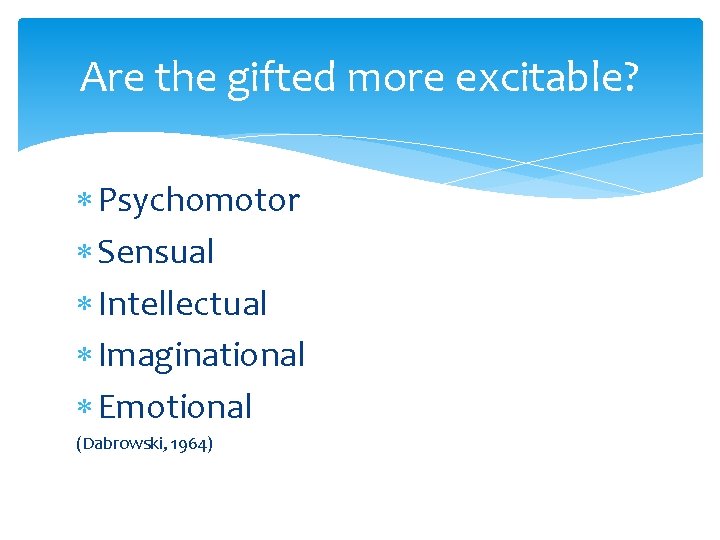
Are the gifted more excitable? Psychomotor Sensual Intellectual Imaginational Emotional (Dabrowski, 1964)
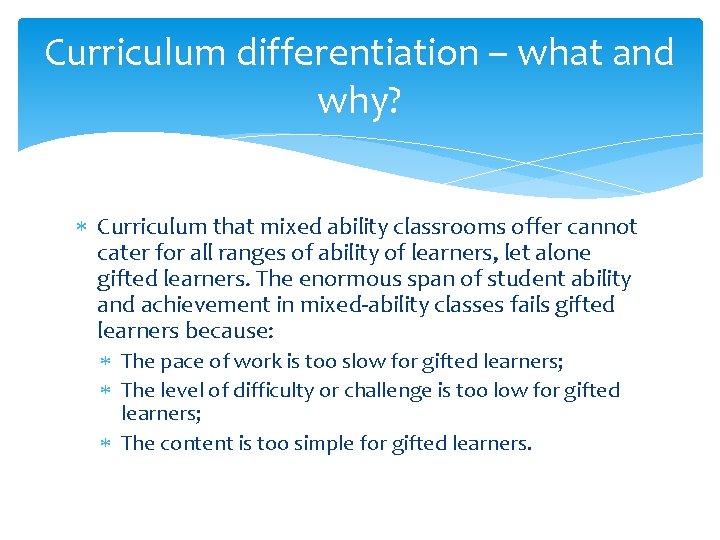
Curriculum differentiation – what and why? Curriculum that mixed ability classrooms offer cannot cater for all ranges of ability of learners, let alone gifted learners. The enormous span of student ability and achievement in mixed-ability classes fails gifted learners because: The pace of work is too slow for gifted learners; The level of difficulty or challenge is too low for gifted learners; The content is too simple for gifted learners.
Curriculum differentiation – what and why? Coorey (1998) reports that there is at least an achievement spread of 5 years of schooling between the top and bottom 10% of students in classrooms, where the full range of scores could have been seven years or more. many suffer underachievement, boredom, frustration and psychological distress (Senate inquiry, 2001)
Differentiated Curriculum – what is it exactly? “A differentiated curriculum is one that is tailored to the needs of groups of gifted learners and/or individual students and provides experiences sufficiently different from the norm to justify specialized intervention, delivered by a trained educator of the gifted using appropriate instructional and assessment processes to optimize learning” (Van. Tassel-Baska, 2005).
Differentiated Classes Feel “Right” “Differentiated classrooms feel right to students who learn in different ways and at different rates and who bring to school different talents and interests. More significantly, such classrooms work better for a full range of students than do one-size-fits-all settings. Teachers in differentiated classrooms are more in touch with their students and approach teaching more as an art than as a mechanical exercise. ” (Tomlinson, 1999)
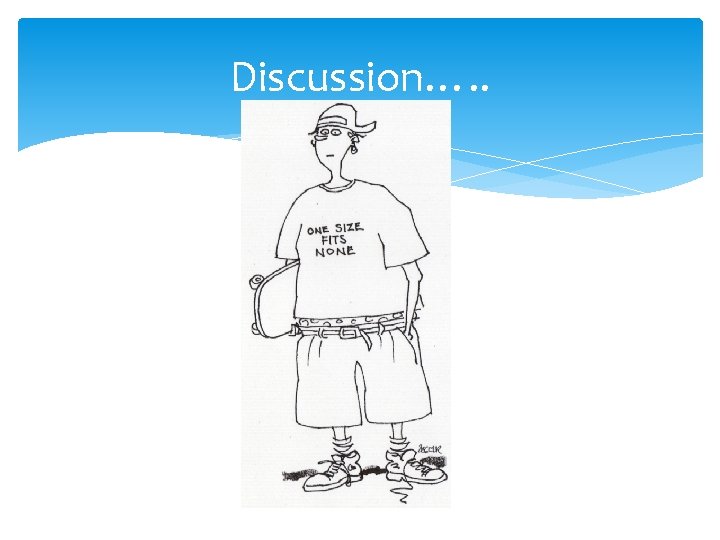
Discussion…. .
Discussion… “Fair is not everyone getting the same thing. Fair is everyone getting what they need. ” Anonymous
“There is nothing so unequal as the equal treatment of unequals. ” Thomas Jefferson (1743 – 1826)
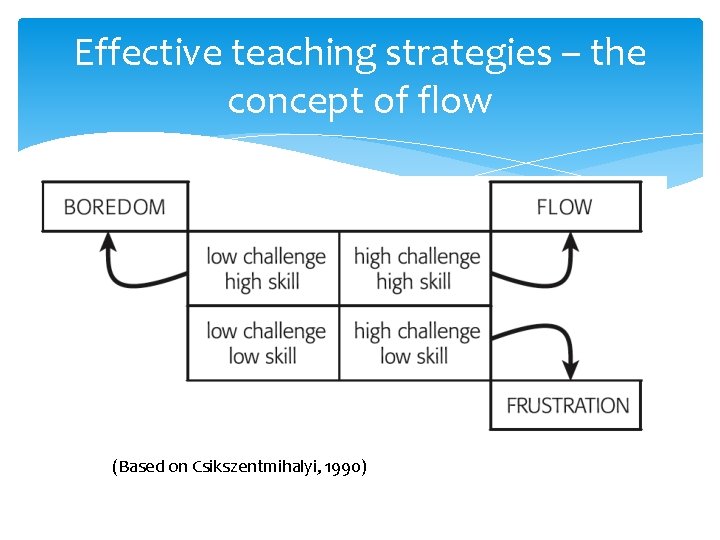
Effective teaching strategies – the concept of flow (Based on Csikszentmihalyi, 1990)
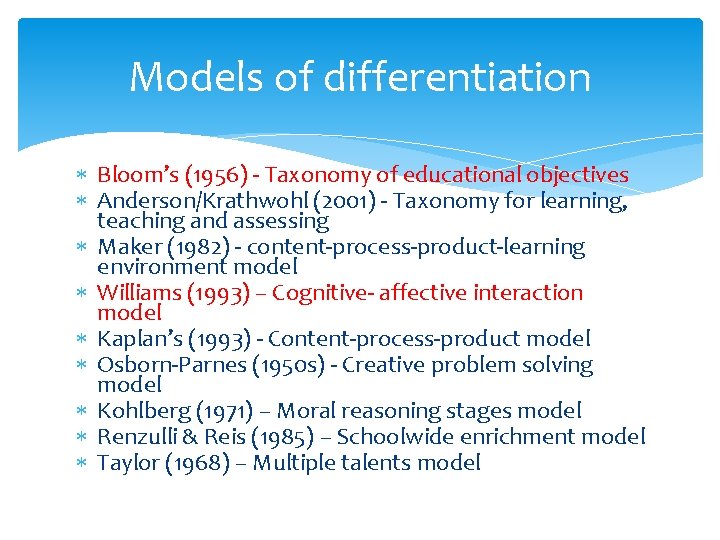
Models of differentiation Bloom’s (1956) - Taxonomy of educational objectives Anderson/Krathwohl (2001) - Taxonomy for learning, teaching and assessing Maker (1982) - content-process-product-learning environment model Williams (1993) – Cognitive- affective interaction model Kaplan’s (1993) - Content-process-product model Osborn-Parnes (1950 s) - Creative problem solving model Kohlberg (1971) – Moral reasoning stages model Renzulli & Reis (1985) – Schoolwide enrichment model Taylor (1968) – Multiple talents model
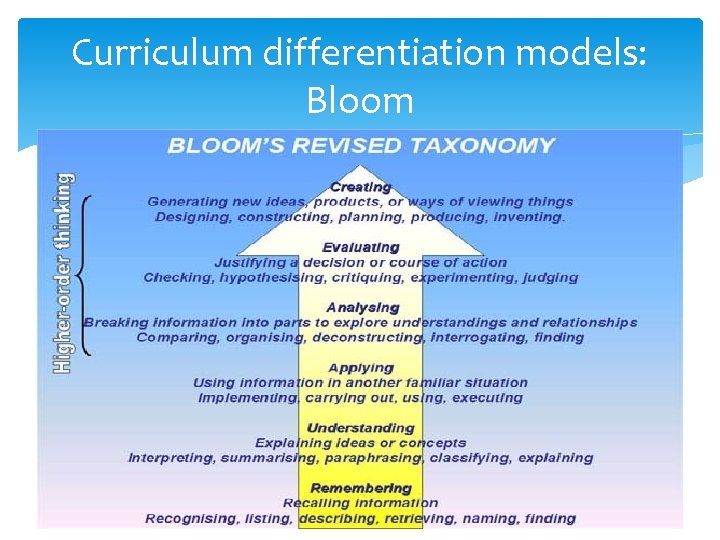
Curriculum differentiation models: Bloom
Blooms Taxonomy Activity Differentiate a lesson you have taught using Bloom’s lower order thinking skills (LOTS) and higher order thinking skills (HOTS). For GAT students more HOTS should be used than LOTS. Share and discuss
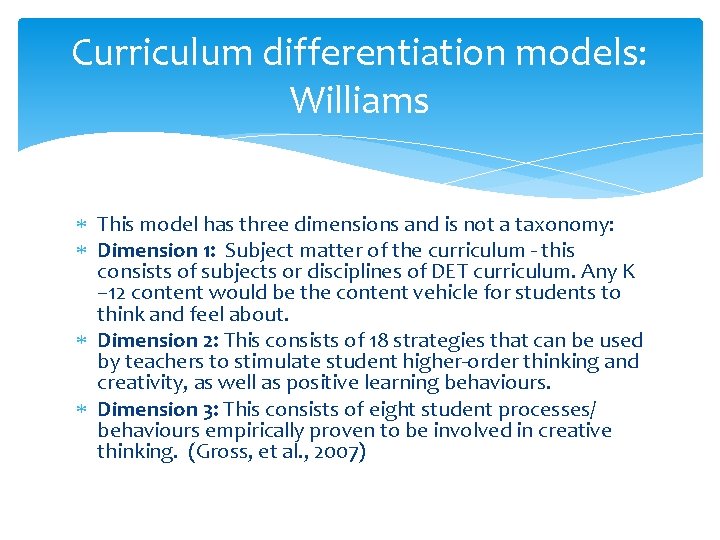
Curriculum differentiation models: Williams The William’s model was developed to allow learners the opportunity for creative thinking (characterised by fluency, flexibility, originality, and elaboration). The instruction strategies also enable and promote the expression of the affective factors of curiosity, imagination, risk-taking and complexity. These creative thinking and personality factors have been empirically verified as important for the expression of creativity. In this way the Williams model aims to cater for both the cognitive and affective needs of the gifted learner (Williams, 1993 and Gross, et al. , 2007).
Curriculum differentiation models: Williams Frank Williams’ (1993) Cognitive – Affective Interaction Model for Enriching Gifted Programs is based on studies of the creative person and process. It is an excellent model to develop higher order thinking skills, including divergent and evaluative skills, in all students. Williams understands that encouraging these skills in gifted students is particularly crucial and Gross et al. (2007) points out that the products developed by the gifted child should be of a qualitatively different level. Mac. Leod (2005) reminds us that the Williams’ Model has research to support that it produces ‘substantial’ gains in the area of academic, social or emotional development.
Curriculum differentiation models: Williams This model has three dimensions and is not a taxonomy: Dimension 1: Subject matter of the curriculum - this consists of subjects or disciplines of DET curriculum. Any K – 12 content would be the content vehicle for students to think and feel about. Dimension 2: This consists of 18 strategies that can be used by teachers to stimulate student higher-order thinking and creativity, as well as positive learning behaviours. Dimension 3: This consists of eight student processes/ behaviours empirically proven to be involved in creative thinking. (Gross, et al. , 2007)
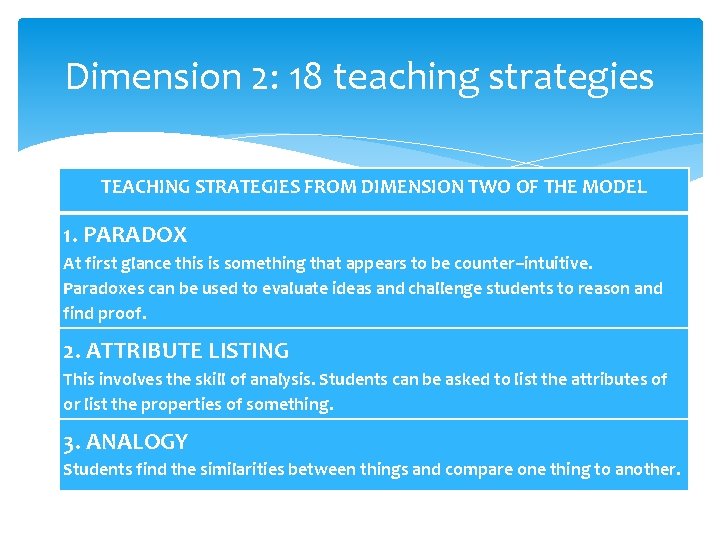
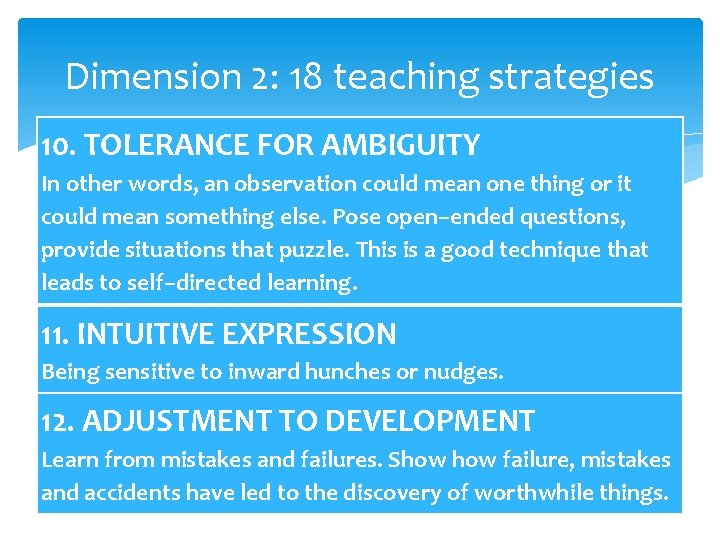
Dimension 2: 18 teaching strategies TEACHING STRATEGIES FROM DIMENSION TWO OF THE MODEL 1. PARADOX At first glance this is something that appears to be counter–intuitive. Paradoxes can be used to evaluate ideas and challenge students to reason and find proof. 2. ATTRIBUTE LISTING This involves the skill of analysis. Students can be asked to list the attributes of or list the properties of something. 3. ANALOGY Students find the similarities between things and compare one thing to another.
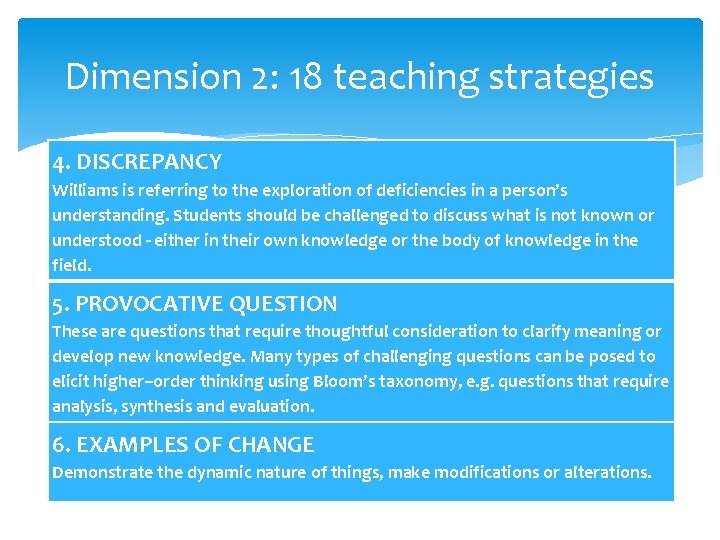
Dimension 2: 18 teaching strategies 4. DISCREPANCY Williams is referring to the exploration of deficiencies in a person’s understanding. Students should be challenged to discuss what is not known or understood - either in their own knowledge or the body of knowledge in the field. 5. PROVOCATIVE QUESTION These are questions that require thoughtful consideration to clarify meaning or develop new knowledge. Many types of challenging questions can be posed to elicit higher–order thinking using Bloom’s taxonomy, e. g. questions that require analysis, synthesis and evaluation. 6. EXAMPLES OF CHANGE Demonstrate the dynamic nature of things, make modifications or alterations.
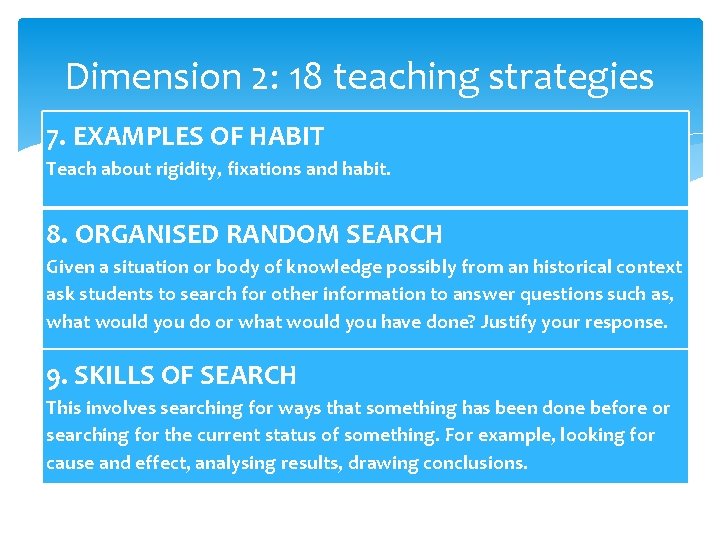
Dimension 2: 18 teaching strategies 7. EXAMPLES OF HABIT Teach about rigidity, fixations and habit. 8. ORGANISED RANDOM SEARCH Given a situation or body of knowledge possibly from an historical context ask students to search for other information to answer questions such as, what would you do or what would you have done? Justify your response. 9. SKILLS OF SEARCH This involves searching for ways that something has been done before or searching for the current status of something. For example, looking for cause and effect, analysing results, drawing conclusions.
Dimension 2: 18 teaching strategies 10. TOLERANCE FOR AMBIGUITY In other words, an observation could mean one thing or it could mean something else. Pose open–ended questions, provide situations that puzzle. This is a good technique that leads to self–directed learning. 11. INTUITIVE EXPRESSION Being sensitive to inward hunches or nudges. 12. ADJUSTMENT TO DEVELOPMENT Learn from mistakes and failures. Show failure, mistakes and accidents have led to the discovery of worthwhile things.
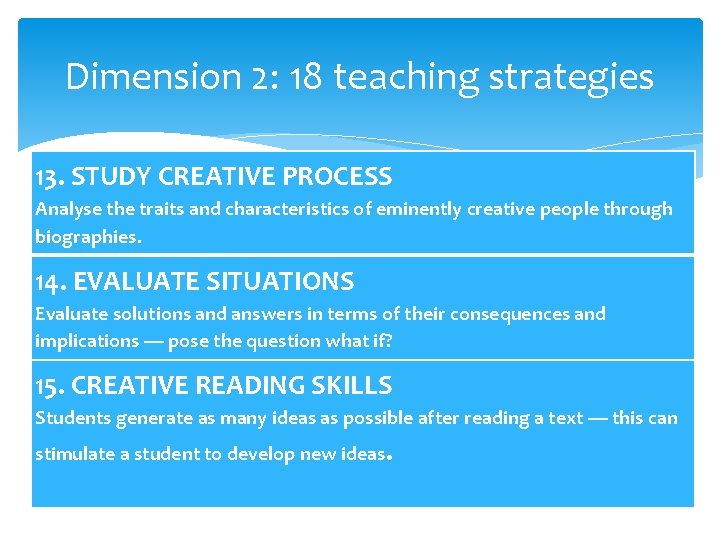
Dimension 2: 18 teaching strategies 13. STUDY CREATIVE PROCESS Analyse the traits and characteristics of eminently creative people through biographies. 14. EVALUATE SITUATIONS Evaluate solutions and answers in terms of their consequences and implications — pose the question what if? 15. CREATIVE READING SKILLS Students generate as many ideas as possible after reading a text — this can stimulate a student to develop new ideas.
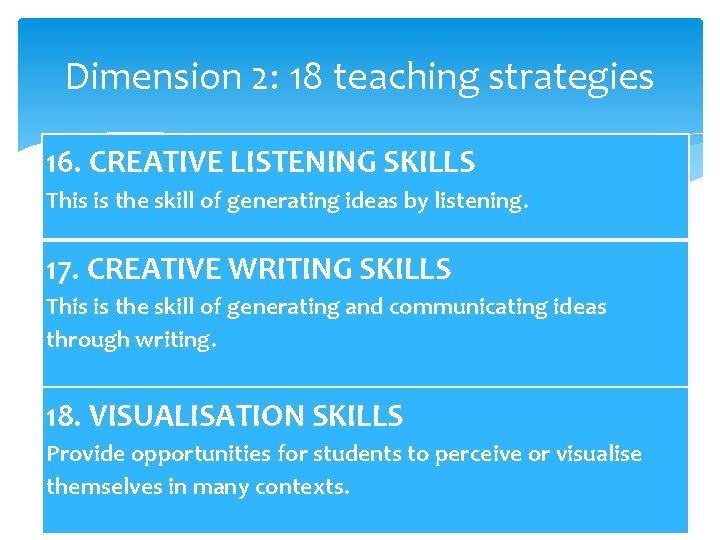
Dimension 2: 18 teaching strategies 16. CREATIVE LISTENING SKILLS This is the skill of generating ideas by listening. 17. CREATIVE WRITING SKILLS This is the skill of generating and communicating ideas through writing. 18. VISUALISATION SKILLS Provide opportunities for students to perceive or visualise themselves in many contexts.
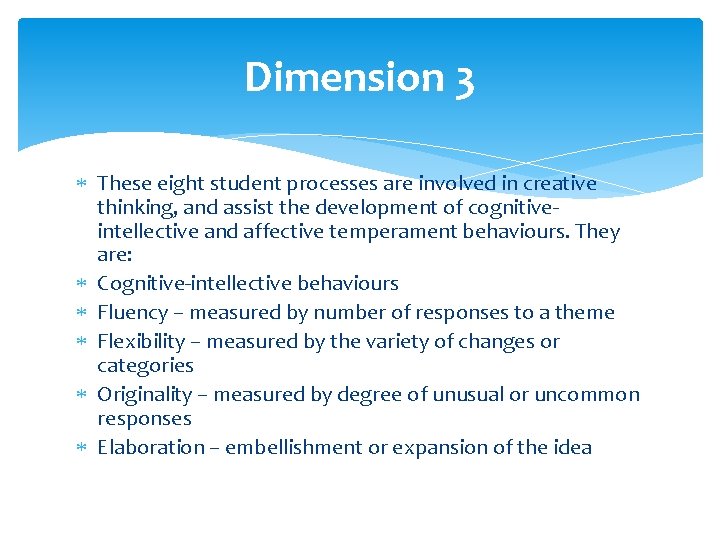
Dimension 3 These eight student processes are involved in creative thinking, and assist the development of cognitiveintellective and affective temperament behaviours. They are: Cognitive-intellective behaviours Fluency – measured by number of responses to a theme Flexibility – measured by the variety of changes or categories Originality – measured by degree of unusual or uncommon responses Elaboration – embellishment or expansion of the idea
Dimension 3 Affective—temperament behaviours Risk-taking – willingness to try different or difficult things Curiosity – ability to seek many alternatives, depth of study Complexity – capacity to explore or discover Imagination – power to visualise, dream or conceive forms of actions symbolically (Mac. Leod, 2005 and Gross, et. al, 2007)
Williams Activity Pick a unit of work you will be doing this year with a selective or enrichment class. Create one question for each of the 18 teaching strategies detailed in the 2 nd dimension of Williams’ model. Let Anna know how it goes
Harry Passow’s test for a differentiated curriculum SHOULD all students do it? COULD all students do it? WOULD all students want to? If the answer to any of these questions is “yes” then it isn’t differentiated. http: //www. hoagiesgifted. org/gifted_quotes. htm
Thank you!!