
An Introduction to TANF in Michigan TANF Benefit
An Introduction to TANF in Michigan TANF Benefit Levels, Caseloads, Spending and Work Requirements and Policies Ashley Burnside November 18 th, 2019
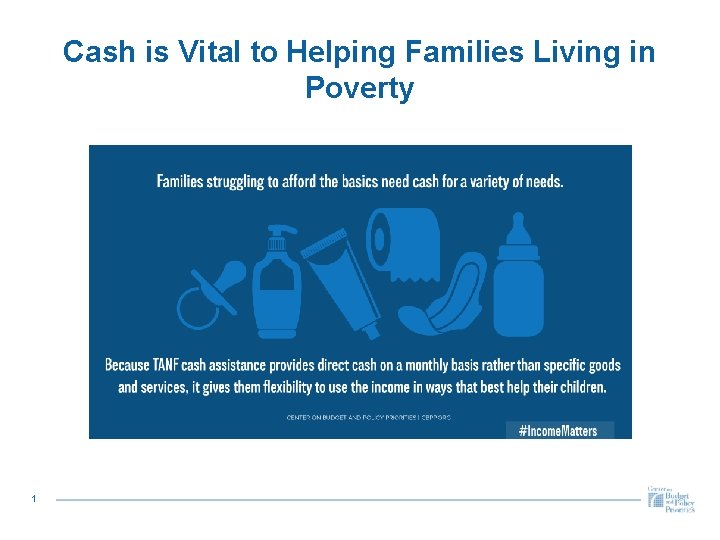
Cash is Vital to Helping Families Living in Poverty 1
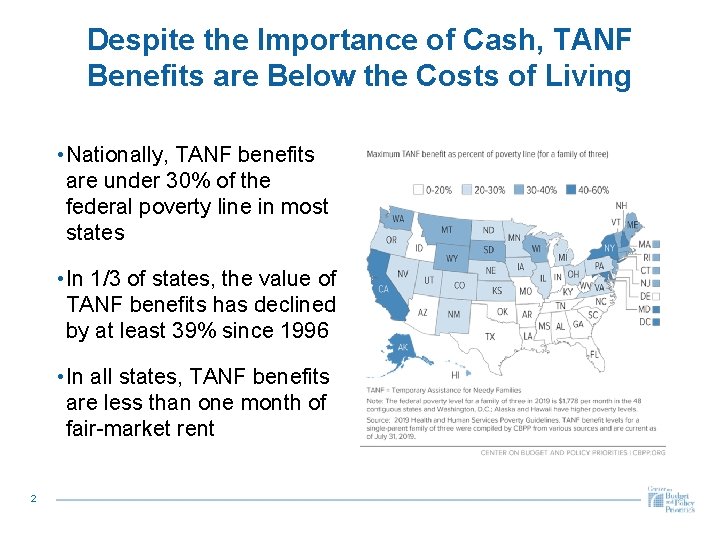
Despite the Importance of Cash, TANF Benefits are Below the Costs of Living • Nationally, TANF benefits are under 30% of the federal poverty line in most states • In 1/3 of states, the value of TANF benefits has declined by at least 39% since 1996 • In all states, TANF benefits are less than one month of fair-market rent 2
Michigan Benefits are Low and Have Not Increased in Over 10 Years • The TANF benefit for a single-parent, family of three is $492 • This is about 28% of the federal poverty line • The benefit covers about 55% of fair-market rent, compared to about 85% in 1996 • The last TANF benefit increase in Michigan was in 2009 3
Michigan’s TANF Benefit Could be Much Higher • If the TANF benefit were the same share of poverty today as it was in 1996, it would be $754 per month • If the benefit were 50% of the poverty line (the deep poverty rate), it would be $889 per month 4
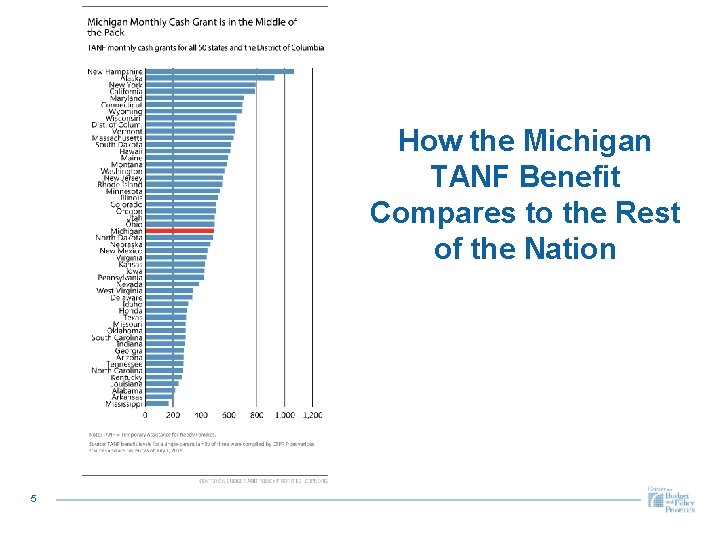
How the Michigan TANF Benefit Compares to the Rest of the Nation 5
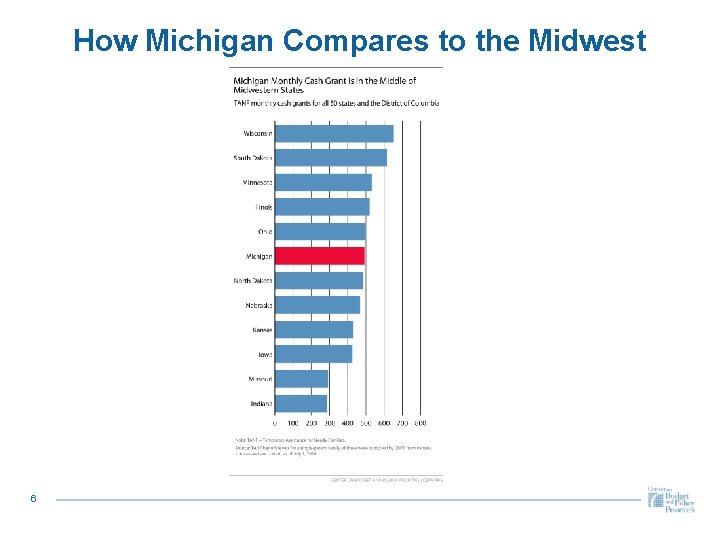
How Michigan Compares to the Midwest 6
States Have Broad Flexibility in How they Can Spend their TANF Dollars • The federal government gives states money from a block grant of $16. 5 billion dollars each year • Michigan gets $775 million per year • The block grant has never been increased for inflation • States have flexibility in how they can use these funds so long as they align with TANF’s four purposes, with one exception – spending that was “authorized under prior law” 7

Four Purposes of TANF 1. Provide assistance to needy families so that children may be cared for in their own homes or in the homes of relatives 2. End the dependence of needy parents on government benefits by promoting job preparation, work, and marriage 3. Prevent and reduce the incidence of out-of-wedlock pregnancies and establish annual numerical goals for preventing and reducing the incidence of these pregnancies; and 4. Encourage the formation and maintenance of two-parent families 8 8

States Also Must Contribute State Dollars Towards TANF • States must also contribute funds towards TANF, which are called Maintenance-of-effort (MOE) dollars • States must contribute 80% (in some instances, 75%) of the state’s historic spending in 1994 or meet a fiscal penalty • In Michigan, the state claimed $570 million in MOE spending in 2018 • 80% MOE Obligation for MI: $500 million • 75% MOE Obligation for MI: $469 million 9
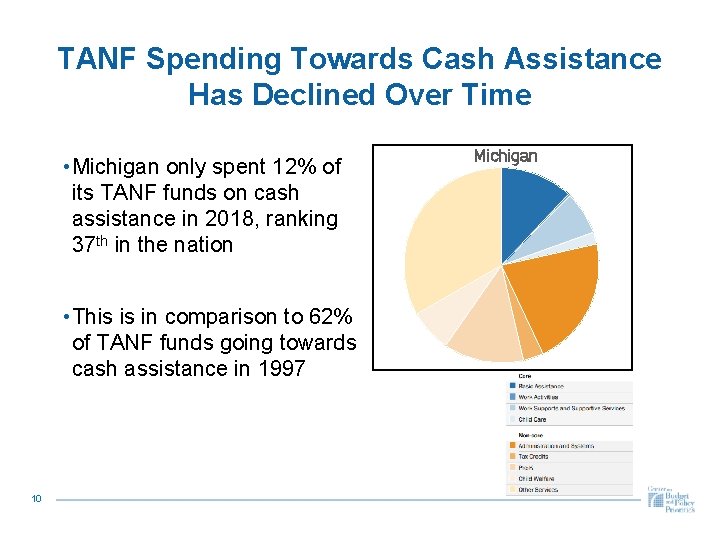
TANF Spending Towards Cash Assistance Has Declined Over Time • Michigan only spent 12% of its TANF funds on cash assistance in 2018, ranking 37 th in the nation • This is in comparison to 62% of TANF funds going towards cash assistance in 1997 10 Michigan

TANF Gives States Broad Flexibility In Setting Eligibility and Work Requirement Policies • Unlike AFDC (or SNAP), federal TANF law and rules do not set parameters for eligibility • There are no federal minimum requirements • Key policy decisions on eligibility are set by states • But federal law can shape state programs through a series of fiscal penalties tied to requirements or prohibitions set forth in the federal law • For example, time limits and work requirements 11 11
Federal Law Puts Some Limits on State Flexibility To Set Eligibility Policies • Federal law does include some constraints through its penalty structure: • Five-year time limit on receipt of federal TANF funds – in Michigan there is a 48 -month lifetime limit • States must require participation in work activities and sanction those who do not participate without good cause • States must meet the TANF work participation rate • States must require TANF families to cooperate with child support benefits 12
Michigan’s TANF Time Limit Policy is Harsh Compared to What it Used to Be • Previously, Michigan had time limit exemptions that would stop the clock, the most generous being if a TANF parent was meeting their work requirement, then those months would not be counted in the time limit • This policy ended in 2011 13
The Work Participation Rate is Not Always What it Seems • States are required to engage a set amount of recipients in a list of work activities for a minimum set of hours each week, or they will face a fiscal penalty • States are required to engage 50% of all TANF families, though this is reduced by the extent of caseload decline since 2005 • States are required to engage 90% of 2 -parent families • Because of the caseload reduction credit, Michigan has a WPR of 0 14
Having a WPR of Zero Gives Michigan Great Flexibility to be Innovative • Because Michigan has a WPR of 0, it has considerable flexibility in how it designs and implements its work requirements, participation and activity requirements • The state is not constrained by federal measures and requirements 15
Michigan Has Chosen a Punitive Approach to its Work Requirements • TANF recipients and applicants are required to participate in the PATH program • Michigan has a 21 -day application eligibility period (AEP) where TANF applicants are required to participate in job search activities before they can receive benefits • The program is intended to identify barriers to employment and secure resources to address those barriers • Between April 2018 and May 2019, 16% of otherwise approved TANF applicants did not complete the AEP and were denied TANF benefits 16 16
Michigan’s Sanction Policies are Also Punitive Towards Families and Children • If TANF recipients in Michigan are sanctioned for failing to meet their TANF work requirement: • Sanction 1: The entire family loses TANF assistance for 3 months • Sanction 2: The entire family loses TANF assistance for 6 months • Sanction 3: The entire family loses TANF assistance permanently • All sanction penalty months count toward the 48 -month lifetime limit 17 17
These Changes have Caused TANF Caseloads to Decline Over Time • Michigan’s caseload has decreased over time in large part due to the 48 -month time limit and economic conditions • In Michigan for every 100 families living in poverty, only 11 received TANF cash assistance in 2018: one of the lowest rates in the nation • This is compared to 88 families in 1996 18
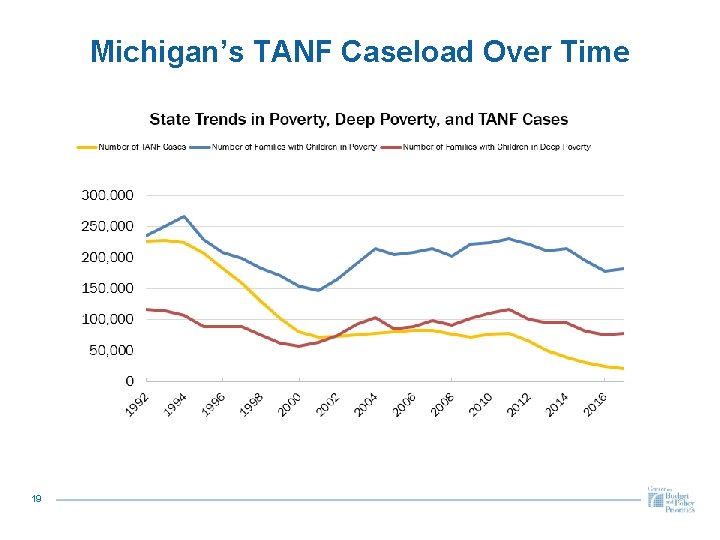
Michigan’s TANF Caseload Over Time 19
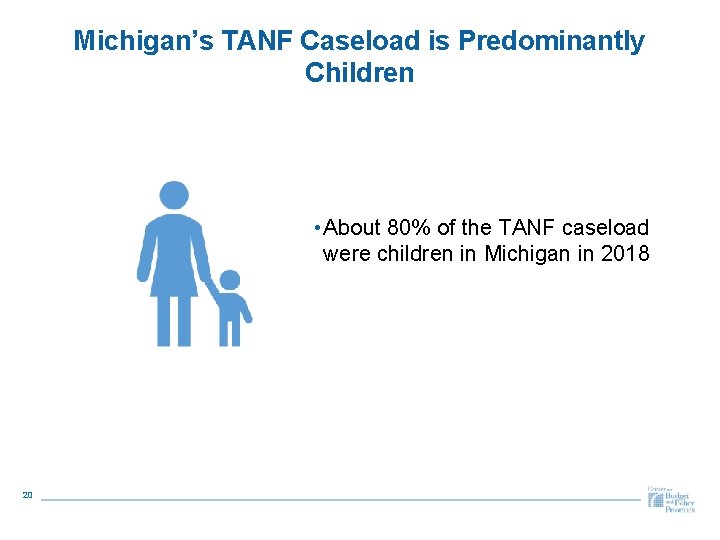
Michigan’s TANF Caseload is Predominantly Children • About 80% of the TANF caseload were children in Michigan in 2018 20
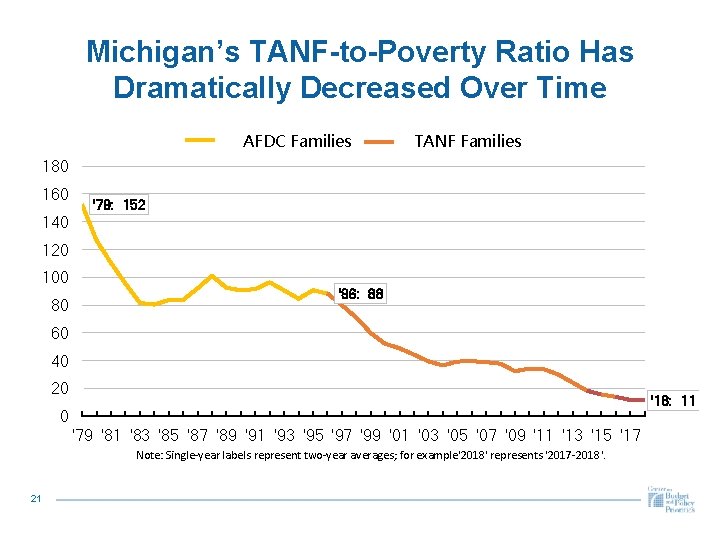
Michigan’s TANF-to-Poverty Ratio Has Dramatically Decreased Over Time AFDC Families TANF Families 180 160 '79: 152 140 120 100 80 '96: 88 60 40 20 '18: 11 0 '79 '81 '83 '85 '87 '89 '91 '93 '95 '97 '99 '01 '03 '05 '07 '09 '11 '13 '15 '17 Note: Single-year labels represent two-year averages; for example'2018' represents '2017 -2018'. 21
Over 100, 000 More Michigan Families Struggling to Make Ends Meet Could Receive TANF Cash Assistance • If the TPR were the same in 2018 as it was in 1996, an estimated 126, 783 more families would be receiving monthly cash assistance benefits 22
Ashley Burnside aburnside@cbpp. org www. cbpp. org
- Slides: 24