
An Introduction to Tactical Management A Disciplined Approach
- Slides: 25
An Introduction to Tactical Management A Disciplined Approach to Investing in the Stock Market Copyright © 1995 -201 Nasdaq, Inc.
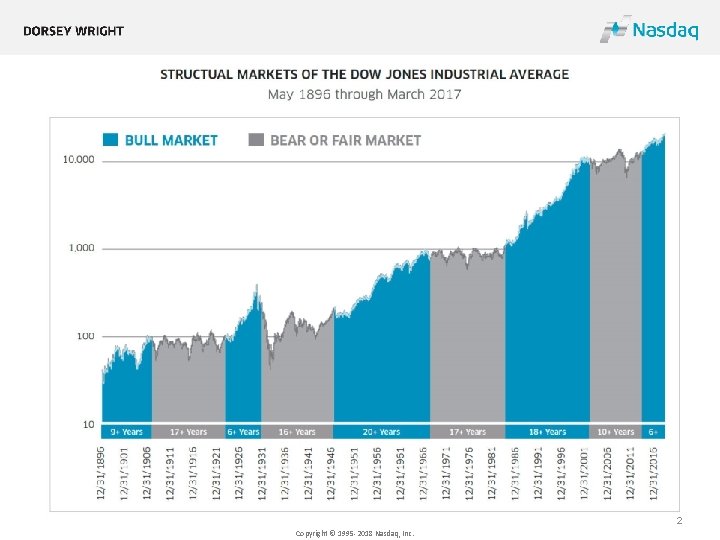
2 Copyright © 1995 -2018 Nasdaq, Inc.
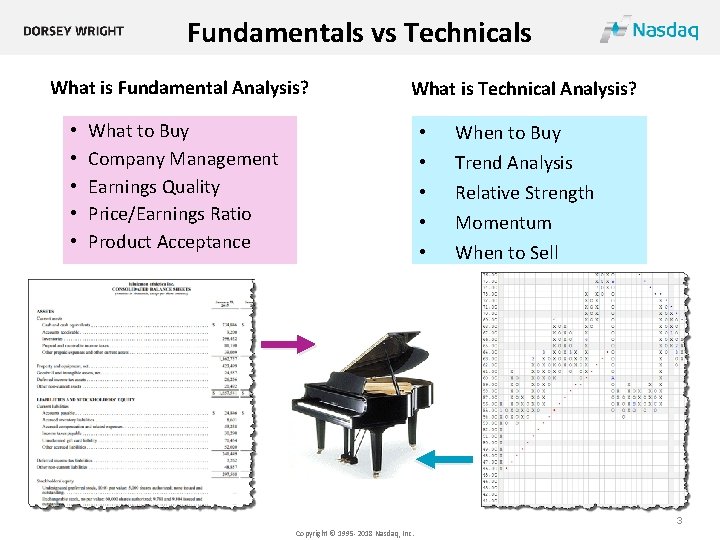
Fundamentals vs Technicals What is Fundamental Analysis? • • • What is Technical Analysis? What to Buy Company Management Earnings Quality Price/Earnings Ratio Product Acceptance • • • When to Buy Trend Analysis Relative Strength Momentum When to Sell 3 Copyright © 1995 -2018 Nasdaq, Inc.
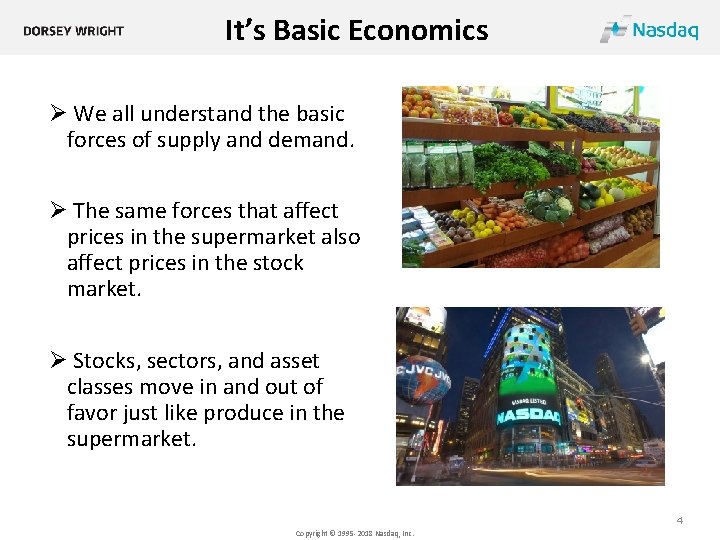
It’s Basic Economics Ø We all understand the basic forces of supply and demand. Ø The same forces that affect prices in the supermarket also affect prices in the stock market. Ø Stocks, sectors, and asset classes move in and out of favor just like produce in the supermarket. 4 Copyright © 1995 -2018 Nasdaq, Inc.
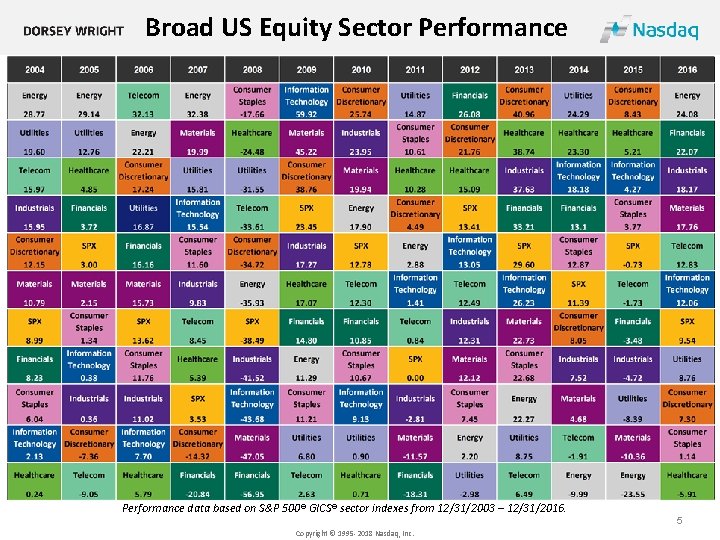
Broad US Equity Sector Performance data based on S&P 500® GICS® sector indexes from 12/31/2003 – 12/31/2016. Copyright © 1995 -2018 Nasdaq, Inc. 5
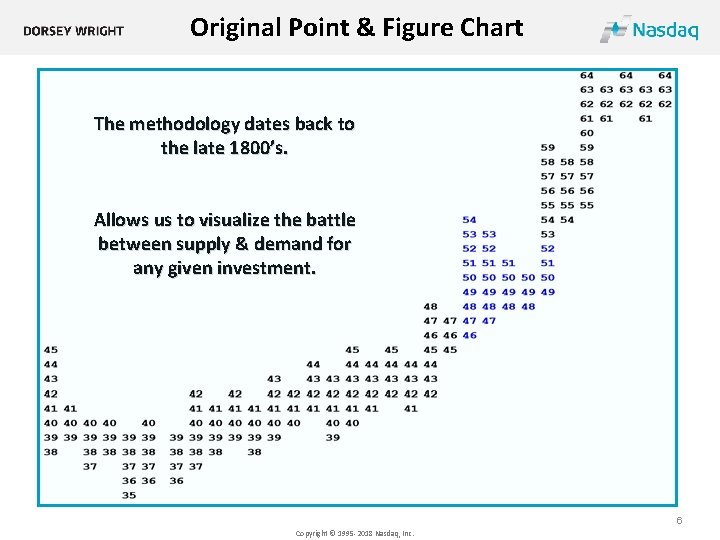
Original Point & Figure Chart The methodology dates back to the late 1800’s. Allows us to visualize the battle between supply & demand for any given investment. 6 Copyright © 1995 -2018 Nasdaq, Inc.
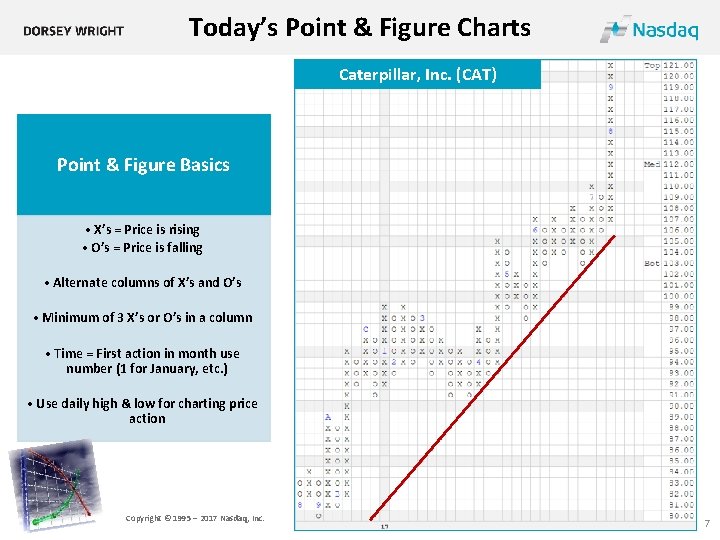
Today’s Point & Figure Charts Caterpillar, Inc. (CAT) Point & Figure Basics • X’s = Price is rising • O’s = Price is falling • Alternate columns of X’s and O’s • Minimum of 3 X’s or O’s in a column • Time = First action in month use number (1 for January, etc. ) • Use daily high & low for charting price action Copyright © 1995 – 2017 Nasdaq, Inc. Copyright © 1995 -2017 Nasdaq, Inc. For Financial Professional Use Only. Not For Use With The Public. 7 7
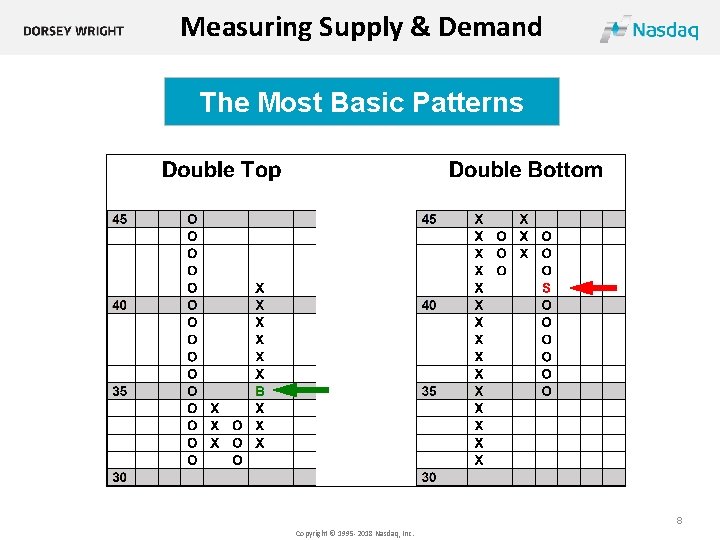
Measuring Supply & Demand The Most Basic Patterns 8 Copyright © 1995 -2018 Nasdaq, Inc.
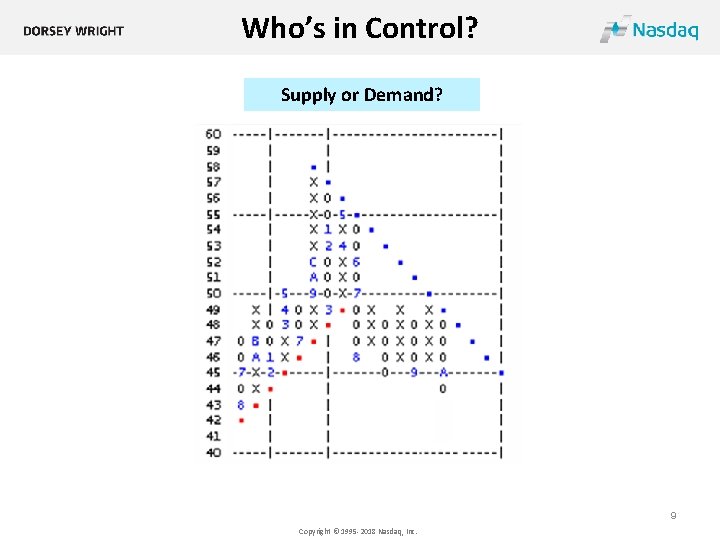
Who’s in Control? Supply or Demand? 9 Copyright © 1995 -2018 Nasdaq, Inc.
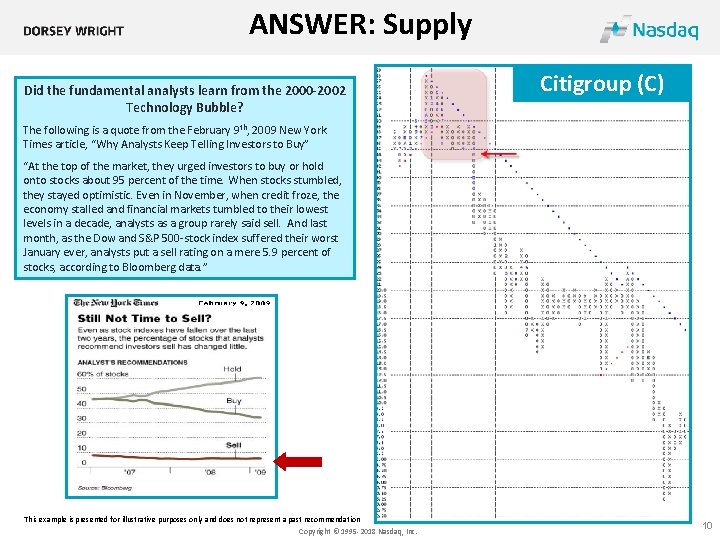
ANSWER: Supply Did the fundamental analysts learn from the 2000 -2002 Technology Bubble? Citigroup (C) The following is a quote from the February 9 th, 2009 New York Times article, “Why Analysts Keep Telling Investors to Buy” “At the top of the market, they urged investors to buy or hold onto stocks about 95 percent of the time. When stocks stumbled, they stayed optimistic. Even in November, when credit froze, the economy stalled and financial markets tumbled to their lowest levels in a decade, analysts as a group rarely said sell. And last month, as the Dow and S&P 500 -stock index suffered their worst January ever, analysts put a sell rating on a mere 5. 9 percent of stocks, according to Bloomberg data. ” This example is presented for illustrative purposes only and does not represent a past recommendation Copyright © 1995 -2018 Nasdaq, Inc. 10
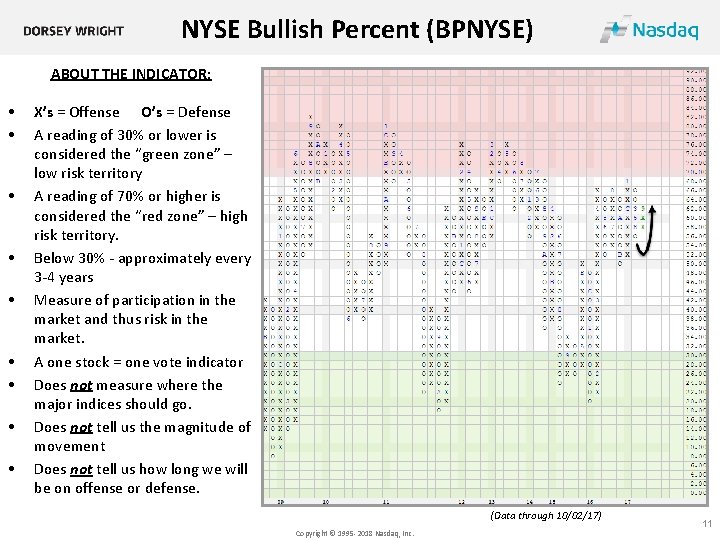
NYSE Bullish Percent (BPNYSE) ABOUT THE INDICATOR: • • • X’s = Offense O’s = Defense A reading of 30% or lower is considered the “green zone” – low risk territory A reading of 70% or higher is considered the “red zone” – high risk territory. Below 30% - approximately every 3 -4 years Measure of participation in the market and thus risk in the market. A one stock = one vote indicator Does not measure where the major indices should go. Does not tell us the magnitude of movement Does not tell us how long we will be on offense or defense. (Data through 10/02/17) Copyright © 1995 -2018 Nasdaq, Inc. 11
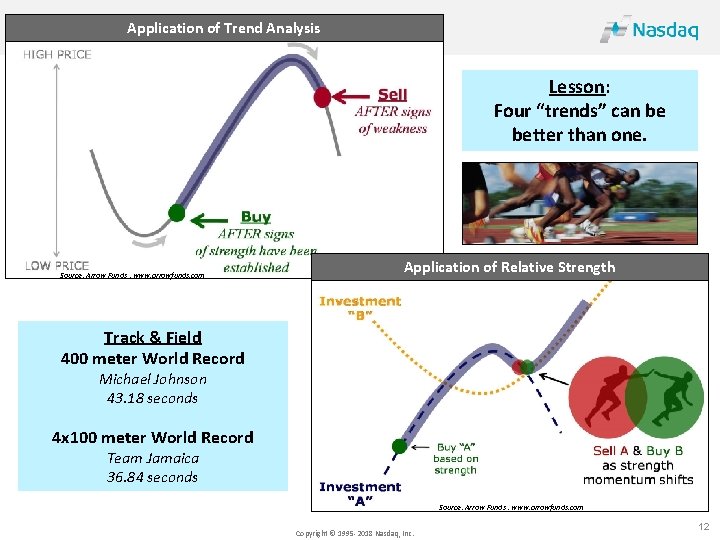
Application of Trend Analysis Lesson: Four “trends” can be better than one. Source: Arrow Funds : www. arrowfunds. com Application of Relative Strength Track & Field 400 meter World Record Michael Johnson 43. 18 seconds 4 x 100 meter World Record Team Jamaica 36. 84 seconds Source: Arrow Funds : www. arrowfunds. com Copyright © 1995 -2018 Nasdaq, Inc. 12
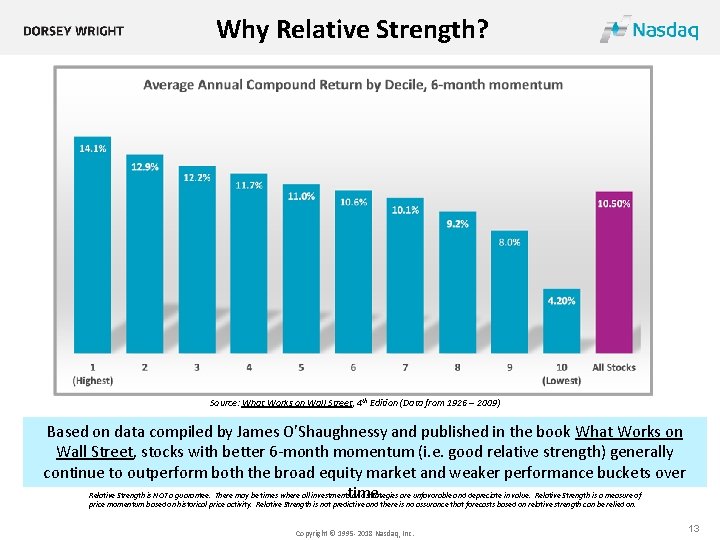
Why Relative Strength? Source: What Works on Wall Street, 4 th Edition (Data from 1926 – 2009) Based on data compiled by James O’Shaughnessy and published in the book What Works on Wall Street, stocks with better 6 -month momentum (i. e. good relative strength) generally continue to outperform both the broad equity market and weaker performance buckets over Relative Strength is NOT a guarantee. There may be times where all investments and strategies are unfavorable and depreciate in value. Relative Strength is a measure of time. price momentum based on historical price activity. Relative Strength is not predictive and there is no assurance that forecasts based on relative strength can be relied on. Copyright © 1995 -2018 Nasdaq, Inc. 13
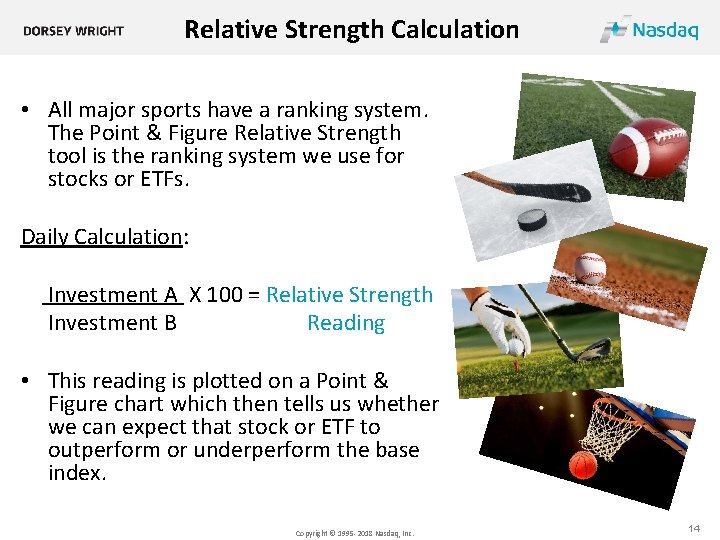
Relative Strength Calculation • All major sports have a ranking system. The Point & Figure Relative Strength tool is the ranking system we use for stocks or ETFs. Daily Calculation: Investment A X 100 = Relative Strength Investment B Reading • This reading is plotted on a Point & Figure chart which then tells us whether we can expect that stock or ETF to outperform or underperform the base index. Copyright © 1995 -2018 Nasdaq, Inc. 14
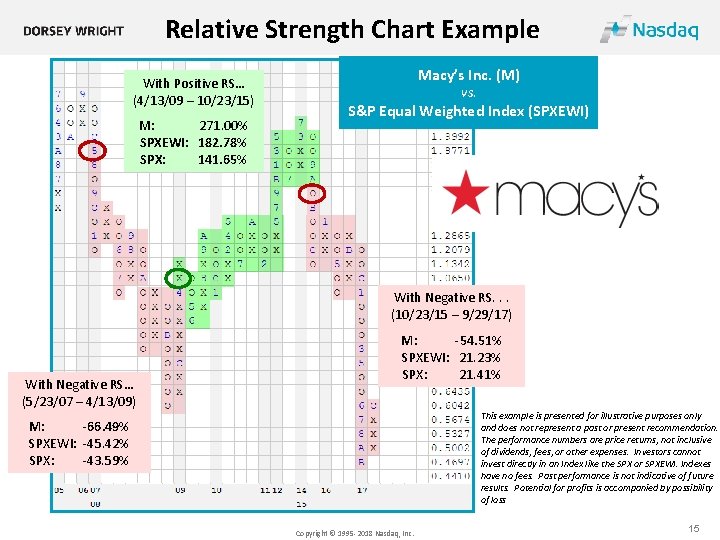
Relative Strength Chart Example With Positive RS… (4/13/09 – 10/23/15) M: 271. 00% SPXEWI: 182. 78% SPX: 141. 65% Macy’s Inc. (M) vs. S&P Equal Weighted Index (SPXEWI) With Negative RS. . . (10/23/15 – 9/29/17) With Negative RS… (5/23/07 – 4/13/09) M: -54. 51% SPXEWI: 21. 23% SPX: 21. 41% This example is presented for illustrative purposes only and does not represent a past or present recommendation. The performance numbers are price returns, not inclusive of dividends, fees, or other expenses. Investors cannot invest directly in an Index like the SPX or SPXEWI. Indexes have no fees. Past performance is not indicative of future results. Potential for profits is accompanied by possibility of loss M: -66. 49% SPXEWI: -45. 42% SPX: -43. 59% Copyright © 1995 -2018 Nasdaq, Inc. 15
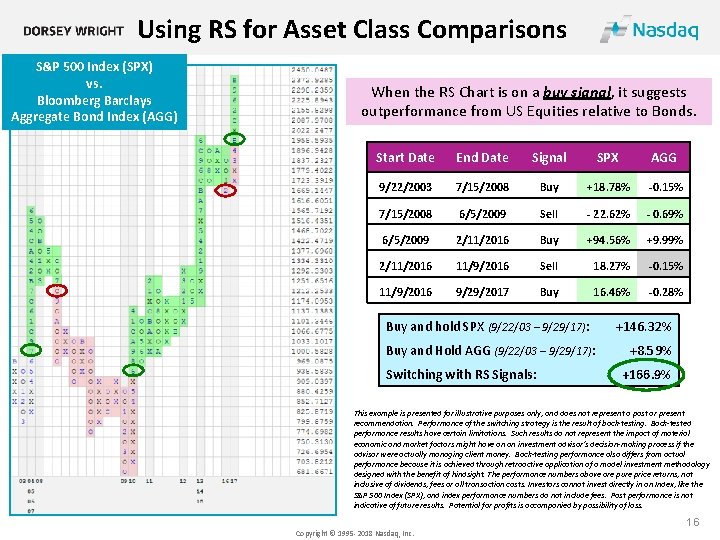
Using RS for Asset Class Comparisons S&P 500 Index (SPX) vs. Bloomberg Barclays Aggregate Bond Index (AGG) When the RS Chart is on a buy signal, it suggests outperformance from US Equities relative to Bonds. Start Date End Date Signal SPX AGG 9/22/2003 7/15/2008 Buy +18. 78% -0. 15% 7/15/2008 6/5/2009 Sell - 22. 62% - 0. 69% 6/5/2009 2/11/2016 Buy +94. 56% +9. 99% 2/11/2016 11/9/2016 Sell 18. 27% -0. 15% 11/9/2016 9/29/2017 Buy 16. 46% -0. 28% Buy and hold SPX (9/22/03 – 9/29/17) : Buy and Hold AGG (9/22/03 – 9/29/17) : Switching with RS Signals: +146. 32% +8. 59% +166. 9% This example is presented for illustrative purposes only, and does not represent a past or present recommendation. Performance of the switching strategy is the result of back-testing. Back-tested performance results have certain limitations. Such results do not represent the impact of material economic and market factors might have on an investment advisor’s decision-making process if the advisor were actually managing client money. Back-testing performance also differs from actual performance because it is achieved through retroactive application of a model investment methodology designed with the benefit of hindsight. The performance numbers above are pure price returns, not inclusive of dividends, fees or all transaction costs. Investors cannot invest directly in an Index, like the S&P 500 Index (SPX), and index performance numbers do not include fees. Past performance is not indicative of future results. Potential for profits is accompanied by possibility of loss. 16 Copyright © 1995 -2018 Nasdaq, Inc.
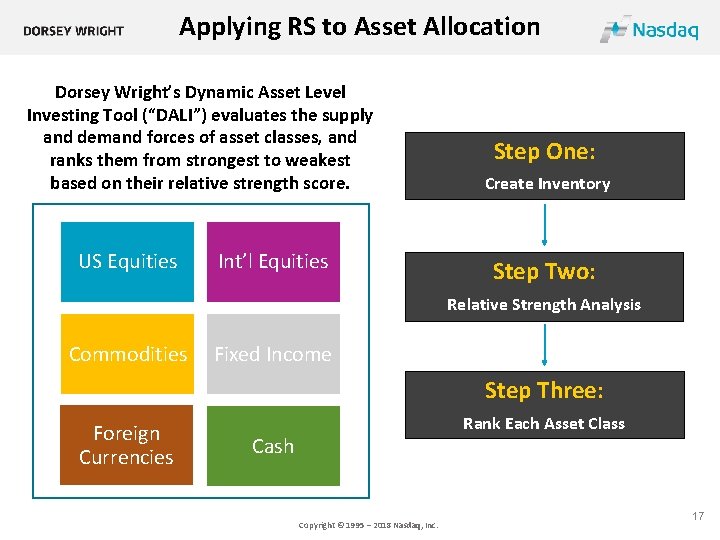
Applying RS to Asset Allocation Dorsey Wright’s Dynamic Asset Level Investing Tool (“DALI”) evaluates the supply and demand forces of asset classes, and ranks them from strongest to weakest based on their relative strength score. US Equities Int’l Equities Step One: Create Inventory Step Two: Relative Strength Analysis Commodities Fixed Income Step Three: Foreign Currencies Rank Each Asset Class Cash Copyright © 1995 – 2018 Nasdaq, Inc. Copyright © 1995 -2018 Nasdaq, Inc. 17
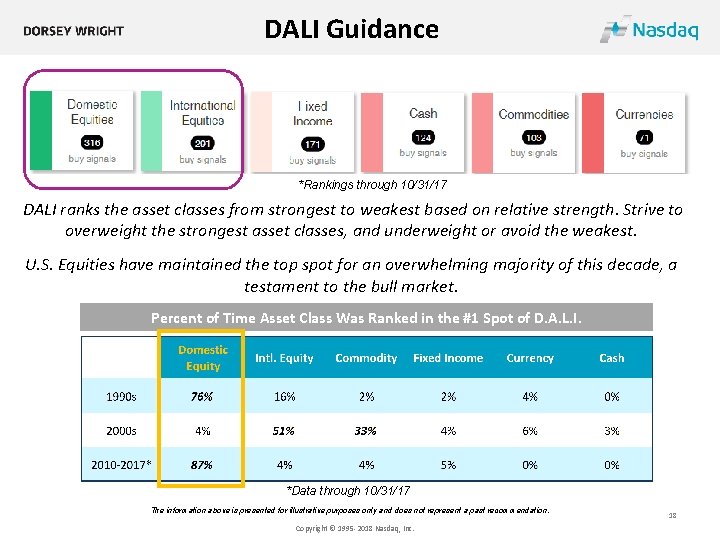
DALI Guidance *Rankings through 10/31/17 DALI ranks the asset classes from strongest to weakest based on relative strength. Strive to overweight the strongest asset classes, and underweight or avoid the weakest. U. S. Equities have maintained the top spot for an overwhelming majority of this decade, a testament to the bull market. Percent of Time Asset Class Was Ranked in the #1 Spot of D. A. L. I. *Data through 10/31/17 The information above is presented for illustrative purposes only and does not represent a past recommendation. Copyright © 1995 -2018 Nasdaq, Inc. 18
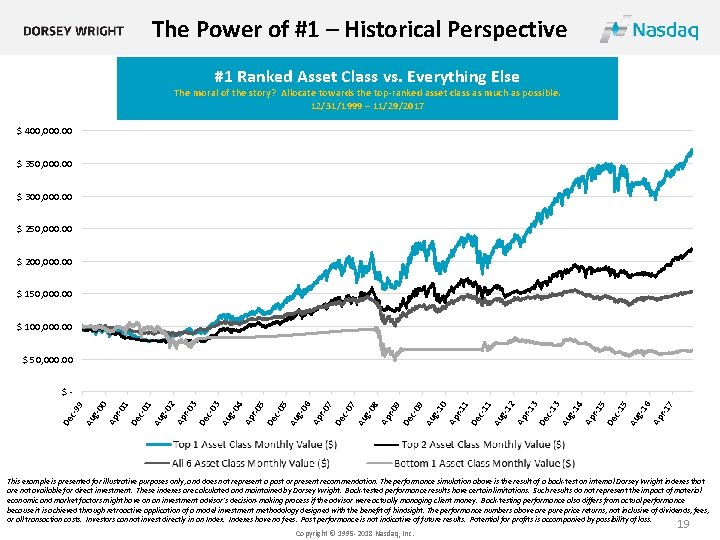
The Power of #1 – Historical Perspective #1 Ranked Asset Class vs. Everything Else The moral of the story? Allocate towards the top-ranked asset class as much as possible. 12/31/1999 – 11/29/2017 $ 400, 000. 00 $ 350, 000. 00 $ 300, 000. 00 $ 250, 000. 00 $ 200, 000. 00 $ 150, 000. 00 $ 100, 000. 00 $ 50, 000. 00 7 r-1 6 Ap g-1 5 Au c-1 5 De r-1 4 Ap g-1 3 Au c-1 3 De r-1 2 Ap g-1 1 Au c-1 1 De r-1 0 Ap g-1 9 Au c-0 9 De r-0 8 Ap g-0 7 Au c-0 7 De r-0 6 Ap g-0 5 Au c-0 5 De r-0 4 Ap g-0 3 Au c-0 3 De r-0 2 Ap g-0 1 Au c-0 1 De r-0 0 Ap g-0 Au De c-9 9 $ - This example is presented for illustrative purposes only, and does not represent a past or present recommendation. The performance simulation above is the result of a back-test on internal Dorsey Wright indexes that are not available for direct investment. These indexes are calculated and maintained by Dorsey Wright. Back-tested performance results have certain limitations. Such results do not represent the impact of material economic and market factors might have on an investment advisor’s decision-making process if the advisor were actually managing client money. Back-testing performance also differs from actual performance because it is achieved through retroactive application of a model investment methodology designed with the benefit of hindsight. The performance numbers above are pure price returns, not inclusive of dividends, fees, or all transaction costs. Investors cannot invest directly in an Indexes have no fees. Past performance is not indicative of future results. Potential for profits is accompanied by possibility of loss. Copyright © 1995 -2018 Nasdaq, Inc. 19
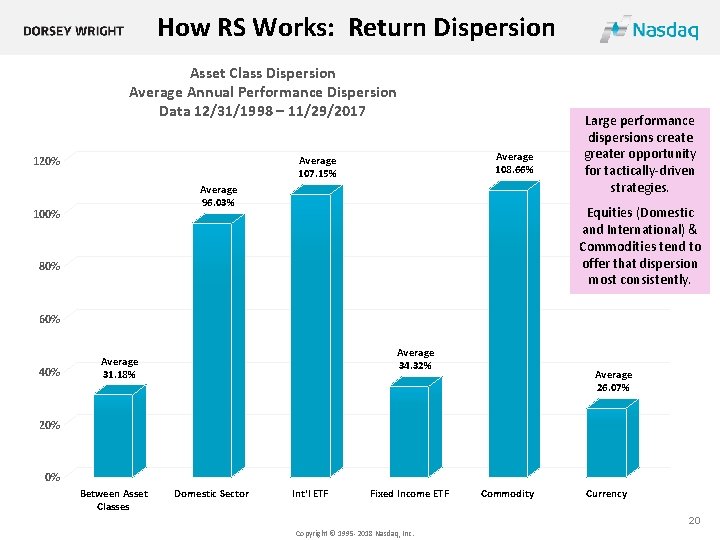
How RS Works: Return Dispersion Asset Class Dispersion Average Annual Performance Dispersion Data 12/31/1998 – 11/29/2017 120% Average 108. 66% Average 107. 15% Average 96. 03% 100% Large performance dispersions create greater opportunity for tactically-driven strategies. Equities (Domestic and International) & Commodities tend to offer that dispersion most consistently. 80% 60% 40% Average 34. 32% Average 31. 18% Average 26. 07% 20% 0% Between Asset Classes Domestic Sector Int'l ETF Fixed Income ETF Commodity Currency 20 Copyright © 1995 -2018 Nasdaq, Inc.
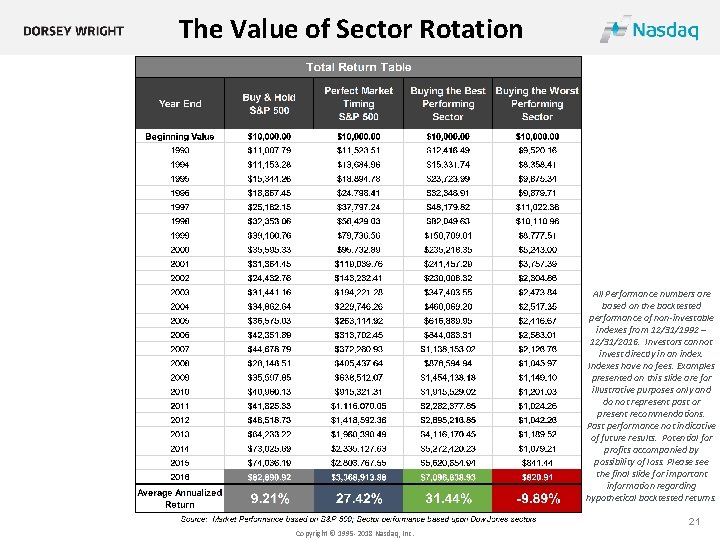
The Value of Sector Rotation All Performance numbers are based on the backtested performance of non-investable indexes from 12/31/1992 – 12/31/2016. Investors cannot invest directly in an index. Indexes have no fees. Examples presented on this slide are for illustrative purposes only and do not represent past or present recommendations. Past performance not indicative of future results. Potential for profits accompanied by possibility of loss. Please see the final slide for important information regarding hypothetical backtested returns. 21 Copyright © 1995 -2018 Nasdaq, Inc.
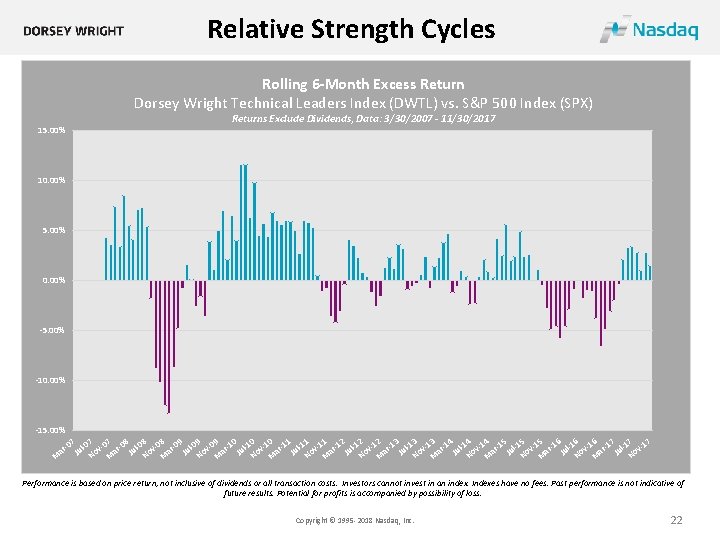
Relative Strength Cycles Rolling 6 -Month Excess Return Dorsey Wright Technical Leaders Index (DWTL) vs. S&P 500 Index (SPX) 15. 00% Returns Exclude Dividends, Data: 3/30/2007 - 11/30/2017 10. 00% 5. 00% 0. 00% -5. 00% -10. 00% -15. 00% 7 8 4 9 0 1 2 3 5 6 7 7 8 9 0 1 3 6 2 4 5 7 7 8 9 0 1 2 3 4 5 6 7 -0 -0 -0 -1 -1 -1 -1 -1 -1 ar Jul ov ar Jul ov ar Jul ov N M N M N M Performance is based on price return, not inclusive of dividends or all transaction costs. Investors cannot invest in an index. Indexes have no fees. Past performance is not indicative of future results. Potential for profits is accompanied by possibility of loss. Copyright © 1995 -2018 Nasdaq, Inc. 22
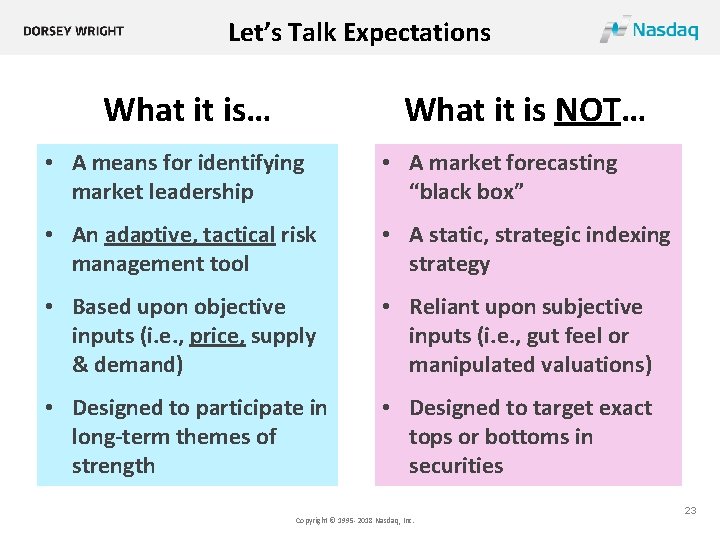
Let’s Talk Expectations What it is NOT… What it is… • A means for identifying market leadership • A market forecasting “black box” • An adaptive, tactical risk management tool • A static, strategic indexing strategy • Based upon objective inputs (i. e. , price, supply & demand) • Reliant upon subjective inputs (i. e. , gut feel or manipulated valuations) • Designed to participate in long-term themes of strength • Designed to target exact tops or bottoms in securities Copyright © 1995 -2018 Nasdaq, Inc. 23
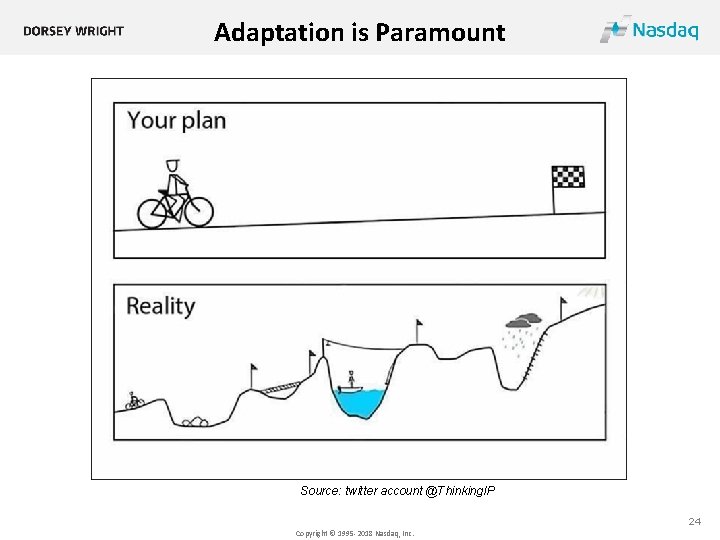
Adaptation is Paramount Source: twitter account @Thinking. IP 24 Copyright © 1995 -2018 Nasdaq, Inc.
Disclosures The information contained herein has been prepared without regard to any particular investor’s investment objectives, financial situation, and needs. Accordingly, investors should not act on any recommendation (express or implied) or information in this material without obtaining specific advice from their financial advisors and should not rely on information herein as the primary basis for their investment decisions. Information contained herein is based on data obtained from recognized statistical services, issuer reports or communications, or other sources believed to be reliable (“information providers”). However, such information has not been verified by Dorsey, Wright & Associates, LLC (DWA) or the information provider and DWA and the information providers make no representations or warranties or take any responsibility as to the accuracy or completeness of any recommendation or information contained herein. DWA and the information provider accept no liability to the recipient whatsoever whether in contract, in tort, for negligence, or otherwise for any direct, indirect, consequential, or special loss of any kind arising out of the use of this document or its contents or of the recipient relying on any such recommendation or information (except insofar as any statutory liability cannot be excluded). Any statements nonfactual in nature constitute only current opinions, which are subject to change without notice. Neither the information nor any opinion expressed shall constitute an offer to sell or a solicitation or an offer to buy any securities, commodities or exchange traded products. This document does not purport to be complete description of the securities or commodities, markets or developments to which reference is made. Unless otherwise stated, performance numbers are based on pure price returns, not inclusive of dividends, fees, or other expenses. Past performance is not indicative of future results. Potential for profits is accompanied by possibility of loss. You should consider this strategy’s investment objectives, risks, charges and expenses before investing. The examples and information presented do not take into consideration commissions, tax implications, or other transaction costs. Some performance information presented is the result of back-tested performance. Back-tested performance is hypothetical (it does not reflect trading in actual accounts) and is provided for informational purposes to illustrate the effects of the Dorsey Wright strategy during a specific period. Back-tested performance results have certain limitations. Such results do not represent the impact of material economic and market factors might have on an investment advisor’s decision making process if the advisor were actually managing client money. Back-testing performance also differs from actual performance because it is achieved through retroactive application of a model investment methodology designed with the benefit of hindsight. Dorsey, Wright & Associates believes the data used in the testing to be from credible, reliable sources, however; Dorsey, Wright & Associates makes no representation or warranties of any kind as to the accuracy of such data. All available data representing the full platform of investment options is used for testing purposes. The relative strength strategy is NOT a guarantee. There may be times where all investments and strategies are unfavorable and depreciate in value. Relative Strength is a measure of price momentum based on historical price activity. Relative Strength is not predictive and there is no assurance that forecasts based on relative strength can be relied upon. Please be aware that the content of this newsletter is based on the opinion of Dorsey, Wright research and may differ from the research provided by Wells Fargo Advisors. This market theme letter was written by Dorsey, Wright & Associates and is provided courtesy of Wells Fargo Advisors. Past performance is not indicative of future results and there is no assurance that any forecasts mentioned in this report will be attained. Stocks offer growth potential but are subject to market fluctuations. Dividends are not guaranteed; companies can reduce or eliminate their dividend at any time. There are special risks associated with an investment in real estate, including credit risk, interest rate fluctuations and the impact of varied economic conditions. Technical analysis is just one form of analysis. You may also want to consider quantitative and fundamental analysis before making any investment decisions. Please be aware that the content of this newsletter is based on the opinions of Dorsey Wright research and may differ from the research provided by Wells Fargo Advisors. Indexes and benchmarks used in this article are unmanaged and cannot be invested in directly. This market theme letter was written by Dorsey Wright & Associates and is provided courtesy of Wells Fargo Advisors is a trade name used by Wells Fargo Clearing Services, LLC, Member SIPC Investment and insurance products: NOT FDIC-Insured NO Bank Guarantee MAY Lose Value Copyright © 1995 -2018 Nasdaq, Inc.