
An introduction to systems thinking and systemic design
![Tools for co-design – outcomes modelling[Theory of Change (To. C) and logic models] Situation](https://slidetodoc.com/presentation_image_h2/ea319141d3d70df34a4fa6a5695935a7/image-38.jpg "Tools for co-design – outcomes modelling[Theory of Change (To. C) and logic models] Situation")
![Tools for co-design – outcomes modelling[Theory of Change (To. C) and logic models] Situation](https://slidetodoc.com/presentation_image_h2/ea319141d3d70df34a4fa6a5695935a7/image-39.jpg "Tools for co-design – outcomes modelling[Theory of Change (To. C) and logic models] Situation")
- Slides: 49
An introduction to systems thinking and systemic design – concepts and tools - it’s a way of collaboratively talking about and designing real-world solutions Will Allen & Margaret Kilvington 1
Content guide 01 02 03 Introduction Why decision-makers are moving towards a systems thinking approach to better deal with complex situations in health, environment, education, etc. Basics of systems thinking 04 05 support systems Introduction to range of tools/methods that support systems thinking and systemic design in practice Nurturing & supporting systems thinking in your practice Systemic design linking systems thinking and design 2
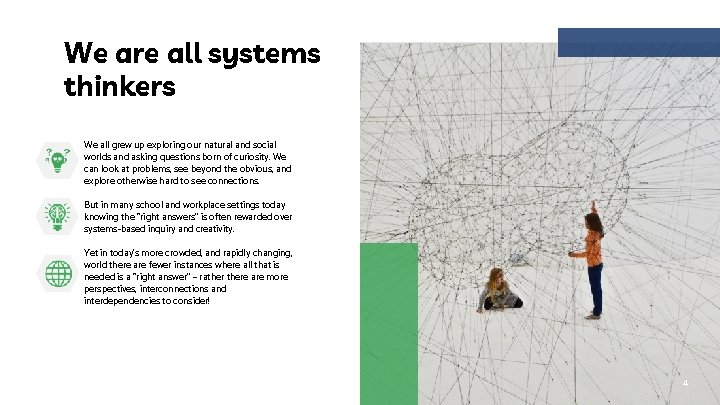
We are all systems thinkers We all grew up exploring our natural and social worlds and asking questions born of curiosity. We can look at problems, see beyond the obvious, and explore otherwise hard to see connections. But in many school and workplace settings today knowing the “right answers” is often rewarded over systems-based inquiry and creativity. Yet in today’s more crowded, and rapidly changing, world there are fewer instances where all that is needed is a “right answer” – rathere are more perspectives, interconnections and interdependencies to consider! 4
Hence the growing interest in learning to strengthen systems thinking practices, and manage organisational cultures that encourage its use in both problem structuring and solution design. 5
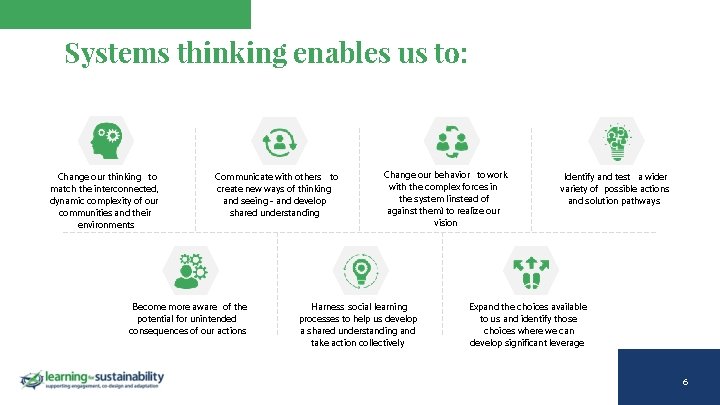
Systems thinking enables us to: Change our thinking to match the interconnected, dynamic complexity of our communities and their environments Communicate with others to create new ways of thinking and seeing - and develop shared understanding Become more aware of the potential for unintended consequences of our actions Change our behavior to work with the complex forces in the system (instead of against them) to realize our vision Harness social learning processes to help us develop a shared understanding and take action collectively Identify and test a wider variety of possible actions and solution pathways Expand the choices available to us and identify those choices where we can develop significant leverage 6
Of course - not all systems are the same! There are different kinds of systems Simple / complicated Complex and adaptive We need to understand them, and use different management styles for each 7
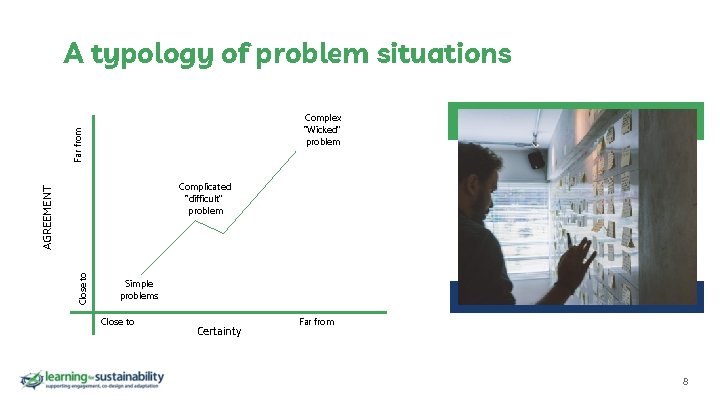
A typology of problem situations Far from Complex “Wicked” problem Close to AGREEMENT Complicated “difficult” problem Simple problems Close to Certainty Far from 8
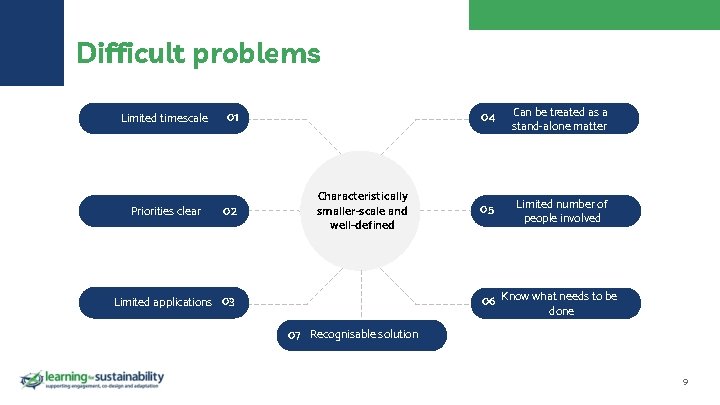
Difficult problems Limited timescale 01 Priorities clear 02 Characteristically smaller-scale and well-defined 04 Can be treated as a stand-alone matter 05 Limited number of people involved 06 Know what needs to be done Limited applications 03 07 Recognisable solution 9
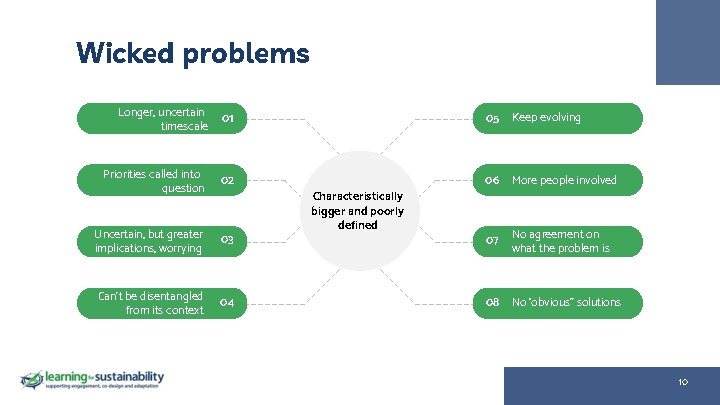
Wicked problems Longer, uncertain timescale 01 05 Keep evolving Priorities called into question 02 06 More people involved Uncertain, but greater implications, worrying 03 07 No agreement on what the problem is Can’t be disentangled from its context 04 08 No ‘obvious” solutions Characteristically bigger and poorly defined 10
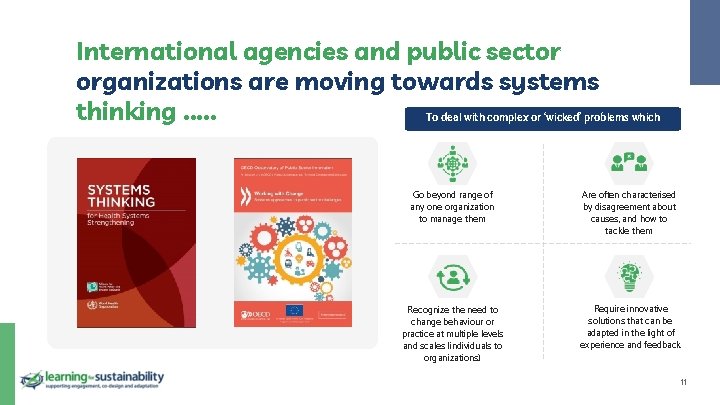
International agencies and public sector organizations are moving towards systems thinking …. . To deal with complex or ‘wicked’ problems which Go beyond range of any one organization to manage them Are often characterised by disagreement about causes, and how to tackle them Recognize the need to change behaviour or practice at multiple levels and scales (individuals to organizations) Require innovative solutions that can be adapted in the light of experience and feedback 11
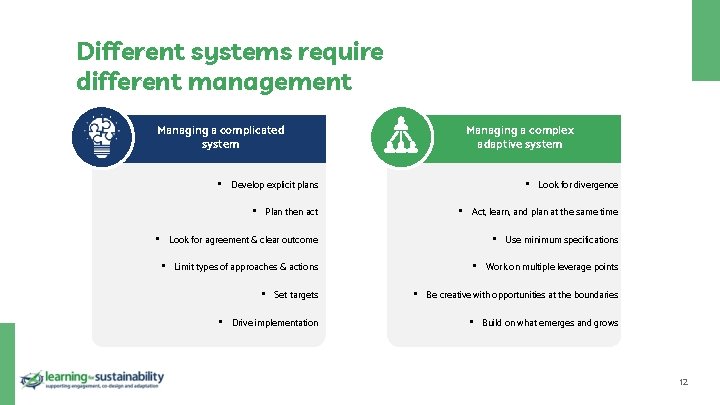
Different systems require different management Managing a complicated system • • Develop explicit plans • • Managing a complex adaptive system • Plan then act Act, learn, and plan at the same time • Look for agreement & clear outcome • • Limit types of approaches & actions • • Set targets Drive implementation • Look for divergence Use minimum specifications Work on multiple leverage points Be creative with opportunities at the boundaries • Build on what emerges and grows 12
02 Basics of systems thinking
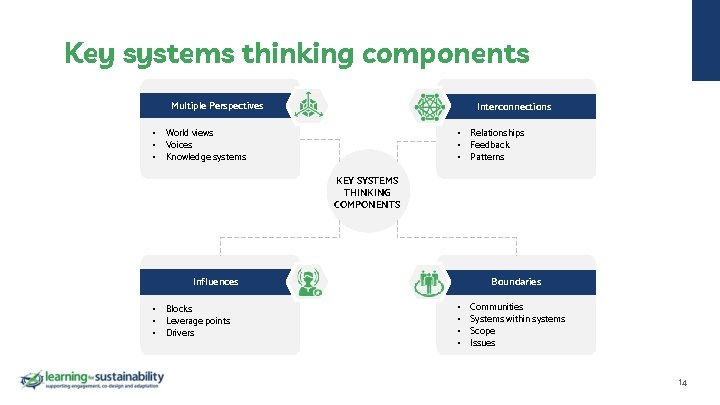
Key systems thinking components Multiple Perspectives Interconnections • World views • Voices • Knowledge systems • Relationships • Feedback • Patterns KEY SYSTEMS THINKING COMPONENTS Influences • Blocks • Leverage points • Drivers Boundaries • • Communities Systems within systems Scope Issues 14
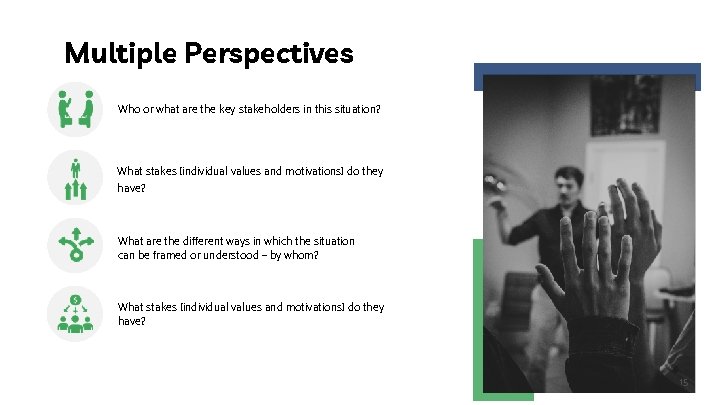
Multiple Perspectives Who or what are the key stakeholders in this situation? What stakes (individual values and motivations) do they have? What are the different ways in which the situation can be framed or understood – by whom? What stakes (individual values and motivations) do they have? 15
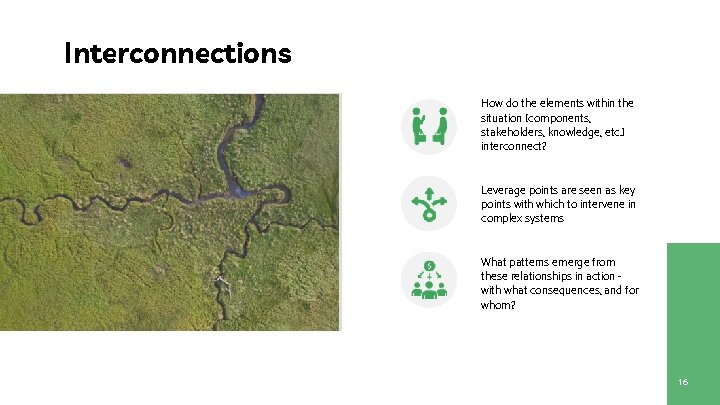
Interconnections How do the elements within the situation (components, stakeholders, knowledge, etc. ) interconnect? Leverage points are seen as key points with which to intervene in complex systems What patterns emerge from these relationships in action with what consequences, and for whom? 16
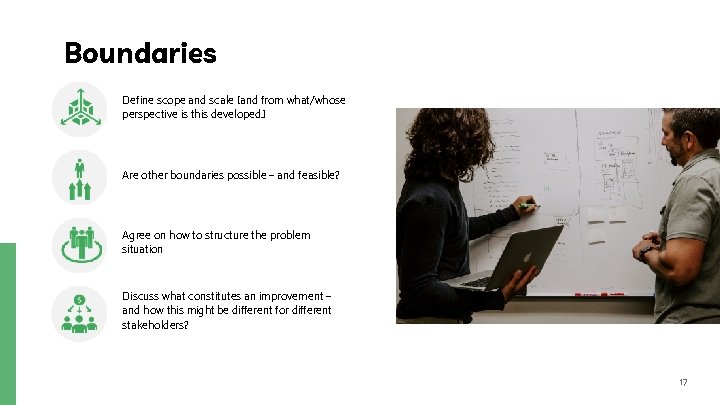
Boundaries Define scope and scale (and from what/whose perspective is this developed. ) Are other boundaries possible – and feasible? Agree on how to structure the problem situation Discuss what constitutes an improvement – and how this might be different for different stakeholders? 17
Influences What drives the systems in question in particular directions Identify …. drivers, trends, enablers, blocks, leverage points Leverage points are seen as key points with which to intervene in complex systems 18
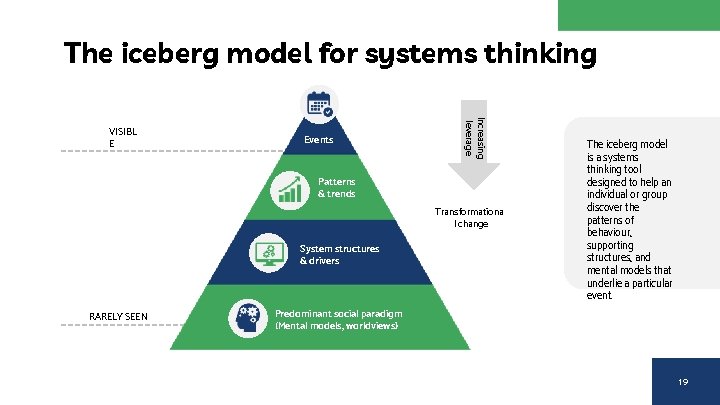
The iceberg model for systems thinking Events Increasing leverage VISIBL E Patterns & trends Transformationa l change System structures & drivers RARELY SEEN The iceberg model is a systems thinking tool designed to help an individual or group discover the patterns of behaviour, supporting structures, and mental models that underlie a particular event. Predominant social paradigm (Mental models, worldviews) 19
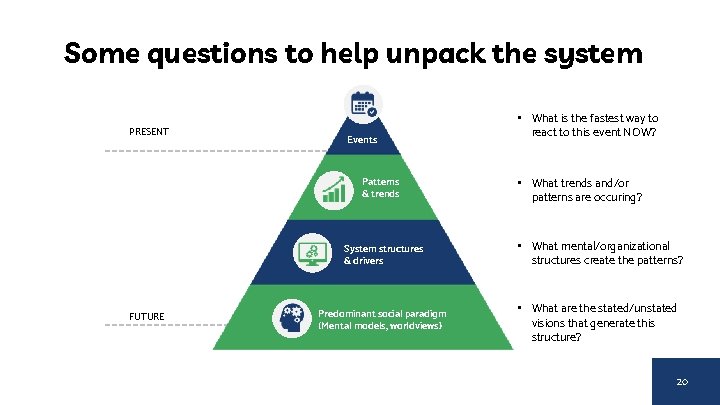
Some questions to help unpack the system PRESENT Events Patterns & trends FUTURE • What is the fastest way to react to this event NOW? • What trends and/or patterns are occuring? System structures & drivers • What mental/organizational structures create the patterns? Predominant social paradigm (Mental models, worldviews) • What are the stated/unstated visions that generate this structure? 20
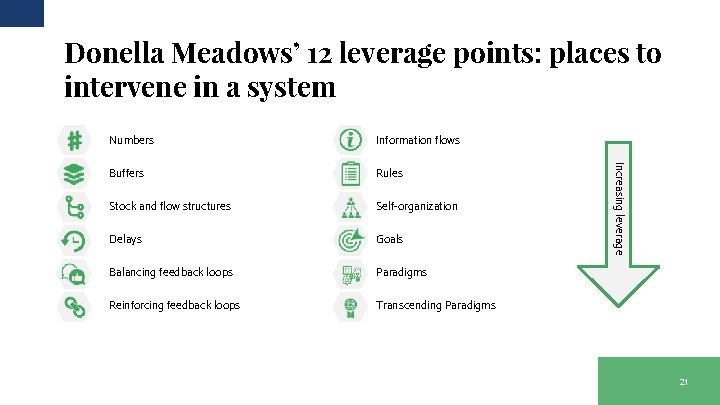
Donella Meadows’ 12 leverage points: places to intervene in a system Information flows Buffers Rules Stock and flow structures Self-organization Delays Goals Balancing feedback loops Paradigms Reinforcing feedback loops Transcending Paradigms Increasing leverage Numbers 21
3 Systemic design linking systems thinking and design
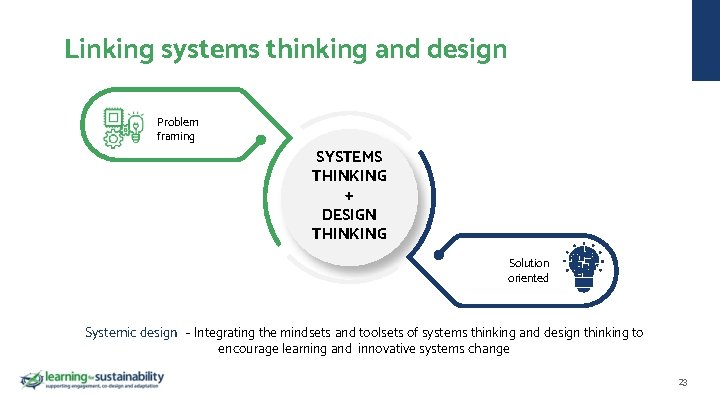
Linking systems thinking and design Problem framing SYSTEMS THINKING + DESIGN THINKING Solution oriented Systemic design - Integrating the mindsets and toolsets of systems thinking and design thinking to encourage learning and innovative systems change 23
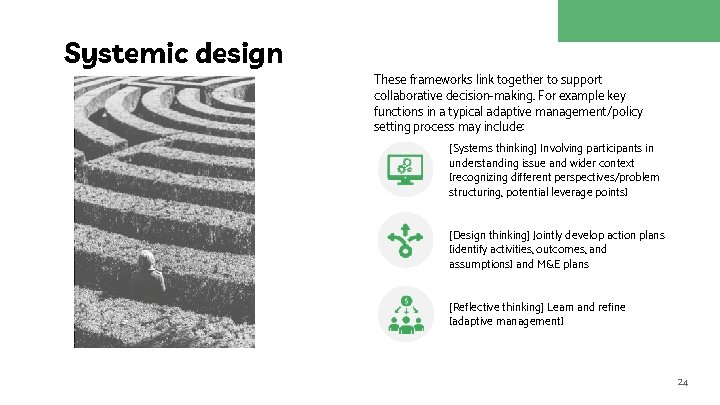
Systemic design These frameworks link together to support collaborative decision-making. For example key functions in a typical adaptive management/policy setting process may include: [Systems thinking] Involving participants in understanding issue and wider context (recognizing different perspectives/problem structuring, potential leverage points) [Design thinking] Jointly develop action plans (identify activities, outcomes, and assumptions) and M&E plans [Reflective thinking] Learn and refine (adaptive management) 24
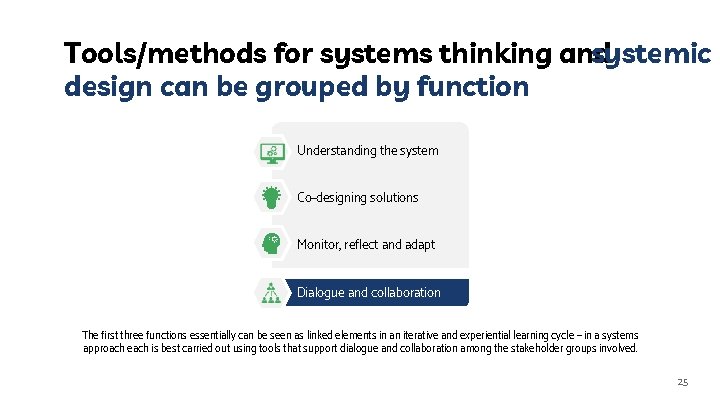
Tools/methods for systems thinking and systemic design can be grouped by function Understanding the system Co-designing solutions Monitor, reflect and adapt Dialogue and collaboration The first three functions essentially can be seen as linked elements in an iterative and experiential learning cycle – in a systems approach each is best carried out using tools that support dialogue and collaboration among the stakeholder groups involved. 25
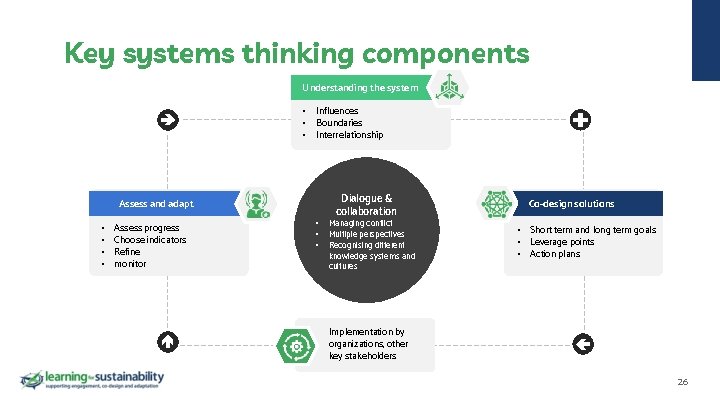
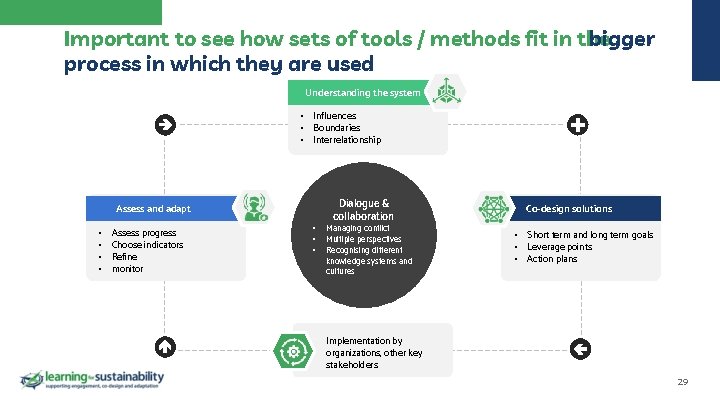
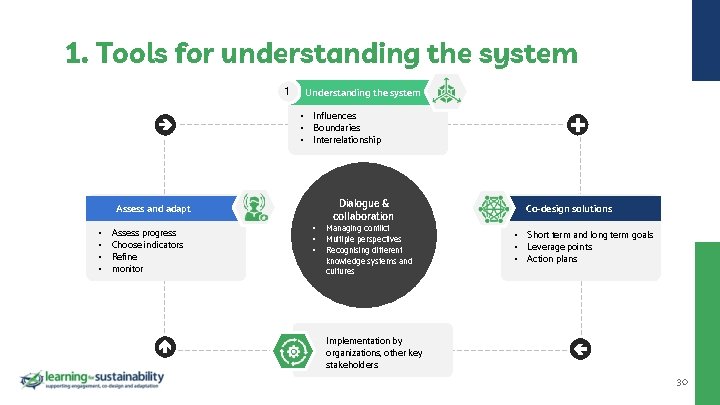
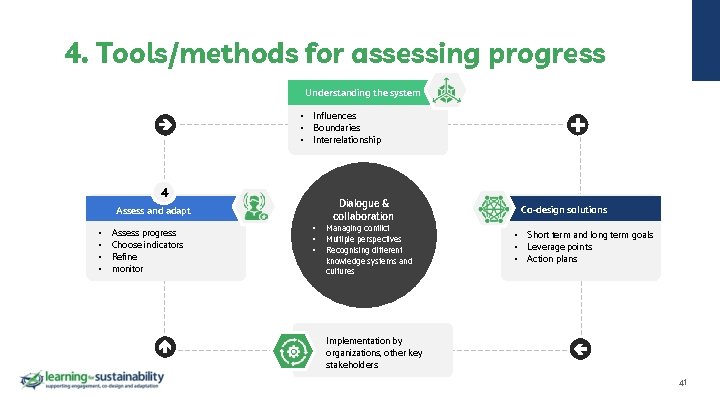
Key systems thinking components Understanding the system • Influences • Boundaries • Interrelationship Assess and adapt • • Assess progress Choose indicators Refine monitor • • • Dialogue & collaboration Managing conflict Multiple perspectives Recognising different knowledge systems and cultures Co-design solutions • Short term and long term goals • Leverage points • Action plans Implementation by organizations, other key stakeholders 26
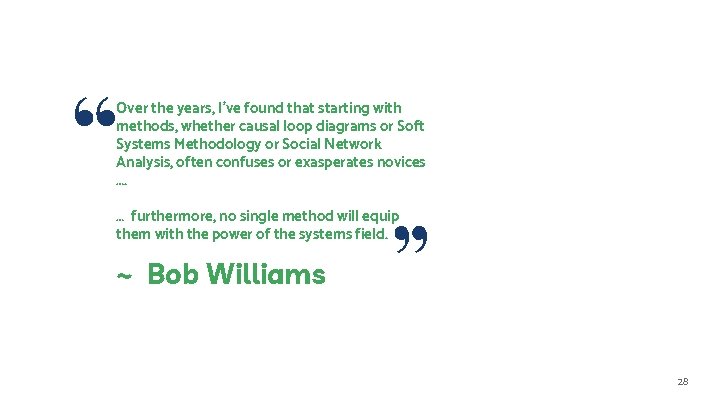
“ Over the years, I’ve found that starting with methods, whether causal loop diagrams or Soft Systems Methodology or Social Network Analysis, often confuses or exasperates novices …. “ … furthermore, no single method will equip them with the power of the systems field. ~ Bob Williams 28
Important to see how sets of tools / methods fit in the bigger process in which they are used Understanding the system • Influences • Boundaries • Interrelationship Assess and adapt • • Assess progress Choose indicators Refine monitor • • • Dialogue & collaboration Managing conflict Multiple perspectives Recognising different knowledge systems and cultures Co-design solutions • Short term and long term goals • Leverage points • Action plans Implementation by organizations, other key stakeholders 29
1. Tools for understanding the system 1 Understanding the system • Influences • Boundaries • Interrelationship Assess and adapt • • Assess progress Choose indicators Refine monitor • • • Dialogue & collaboration Managing conflict Multiple perspectives Recognising different knowledge systems and cultures Co-design solutions • Short term and long term goals • Leverage points • Action plans Implementation by organizations, other key stakeholders 30
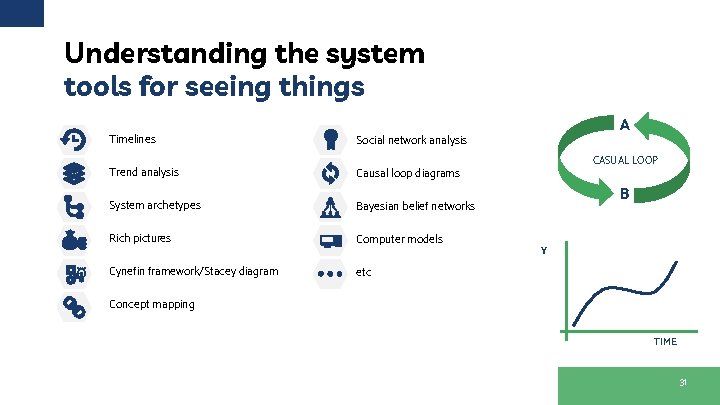
Understanding the system tools for seeing things Timelines Social network analysis Trend analysis Causal loop diagrams System archetypes Bayesian belief networks Rich pictures Computer models Cynefin framework/Stacey diagram etc A CASUAL LOOP B Y Concept mapping TIME 31
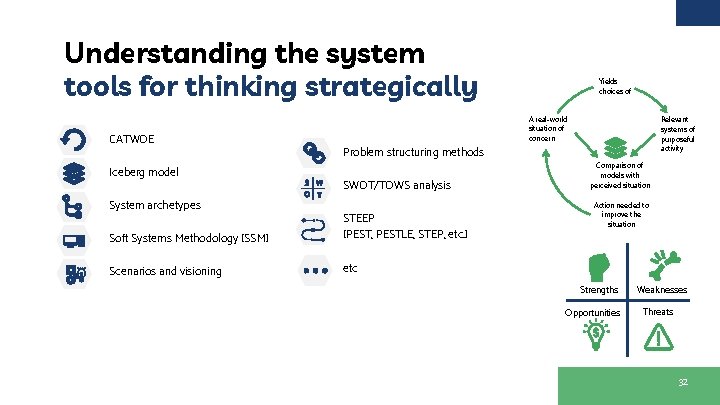
Understanding the system tools for thinking strategically CATWOE Iceberg model System archetypes Problem structuring methods SWOT/TOWS analysis Soft Systems Methodology (SSM) STEEP (PEST, PESTLE, STEP, etc. ) Scenarios and visioning etc Yields choices of A real-world situation of concern Relevant systems of purposeful activity Comparison of models with perceived situation Action needed to improve the situation Strengths Opportunities Weaknesses Threats 32
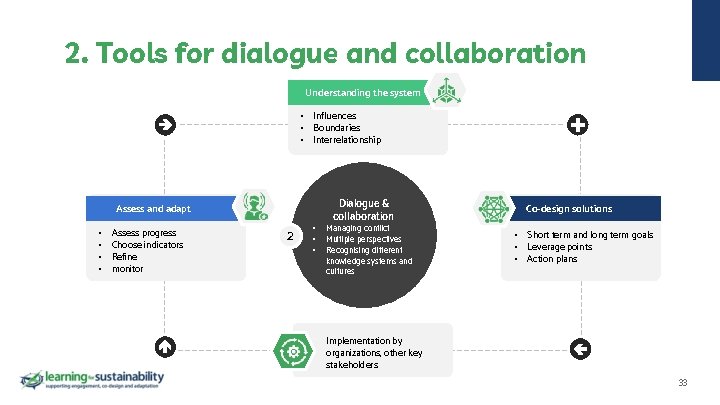
2. Tools for dialogue and collaboration Understanding the system • Influences • Boundaries • Interrelationship Assess and adapt • • Assess progress Choose indicators Refine monitor 2 • • • Dialogue & collaboration Managing conflict Multiple perspectives Recognising different knowledge systems and cultures Co-design solutions • Short term and long term goals • Leverage points • Action plans Implementation by organizations, other key stakeholders 33
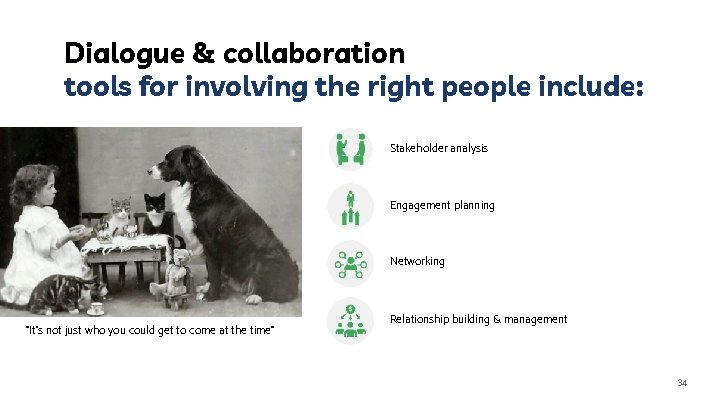
Dialogue & collaboration tools for involving the right people include: Stakeholder analysis Engagement planning Networking “It’s not just who you could get to come at the time” Relationship building & management 34
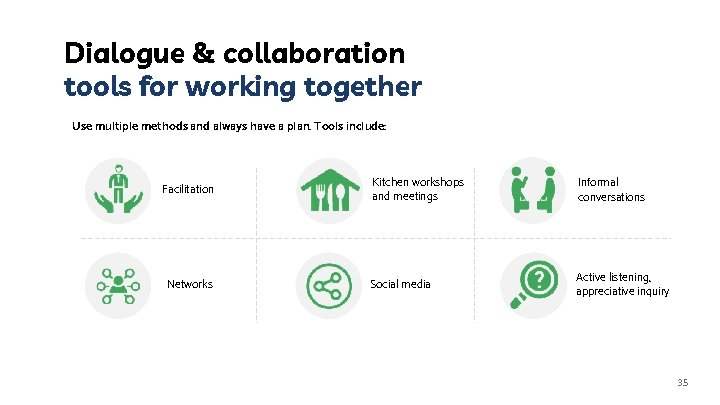
Dialogue & collaboration tools for working together Use multiple methods and always have a plan. Tools include: Facilitation Networks Kitchen workshops and meetings Informal conversations Social media Active listening, appreciative inquiry 35
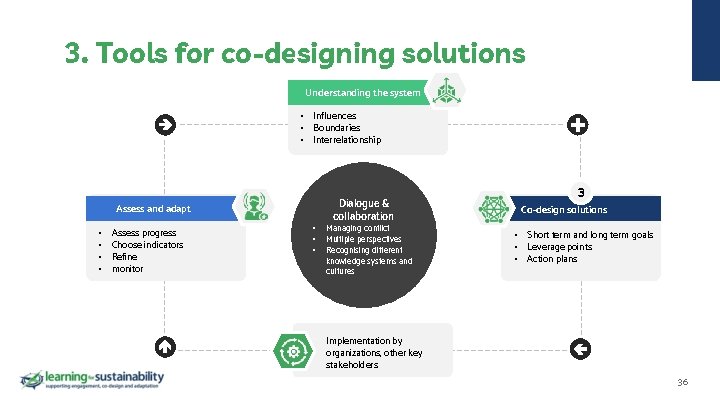
3. Tools for co-designing solutions Understanding the system • Influences • Boundaries • Interrelationship Assess and adapt • • Assess progress Choose indicators Refine monitor • • • Dialogue & collaboration Managing conflict Multiple perspectives Recognising different knowledge systems and cultures 3 Co-design solutions • Short term and long term goals • Leverage points • Action plans Implementation by organizations, other key stakeholders 36
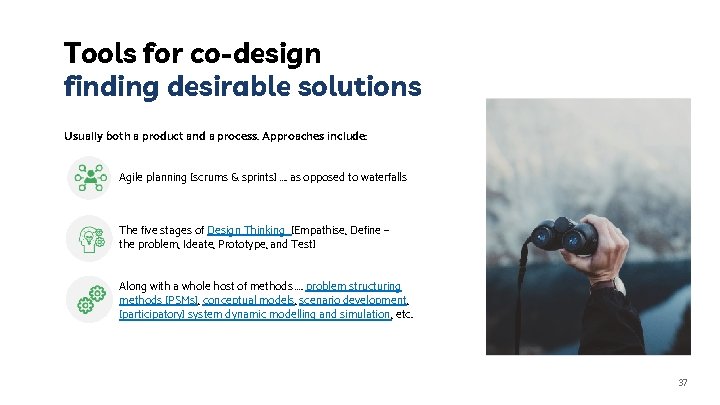
Tools for co-design finding desirable solutions Usually both a product and a process. Approaches include: Agile planning (scrums & sprints) …. as opposed to waterfalls The five stages of Design Thinking (Empathise, Define – the problem, Ideate, Prototype, and Test) Along with a whole host of methods …. problem structuring methods (PSMs), conceptual models, scenario development, (participatory) system dynamic modelling and simulation, etc. 37
Tools for co-design – outcomes modelling[Theory of Change (To. C) and logic models] Situation analysis Inputs, activities & outputs Outcomes Vision 38
Tools for co-design – outcomes modelling[Theory of Change (To. C) and logic models] Situation analysis Inputs, activities & outputs Outcomes - Impact Intermediate Long-term Changes - in individuals & organisations Changes in practice Changes in end states Vision 39
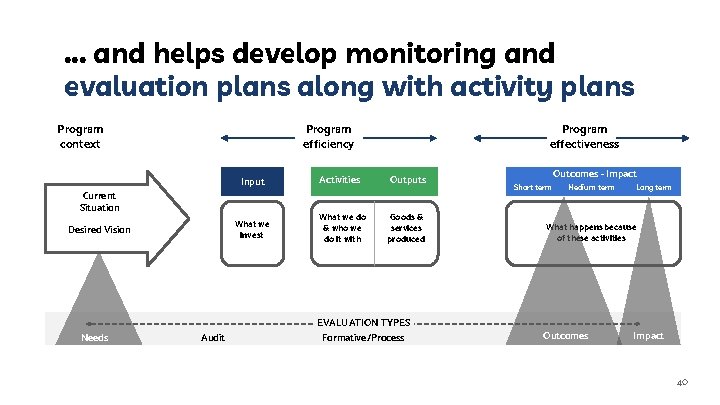
… and helps develop monitoring and evaluation plans along with activity plans Program context Program efficiency Current Situation Desired Vision Needs Audit Program effectiveness Input Activities Outputs What we invest What we do & who we do it with Goods & services produced EVALUATION TYPES Formative/Process Short term Outcomes - Impact Medium term Long term What happens because of these activities Outcomes Impact 40
4. Tools/methods for assessing progress Understanding the system • Influences • Boundaries • Interrelationship 4 Assess and adapt • • Assess progress Choose indicators Refine monitor • • • Dialogue & collaboration Managing conflict Multiple perspectives Recognising different knowledge systems and cultures Co-design solutions • Short term and long term goals • Leverage points • Action plans Implementation by organizations, other key stakeholders 41
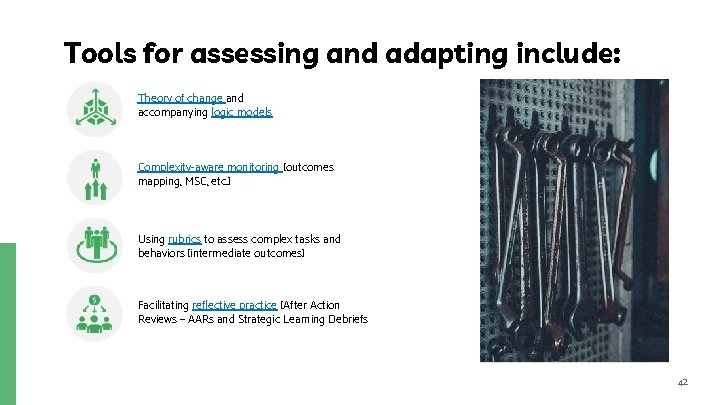
Tools for assessing and adapting include: Theory of change and accompanying logic models Complexity-aware monitoring (outcomes mapping, MSC, etc. ) Using rubrics to assess complex tasks and behaviors (intermediate outcomes) Facilitating reflective practice (After Action Reviews – AARs and Strategic Learning Debriefs 42
05 Embedding systems thinking in practice 43
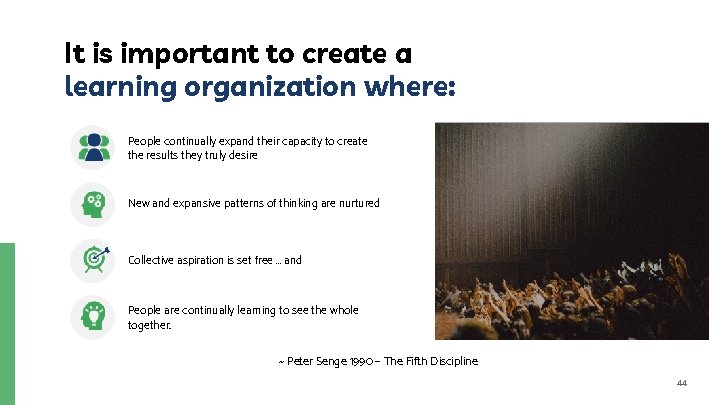
It is important to create a learning organization where: People continually expand their capacity to create the results they truly desire New and expansive patterns of thinking are nurtured Collective aspiration is set free … and People are continually learning to see the whole together. ~ Peter Senge 1990 – The Fifth Discipline 44
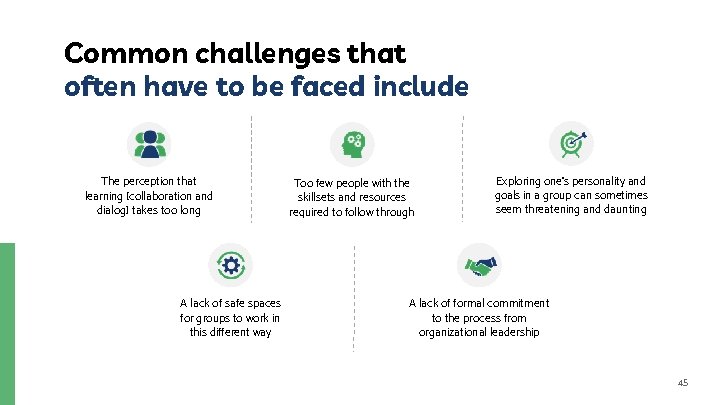
Common challenges that often have to be faced include The perception that learning (collaboration and dialog) takes too long A lack of safe spaces for groups to work in this different way Too few people with the skillsets and resources required to follow through Exploring one’s personality and goals in a group can sometimes seem threatening and daunting A lack of formal commitment to the process from organizational leadership 45
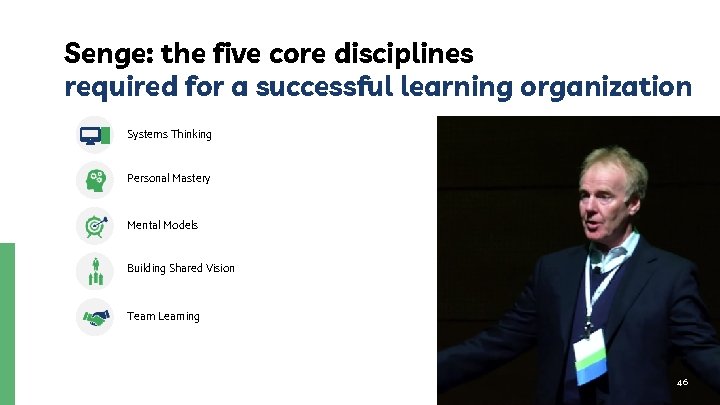
Senge: the five core disciplines required for a successful learning organization Systems Thinking Personal Mastery Mental Models Building Shared Vision Team Learning 46
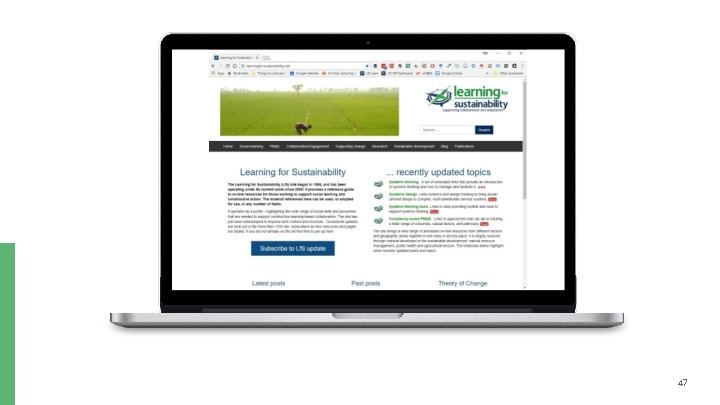
47
For more information • Dr Margaret Kilvington – margaret. kilvington@gmail. com - Independent Social Research, Evaluation & Facilitation • Dr Will Allen – willallennz@gmail. com - Will Allen & Associates / Learning for Sustainability • Annotated links to a wide range of related on-line material can be found via the Learning for Sustainability clearinghouse - https: //learningforsustainability. net/ Reference as: Allen & Kilvington (2018) Summary: An introduction to systems thinking and systemic design – concepts and tools (Presentation). Based on material for an introductory workshop. Available online https: //learningforsustainability. net/post/systemicdesign-intro/ 48
Topic information: Graphics & photos: SLIDE 8: See: Ralph D. Stacey and Dave Snowden SLIDE 12: Complicated or complex – knowing the difference is important SLIDE 19: Systems thinking: what, why when, where and how SLIDE 21: Leverage points – places to intervene in a system SLIDE 23: Systemic design SLIDE 24: Systemic design SLIDE 28: All methods are wrong - some methods are useful SLIDE 31: Systems methods and tools SLIDE 32: Strategy tools and approaches SLIDE 34: Stakeholder mapping and analysis SLIDE 35: Using dialogue and negotiation SLIDE 38: Theory of Change and logic models SLIDE 41: Planning, monitoring & evaluation – closing the loop SLIDE 45: Organizational learning SLIDE 47: Learning for Sustainability website SLIDE 1: Photo by Will Allen SLIDE 3: Photo by Austin Distel on Unsplash SLIDE 4: Photo by Alina Grubnyak on Unsplash SLIDE 5: Photo by Alina Grubnyak on Unsplash SLIDE 7: Photo by Sveta Fedarava on Unsplash SLIDE 8: Photo by Starta ê Team on Unsplash SLIDE 13: Photo by Dylan de Jonge on Unsplash SLIDE 15: Photo by Artem Maltsev on Unsplash SLIDE 16: Photo by Dan Meyers on Unsplash SLIDE 17: Photo by Kaleidico on Unsplash SLIDE 18: Photo by Bill Oxford on Unsplash SLIDE 22: Photo by Saad Salim on Unsplash SLIDE 24: Photo by Maksym Kaharlytskyi on Unsplash SLIDE 3: Photo by Austin Distel on Unsplash SLIDE 34: Source: http: //weird-vintage. com SLIDE 37: Photo by Nathan Thomassin on Unsplash SLIDE 42: Photo by Markus Spiske on Unsplash SLIDE 43: Photo by Kaleidico on Unsplash SLIDE 44: Photo by Edwin Andrade on Unsplash SLIDE 46: Source: Peter Senge Systems Thinking 49