
An Introduction to Structured Output Learning Using Support

- Slides: 24
An Introduction to Structured Output Learning Using Support Vector Machines Yisong Yue Cornell University Some material used courtesy of Thorsten Joachims (Cornell University)
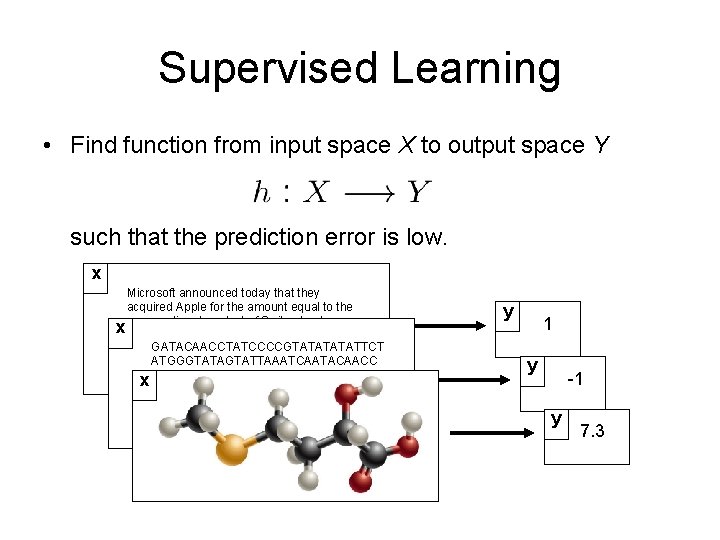
Supervised Learning • Find function from input space X to output space Y such that the prediction error is low. x Microsoft announced today that they acquired Apple for the amount equal to the national product of Switzerland. x gross Microsoft officials stated that they first GATACAACCTATCCCCGTATATTCT wanted to buy Switzerland, but eventually ATGGGTATAGTATTAAATCAATACAACC were turned off by the mountains and the snowy winters… x TATCCCCGTATATTCTATGGGTATA GTATTAAATCAATACAACCTATCCCCGT ATATTCTATGGGTATAGTATTAAAT CAGATACAACCTATCCCCGTATAT TCTATGGGTATAGTATTAAATCACATTTA y 1 y -1 y 7. 3
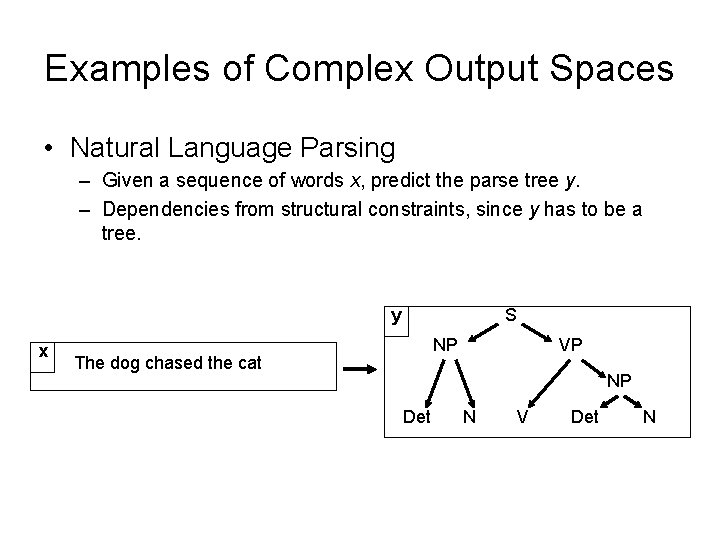
Examples of Complex Output Spaces • Natural Language Parsing – Given a sequence of words x, predict the parse tree y. – Dependencies from structural constraints, since y has to be a tree. y x S NP The dog chased the cat VP NP Det N V Det N
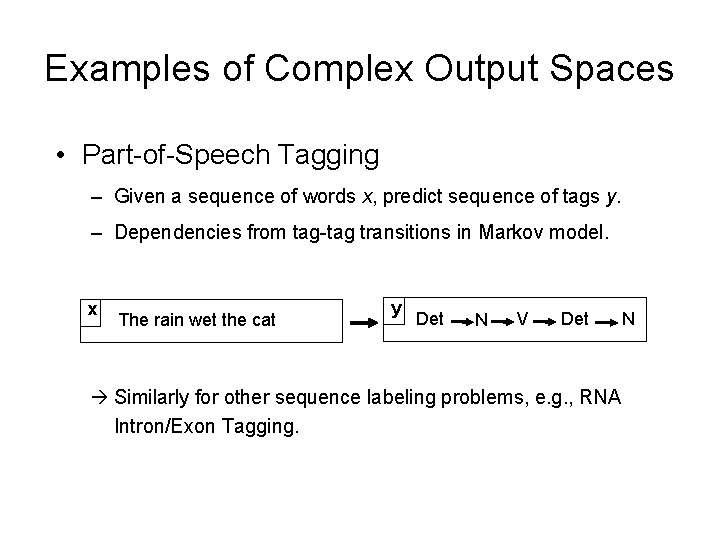
Examples of Complex Output Spaces • Part-of-Speech Tagging – Given a sequence of words x, predict sequence of tags y. – Dependencies from tag-tag transitions in Markov model. x The rain wet the cat y Det N V Det Similarly for other sequence labeling problems, e. g. , RNA Intron/Exon Tagging. N
Examples of Complex Output Spaces • Multi-class Labeling • Protein Sequence Alignment • Noun Phrase Co-reference Clustering • Learning Parameters of Graphical Models – Markov Random Fields • Multivariate Performance Measures – – F 1 Score ROC Area Average Precision NDCG
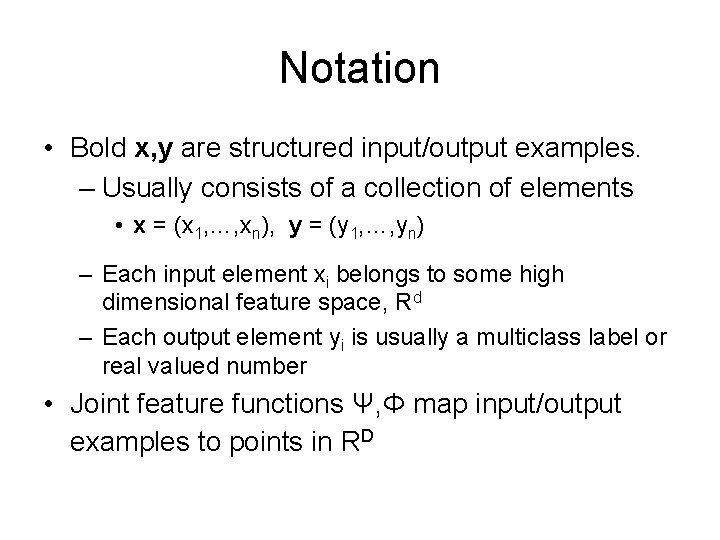
Notation • Bold x, y are structured input/output examples. – Usually consists of a collection of elements • x = (x 1, …, xn), y = (y 1, …, yn) – Each input element xi belongs to some high dimensional feature space, Rd – Each output element yi is usually a multiclass label or real valued number • Joint feature functions Ψ, Φ map input/output examples to points in RD
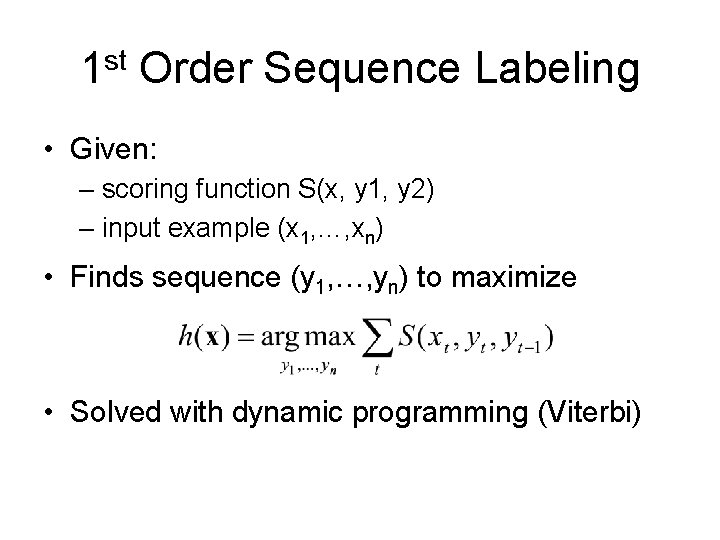
1 st Order Sequence Labeling • Given: – scoring function S(x, y 1, y 2) – input example (x 1, …, xn) • Finds sequence (y 1, …, yn) to maximize • Solved with dynamic programming (Viterbi)
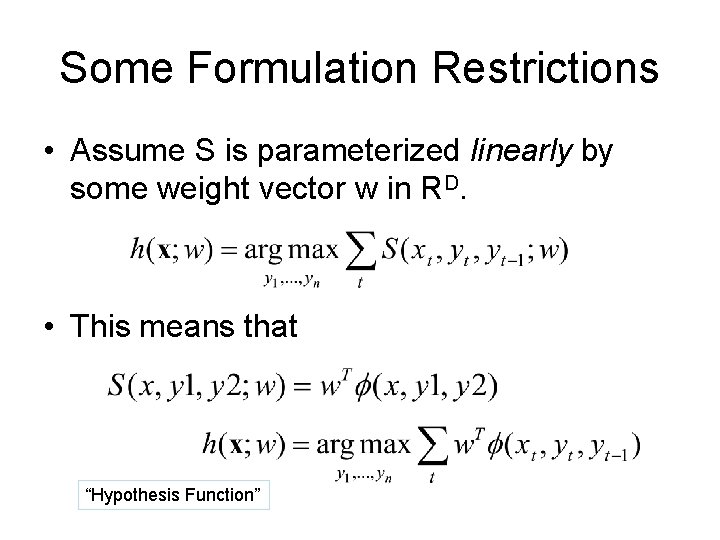
Some Formulation Restrictions • Assume S is parameterized linearly by some weight vector w in RD. • This means that “Hypothesis Function”
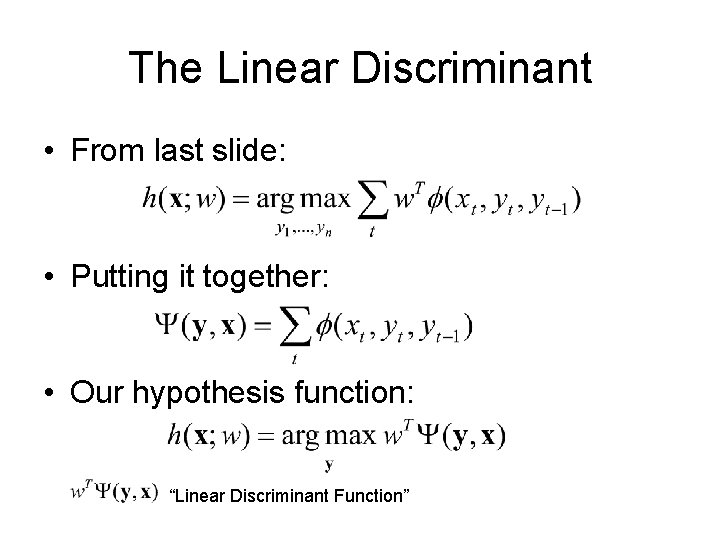
The Linear Discriminant • From last slide: • Putting it together: • Our hypothesis function: “Linear Discriminant Function”
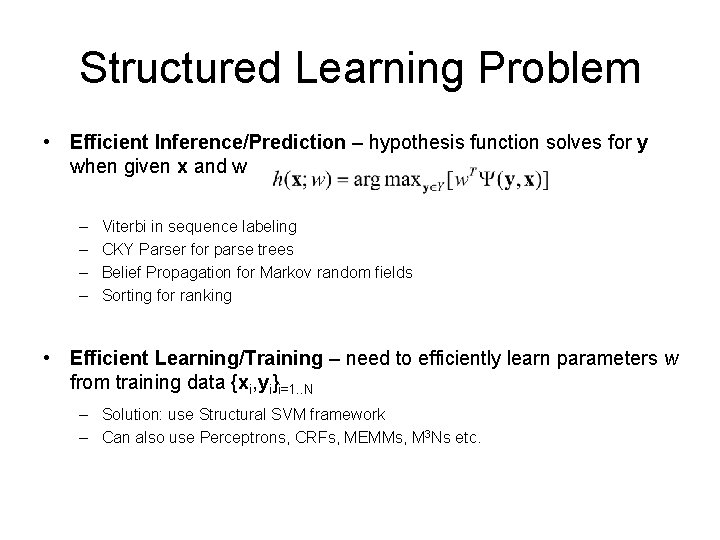
Structured Learning Problem • Efficient Inference/Prediction – hypothesis function solves for y when given x and w – – Viterbi in sequence labeling CKY Parser for parse trees Belief Propagation for Markov random fields Sorting for ranking • Efficient Learning/Training – need to efficiently learn parameters w from training data {xi, yi}i=1. . N – Solution: use Structural SVM framework – Can also use Perceptrons, CRFs, MEMMs, M 3 Ns etc.
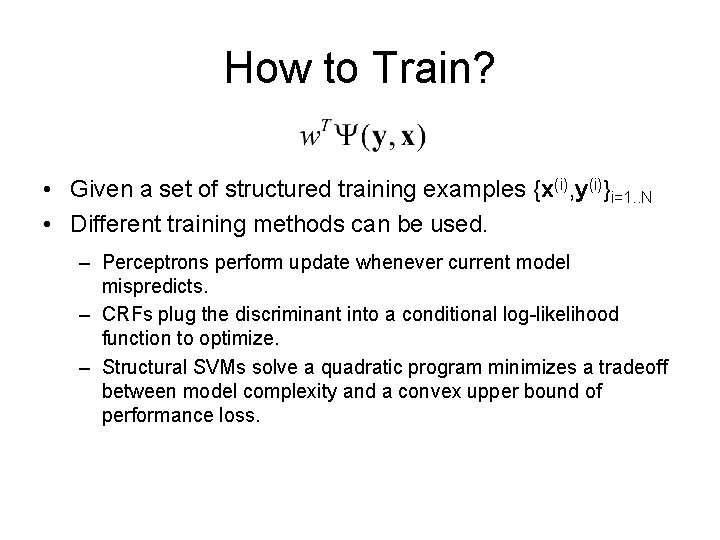
How to Train? • Given a set of structured training examples {x(i), y(i)}i=1. . N • Different training methods can be used. – Perceptrons perform update whenever current model mispredicts. – CRFs plug the discriminant into a conditional log-likelihood function to optimize. – Structural SVMs solve a quadratic program minimizes a tradeoff between model complexity and a convex upper bound of performance loss.
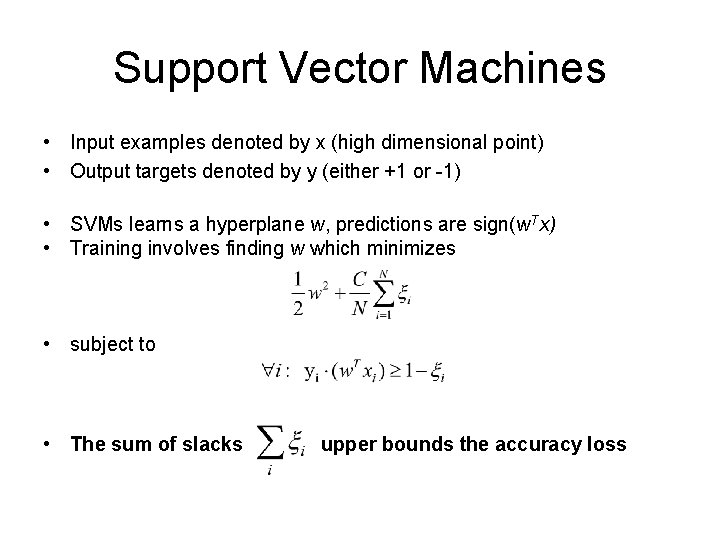
Support Vector Machines • Input examples denoted by x (high dimensional point) • Output targets denoted by y (either +1 or -1) • SVMs learns a hyperplane w, predictions are sign(w. Tx) • Training involves finding w which minimizes • subject to • The sum of slacks upper bounds the accuracy loss
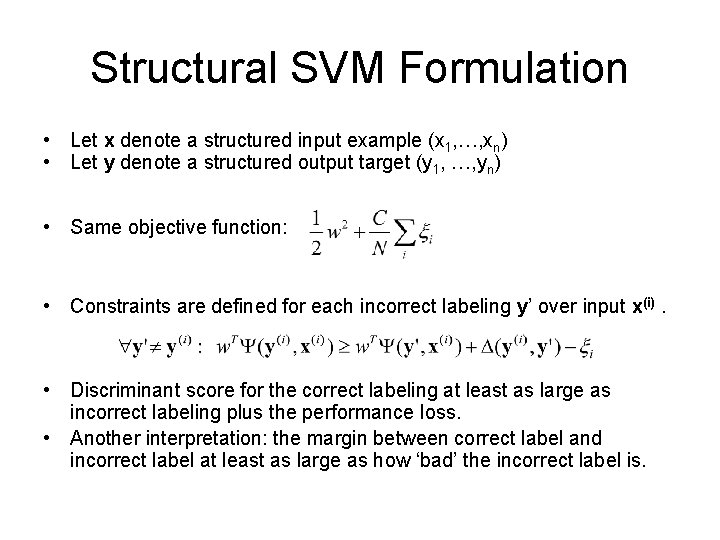
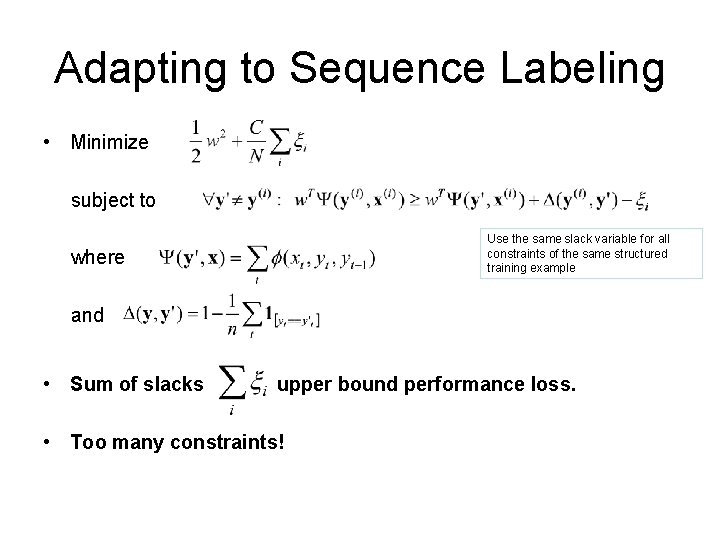
Structural SVM Formulation • Let x denote a structured input example (x 1, …, xn) • Let y denote a structured output target (y 1, …, yn) • Same objective function: • Constraints are defined for each incorrect labeling y’ over input x(i). • Discriminant score for the correct labeling at least as large as incorrect labeling plus the performance loss. • Another interpretation: the margin between correct label and incorrect label at least as large as how ‘bad’ the incorrect label is.
Adapting to Sequence Labeling • Minimize subject to Use the same slack variable for all constraints of the same structured training example where and • Sum of slacks upper bound performance loss. • Too many constraints!
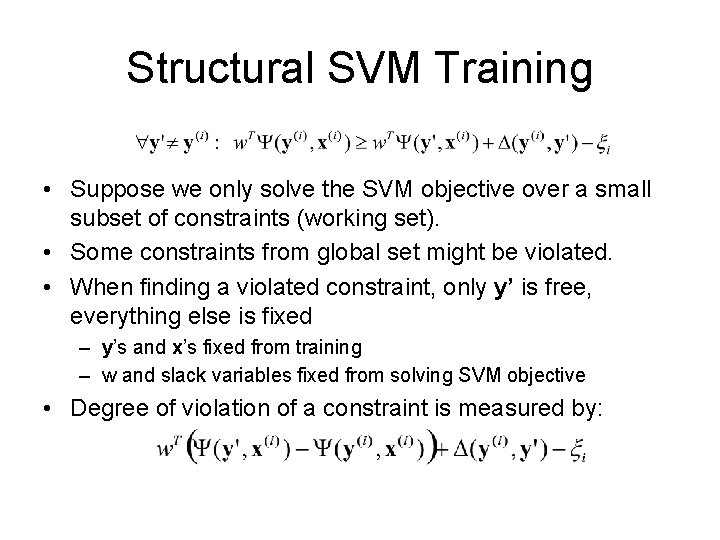
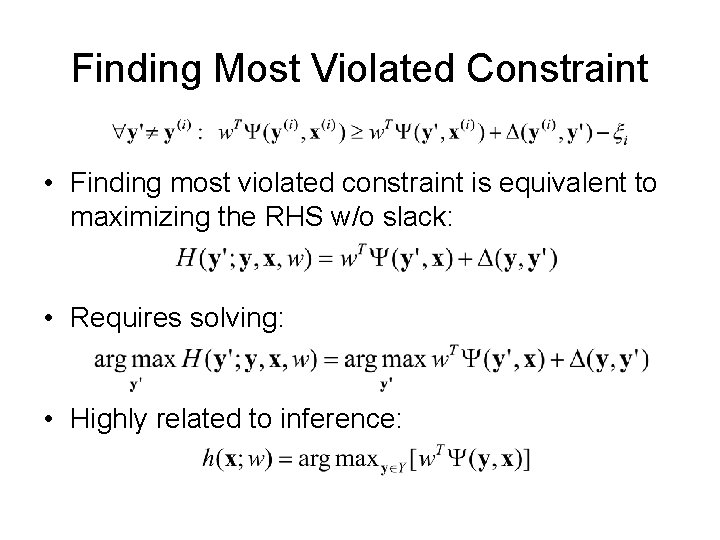
Structural SVM Training • Suppose we only solve the SVM objective over a small subset of constraints (working set). • Some constraints from global set might be violated. • When finding a violated constraint, only y’ is free, everything else is fixed – y’s and x’s fixed from training – w and slack variables fixed from solving SVM objective • Degree of violation of a constraint is measured by:
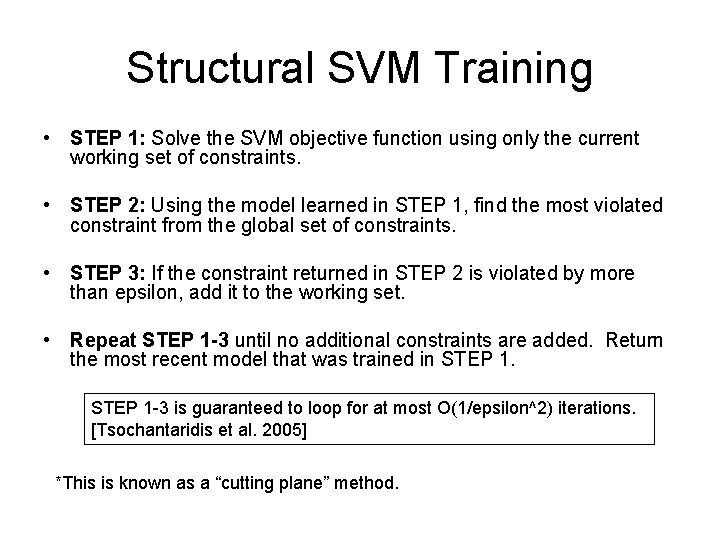
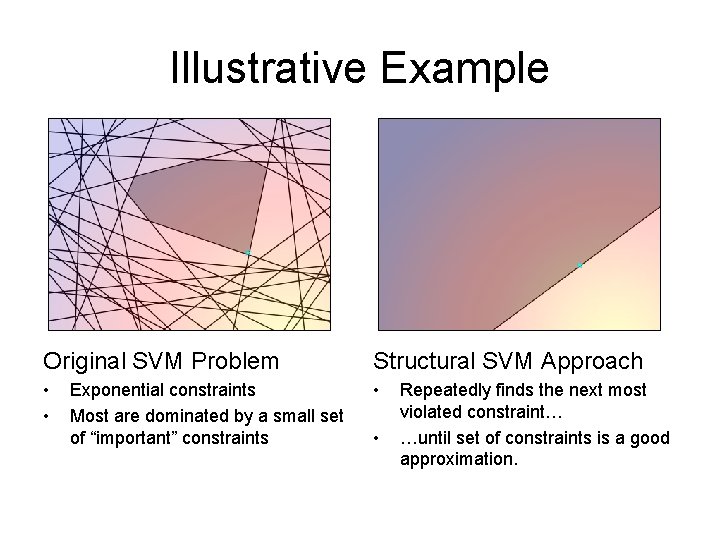
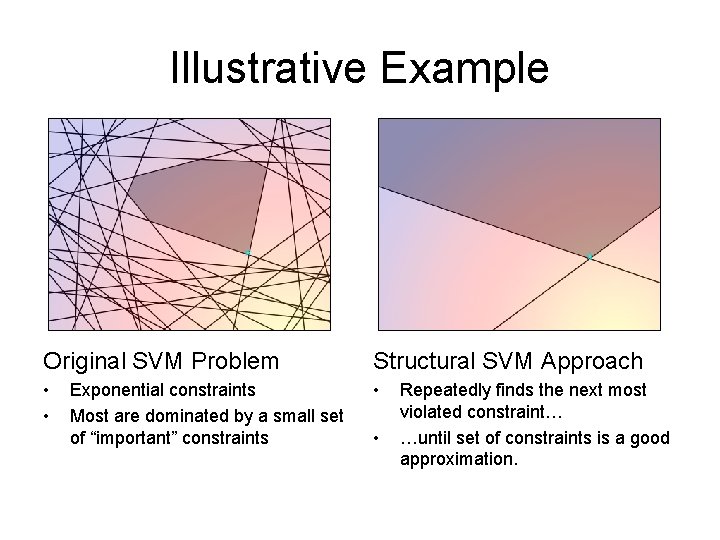
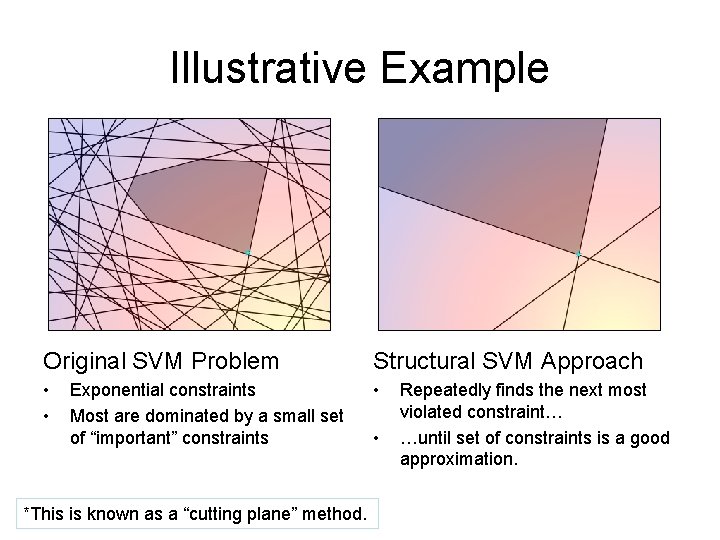
Structural SVM Training • STEP 1: Solve the SVM objective function using only the current working set of constraints. • STEP 2: Using the model learned in STEP 1, find the most violated constraint from the global set of constraints. • STEP 3: If the constraint returned in STEP 2 is violated by more than epsilon, add it to the working set. • Repeat STEP 1 -3 until no additional constraints are added. Return the most recent model that was trained in STEP 1 -3 is guaranteed to loop for at most O(1/epsilon^2) iterations. [Tsochantaridis et al. 2005] *This is known as a “cutting plane” method.
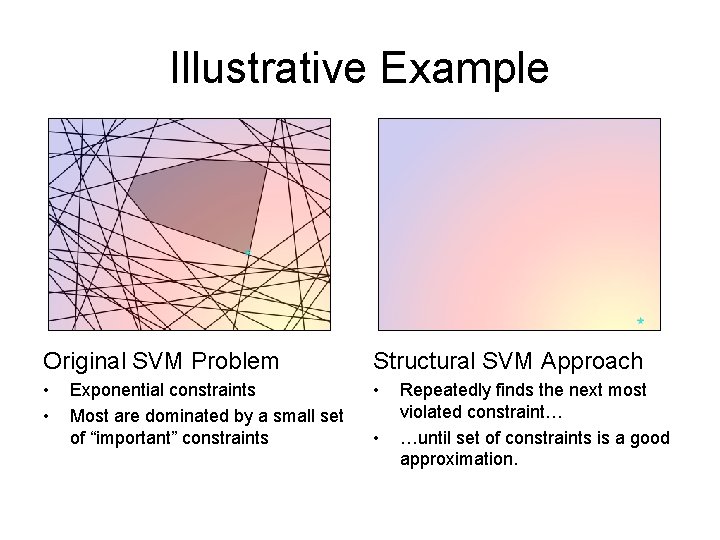
Illustrative Example Original SVM Problem Structural SVM Approach • • • Exponential constraints Most are dominated by a small set of “important” constraints • Repeatedly finds the next most violated constraint… …until set of constraints is a good approximation.
Illustrative Example Original SVM Problem Structural SVM Approach • • • Exponential constraints Most are dominated by a small set of “important” constraints • Repeatedly finds the next most violated constraint… …until set of constraints is a good approximation.
Illustrative Example Original SVM Problem Structural SVM Approach • • • Exponential constraints Most are dominated by a small set of “important” constraints • Repeatedly finds the next most violated constraint… …until set of constraints is a good approximation.
Illustrative Example Original SVM Problem Structural SVM Approach • • • Exponential constraints Most are dominated by a small set of “important” constraints *This is known as a “cutting plane” method. • Repeatedly finds the next most violated constraint… …until set of constraints is a good approximation.
Finding Most Violated Constraint • Structural SVM is an oracle framework. • Requires subroutine to find the most violated constraint. – Dependent on formulation of loss function and joint feature representation. • Exponential number of constraints! • Can usually expect efficient solution when inference has efficient algorithm.
Finding Most Violated Constraint • Finding most violated constraint is equivalent to maximizing the RHS w/o slack: • Requires solving: • Highly related to inference:
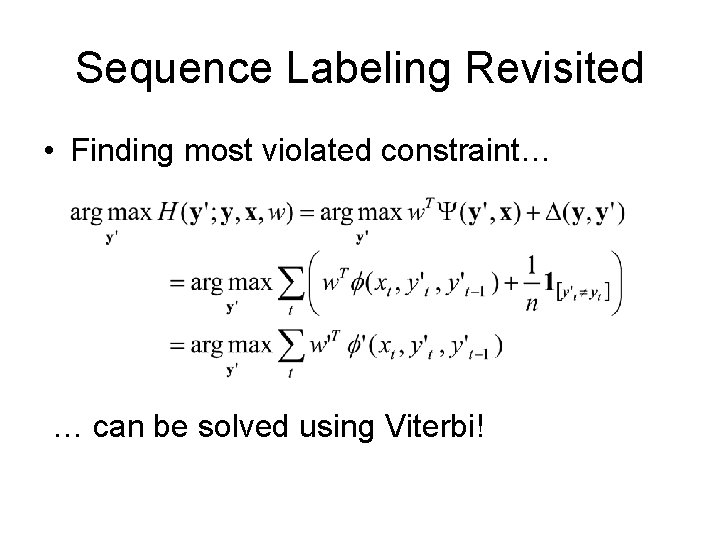
Sequence Labeling Revisited • Finding most violated constraint… … can be solved using Viterbi!
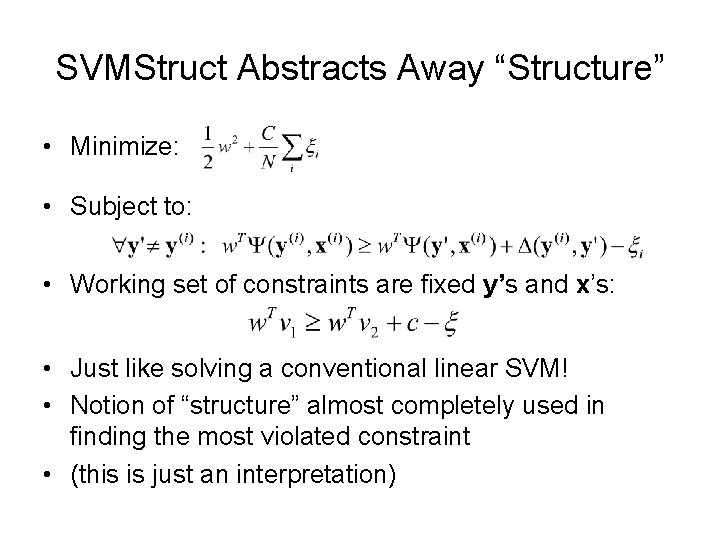
SVMStruct Abstracts Away “Structure” • Minimize: • Subject to: • Working set of constraints are fixed y’s and x’s: • Just like solving a conventional linear SVM! • Notion of “structure” almost completely used in finding the most violated constraint • (this is just an interpretation)