
An Introduction to Statistics Introduction to Statistics I
![Variability: Standard Deviation n n let X = [3, 4, 5 , 6, 7]](https://slidetodoc.com/presentation_image_h2/80a0d093f03b97cec6d325399d4f48ef/image-54.jpg "Variability: Standard Deviation n n let X = [3, 4, 5 , 6, 7]")
- Slides: 54
An Introduction to Statistics
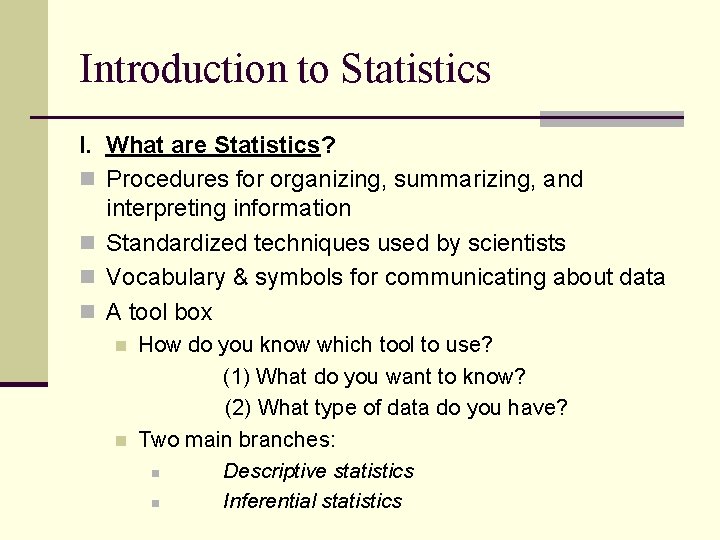
Introduction to Statistics I. What are Statistics? n Procedures for organizing, summarizing, and interpreting information n Standardized techniques used by scientists n Vocabulary & symbols for communicating about data n A tool box n n How do you know which tool to use? (1) What do you want to know? (2) What type of data do you have? Two main branches: n Descriptive statistics n Inferential statistics
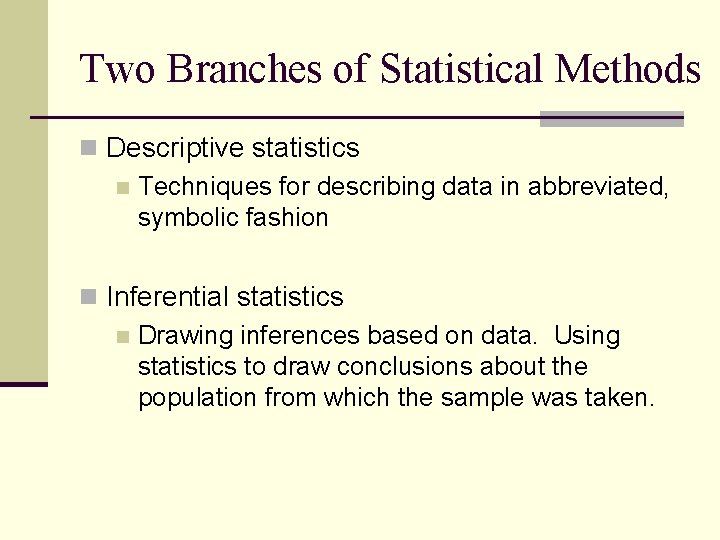
Two Branches of Statistical Methods n Descriptive statistics n Techniques for describing data in abbreviated, symbolic fashion n Inferential statistics n Drawing inferences based on data. Using statistics to draw conclusions about the population from which the sample was taken.
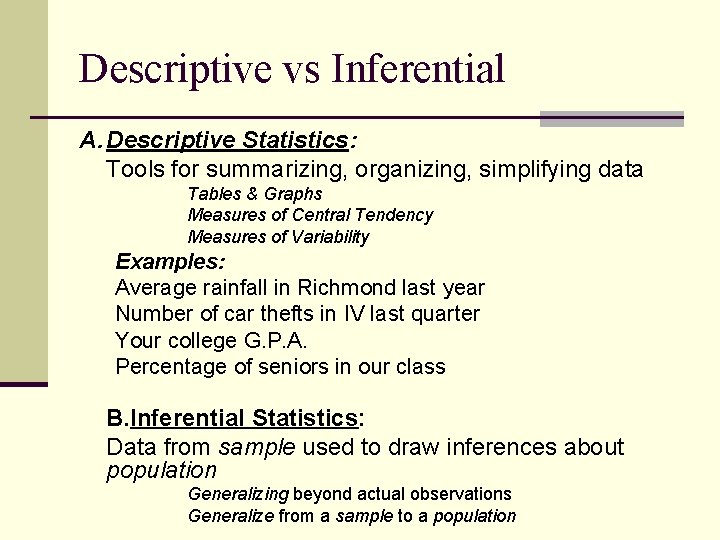
Descriptive vs Inferential A. Descriptive Statistics: Tools for summarizing, organizing, simplifying data Tables & Graphs Measures of Central Tendency Measures of Variability Examples: Average rainfall in Richmond last year Number of car thefts in IV last quarter Your college G. P. A. Percentage of seniors in our class B. Inferential Statistics: Data from sample used to draw inferences about population Generalizing beyond actual observations Generalize from a sample to a population
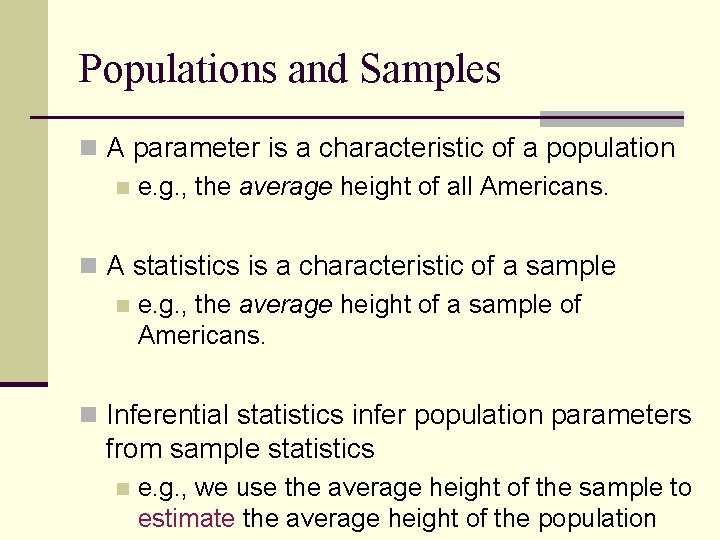
Populations and Samples n A parameter is a characteristic of a population n e. g. , the average height of all Americans. n A statistics is a characteristic of a sample n e. g. , the average height of a sample of Americans. n Inferential statistics infer population parameters from sample statistics n e. g. , we use the average height of the sample to estimate the average height of the population
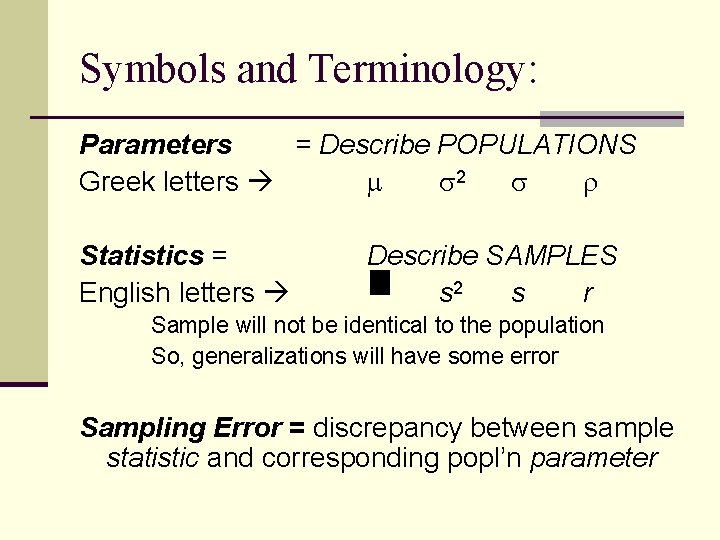
Symbols and Terminology: Parameters = Describe POPULATIONS Greek letters 2 Statistics = English letters Describe SAMPLES s 2 s r Sample will not be identical to the population So, generalizations will have some error Sampling Error = discrepancy between sample statistic and corresponding popl’n parameter
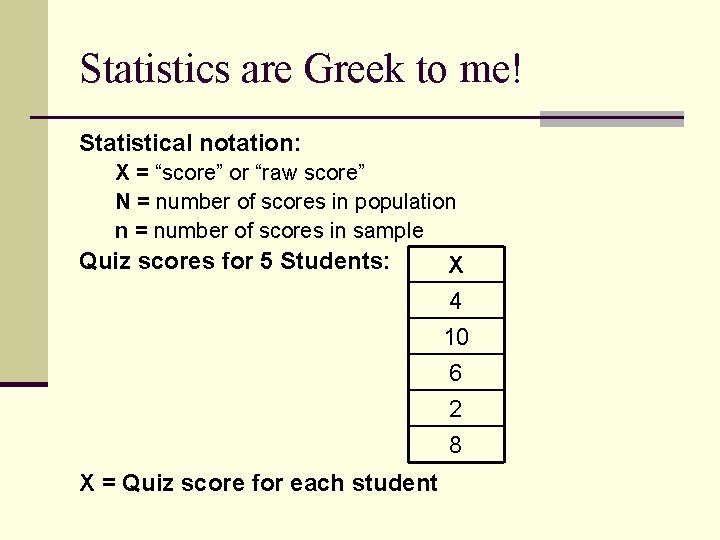
Statistics are Greek to me! Statistical notation: X = “score” or “raw score” N = number of scores in population n = number of scores in sample Quiz scores for 5 Students: X 4 10 6 2 8 X = Quiz score for each student
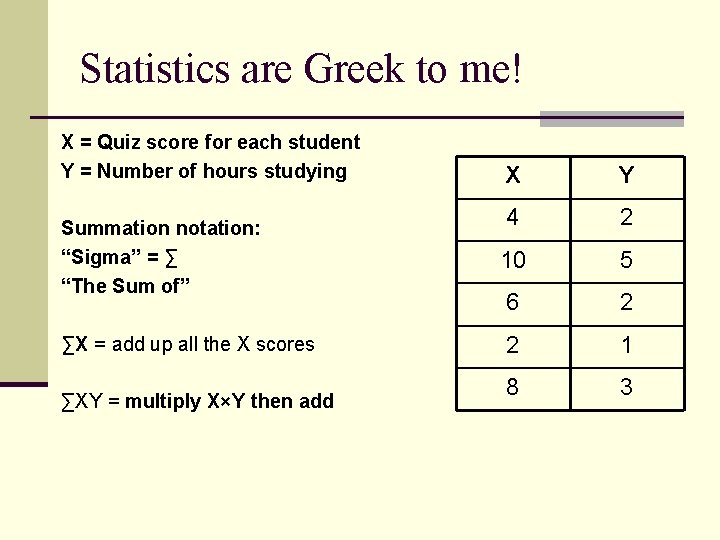
Statistics are Greek to me! X = Quiz score for each student Y = Number of hours studying Summation notation: “Sigma” = ∑ “The Sum of” ∑X = add up all the X scores ∑XY = multiply X×Y then add X Y 4 2 10 5 6 2 2 1 8 3
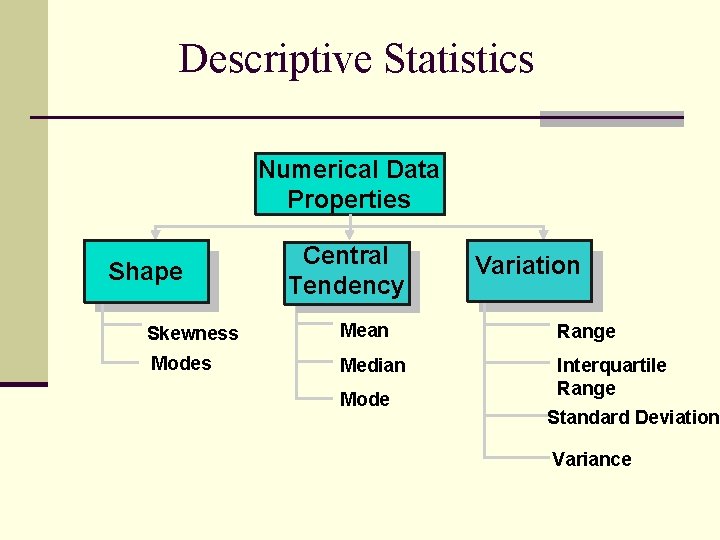
Descriptive Statistics Numerical Data Properties Shape Central Tendency Skewness Mean Modes Median Mode Variation Range Interquartile Range Standard Deviation Variance
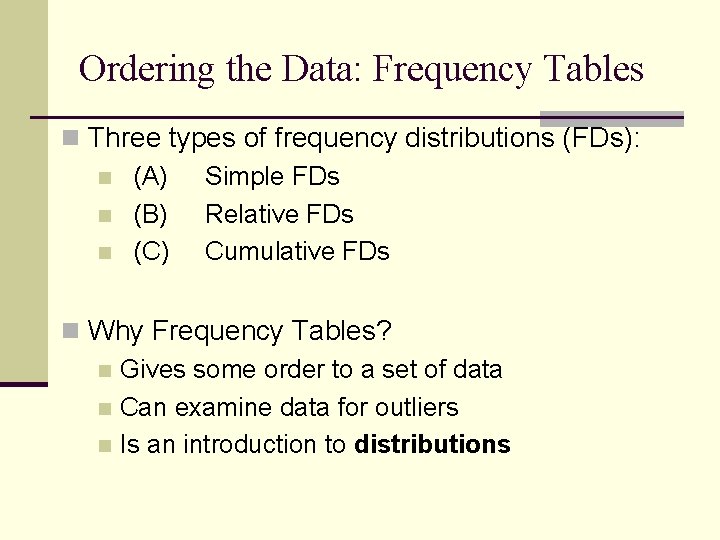
Ordering the Data: Frequency Tables n Three types of frequency distributions (FDs): n (A) Simple FDs n (B) Relative FDs n (C) Cumulative FDs n Why Frequency Tables? n Gives some order to a set of data n Can examine data for outliers n Is an introduction to distributions
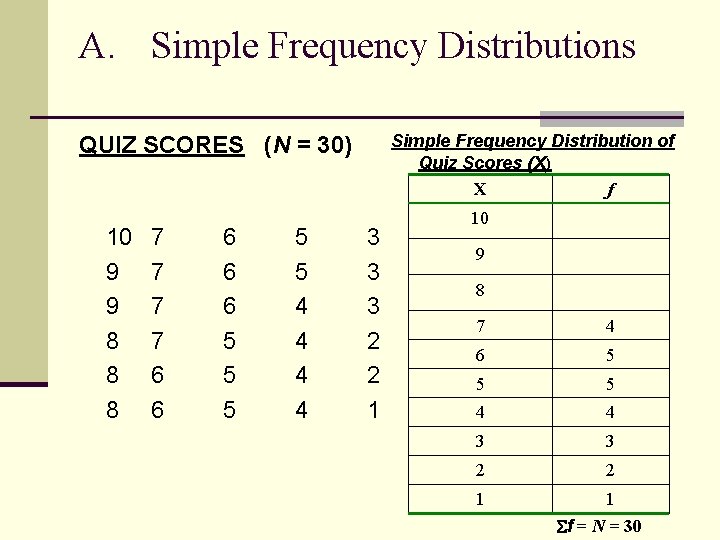
A. Simple Frequency Distributions Simple Frequency Distribution of Quiz Scores (X) X f QUIZ SCORES (N = 30) 10 9 9 8 8 8 7 7 6 6 6 5 5 5 4 4 3 3 3 2 2 1 10 9 8 7 4 6 5 5 5 4 4 3 3 2 2 1 1 f = N = 30
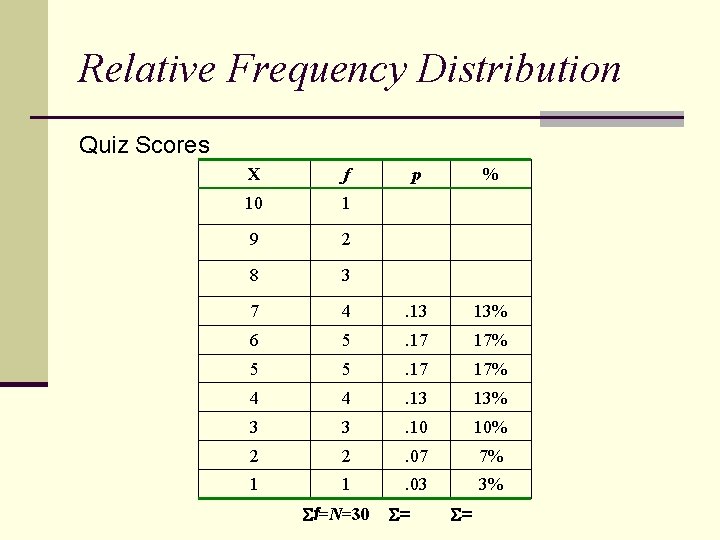
Relative Frequency Distribution Quiz Scores X f p % 10 1 9 2 8 3 7 4 . 13 13% 6 5 . 17 17% 5 5 . 17 17% 4 4 . 13 13% 3 3 . 10 10% 2 2 . 07 7% 1 1 . 03 3% f=N=30 = =
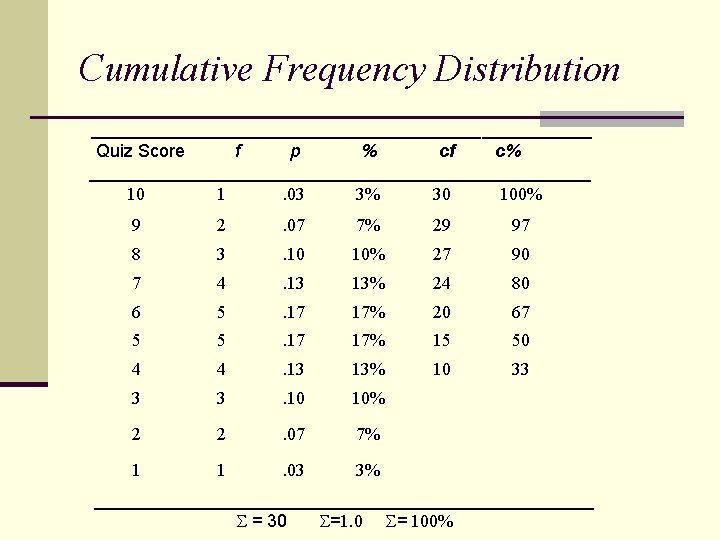
Cumulative Frequency Distribution _________________________ Quiz Score f p % cf c% _________________________ 10 1. 03 3% 30 100% 9 2 . 07 7% 29 97 8 3 . 10 10% 27 90 7 4 . 13 13% 24 80 6 5 . 17 17% 20 67 5 5 . 17 17% 15 50 4 4 . 13 13% 10 33 3 3 . 10 10% 2 2 . 07 7% 1 1 . 03 3% _________________________ = 30 =1. 0 = 100%
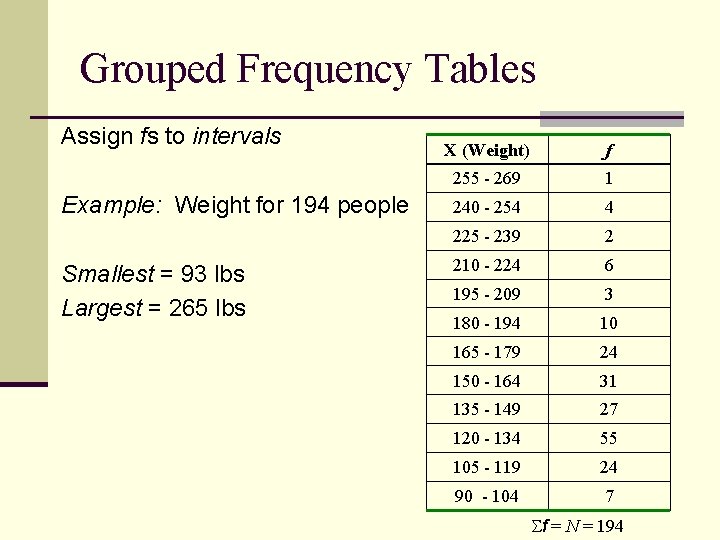
Grouped Frequency Tables Assign fs to intervals Example: Weight for 194 people Smallest = 93 lbs Largest = 265 lbs X (Weight) f 255 - 269 1 240 - 254 4 225 - 239 2 210 - 224 6 195 - 209 3 180 - 194 10 165 - 179 24 150 - 164 31 135 - 149 27 120 - 134 55 105 - 119 24 90 - 104 7 f = N = 194
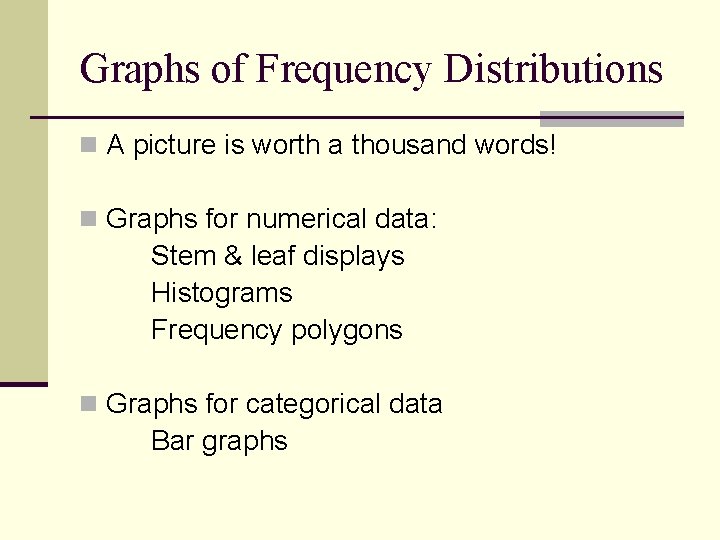
Graphs of Frequency Distributions n A picture is worth a thousand words! n Graphs for numerical data: Stem & leaf displays Histograms Frequency polygons n Graphs for categorical data Bar graphs
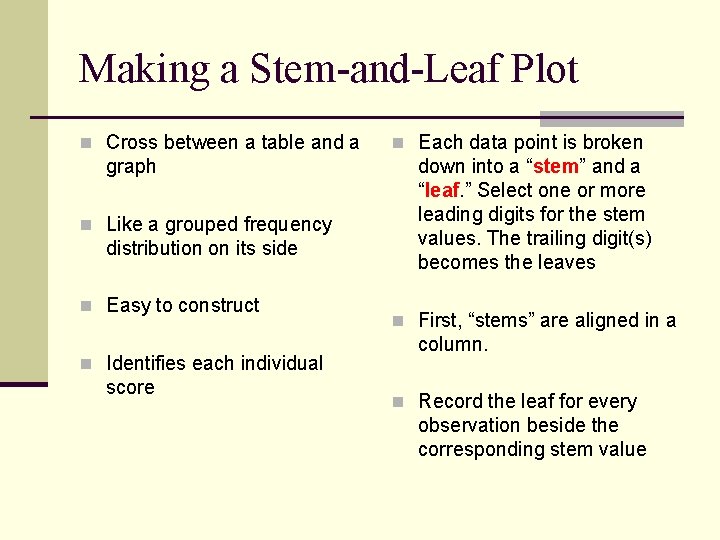
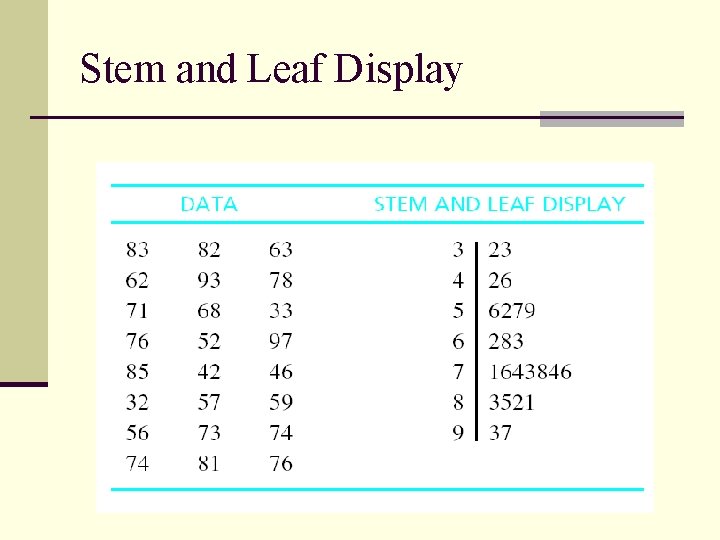
Making a Stem-and-Leaf Plot n Cross between a table and a graph n Like a grouped frequency distribution on its side n Easy to construct n Identifies each individual score n Each data point is broken down into a “stem” and a “leaf. ” Select one or more leading digits for the stem values. The trailing digit(s) becomes the leaves n First, “stems” are aligned in a column. n Record the leaf for every observation beside the corresponding stem value
Stem and Leaf Display
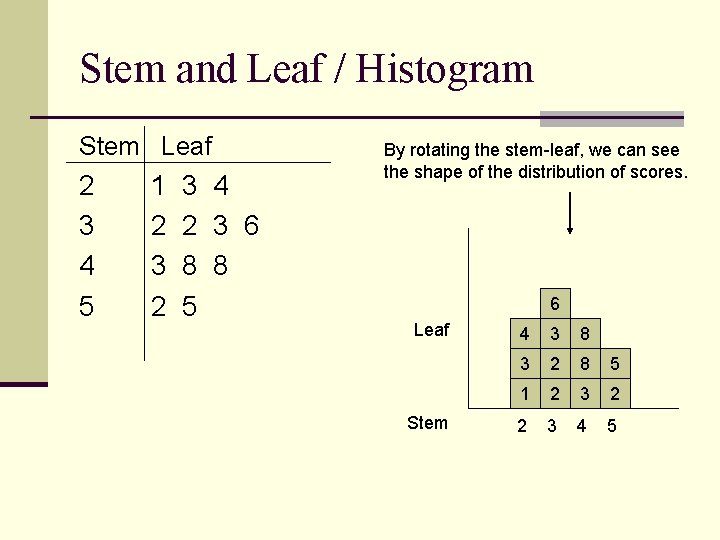
Stem and Leaf / Histogram Stem Leaf 2 3 4 5 1 2 3 4 2 3 6 8 8 5 By rotating the stem-leaf, we can see the shape of the distribution of scores. 6 Leaf Stem 4 3 8 3 2 8 5 1 2 3 2 2 3 4 5
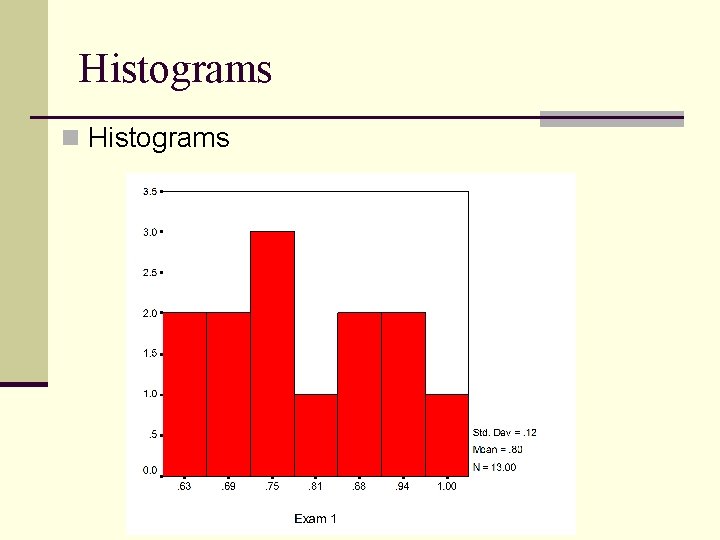
Histograms n Histograms
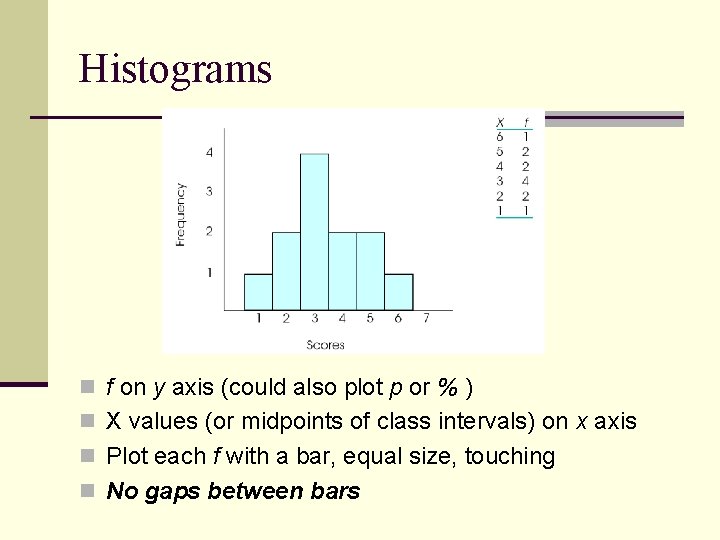
Histograms n f on y axis (could also plot p or % ) n X values (or midpoints of class intervals) on x axis n Plot each f with a bar, equal size, touching n No gaps between bars
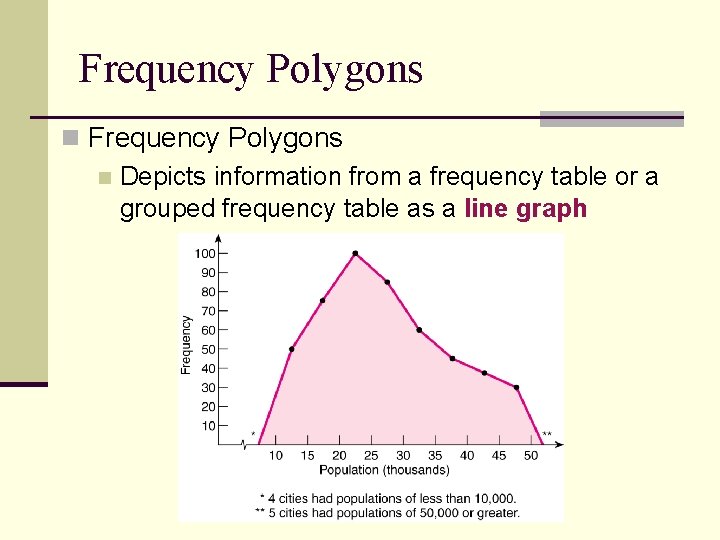
Frequency Polygons n Depicts information from a frequency table or a grouped frequency table as a line graph
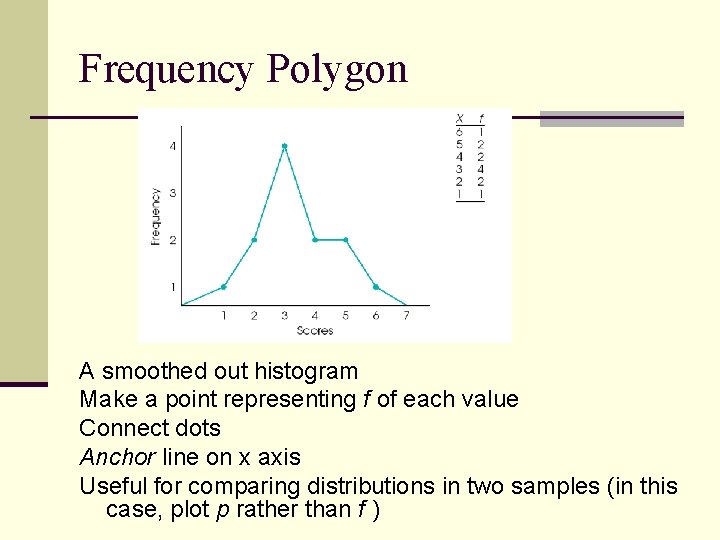
Frequency Polygon A smoothed out histogram Make a point representing f of each value Connect dots Anchor line on x axis Useful for comparing distributions in two samples (in this case, plot p rather than f )
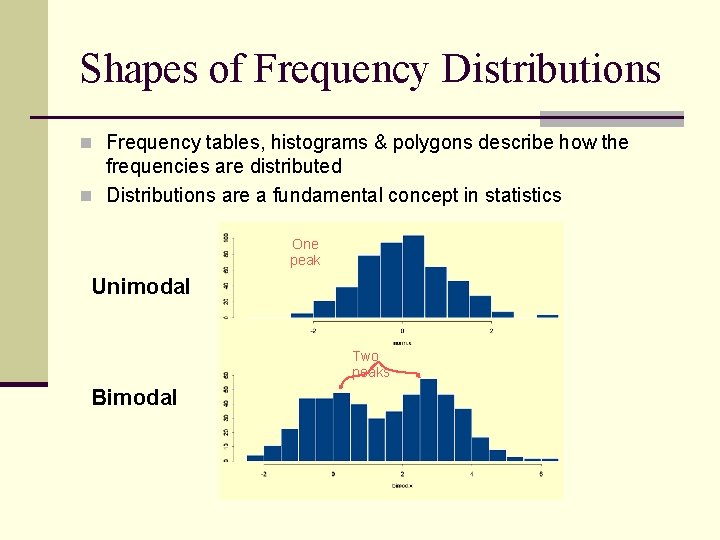
Shapes of Frequency Distributions n Frequency tables, histograms & polygons describe how the frequencies are distributed n Distributions are a fundamental concept in statistics One peak Unimodal Two peaks Bimodal
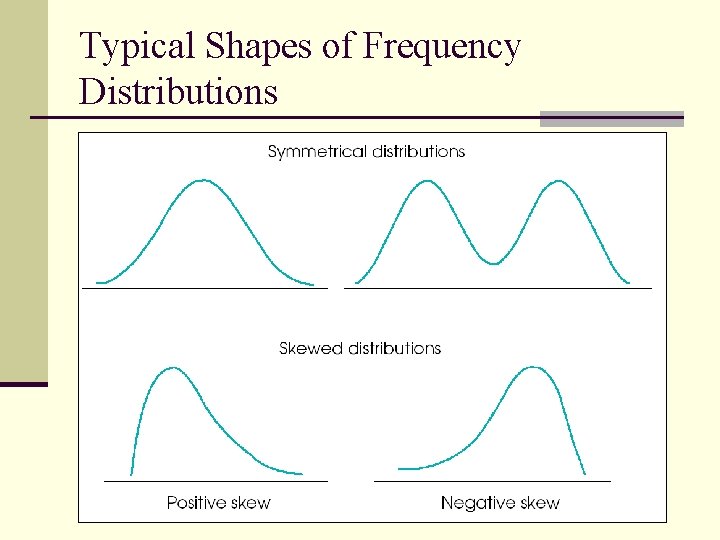
Typical Shapes of Frequency Distributions
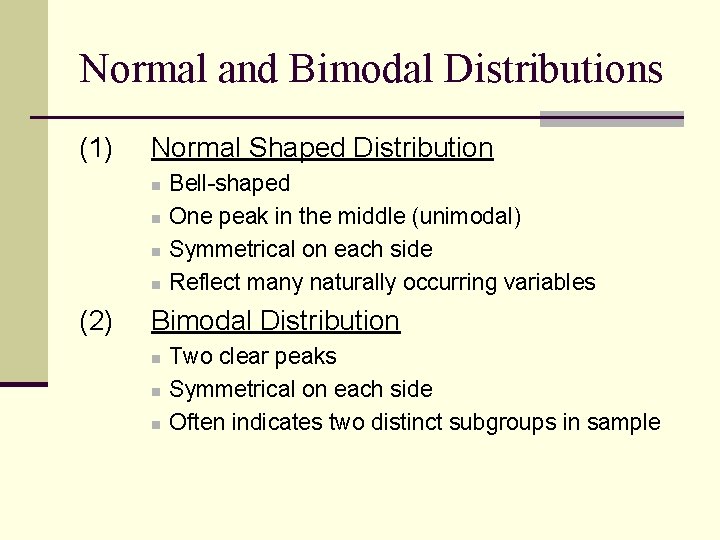
Normal and Bimodal Distributions (1) Normal Shaped Distribution n n (2) Bell-shaped One peak in the middle (unimodal) Symmetrical on each side Reflect many naturally occurring variables Bimodal Distribution n Two clear peaks Symmetrical on each side Often indicates two distinct subgroups in sample
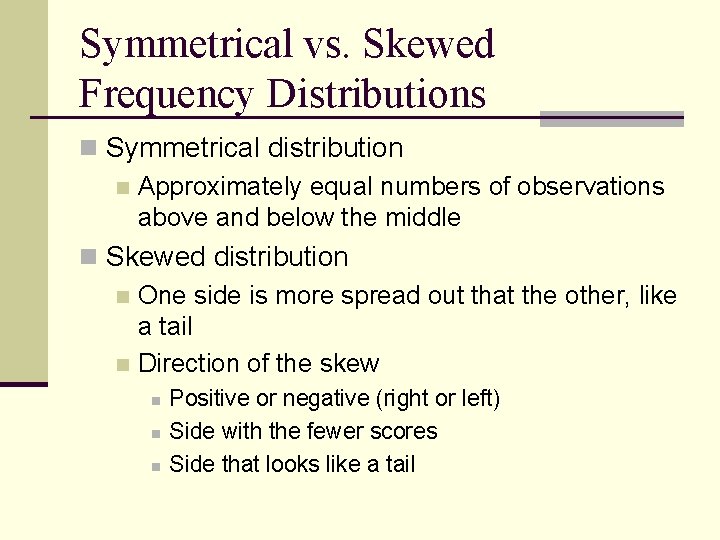
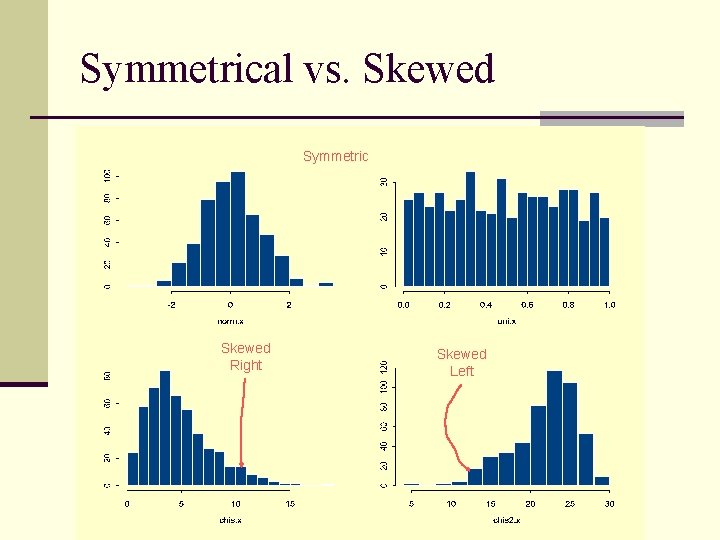
Symmetrical vs. Skewed Frequency Distributions n Symmetrical distribution n Approximately equal numbers of observations above and below the middle n Skewed distribution n One side is more spread out that the other, like a tail n Direction of the skew n n n Positive or negative (right or left) Side with the fewer scores Side that looks like a tail
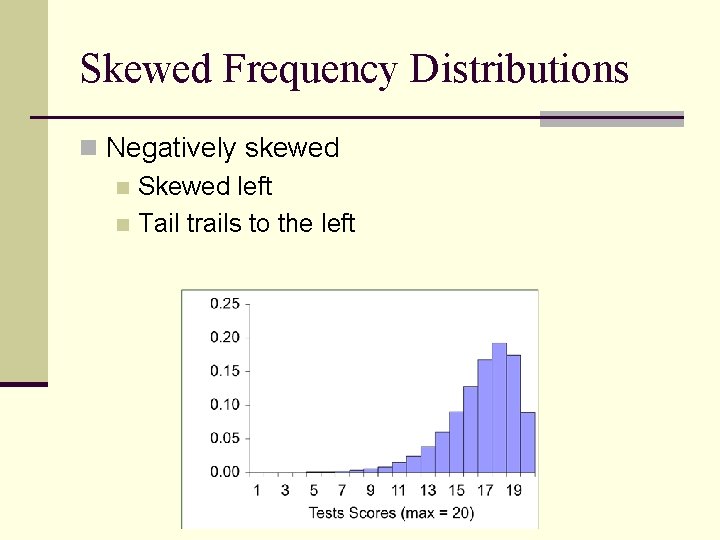
Symmetrical vs. Skewed Symmetric Skewed Right Skewed Left
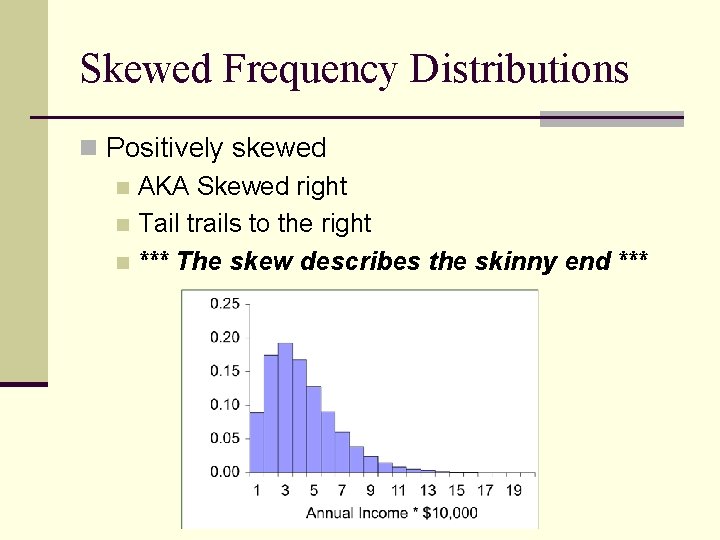
Skewed Frequency Distributions n Positively skewed n AKA Skewed right n Tail trails to the right n *** The skew describes the skinny end ***
Skewed Frequency Distributions n Negatively skewed n Skewed left n Tail trails to the left
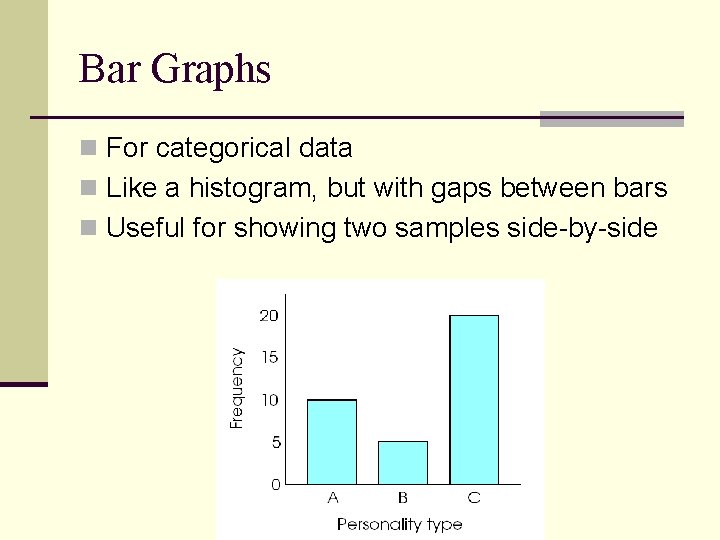
Bar Graphs n For categorical data n Like a histogram, but with gaps between bars n Useful for showing two samples side-by-side
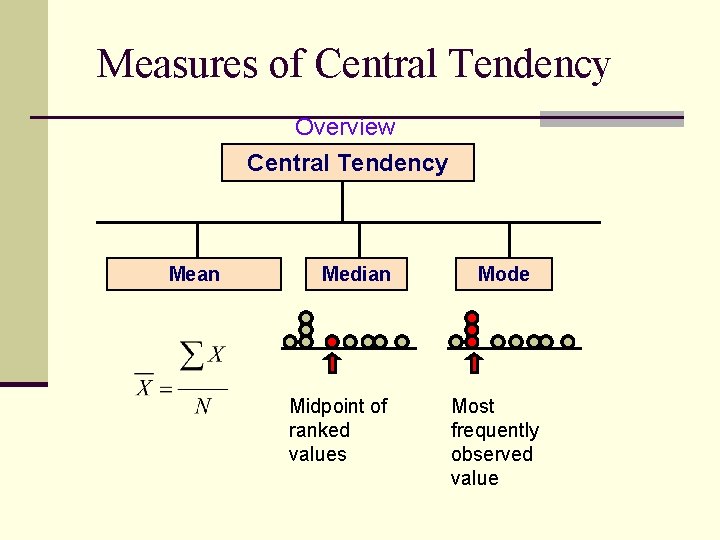
Central Tendency n Give information concerning the average or typical score of a number of scores mean n median n mode n
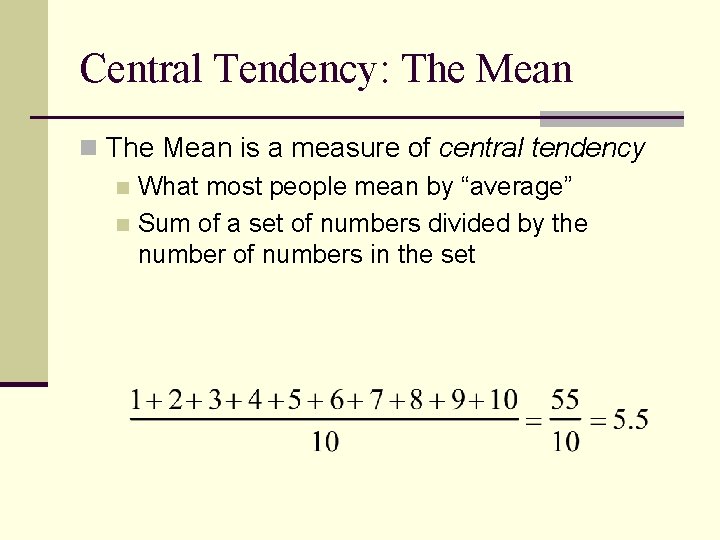
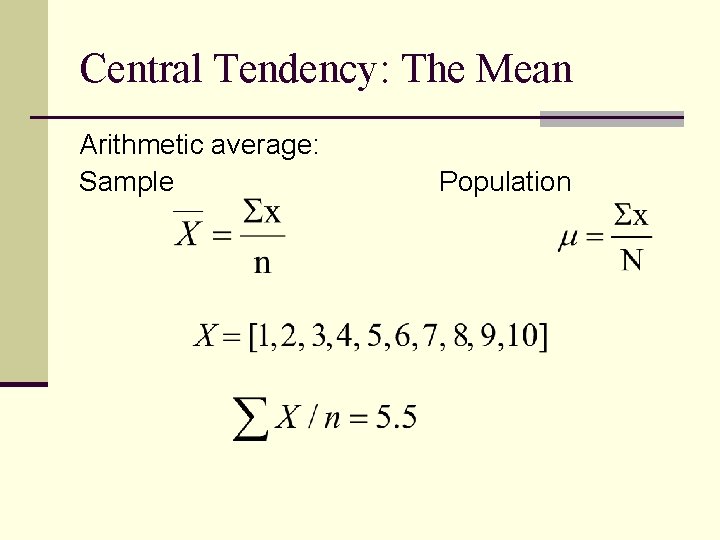
Central Tendency: The Mean n The Mean is a measure of central tendency n What most people mean by “average” n Sum of a set of numbers divided by the number of numbers in the set
Central Tendency: The Mean Arithmetic average: Sample Population
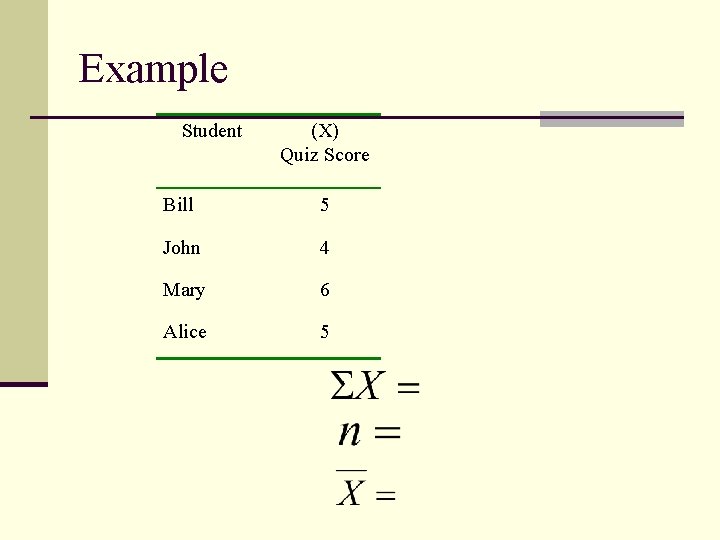
Example Student (X) Quiz Score Bill 5 John 4 Mary 6 Alice 5
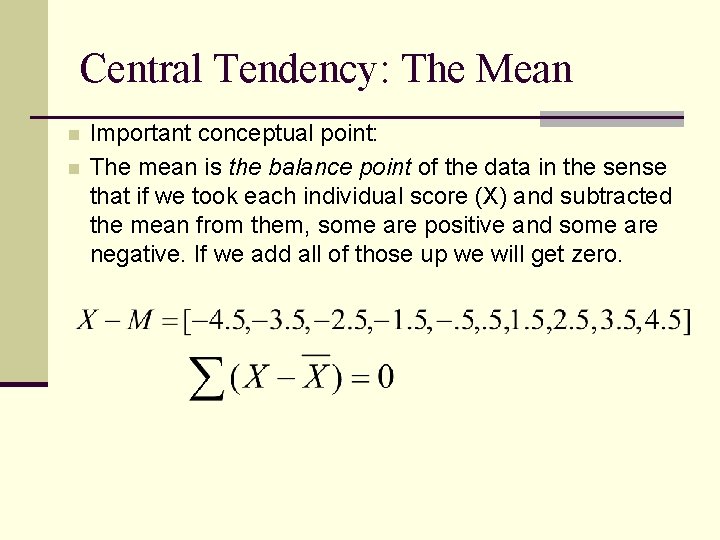
Central Tendency: The Mean n n Important conceptual point: The mean is the balance point of the data in the sense that if we took each individual score (X) and subtracted the mean from them, some are positive and some are negative. If we add all of those up we will get zero.
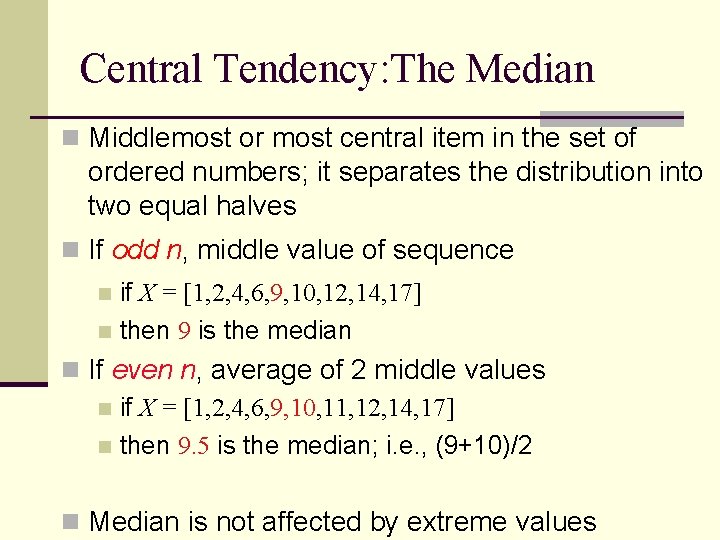
Central Tendency: The Median n Middlemost or most central item in the set of ordered numbers; it separates the distribution into two equal halves n If odd n, middle value of sequence if X = [1, 2, 4, 6, 9, 10, 12, 14, 17] n then 9 is the median n n If even n, average of 2 middle values n if X = [1, 2, 4, 6, 9, 10, 11, 12, 14, 17] n then 9. 5 is the median; i. e. , (9+10)/2 n Median is not affected by extreme values
Median vs. Mean n Midpoint vs. balance point n Md based on middle location/# of scores n based on deviations/distance/balance n Change a score, Md may not change n Change a score, will always change
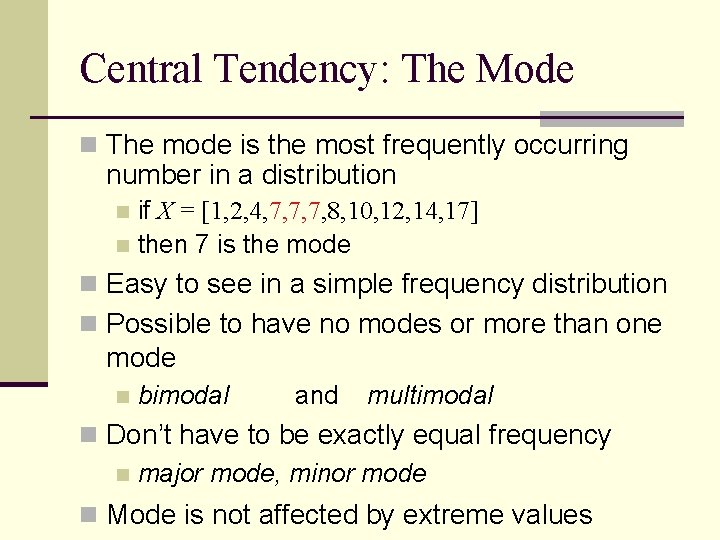
Central Tendency: The Mode n The mode is the most frequently occurring number in a distribution if X = [1, 2, 4, 7, 7, 7, 8, 10, 12, 14, 17] n then 7 is the mode n n Easy to see in a simple frequency distribution n Possible to have no modes or more than one mode n bimodal and multimodal n Don’t have to be exactly equal frequency n major mode, minor mode n Mode is not affected by extreme values
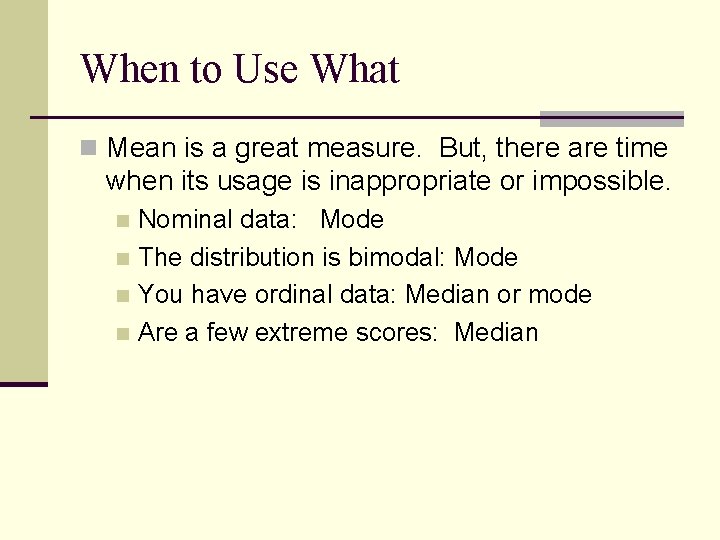
When to Use What n Mean is a great measure. But, there are time when its usage is inappropriate or impossible. Nominal data: Mode n The distribution is bimodal: Mode n You have ordinal data: Median or mode n Are a few extreme scores: Median n
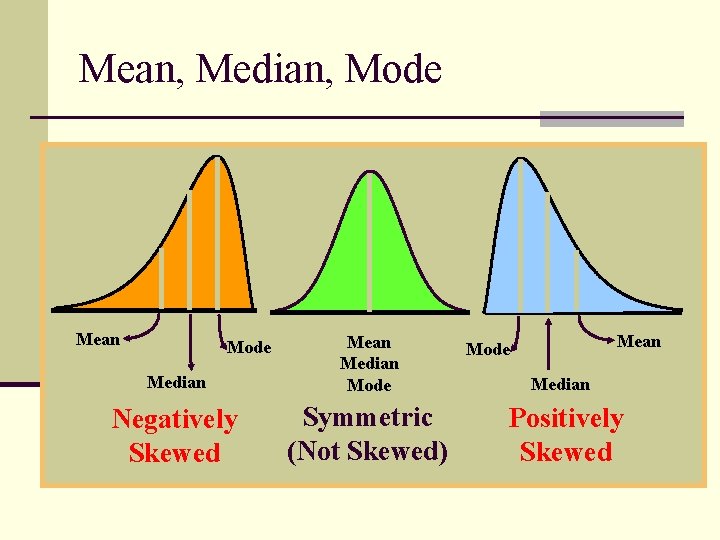
Mean, Median, Mode Mean Median Mode Negatively Skewed Symmetric (Not Skewed) Mode Mean Mode Median Positively Skewed
Measures of Central Tendency Overview Central Tendency Mean Median Midpoint of ranked values Mode Most frequently observed value
Class Activity n Complete the questionnaires n As a group, analyze the classes data from the three questions you are assigned compute the appropriate measures of central tendency for each of the questions n Create a frequency distribution graph for the data from each question n
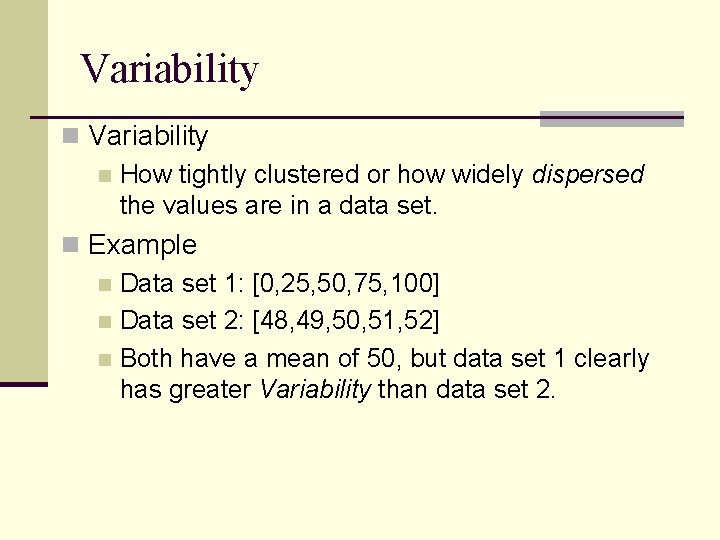
Variability n How tightly clustered or how widely dispersed the values are in a data set. n Example n Data set 1: [0, 25, 50, 75, 100] n Data set 2: [48, 49, 50, 51, 52] n Both have a mean of 50, but data set 1 clearly has greater Variability than data set 2.
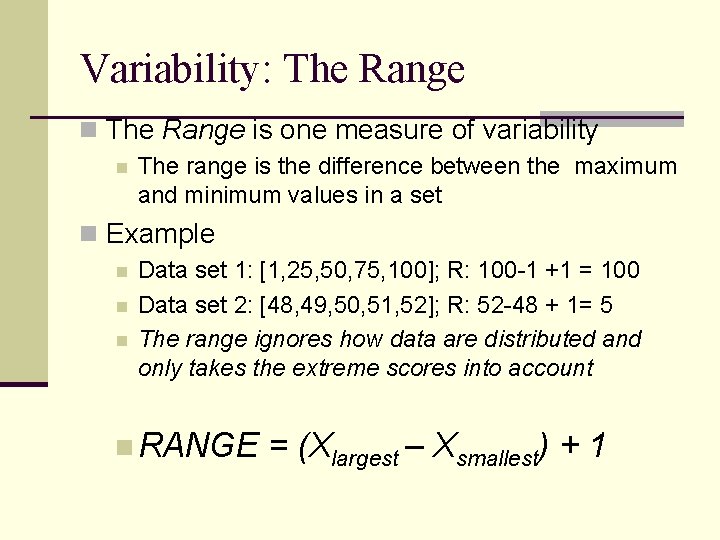
Variability: The Range n The Range is one measure of variability n The range is the difference between the maximum and minimum values in a set n Example n n n Data set 1: [1, 25, 50, 75, 100]; R: 100 -1 +1 = 100 Data set 2: [48, 49, 50, 51, 52]; R: 52 -48 + 1= 5 The range ignores how data are distributed and only takes the extreme scores into account n RANGE = (Xlargest – Xsmallest) + 1
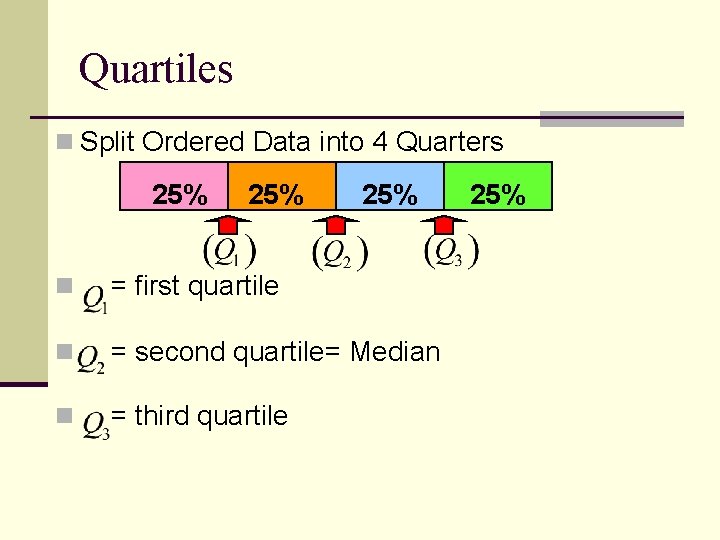
Quartiles n Split Ordered Data into 4 Quarters 25% 25% n = first quartile n = second quartile= Median n = third quartile 25%
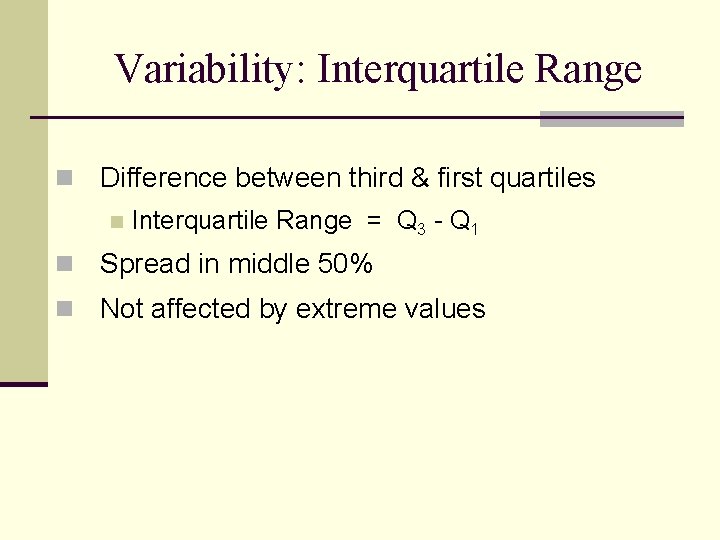
Variability: Interquartile Range n Difference between third & first quartiles n Interquartile Range = Q 3 - Q 1 n Spread in middle 50% n Not affected by extreme values
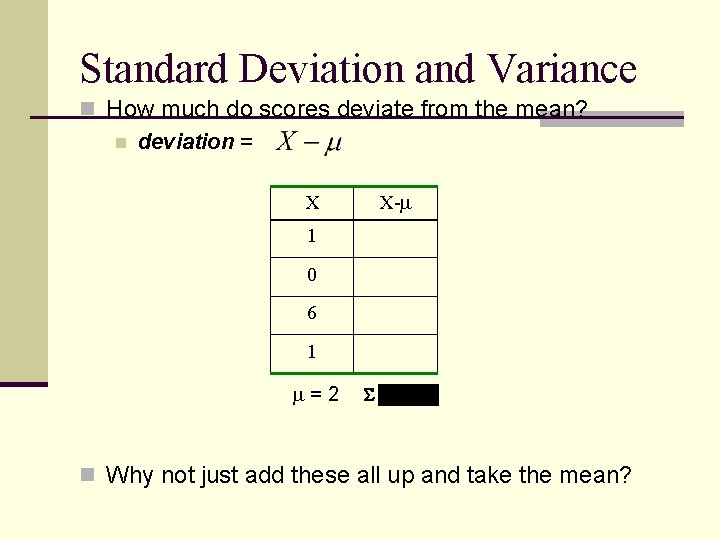
Standard Deviation and Variance n How much do scores deviate from the mean? n deviation = X X- 1 0 6 1 =2 n Why not just add these all up and take the mean?
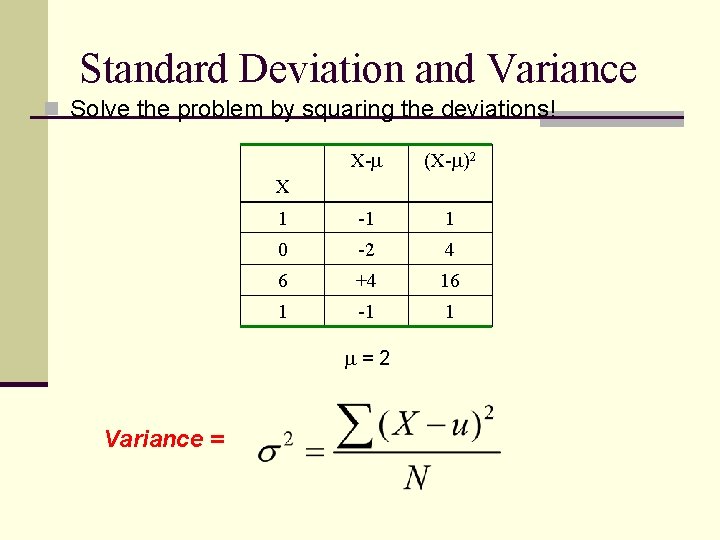
Standard Deviation and Variance n Solve the problem by squaring the deviations! X- (X- )2 1 -1 1 0 -2 4 6 +4 16 1 -1 1 X =2 Variance =
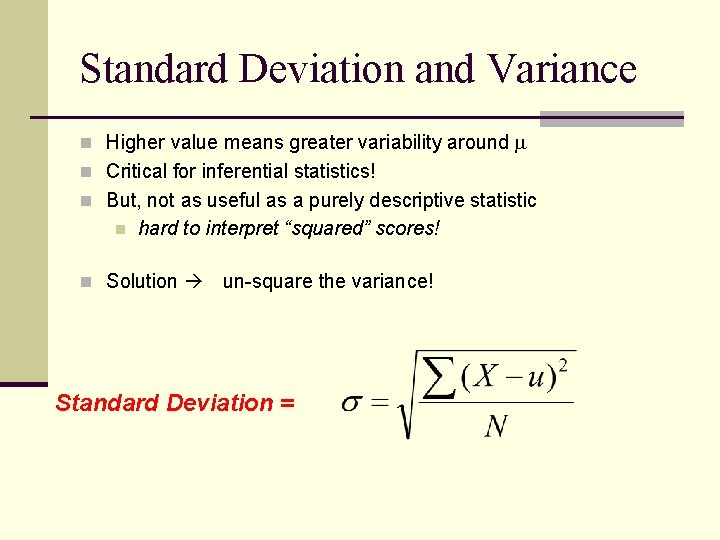
Standard Deviation and Variance n Higher value means greater variability around n Critical for inferential statistics! n But, not as useful as a purely descriptive statistic n hard to interpret “squared” scores! n Solution un-square the variance! Standard Deviation =
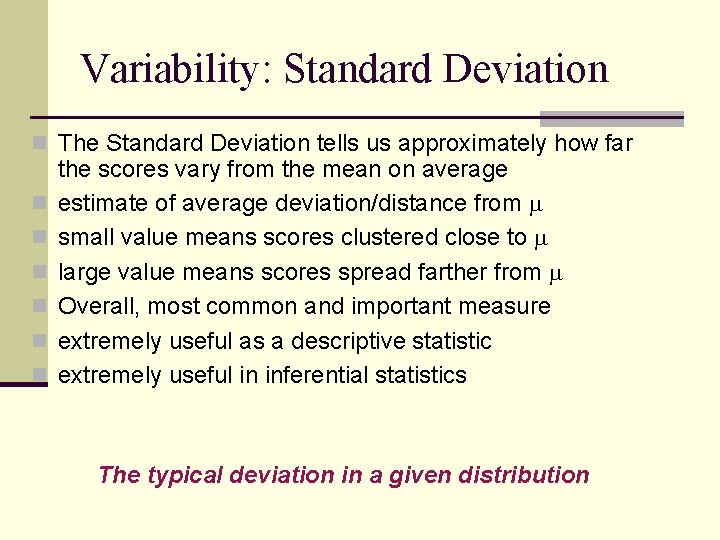
Variability: Standard Deviation n The Standard Deviation tells us approximately how far n n n the scores vary from the mean on average estimate of average deviation/distance from small value means scores clustered close to large value means scores spread farther from Overall, most common and important measure extremely useful as a descriptive statistic extremely useful in inferential statistics The typical deviation in a given distribution
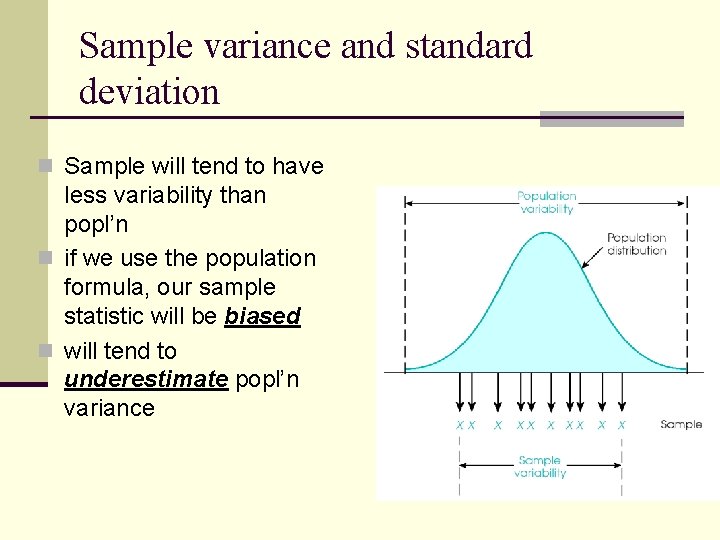
Sample variance and standard deviation n Sample will tend to have less variability than popl’n n if we use the population formula, our sample statistic will be biased n will tend to underestimate popl’n variance
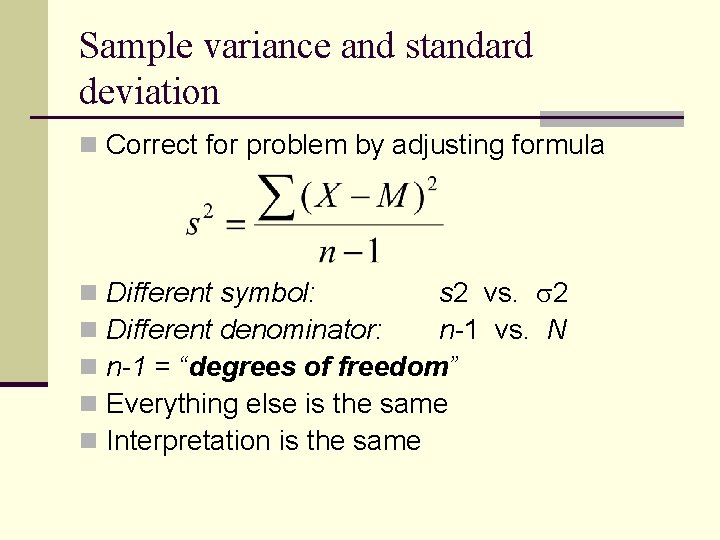
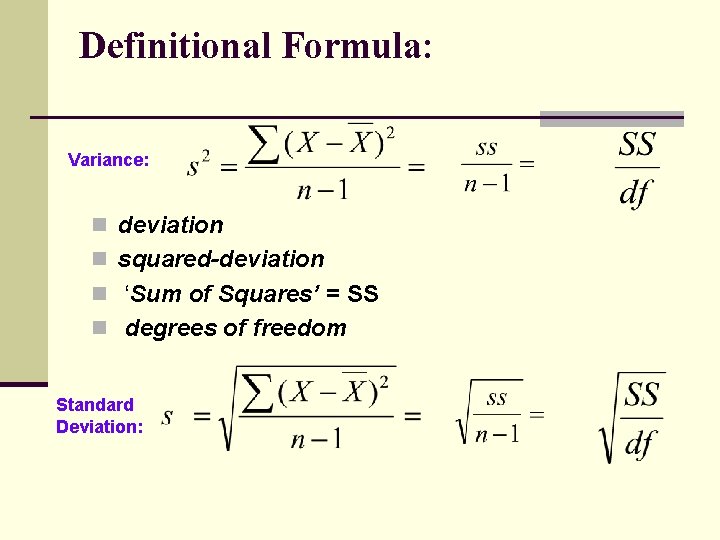
Sample variance and standard deviation n Correct for problem by adjusting formula n n n Different symbol: s 2 vs. 2 Different denominator: n-1 vs. N n-1 = “degrees of freedom” Everything else is the same Interpretation is the same
Definitional Formula: Variance: n deviation n squared-deviation n ‘Sum of Squares’ = SS n degrees of freedom Standard Deviation:
Variability: Standard Deviation n n let X = [3, 4, 5 , 6, 7] X=5 (X - X) = [-2, -1, 0, 1, 2] ñ subtract x from each number in X (X - X)2 = [4, 1, 0, 1, 4] ñ squared deviations from the mean (X - X)2 = 10 ñ sum of squared deviations from the mean (SS) n (X - X)2 /n-1 = 10/5 = 2. 5 ñ average squared deviation from the mean n (X - X)2 /n-1 = 2. 5 = 1. 58 ñ square root of averaged squared deviation