
An Introduction to Snort Richard Bejtlich Tao Security
An Introduction to Snort Richard Bejtlich Tao. Security Houston ISSA Meeting 11 Apr 02
Outline n n n n Introduction to Intrusion Detection What is Snort? Installing Snort Rules Snort in Action Third-Party Enhancements Conclusion
About Me n n n Bejtlich = “bate-lik” Senior engineer for managed network security operations, BATC (2001 -) Former captain at US Air Force Computer Emergency Response Team (1998 -2001) Student of intrusion detection, incident response, and digital forensics www. taosecurity. com
Introduction to Intrusion Detection n Network defense or “protection” model n n n Planning Prevention Detection Response Intrusion detection is the process of discovering, analyzing, and reporting unauthorized or damaging network or computer activities
Introduction to Intrusion Detection n All network and computer activities fall in one of three categories: n n Normal Abnormal but not malicious Malicious Intrusion detection operates in two arenas: n n What a computer says: network traffic What a computer thinks: computer processes
Introduction to Intrusion Detection n n Network traffic is monitored by networkbased intrusion detection systems (NIDS) Computer processes are monitored by hostbased intrusion detection systems (HIDS) So-called “hybrid” systems examine network traffic to or from a host, as well as processes on that host NIDS are easier to deploy and manage, but HIDS may give greater visibility to events
What is Snort? n n Snort is a fast, flexible, small-footprint, opensource NIDS developed by the security community and a “benevolent dictator” Lead coder: Marty Roesch, now founder of Sourcefire (www. sourcefire. com) Initially developed in late 1998 as a sniffer with consistent output, unlike protocoldependent output of TCPDump Licensed under GPL, but version 2. 0 may change to a different license
Installing Snort n As of 16 Mar 02, version 1. 8. 4 available at www. snort. org/dl/ in these forms: n n UNIX source Solaris, Free. BSD, Windows binary packages Red Hat. rpm Requires installation of libpcap first! n n UNIX: www. tcpdump. org/release/libpcap 0. 7. 1. tar. gz or newest available source Windows: netgroup-serv. polito. it/winpcap/install/ offers winpcap 2. 2 and 2. 3 beta (XP requires 2. 3)
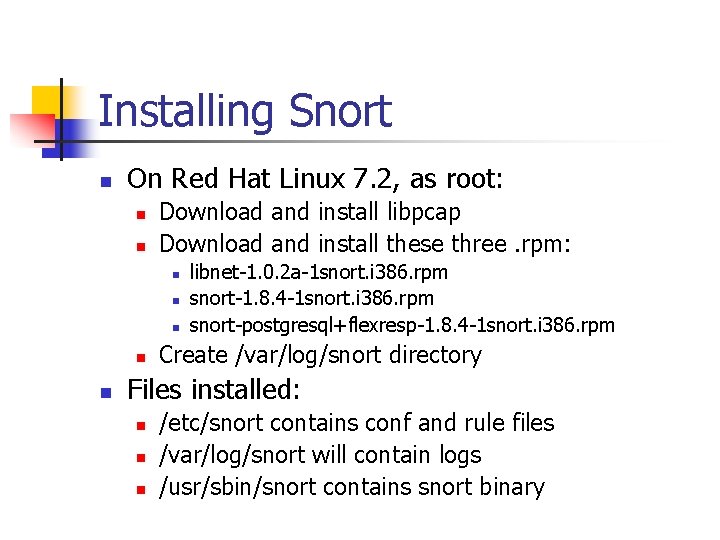
Installing Snort n On Red Hat Linux 7. 2, as root: n n Download and install libpcap Download and install these three. rpm: n n n libnet-1. 0. 2 a-1 snort. i 386. rpm snort-1. 8. 4 -1 snort. i 386. rpm snort-postgresql+flexresp-1. 8. 4 -1 snort. i 386. rpm Create /var/log/snort directory Files installed: n n n /etc/snort contains conf and rule files /var/log/snort will contain logs /usr/sbin/snort contains snort binary

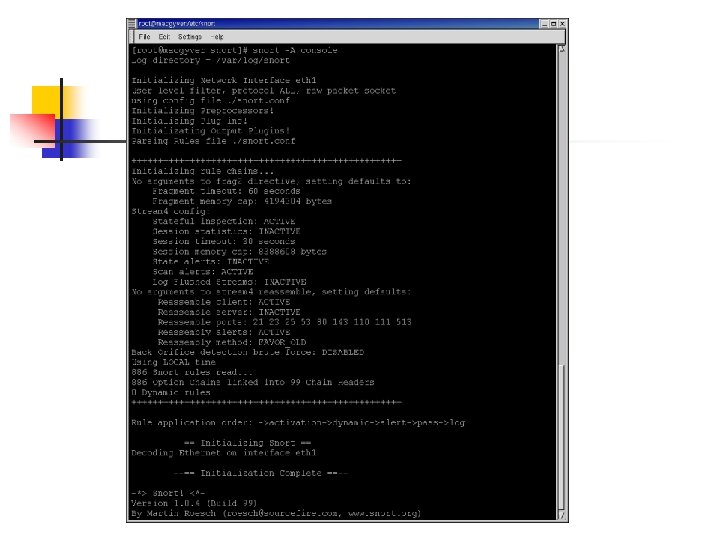
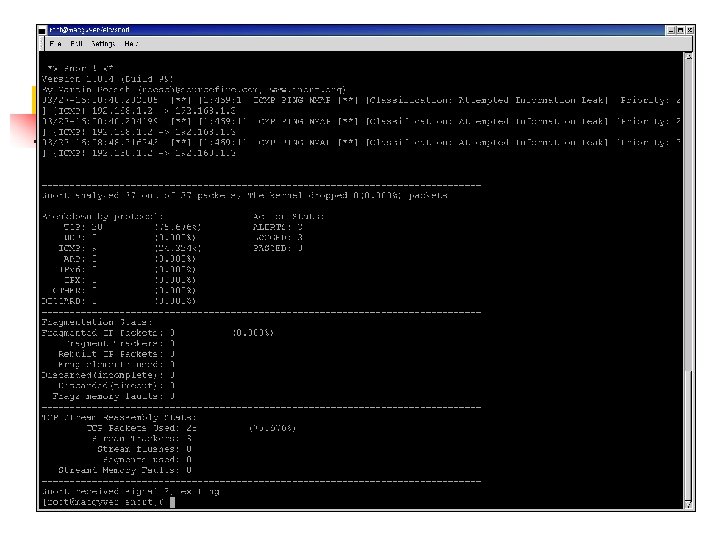
Installing Snort n For a quick test, execute this command within the /etc/snort directory: n n From a separate machine, use nmap to generate events for Snort to detect: n n snort –A console nmap –s. P <snort_machine_IP_address> You should see an alert like this: 03/27 -15: 18: 06. 911226 [**] [1: 469: 1] ICMP PING NMAP [**] [Classification: Attempted Information Leak] [Priority: 2] {ICMP} 192. 168. 1. 20 -> 192. 168. 1. 237
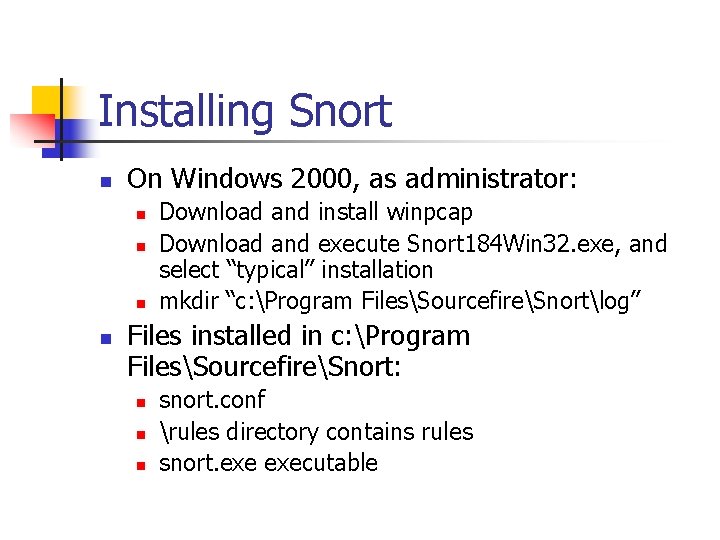
Installing Snort n On Windows 2000, as administrator: n n Download and install winpcap Download and execute Snort 184 Win 32. exe, and select “typical” installation mkdir “c: Program FilesSourcefireSnortlog” Files installed in c: Program FilesSourcefireSnort: n n n snort. conf rules directory contains rules snort. executable
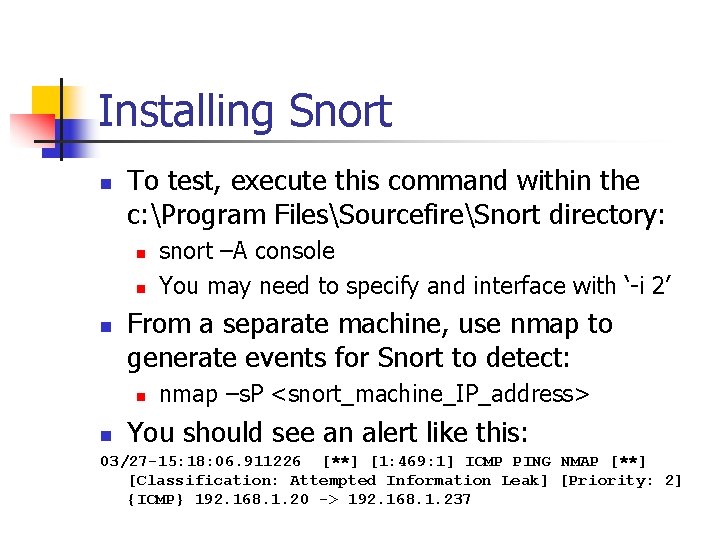
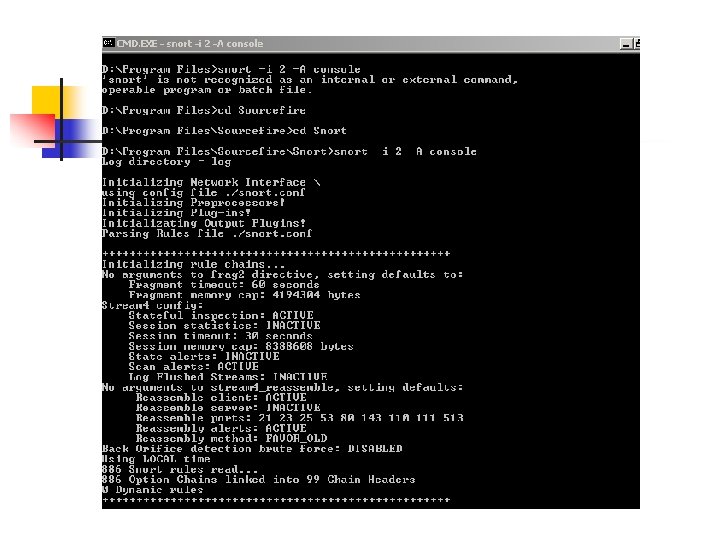
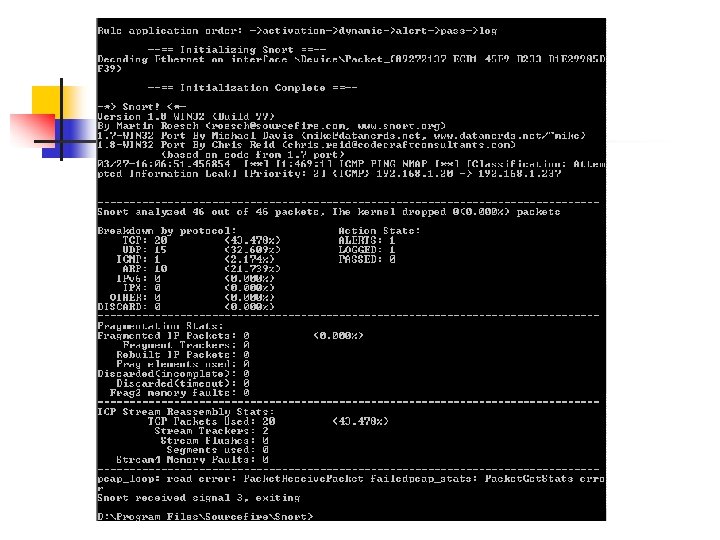
Installing Snort n To test, execute this command within the c: Program FilesSourcefireSnort directory: n n n From a separate machine, use nmap to generate events for Snort to detect: n n snort –A console You may need to specify and interface with ‘-i 2’ nmap –s. P <snort_machine_IP_address> You should see an alert like this: 03/27 -15: 18: 06. 911226 [**] [1: 469: 1] ICMP PING NMAP [**] [Classification: Attempted Information Leak] [Priority: 2] {ICMP} 192. 168. 1. 20 -> 192. 168. 1. 237
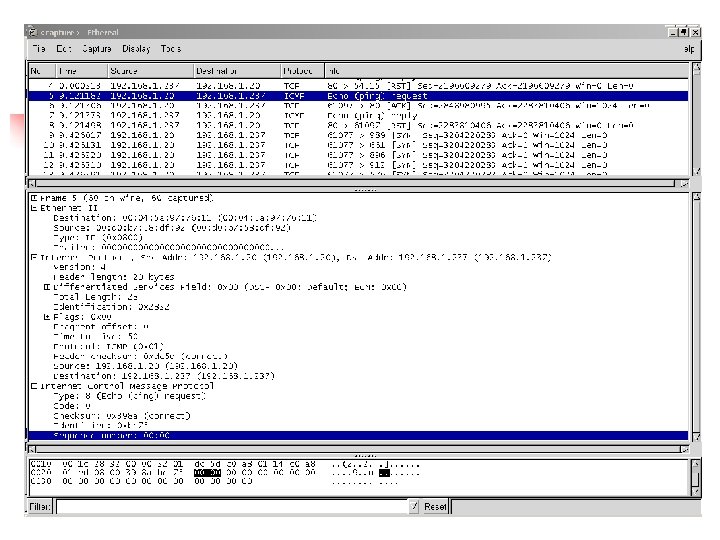
Installing Snort n n While not an element of Snort, Ethereal is the best open source GUI-based packet viewer www. ethereal. com offers: n n n Windows: www. ethereal. com/distribution/win 32/etherealsetup-0. 9. 2. exe UNIX: www. ethereal. com/download. html Red Hat Linux RPMs: ftp. ethereal. com/pub/ethereal/rpms/
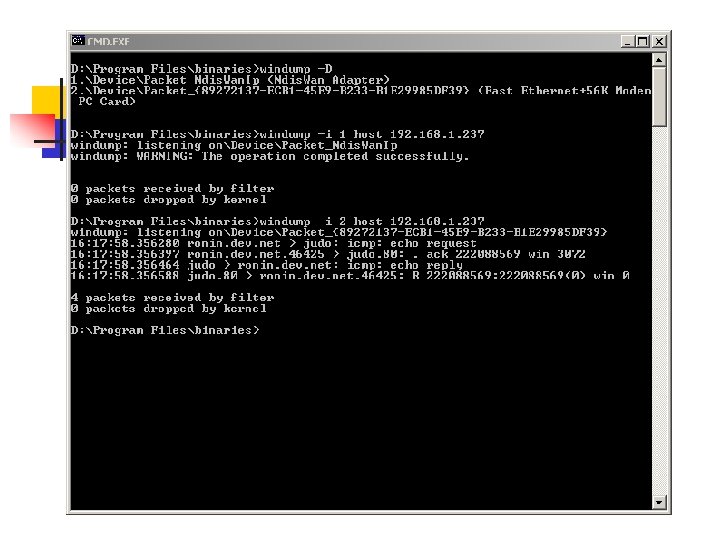
Installing Snort n Also not an element of Snort, tcpdump is a well-established CLI packet capture tool n n www. tcpdump. org offers UNIX source netgroup-serv. polito. it/windump/install/ offers windump, a Windows port of tcpdump n n n windump is helpful because it will help you see the different interfaces available on your sensor Next slide shows two available interfaces; note only the second is capable of sniffing snort –A console –i 2
Snort Rules n n Snort rules are extremely flexible and are easy to modify, unlike many commercial NIDS Sample rule to detect Sub. Seven trojan: alert tcp $EXTERNAL_NET 27374 -> $HOME_NET any (msg: "BACKDOOR subseven 22"; flags: A+; content: "|0 d 0 a 5 b 52504 c 5 d 3030320 d 0 a|"; reference: arachnids, 485; reference: url, www. hackfix. org/subseven/; sid: 103; classtype: misc-activity; rev: 4; ) n n Elements before parentheses comprise ‘rule header’ Elements in parentheses are ‘rule options’
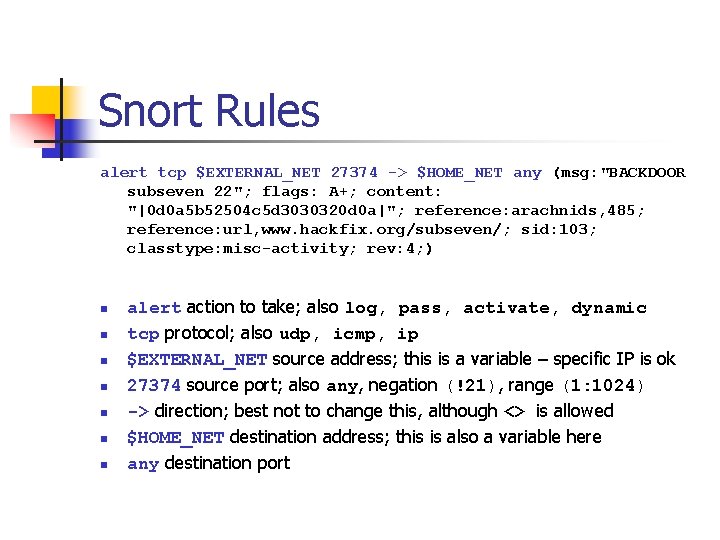
Snort Rules alert tcp $EXTERNAL_NET 27374 -> $HOME_NET any (msg: "BACKDOOR subseven 22"; flags: A+; content: "|0 d 0 a 5 b 52504 c 5 d 3030320 d 0 a|"; reference: arachnids, 485; reference: url, www. hackfix. org/subseven/; sid: 103; classtype: misc-activity; rev: 4; ) n n n n alert action to take; also log, pass, activate, dynamic tcp protocol; also udp, icmp, ip $EXTERNAL_NET source address; this is a variable – specific IP is ok 27374 source port; also any, negation (!21), range (1: 1024) -> direction; best not to change this, although <> is allowed $HOME_NET destination address; this is also a variable here any destination port
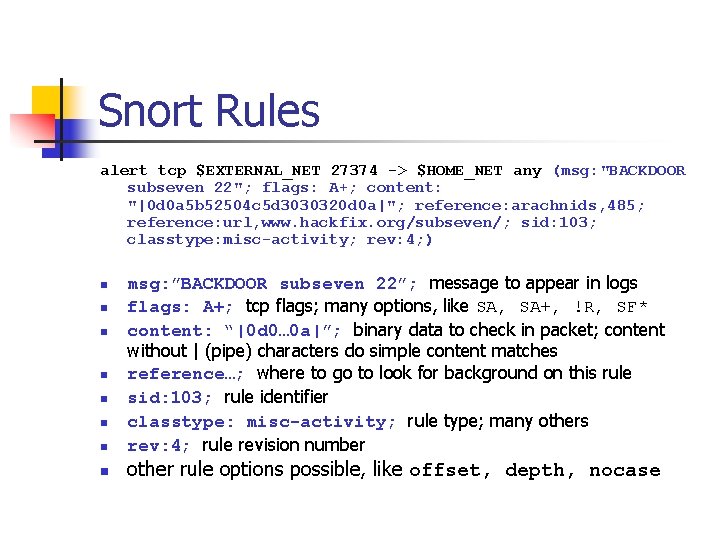
Snort Rules alert tcp $EXTERNAL_NET 27374 -> $HOME_NET any (msg: "BACKDOOR subseven 22"; flags: A+; content: "|0 d 0 a 5 b 52504 c 5 d 3030320 d 0 a|"; reference: arachnids, 485; reference: url, www. hackfix. org/subseven/; sid: 103; classtype: misc-activity; rev: 4; ) n msg: ”BACKDOOR subseven 22”; message to appear in logs flags: A+; tcp flags; many options, like SA, SA+, !R, SF* content: “|0 d 0… 0 a|”; binary data to check in packet; content without | (pipe) characters do simple content matches reference…; where to go to look for background on this rule sid: 103; rule identifier classtype: misc-activity; rule type; many others rev: 4; rule revision number n other rule options possible, like offset, depth, nocase n n n
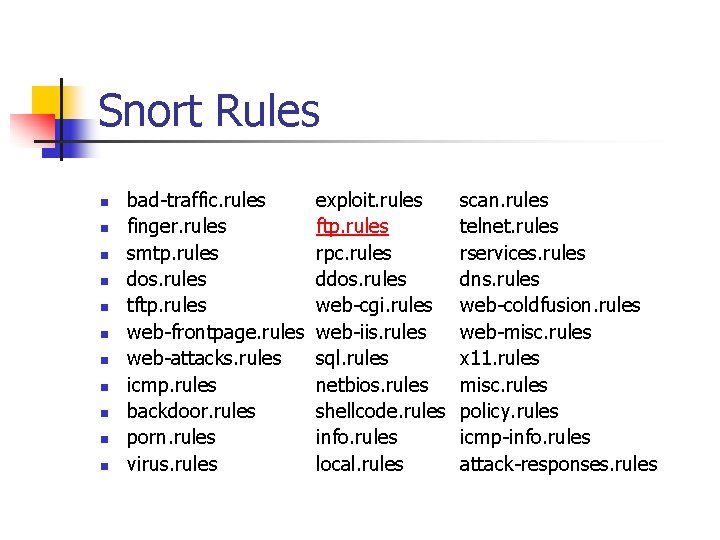
Snort Rules n n n bad-traffic. rules finger. rules smtp. rules dos. rules tftp. rules web-frontpage. rules web-attacks. rules icmp. rules backdoor. rules porn. rules virus. rules exploit. rules ftp. rules rpc. rules ddos. rules web-cgi. rules web-iis. rules sql. rules netbios. rules shellcode. rules info. rules local. rules scan. rules telnet. rules rservices. rules dns. rules web-coldfusion. rules web-misc. rules x 11. rules misc. rules policy. rules icmp-info. rules attack-responses. rules
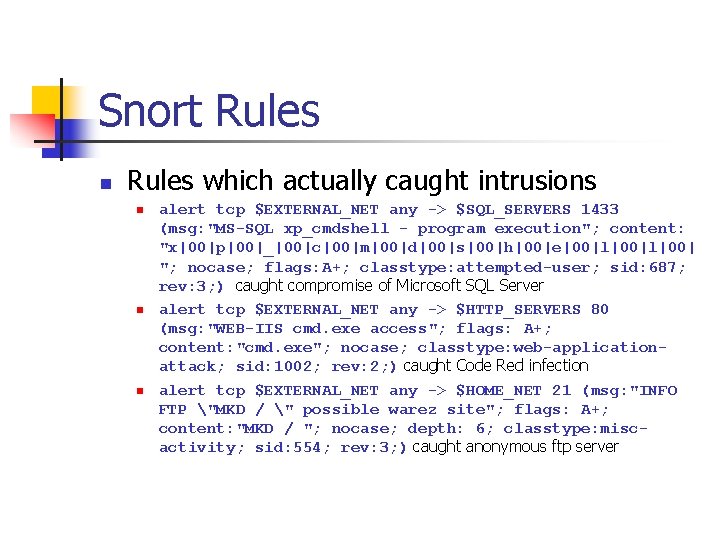
Snort Rules n Rules which actually caught intrusions n n n alert tcp $EXTERNAL_NET any -> $SQL_SERVERS 1433 (msg: "MS-SQL xp_cmdshell - program execution"; content: "x|00|p|00|_|00|c|00|m|00|d|00|s|00|h|00|e|00|l|00| "; nocase; flags: A+; classtype: attempted-user; sid: 687; rev: 3; ) caught compromise of Microsoft SQL Server alert tcp $EXTERNAL_NET any -> $HTTP_SERVERS 80 (msg: "WEB-IIS cmd. exe access"; flags: A+; content: "cmd. exe"; nocase; classtype: web-applicationattack; sid: 1002; rev: 2; ) caught Code Red infection alert tcp $EXTERNAL_NET any -> $HOME_NET 21 (msg: "INFO FTP "MKD / " possible warez site"; flags: A+; content: "MKD / "; nocase; depth: 6; classtype: miscactivity; sid: 554; rev: 3; ) caught anonymous ftp server
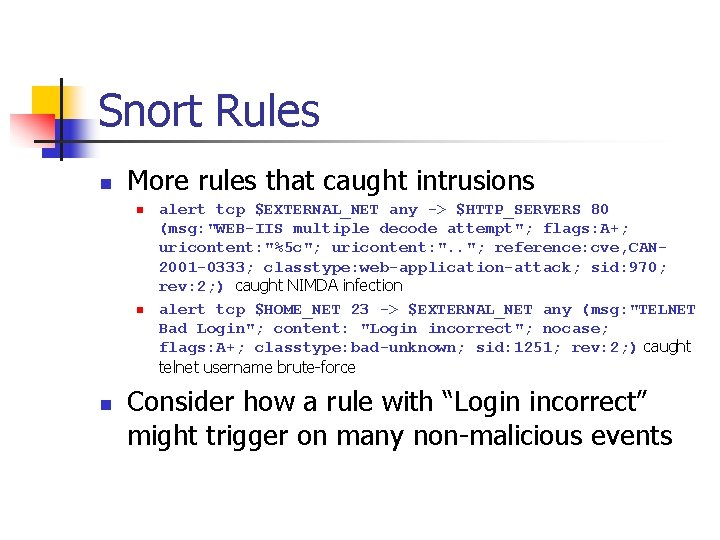
Snort Rules n More rules that caught intrusions n n n alert tcp $EXTERNAL_NET any -> $HTTP_SERVERS 80 (msg: "WEB-IIS multiple decode attempt"; flags: A+; uricontent: "%5 c"; uricontent: ". . "; reference: cve, CAN 2001 -0333; classtype: web-application-attack; sid: 970; rev: 2; ) caught NIMDA infection alert tcp $HOME_NET 23 -> $EXTERNAL_NET any (msg: "TELNET Bad Login"; content: "Login incorrect"; nocase; flags: A+; classtype: bad-unknown; sid: 1251; rev: 2; ) caught telnet username brute-force Consider how a rule with “Login incorrect” might trigger on many non-malicious events
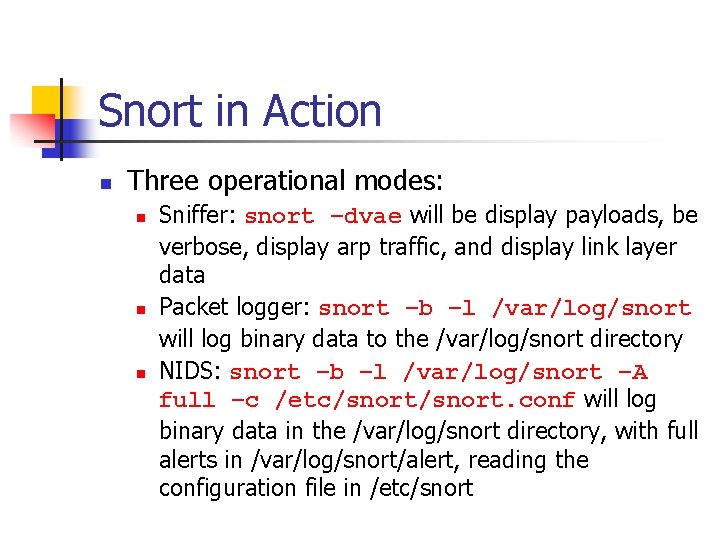
Snort in Action n Three operational modes: n n n Sniffer: snort –dvae will be display payloads, be verbose, display arp traffic, and display link layer data Packet logger: snort –b –l /var/log/snort will log binary data to the /var/log/snort directory NIDS: snort –b –l /var/log/snort –A full –c /etc/snort. conf will log binary data in the /var/log/snort directory, with full alerts in /var/log/snort/alert, reading the configuration file in /etc/snort
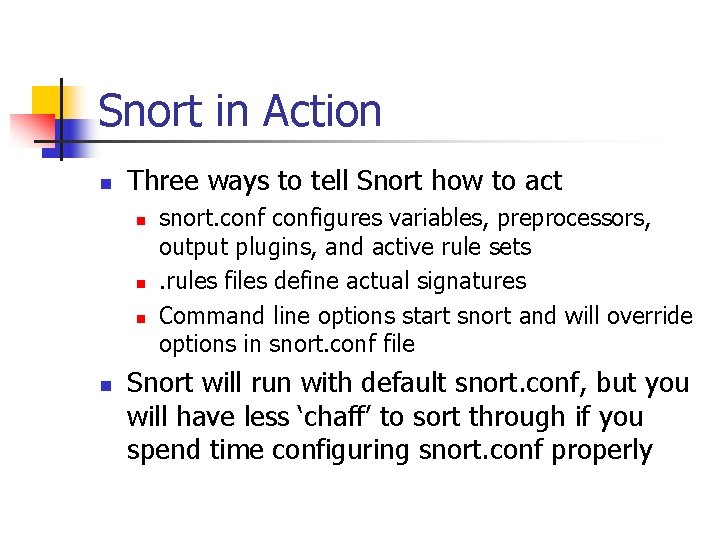
Snort in Action n Three ways to tell Snort how to act n n snort. configures variables, preprocessors, output plugins, and active rule sets. rules files define actual signatures Command line options start snort and will override options in snort. conf file Snort will run with default snort. conf, but you will have less ‘chaff’ to sort through if you spend time configuring snort. conf properly
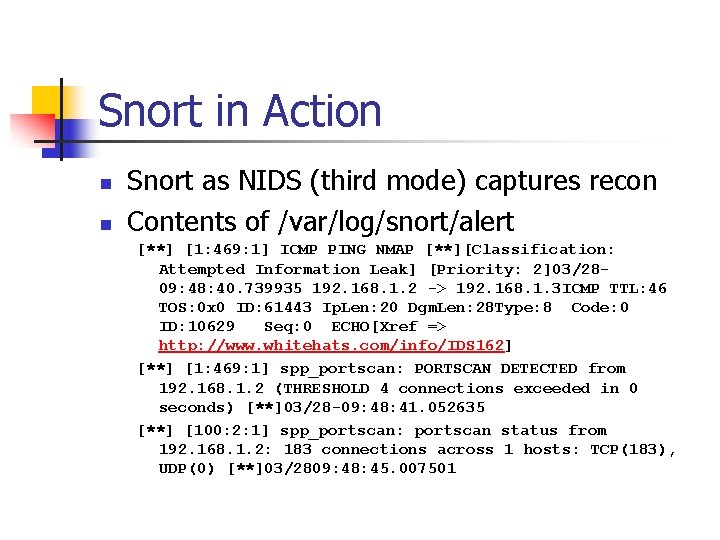
Snort in Action n n Snort as NIDS (third mode) captures recon Contents of /var/log/snort/alert [**] [1: 469: 1] ICMP PING NMAP [**][Classification: Attempted Information Leak] [Priority: 2]03/2809: 48: 40. 739935 192. 168. 1. 2 -> 192. 168. 1. 3 ICMP TTL: 46 TOS: 0 x 0 ID: 61443 Ip. Len: 20 Dgm. Len: 28 Type: 8 Code: 0 ID: 10629 Seq: 0 ECHO[Xref => http: //www. whitehats. com/info/IDS 162] [**] [1: 469: 1] spp_portscan: PORTSCAN DETECTED from 192. 168. 1. 2 (THRESHOLD 4 connections exceeded in 0 seconds) [**]03/28 -09: 48: 41. 052635 [**] [100: 2: 1] spp_portscan: portscan status from 192. 168. 1. 2: 183 connections across 1 hosts: TCP(183), UDP(0) [**]03/2809: 48: 45. 007501
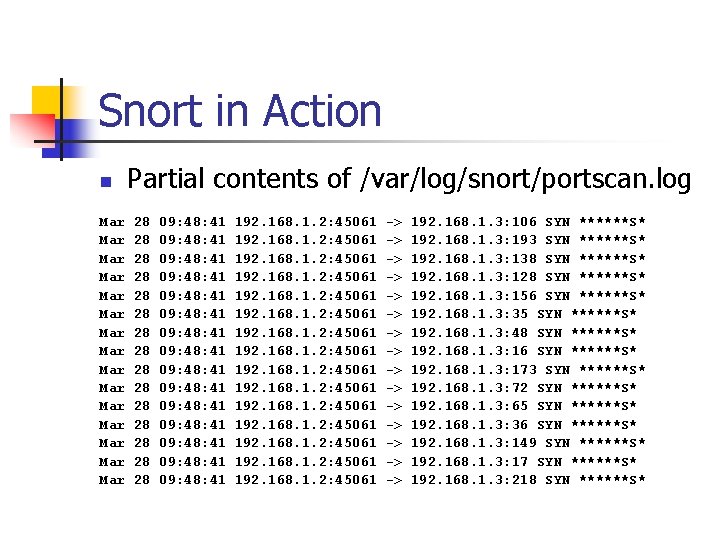
Snort in Action n Mar Mar Mar Mar Partial contents of /var/log/snort/portscan. log 28 28 28 28 09: 48: 41 09: 48: 41 09: 48: 41 09: 48: 41 192. 168. 1. 2: 45061 192. 168. 1. 2: 45061 -> -> -> -> 192. 168. 1. 3: 106 SYN ******S* 192. 168. 1. 3: 193 SYN ******S* 192. 168. 1. 3: 138 SYN ******S* 192. 168. 1. 3: 128 SYN ******S* 192. 168. 1. 3: 156 SYN ******S* 192. 168. 1. 3: 35 SYN ******S* 192. 168. 1. 3: 48 SYN ******S* 192. 168. 1. 3: 16 SYN ******S* 192. 168. 1. 3: 173 SYN ******S* 192. 168. 1. 3: 72 SYN ******S* 192. 168. 1. 3: 65 SYN ******S* 192. 168. 1. 3: 36 SYN ******S* 192. 168. 1. 3: 149 SYN ******S* 192. 168. 1. 3: 17 SYN ******S* 192. 168. 1. 3: 218 SYN ******S*
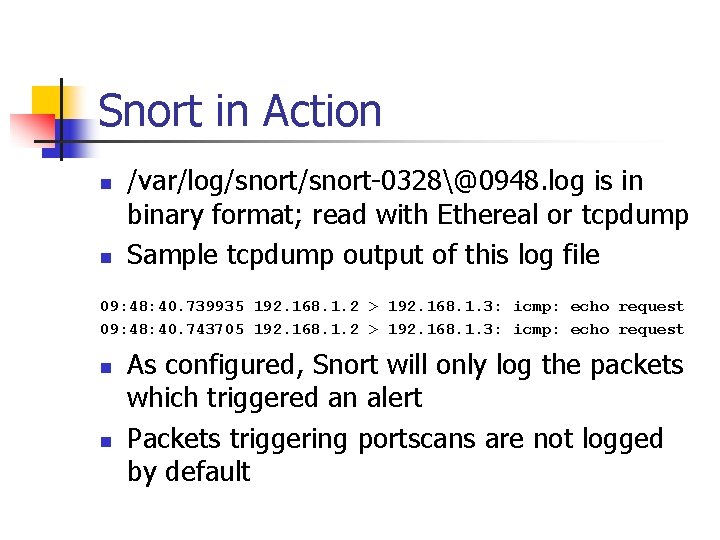
Snort in Action n n /var/log/snort-0328@0948. log is in binary format; read with Ethereal or tcpdump Sample tcpdump output of this log file 09: 48: 40. 739935 192. 168. 1. 2 > 192. 168. 1. 3: icmp: echo request 09: 48: 40. 743705 192. 168. 1. 2 > 192. 168. 1. 3: icmp: echo request n n As configured, Snort will only log the packets which triggered an alert Packets triggering portscans are not logged by default
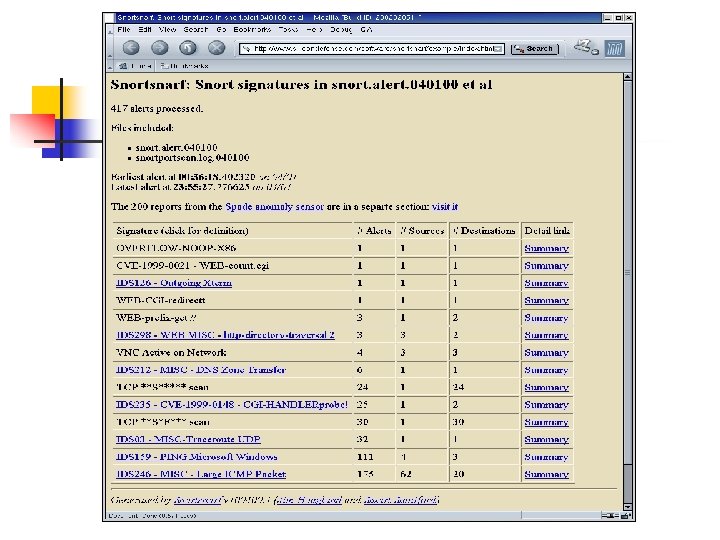
Third-Party Enhancements n Snort. Snarf n n www. silicondefense. com/software/snortsnarf/ Snort. Snarf is a Perl program to take files of alerts from the Snort to produce HTML reports Output intended for diagnostic inspection Silicon Defense also supplies sensors with commercial support n Description and screenshot taken from Snort. Snarf web
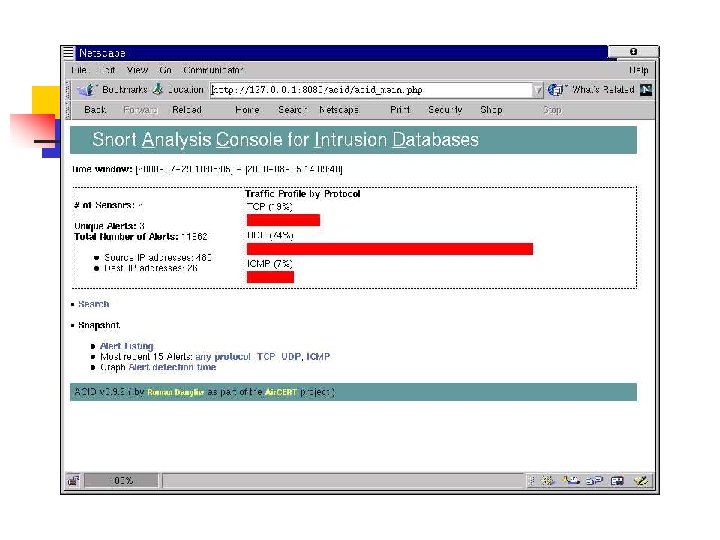
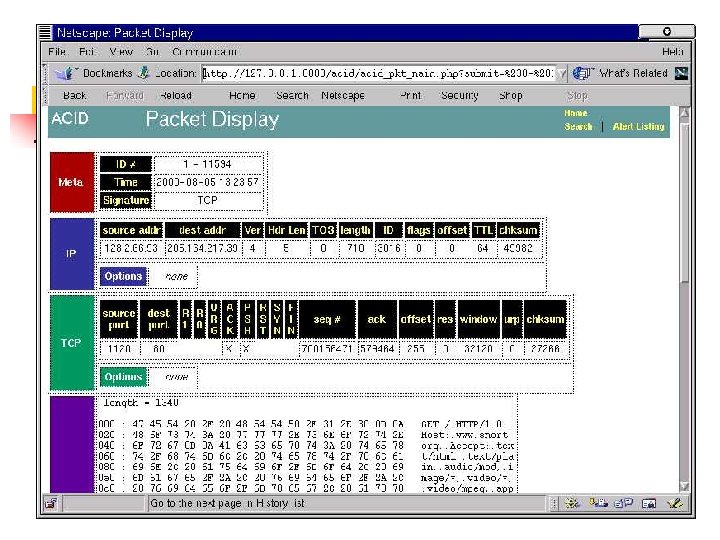
Third-Party Enhancements n Analysis Console for Intrusion Databases (ACID) n n n acidlab. sourceforge. net/ PHP-based analysis engine to search and process a database of security events generated by various IDSes, firewalls, and network monitoring tools Query-builder and search interface, packet viewer (decoder), alert management, chart and statistics generation n Description and screenshots taken from ACID web
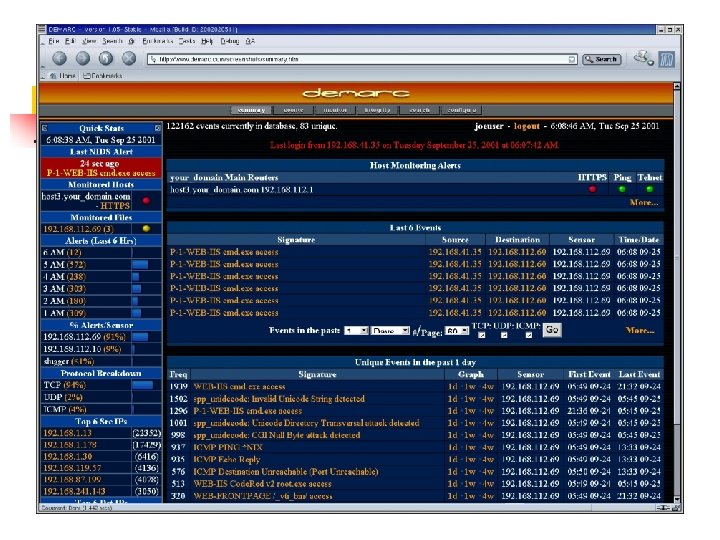
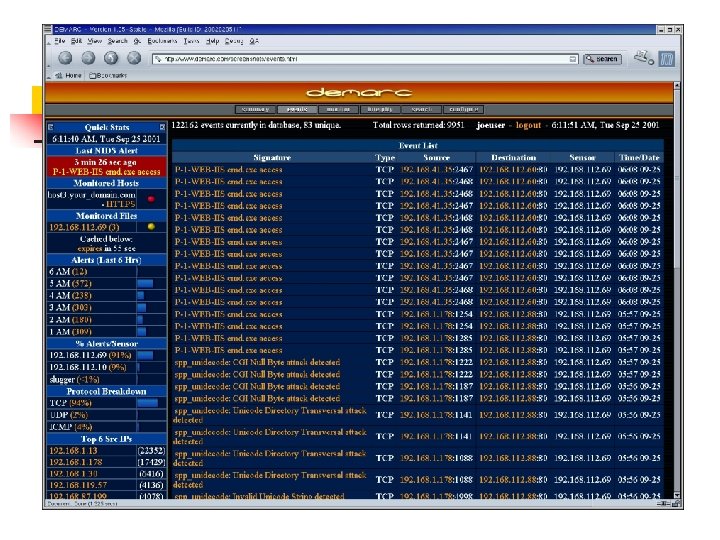
n Demarc n n www. demarc. com NIDS management console, integrating Snort with the convenience and power of a centralized interface for all network sensors Monitor all servers / hosts to make sure network services such as a mail or web servers remain accessible at all times Monitor system logs for anomalous log entries that may indicate intruders or system malfunctions n Description and screenshots taken from demarc web
Conclusion n n Snort is a powerful tool, but maximizing its usefulness requires a trained operator Becoming proficient with network intrusion detection takes 12 months; “expert” 24 -36? Snort is considered a superior NIDS when compared to most commercial systems Managed network security providers should collect enough information to make decisions without calling clients to ask what happened
- Slides: 40