
An introduction to school support Core training day
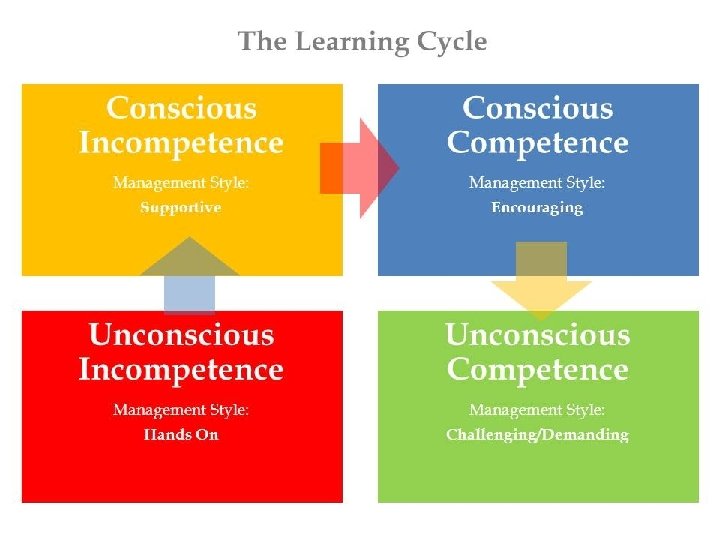



- Slides: 56
An introduction to school support Core training day
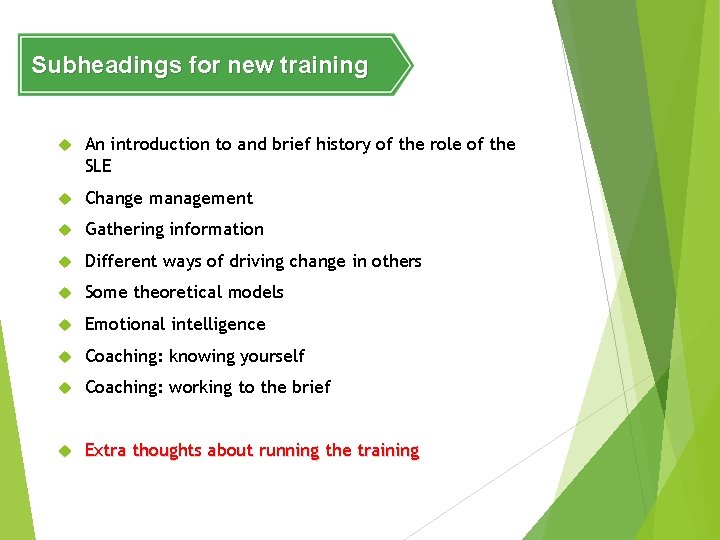
Subheadings for new training An introduction to and brief history of the role of the SLE Change management Gathering information Different ways of driving change in others Some theoretical models Emotional intelligence Coaching: knowing yourself Coaching: working to the brief Extra thoughts about running the training
Taboo What did you gain from doing this? What did the facilitator/ accreditor gain?
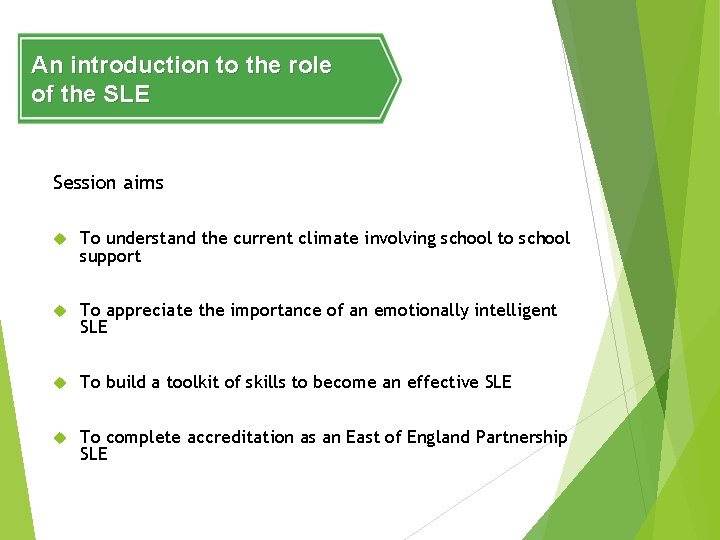
An introduction to the role of the SLE Session aims To understand the current climate involving school to school support To appreciate the importance of an emotionally intelligent SLE To build a toolkit of skills to become an effective SLE To complete accreditation as an East of England Partnership SLE
Pre-core tasks Learning walk Persuasive conversation Working style questionnaire
An introduction to the role of the SLE What are system leaders? Leaders, usually working with other leaders within and beyond their individual organisations; sharing and harnessing the best resources that the system can offer to bring about improvement in their own and other organisations; and influencing thinking, policy and practice so as to have a positive impact on the lives and life chances of all children and young people. Key words?
An introduction to the role of the SLE System leaders Leaders, usually working with other leaders within and beyond their individual organisations; sharing and harnessing the best resources that the system can offer to bring about improvement in their own and other organisations; and influencing thinking, policy and practice so as to have a positive impact on the lives and life chances of all children and young people. About the SLE programme Jacqueline Smith, head of the teaching school at Lampton, on deploying SLEs: "We get even more than we give. Staff are really motivated by professional recognition and respect for their expertise. “ Dean Jones, SLE in Rotherham: “The SLE programme empowers a normal classroom leader to lead. It improves their confidence and leadership skills. ”
An introduction to the role of the SLE Principles underpinning system leadership • • being driven by a moral purpose improving all children and young people’s lives regardless of which school or children’s centre they attend or neighbourhood to which they live • recognising the reciprocal benefits derived from peer-to-peer support • ensuring there is a positive impact with measurable outcomes • • accepting collective responsibility and shared accountability for the performance of the (education) system increasingly moving from intervention to prevention
An introduction to the role of the SLE “Growing leaders is like growing fruit trees. Other owners may one day have the benefit of your trees, but maybe you will benefit from other unknown owners of orchards. The best organisations take pride in the fact that they grow more leaders than they need; they are net exporters of leaders. ” John Adair
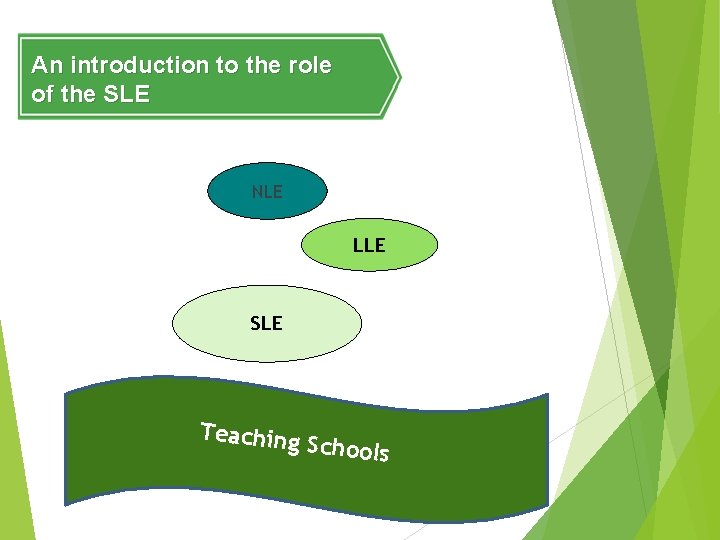
An introduction to the role of the SLE NLE LLE SLE Teaching Schools
A history of the SLE programme 2011 – pilot in the Manchester area 2012 – 11 ‘training schools’ identified nationally to train all SLEs. Careful Quality control from the pilot group 6000+ SLEs trained. All went through core training, which was fully funded by the Df. E 2015 – end of the formal support process. Certification and identification handed over to all TSAs. Training still available, but no longer funded. Some SLEs identified without core training 2016 – Df. E provide start-up funding for each Region to agree a regional solution to accreditation and quality assurance
East of England SLE Partnership The fundamental purpose of the group is to promote the best possible recruitment, training and support of SLEs. This is achieved through: Support and promotion of recruitment and training and sharing the eastern region’s high expectations of the effectiveness and impact of induction as a process to ensure sustainable improvement to overall educational standards and performance of SLEs Review and evaluation of the role of the SLE Coordinator and secure strategies to ensure effective quality assurance Sharing best practice amongst SLEs to ensure the approaches of the Eastern region are being upheld , to continually improve the training and induction process to promote the highest standard of school to school support Providing a ‘Critical Friend’ community to support individual selfevaluation and quality assurance processes Facilitating mechanisms for regular, clear and consistent communications to all SLEs and Head Teachers Ensuring appropriate marketing and promotion of SLEs is undertaken
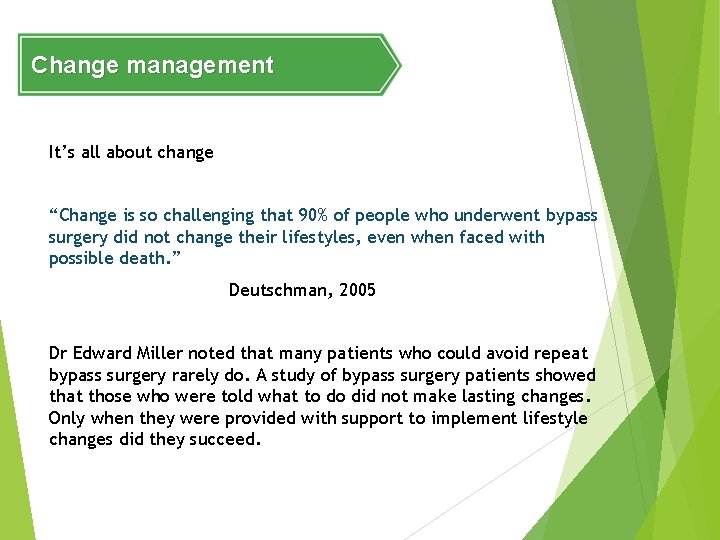
Change management It’s all about change “Change is so challenging that 90% of people who underwent bypass surgery did not change their lifestyles, even when faced with possible death. ” Deutschman, 2005 Dr Edward Miller noted that many patients who could avoid repeat bypass surgery rarely do. A study of bypass surgery patients showed that those who were told what to do did not make lasting changes. Only when they were provided with support to implement lifestyle changes did they succeed.
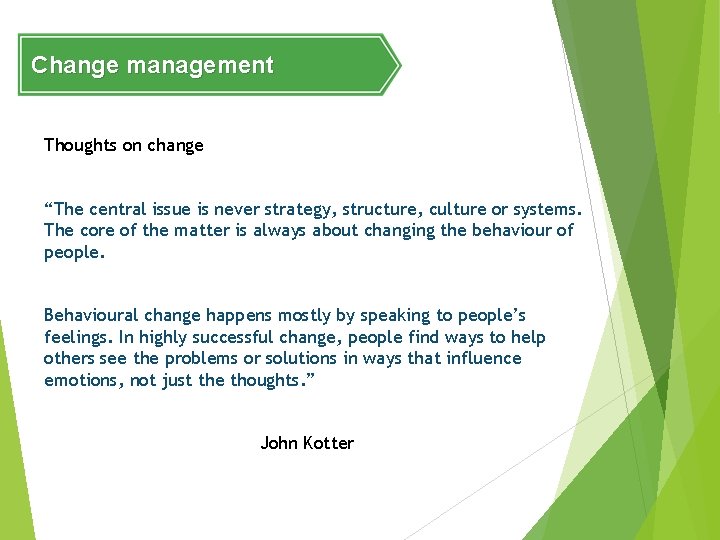
Change management Thoughts on change “The central issue is never strategy, structure, culture or systems. The core of the matter is always about changing the behaviour of people. Behavioural change happens mostly by speaking to people’s feelings. In highly successful change, people find ways to help others see the problems or solutions in ways that influence emotions, not just the thoughts. ” John Kotter
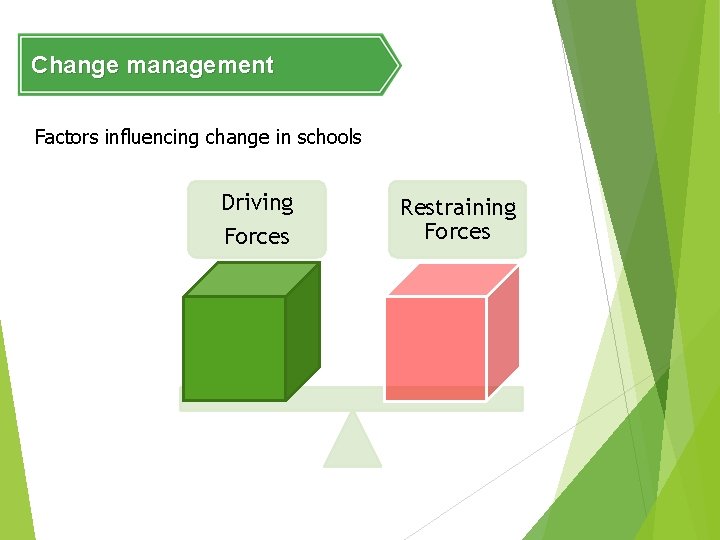
Change management Factors influencing change in schools Driving Forces Restraining Forces
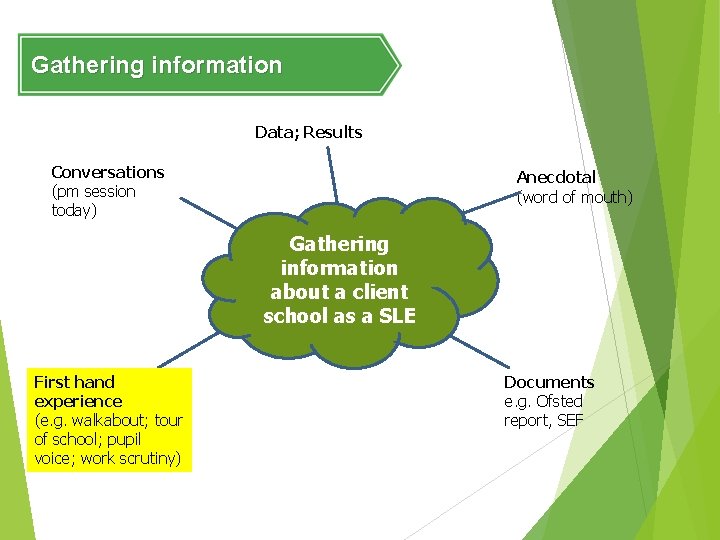
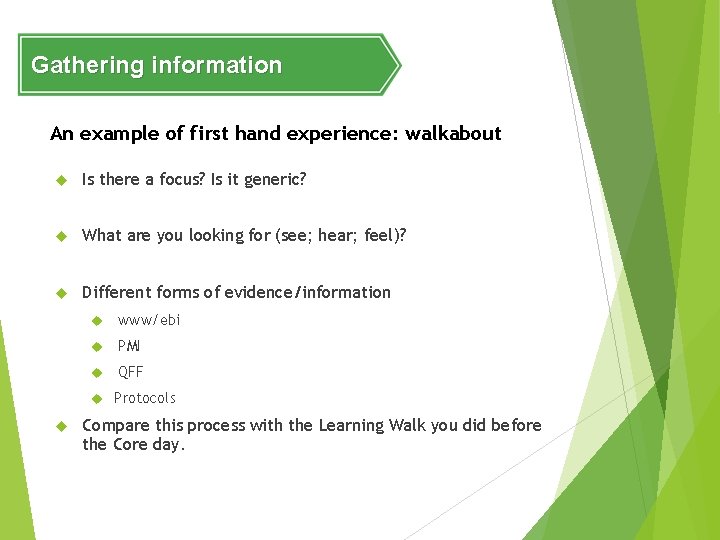
Gathering information Data; Results Conversations (pm session today) Anecdotal (word of mouth) Gathering information about a client school as a SLE First hand experience (e. g. walkabout; tour of school; pupil voice; work scrutiny) Documents e. g. Ofsted report, SEF
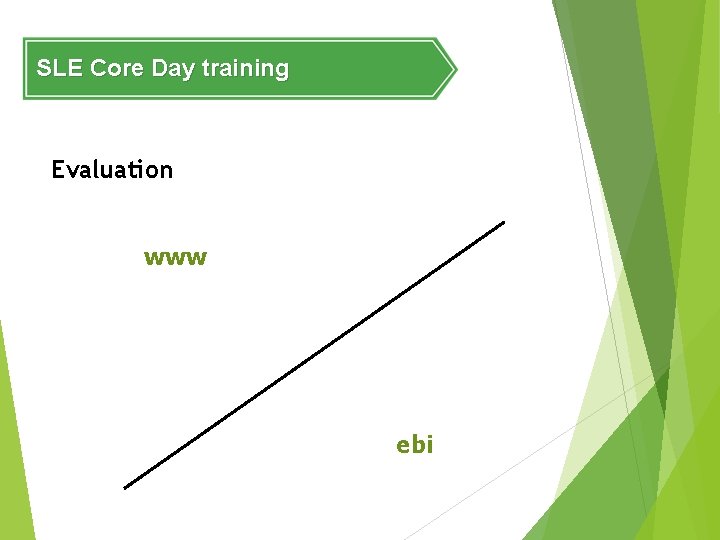
Gathering information An example of first hand experience: walkabout Is there a focus? Is it generic? What are you looking for (see; hear; feel)? Different forms of evidence/information www/ebi PMI QFF Protocols Compare this process with the Learning Walk you did before the Core day.
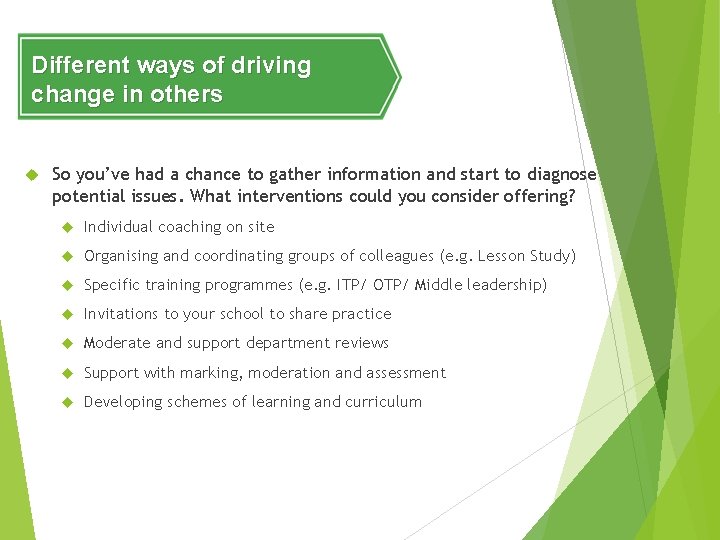
Different ways of driving change in others So you’ve had a chance to gather information and start to diagnose potential issues. What interventions could you consider offering? Individual coaching on site Organising and coordinating groups of colleagues (e. g. Lesson Study) Specific training programmes (e. g. ITP/ OTP/ Middle leadership) Invitations to your school to share practice Moderate and support department reviews Support with marking, moderation and assessment Developing schemes of learning and curriculum
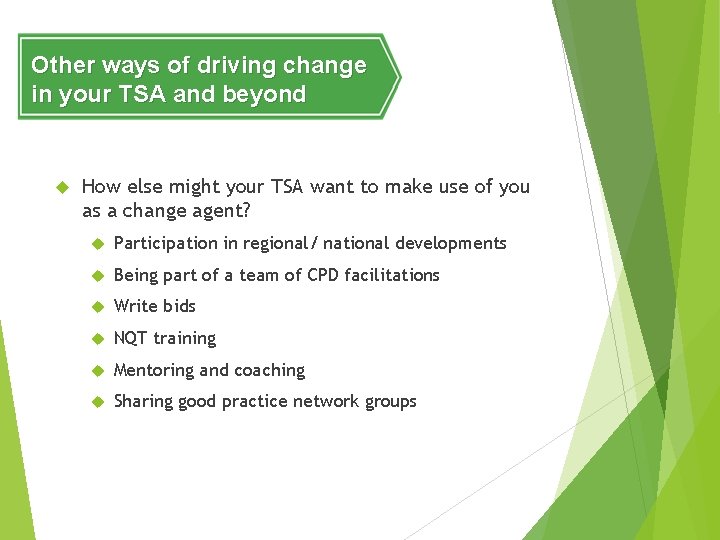
Other ways of driving change in your TSA and beyond How else might your TSA want to make use of you as a change agent? Participation in regional/ national developments Being part of a team of CPD facilitations Write bids NQT training Mentoring and coaching Sharing good practice network groups
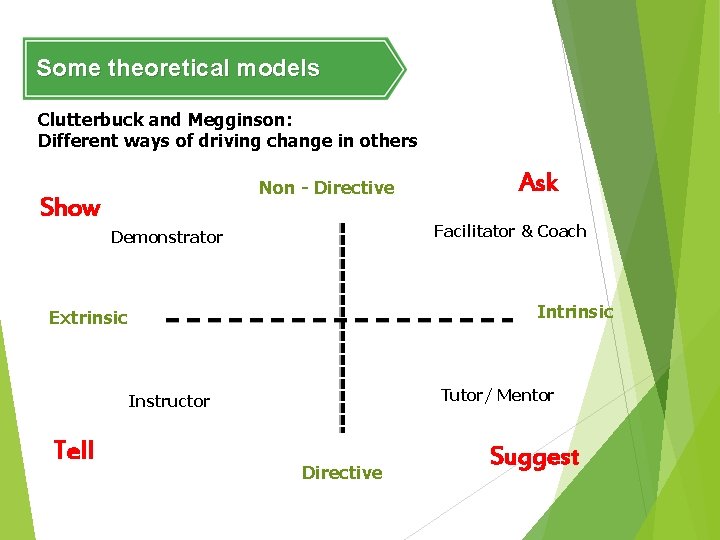
Some theoretical models Clutterbuck and Megginson: Different ways of driving change in others Non - Directive Show Facilitator & Coach Demonstrator Intrinsic Extrinsic Tutor/ Mentor Instructor Tell Ask Directive Suggest
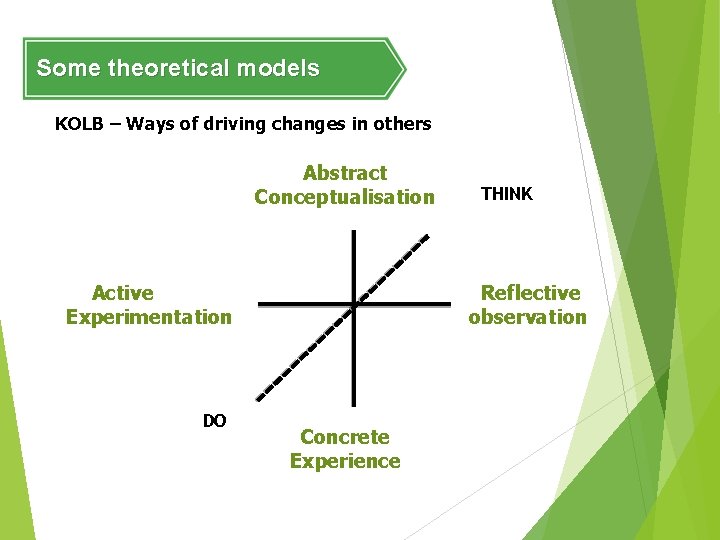
Some theoretical models KOLB – Ways of driving changes in others Abstract Conceptualisation Active Experimentation DO THINK Reflective observation Concrete Experience
How do you know which strategy or approach to use? Use your Emotional Intelligence!
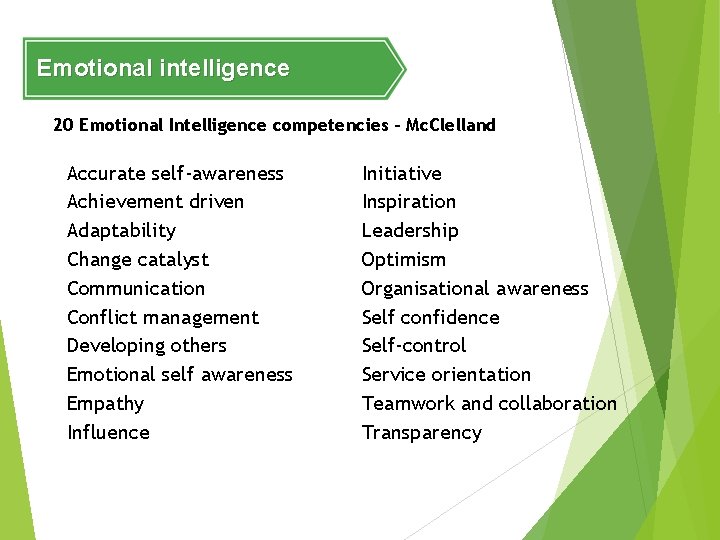
Emotional intelligence 20 Emotional Intelligence competencies - Mc. Clelland Accurate self-awareness Achievement driven Adaptability Change catalyst Communication Conflict management Developing others Emotional self awareness Empathy Influence Initiative Inspiration Leadership Optimism Organisational awareness Self confidence Self-control Service orientation Teamwork and collaboration Transparency
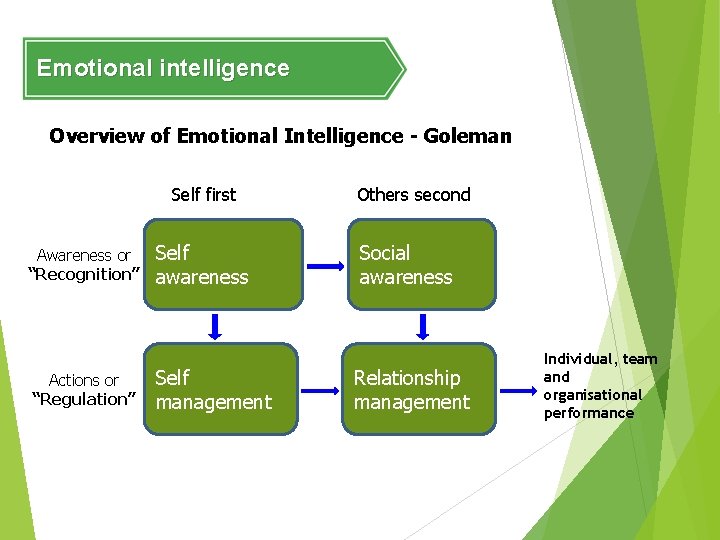
Emotional intelligence Overview of Emotional Intelligence - Goleman Self first Awareness or “Recognition” Actions or “Regulation” Self awareness Self management Others second Social awareness Relationship management Individual, team and organisational performance
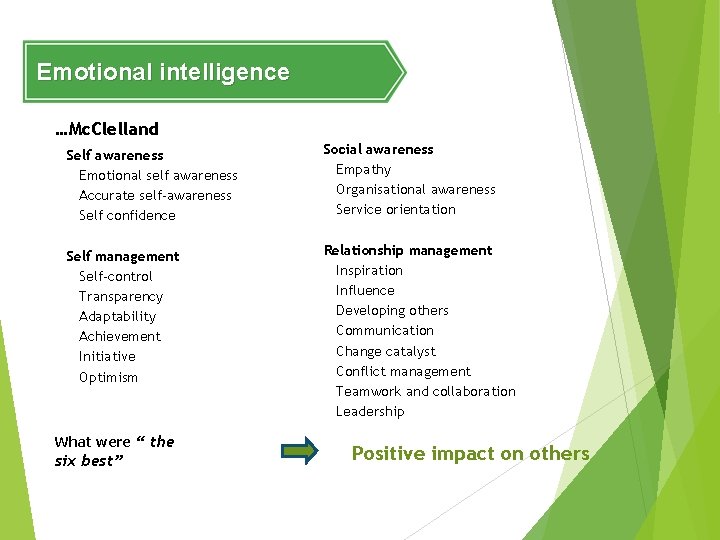
Emotional intelligence …Mc. Clelland Self awareness Emotional self awareness Accurate self-awareness Self confidence Social awareness Empathy Organisational awareness Service orientation Self management Self-control Transparency Adaptability Achievement Initiative Optimism Relationship management Inspiration Influence Developing others Communication Change catalyst Conflict management Teamwork and collaboration Leadership What were “ the six best” Positive impact on others
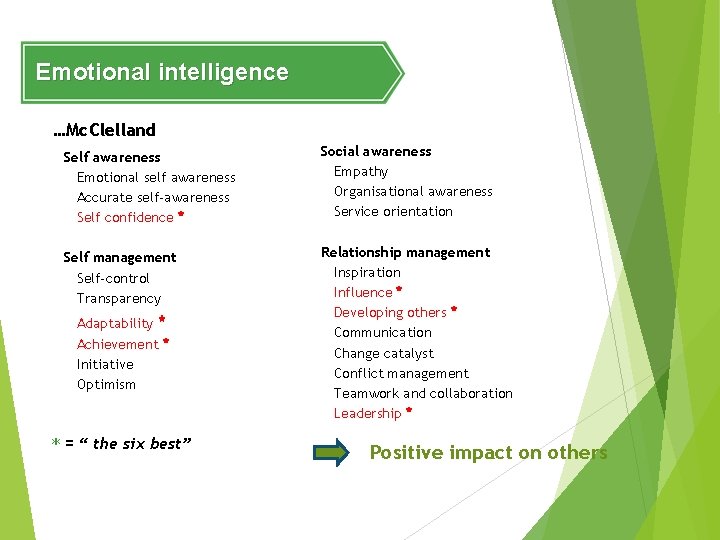
Emotional intelligence …Mc. Clelland Self awareness Emotional self awareness Accurate self-awareness Self confidence * Social awareness Empathy Organisational awareness Service orientation Self management Self-control Transparency Relationship management Inspiration Influence * Developing others * Communication Change catalyst Conflict management Teamwork and collaboration Leadership * Adaptability * Achievement * Initiative Optimism * = “ the six best” Positive impact on others
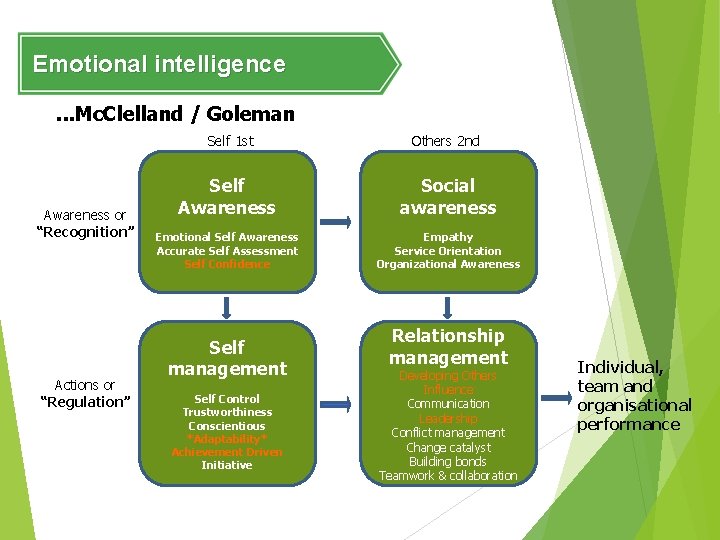
Emotional intelligence. . . Mc. Clelland / Goleman Awareness or “Recognition” Actions or “Regulation” Self 1 st Others 2 nd Self Awareness Social awareness Emotional Self Awareness Accurate Self Assessment Self Confidence Empathy Service Orientation Organizational Awareness Self management Self Control Trustworthiness Conscientious *Adaptability* Achievement Driven Initiative Relationship management Developing Others Influence Communication Leadership Conflict management Change catalyst Building bonds Teamwork & collaboration Individual, team and organisational performance
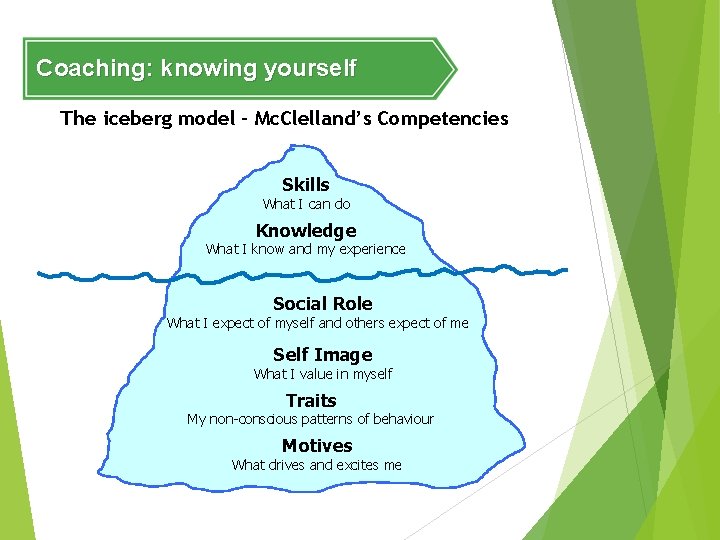
Coaching: knowing yourself The iceberg model – Mc. Clelland’s Competencies Skills What I can do Knowledge What I know and my experience Social Role What I expect of myself and others expect of me Self Image What I value in myself Traits My non-conscious patterns of behaviour Motives What drives and excites me
Coaching: knowing yourself Motives Look at the picture for ten seconds then write down what you saw.
Coaching: knowing yourself Motives A motive is a non-conscious need that has to be fulfilled time and time again. Motives are deeply embedded in people and drive their behaviours. They are the source of energy to do things. Motives can be understood and managed, but do not appear to be capable of being changed. Leaders might consider the potential for arousing motives in others so as to match tasks and roles to meet their needs.
Coaching: knowing yourself
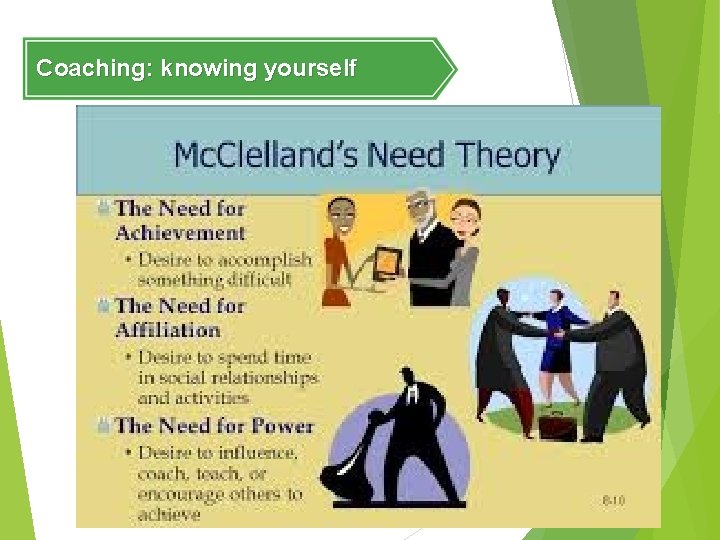
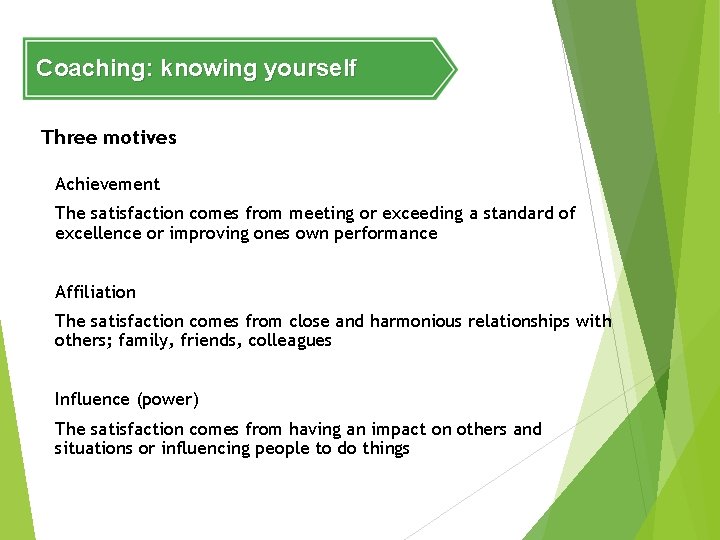
Coaching: knowing yourself Three motives Achievement The satisfaction comes from meeting or exceeding a standard of excellence or improving ones own performance Affiliation The satisfaction comes from close and harmonious relationships with others; family, friends, colleagues Influence (power) The satisfaction comes from having an impact on others and situations or influencing people to do things
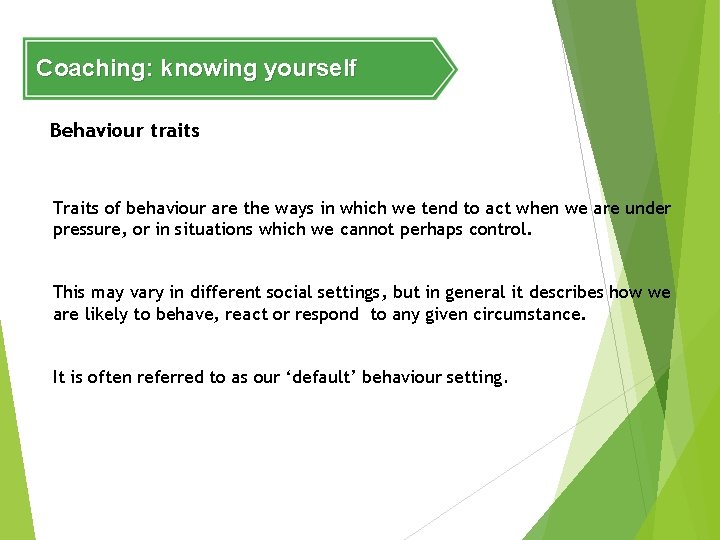
Coaching: knowing yourself Behaviour traits Traits of behaviour are the ways in which we tend to act when we are under pressure, or in situations which we cannot perhaps control. This may vary in different social settings, but in general it describes how we are likely to behave, react or respond to any given circumstance. It is often referred to as our ‘default’ behaviour setting.
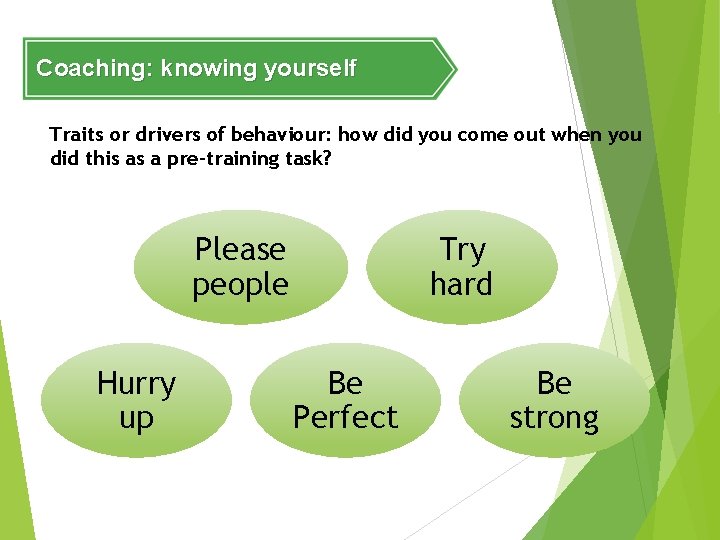
Coaching: knowing yourself Traits or drivers of behaviour: how did you come out when you did this as a pre-training task? Please people Hurry up Try hard Be Perfect Be strong
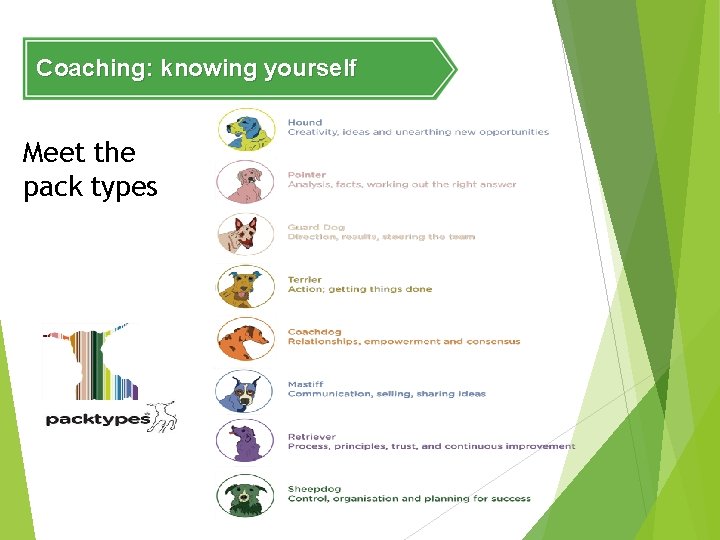
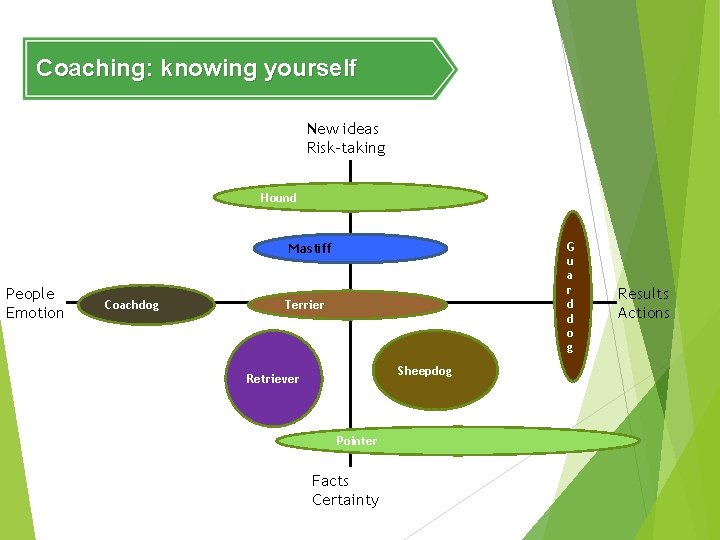
Coaching: knowing yourself Meet the pack types
Coaching: knowing yourself New ideas Risk-taking Hound G u a r d d o g Mastiff People Emotion Coachdog Terrier Sheepdog Retriever Pointer Facts Certainty Results Actions
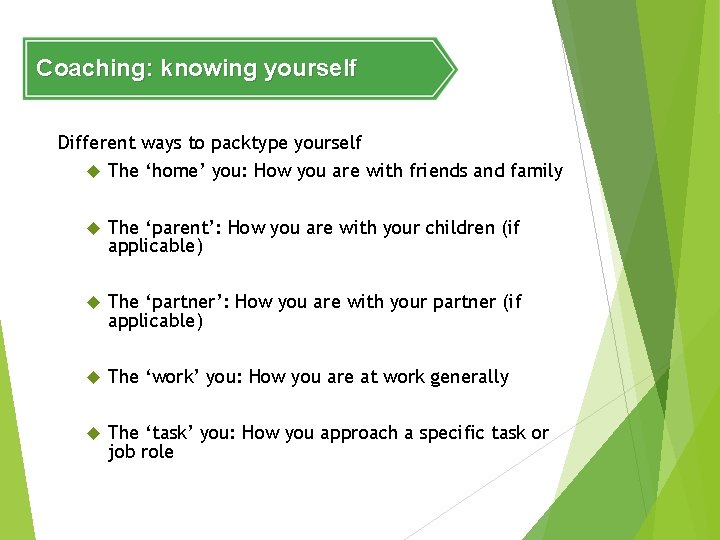
Coaching: knowing yourself Different ways to packtype yourself The ‘home’ you: How you are with friends and family The ‘parent’: How you are with your children (if applicable) The ‘partner’: How you are with your partner (if applicable) The ‘work’ you: How you are at work generally The ‘task’ you: How you approach a specific task or job role
Coaching: knowing yourself Lunch
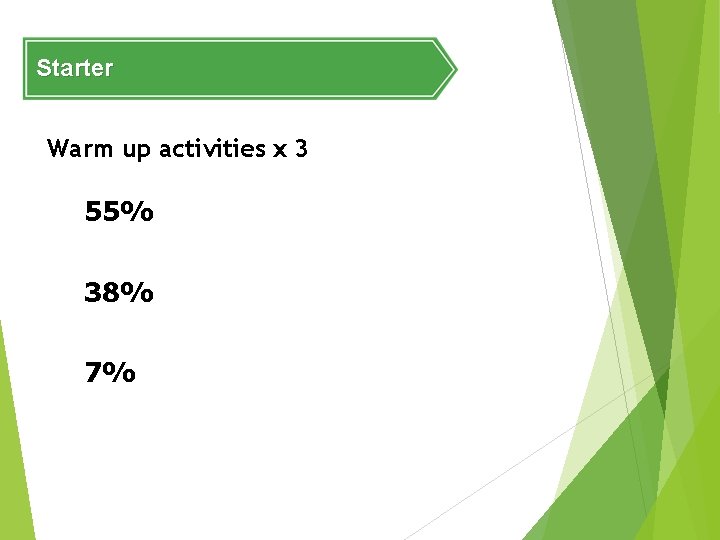
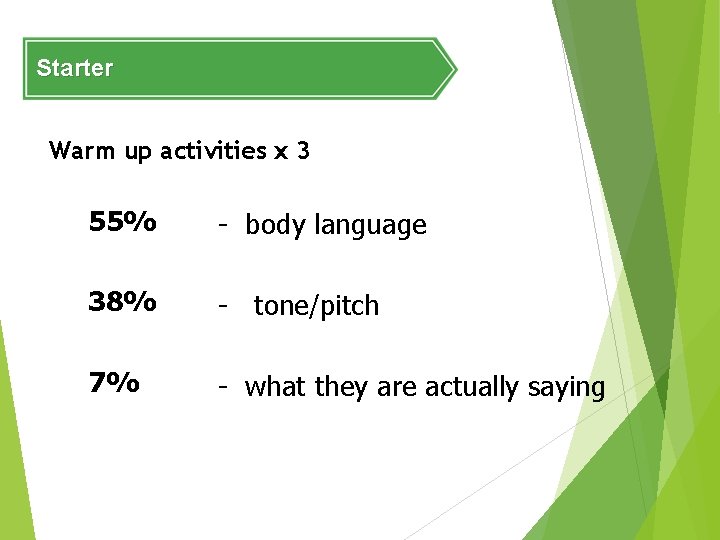
Starter Warm up activities x 3 1. Spot the difference 2. Tone: reading between the lines. 3. Video conversation: 1 minute to find out how they were feeling.
Starter Warm up activities x 3 55% 38% 7%
Starter Warm up activities x 3 55% - body language 38% - tone/pitch 7% - what they are actually saying
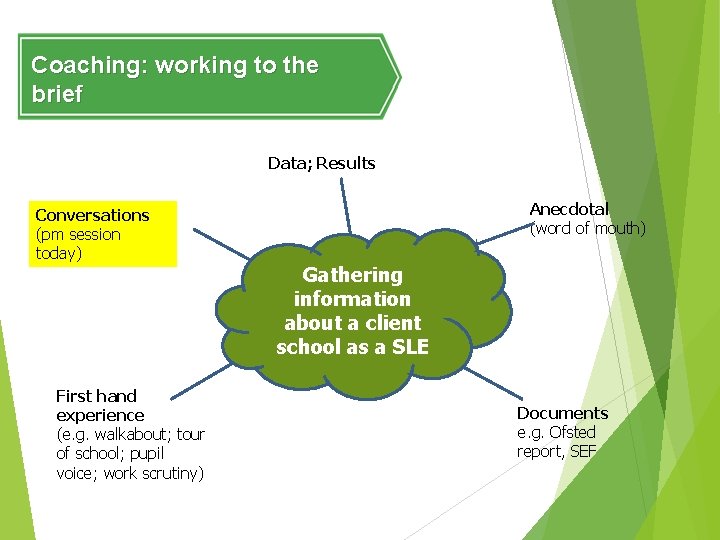
Coaching: working to the brief Data; Results Conversations (pm session today) First hand experience (e. g. walkabout; tour of school; pupil voice; work scrutiny) Anecdotal (word of mouth) Gathering information about a client school as a SLE Documents e. g. Ofsted report, SEF
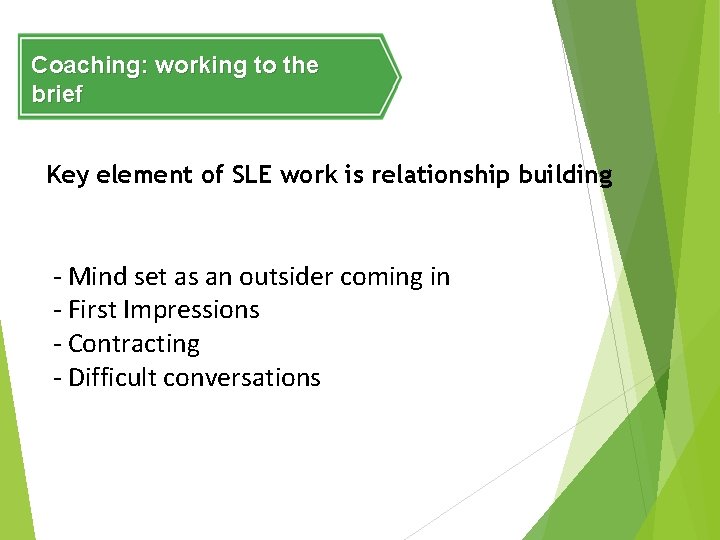
Coaching: working to the brief Key element of SLE work is relationship building - Mind set as an outsider coming in - First Impressions - Contracting - Difficult conversations
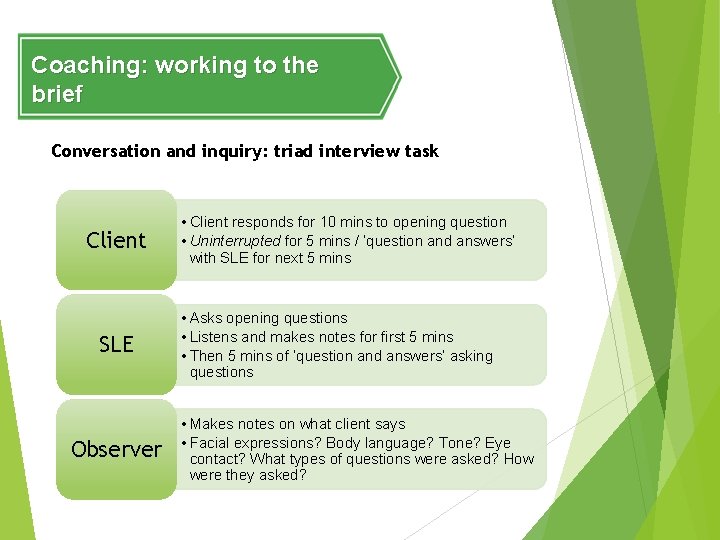
Coaching: working to the brief Conversation and inquiry: triad interview task Client SLE Observer • Client responds for 10 mins to opening question • Uninterrupted for 5 mins / ‘question and answers’ with SLE for next 5 mins • Asks opening questions • Listens and makes notes for first 5 mins • Then 5 mins of ‘question and answers’ asking questions • Makes notes on what client says • Facial expressions? Body language? Tone? Eye contact? What types of questions were asked? How were they asked?
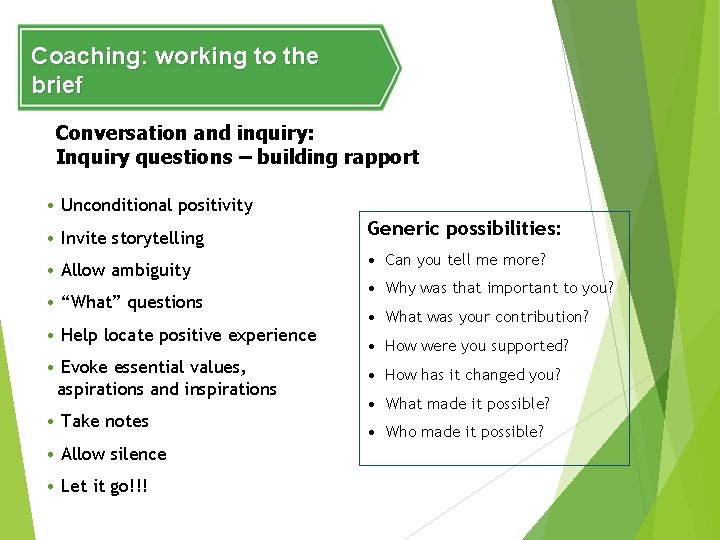
Coaching: working to the brief Conversation and inquiry: Inquiry questions – building rapport • Unconditional positivity • Invite storytelling • Allow ambiguity • “What” questions • Help locate positive experience • Evoke essential values, aspirations and inspirations • Take notes • Allow silence • Let it go!!! Generic possibilities: • Can you tell me more? • Why was that important to you? • What was your contribution? • How were you supported? • How has it changed you? • What made it possible? • Who made it possible?
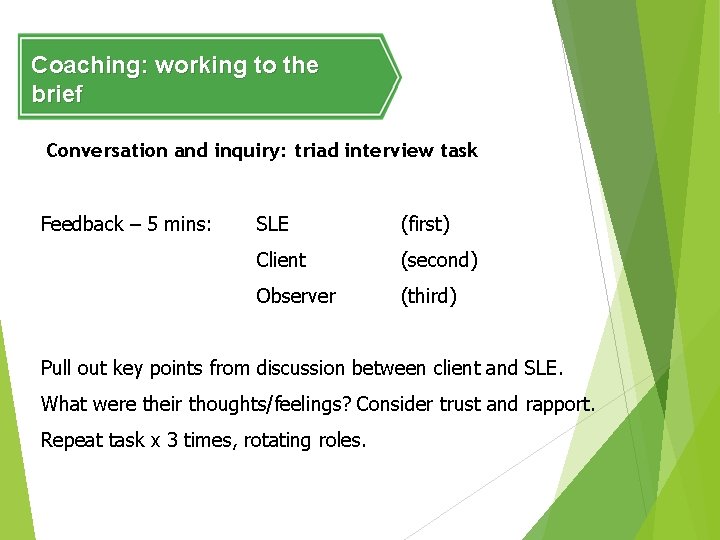
Coaching: working to the brief Conversation and inquiry: triad interview task Feedback – 5 mins: SLE (first) Client (second) Observer (third) Pull out key points from discussion between client and SLE. What were their thoughts/feelings? Consider trust and rapport. Repeat task x 3 times, rotating roles.
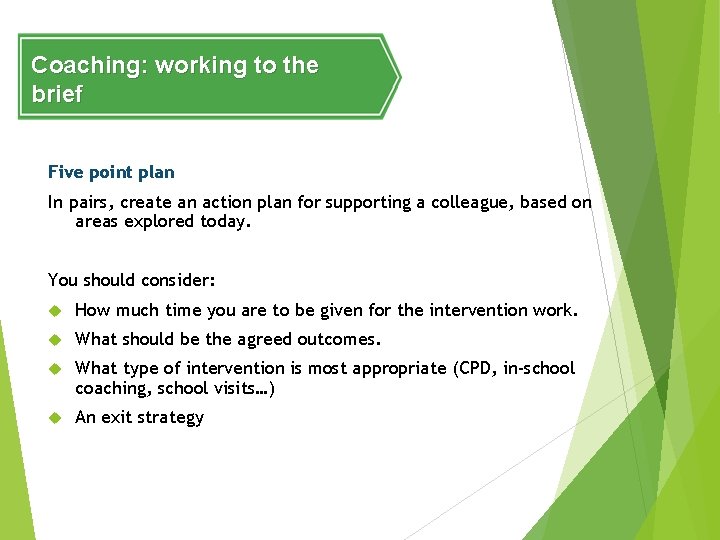
Coaching: working to the brief Five point plan In pairs, create an action plan for supporting a colleague, based on areas explored today. You should consider: How much time you are to be given for the intervention work. What should be the agreed outcomes. What type of intervention is most appropriate (CPD, in-school coaching, school visits…) An exit strategy
SLE Core Day training Evaluation www ebi
SLE Core Day training References Fruit trees quote Adair, J, 2006, How to grow leaders: The seven key principles of effective development, Kogan page Change quotes Deutschman, A, 2007, Change or die: The three key ways to change at work and in life, Harper. Business John Kotter, J, 2002, The heart of change: Real life stories of how people change their organisations, Harvard Business Press Different ways of driving change in others Clutterbuck, D, & Megginson, D, 2005, Techniques for coaching and mentoring, Taylor & Francis Kolb, D, 1984, Experiential learning: Experience as the source of learning and development, Financial Times/Prentice Hall Emotional intelligence competencies Goleman, D, 1996, Emotional intelligence: Why it can matter more than IQ, Bloomsbury Publishing Mc. Lelland, D, 1998, Identifying competencies with behavioural event interviews, Psycological Science 9 Iceberg model Spencer, L, and Spencer, S, 1993, Competence at work: Models for superior performance, Wiley
SLE Core Day training Training materials developed by Ashton on Mersey Teaching School on behalf of the National College and then by St Thomas More and Chiltern Teaching Schools on behalf of The East of England SLE Partnership
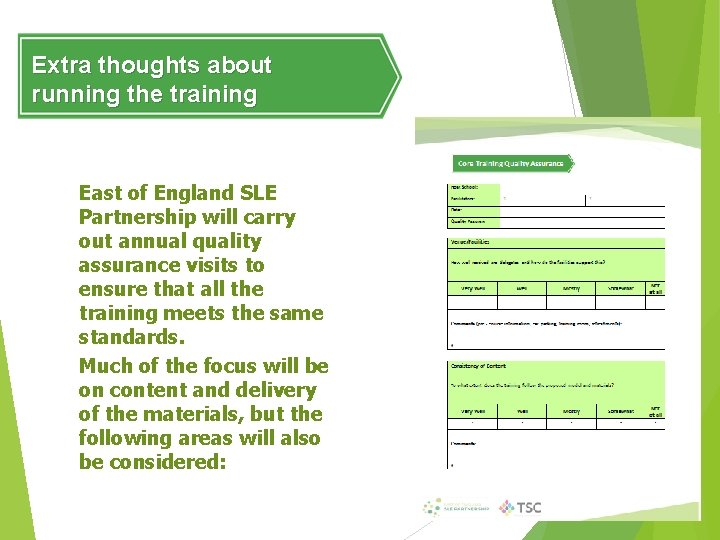
Extra thoughts about running the training East of England SLE Partnership will carry out annual quality assurance visits to ensure that all the training meets the same standards. Much of the focus will be on content and delivery of the materials, but the following areas will also be considered:
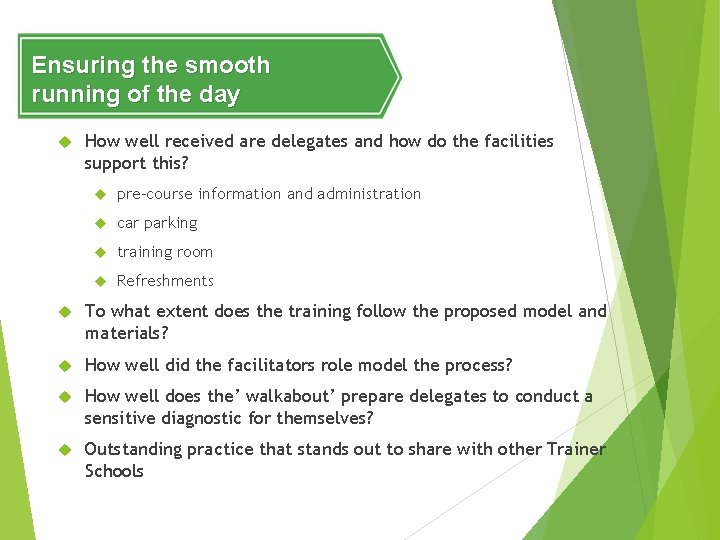
Ensuring the smooth running of the day How well received are delegates and how do the facilities support this? pre-course information and administration car parking training room Refreshments To what extent does the training follow the proposed model and materials? How well did the facilitators role model the process? How well does the’ walkabout’ prepare delegates to conduct a sensitive diagnostic for themselves? Outstanding practice that stands out to share with other Trainer Schools