
An Introduction to Safety Management System SMS Safety


- Slides: 53
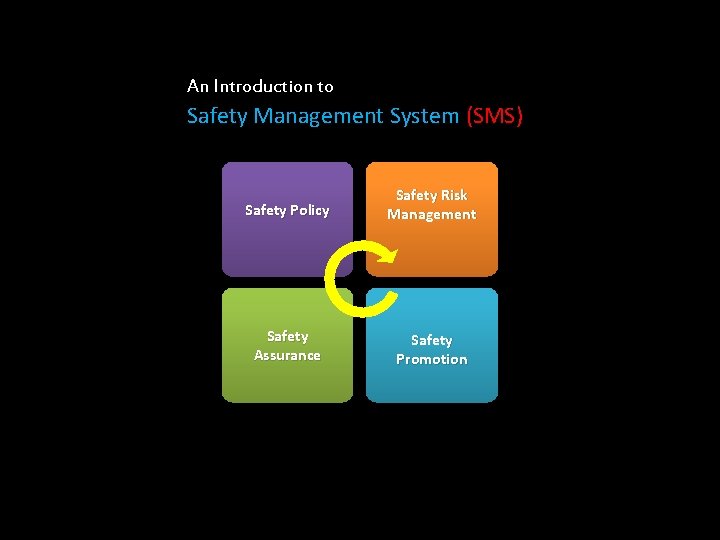
An Introduction to Safety Management System (SMS) Safety Policy Safety Risk Management Safety Assurance Safety Promotion
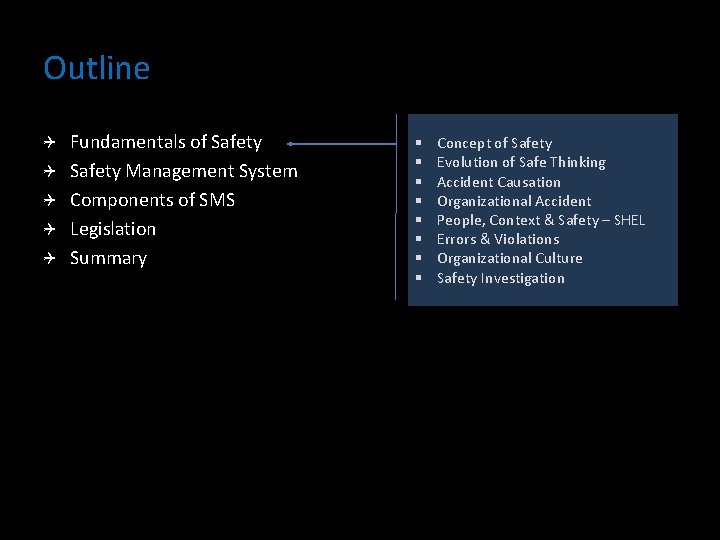
Outline Fundamentals of Safety Management System Components of SMS Legislation Summary § § § § Concept of Safety Evolution of Safe Thinking Accident Causation Organizational Accident People, Context & Safety – SHEL Errors & Violations Organizational Culture Safety Investigation
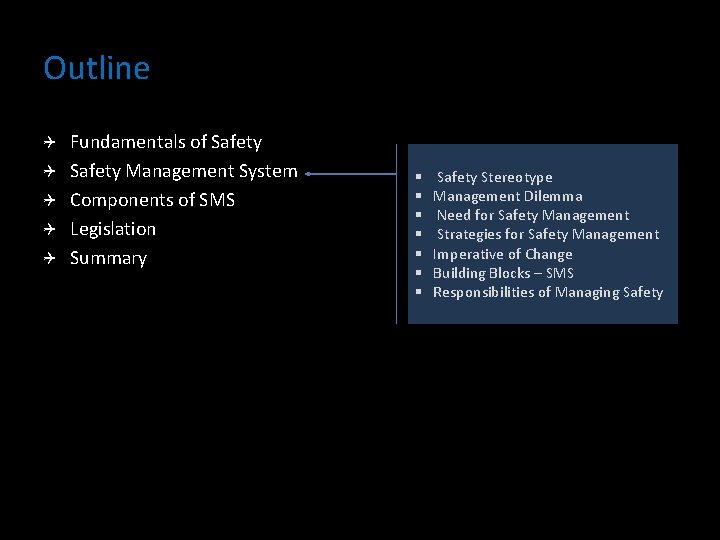
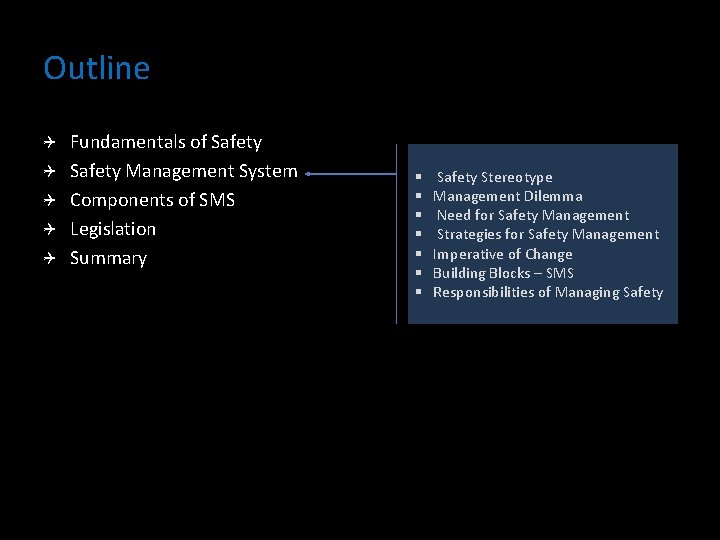
Outline Fundamentals of Safety Management System Components of SMS Legislation Summary § § § § Safety Stereotype Management Dilemma Need for Safety Management Strategies for Safety Management Imperative of Change Building Blocks – SMS Responsibilities of Managing Safety
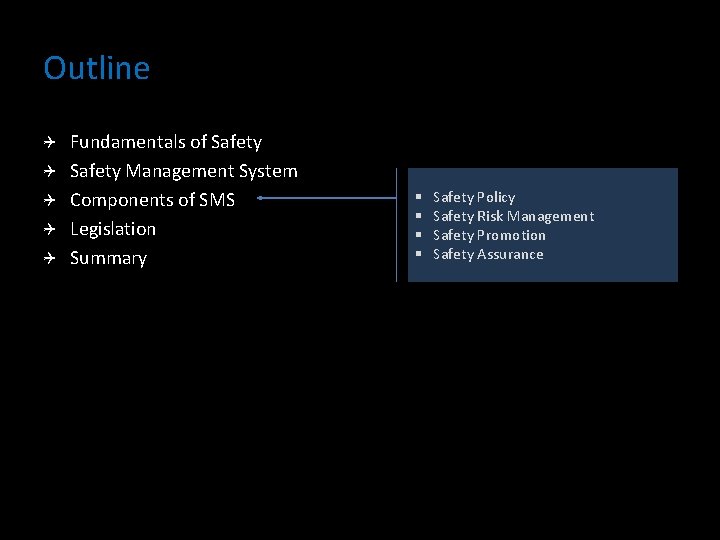
Outline Fundamentals of Safety Management System Components of SMS Legislation Summary § § Safety Policy Safety Risk Management Safety Promotion Safety Assurance
The Concept of Safety Zero accidents or serious incidents — a view widely held by the travelling public; Freedom from hazards, i. e. those factors which cause or are likely to cause harm; Attitudes of employees of aviation organizations towards unsafe acts and conditions; Error avoidance; and Regulatory compliance.
What is Safety? The state in which the possibility of harm to persons or of property damage is reduced to, and maintained at or below, an acceptable level through a continuing process of hazard identification and safety risk management.
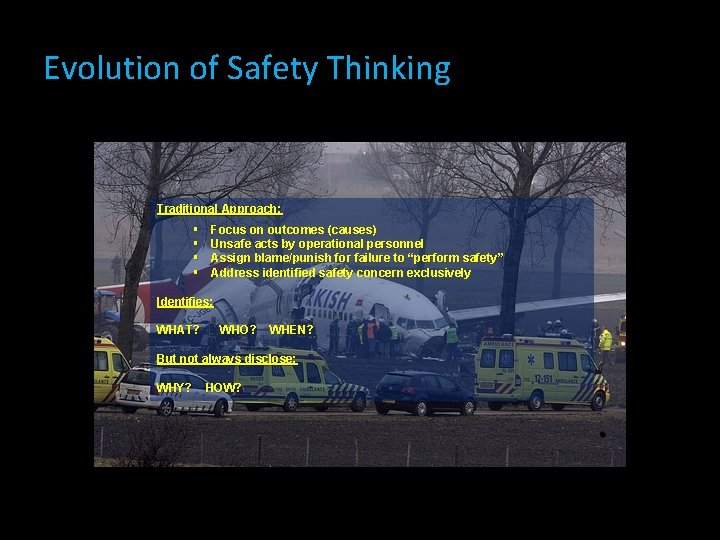
Evolution of Safety Thinking Traditional Approach: § § Focus on outcomes (causes) Unsafe acts by operational personnel Assign blame/punish for failure to “perform safety” Address identified safety concern exclusively Identifies: WHAT? WHO? WHEN? But not always disclose: WHY? HOW?
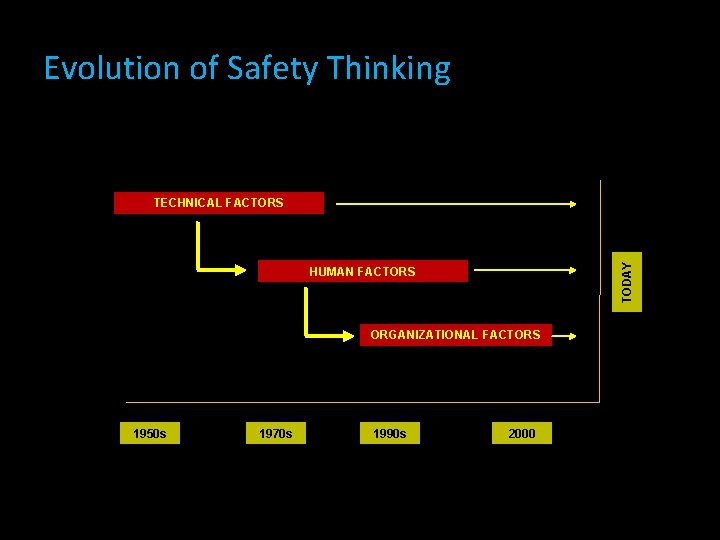
Evolution of Safety Thinking TODAY TECHNICAL FACTORS HUMAN FACTORS ORGANIZATIONAL FACTORS 1950 s 1970 s 1990 s 2000
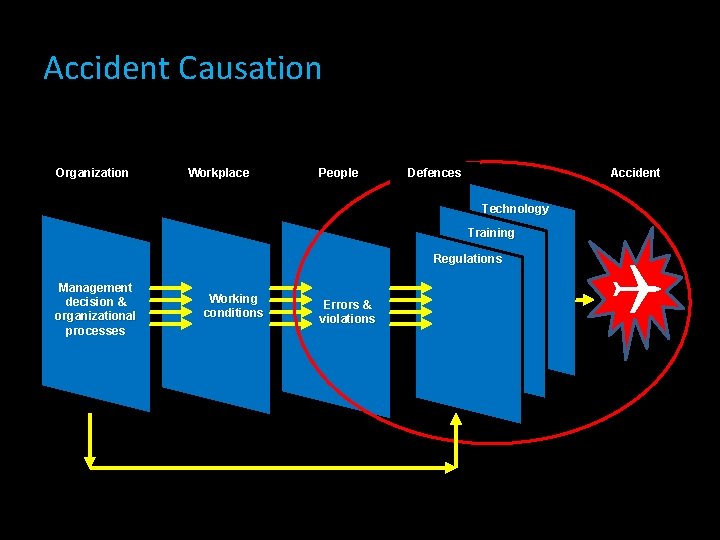
Accident Causation Organization Workplace People Defences Accident Technology Training Regulations Management decision & organizational processes Working conditions Errors & violations
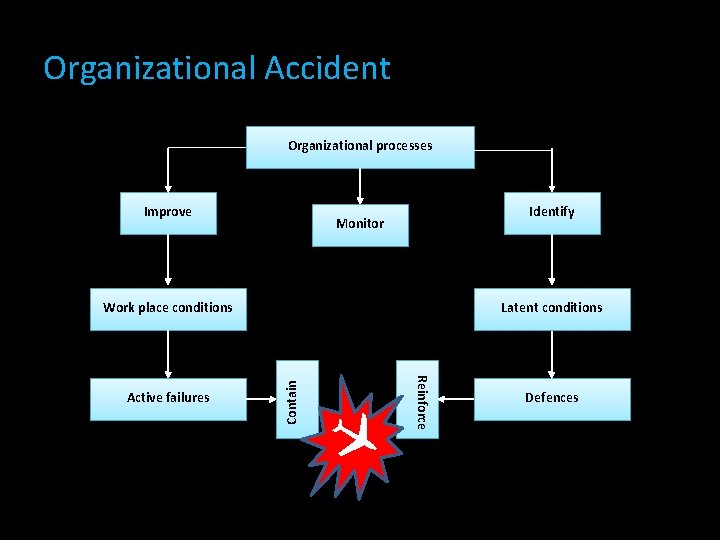
Organizational Accident Organizational processes Improve Identify Monitor Reinforce Active failures Latent conditions Contain Work place conditions Defences
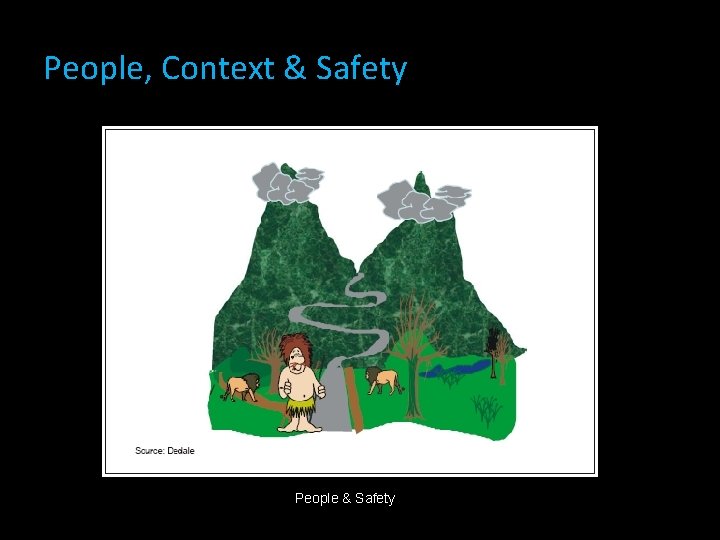
People, Context & Safety People & Safety
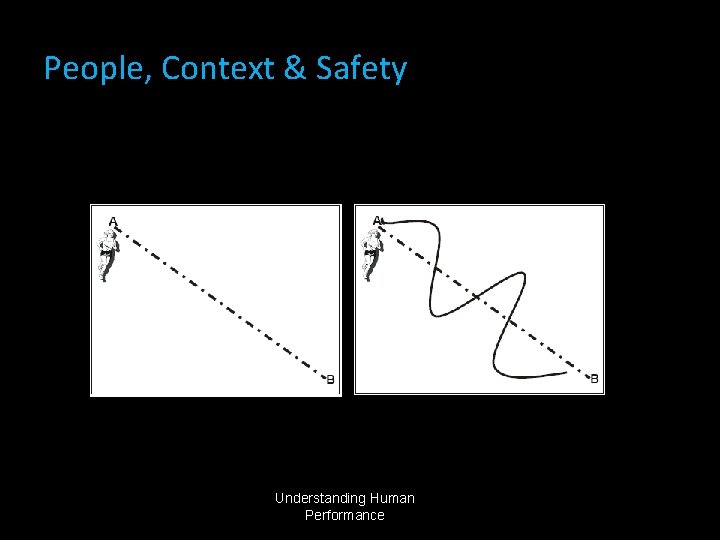
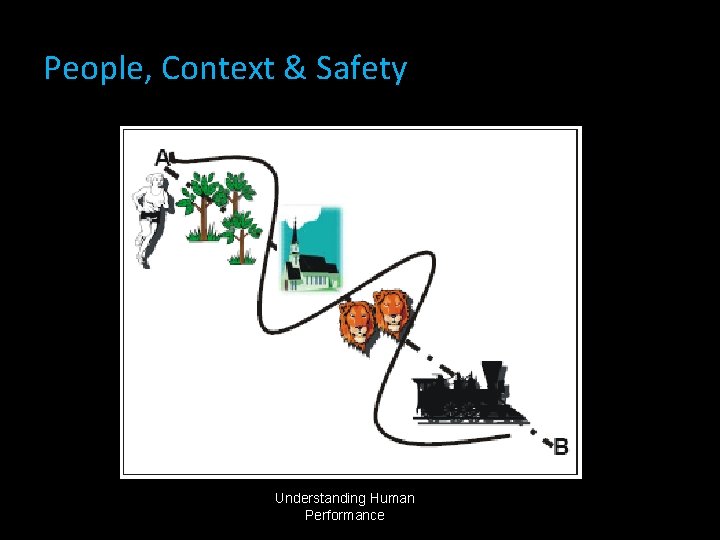
People, Context & Safety Understanding Human Performance
People, Context & Safety Understanding Human Performance
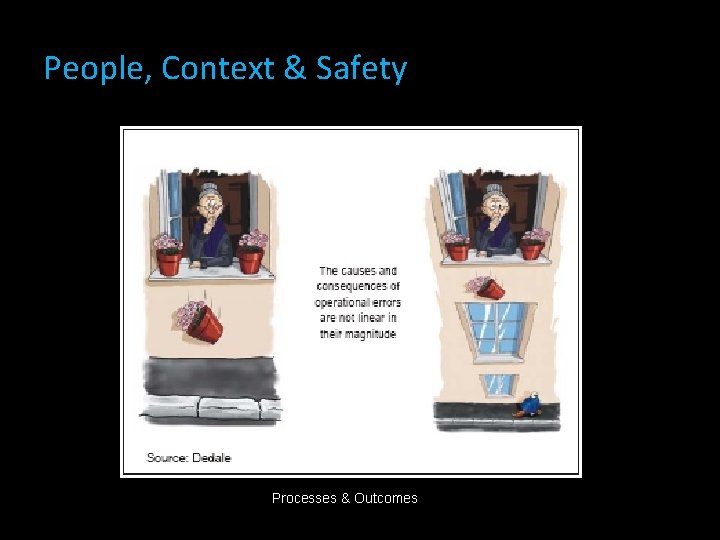
People, Context & Safety Processes & Outcomes
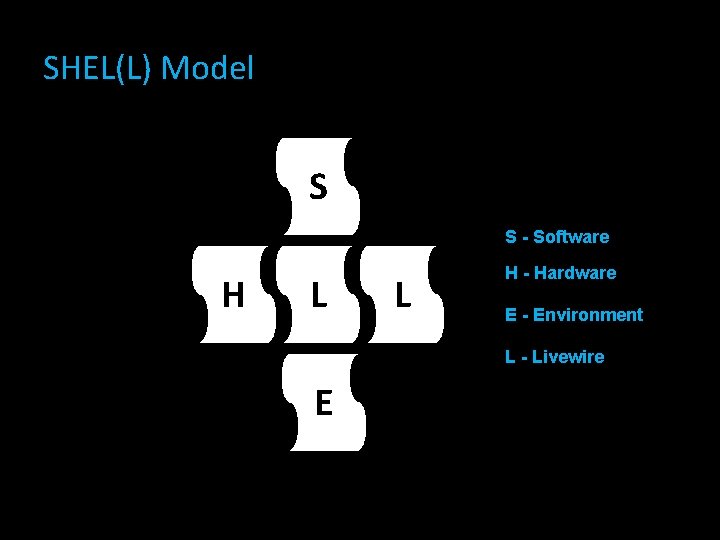
SHEL(L) Model S S - Software H L L H - Hardware E - Environment L - Livewire E
SHEL(L) Model Important factors affecting human performance: a) Physical factors b) Physiological factors c) Psychological factors d) Psycho-social factors
SHEL(L) Model Interfaces between different components of the aviation system: a) Liveware-Hardware (L-H) b) Liveware-Software (L-S) c) Liveware-Liveware (L-L) d) Liveware-Environment (L-E)
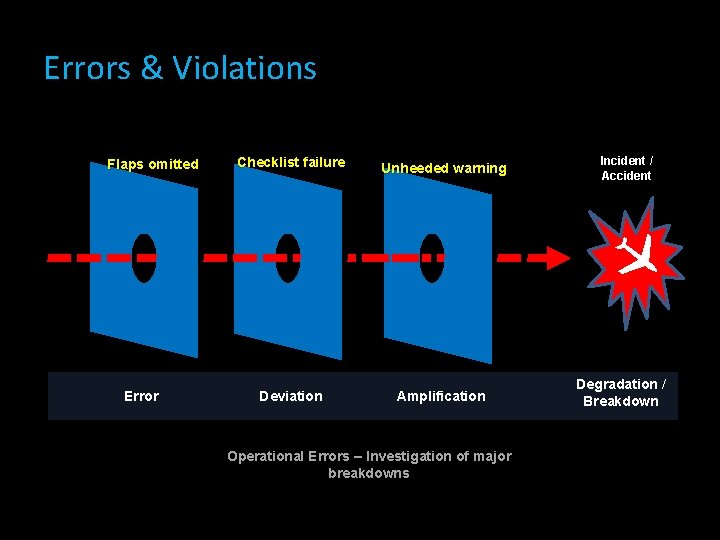
Errors & Violations Flaps omitted Checklist failure Unheeded warning Incident / Accident Error Deviation Amplification Operational Errors – Investigation of major breakdowns Degradation / Breakdown
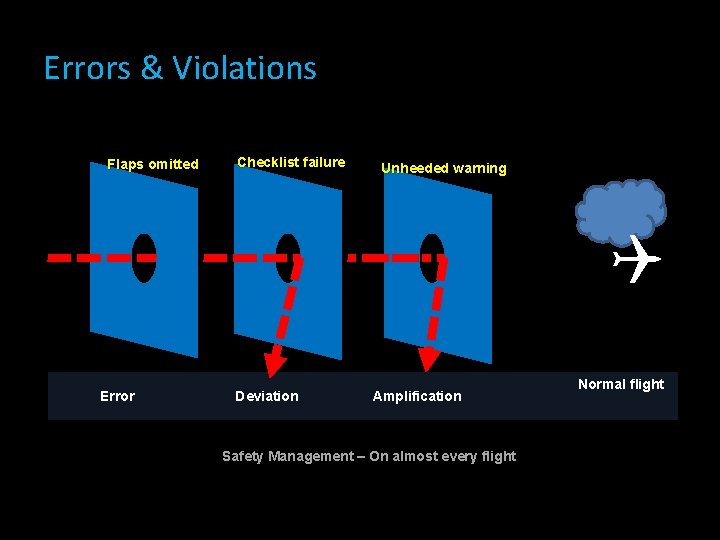
Errors & Violations Flaps omitted Checklist failure Unheeded warning Error Deviation Amplification Safety Management – On almost every flight Normal flight
3 Strategies to Control Operational Errors 1. Reduction strategies a) Human-centred design; b) Ergonomic factors; and c) Training. 2. Capturing strategies a) Checklists; b) Task cards; and c) Flight strips. 3. Tolerance strategies a) system redundancies; and b) structural inspections.
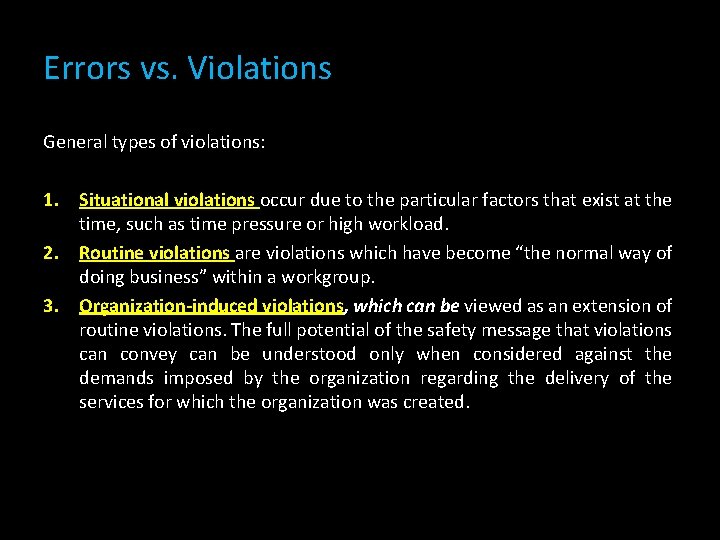
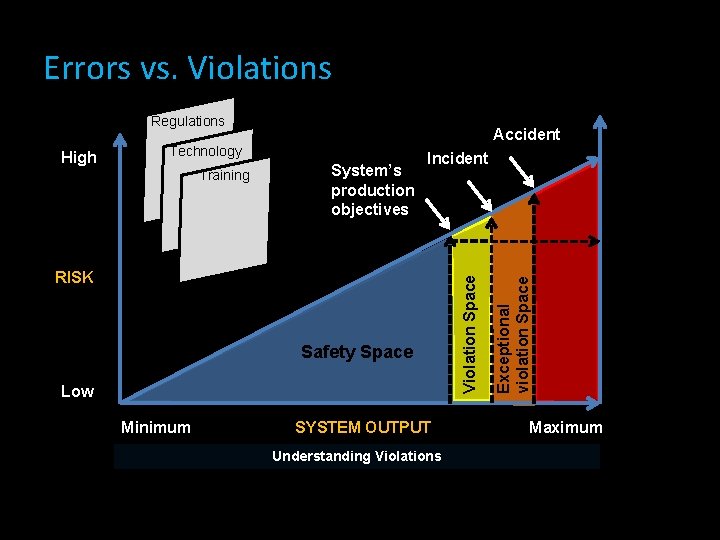
Errors vs. Violations General types of violations: 1. Situational violations occur due to the particular factors that exist at the time, such as time pressure or high workload. 2. Routine violations are violations which have become “the normal way of doing business” within a workgroup. 3. Organization-induced violations, which can be viewed as an extension of routine violations. The full potential of the safety message that violations can convey can be understood only when considered against the demands imposed by the organization regarding the delivery of the services for which the organization was created.
Errors vs. Violations Regulations Training System’s production objectives Incident RISK Safety Space Low Minimum SYSTEM OUTPUT Understanding Violations Exceptional violation Space Technology Violation Space High Accident Maximum
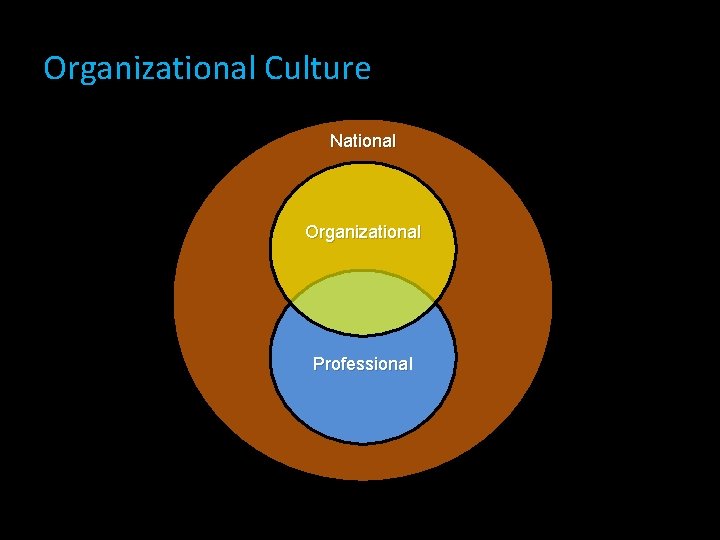
Organizational Culture National Organizational Professiona
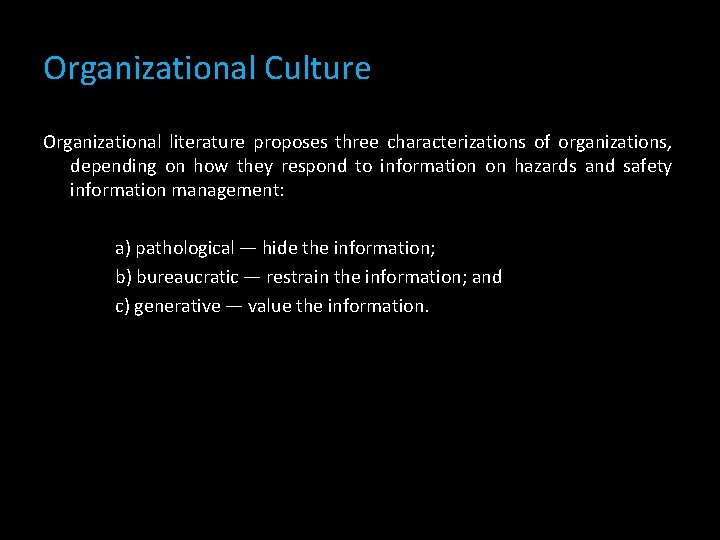
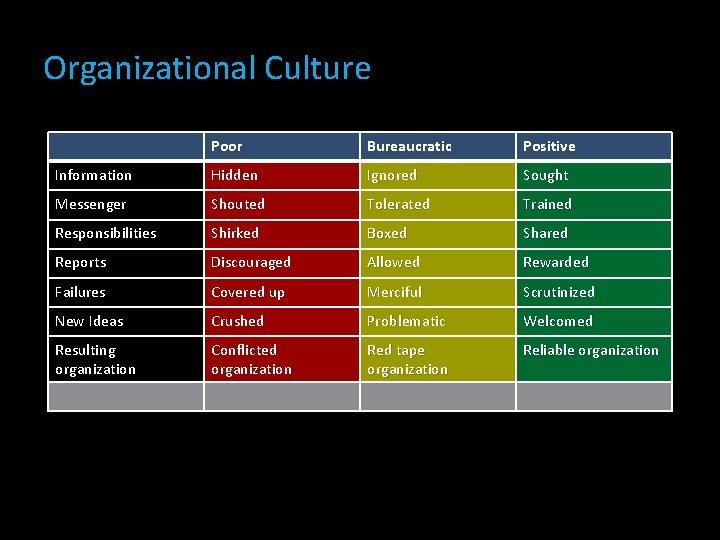
Organizational Culture Organizational literature proposes three characterizations of organizations, depending on how they respond to information on hazards and safety information management: a) pathological — hide the information; b) bureaucratic — restrain the information; and c) generative — value the information.
Organizational Culture a) National culture differentiates the national characteristics and value systems of particular nations. b) Professional culture differentiates the characteristics and value systems of particular professional groups c) Organizational culture differentiates the characteristics and value systems of particular organizations
Organizational Culture Poor Bureaucratic Positive Information Hidden Ignored Sought Messenger Shouted Tolerated Trained Responsibilities Shirked Boxed Shared Reports Discouraged Allowed Rewarded Failures Covered up Merciful Scrutinized New Ideas Crushed Problematic Welcomed Resulting organization Conflicted organization Red tape organization Reliable organization
Effective Safety Reporting Effective safety reporting builds upon certain basic attributes, such as: a) Senior management places strong emphasis on hazard identification as part of the strategy for the management of safety; b) Senior management and operational personnel hold a realistic view of the hazards faced by the organization’s service delivery activities; c) Senior management defines the operational requirements needed to support active hazard reporting, ensures that key safety data are properly registered, demonstrates a receptive attitude to the reporting of hazards by operational personnel and implements measures to address the consequences of hazards;
Effective Safety Reporting d) Senior management ensures that key safety data are properly safeguarded and promotes a system of checks and); e) Personnel are formally trained to recognize and report hazards and understand the incidence and consequences of hazards in the activities supporting delivery of services; and f) There is a low incidence of hazardous behaviour, and a safety ethic which discourages such behaviour.
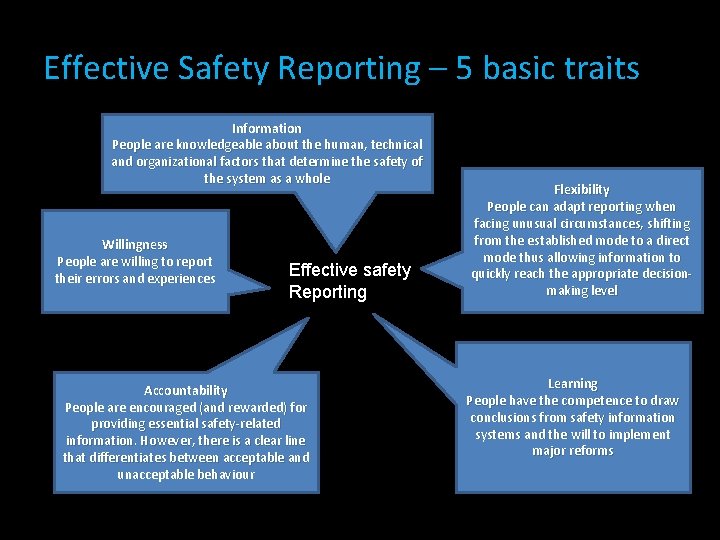
Effective Safety Reporting – 5 basic traits Information People are knowledgeable about the human, technical and organizational factors that determine the safety of the system as a whole Willingness People are willing to report their errors and experiences Effective safety Reporting Accountability People are encouraged (and rewarded) for providing essential safety-related information. However, there is a clear line that differentiates between acceptable and unacceptable behaviour Flexibility People can adapt reporting when facing unusual circumstances, shifting from the established mode to a direct mode thus allowing information to quickly reach the appropriate decisionmaking level Learning People have the competence to draw conclusions from safety information systems and the will to implement major reforms
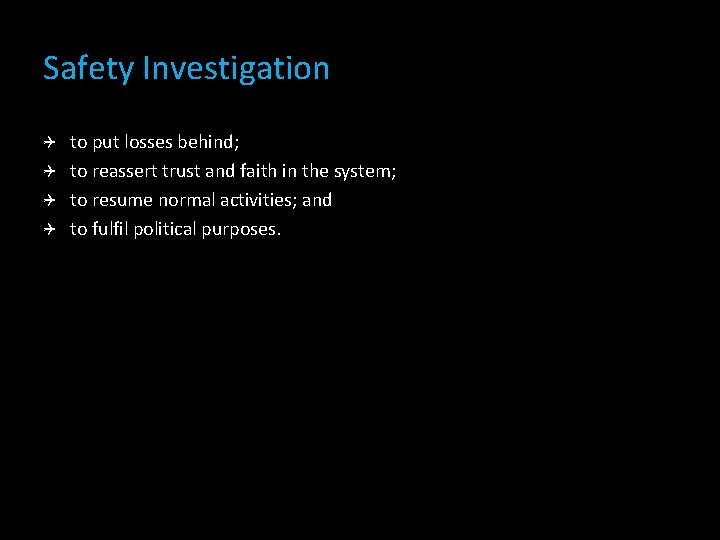
Safety Investigation to put losses behind; to reassert trust and faith in the system; to resume normal activities; and to fulfil political purposes.
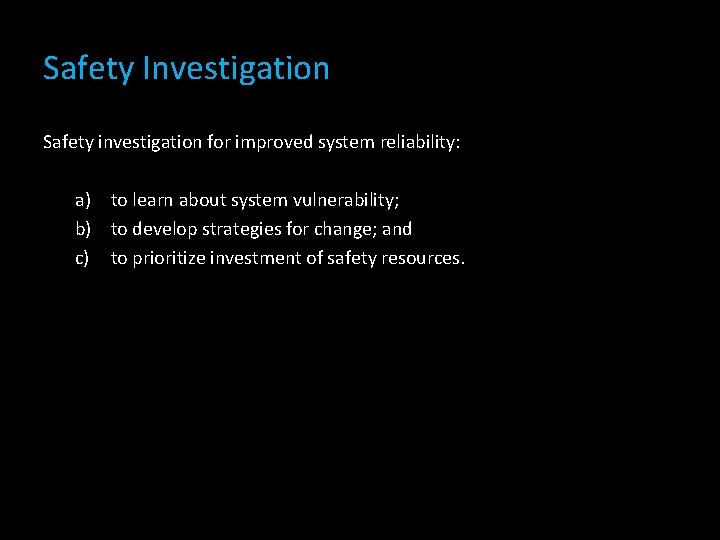
Safety Investigation Safety investigation for improved system reliability: a) to learn about system vulnerability; b) to develop strategies for change; and c) to prioritize investment of safety resources.
Outline Fundamentals of Safety Management System Components of SMS Legislation Summary § § § § Safety Stereotype Management Dilemma Need for Safety Management Strategies for Safety Management Imperative of Change Building Blocks – SMS Responsibilities of Managing Safety
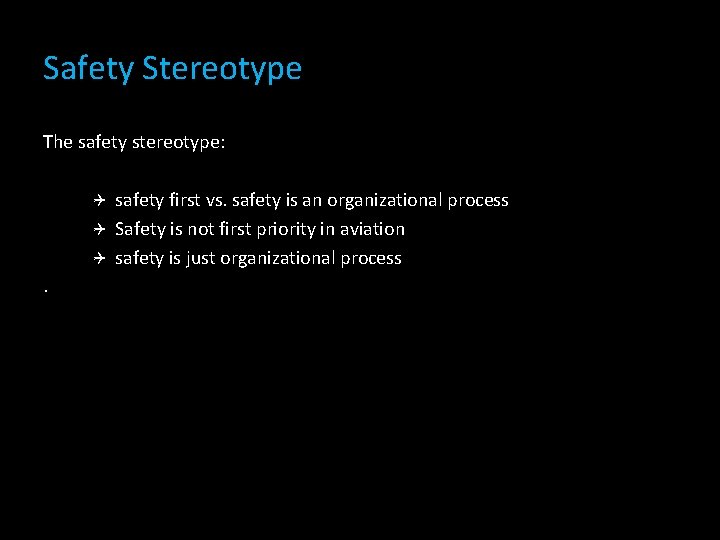
Safety Stereotype The safety stereotype: . safety first vs. safety is an organizational process Safety is not first priority in aviation safety is just organizational process
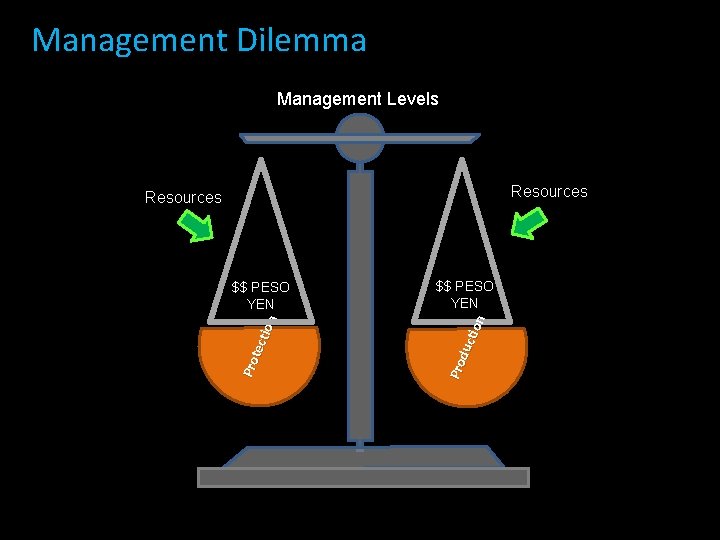
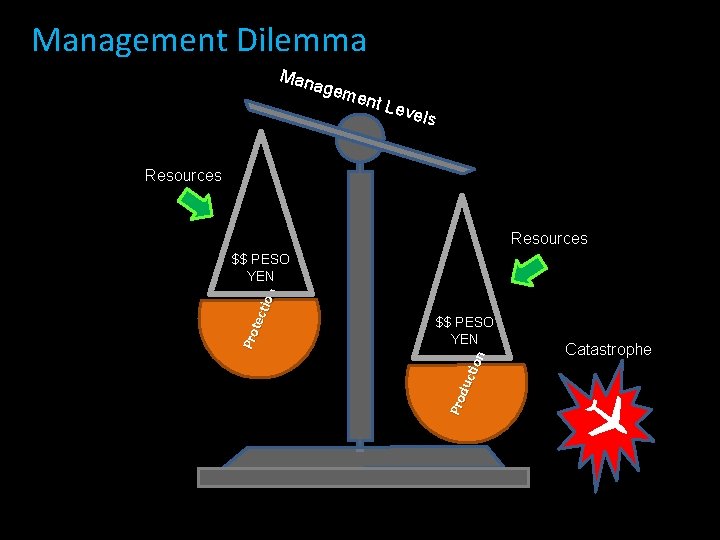
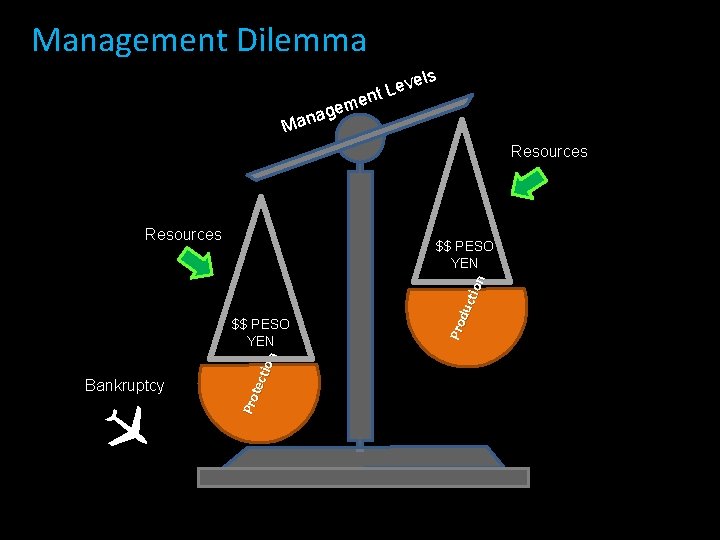
Management Dilemma of 2 P’s: Production Protection
Management Dilemma Management Levels Resources $$ PESO YEN Pro tec tion Pro duc tion Resources
Management Dilemma Man agem ent L e vels Resources $$ PESO YEN Pro duc tion Pro tec tion $$ PESO YEN Catastrophe
Management Dilemma els v e nt L e m e ag n a M Resources Bankruptcy Pro tec tion $$ PESO YEN Pro duc tion $$ PESO YEN
Need for Safety Management Minor-major accident § Major air disaster are rare § Incidents occur more frequently § Ignoring the major could lead to an increase number of more serious accidents
Need for Safety Management Minor-major accident Economics of Safety § § Accidents cost money Insurance can help but not all There are many uninsured cost Lost of confidence of the travelling public
Need for Safety Management Minor-major accident Economics of Safety Publics perceived safety while traveling § Prerequisite for a sustainable aviation business
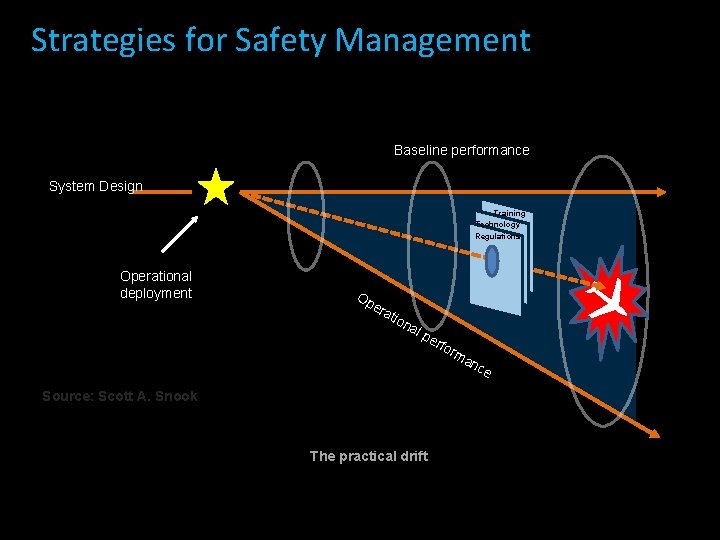
Strategies for Safety Management Baseline performance System Design Training Technology Regulations Operational deployment Op era tio na lp Source: Scott A. Snook The practical drift erf orm an ce
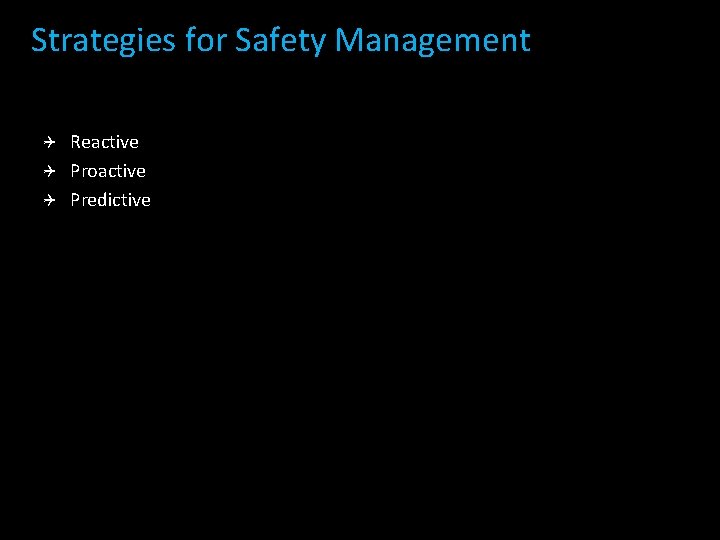
Strategies for Safety Management Reactive Proactive Predictive
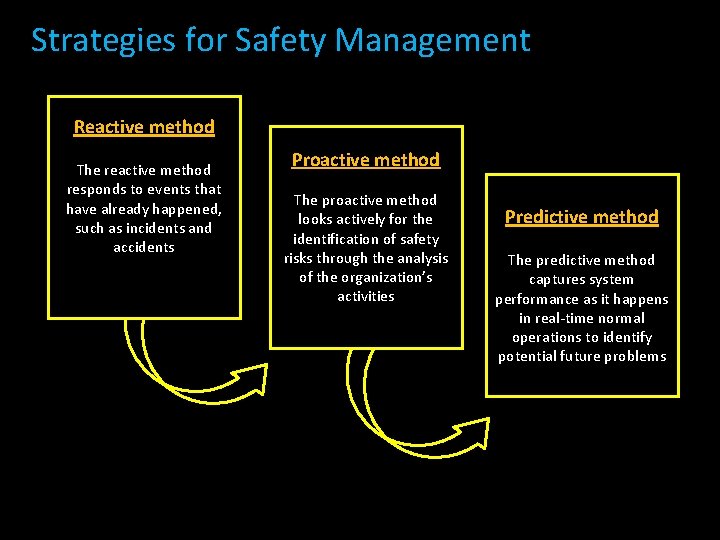
Strategies for Safety Management Reactive method The reactive method responds to events that have already happened, such as incidents and accidents Proactive method The proactive method looks actively for the identification of safety risks through the analysis of the organization’s activities Predictive method The predictive method captures system performance as it happens in real-time normal operations to identify potential future problems
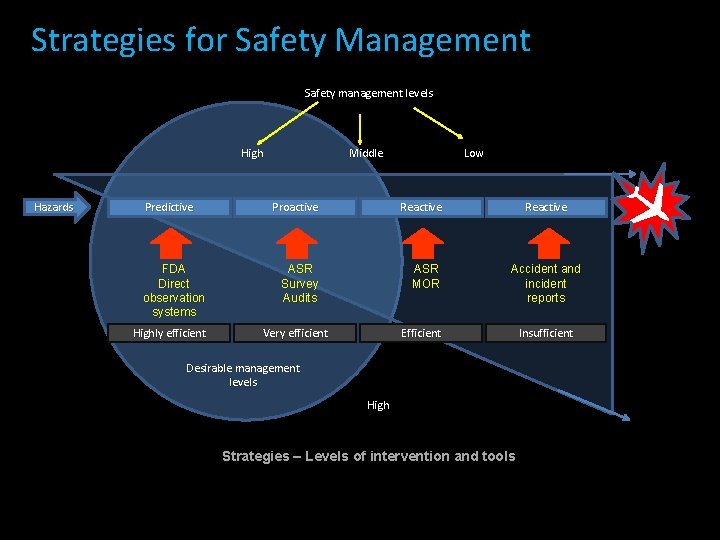
Strategies for Safety Management Safety management levels High Hazards Predictive FDA Direct observation systems Highly efficient Middle Low Proactive Reactive ASR Survey Audits ASR MOR Very efficient Reactive Accident and incident reports Efficient Desirable management levels High Strategies – Levels of intervention and tools Insufficient
Imperative of Change The management of change Aircraft and Equipment are changing overtime Hazards that are by product of change Change can introduce new hazard Formal Process for the Management of change § § § Critically of system and activities Stability of systems and operational environment Past performance
Imperative of Change The traditional safety paradigm relied on the accident/serious incident investigation process as its main safety intervention and method, and it was built upon three basic assumptions: a) The aviation system performs most of the time as per design specifications (i. e. baseline performance); b) Regulatory compliance guarantees system baseline performance and therefore ensures safety (compliance-based); and c) Because regulatory compliance guarantees system baseline performance, minor, largely inconsequential deviations during routine operations (i. e. processes) do not matter, only major deviations leading to bad consequences (i. e. outcomes) matter (outcome oriented).
Imperative of Change It is based on the notion of managing safety through process control, beyond the investigation of occurrences, and it builds upon three basic assumptions also: a) The aviation system does not perform most of the time as per design specifications (i. e. operational performance leads to the practical drift); b) Rather than relying on regulatory compliance exclusively, realtime performance of the system is constantly monitored (performance-based); and c) Minor, inconsequential deviations during routine operations are constantly tracked analysed (process oriented).
8 Building Blocks - SMS 1. 2. 3. 4. 5. 6. 7. 8. Senior Management’s commitment to the management of safety Effective safety reporting Continuous monitoring Investigation of safety occurrences Sharing safety lessons learned and best practices Integration of safety training for operational personnel Effective implementation of standard operating procedures (SOP’s) Continuous improvement of the overall level of safety
4 Responsibilities of Managing Safety The responsibilities for managing safety can be grouped into four generic and basic areas, as follows: a) Definition of policies and procedures regarding safety. Policies and procedures are organizational mandates reflecting how senior management wants operations to be conducted. b) Allocation of resources for safety management activities. Managing safety requires resources. The allocation of resources is a managerial function. c) Adoption of best industry practices. The tradition of aviation regarding safety excellence has led to the continuous development of robust safety practices. Aviation has, in addition, a tradition regarding exchange of safety information through both institutional and informal channels.
4 Responsibilities of Managing Safety d) Incorporation of regulations governing civil aviation safety. There will always be a need for a regulatory framework as the bedrock for safety management endeavours. In fact, sensible safety management can develop only from sensible regulations.
Summary In summary, safety management: a) includes the entire operation; b) focuses on processes, making a clear differentiation between processes and outcomes; c) is data-driven; d) involves constant monitoring; e) is strictly documented; f) aims at gradual improvement as opposed to dramatic change; and g) is based on strategic planning as opposed to piecemeal initiatives.
The End
Questions & Answers