
An introduction to RPA within NHS corporate services


- Slides: 8
An introduction to RPA within NHS corporate services July 2019
Introduction to Robotic Process Automation (RPA) RPA is software which uses the notion of virtual workers, to perform repetitive administrative tasks or processes which would otherwise be completed by humans. RPA can be seen as the first step in automation for an organisation. What can RPA do? Navigate Interact with systems Enter data Log in/out Copy/Paste Link to APIs 2 | An introduction to RPA within NHS corporate services What are the benefits? ► Works 24/7/365 ► Fast and effective ► Scalable ► Cost effective – equivalent to 8 WTE’s ► “Out of the box” solutions with no coding required
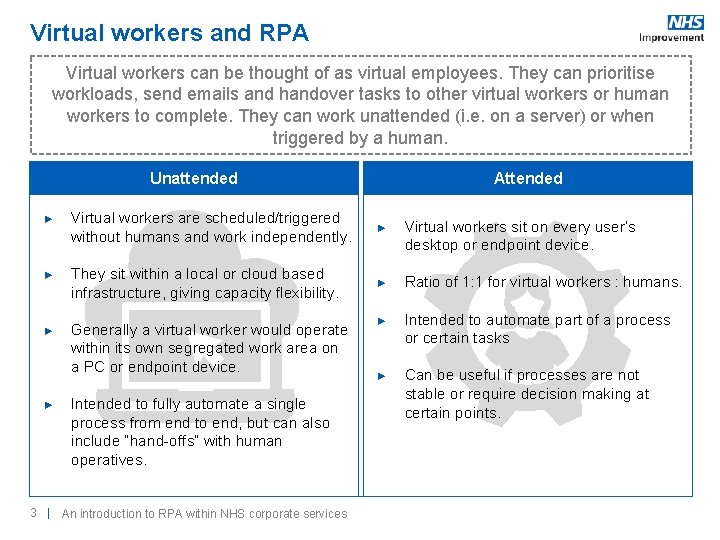
Virtual workers and RPA Virtual workers can be thought of as virtual employees. They can prioritise workloads, send emails and handover tasks to other virtual workers or human workers to complete. They can work unattended (i. e. on a server) or when triggered by a human. Unattended Attended ► Virtual workers are scheduled/triggered without humans and work independently. ► Virtual workers sit on every user’s desktop or endpoint device. ► They sit within a local or cloud based infrastructure, giving capacity flexibility. ► Ratio of 1: 1 for virtual workers : humans. ► Generally a virtual worker would operate within its own segregated work area on a PC or endpoint device. ► Intended to automate part of a process or certain tasks ► Can be useful if processes are not stable or require decision making at certain points. ► Intended to fully automate a single process from end to end, but can also include “hand-offs” with human operatives. 3 | An introduction to RPA within NHS corporate services
A demonstration of RPA… 4 | An introduction to RPA within NHS corporate services
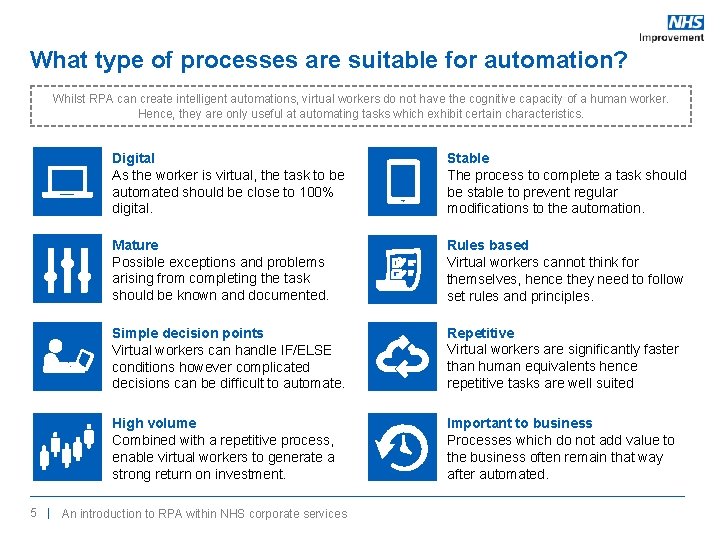
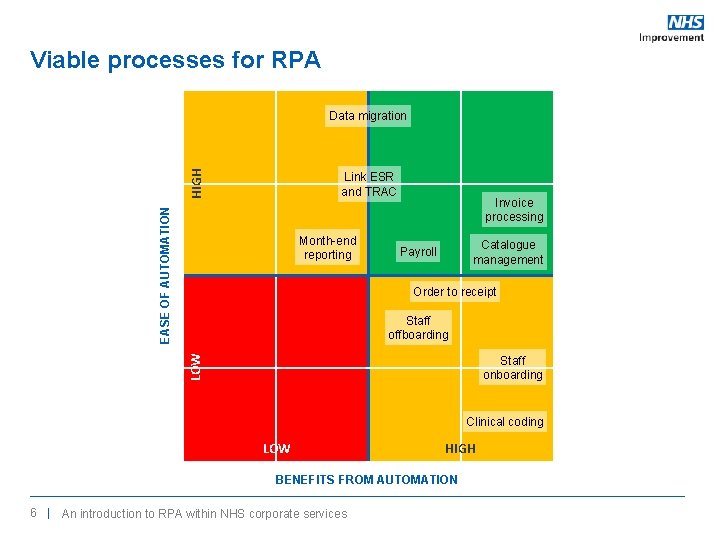
What type of processes are suitable for automation? Whilst RPA can create intelligent automations, virtual workers do not have the cognitive capacity of a human worker. Hence, they are only useful at automating tasks which exhibit certain characteristics. Digital As the worker is virtual, the task to be automated should be close to 100% digital. Stable The process to complete a task should be stable to prevent regular modifications to the automation. Mature Possible exceptions and problems arising from completing the task should be known and documented. Rules based Virtual workers cannot think for themselves, hence they need to follow set rules and principles. Simple decision points Virtual workers can handle IF/ELSE conditions however complicated decisions can be difficult to automate. Repetitive Virtual workers are significantly faster than human equivalents hence repetitive tasks are well suited High volume Combined with a repetitive process, enable virtual workers to generate a strong return on investment. Important to business Processes which do not add value to the business often remain that way after automated. 5 | An introduction to RPA within NHS corporate services
Viable processes for RPA HIGH Data migration EASE OF AUTOMATION Link ESR and TRAC Month-end reporting Invoice processing Catalogue management Payroll Order to receipt LOW Staff offboarding Staff onboarding Clinical coding LOW HIGH BENEFITS FROM AUTOMATION 6 | An introduction to RPA within NHS corporate services
In conclusion…. . § RPA can be used to deliver on CIP targets and reduce burden of repetitive processes on staff § Be clear on ambitions and aims before commissioning a supplier and ensure the process is appropriate § Consider a proof of concept and the potential financial investment this may require § Utilise Supplier skills for early stages but look to build STP / ICS shared development expertise and capabilities over the longer term § Cloud based solutions which can be procured effectively an efficiently through G Cloud Frameworks § As RPA automations are digital objects, they can be readily shared with other providers and NHS I will support and encourage trusts to share developments and knowledge 7 | An introduction to RPA within NHS corporate services
nhsi. corpservices@nhs. net 8 | An introduction to RPA within NHS corporate services