
An introduction to radiation hard Monolithic Active Pixel
- Slides: 28
An introduction to radiation hard Monolithic Active Pixel Sensors Or: A tool to measure Secondary Vertices Dennis Doering*, Goethe University Frankfurt am Main on behalf of the CBM-MVD-Collaboration 1
An introduction to radiation hard Monolithic Active Pixel Sensors Or: A tool to measure Secondary Vertices Outline - The challenge to measure Secondary Vertices - Operation principle of MAPS - Radiation damage effects - High Resistivity and radiation hardness - Conclusion 2
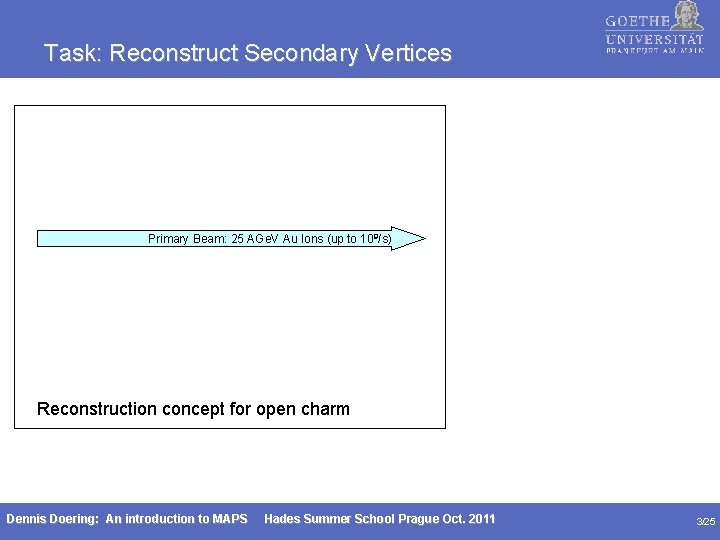
Task: Reconstruct Secondary Vertices Primary Beam: 25 AGe. V Au Ions (up to 109/s) Reconstruction concept for open charm Dennis Doering: An introduction to MAPS Hades Summer School Prague Oct. 2011 3/17 /25
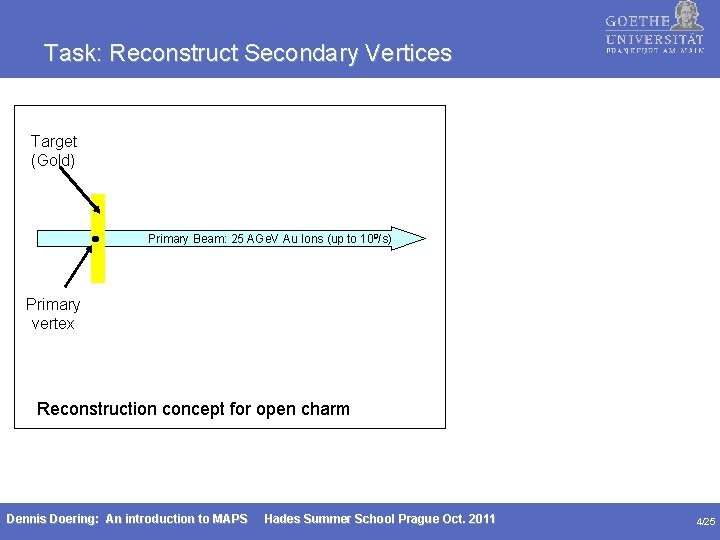
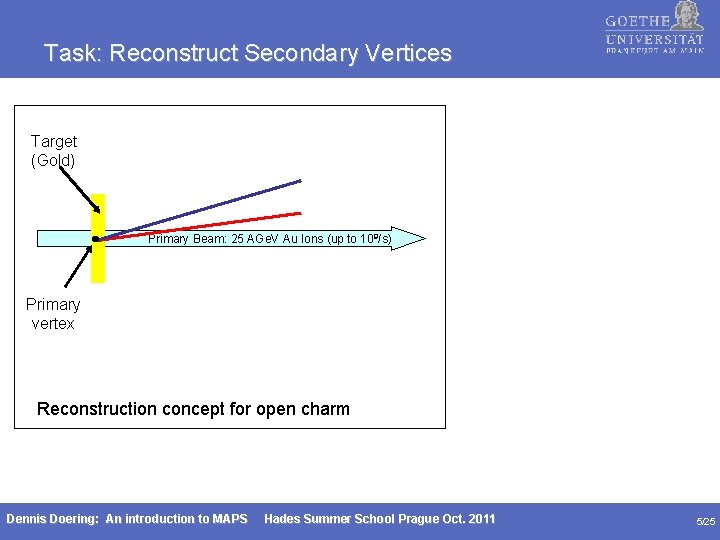
Task: Reconstruct Secondary Vertices Target (Gold) Primary Beam: 25 AGe. V Au Ions (up to 109/s) Primary vertex Reconstruction concept for open charm Dennis Doering: An introduction to MAPS Hades Summer School Prague Oct. 2011 4/17 /25
Task: Reconstruct Secondary Vertices Target (Gold) Primary Beam: 25 AGe. V Au Ions (up to 109/s) Primary vertex Reconstruction concept for open charm Dennis Doering: An introduction to MAPS Hades Summer School Prague Oct. 2011 5/17 /25
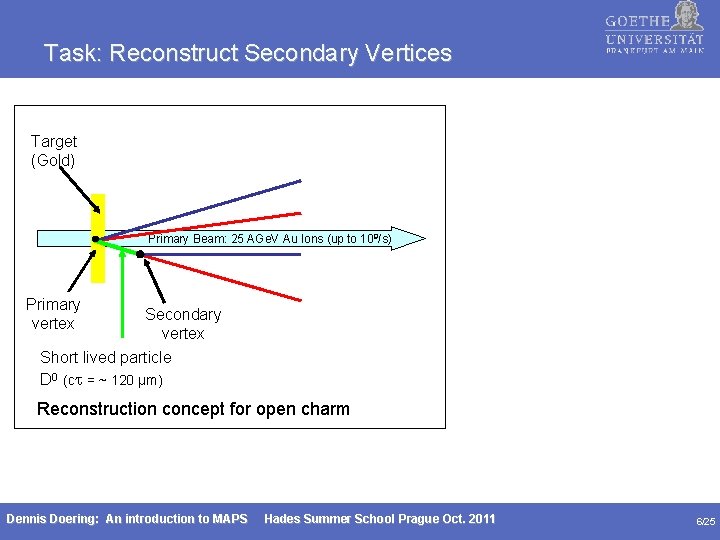
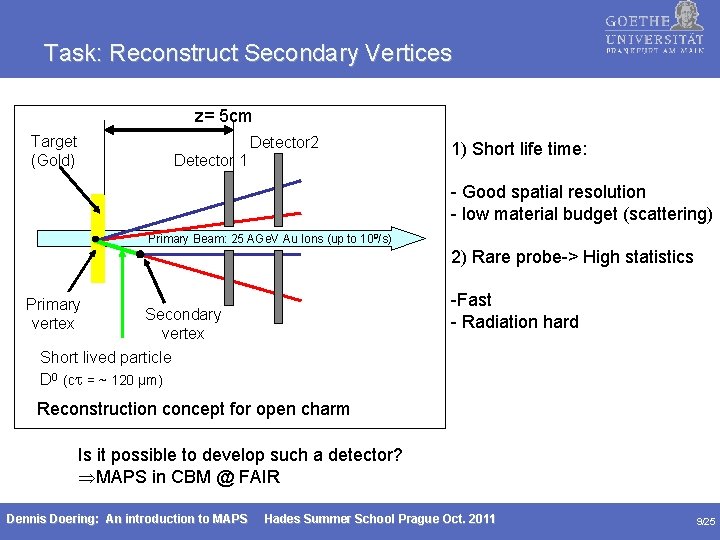
Task: Reconstruct Secondary Vertices Target (Gold) Primary Beam: 25 AGe. V Au Ions (up to 109/s) Primary vertex Secondary vertex Short lived particle D 0 (ct = ~ 120 µm) Reconstruction concept for open charm Dennis Doering: An introduction to MAPS Hades Summer School Prague Oct. 2011 6/17 /25
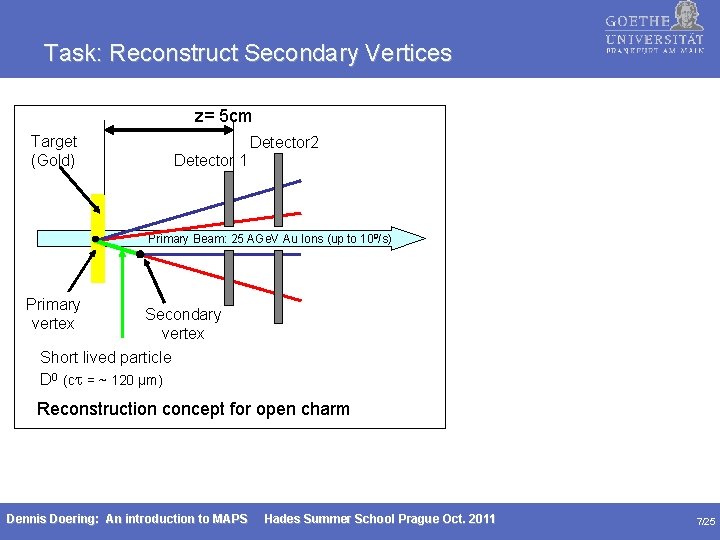
Task: Reconstruct Secondary Vertices zz= 5 cm Target (Gold) Detector 2 Detector 1 Primary Beam: 25 AGe. V Au Ions (up to 109/s) Primary vertex Secondary vertex Short lived particle D 0 (ct = ~ 120 µm) Reconstruction concept for open charm Dennis Doering: An introduction to MAPS Hades Summer School Prague Oct. 2011 7/17 /25
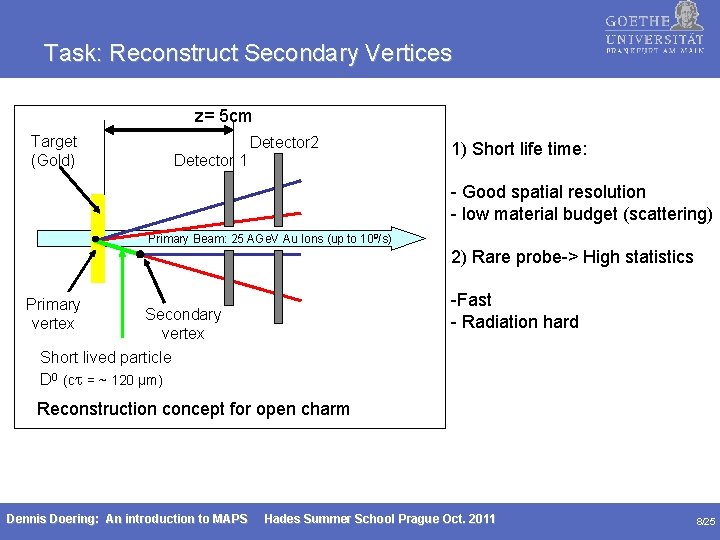
Task: Reconstruct Secondary Vertices z= 5 cm Target (Gold) Detector 2 Detector 1 1) Short life time: - Good spatial resolution - low material budget (scattering) Primary Beam: 25 AGe. V Au Ions (up to 109/s) 2) Rare probe-> High statistics -Fast - Radiation hard Primary vertex Secondary vertex Short lived particle D 0 (ct = ~ 120 µm) Reconstruction concept for open charm Dennis Doering: An introduction to MAPS Hades Summer School Prague Oct. 2011 8/17 /25
Task: Reconstruct Secondary Vertices zz= 5 cm Target (Gold) Detector 2 Detector 1 1) Short life time: - Good spatial resolution - low material budget (scattering) Primary Beam: 25 AGe. V Au Ions (up to 109/s) 2) Rare probe-> High statistics -Fast - Radiation hard Primary vertex Secondary vertex Short lived particle D 0 (ct = ~ 120 µm) Reconstruction concept for open charm Is it possible to develop such a detector? ÞMAPS in CBM @ FAIR Dennis Doering: An introduction to MAPS Hades Summer School Prague Oct. 2011 9/17 /25
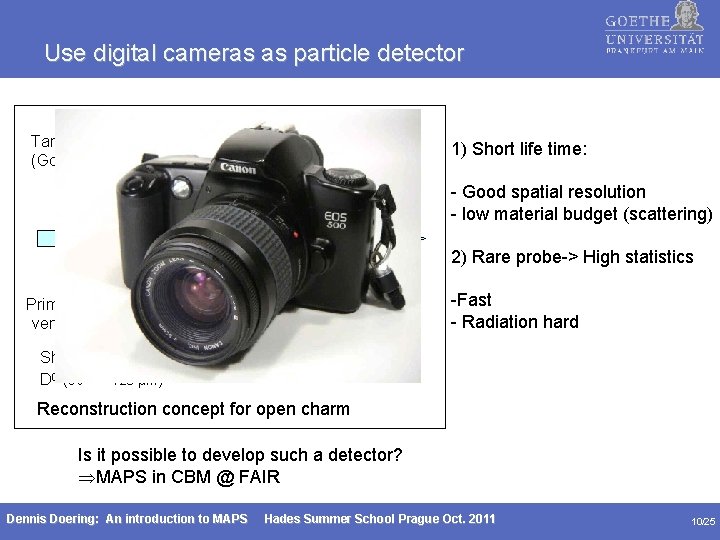
Use digital cameras as particle detector zz= 5 cm Target (Gold) Detector 2 Detector 1 1) Short life time: - Good spatial resolution - low material budget (scattering) Primary Beam: 25 AGe. V Au Ions (up to 109/s) 2) Rare probe-> High statistics -Fast - Radiation hard Primary vertex Secondary vertex Short lived particle D 0 (ct = ~ 120 µm) Reconstruction concept for open charm Is it possible to develop such a detector? ÞMAPS in CBM @ FAIR Dennis Doering: An introduction to MAPS Hades Summer School Prague Oct. 2011 10/17 /25
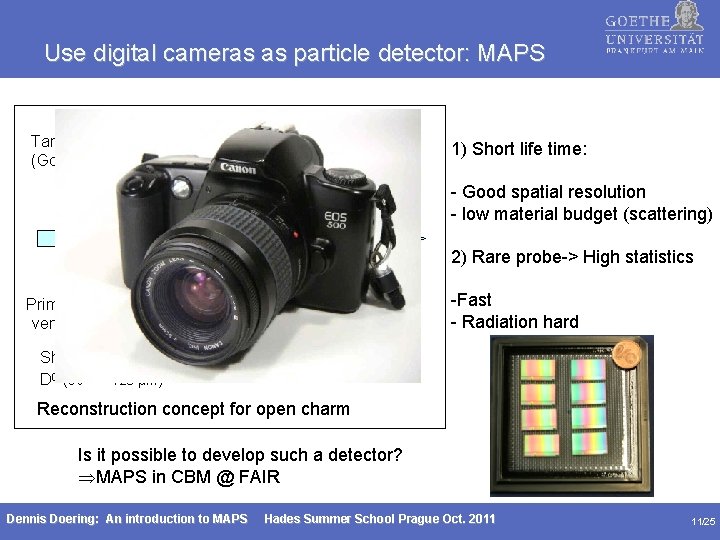
Use digital cameras as particle detector: MAPS zz= 5 cm Target (Gold) Detector 2 Detector 1 1) Short life time: - Good spatial resolution - low material budget (scattering) Primary Beam: 25 AGe. V Au Ions (up to 109/s) 2) Rare probe-> High statistics -Fast - Radiation hard Primary vertex Secondary vertex Short lived particle D 0 (ct = ~ 120 µm) Reconstruction concept for open charm Is it possible to develop such a detector? ÞMAPS in CBM @ FAIR Dennis Doering: An introduction to MAPS Hades Summer School Prague Oct. 2011 11/17 /25
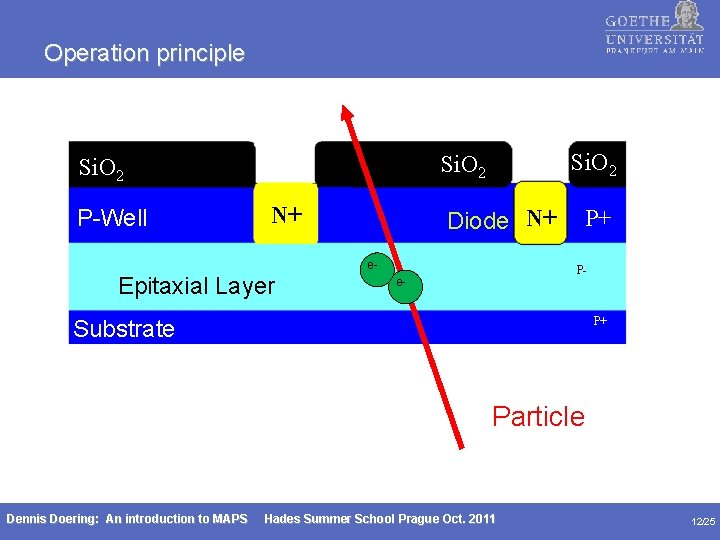
Operation principle P-Well Si. O 2 N+ Diode N+ e- Epitaxial Layer P+ P- e- P+ Substrate Particle Dennis Doering: An introduction to MAPS Hades Summer School Prague Oct. 2011 12/17 /25
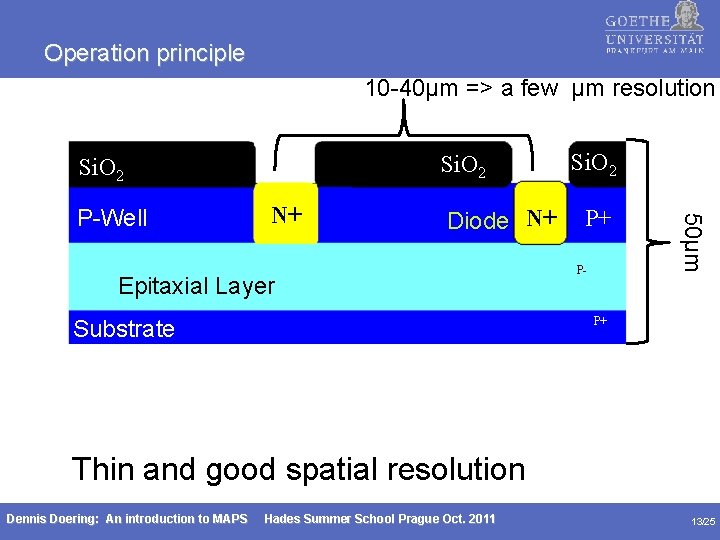
Operation principle 10 -40µm => a few µm resolution Si. O 2 N+ Diode N+ Epitaxial Layer P+ P- 50µm P-Well Si. O 2 P+ Substrate Thin and good spatial resolution Dennis Doering: An introduction to MAPS Hades Summer School Prague Oct. 2011 13/17 /25
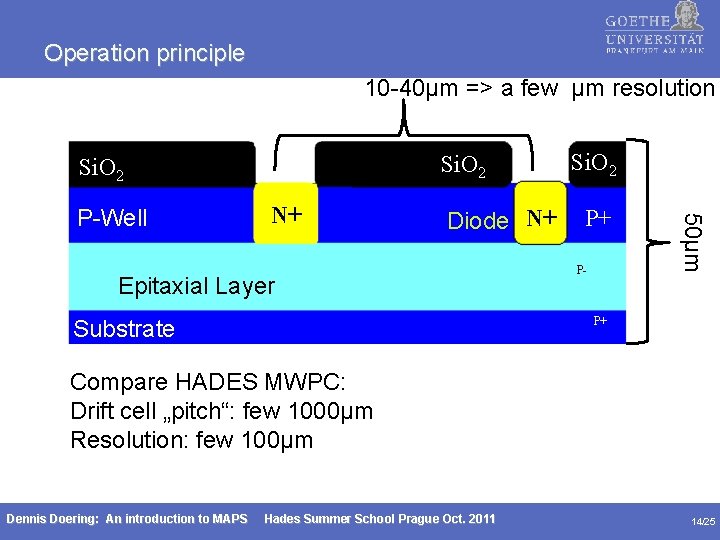
Operation principle 10 -40µm => a few µm resolution Si. O 2 N+ Diode N+ Epitaxial Layer P+ P- 50µm P-Well Si. O 2 P+ Substrate Compare HADES MWPC: Drift cell „pitch“: few 1000µm Resolution: few 100µm Dennis Doering: An introduction to MAPS Hades Summer School Prague Oct. 2011 14/17 /25
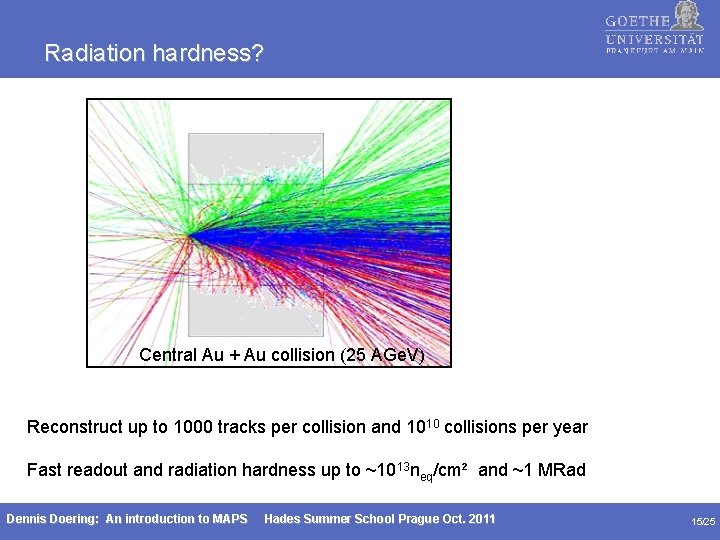
Radiation hardness? Central Au + Au collision (25 AGe. V) Reconstruct up to 1000 tracks per collision and 1010 collisions per year Fast readout and radiation hardness up to ~1013 neq/cm² and ~1 MRad Dennis Doering: An introduction to MAPS Hades Summer School Prague Oct. 2011 15/17 /25
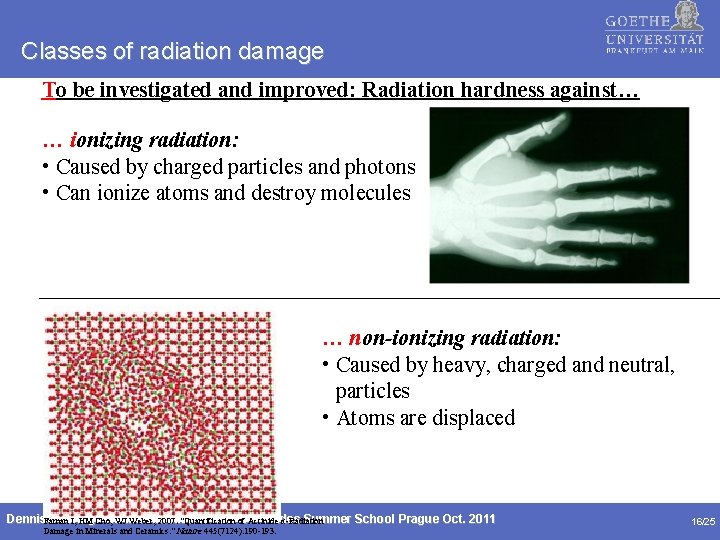
Classes of radiation damage To be investigated and improved: Radiation hardness against… … ionizing radiation: • Caused by charged particles and photons • Can ionize atoms and destroy molecules … non-ionizing radiation: • Caused by heavy, charged and neutral, particles • Atoms are displaced Dennis. Farnan Doering: An to MAPS Hades Summer School Prague Oct. 2011 I, HM Cho, WJintroduction Weber, 2007. "Quantification of Actinide α-Radiation Damage in Minerals and Ceramics. " Nature 445(7124): 190 -193. 16/17 /25
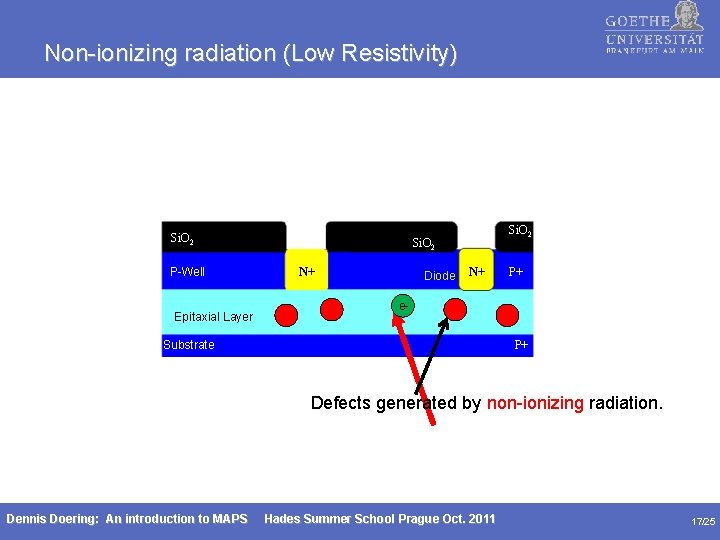
Non-ionizing radiation (Low Resistivity) Si. O 2 P-Well Epitaxial Layer Si. O 2 N+ Diode N+ e- Substrate P+ PP+ Defects generated by non-ionizing radiation. Dennis Doering: An introduction to MAPS Hades Summer School Prague Oct. 2011 17/17 /25
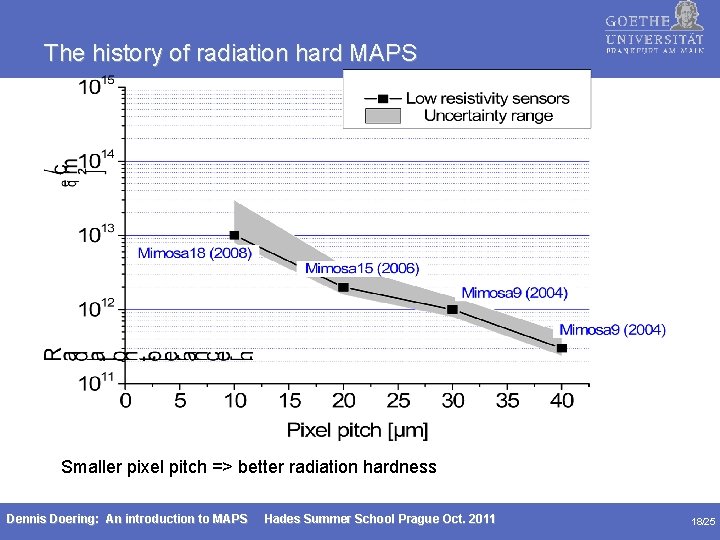
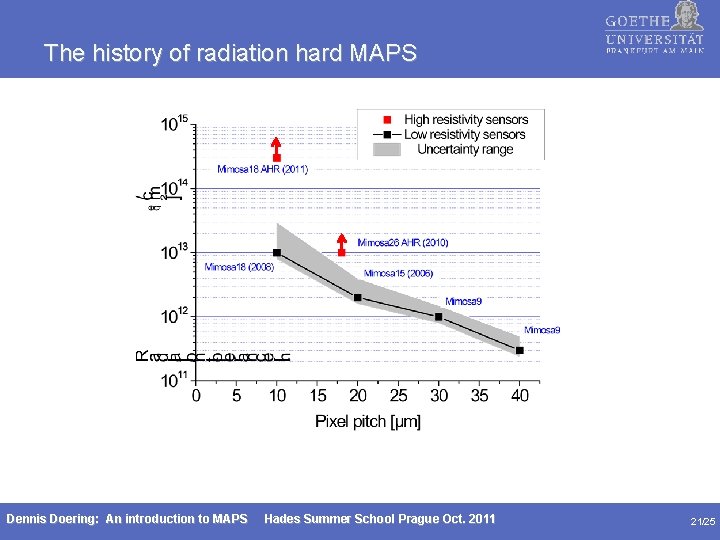
The history of radiation hard MAPS Smaller pixel pitch => better radiation hardness Dennis Doering: An introduction to MAPS Hades Summer School Prague Oct. 2011 18/17 /25
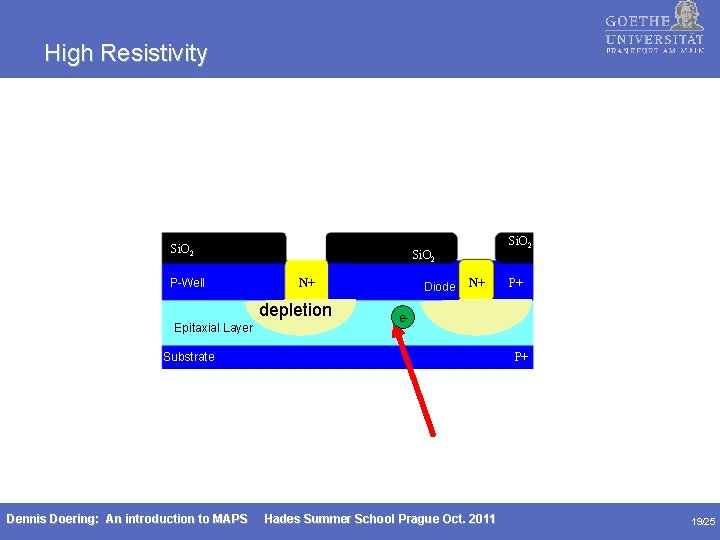
High Resistivity Si. O 2 P-Well N+ depletion Epitaxial Layer Si. O 2 Diode N+ e- Substrate Dennis Doering: An introduction to MAPS P+ PP+ Hades Summer School Prague Oct. 2011 19/17 /25
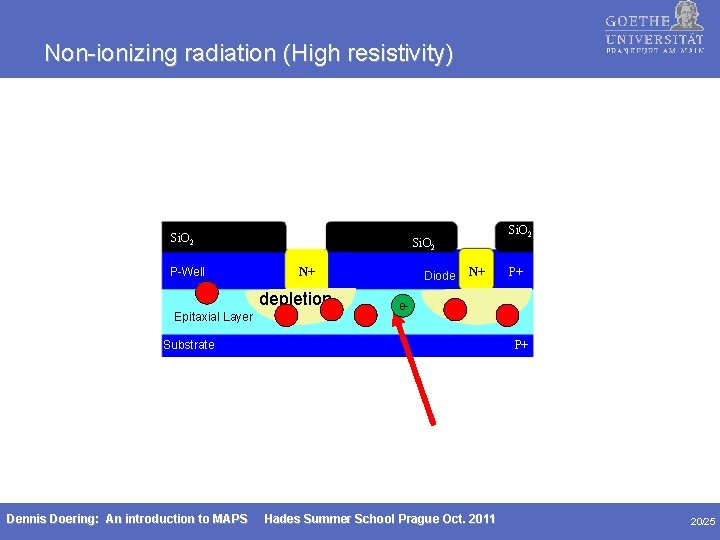
Non-ionizing radiation (High resistivity) Si. O 2 P-Well N+ depletion Epitaxial Layer Si. O 2 Diode N+ e- Substrate Dennis Doering: An introduction to MAPS P+ PP+ Hades Summer School Prague Oct. 2011 20/17 /25
The history of radiation hard MAPS Dennis Doering: An introduction to MAPS Hades Summer School Prague Oct. 2011 21/17 /25
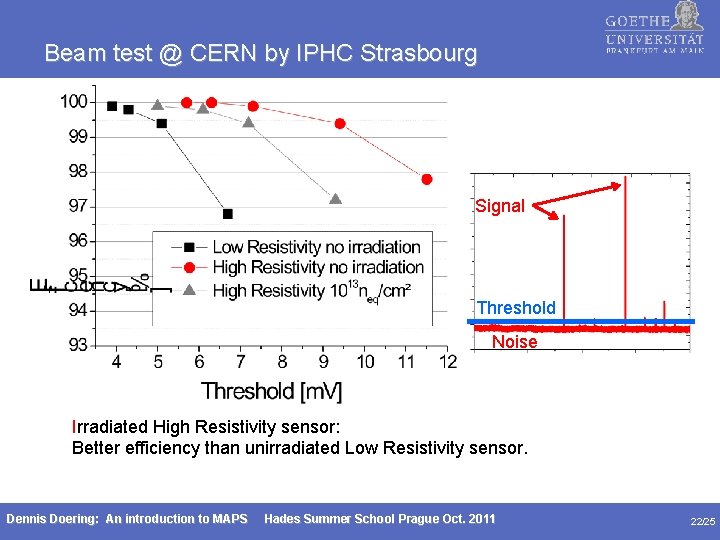
Beam test @ CERN by IPHC Strasbourg Signal Threshold Noise Irradiated High Resistivity sensor: Better efficiency than unirradiated Low Resistivity sensor. Dennis Doering: An introduction to MAPS Hades Summer School Prague Oct. 2011 22/17 /25
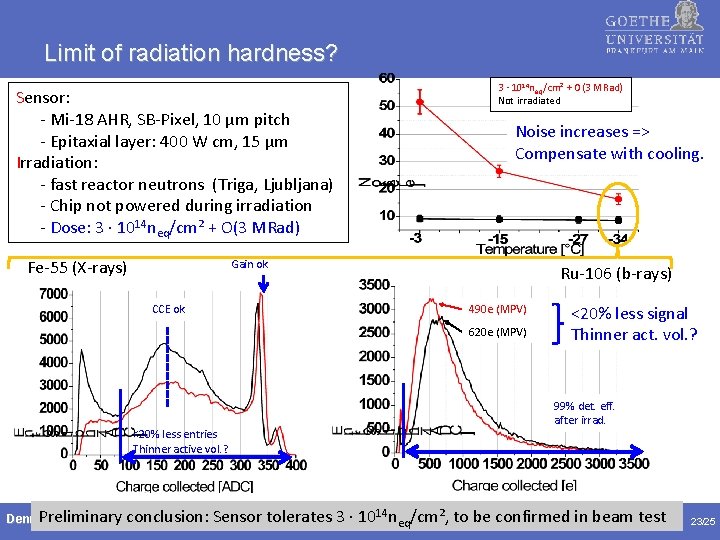
Limit of radiation hardness? Sensor: - Mi-18 AHR, SB-Pixel, 10 µm pitch - Epitaxial layer: 400 W cm, 15 µm Irradiation: - fast reactor neutrons (Triga, Ljubljana) - Chip not powered during irradiation - Dose: 3 · 1014 neq/cm² + O(3 MRad) Fe-55 (X-rays) 3 · 1014 neq/cm² + O(3 MRad) Not irradiated Noise increases => Compensate with cooling. Gain ok CCE ok Ru-106 (b-rays) <20% less signal Thinner act. vol. ? 490 e (MPV) 620 e (MPV) <20% less entries Thinner active vol. ? 99% det. eff. after irrad. Preliminary conclusion: tolerates 3 · School 1014 neq /cm², Oct. to 2011 be confirmed Dennis Doering: An introduction to Sensor MAPS Hades Summer Prague in beam test 23/17 /25
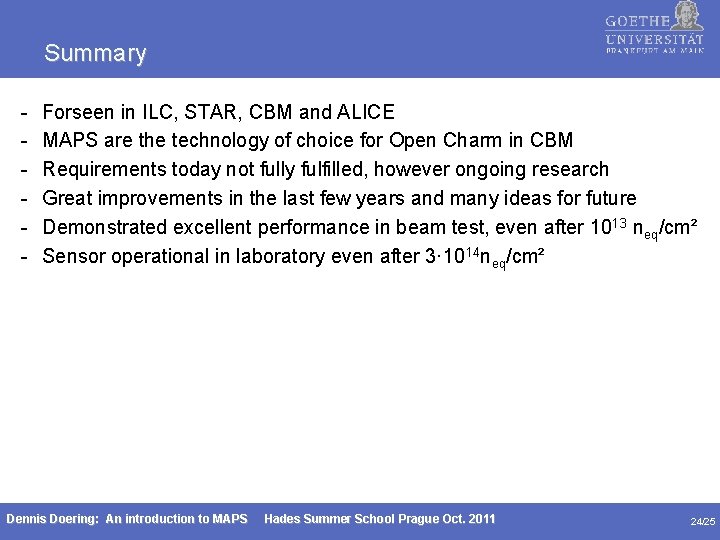
Summary - Forseen in ILC, STAR, CBM and ALICE MAPS are the technology of choice for Open Charm in CBM Requirements today not fully fulfilled, however ongoing research Great improvements in the last few years and many ideas for future Demonstrated excellent performance in beam test, even after 1013 neq/cm² Sensor operational in laboratory even after 3· 1014 neq/cm² Dennis Doering: An introduction to MAPS Hades Summer School Prague Oct. 2011 24/17 /25
Summary - Forseen in ILC, STAR, CBM and ALICE MAPS are the technology of choice for Open Charm in CBM Requirements today not fully fulfilled, however ongoing research Great improvements in the last few years and many ideas for future Demonstrated excellent performance in beam test, even after 1013 neq/cm² Sensor operational in laboratory even after 3· 1014 neq/cm² Conclusion: Monolithic Active Pixel Sensors A detector that YOU should know Dennis Doering: An introduction to MAPS Hades Summer School Prague Oct. 2011 25/17 /25
BACK-UP Dennis Doering: An introduction to MAPS Hades Summer School Prague Oct. 2011 26/17 /25
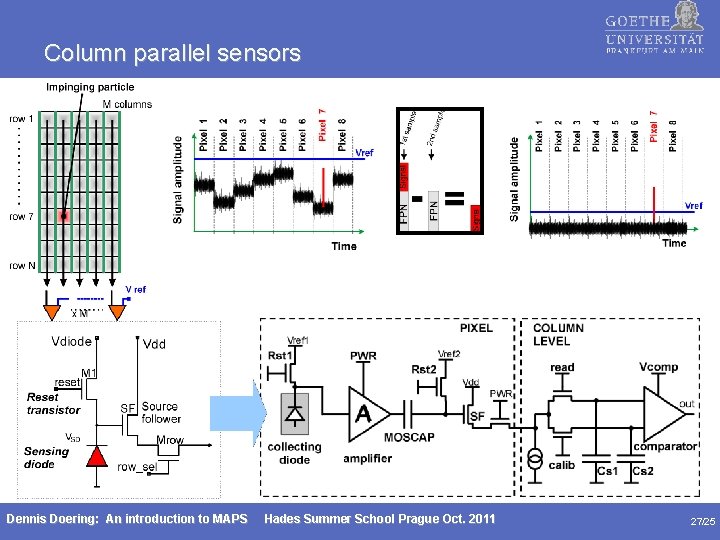
Column parallel sensors Dennis Doering: An introduction to MAPS Hades Summer School Prague Oct. 2011 27/17 /25
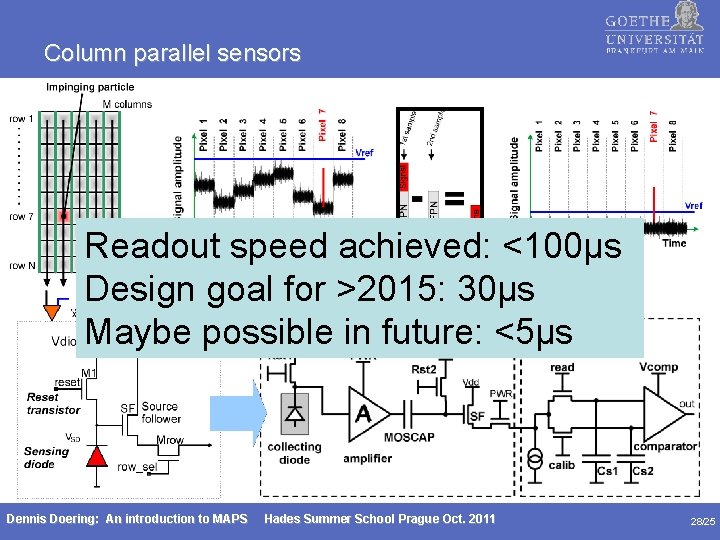
Column parallel sensors Readout speed achieved: <100µs Design goal for >2015: 30µs Maybe possible in future: <5µs Dennis Doering: An introduction to MAPS Hades Summer School Prague Oct. 2011 28/17 /25