
AN INTRODUCTION TO PERIODICITY INTRODUCTION The Periodic Table
AN INTRODUCTION TO PERIODICITY
INTRODUCTION The Periodic Table is made up by placing the elements in ATOMIC NUMBER ORDER and arranging them in. . . ROWS (PERIODS) COLUMNS (GROUPS) and
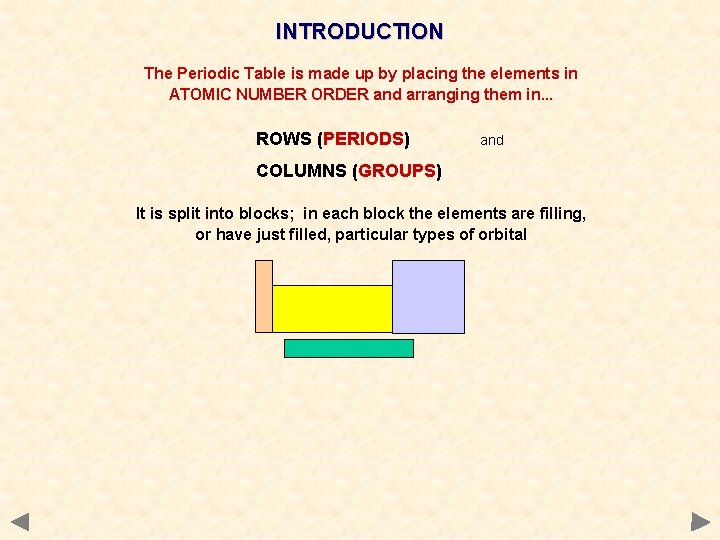
INTRODUCTION The Periodic Table is made up by placing the elements in ATOMIC NUMBER ORDER and arranging them in. . . ROWS (PERIODS) and COLUMNS (GROUPS) It is split into blocks; in each block the elements are filling, or have just filled, particular types of orbital
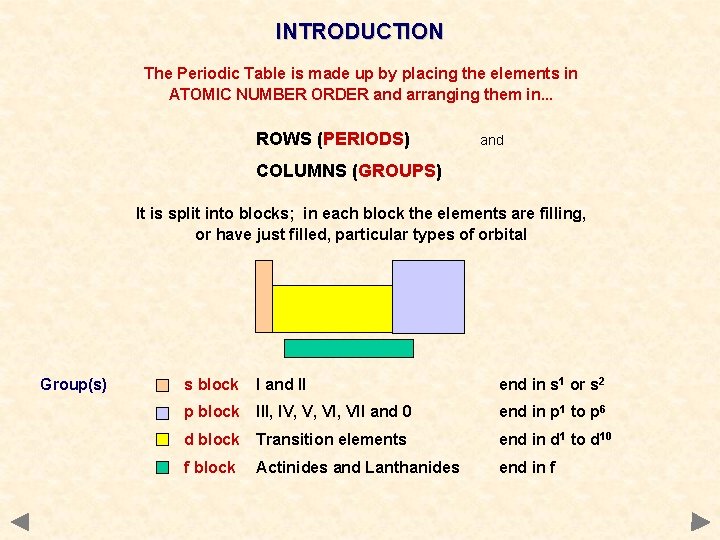
INTRODUCTION The Periodic Table is made up by placing the elements in ATOMIC NUMBER ORDER and arranging them in. . . ROWS (PERIODS) and COLUMNS (GROUPS) It is split into blocks; in each block the elements are filling, or have just filled, particular types of orbital Group(s) s block I and II end in s 1 or s 2 p block III, IV, V, VII and 0 end in p 1 to p 6 d block Transition elements end in d 1 to d 10 f block Actinides and Lanthanides end in f
INTRODUCTION The outer electron configuration is a periodic function. . . it repeats every so often Because many physical and chemical properties are influenced by the outer shell configuration of an atom, it isn’t surprising that such properties also exhibit periodicity. . . • • atomic radius ionisation energy electron affinity electronegativity electrical conductivity melting point and boiling point It is much more important to know and understand each trend and how it arises than remember individual values.
INTRODUCTION The outer electron configuration is a periodic function. . . it repeats every so often Because many physical and chemical properties are influenced by the outer shell configuration of an atom, it isn’t surprising that such properties also exhibit periodicity. . . • • atomic radius ionisation energy electron affinity electronegativity electrical conductivity melting point and boiling point The first two periods in the periodic table are not typical. . . Period 1 (H, He) contains only two elements Period 2 (Li - Ne) elements at the top of each group have small sizes and high I. E. values Period 3 (Na-Ar) is the most suitable period for studying trends
- Slides: 6