
An Introduction to Optical Window Design University of







- Slides: 16
An Introduction to Optical Window Design University of Arizona Introductory Opto-Mechanical Engineering Dan Willistein December 14, 2006 Introduction to Optical Windows Design 1
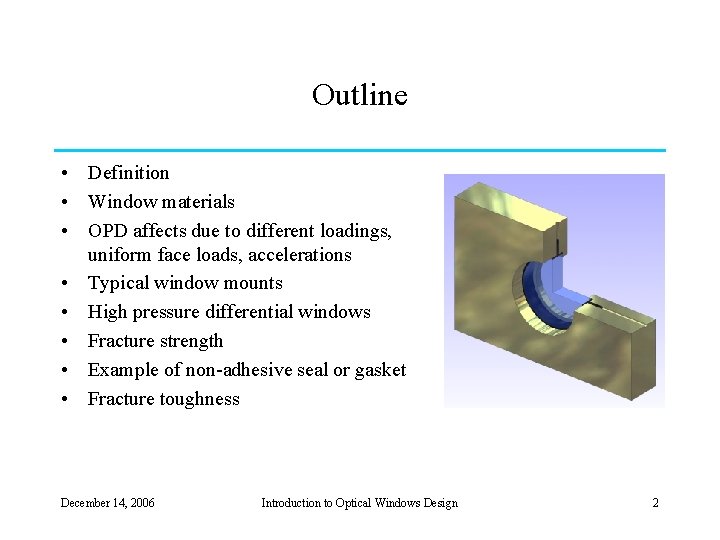
Outline • Definition • Window materials • OPD affects due to different loadings, uniform face loads, accelerations • Typical window mounts • High pressure differential windows • Fracture strength • Example of non-adhesive seal or gasket • Fracture toughness December 14, 2006 Introduction to Optical Windows Design 2
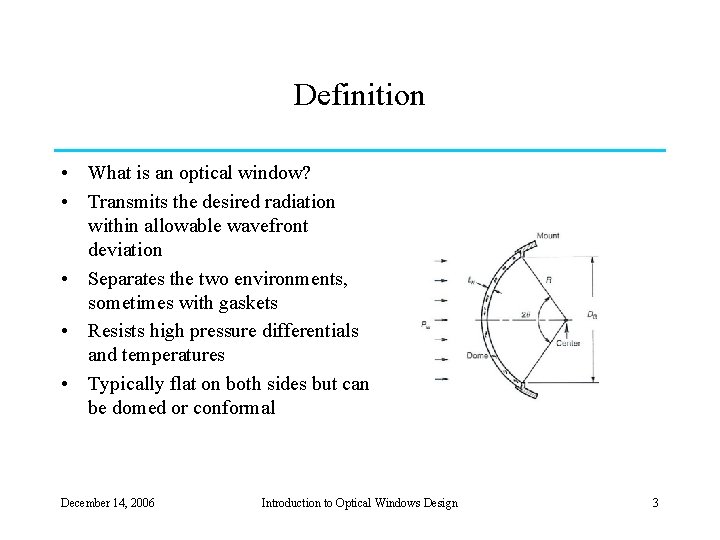
Definition • What is an optical window? • Transmits the desired radiation within allowable wavefront deviation • Separates the two environments, sometimes with gaskets • Resists high pressure differentials and temperatures • Typically flat on both sides but can be domed or conformal December 14, 2006 Introduction to Optical Windows Design 3
Window Materials • Application dependent • BK 7 common for visible spectrum • Ca. Fl for IR apps. • Mg. F 2 for UV apps. Table 1. adapted from Red Optronics, www. redoptronics. com 2 December 14, 2006 Introduction to Optical Windows Design 4
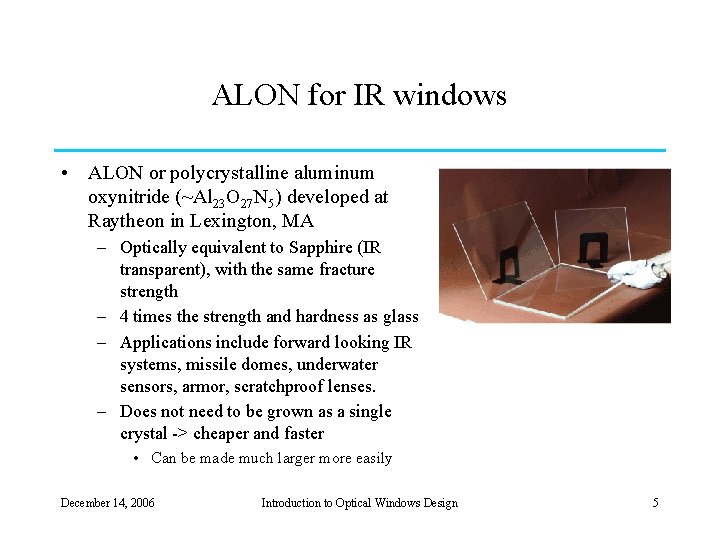
ALON for IR windows • ALON or polycrystalline aluminum oxynitride (~Al 23 O 27 N 5) developed at Raytheon in Lexington, MA – Optically equivalent to Sapphire (IR transparent), with the same fracture strength – 4 times the strength and hardness as glass – Applications include forward looking IR systems, missile domes, underwater sensors, armor, scratchproof lenses. – Does not need to be grown as a single crystal -> cheaper and faster • Can be made much larger more easily December 14, 2006 Introduction to Optical Windows Design 5
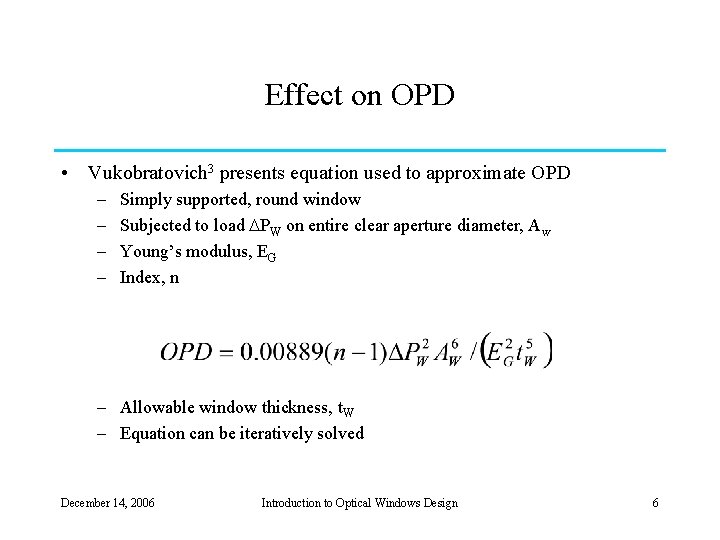
Effect on OPD • Vukobratovich 3 presents equation used to approximate OPD – – Simply supported, round window Subjected to load DPW on entire clear aperture diameter, Aw Young’s modulus, EG Index, n – Allowable window thickness, t. W – Equation can be iteratively solved December 14, 2006 Introduction to Optical Windows Design 6
Effect on OPD • Vukobratovich 3 presents equation used to approximate OPD – Can be extended for simple axial accelerations – Substitute: – For DPW in first equation: – Where a. G is acceleration, r. G is material density – Again, allowable window thickness, t. W December 14, 2006 Introduction to Optical Windows Design 7
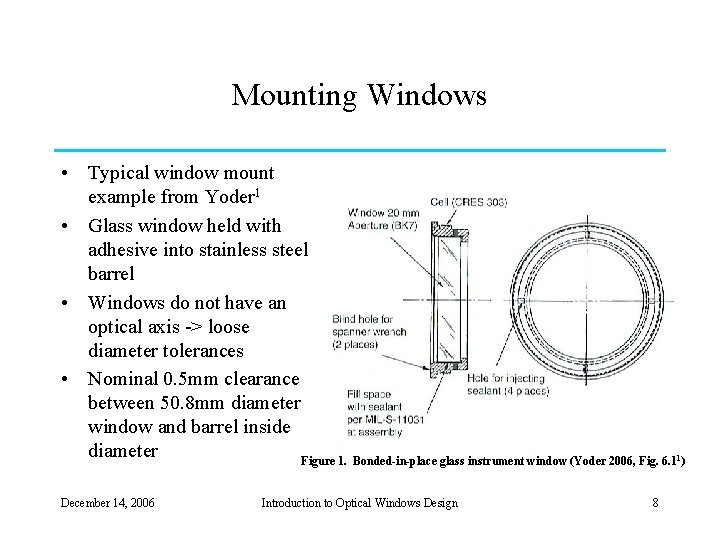
Mounting Windows • Typical window mount example from Yoder 1 • Glass window held with adhesive into stainless steel barrel • Windows do not have an optical axis -> loose diameter tolerances • Nominal 0. 5 mm clearance between 50. 8 mm diameter window and barrel inside diameter Figure 1. Bonded-in-place glass instrument window (Yoder 2006, Fig. 6. 1 ) 1 December 14, 2006 Introduction to Optical Windows Design 8
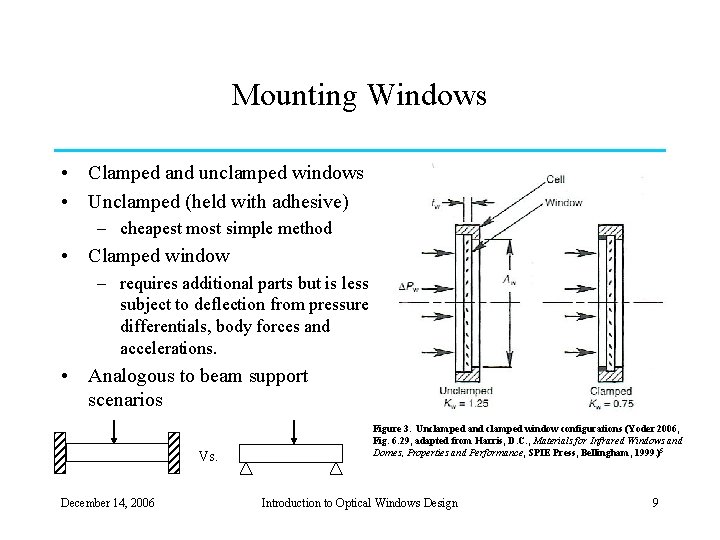
Mounting Windows • Clamped and unclamped windows • Unclamped (held with adhesive) – cheapest most simple method • Clamped window – requires additional parts but is less subject to deflection from pressure differentials, body forces and accelerations. • Analogous to beam support scenarios Vs. December 14, 2006 Figure 3. Unclamped and clamped window configurations (Yoder 2006, Fig. 6. 29, adapted from Harris, D. C. , Materials for Infrared Windows and Domes, Properties and Performance, SPIE Press, Bellingham, 1999. )5 Introduction to Optical Windows Design 9
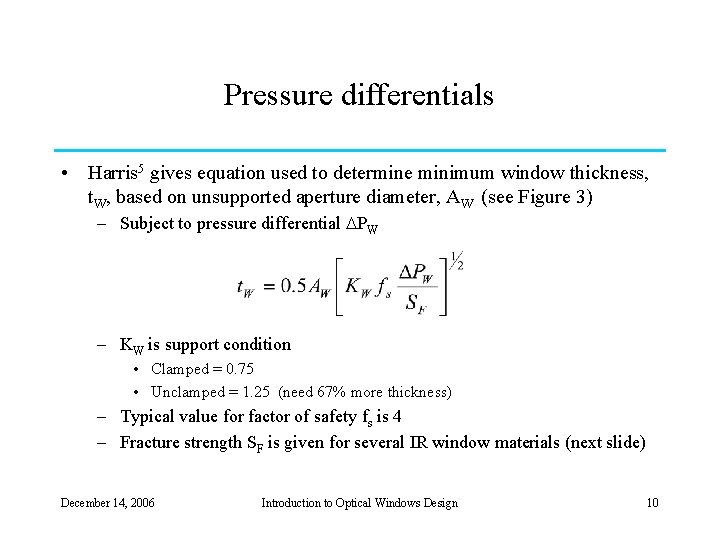
Pressure differentials • Harris 5 gives equation used to determine minimum window thickness, t. W, based on unsupported aperture diameter, AW (see Figure 3) – Subject to pressure differential DPW – KW is support condition • Clamped = 0. 75 • Unclamped = 1. 25 (need 67% more thickness) – Typical value for factor of safety fs is 4 – Fracture strength SF is given for several IR window materials (next slide) December 14, 2006 Introduction to Optical Windows Design 10
Fracture strength • Depends on: Table 2 (Yoder 2006, Table 6. 1)4 – surface finish – fabrication method • Best to check this value with manufacturer December 14, 2006 Introduction to Optical Windows Design 11
Special sealing considerations • Adhesives not always permissible – Depends on requirements of application ->is outgasing a problem? • Example: 7. 6 cm diameter Na. Cl window, 0. 9 cm thick 6 – High vacuum chamber used for laser irradiation of sample gases. – High thermal shock – Long term pressure loading – lead gasket is pressed between Na. Cl and metal housing forming seal – Belleville washers provide axial preload – Free to move with temperature changes Figure 4. Na. Cl window for high vacuum IR system (Manuccia et. al. , adapted by Yoder, 2006) radially 6 December 14, 2006 Introduction to Optical Windows Design 12
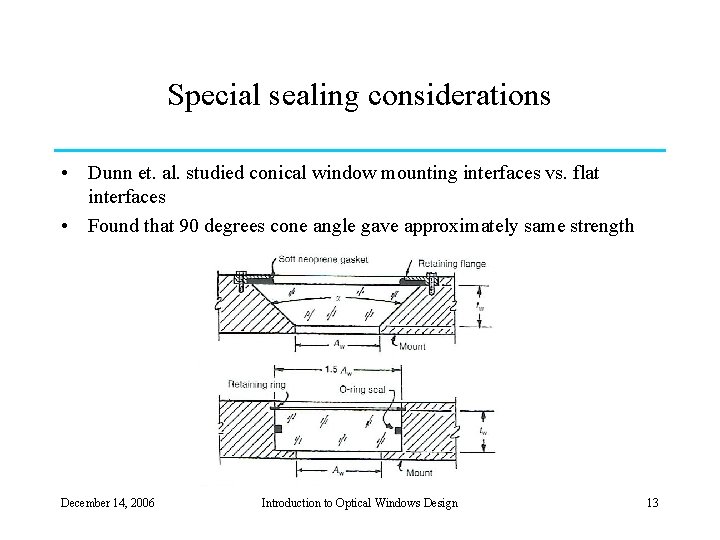
Special sealing considerations • Dunn et. al. studied conical window mounting interfaces vs. flat interfaces • Found that 90 degrees cone angle gave approximately same strength December 14, 2006 Introduction to Optical Windows Design 13
Fracture Toughness • Doyle and Kahan 7 present Griffith’s law for stress intensity factor KI calculation: • Y is a crack geometry factor, s id the nominal tensile stress, and a is the flaw size. Failure when the stress intensity factor exceeds fracture toughness Fracture toughness for several optical window materials given: 7 • • December 14, 2006 Introduction to Optical Windows Design 14
Conclusions 1. Optical windows at the outset seem like a simple design task but when they are used in applications with any amount of special requirements, careful attention to details of the design is in order. 2. Sealing optical windows can be accomplished with flexible silicone based adhesives such as RTV and aided with clamps. However, when requirements prohibit the use of conventional sealants, other methods and materials must be used such as the lead gasket example discussed here. 3. Windows subjected to high pressures can be designed using guideline formulas discussed here and appropriate safety factors. 4. The strength of optical glass involves understanding not only the basic material strength properties but also the surface quality, inclusions and the loading cycle of the window. December 14, 2006 Introduction to Optical Windows Design 15
References 1. Yoder, P. R. , Opto-Mechanical Systems Design, 3 rd Ed. , CRC Press, 2006. 2. Red Optronics in Mountain View, CA, website: www. redoptronics. com 3. Vukobratovich, D. , Introduction to Opto-Mechanical Design, SPIE Short Course SC 014, 2003. 4. Dunn, G. and Stachiw, J. , Acrylic windows for underwater structures, Proc. SPIE, 7, D-XX-1, 1966. 5. Harris, D. C. , Materials for Infrared Windows and Domes, Properties and Performance, SPIE Press, Bellingham, 1999. 6. Manuccia, T. J. , Peele, J. R. , and Geosling, C. E. , “High temperature ultrahigh vacuum infrared window seal”, Rev. Sci. Instum. , 52, 1857, 1981. 7. K. B. Doyle, M. A. Kahan, “Design strength of optical glass, ” Optomechanics 2003, Proc. SPIE 5176 (2003). December 14, 2006 Introduction to Optical Windows Design 16