
An Introduction to Nuclear Radiation Detection and Spectroscopy











- Slides: 42
An Introduction to Nuclear Radiation Detection and Spectroscopy Systems IAEA Training Course for the Maintenance of Nuclear Electronic Systems Nuclear Detection & Spectroscopy Systems 1
Principles Of Electronic Radiation Detectors 1. Some principles of detecting radiation with electronic detectors 2. Some interactions of radiation with detectors 3. Components of a nuclear counting or spectroscopy systems 4. Concept of detector energy resolution Nuclear Detection & Spectroscopy Systems 2
Radiation interactions in matter produce • Ionization and / or excitation of atoms • Ionization/excitation is primarily by charged particles primarily energetic electrons • Photon interactions produce energetic electrons that in turn produce ionization/excitation Nuclear Detection & Spectroscopy Systems 3
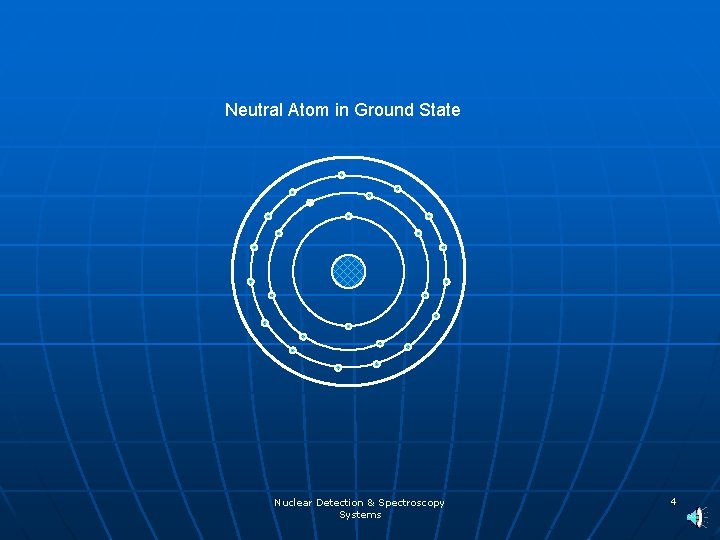
Neutral Atom in Ground State Nuclear Detection & Spectroscopy Systems 4
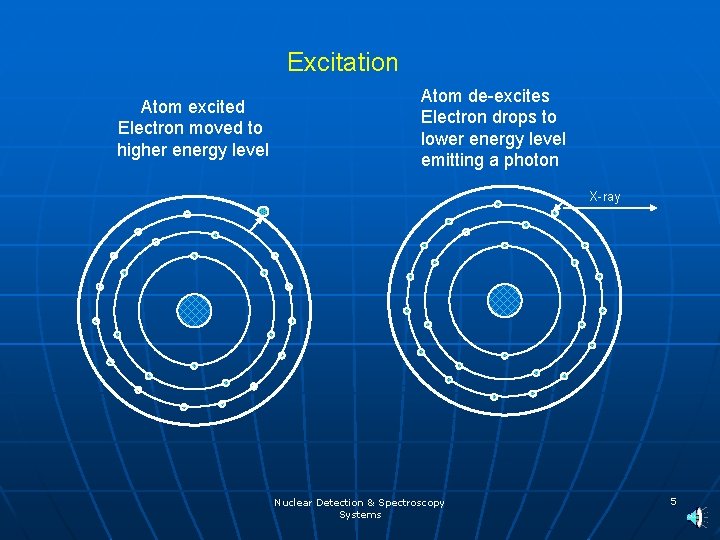
Excitation Atom excited Electron moved to higher energy level Atom de-excites Electron drops to lower energy level emitting a photon X-ray Nuclear Detection & Spectroscopy Systems 5
Ionization Electron removed from atom Atom is missing an electron Nuclear Detection & Spectroscopy Systems 6
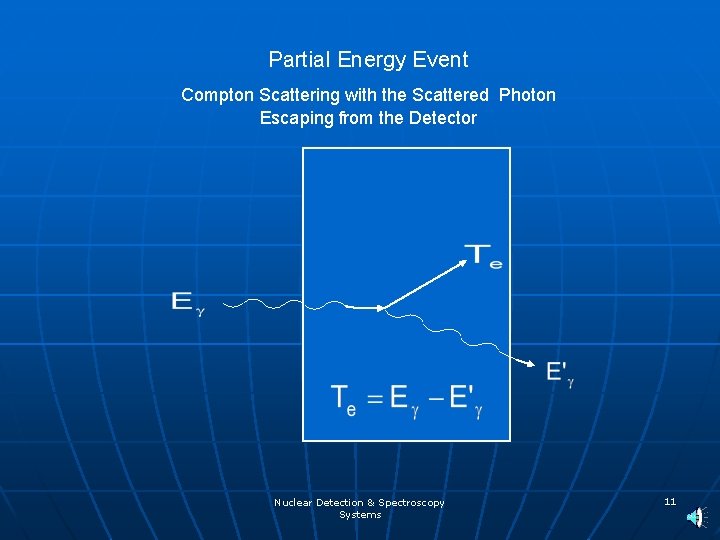
Ionization/excitation requires energy • Detector sees only energy deposited in the detector which results in ionization/excitation, not the energy of the radiation. • Partial Energy Events –Detectors with thick windows so charged particles lose some of their energy before reaching the sensitive part of the detector. –Electrons or other charged particles with ranges greater than the dimensions of the detector. –Electrons that cross the boundaries of the detector before depositing all of their energy. (backscattering) –Compton scattering with loss of secondary photon –Pair Production with loss of annihilation radiation –X ray escapes Nuclear Detection & Spectroscopy Systems 7
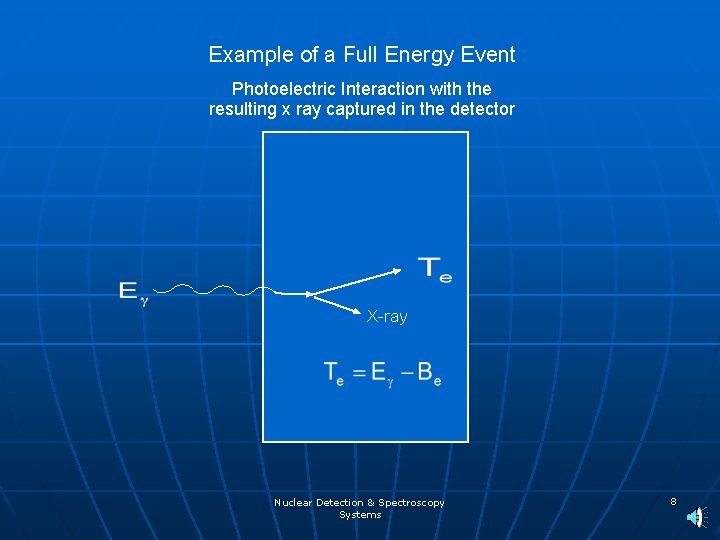
Example of a Full Energy Event Photoelectric Interaction with the resulting x ray captured in the detector X-ray Nuclear Detection & Spectroscopy Systems 8
Example of a Partial Energy Event Photoelectric Interaction with the X ray Escaping from the Detector E Nuclear Detection & Spectroscopy Systems 9
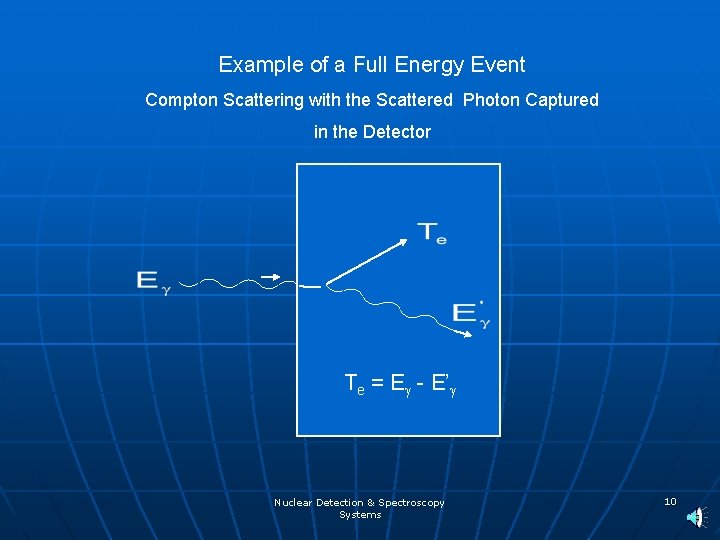
Example of a Full Energy Event Compton Scattering with the Scattered Photon Captured in the Detector Te = E - E’ Nuclear Detection & Spectroscopy Systems 10
Partial Energy Event Compton Scattering with the Scattered Photon Escaping from the Detector Nuclear Detection & Spectroscopy Systems 11
Detectors may give information about • The number of radiation events, N. • The energy deposited in the detector by each radiation event, E. • The total energy deposited in the detector, that is N x E. The first two types of detectors are used with systems that analyze pulses from the detector while third type of detector is used with a system that measures the current from the detector. Nuclear Detection & Spectroscopy Systems 12
n Nuclear counting systems detect only the number of radiation events. N = number of events § Nuclear spectrometers detect and analyze individual events occurring in the detector (pulses from the detector system) giving information about both N = number of events and E = energy deposited by the event. Nuclear Detection & Spectroscopy Systems 13
Components of Standard Nuclear Counting/Spectroscopy Systems Nuclear Detection & Spectroscopy Systems 14
Detector System Bias Voltage MCA Detector Pre Amplifier Integral Discriminator Scaler Timer Differential Discriminator Scaler Timer Nuclear Detection & Spectroscopy Systems 15
Primary Classes of Electronic Detectors • Gas Detectors • • • Ionization detectors Proportional detectors Geiger-Mueller counters • Scintillation Detectors • Solid State Detectors – Silicon junction detectors – Lithium drifted silicon – Germanium • Planar • Coaxial Nuclear Detection & Spectroscopy Systems 16
Nuclear Instrument Standards • Nuclear Instrument Module (NIM) standard was established in the early 1960’s. • Computer Automated Measurement and Control (CAMAC) established in early 1970’s. • Specifies voltages and current ratings of the power supplies used to power nuclear instrumentation. • Specifies modular packaging system. • Specifies amplitudes, shapes and polarity of pulses into and out of various components of nuclear counting systems. • Allows interchangeability of modules from different manufacturers. Nuclear Detection & Spectroscopy Systems 17
n Bias Power Supply / High voltage supply — Bias voltages vary from 20 to over 6000 volts. – High voltages require special high voltage cables and connectors. – Some detectors, such as scintillation detectors, require very well regulated high voltage power supplies. – Some detectors, such as germanium solid state detectors, require very well filtered bias supplies. – Current requirements for different detectors vary from milliamps to microamps. Nuclear Detection & Spectroscopy Systems 18
n Preamplifier / preamp • Usually gets power from main amplifier. • Most often, the bias voltage for the detector is applied through the preamp so the connecting cable from the preamp to the detector may have high voltage on it and require a special high voltage cable and connectors. • Because the electronic noise of the system will usually be dependent on the capacitance of the detector and input stage of the preamp and coaxial cables are capacitors, the connections between the detector and the preamp should be kept as short as possible. Nuclear Detection & Spectroscopy Systems 19
• Preamplifier converts the charge from the detector to a voltage pulse. • The preamp may or may not amplify the voltage pulse. Voltage signals from the detector vary from microvolts (10 -6 volts) to volts ( up to 1 or 2 volts for a typical scintillation detector and to 20 or 30 volts for some types of scintillation systems or G-M detectors. Nuclear Detection & Spectroscopy Systems 20
• Shapes the pulse n Rise time will usually be determined by the characteristics of the detector. n Decay or fall time determined by the preamp and for systems following the NIM standard the decay time should be greater than 30 sec (30 E-6 seconds). n Pulse may be either positive or negative (+ or -). • Matches the impedance and drives the cable Nuclear Detection & Spectroscopy Systems 21
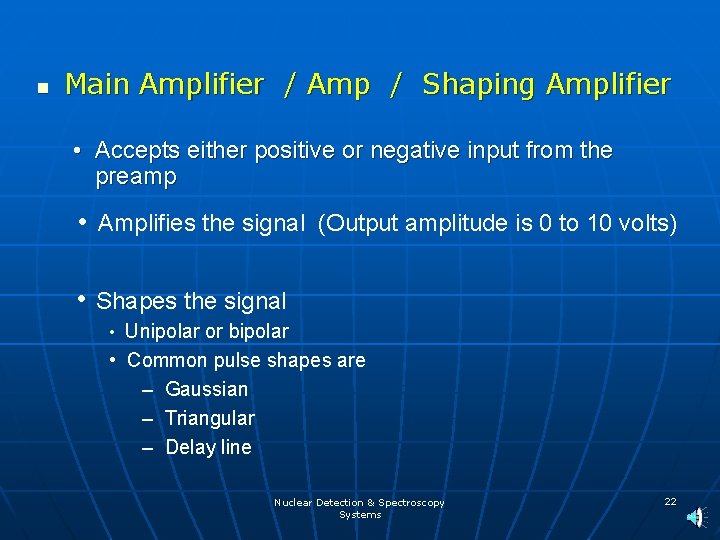
n Main Amplifier / Amp / Shaping Amplifier • Accepts either positive or negative input from the preamp • Amplifies the signal (Output amplitude is 0 to 10 volts) • Shapes the signal • Unipolar or bipolar • Common pulse shapes are – Gaussian – Triangular – Delay line Nuclear Detection & Spectroscopy Systems 22
Pulse Height Analyzing Systems • PULSE AMPLITUDE proportional to CHARGE proportional to ENERGY DEPOSITED. • Nuclear counters select pulses of certain amplitudes and count them. • Nuclear spectrometers analyze the amplitude of the pulses to determine the energy distribution of the pulses (pulse spectrum) from which the investigator attempts to determine the energy of the radiations from the source. Nuclear Detection & Spectroscopy Systems 23
Detector System Bias Voltage MCA Detector Pre Amplifier Integral Discriminator Scaler Timer Differential Discriminator Scaler Timer Pulse Height Analyzing System Nuclear Detection & Spectroscopy Systems 24
Gamma-Ray Source Spectrum from Cs-137 Number of - rays / sec - rays emitted from source Energy Nuclear Detection & Spectroscopy Systems 25
Number of - rays / sec - rays emitted from source detector response (full energy events) Energy Nuclear Detection & Spectroscopy Systems 26
/ sec Number of - rays emitted from source Electronic noise Detector response (partial energy events) detector response (full energy events Energy Nuclear Detection & Spectroscopy Systems 27
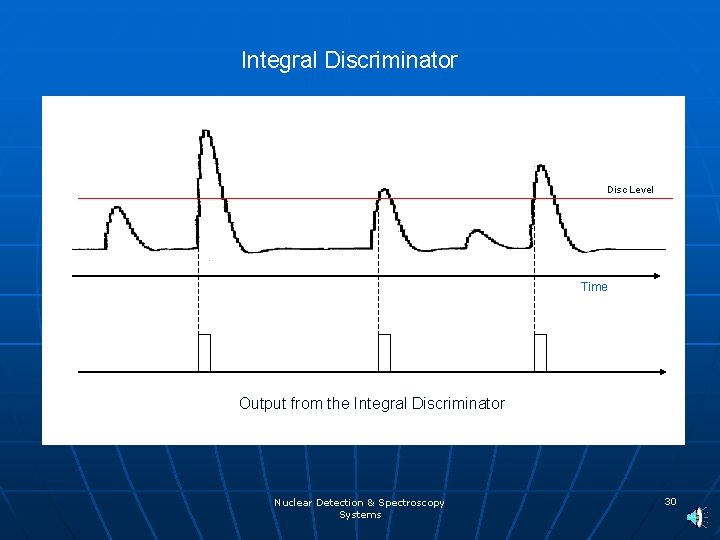
Pulses from the amplifier are random in time and vary in amplitude. Time Nuclear Detection & Spectroscopy Systems 28
Integral Analyzer System Bias Voltage MCA Detector Pre Amplifier Integral Discriminator Scaler Timer Differential Discriminator Scaler Timer Nuclear Detection & Spectroscopy Systems 29
Integral Discriminator Disc Level Time Output from the Integral Discriminator Nuclear Detection & Spectroscopy Systems 30
Nuclear Detection & Spectroscopy Systems 31
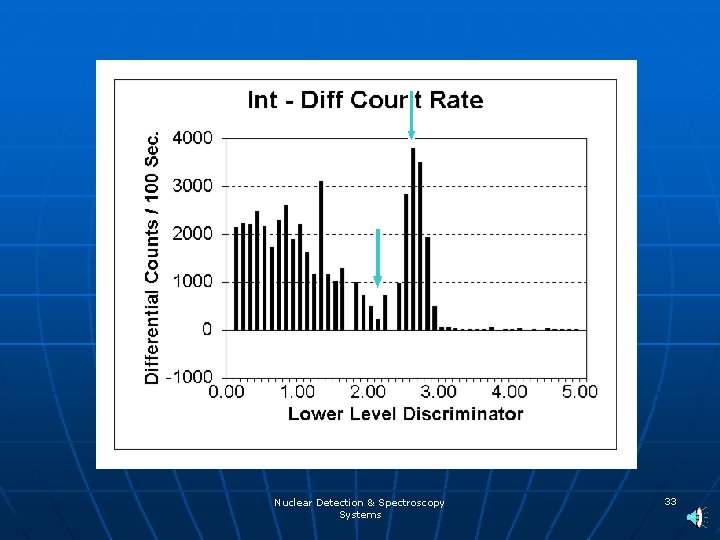
Ni = N i - N i + 1 Nuclear Detection & Spectroscopy Systems 32
Nuclear Detection & Spectroscopy Systems 33
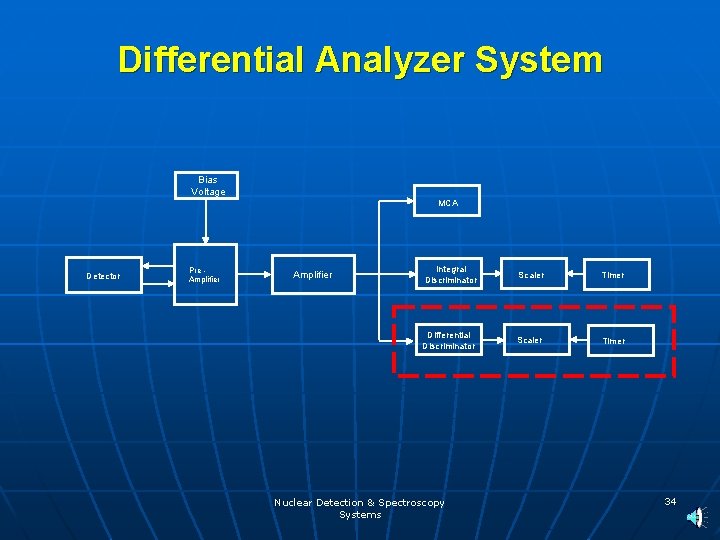
Differential Analyzer System Bias Voltage MCA Detector Pre Amplifier Integral Discriminator Scaler Timer Differential Discriminator Scaler Timer Nuclear Detection & Spectroscopy Systems 34
Differential Discriminator Upper Disc level E or Window Disc Level Time Output from Differential Discriminator Nuclear Detection & Spectroscopy Systems 35
Nuclear Detection & Spectroscopy Systems 36
Multichannel Analyzer System Bias Voltage MCA Detector Pre Amplifier Integral Discriminator Scaler Timer Differential Discriminator Scaler Timer Nuclear Detection & Spectroscopy Systems 37
Nuclear Detection & Spectroscopy Systems 38
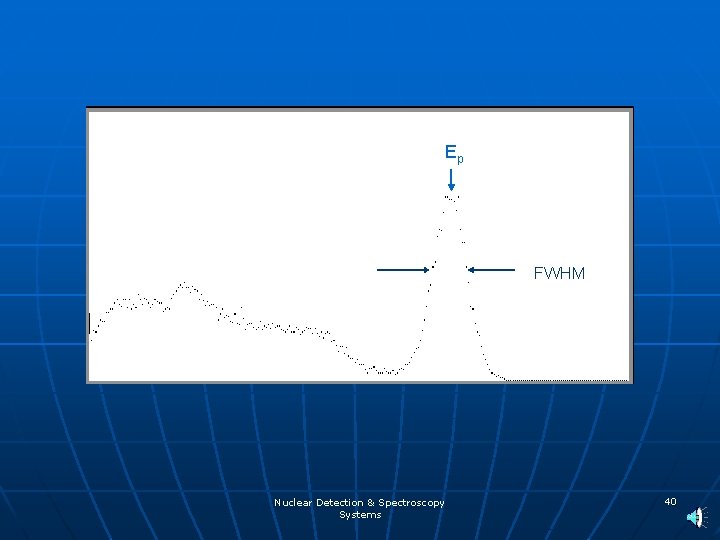
Resolution FWHM (in Energy) 100% Resolution = Energy of Peak, Ep Resolution is a measure of a system’s ability to resolve two peaks that are close together. Nuclear Detection & Spectroscopy Systems 39
Ep FWHM Nuclear Detection & Spectroscopy Systems 40
Summary n n Output of detectors is proportional to the energy deposited in the detector. Output of detectors is pulse of charge. Individual pulses may be selected analyzed. The distribution of individual pulses may be analyzed to determine a detector spectrum from which the source spectrum of the radiation emitted by the source can be determined. Nuclear Detection & Spectroscopy Systems 41
This is the end of the Introduction to Nuclear Radiation Detection And Spectroscopy Systems Nuclear Detection & Spectroscopy Systems 42