
An Introduction to Next Generation Library Interfaces Marshall
An Introduction to Next Generation Library Interfaces Marshall Breeding Director for Innovative Technologies and Research Vanderbilt University http: //staffweb. library. vanderbilt. edu/breeding http: //www. librarytechnology. org/ Northern Suburban Library System Buffalo Grove, IL March 18, 2008
Abstract Marshall Breeding, Director of Innovative Technologies and Research at Jean & Alexander Heard Library, Vanderbilt University, and author of a 40 -page report on “Next Generation Library Catalogs” (Library Technology Reports, July/August 2007) will present an overview of this emerging genre of products that aim to provide libraries with better tools for delivering content and services to their users. Also included in Mr. Breeding’s informative “tour” will be the general features and capabilities of Next-Gen catalogs and some of the options currently available to libraries.
Crowded Landscape of Information Providers on the Web • Lots of non-library Web destinations deliver content to library patrons – – Google Scholar Amazon Wikipedia Ask. com • Do Library Web sites and catalogs meet the • information needs of our users? Do they attract their interest?
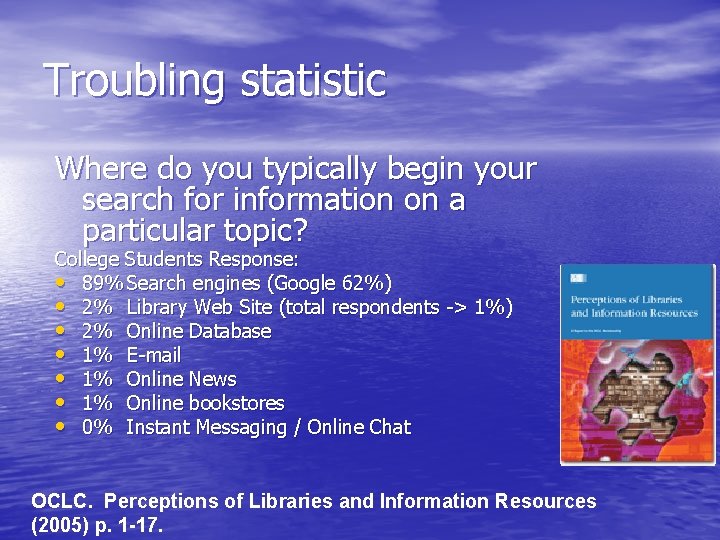
Troubling statistic Where do you typically begin your search for information on a particular topic? College Students Response: • 89% Search engines (Google 62%) • 2% Library Web Site (total respondents -> 1%) • 2% Online Database • 1% E-mail • 1% Online News • 1% Online bookstores • 0% Instant Messaging / Online Chat OCLC. Perceptions of Libraries and Information Resources (2005) p. 1 -17.
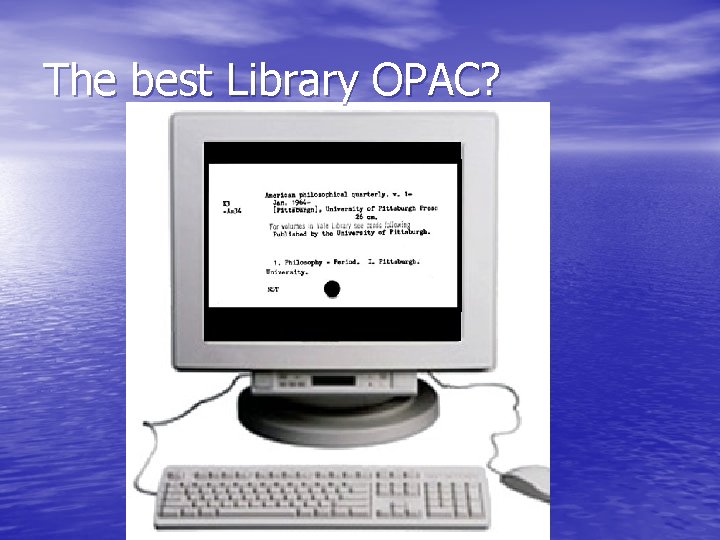
The best Library OPAC?
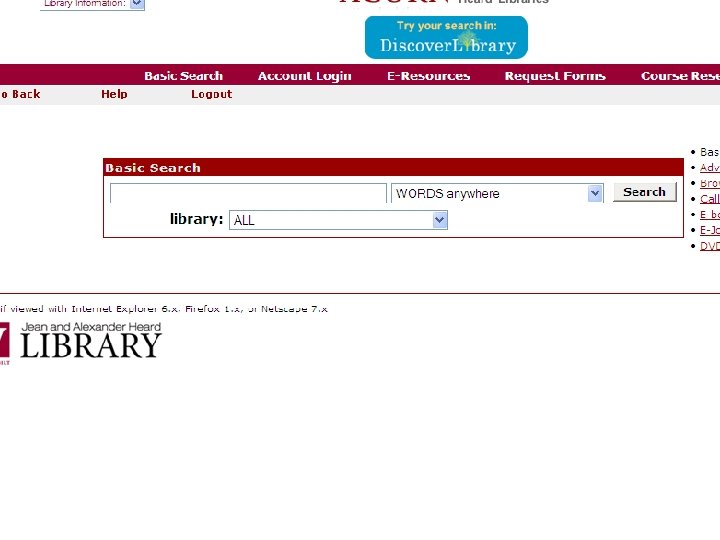

Demand for compelling library interfaces • Urgent need for libraries to offer interfaces their users will like to use • Move out of the 1990’s • Powerful search capabilities in tune with how the Web works today • User expectations set by other Web destination • Eg: i. Link / i. Bistro introduced in 2000
Inadequacy of ILS OPACs • Online Catalog modules provided with an ILS subject to broad criticism as failing to meet expectations of growing segments of library patrons. • Not great at delivering electronic content • Complex text-based interfaces • Relatively weak keyword search engines • Lack of good relevancy sorting • Narrow scope of content
Typical Library Web site components • Books: Library OPAC (ILS module) • Articles: Aggregated content products, e- journal collections • Open. URL linking services • E-journal finding aids (Often managed by link resolver) • Local digital collections – ETDs, photos, rich media collections • Metasearch engines
Change underway • Widespread dissatisfaction with most of the • • current OPACs. Many efforts toward nextgeneration catalogs and interfaces. Movement among libraries to break out of the current mold of library catalogs and offer new interfaces better suited to the expectations of library users. Decoupling of the front-end interface from the back-end library automation system.
Working toward a new generation of library interfaces • Redefinition of the “library catalog” • Traditional notions of the library catalog are being questioned • Better information delivery tools • More powerful search capabilities • More elegant presentation
Redefinition of library catalogs • More comprehensive information discovery environments • It’s no longer enough to provide a catalog limited to print • • • resources Digital resources cannot be an afterthought Forcing users to use different interfaces depending on type of content becoming less tenable Libraries working toward consolidated search environments that give equal footing to digital and print resources
Comprehensive Search Service • More like OAI – Open Archives Initiative – Consolidated search services based on metadata and data gathered in advance • Problems of scale diminished • Problems of cooperation persist • Eg: Royal Library of Denmark
Web 2. 0 Flavorings • A more social and collaborative approach • Web Tools and technology that foster collaboration • Blogs, wiki, blogs, tagging, social bookmarking, user rating, user reviews
Web 2. 0 supporting technologies • Web services • XML APIs • AJAX (asynchronous Java. Script and XML)
The holy grail of New Gen Library Interfaces • A single point of entry into all the content and services offered by the library • Print + Electronic • Local + Remote • Locally created Content
Interface expectations • Millennial generation library users are well • acclimated to the Web Used to relevancy ranking – – – The “good stuff” should be listed first Users tend not to delve deep into a result list Good relevancy requires a sophisticated approach, including objective matching criteria supplemented by popularity and relatedness factors. • “Did you mean? ” and other features to avoid “No • results found” More like this
Interface expectations (cont…) • Very rapid response. Users have a low tolerance for slow • • • systems Rich visual information: book jacket images, rating scores, etc. Let users drill down through the result set incrementally narrowing the field Faceted Browsing – – – Drill-down vs up-front Boolean or “Advanced Search” gives the users clues about the number of hits in each sub topic Ability to explore collections without a priori knowledge • Navigational Bread crumbs
Appropriate organizational structures • LCSH vs FAST (Faceted Application of Subject Terminology) • Full MARC vs Dublin Core or MODS • Discipline-specific thesauri or ontologies • “tags”
Deep search • Increasing opportunities to search the full contents – Google Library Print, Google Publisher, Open Content Alliance, Microsoft Live Book Search, etc. – High-quality metadata will improve search precision • Commercial search providers already offer • • “search inside the book” No comprehensive full text search for books quite yet Not currently available through library search environments
Beyond Discovery • Fulfillment oriented • Search -> select -> view • Delivery/Fulfillment much harder than discovery • Back-end complexity should be as seamless as possible to the user
Library-specific Features • Appropriate relevance factors – Objective keyword ranking + Library weightings – Circulation frequency, OCLC holdings, scholarly content • Results grouping (FRBR) • Collection focused (vs sales-driven)
Enterprise Integration • Ability to deliver content and services through non-library applications • Campus portal solutions • Courseware • Social networking environments • Search portals / Feed aggregators
Smart and Sophisticated • Much more difficult than old gen OPACS • Not a dumbed-down approach • Wed library specific requirements and expectations with e-commerce technologies
Architecture and Standards • Need to have an standard approach for connecting new generation interfaces with ILS and other repositories • Proprietary and ad hoc methods currently prevail • Digital Library Federation – ILS-Discovery Interface Group
New-Gen Library Interfaces Current Commercial and Open Source Products
Common characteristics • Decoupled interface • Mass export of catalog data • Alternative search engine • Alternative interface • Hooks back into the ILS for holdings and patron services
Endeca Guided Navigation • North Carolina State University http: //www. lib. ncsu. edu/catalog/ • Mc. Master University http: //libcat. mcmaster. ca/ • Phoenix Public Library http: //www. phoenixpubliclibrary. org/ • Florida Center for Library Automation http: //catalog. fcla. edu/ux. jsp
Aqua. Browser Library • Queens Borough Public Library – http: //aqua. queenslibrary. org/ • Oklahoma State University – http: //boss. library. okstate. edu/ • University of Chicago – http: //lens. lib. uchicago. edu/
Ex Libris Primo • Discovery and Delivery platform for academic libraries • Vanderbilt University http: //alphasearch. library. vanderbilt. edu • University of Minnesota http: //prime 2. oit. umn. edu: 1701/primo_library/li bweb/action/search. do? vid=TWINCITIES • University of Iowa http: //smartsearch. uiowa. edu/
Encore from Innovative Interfaces • Designed for academic, public and special • libraries Nashville Public Library http: //nplencore. library. nashville. org/iii/encore/app • Scottsdale Public Library http: //encore. scottsdaleaz. gov/iii/encore/app • Yale University Lillian Goldman Law Library http: //encore. law. yale. edu/iii/encore/app
OCLC Worldcat Local • OCLC Worldcat customized for local library catalog – Relies on hooks into ILS for local services – Tied to library holdings set in World. Cat • University of Washington Libraries http: //uwashington. worldcat. org/ • University of California Melvyl Catalog
Sirsi. Dynix • No faceted search product currently available: – – – Enterprise Portal Solution Rooms / School. Rooms i. Link / i. Bistro (legacy) • Product based on FAST announced in March • 2006 – withdrawn Product based on Brainware Globalbrain announced in Nov 2007 – Prototype Expected by April 2008
The Library Corporation • Indigo • Library Positioning Software
VUFind – Villanova University Based on Apache Solr search toolkit http: //www. vufind. org/
Library-developed solutions • e. Xtensible Catalog • University of Rochester – River Campus Libraries • Financial support from the Andrew W. Mellon Foundation • http: //www. extensiblecatalog. info/
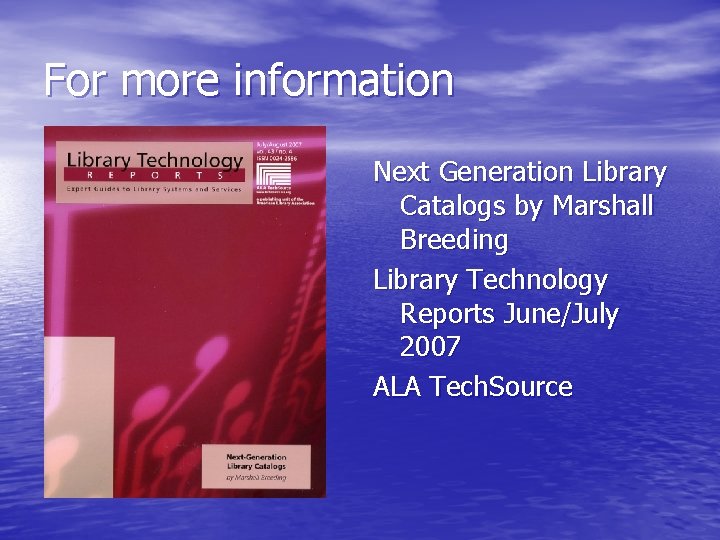
For more information Next Generation Library Catalogs by Marshall Breeding Library Technology Reports June/July 2007 ALA Tech. Source
Questions and Discussion
- Slides: 38