
An Introduction to Mood and Emotion in Sport


- Slides: 23
An Introduction to Mood and Emotion in Sport Psychology of Sport Performance Image by Ian D
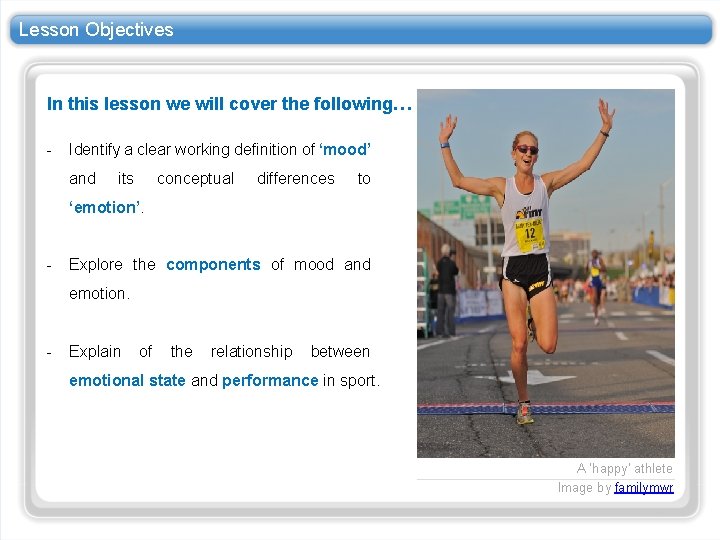
Lesson Objectives In this lesson we will cover the following… - Identify a clear working definition of ‘mood’ and its conceptual differences to ‘emotion’. - Explore the components of mood and emotion. - Explain of the relationship between emotional state and performance in sport. A ‘happy’ athlete Image by familymwr
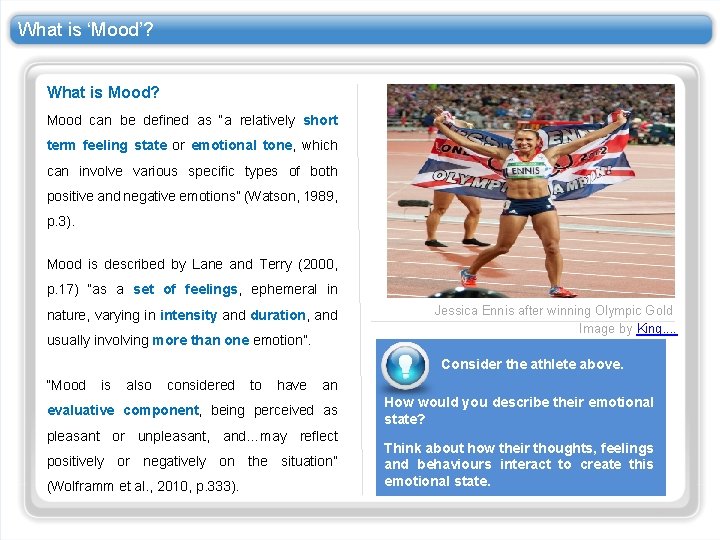
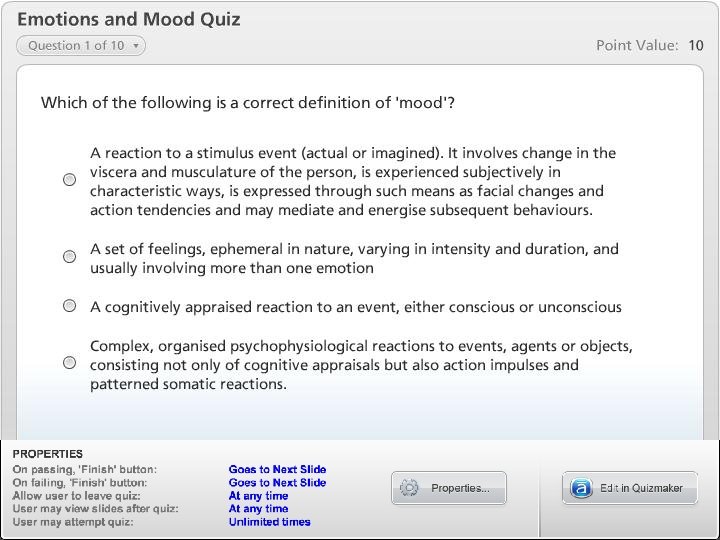
What is ‘Mood’? What is Mood? Mood can be defined as “a relatively short term feeling state or emotional tone, which can involve various specific types of both positive and negative emotions” (Watson, 1989, p. 3). Mood is described by Lane and Terry (2000, p. 17) “as a set of feelings, ephemeral in nature, varying in intensity and duration, and usually involving more than one emotion”. Jessica Ennis after winning Olympic Gold Image by King. . Consider the athlete above. “Mood is also considered to have an evaluative component, being perceived as pleasant or unpleasant, and…may reflect positively or negatively on the situation” (Wolframm et al. , 2010, p. 333). How would you describe their emotional state? Think about how their thoughts, feelings and behaviours interact to create this emotional state.
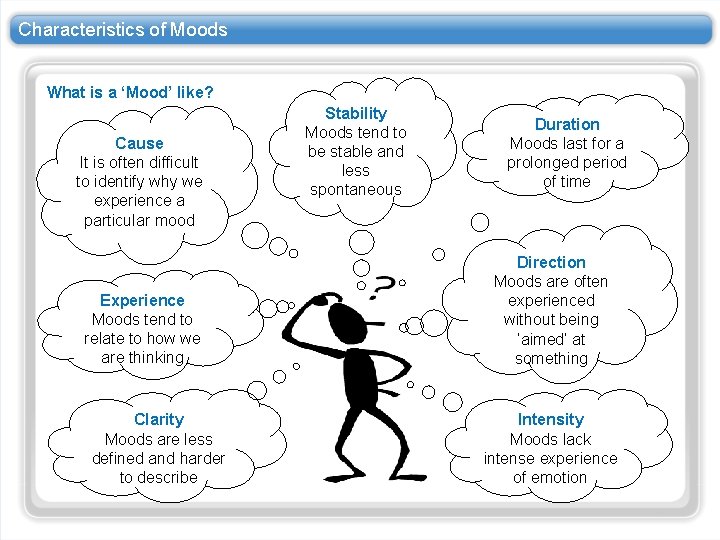
Characteristics of Moods What is a ‘Mood’ like? Cause It is often difficult to identify why we experience a particular mood Experience Moods tend to relate to how we are thinking Clarity Moods are less defined and harder to describe Stability Moods tend to be stable and less spontaneous Duration Moods last for a prolonged period of time Direction Moods are often experienced without being ‘aimed’ at something Intensity Moods lack intense experience of emotion
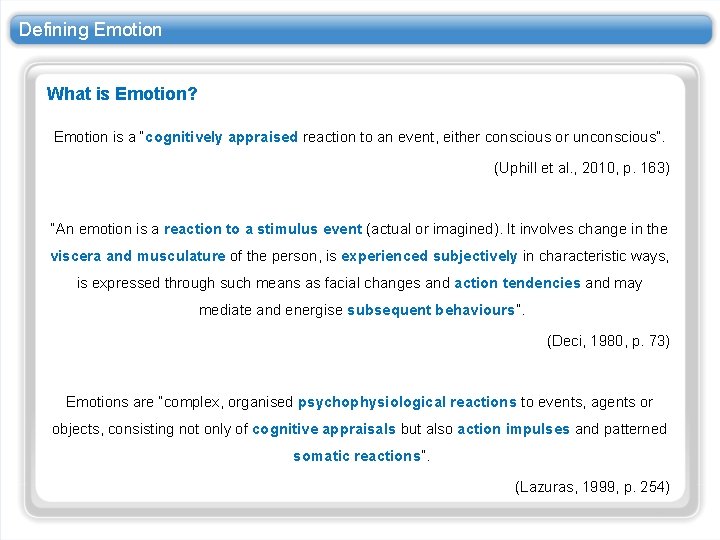
Defining Emotion What is Emotion? Emotion is a “cognitively appraised reaction to an event, either conscious or unconscious”. (Uphill et al. , 2010, p. 163) “An emotion is a reaction to a stimulus event (actual or imagined). It involves change in the viscera and musculature of the person, is experienced subjectively in characteristic ways, is expressed through such means as facial changes and action tendencies and may mediate and energise subsequent behaviours”. (Deci, 1980, p. 73) Emotions are “complex, organised psychophysiological reactions to events, agents or objects, consisting not only of cognitive appraisals but also action impulses and patterned somatic reactions”. (Lazuras, 1999, p. 254)
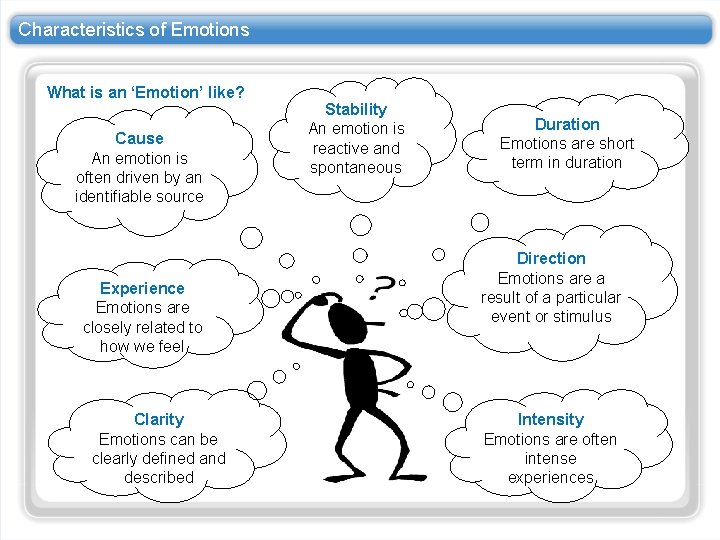
Characteristics of Emotions What is an ‘Emotion’ like? Cause An emotion is often driven by an identifiable source Experience Emotions are closely related to how we feel Clarity Emotions can be clearly defined and described Stability An emotion is reactive and spontaneous Duration Emotions are short term in duration Direction Emotions are a result of a particular event or stimulus Intensity Emotions are often intense experiences
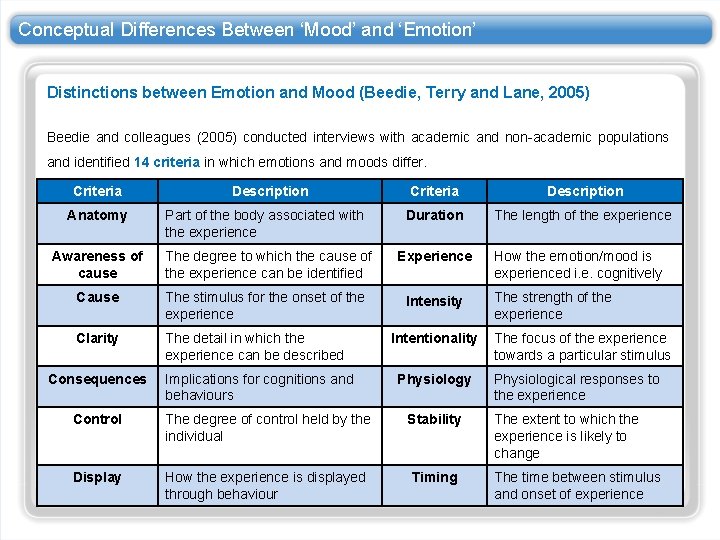
Conceptual Differences Between ‘Mood’ and ‘Emotion’ Distinctions between Emotion and Mood (Beedie, Terry and Lane, 2005) Beedie and colleagues (2005) conducted interviews with academic and non-academic populations and identified 14 criteria in which emotions and moods differ. Criteria Anatomy Description Part of the body associated with the experience Criteria Description Duration The length of the experience Awareness of cause The degree to which the cause of the experience can be identified Experience Cause The stimulus for the onset of the experience Intensity Clarity The detail in which the experience can be described Consequences Implications for cognitions and behaviours Intentionality Physiology Control The degree of control held by the individual Stability Display How the experience is displayed through behaviour Timing How the emotion/mood is experienced i. e. cognitively The strength of the experience The focus of the experience towards a particular stimulus Physiological responses to the experience The extent to which the experience is likely to change The time between stimulus and onset of experience
Distinctions between Emotion and Mood (Beedie, Terry and Lane, 2005) Criteria Emotion Mood Anatomy Related to the heart Related to the mind Awareness of cause Individual is aware of the cause Individual may be unaware of the cause Caused by a specific event or object Cause is less well defined Clarity Clearly defined Nebulous Consequences Largely behavioural and expressive Largely cognitive Control Not controllable Controllable Displayed Not displayed Duration Brief Enduring Experience Felt Thought Intensity Intense Mild Intentionality About something Not about anything in particular Physiology Distinct physiological patterning No distinct physiological patterning Stability Fleeting and volatile Stable Timing Rises and dissipates quickly Rises and dissipates slowly
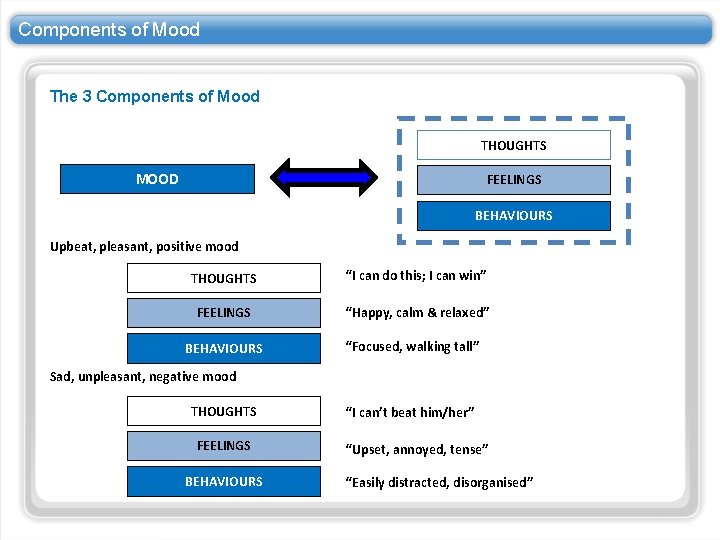
Components of Mood The 3 Components of Mood THOUGHTS FEELINGS MOOD BEHAVIOURS MOODpositive mood Upbeat, pleasant, THOUGHTS “I can do this; I can win” FEELINGS “Happy, calm & relaxed” BEHAVIOURS “Focused, walking tall” Sad, unpleasant, negative mood THOUGHTS FEELINGS BEHAVIOURS “I can’t beat him/her” “Upset, annoyed, tense” “Easily distracted, disorganised”
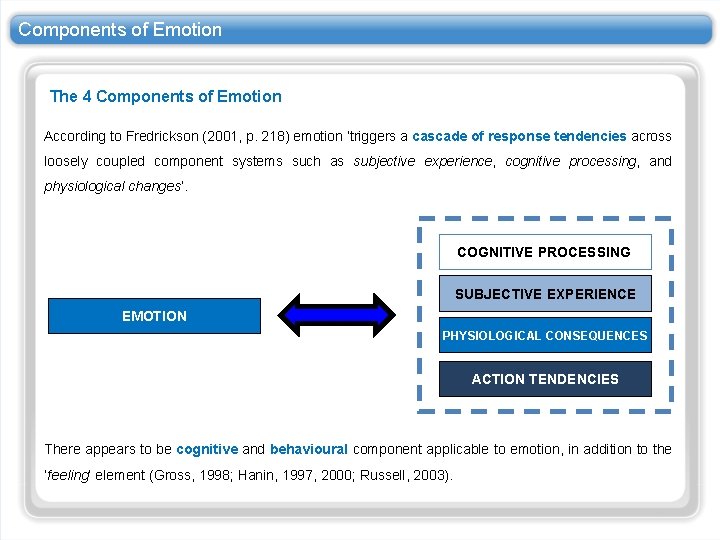
Components of Emotion The 4 Components of Emotion According to Fredrickson (2001, p. 218) emotion ‘triggers a cascade of response tendencies across loosely coupled component systems such as subjective experience, cognitive processing, and physiological changes’. COGNITIVE PROCESSING SUBJECTIVE EXPERIENCE EMOTION PHYSIOLOGICAL CONSEQUENCES MOOD ACTION TENDENCIES There appears to be cognitive and behavioural component applicable to emotion, in addition to the ‘feeling’ element (Gross, 1998; Hanin, 1997, 2000; Russell, 2003).
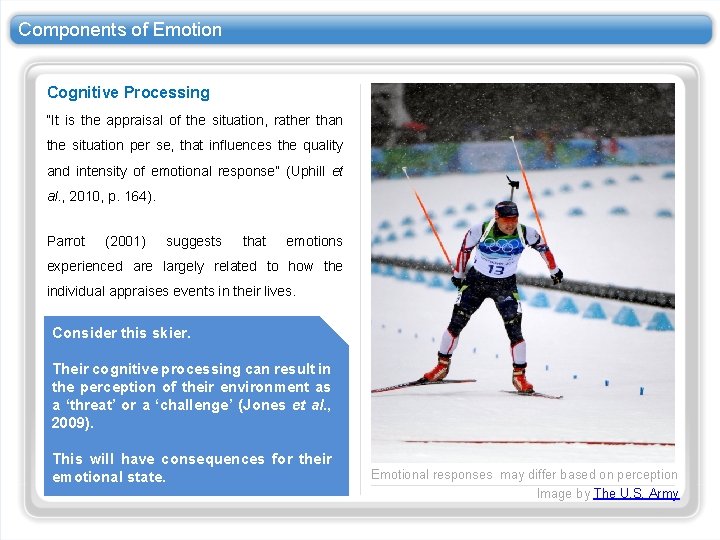
Components of Emotion Cognitive Processing “It is the appraisal of the situation, rather than the situation per se, that influences the quality and intensity of emotional response” (Uphill et al. , 2010, p. 164). Parrot (2001) suggests that emotions experienced are largely related to how the individual appraises events in their lives. Consider this skier. Their cognitive processing can result in the perception of their environment as a ‘threat’ or a ‘challenge’ (Jones et al. , 2009). This will have consequences for their emotional state. Emotional responses may differ based on perception Image by The U. S. Army
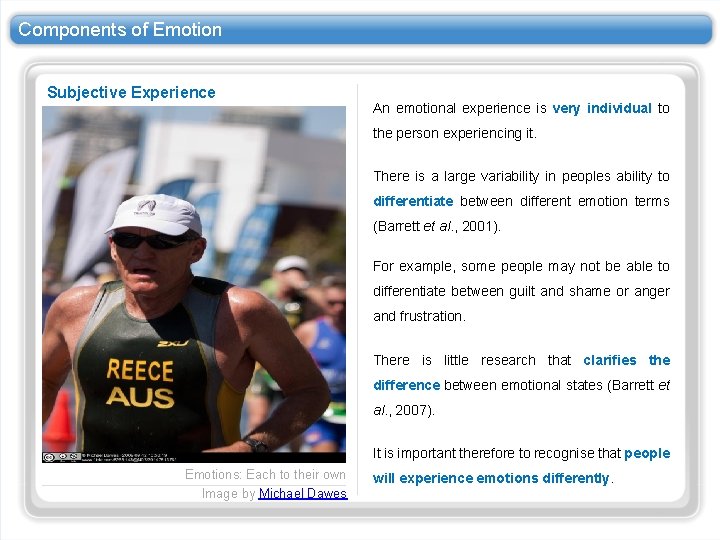
Components of Emotion Subjective Experience An emotional experience is very individual to the person experiencing it. There is a large variability in peoples ability to differentiate between different emotion terms (Barrett et al. , 2001). For example, some people may not be able to differentiate between guilt and shame or anger and frustration. There is little research that clarifies the difference between emotional states (Barrett et al. , 2007). It is important therefore to recognise that people Emotions: Each to their own Image by Michael Dawes will experience emotions differently.
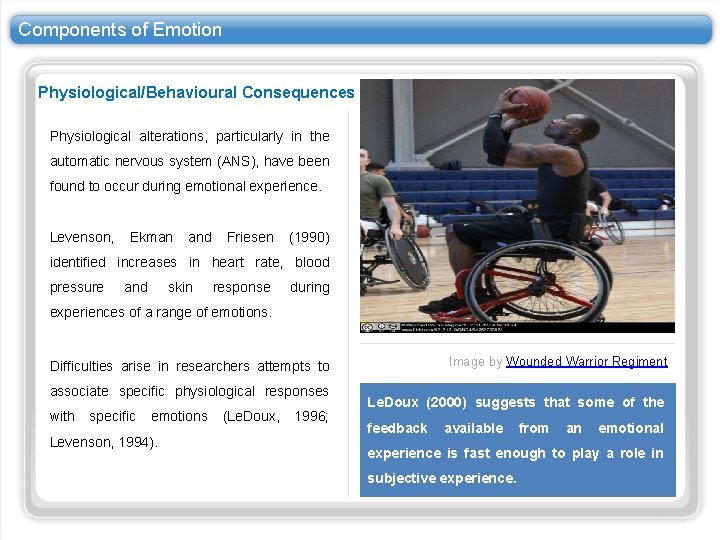
Components of Emotion Physiological/Behavioural Consequences Physiological alterations, particularly in the automatic nervous system (ANS), have been found to occur during emotional experience. Levenson, Ekman and Friesen (1990) identified increases in heart rate, blood pressure and skin response during experiences of a range of emotions. Image by Wounded Warrior Regiment Difficulties arise in researchers attempts to associate specific physiological responses with specific emotions Levenson, 1994). (Le. Doux, 1996; Le. Doux (2000) suggests that some of the feedback available from an emotional experience is fast enough to play a role in subjective experience.
Components of Emotion Action Tendencies Given that it is difficult to tie specific physiological responses to certain emotions, it also becomes difficult to match certain behaviours (or actions tendencies). There is some intuitive value in thinking that those who are angry hit, those who are afraid will run and those that are happy will socially engage. However this is inconsistent. Fredrickson (1998) comments that this is primarily due to the various influences of factors such as cultural norms, coping styles, impulse control and the specific nature of the Fear does not always mean run Image by familymwr environment experienced. in which the emotion is
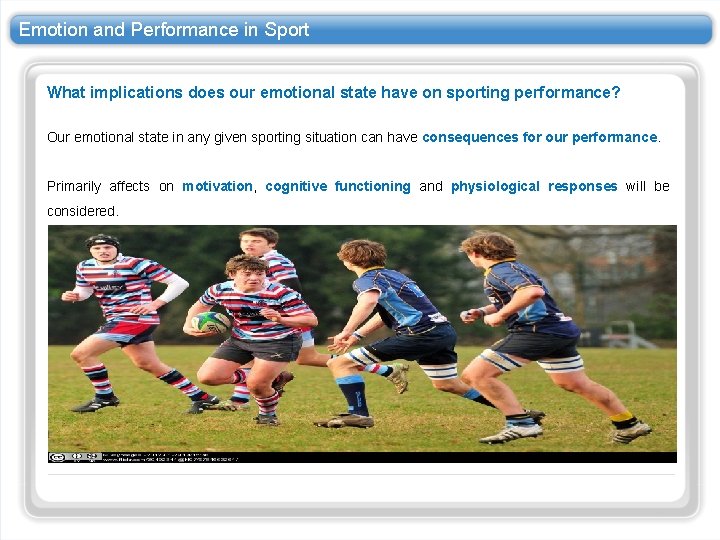
Emotion and Performance in Sport What implications does our emotional state have on sporting performance? Our emotional state in any given sporting situation can have consequences for our performance. Primarily affects on motivation, cognitive functioning and physiological responses will be considered.
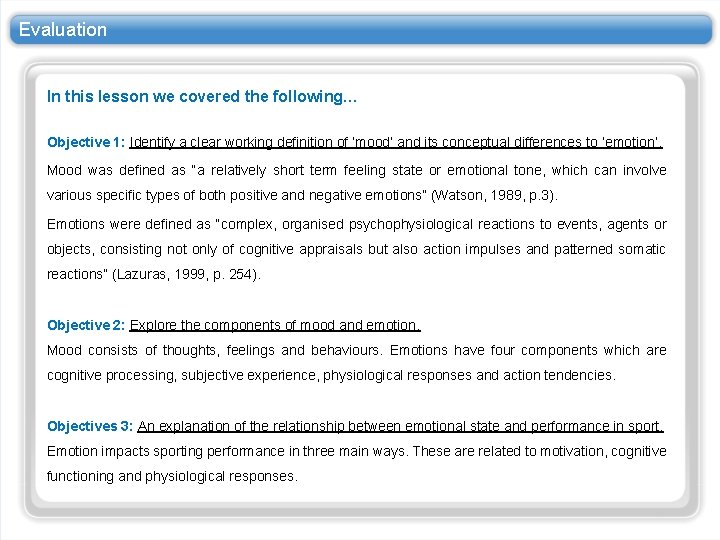
Evaluation In this lesson we covered the following… Objective 1: Identify a clear working definition of ‘mood’ and its conceptual differences to ‘emotion’. Mood was defined as “a relatively short term feeling state or emotional tone, which can involve various specific types of both positive and negative emotions” (Watson, 1989, p. 3). Emotions were defined as “complex, organised psychophysiological reactions to events, agents or objects, consisting not only of cognitive appraisals but also action impulses and patterned somatic reactions” (Lazuras, 1999, p. 254). Objective 2: Explore the components of mood and emotion. Mood consists of thoughts, feelings and behaviours. Emotions have four components which are cognitive processing, subjective experience, physiological responses and action tendencies. Objectives 3: An explanation of the relationship between emotional state and performance in sport. Emotion impacts sporting performance in three main ways. These are related to motivation, cognitive functioning and physiological responses.
References Barrett, L. F. , Gross, J. J. , Christenson, T. C. and Benvenuto, M. (2001). Knowing what your feeling and knowing what to do about it: mapping the relation between emotion differentiation and emotion regulation. Cognition and Emotion, 15, 713 -724. Barrett, L. F. , Mesquita, B. , Ochsner, K. N. and Gross, J. J. (2007). The experience of emotion. Annual Review of Psychology, 58, 373 -403. Beedie, C. J. , Terry, P. C. and Lane, A. M. (2005). Distinctions between mood and emotion. Cognition and Emotion, 19(6), 847 -878. Deci, E. L. (1980). The psychology of self-determination. Lexington: MA, Heath. Frederickson, B. L. (2001). The role of positive emotions in positive psychology. American Psychologist, 56, 218 -226. Gross, J. J. (1998). Antecedent- and response-foccsed emotion regulation: divergent consequences for experience, expression and physiology. Journal of Personality and Social Psychology, 27, 39 -52. Hanin, Y. L. (1997). Emotions and athletic performance: individual zones of optimal functioning model. European Yearbook of Sport Psychology, 1, 29 -72.
References Jones, M. , Meijen, C. , Mc. Carthy, P. J. and Sheffield, D. (2009). A theory of challenge and threat states in athletes. International Review of Sport and Exercise Psychology, 2(2), 161 -180. Lane, A. M. , & Terry, P. C. (2000). The nature of mood: Development of a conceptual model with a focus on depression. Journal of Applied Sport Psychology, 12, 16 -33. Lazuras, R. S. (1999). The cognition-emotion debate: a bit of history. In T. Dalgleish and M. J. Power (Eds. ). Handbook of cognition and emotion. Wiley: Chichester. Le Doux, J. E. (1996). The Emotional Brain. Simon and Schuster: New York, NY. Le Doux, J. E. (2000). Cognitive-emotional interactions: listen to the brain. In R. D. Lane and L. Nadel (Eds. ). Cognitive Neuroscience of Emotion. Oxford university Press: Oxford. Levenson, R. W. (1994). The search for autonomic specificity. In P. Ekman and R. J. Davidson, (Eds. ). The Nature of Emotion: Fundamental Questions. Oxford university Press: Oxford.
References Parrott, W. G. (2001). Emotions in social psychology. Psychology Press: Hove. Russell, J. A. (2003). Core affect and the psychological construction of emotion. Psychological Review, 110, 145 -172. Uphill, M. A. , Mc. Carthy, P. J. and Jones, M. V. (2009). Getting a grip on emotion regulation in sport. In S. D. Mellalieu and S. Hanton (Eds. ). Advances in Applied Sport Psychology, Routledge: New York, NY. Watson, D. (1989). Health complaints, stress and distress: Exploring the central role of negative affectivity. Psychological Review, 96(2), 234 -254. Wolframm, I. A. , Shearman, J. and Micklewright, D. (2010). A preliminary investigation into pre-competitive mood states of advances and novice equestrian dressage riders. Journal of Applied Sport Psychology, 22(3). 333 -342.