
An Introduction to Modern Particle Physics Mark Thomson

- Slides: 28
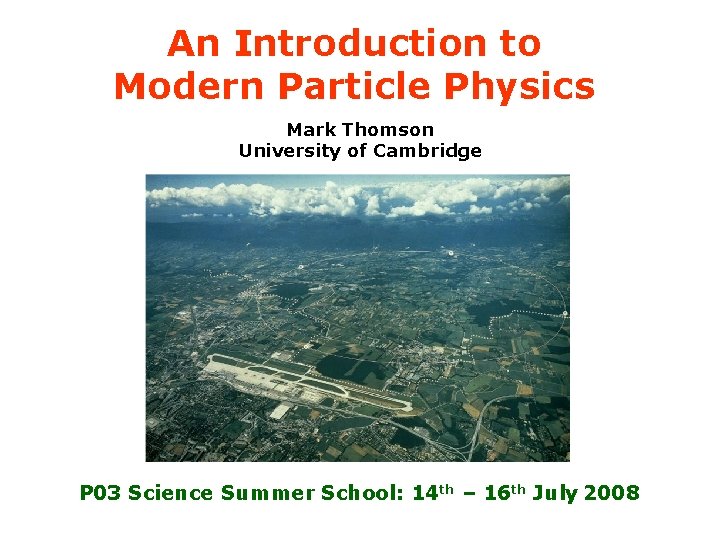
An Introduction to Modern Particle Physics Mark Thomson University of Cambridge P 03 Science Summer School: 14 th – 16 th July 2008
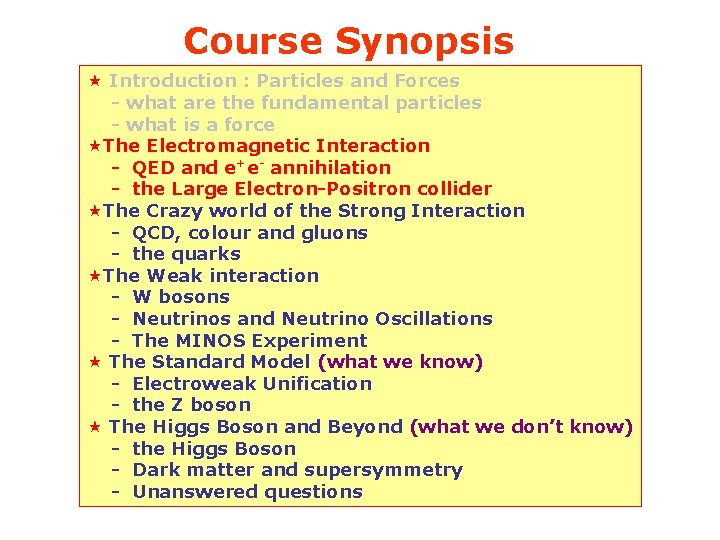
Course Synopsis « Introduction : Particles and Forces - what are the fundamental particles - what is a force «The Electromagnetic Interaction - QED and e+e- annihilation - the Large Electron-Positron collider «The Crazy world of the Strong Interaction - QCD, colour and gluons - the quarks «The Weak interaction - W bosons - Neutrinos and Neutrino Oscillations - The MINOS Experiment « The Standard Model (what we know) - Electroweak Unification - the Z boson « The Higgs Boson and Beyond (what we don’t know) - the Higgs Boson - Dark matter and supersymmetry - Unanswered questions
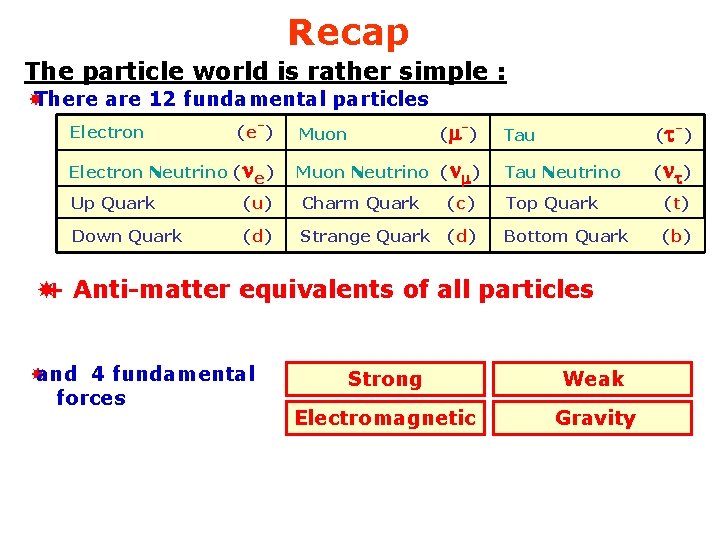
Recap The particle world is rather simple : There are 12 fundamental particles Electron (e-) Electron Neutrino (ne) ( m- ) Muon Neutrino (nm) Tau ( t -) Tau Neutrino ( n t) Up Quark (u) Charm Quark (c) Top Quark (t) Down Quark (d) Strange Quark (d) Bottom Quark (b) + Anti-matter equivalents of all particles and 4 fundamental forces Strong Weak Electromagnetic Gravity
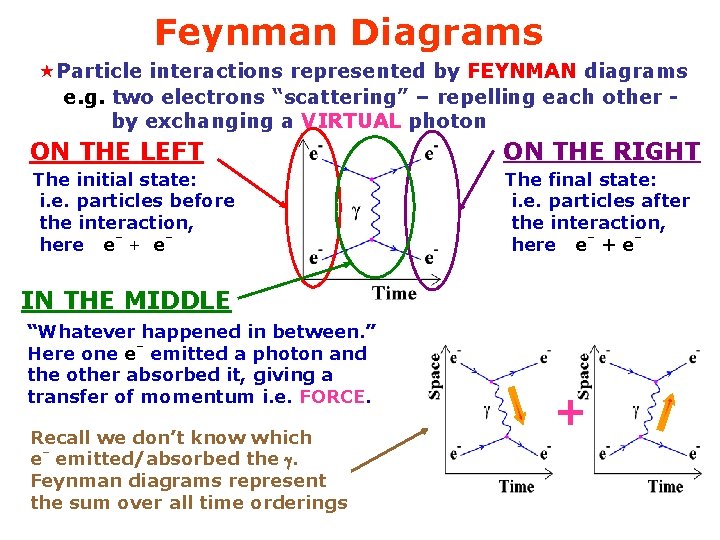
Feynman Diagrams «Particle interactions represented by FEYNMAN diagrams e. g. two electrons “scattering” – repelling each other by exchanging a VIRTUAL photon ON THE LEFT ON THE RIGHT The initial state: i. e. particles before the interaction, here e- + e- The final state: i. e. particles after the interaction, here e- + e- IN THE MIDDLE “Whatever happened in between. ” Here one e- emitted a photon and the other absorbed it, giving a transfer of momentum i. e. FORCE. Recall we don’t know which e- emitted/absorbed the g. Feynman diagrams represent the sum over all time orderings +
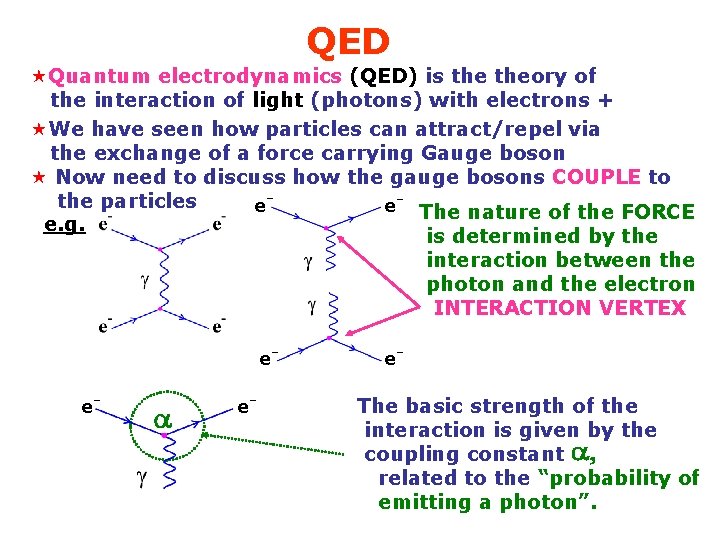
QED «Quantum electrodynamics (QED) is theory of the interaction of light (photons) with electrons + «We have seen how particles can attract/repel via the exchange of a force carrying Gauge boson « Now need to discuss how the gauge bosons COUPLE to the particles ee- The nature of the FORCE e. g. is determined by the interaction between the photon and the electron INTERACTION VERTEX ee- a e- e- The basic strength of the interaction is given by the coupling constant a, related to the “probability of emitting a photon”.
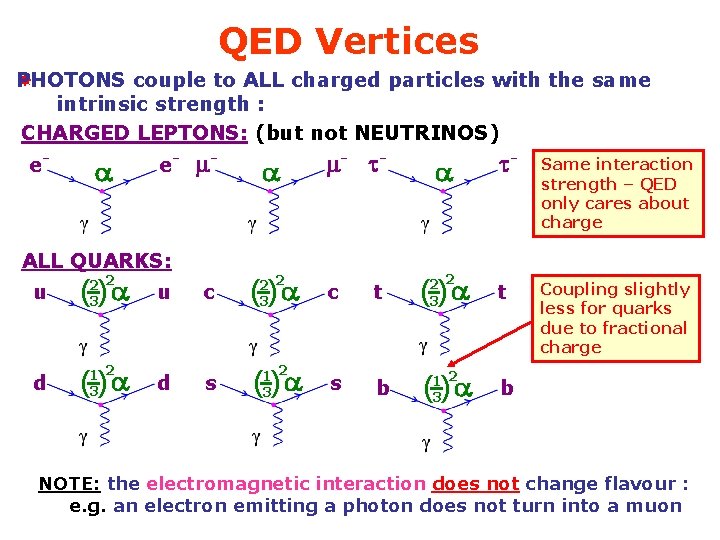
QED Vertices PHOTONS couple to ALL charged particles with the same intrinsic strength : CHARGED LEPTONS: (but not NEUTRINOS) e- a e- m- ALL QUARKS: 2 2 3 u ( )a d 1 2 3 ( )a u d a m- t - c 2 2 3 ( )a c t s 1 2 3 s b ( )a t- Same interaction strength – QED only cares about charge 2 2 3 t Coupling slightly less for quarks due to fractional charge 1 2 3 b a ( )a NOTE: the electromagnetic interaction does not change flavour : e. g. an electron emitting a photon does not turn into a muon
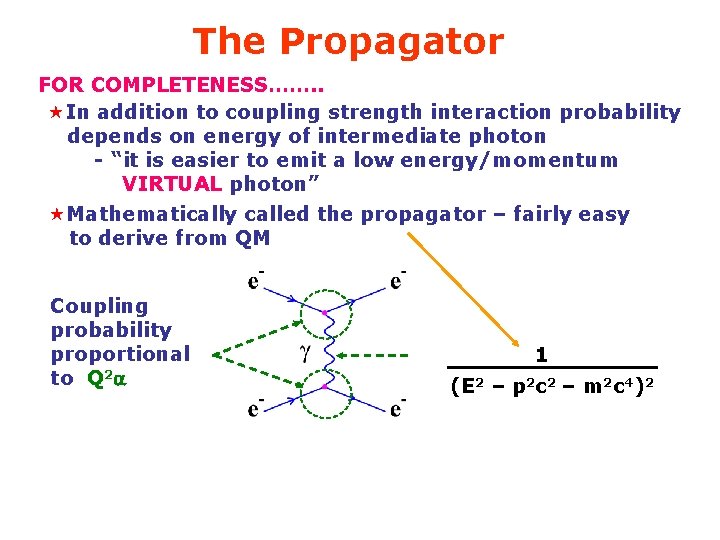
The Propagator FOR COMPLETENESS……. . «In addition to coupling strength interaction probability depends on energy of intermediate photon - “it is easier to emit a low energy/momentum VIRTUAL photon” «Mathematically called the propagator – fairly easy to derive from QM Coupling probability proportional to Q 2 a 1 (E 2 – p 2 c 2 – m 2 c 4)2
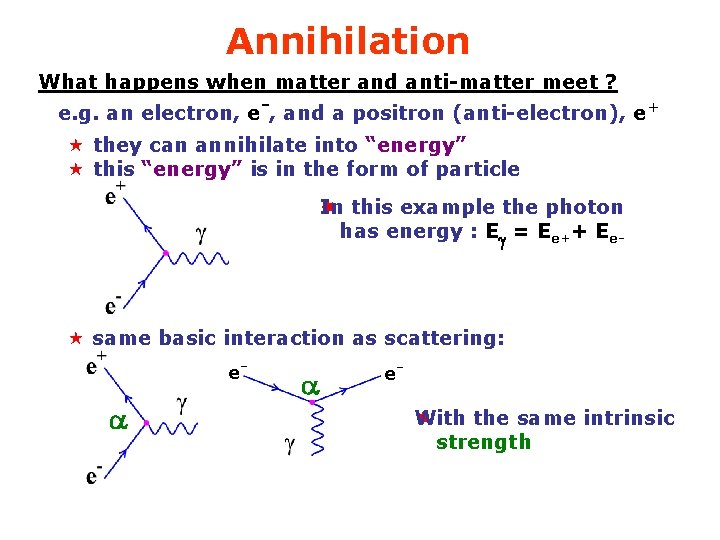
Annihilation What happens when matter and anti-matter meet ? e. g. an electron, e-, and a positron (anti-electron), e+ « they can annihilate into “energy” « this “energy” is in the form of particle In this example the photon has energy : Eg = Ee++ Ee- « same basic interaction as scattering: e- a a e- With the same intrinsic strength
Electron-Positron Annihilation «Electrons/positrons are relatively easy to accelerate to high energies «All of the energy of the collision is converted into the energy of the photon «That energy can then create a particle – anti-particle pair provided: • they are charged (need to interact with a photon) • energy > 2 mc 2 (need sufficient energy to make the two new particles) ? ?
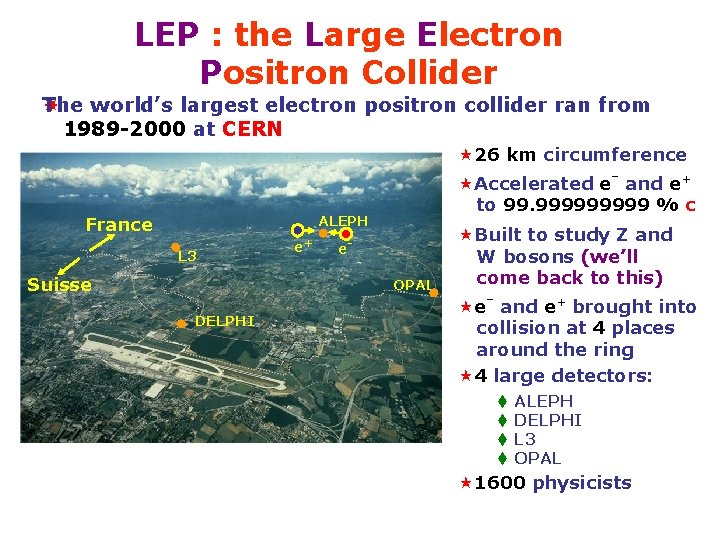
LEP : the Large Electron Positron Collider The world’s largest electron positron collider ran from 1989 -2000 at CERN « 26 km circumference «Accelerated e- and e+ to 99. 99999 % c ALEPH France L 3 Suisse e+ e. OPAL DELPHI «Built to study Z and W bosons (we’ll come back to this) «e- and e+ brought into collision at 4 places around the ring « 4 large detectors: t t ALEPH DELPHI L 3 OPAL « 1600 physicists
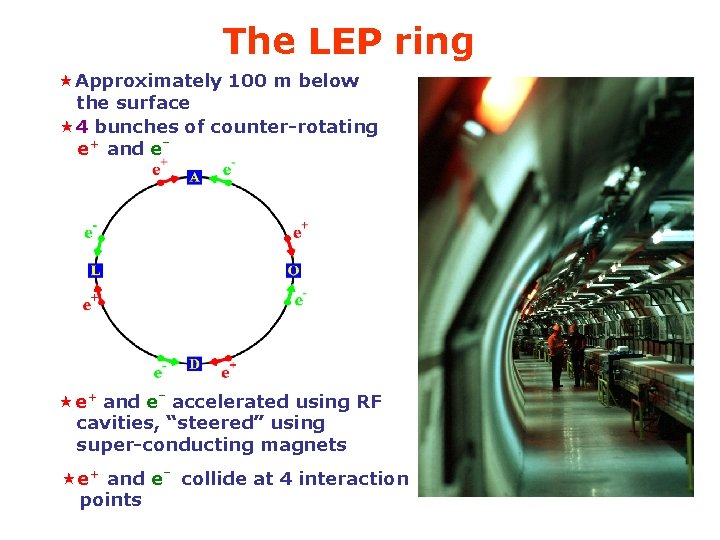
The LEP ring «Approximately 100 m below the surface « 4 bunches of counter-rotating e+ and e- «e+ and e- accelerated using RF cavities, “steered” using super-conducting magnets «e+ and e- collide at 4 interaction points
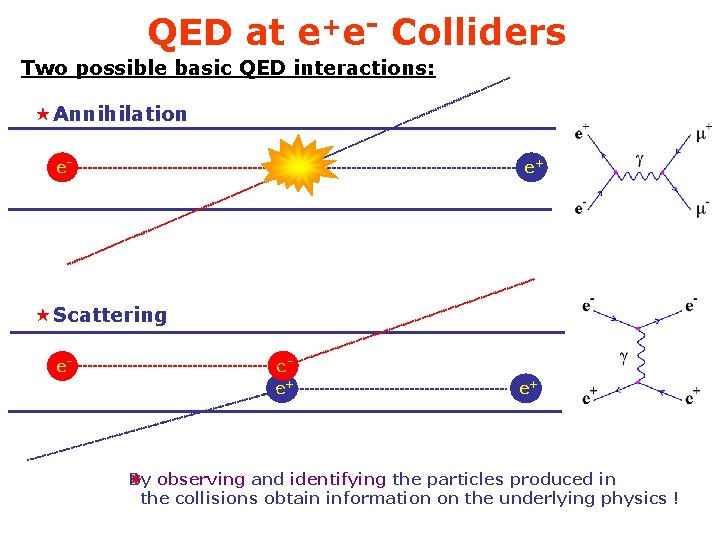
QED at e+e- Colliders Two possible basic QED interactions: «Annihilation e- mm-+ e+ «Scattering e- ee+ e+ y observing and identifying the particles produced in B the collisions obtain information on the underlying physics !
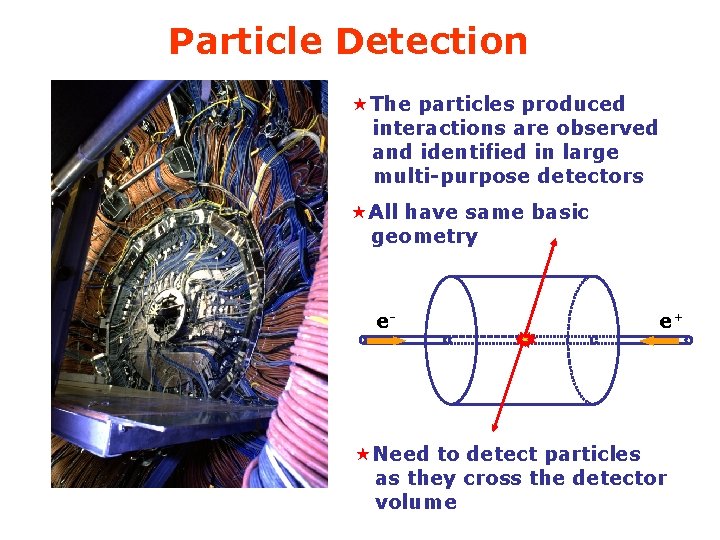
Particle Detection «The particles produced interactions are observed and identified in large multi-purpose detectors «All have same basic geometry e- e+ «Need to detect particles as they cross the detector volume
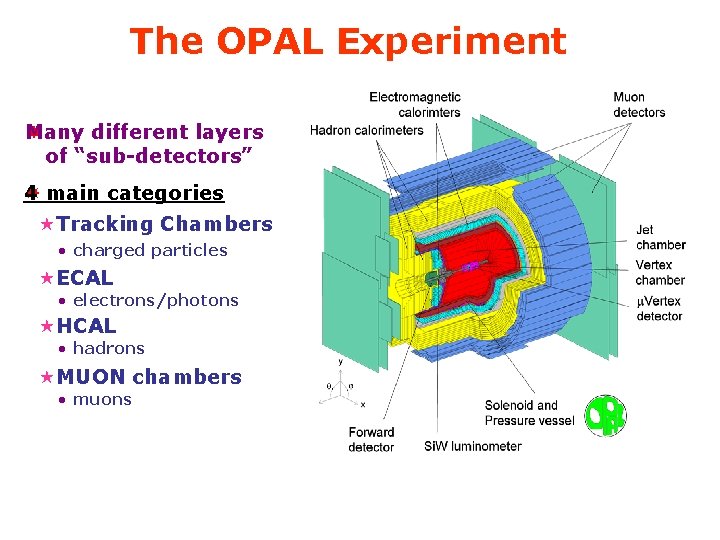
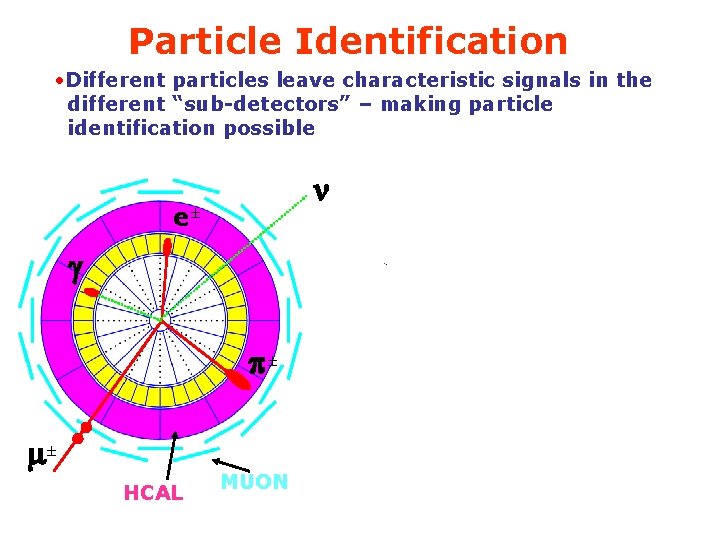
The OPAL Experiment Many different layers of “sub-detectors” 4 main categories «Tracking Chambers • charged particles «ECAL • electrons/photons «HCAL • hadrons «MUON chambers • muons
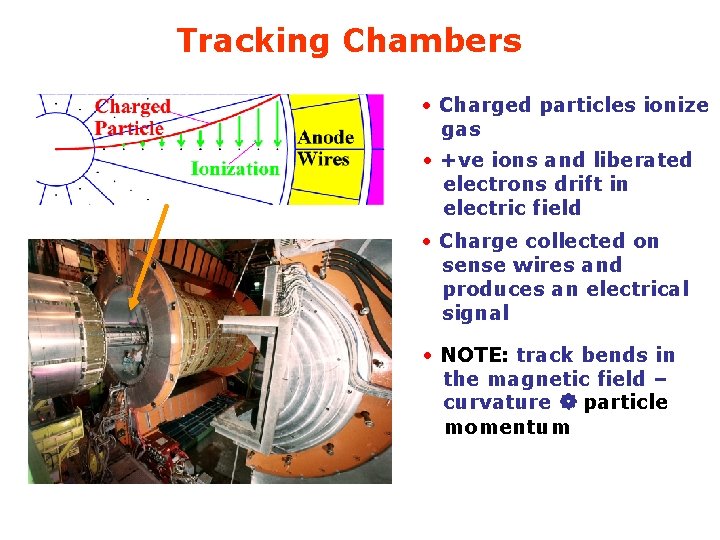
Tracking Chambers • Charged particles ionize gas • +ve ions and liberated electrons drift in electric field • Charge collected on sense wires and produces an electrical signal • NOTE: track bends in the magnetic field – curvature particle momentum
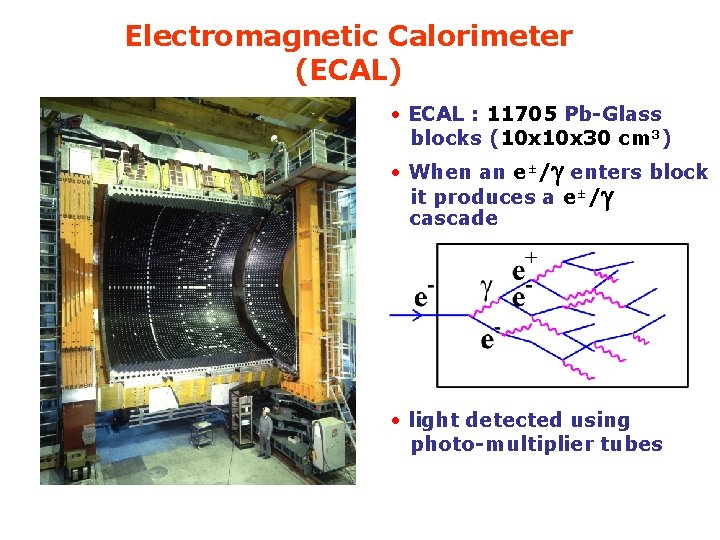
Electromagnetic Calorimeter (ECAL) • ECAL : 11705 Pb-Glass blocks (10 x 30 cm 3) • When an e±/g enters block it produces a e±/g cascade • light detected using photo-multiplier tubes
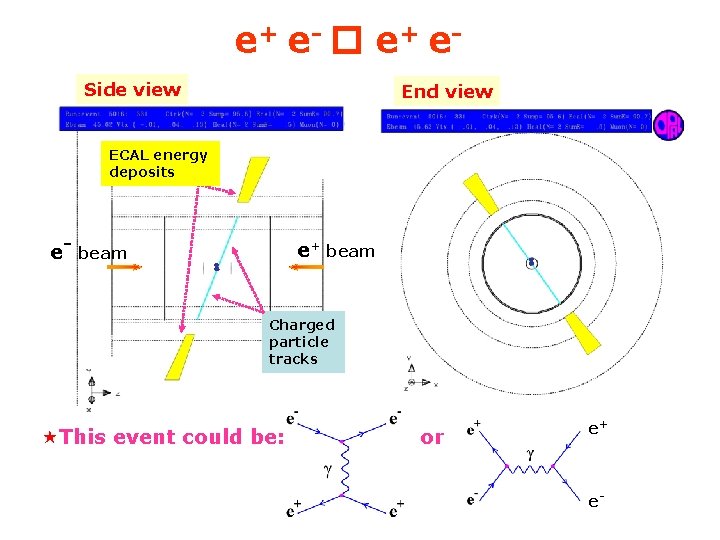
e+ e- e + e. Side view End view ECAL energy deposits e- e+ beam Charged particle tracks «This event could be: or e+ e-
Particle Identification • Different particles leave characteristic signals in the different “sub-detectors” – making particle identification possible n e± g p± m± HCAL MUON
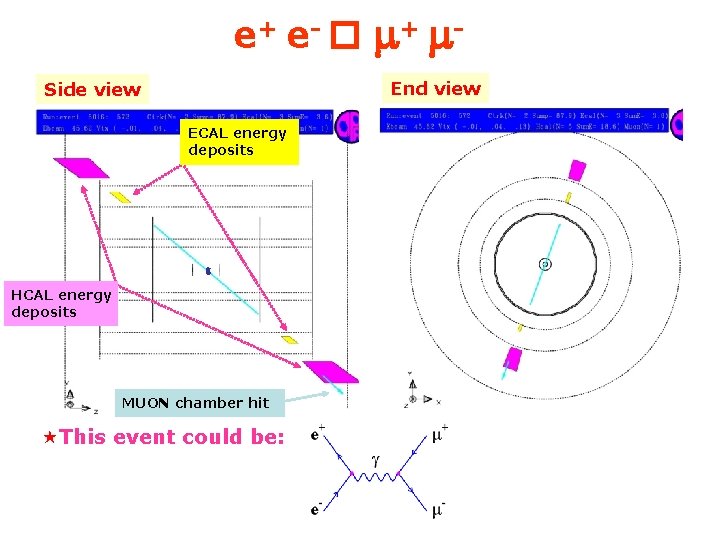
e+ e- m+ m. End view Side view ECAL energy deposits HCAL energy deposits MUON chamber hit «This event could be:
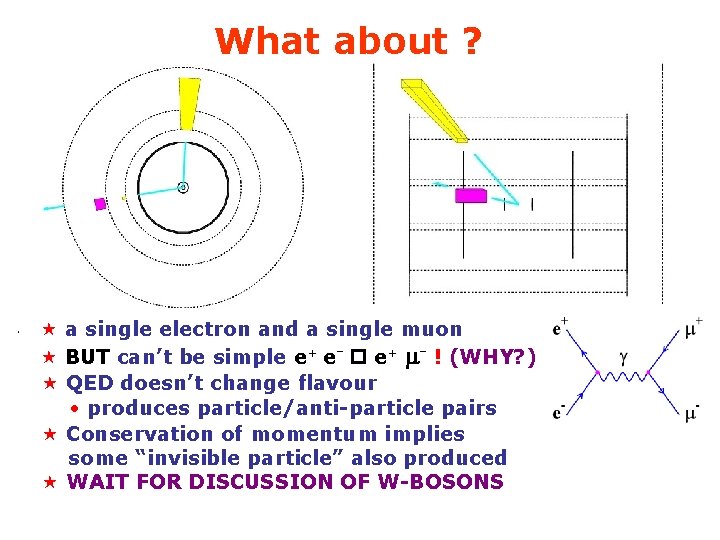
What about ? « a single electron and a single muon « BUT can’t be simple e+ e- e+ m- ! (WHY? ) « QED doesn’t change flavour • produces particle/anti-particle pairs « Conservation of momentum implies some “invisible particle” also produced « WAIT FOR DISCUSSION OF W-BOSONS
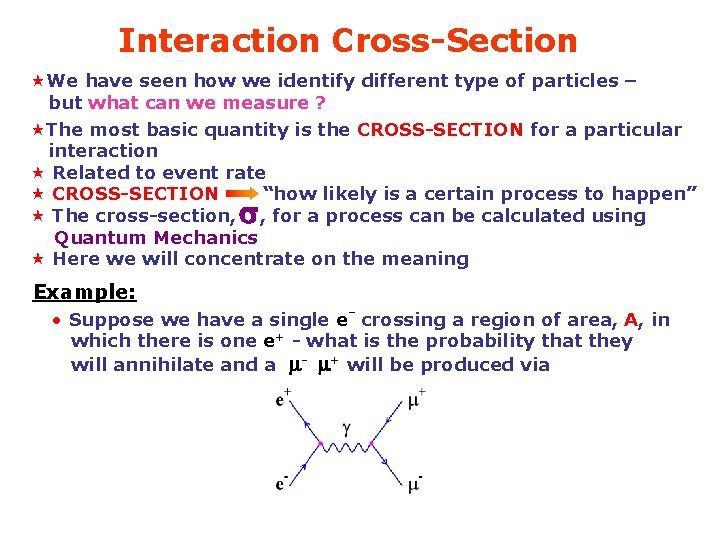
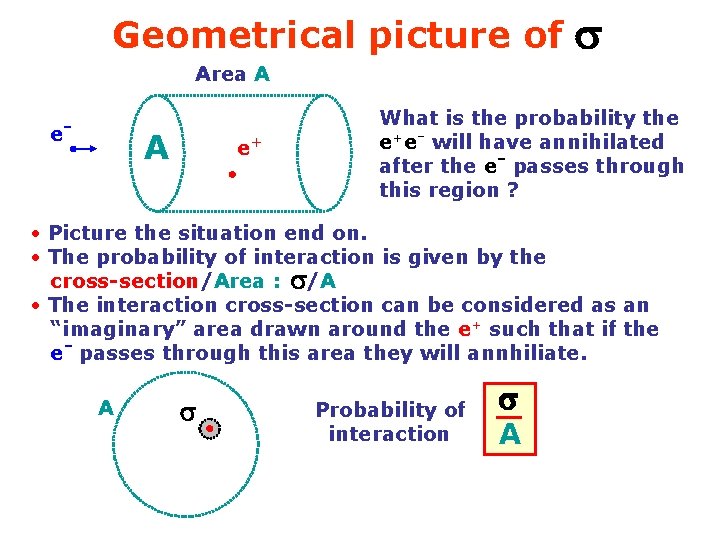
Interaction Cross-Section «We have seen how we identify different type of particles – but what can we measure ? «The most basic quantity is the CROSS-SECTION for a particular interaction « Related to event rate « CROSS-SECTION “how likely is a certain process to happen” « The cross-section, , for a process can be calculated using Quantum Mechanics « Here we will concentrate on the meaning s Example: • Suppose we have a single e- crossing a region of area, A, in which there is one e+ - what is the probability that they will annihilate and a m- m+ will be produced via
Geometrical picture of s Area A e- A e+ What is the probability the e+e- will have annihilated after the e- passes through this region ? • Picture the situation end on. • The probability of interaction is given by the cross-section/Area : s/A • The interaction cross-section can be considered as an “imaginary” area drawn around the e+ such that if the e- passes through this area they will annhiliate. A s Probability of interaction s A
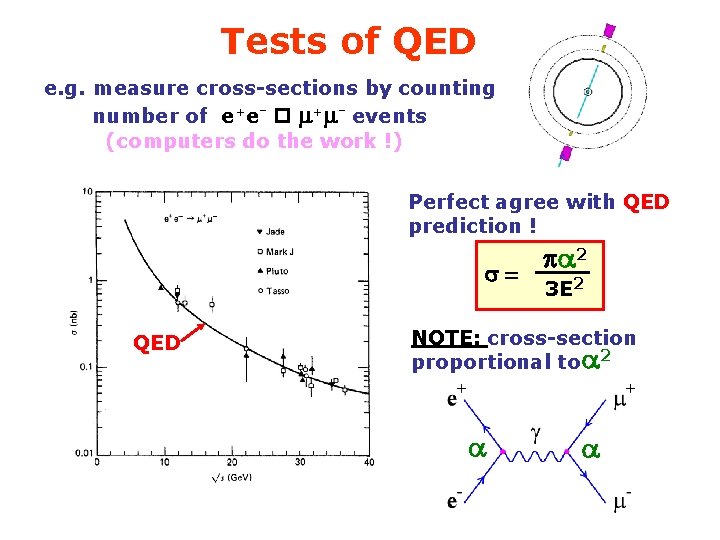
Tests of QED e. g. measure cross-sections by counting number of e+e- m+m- events (computers do the work !) Perfect agree with QED prediction ! s= QED pa 2 3 E 2 NOTE: cross-section proportional to a 2 a a
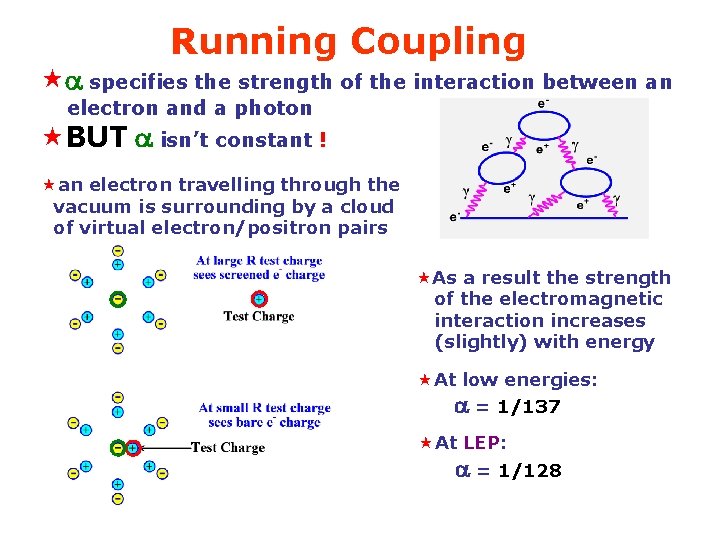
Running Coupling «a specifies the strength of the interaction between an electron and a photon «BUT a isn’t constant ! «an electron travelling through the vacuum is surrounding by a cloud of virtual electron/positron pairs «As a result the strength of the electromagnetic interaction increases (slightly) with energy «At low energies: a = 1/137 «At LEP: a = 1/128
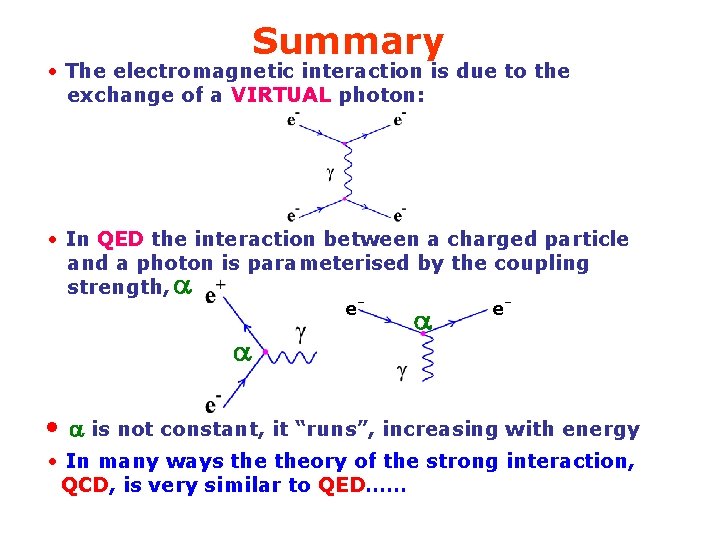
Summary • The electromagnetic interaction is due to the exchange of a VIRTUAL photon: • In QED the interaction between a charged particle and a photon is parameterised by the coupling strength, a e- a a e- • a is not constant, it “runs”, increasing with energy • In many ways theory of the strong interaction, QCD, is very similar to QED……
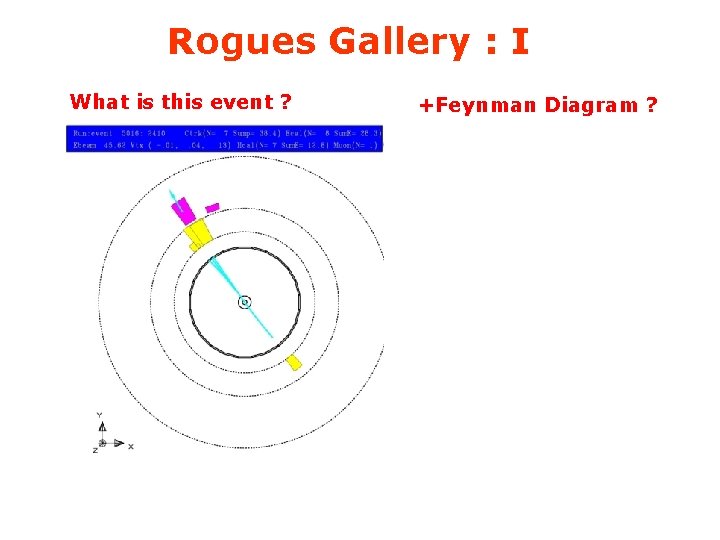
Rogues Gallery : I What is this event ? +Feynman Diagram ? t+ t-
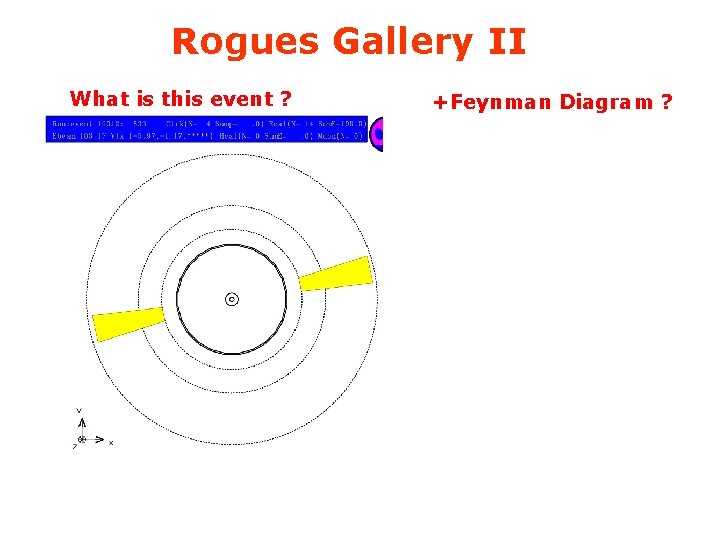
Rogues Gallery II What is this event ? +Feynman Diagram ?
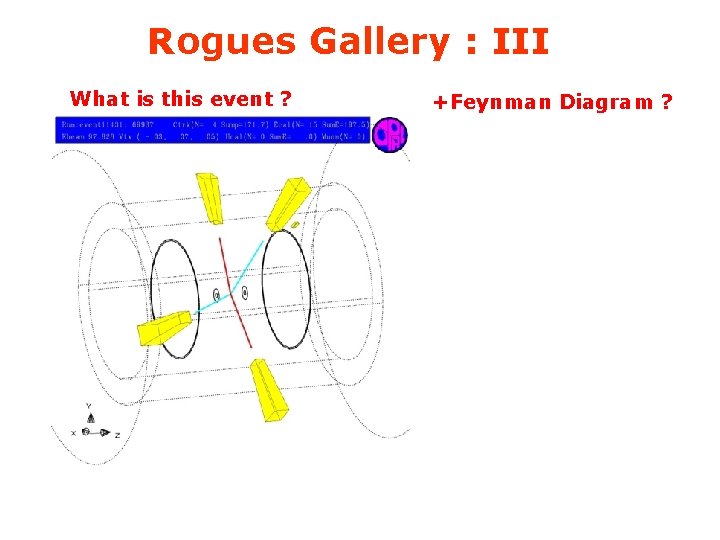
Rogues Gallery : III What is this event ? +Feynman Diagram ? e- e+