
An Introduction to Modern Particle Physics Mark Thomson

- Slides: 46
An Introduction to Modern Particle Physics Mark Thomson University of Cambridge P 03 Science Summer School: 14 th – 16 th July 2008 1
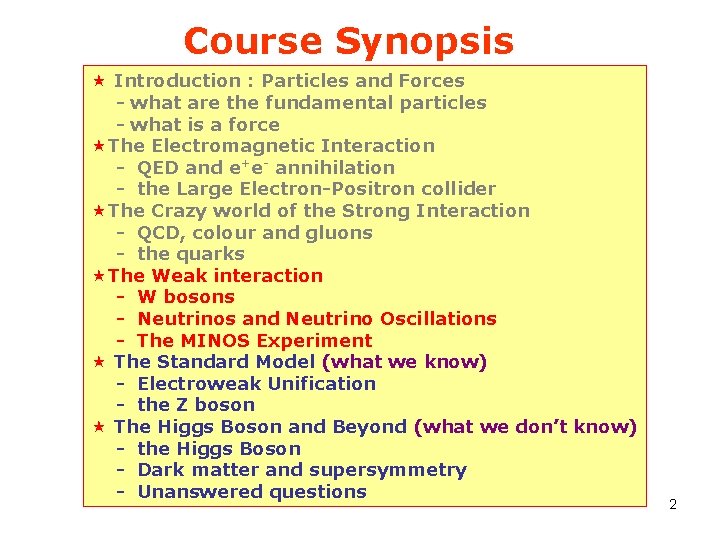
Course Synopsis « Introduction : Particles and Forces - what are the fundamental particles - what is a force «The Electromagnetic Interaction - QED and e+e- annihilation - the Large Electron-Positron collider «The Crazy world of the Strong Interaction - QCD, colour and gluons - the quarks «The Weak interaction - W bosons - Neutrinos and Neutrino Oscillations - The MINOS Experiment « The Standard Model (what we know) - Electroweak Unification - the Z boson « The Higgs Boson and Beyond (what we don’t know) - the Higgs Boson - Dark matter and supersymmetry - Unanswered questions 2
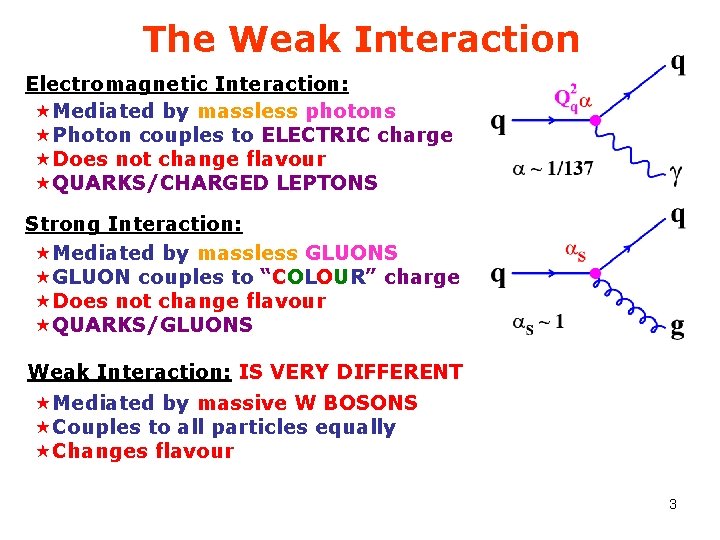
The Weak Interaction Electromagnetic Interaction: «Mediated by massless photons «Photon couples to ELECTRIC charge «Does not change flavour «QUARKS/CHARGED LEPTONS Strong Interaction: «Mediated by massless GLUONS «GLUON couples to “COLOUR” charge «Does not change flavour «QUARKS/GLUONS Weak Interaction: IS VERY DIFFERENT «Mediated by massive W BOSONS «Couples to all particles equally «Changes flavour 3
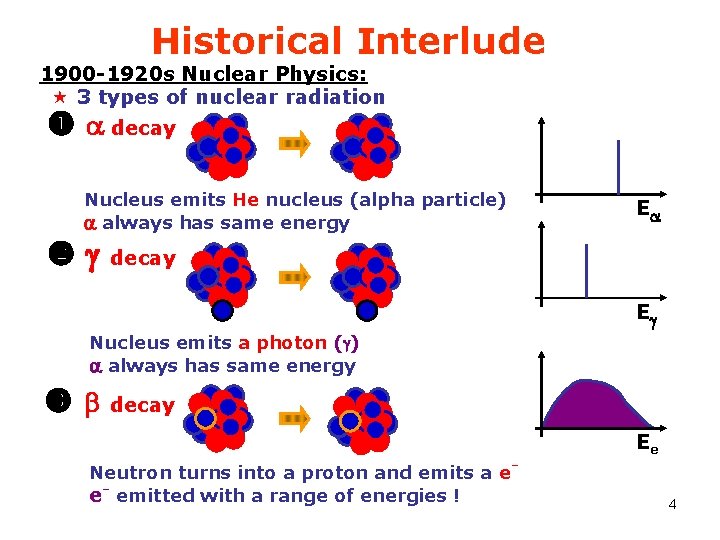
Historical Interlude 1900 -1920 s Nuclear Physics: « 3 types of nuclear radiation a decay Nucleus emits He nucleus (alpha particle) a always has same energy g Ea decay Eg Nucleus emits a photon (g) a always has same energy b decay Neutron turns into a proton and emits a ee- emitted with a range of energies ! Ee 4
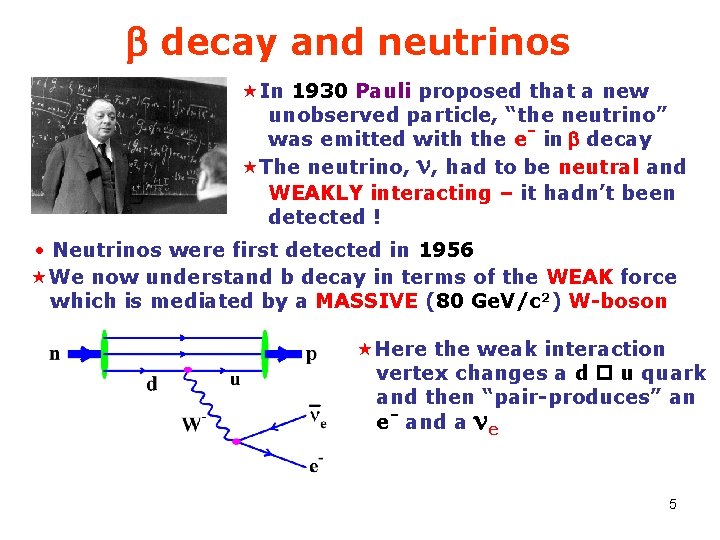
b decay and neutrinos «In 1930 Pauli proposed that a new unobserved particle, “the neutrino” was emitted with the e- in b decay «The neutrino, n, had to be neutral and WEAKLY interacting – it hadn’t been detected ! • Neutrinos were first detected in 1956 «We now understand b decay in terms of the WEAK force which is mediated by a MASSIVE (80 Ge. V/c 2) W-boson «Here the weak interaction vertex changes a d u quark and then “pair-produces” an e- and a ne 5
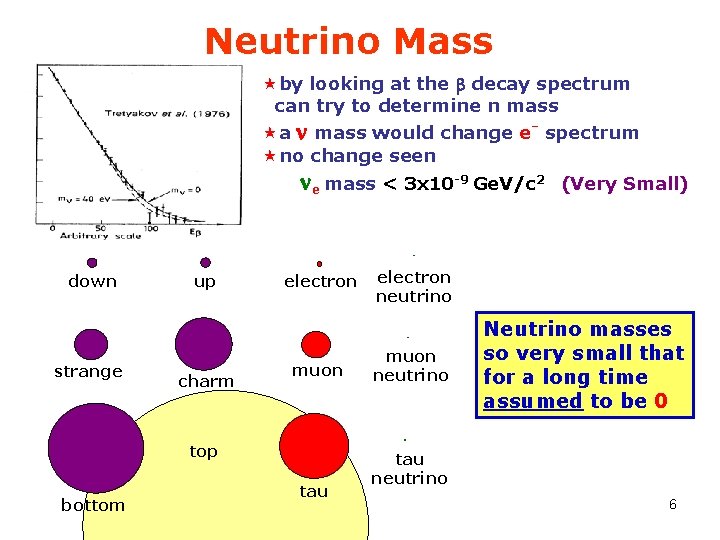
Neutrino Mass «by looking at the b decay spectrum can try to determine n mass «a n mass would change e- spectrum «no change seen ne mass < 3 x 10 -9 Ge. V/c 2 (Very Small) . down up electron neutrino. strange charm muon . top bottom muon neutrino Neutrino masses so very small that for a long time assumed to be 0 tau neutrino 6
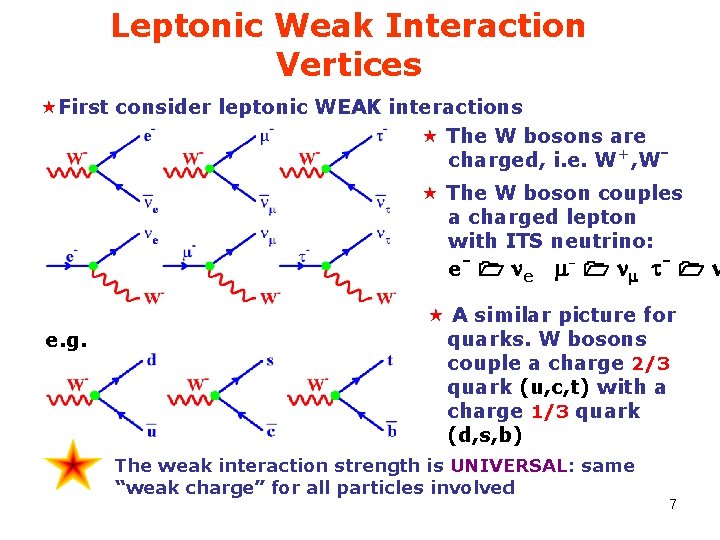
Leptonic Weak Interaction Vertices «First consider leptonic WEAK interactions « The W bosons are charged, i. e. W+, W- « The W boson couples a charged lepton with ITS neutrino: e- n e m - n m t - n e. g. « A similar picture for quarks. W bosons couple a charge 2/3 quark (u, c, t) with a charge 1/3 quark (d, s, b) The weak interaction strength is UNIVERSAL: same “weak charge” for all particles involved 7
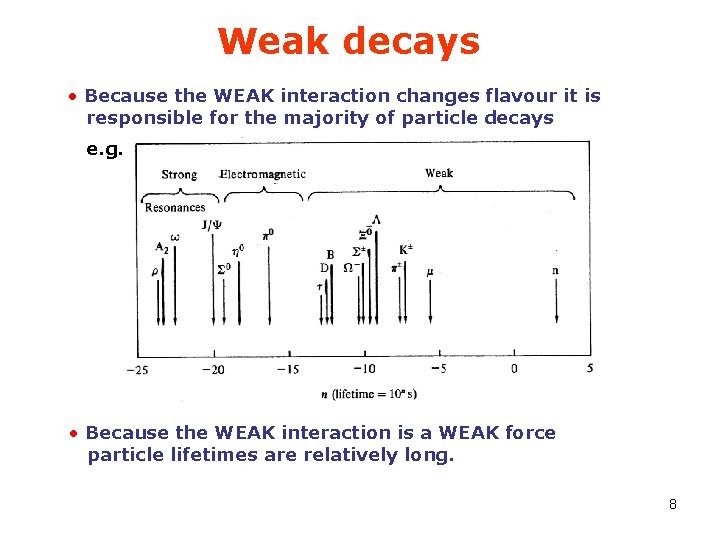
Weak decays • Because the WEAK interaction changes flavour it is responsible for the majority of particle decays e. g. • Because the WEAK interaction is a WEAK force particle lifetimes are relatively long. 8
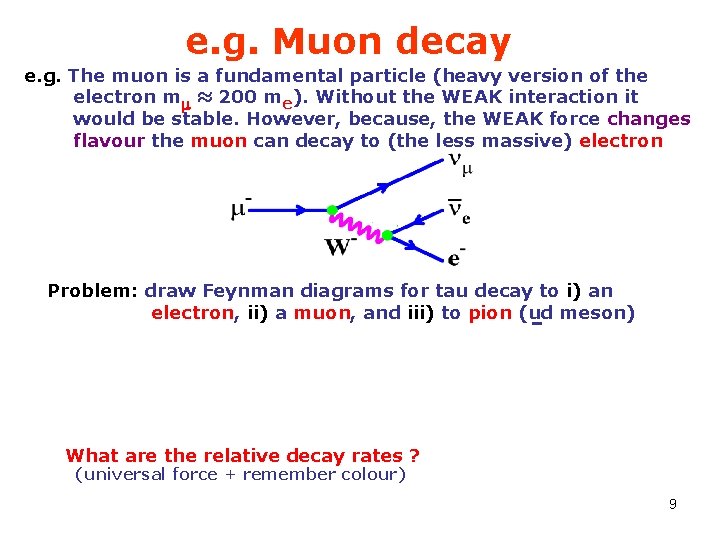
e. g. Muon decay e. g. The muon is a fundamental particle (heavy version of the electron mm ≈ 200 me). Without the WEAK interaction it would be stable. However, because, the WEAK force changes flavour the muon can decay to (the less massive) electron Problem: draw Feynman diagrams for tau decay to i) an electron, ii) a muon, and iii) to pion (ud meson) What are the relative decay rates ? (universal force + remember colour) 1: 1: 3 9
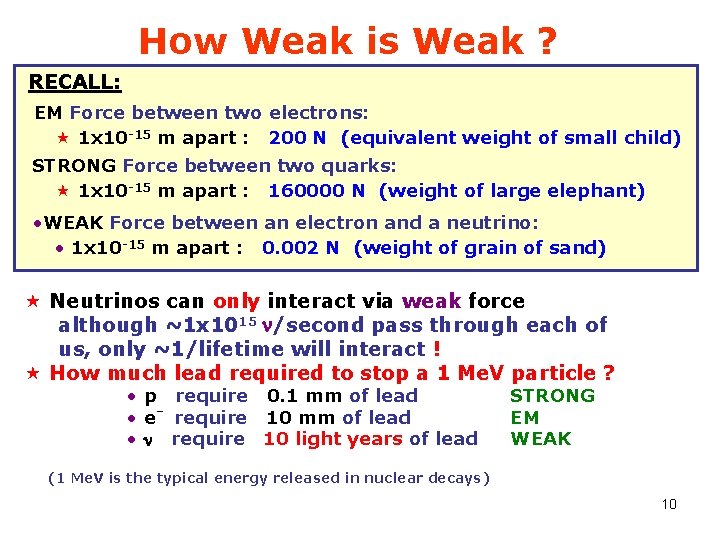
How Weak is Weak ? RECALL: EM Force between two electrons: « 1 x 10 -15 m apart : 200 N (equivalent weight of small child) STRONG Force between two quarks: « 1 x 10 -15 m apart : 160000 N (weight of large elephant) • WEAK Force between an electron and a neutrino: • 1 x 10 -15 m apart : 0. 002 N (weight of grain of sand) « Neutrinos can only interact via weak force although ~1 x 10¹⁵ n/second pass through each of us, only ~1/lifetime will interact ! « How much lead required to stop a 1 Me. V particle ? • • • p require 0. 1 mm of lead e- require 10 mm of lead n require 10 light years of lead STRONG EM WEAK (1 Me. V is the typical energy released in nuclear decays) 10
«Two interesting questions………. . What do we know about neutrinos – are they really massless ? Why is the weak force so much “weaker” than the EM and Strong forces ? Discuss neutrinos first…. . 11
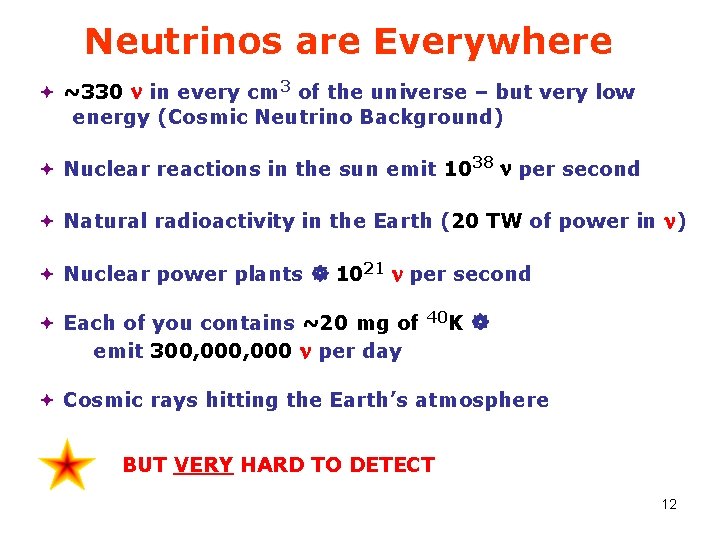
Neutrinos are Everywhere ª ~330 n in every cm 3 of the universe – but very low energy (Cosmic Neutrino Background) ª Nuclear reactions in the sun emit 1038 n per second ª Natural radioactivity in the Earth (20 TW of power in n) ª Nuclear power plants 1021 n per second ª Each of you contains ~20 mg of emit 300, 000 n per day 40 K ª Cosmic rays hitting the Earth’s atmosphere BUT VERY HARD TO DETECT 12
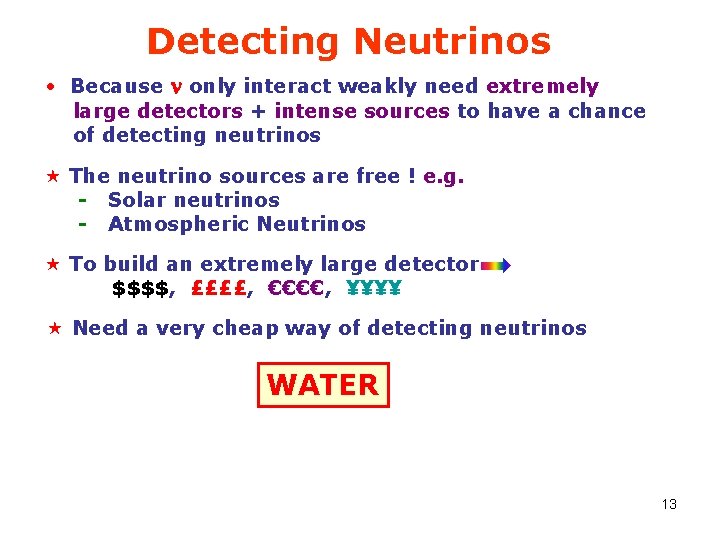
Detecting Neutrinos • Because n only interact weakly need extremely large detectors + intense sources to have a chance of detecting neutrinos « The neutrino sources are free ! e. g. - Solar neutrinos - Atmospheric Neutrinos « To build an extremely large detector $$$$, ££££, €€€€, ¥¥¥¥ « Need a very cheap way of detecting neutrinos WATER 13
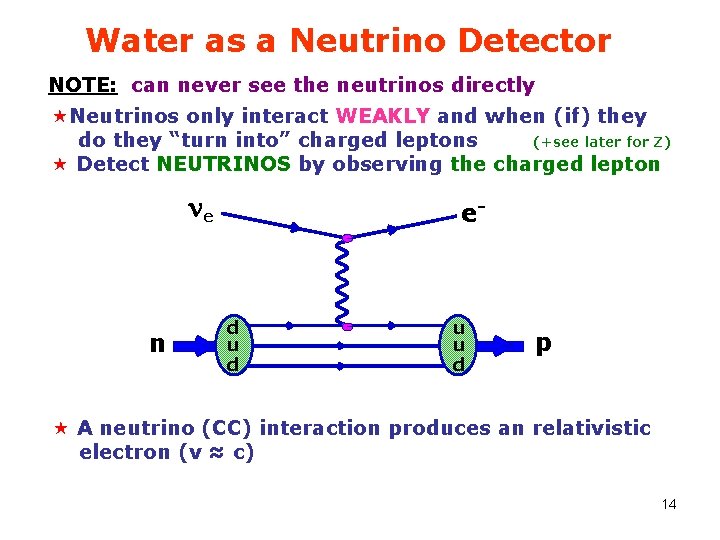
Water as a Neutrino Detector NOTE: can never see the neutrinos directly «Neutrinos only interact WEAKLY and when (if) they do they “turn into” charged leptons (+see later for Z) « Detect NEUTRINOS by observing the charged lepton ne n e- d u u d p « A neutrino (CC) interaction produces an relativistic electron (v ≈ c) 14
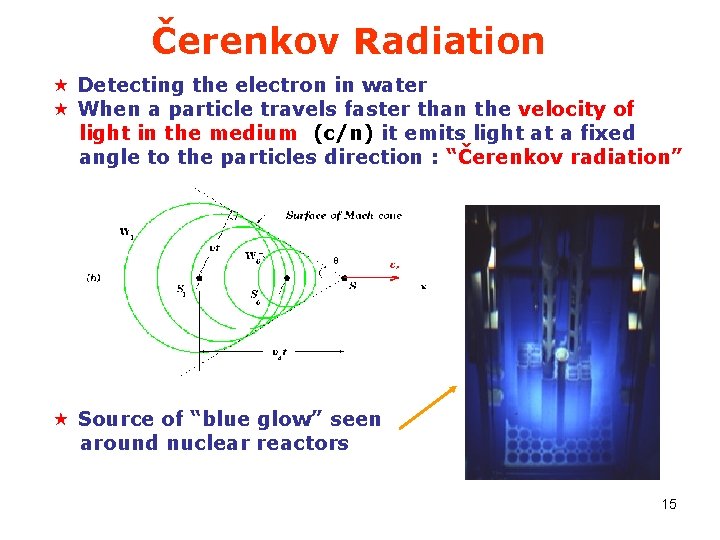
Čerenkov Radiation « Detecting the electron in water « When a particle travels faster than the velocity of light in the medium (c/n) it emits light at a fixed angle to the particles direction : “Čerenkov radiation” « Source of “blue glow” seen around nuclear reactors 15
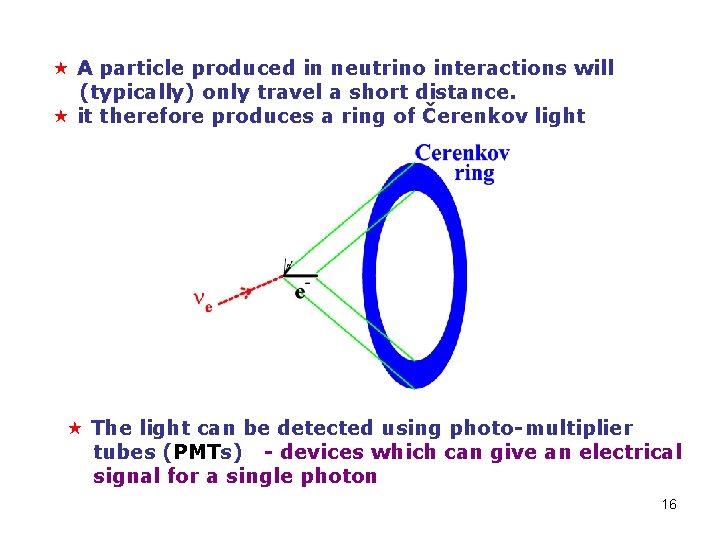
« A particle produced in neutrino interactions will (typically) only travel a short distance. « it therefore produces a ring of Čerenkov light « The light can be detected using photo-multiplier tubes (PMTs) - devices which can give an electrical signal for a single photon 16
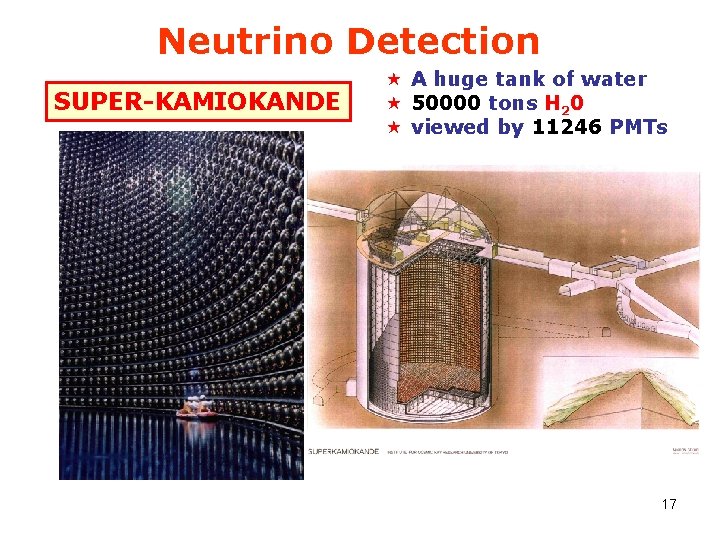
Neutrino Detection SUPER-KAMIOKANDE « A huge tank of water « 50000 tons H 20 « viewed by 11246 PMTs 17
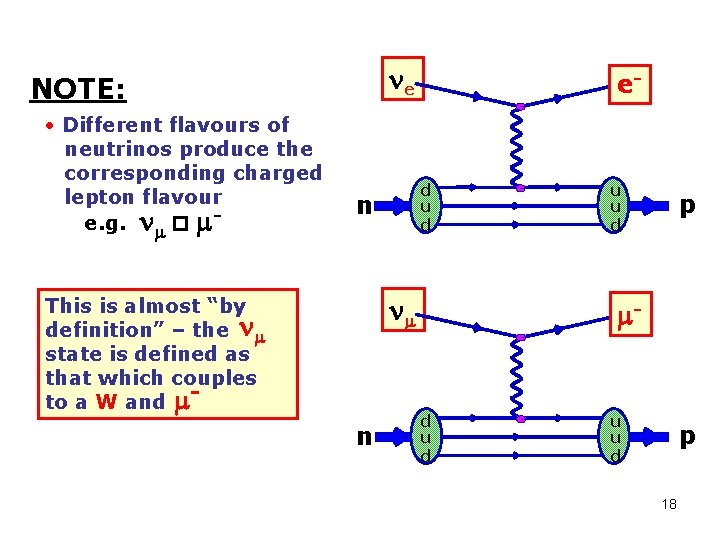
ne NOTE: • Different flavours of neutrinos produce the corresponding charged lepton flavour e. g. nm m- e- d u d n nm This is almost “by definition” – the nm state is defined as that which couples to a W and m- n u u d p m- d u u d p 18
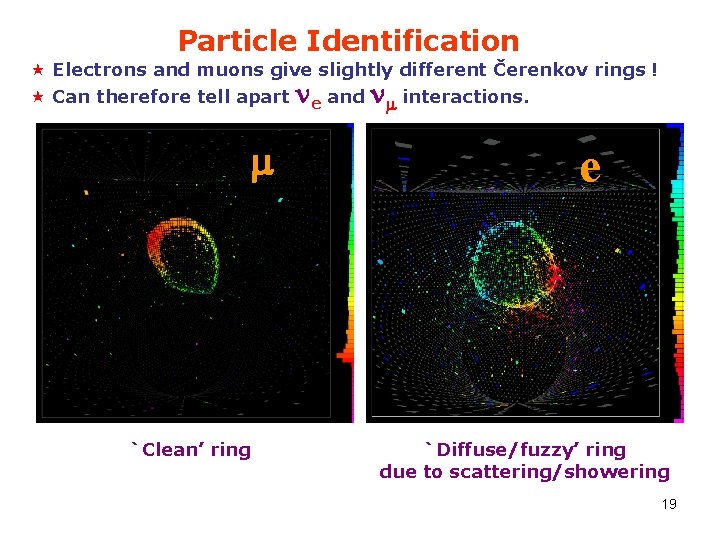
Particle Identification « Electrons and muons give slightly different Čerenkov rings ! « Can therefore tell apart ne and nm interactions. m `Clean’ ring e `Diffuse/fuzzy’ ring due to scattering/showering 19
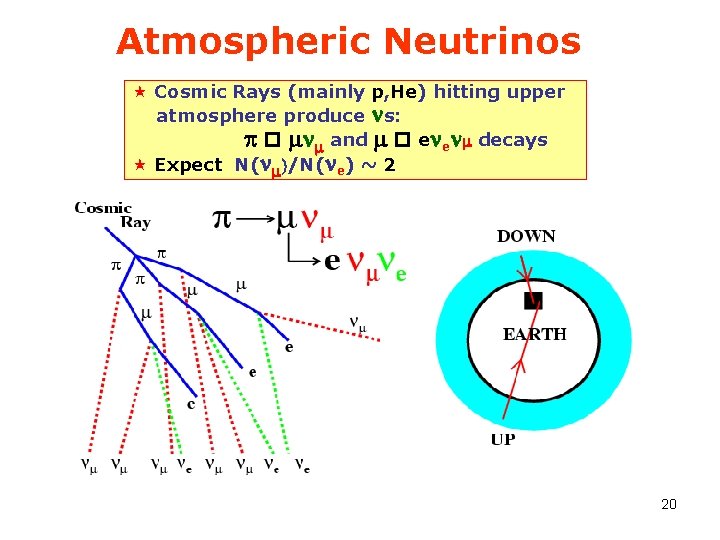
Atmospheric Neutrinos « Cosmic Rays (mainly p, He) hitting upper atmosphere produce ns: ____ p mnm and m enenm decays « Expect N(nm)/N(ne) ~ 2 20
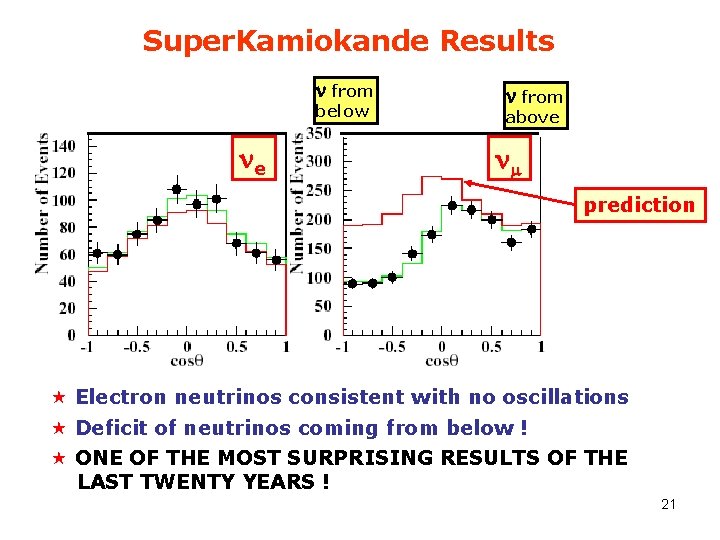
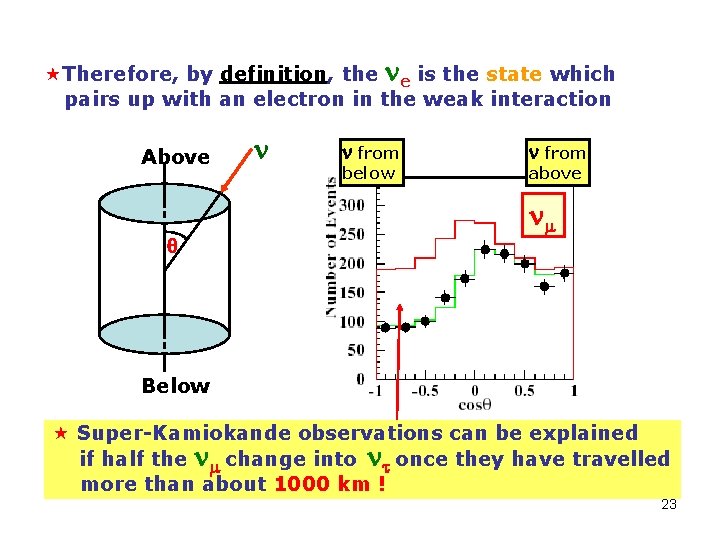
Super. Kamiokande Results n from below ne n from above nm prediction « Electron neutrinos consistent with no oscillations « Deficit of neutrinos coming from below ! « ONE OF THE MOST SURPRISING RESULTS OF THE LAST TWENTY YEARS ! 21
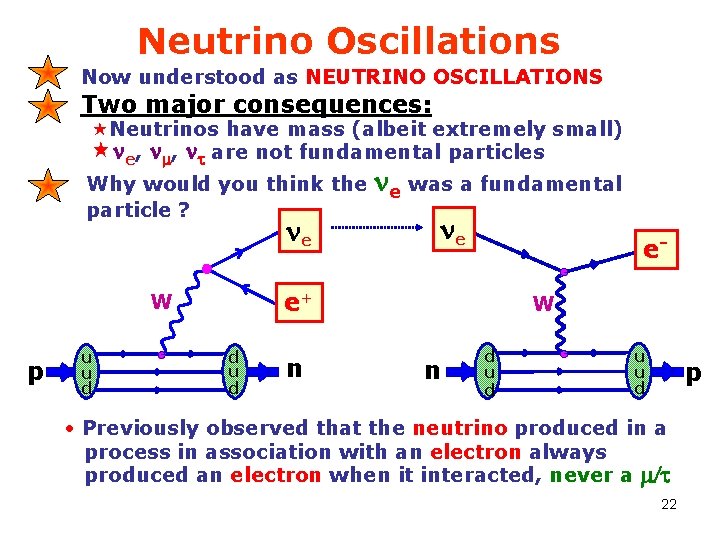
Neutrino Oscillations Now understood as NEUTRINO OSCILLATIONS Two major consequences: «Neutrinos have mass (albeit extremely small) «ne, nm, nt are not fundamental particles Why would you think the particle ? ne p ne e- e+ W u u d ne was a fundamental d u d n W n d u u d p • Previously observed that the neutrino produced in a process in association with an electron always produced an electron when it interacted, never a m/t 22
«Therefore, by definition, the ne is the state which pairs up with an electron in the weak interaction Above n n from below ne q n from above nm Below « Super-Kamiokande observations can be explained if half the nm change into nt once they have travelled more than about 1000 km ! 23
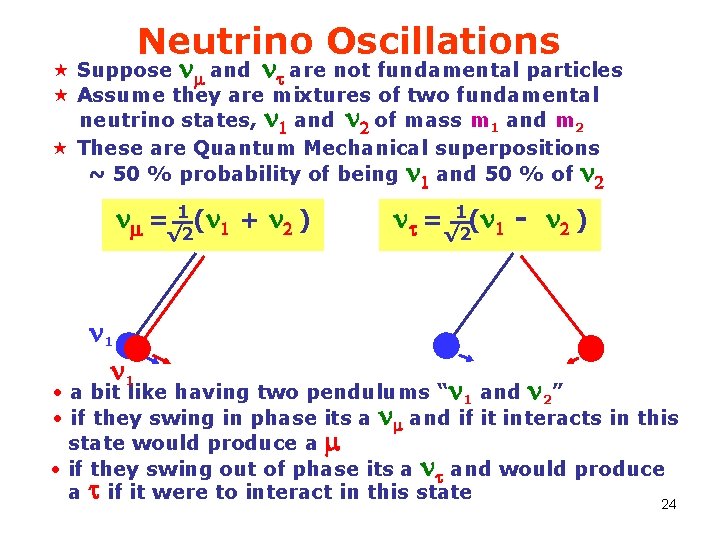
Neutrino Oscillations « Suppose nm and nt are not fundamental particles « Assume they are mixtures of two fundamental neutrino states, n 1 and n 2 of mass m 1 and m 2 « These are Quantum Mechanical superpositions ~ 50 % probability of being n 1 and 50 % of n 2 1 nm =√ 2 ( n 1 + n 2 ) 1 nt =√ 2 ( n 1 - n 2 ) n 1 • a bit like having two pendulums “n 1 and n 2” • if they swing in phase its a nm and if it interacts in this state would produce a m • if they swing out of phase its a nt and would produce a t if it were to interact in this state 24
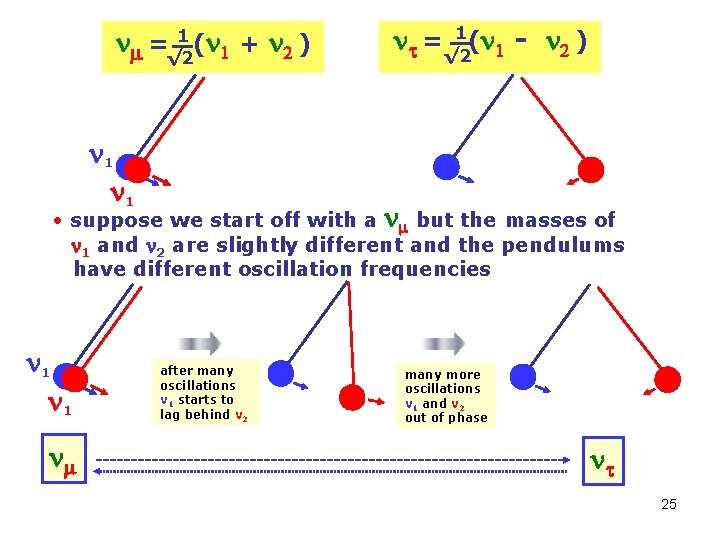
1 nm =√ 2 ( n 1 + n 2 ) 1 nt =√ 2 ( n 1 - n 2 ) n 1 • suppose we start off with a nm but the masses of n 1 and n 2 are slightly different and the pendulums have different oscillation frequencies n 1 nm after many oscillations v 1 starts to lag behind v 2 many more oscillations v 1 and v 2 out of phase nt 25
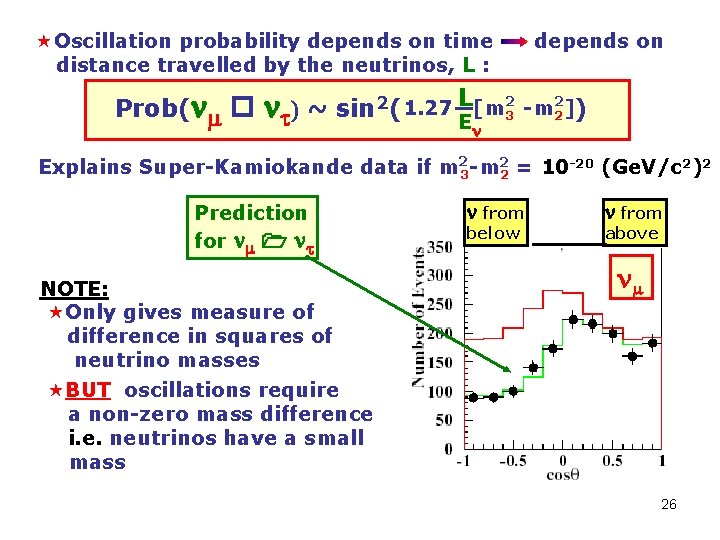
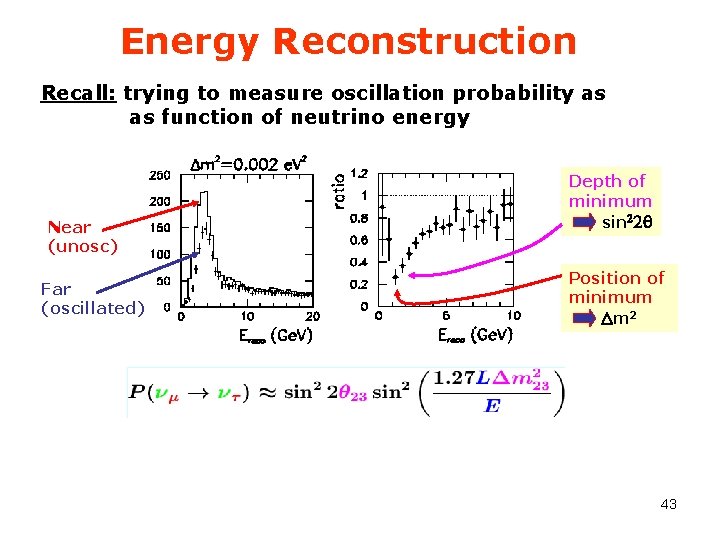
«Oscillation probability depends on time distance travelled by the neutrinos, L : Prob(nm depends on nt) ~ sin 2(1. 27 LE[m 23 -m 22]) n Explains Super-Kamiokande data if m 23 -m 22 = 10 -20 (Ge. V/c 2)2 Prediction for nm nt NOTE: «Only gives measure of difference in squares of neutrino masses n from below n from above nm «BUT oscillations require a non-zero mass difference i. e. neutrinos have a small mass 26
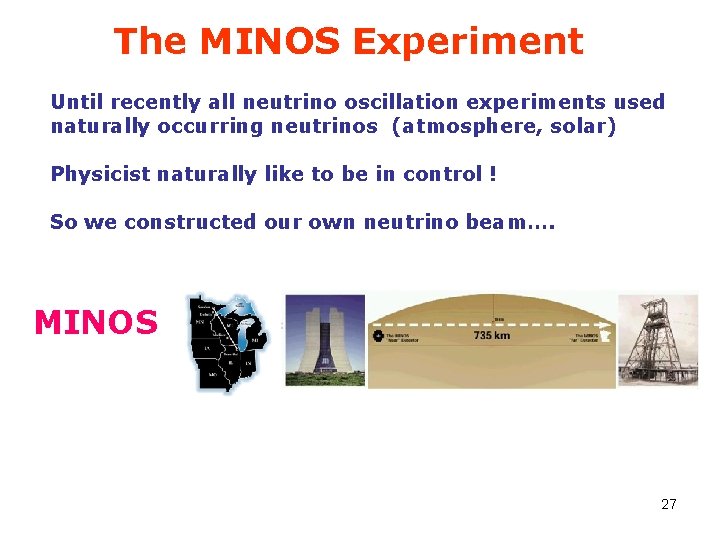
The MINOS Experiment Until recently all neutrino oscillation experiments used naturally occurring neutrinos (atmosphere, solar) Physicist naturally like to be in control ! So we constructed our own neutrino beam…. MINOS 27
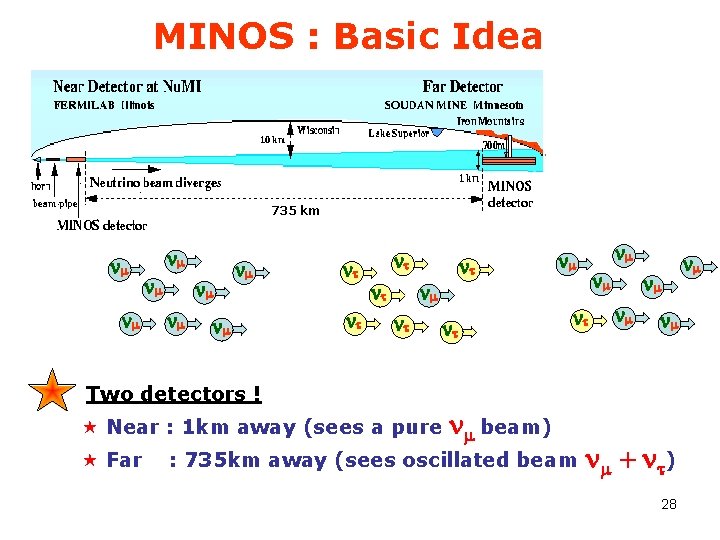
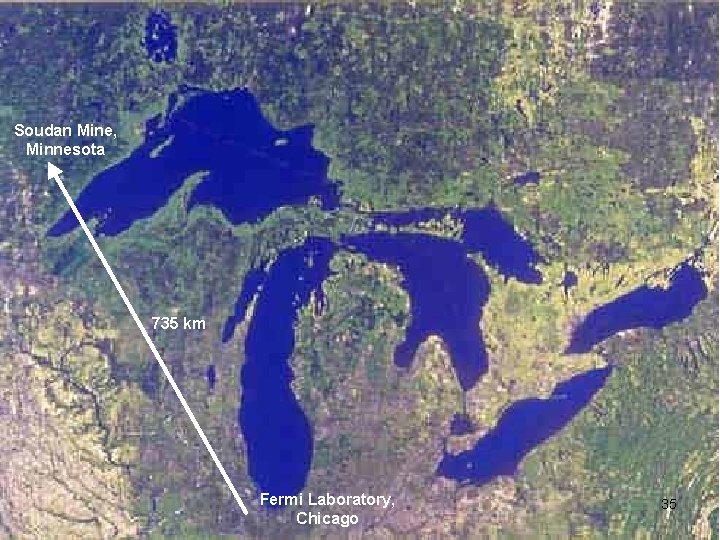
MINOS : Basic Idea 735 km nm nm nt nt nm nm Two detectors ! « Near : 1 km away (sees a pure « Far nm beam) : 735 km away (sees oscillated beam n m + n t) 28
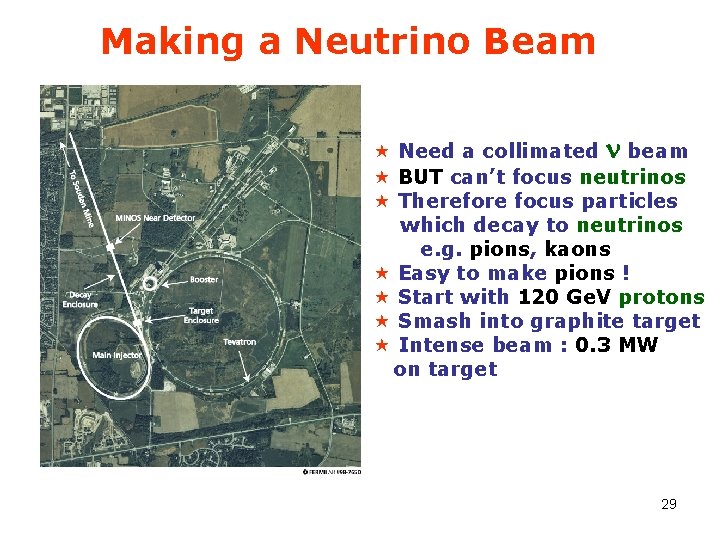
Making a Neutrino Beam « Need a collimated n beam « BUT can’t focus neutrinos « Therefore focus particles which decay to neutrinos e. g. pions, kaons « Easy to make pions ! « Start with 120 Ge. V protons « Smash into graphite target « Intense beam : 0. 3 MW on target 29
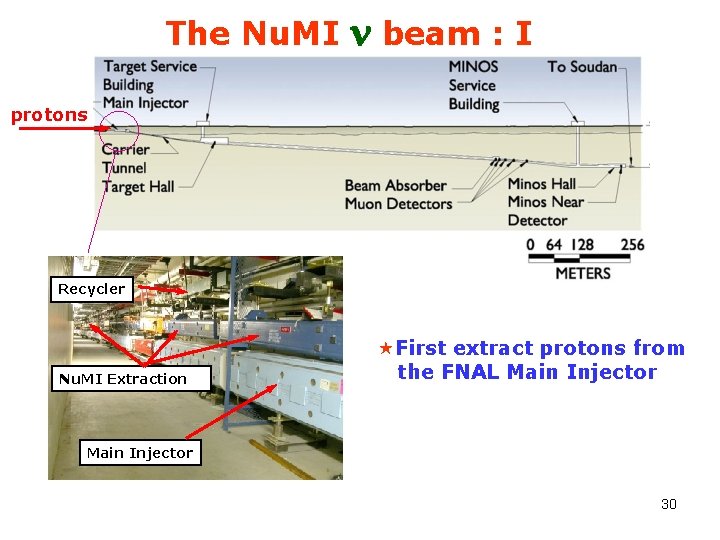
The Nu. MI n beam : I protons Recycler Nu. MI Extraction «First extract protons from the FNAL Main Injector 30
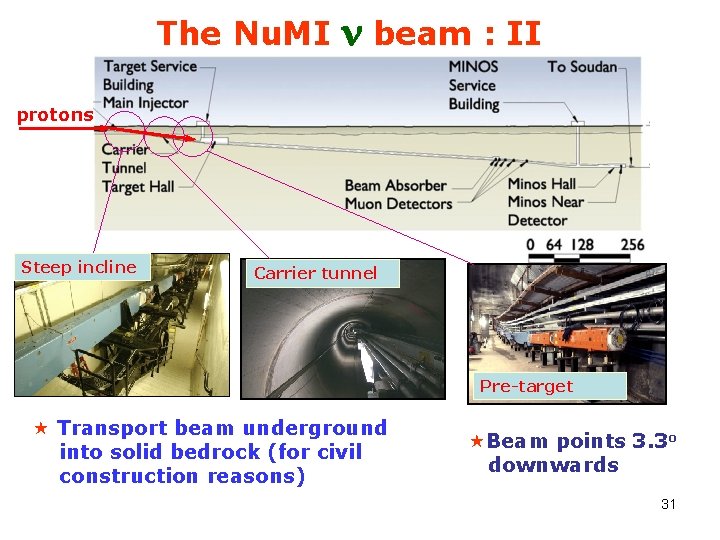
The Nu. MI n beam : II protons Steep incline Carrier tunnel Pre-target « Transport beam underground into solid bedrock (for civil construction reasons) «Beam points 3. 3 o downwards 31
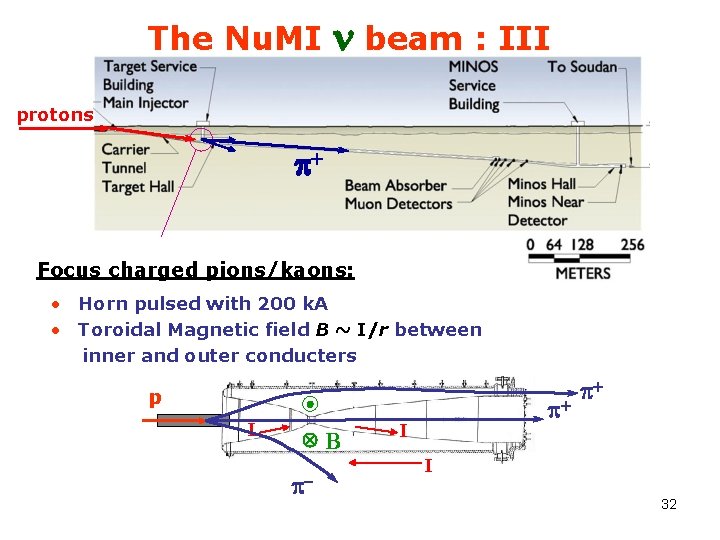
The Nu. MI n beam : III protons p+ Focus charged pions/kaons: • Horn pulsed with 200 k. A • Toroidal Magnetic field B ~ I/r between inner and outer conducters p I p- B p+ I 32
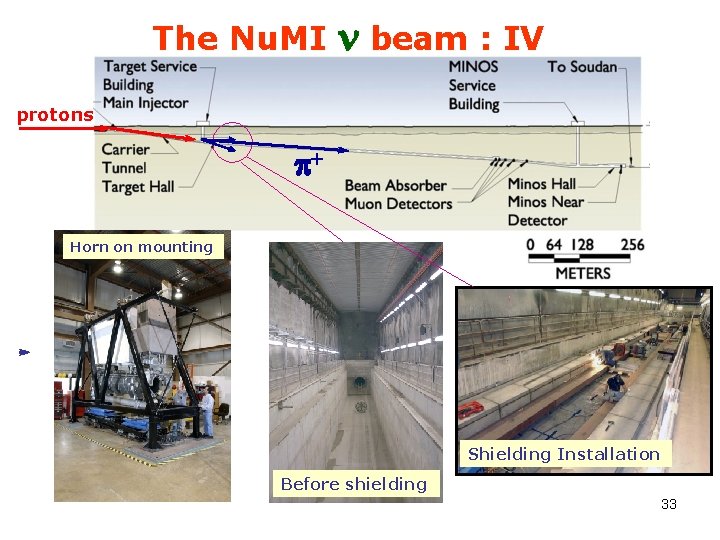
The Nu. MI n beam : IV protons p+ Horn on mounting Shielding Installation Before shielding 33
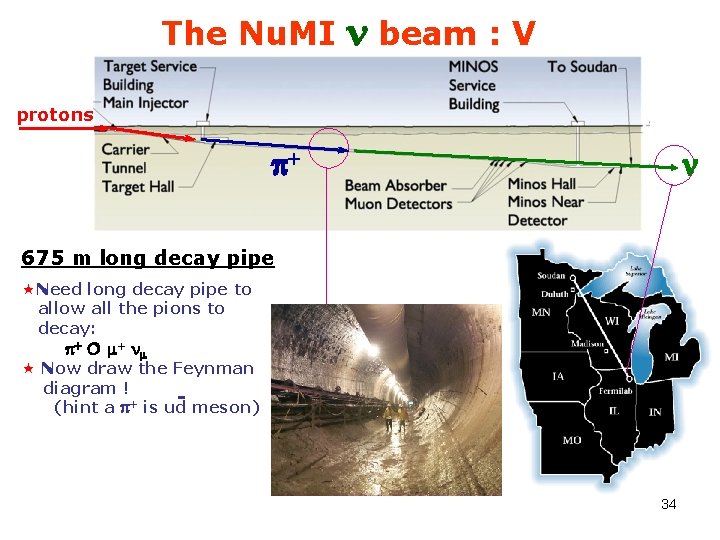
The Nu. MI n beam : V protons p+ n 675 m long decay pipe «Need long decay pipe to allow all the pions to decay: p + m+ n m « Now draw the Feynman diagram ! (hint a p+ is ud meson) 34
Soudan Mine, Minnesota 735 km Fermi Laboratory, Chicago 35
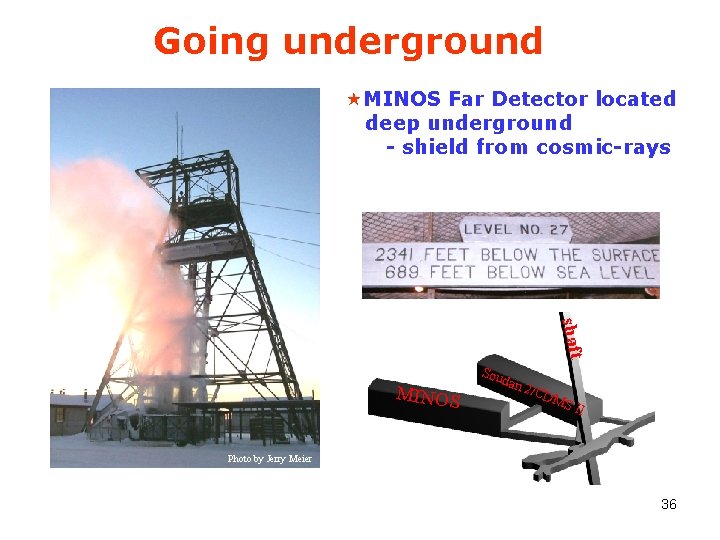
Going underground «MINOS Far Detector located deep underground - shield from cosmic-rays shaft MINOS Sou dan 2/C DM S II Photo by Jerry Meier 36
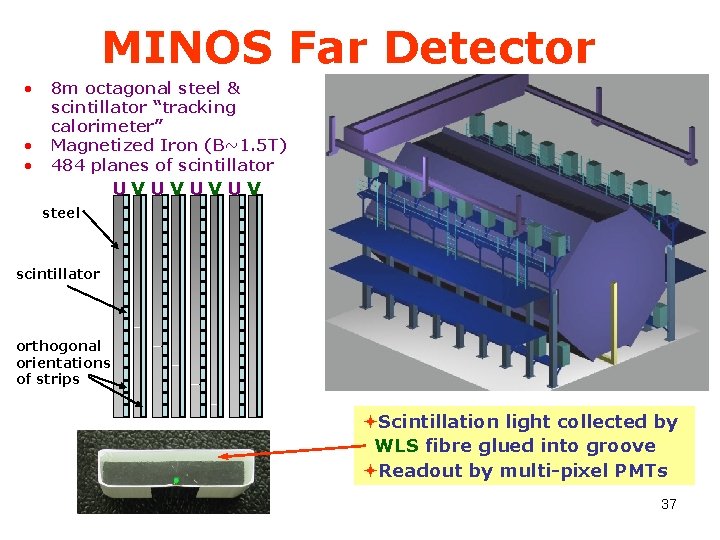
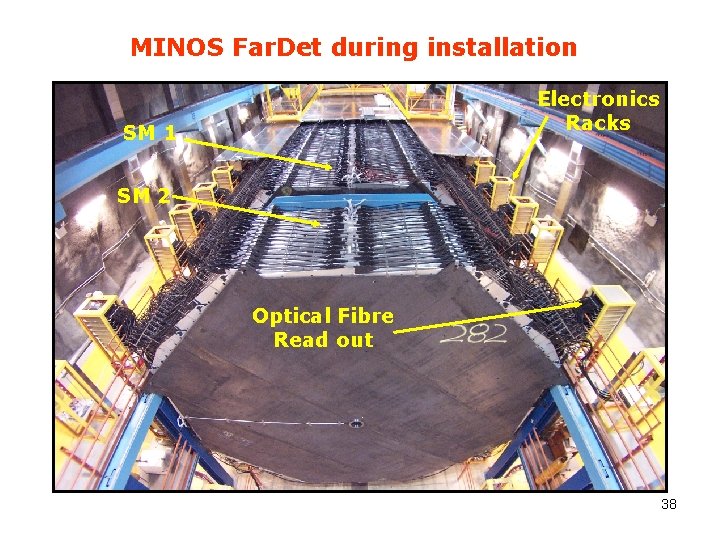
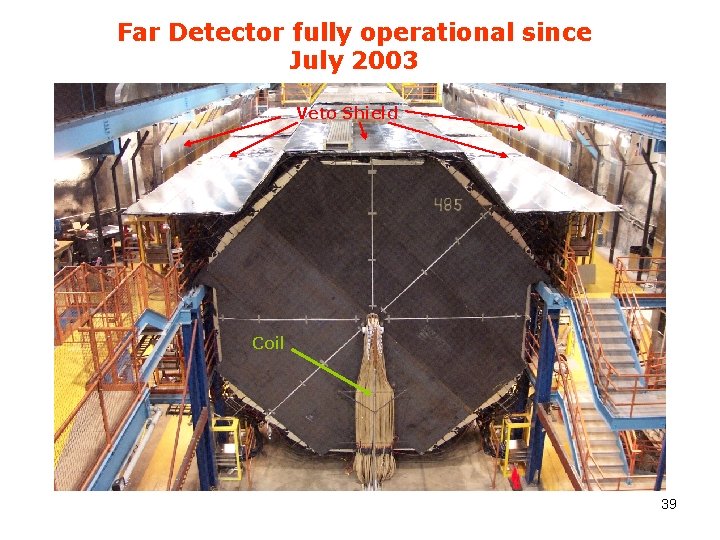
MINOS Far Detector • • • 8 m octagonal steel & scintillator “tracking calorimeter” Magnetized Iron (B~1. 5 T) 484 planes of scintillator UVUV steel scintillator orthogonal orientations of strips ªScintillation light collected by WLS fibre glued into groove ªReadout by multi-pixel PMTs 37
MINOS Far. Det during installation Electronics Racks SM 1 SM 2 Optical Fibre Read out 38
Far Detector fully operational since July 2003 Veto Shield Coil 39
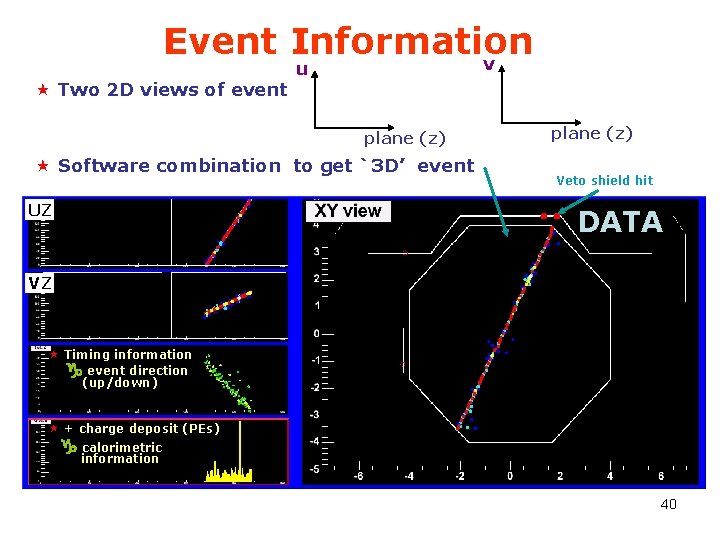
Event Information v « Two 2 D views of event u plane (z) « Software combination to get `3 D’ event UZ plane (z) Veto shield hit DATA VZ « Timing information g event direction (up/down) « + charge deposit (PEs) g calorimetric information 40
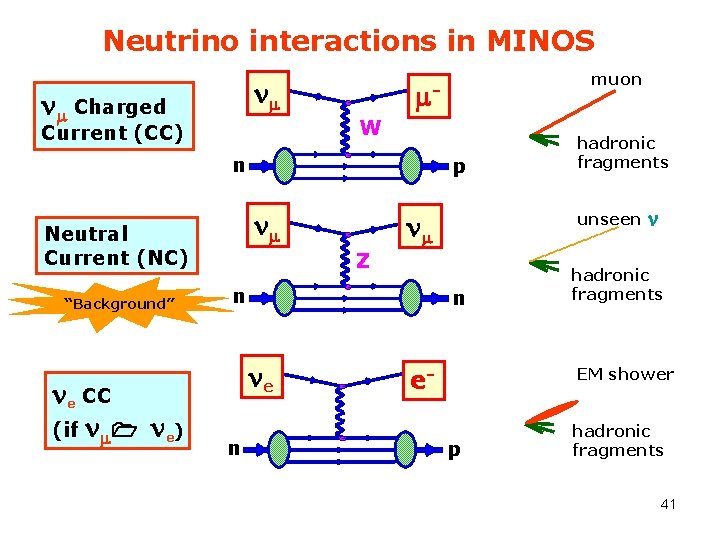
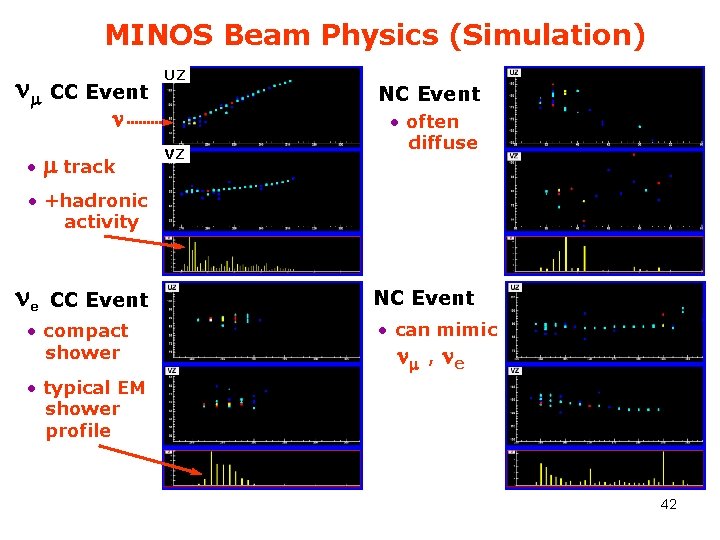
Neutrino interactions in MINOS nm nm Charged W Current (CC) n ne CC (if nm ne) p d d u nm Neutral Current (NC) “Background” muon m- nm unseen Z n ne n n d d u ed d u hadronic fragments n hadronic fragments EM shower p hadronic fragments 41
MINOS Beam Physics (Simulation) nm • CC Event UZ n m track VZ NC Event • often diffuse • +hadronic activity ne CC Event • compact shower NC Event • can mimic nm , ne • typical EM shower profile 42
Energy Reconstruction Recall: trying to measure oscillation probability as as function of neutrino energy Near (unosc) Far (oscillated) Depth of minimum sin 22 q Position of minimum D m 2 43
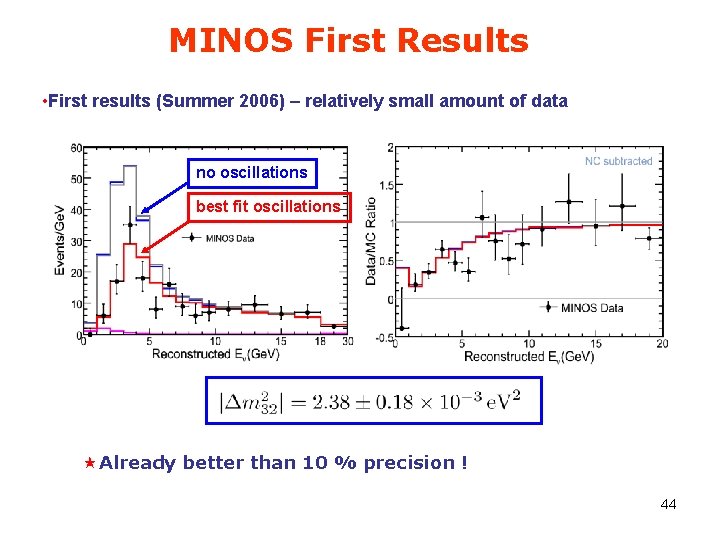
MINOS First Results • First results (Summer 2006) – relatively small amount of data no oscillations best fit oscillations «Already better than 10 % precision ! 44
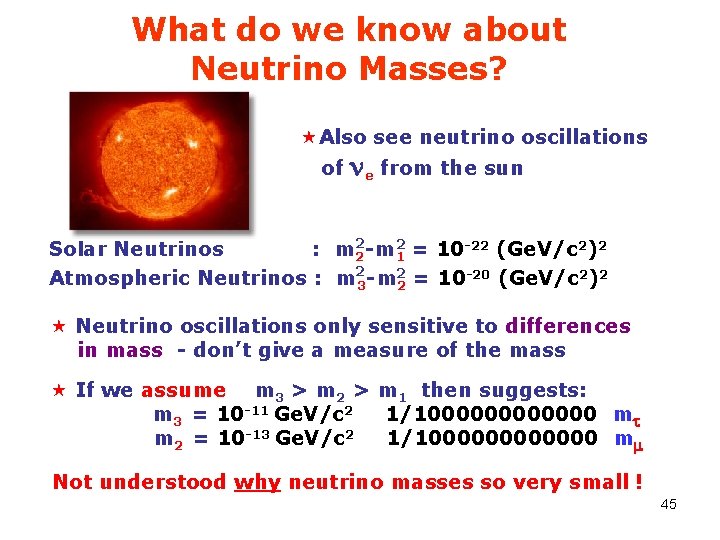
What do we know about Neutrino Masses? «Also see neutrino oscillations of ne from the sun Solar Neutrinos : m 22 -m 12 = 10 -22 (Ge. V/c 2)2 Atmospheric Neutrinos : m 23 -m 22 = 10 -20 (Ge. V/c 2)2 « Neutrino oscillations only sensitive to differences in mass - don’t give a measure of the mass « If we assume m 3 > m 2 > m 1 then suggests: m 3 = 10 -11 Ge. V/c 2 1/1000000 mt m 2 = 10 -13 Ge. V/c 2 1/1000000 mm Not understood why neutrino masses so very small ! 45
Summary « Just recently starting to understand nature of NEUTRINOS « WEAK interaction due to exchange of massive W bosons (~ 80 x mass of proton) Next handout will discuss the unification of the WEAK and Electromagnetic forces 46