
An Introduction to Manx Gaelic Fosleyraa dys y
![What is Manx? • Native name: Gaelg / Gailck [gilk/gilg]; / y Gaelg [əˈɣɪlk]](https://slidetodoc.com/presentation_image_h2/5fcaa06d11a6c40fbe4d16c458babbf9/image-2.jpg "What is Manx? • Native name: Gaelg / Gailck [gilk/gilg]; / y Gaelg [əˈɣɪlk]")
- Slides: 17
An Introduction to Manx (Gaelic) Fosley-raa dys y Ghaelg
What is Manx? • Native name: Gaelg / Gailck [gilk/gilg]; / y Gaelg [əˈɣɪlk] • Language family: Indo-European, Celtic, Insular, Goidelic • Descended from Old Irish • Similar to Scottish Gaelic and Irish (Gaelic) • Influenced by Old Norse and English
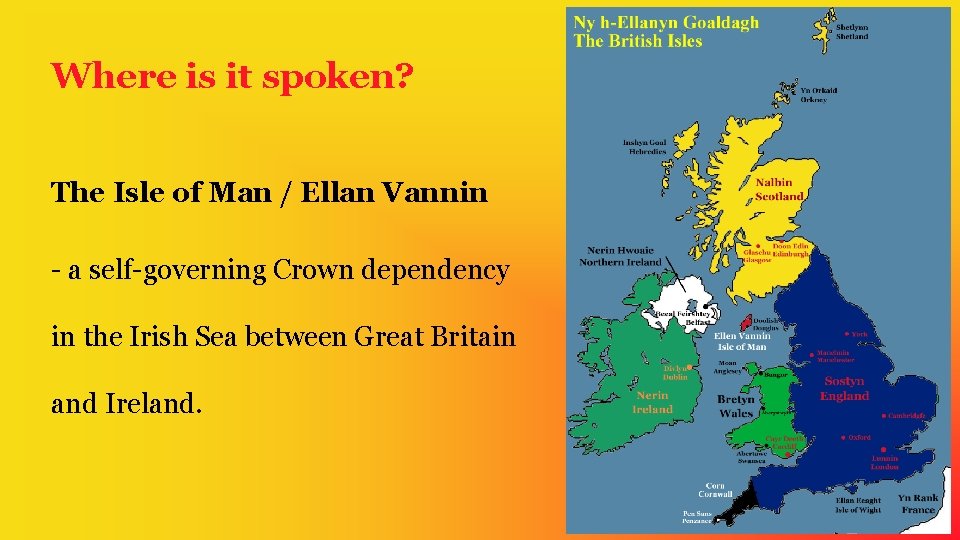
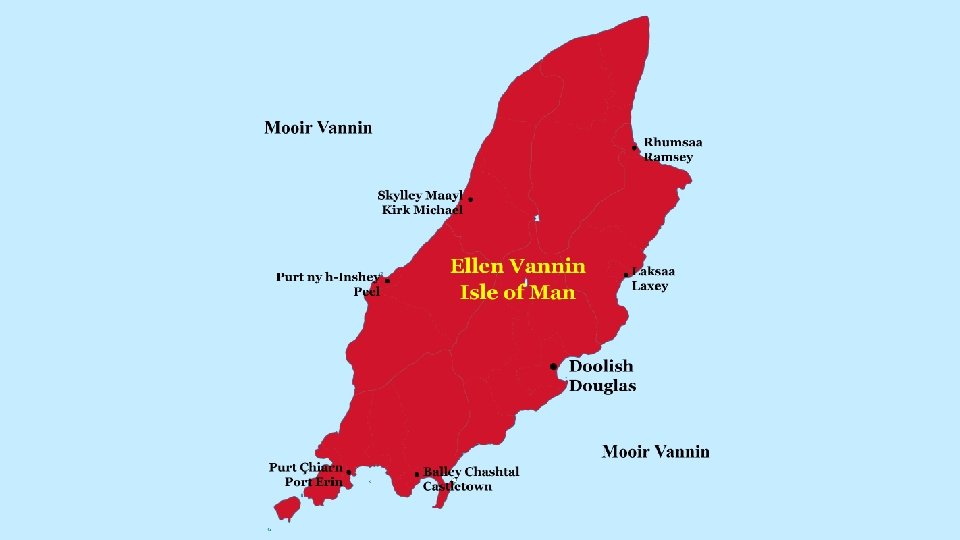
Where is it spoken? The Isle of Man / Ellan Vannin - a self-governing Crown dependency in the Irish Sea between Great Britain and Ireland.
A brief history of Manx • 5 th Century AD Old Irish brought to Isle of Man • Manx started to emerge as distinct language by the 13 th century • Language declined from the early 19 th century • Revival efforts from the late 19 th century • Disappeared as a community language in the early 20 th century • Manx taught in schools from 1980 s. Bunscoill Ghaelgagh opened in 2001 • 1, 823 speakers of Manx (2011 census)
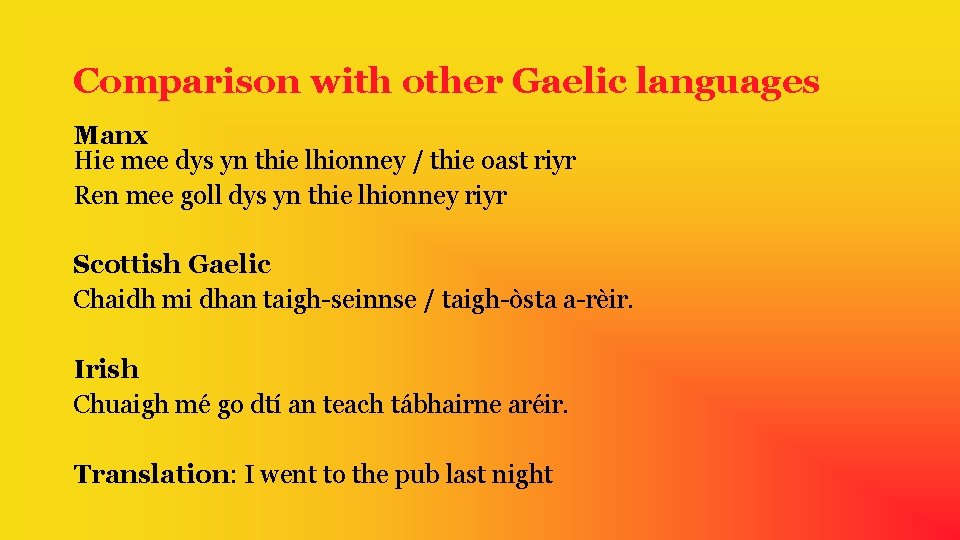
Comparison with other Gaelic languages Manx Hie mee dys yn thie lhionney / thie oast riyr Ren mee goll dys yn thie lhionney riyr Scottish Gaelic Chaidh mi dhan taigh-seinnse / taigh-òsta a-rèir. Irish Chuaigh mé go dtí an teach tábhairne aréir. Translation: I went to the pub last night
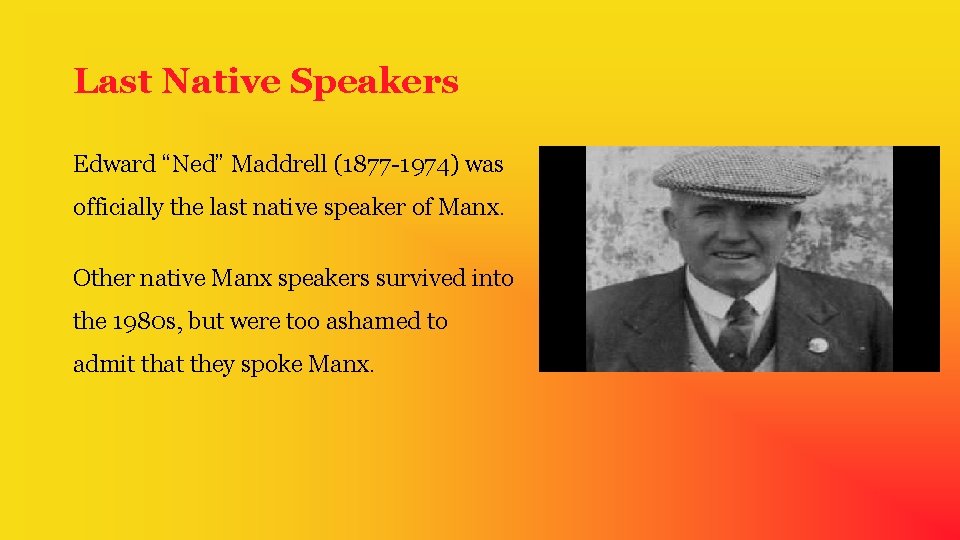
Last Native Speakers Edward “Ned” Maddrell (1877 -1974) was officially the last native speaker of Manx. Other native Manx speakers survived into the 1980 s, but were too ashamed to admit that they spoke Manx.
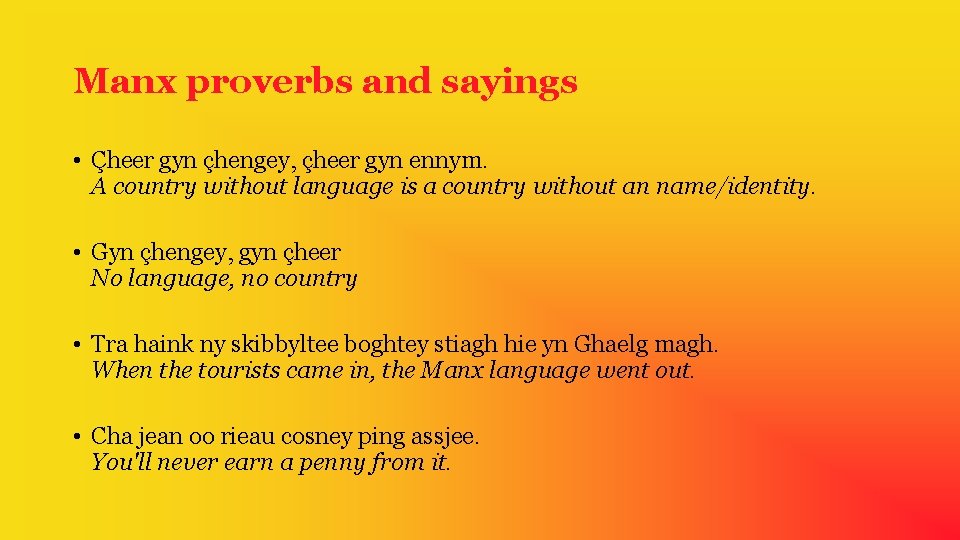
Manx proverbs and sayings • Çheer gyn çhengey, çheer gyn ennym. A country without language is a country without an name/identity. • Gyn çhengey, gyn çheer No language, no country • Tra haink ny skibbyltee boghtey stiagh hie yn Ghaelg magh. When the tourists came in, the Manx language went out. • Cha jean oo rieau cosney ping assjee. You'll never earn a penny from it.
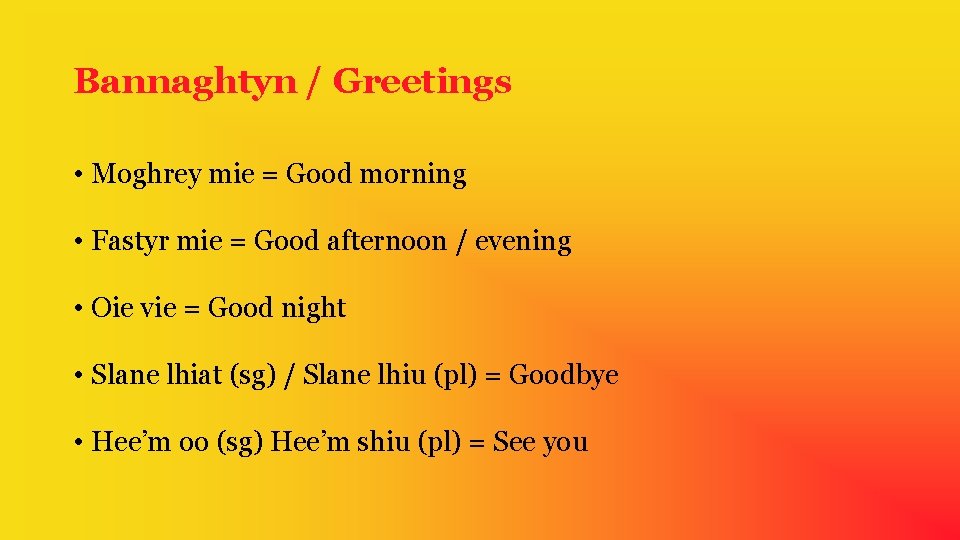
Bannaghtyn / Greetings • Moghrey mie = Good morning • Fastyr mie = Good afternoon / evening • Oie vie = Good night • Slane lhiat (sg) / Slane lhiu (pl) = Goodbye • Hee’m oo (sg) Hee’m shiu (pl) = See you
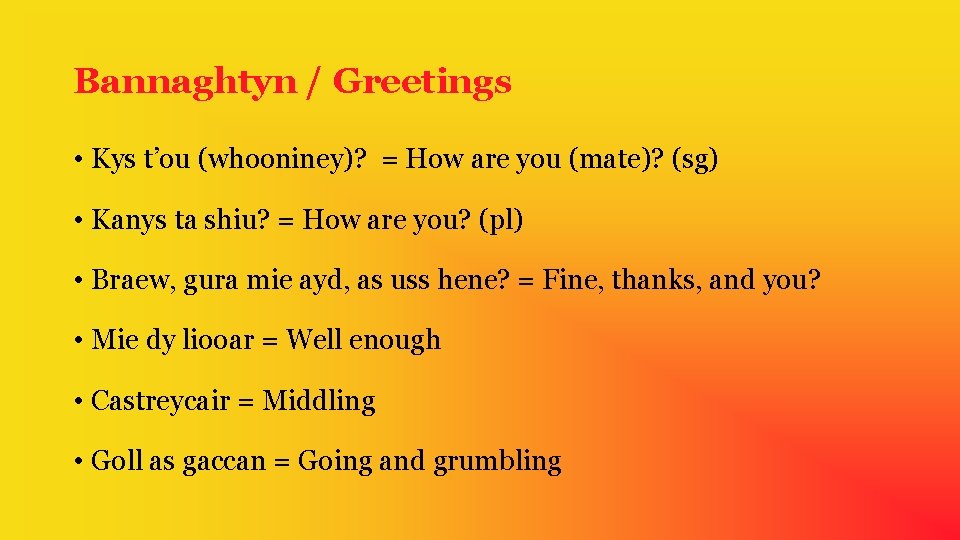
Bannaghtyn / Greetings • Kys t’ou (whooniney)? = How are you (mate)? (sg) • Kanys ta shiu? = How are you? (pl) • Braew, gura mie ayd, as uss hene? = Fine, thanks, and you? • Mie dy liooar = Well enough • Castreycair = Middling • Goll as gaccan = Going and grumbling
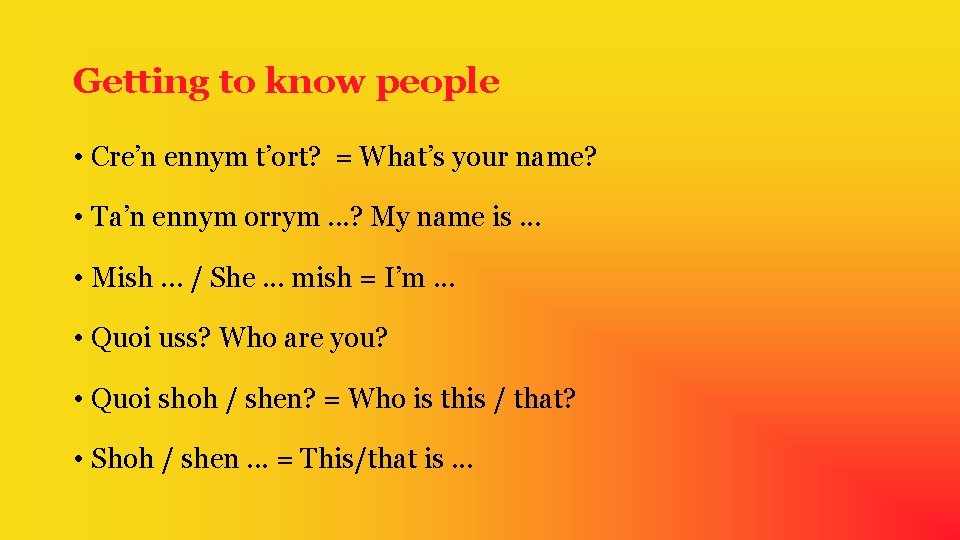
Getting to know people • Cre’n ennym t’ort? = What’s your name? • Ta’n ennym orrym. . . ? My name is. . . • Mish. . . / She. . . mish = I’m. . . • Quoi uss? Who are you? • Quoi shoh / shen? = Who is this / that? • Shoh / shen. . . = This/that is. . .
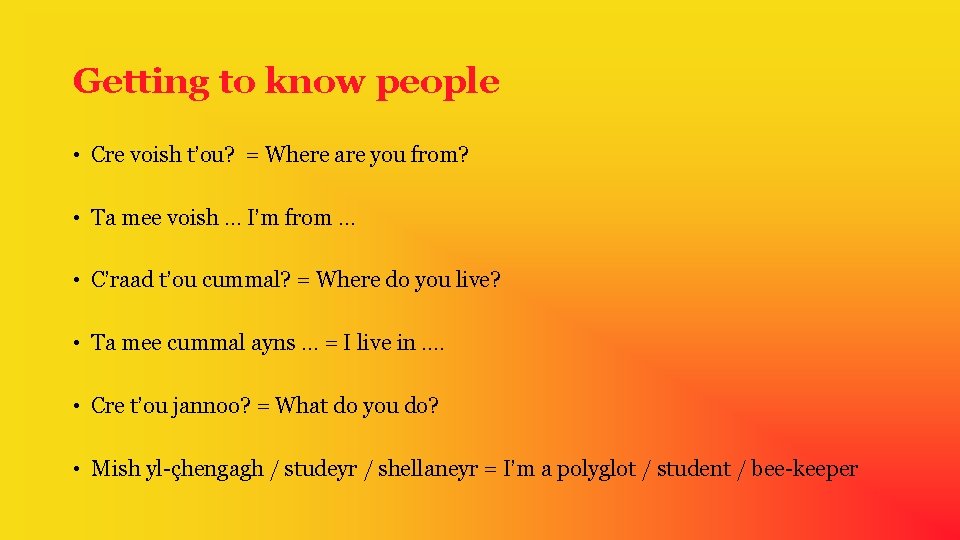
Getting to know people • Cre voish t’ou? = Where are you from? • Ta mee voish. . . I’m from. . . • C’raad t’ou cummal? = Where do you live? • Ta mee cummal ayns. . . = I live in. . • Cre t’ou jannoo? = What do you do? • Mish yl-çhengagh / studeyr / shellaneyr = I’m a polyglot / student / bee-keeper
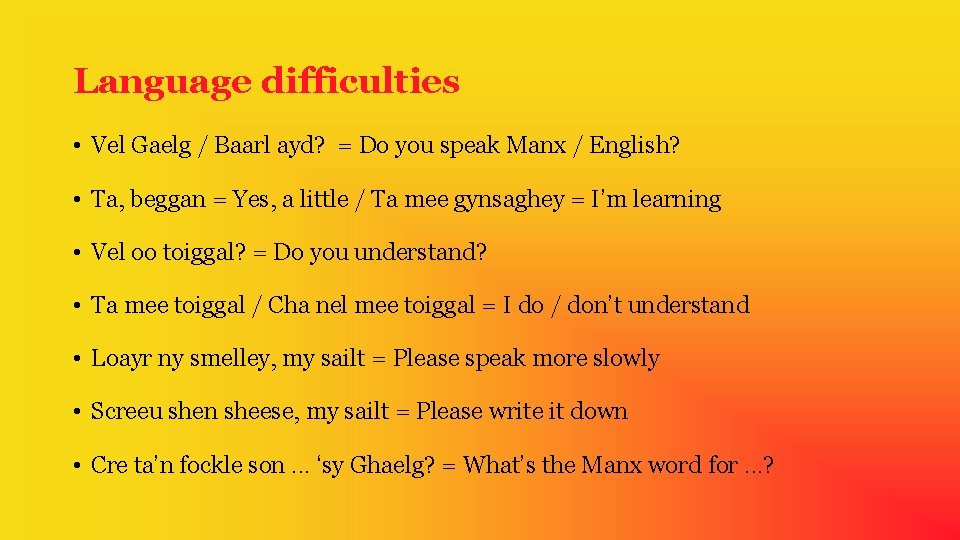
Language difficulties • Vel Gaelg / Baarl ayd? = Do you speak Manx / English? • Ta, beggan = Yes, a little / Ta mee gynsaghey = I’m learning • Vel oo toiggal? = Do you understand? • Ta mee toiggal / Cha nel mee toiggal = I do / don’t understand • Loayr ny smelley, my sailt = Please speak more slowly • Screeu shen sheese, my sailt = Please write it down • Cre ta’n fockle son. . . ‘sy Ghaelg? = What’s the Manx word for. . . ?
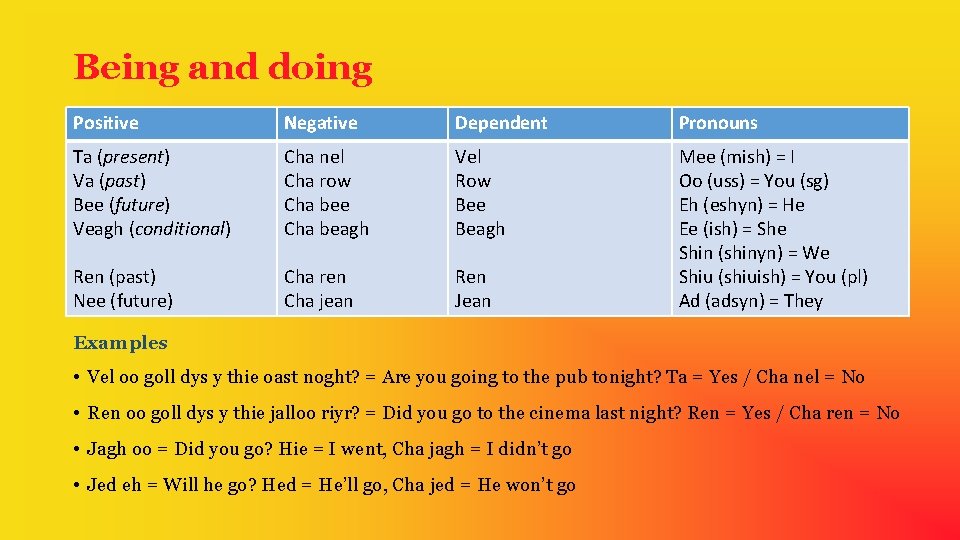
Being and doing Positive Negative Dependent Pronouns Ta (present) Va (past) Bee (future) Veagh (conditional) Cha nel Cha row Cha bee Cha beagh Vel Row Bee Beagh Ren (past) Nee (future) Cha ren Cha jean Ren Jean Mee (mish) = I Oo (uss) = You (sg) Eh (eshyn) = He Ee (ish) = She Shin (shinyn) = We Shiu (shiuish) = You (pl) Ad (adsyn) = They Examples • Vel oo goll dys y thie oast noght? = Are you going to the pub tonight? Ta = Yes / Cha nel = No • Ren oo goll dys y thie jalloo riyr? = Did you go to the cinema last night? Ren = Yes / Cha ren = No • Jagh oo = Did you go? Hie = I went, Cha jagh = I didn’t go • Jed eh = Will he go? Hed = He’ll go, Cha jed = He won’t go
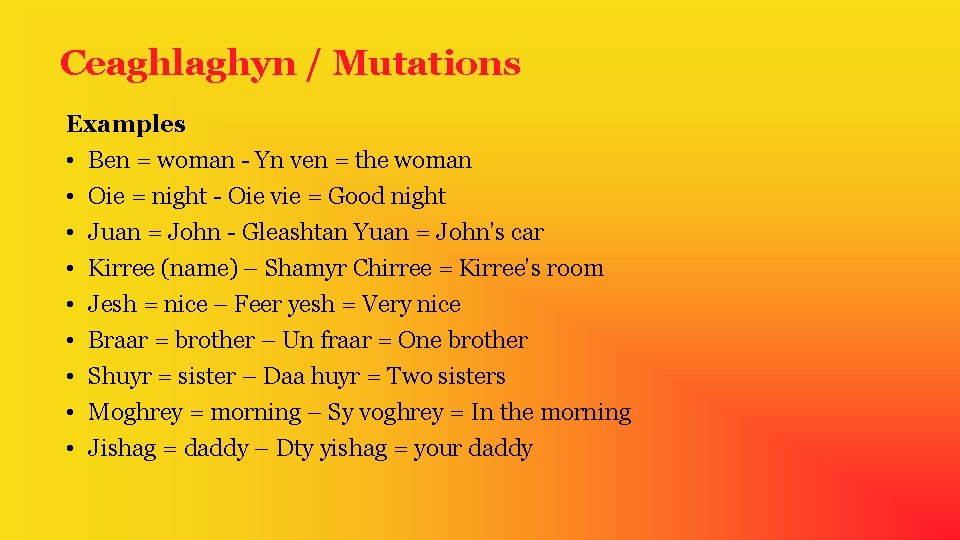
Ceaghlaghyn / Mutations Examples • Ben = woman - Yn ven = the woman • Oie = night - Oie vie = Good night • Juan = John - Gleashtan Yuan = John’s car • Kirree (name) – Shamyr Chirree = Kirree’s room • Jesh = nice – Feer yesh = Very nice • Braar = brother – Un fraar = One brother • Shuyr = sister – Daa huyr = Two sisters • Moghrey = morning – Sy voghrey = In the morning • Jishag = daddy – Dty yishag = your daddy
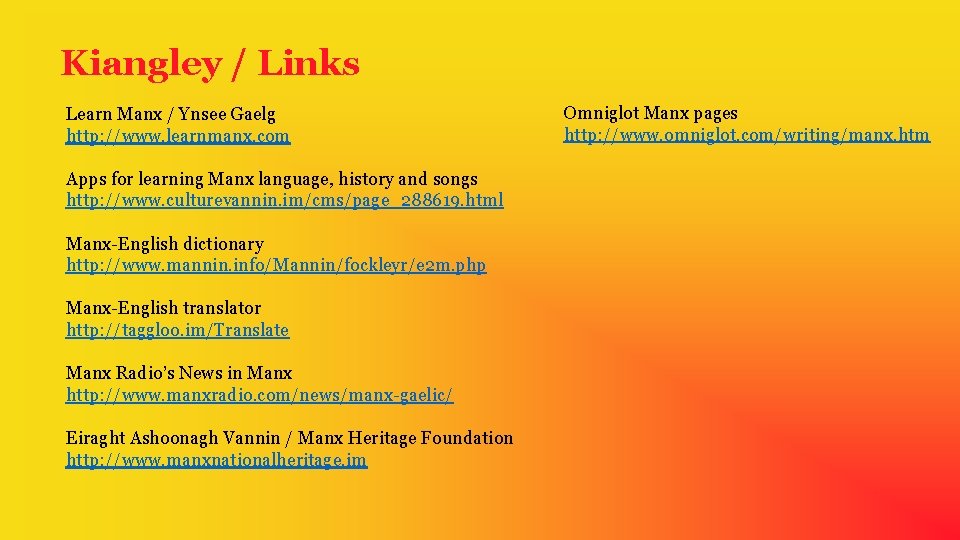
Kiangley / Links Learn Manx / Ynsee Gaelg http: //www. learnmanx. com Apps for learning Manx language, history and songs http: //www. culturevannin. im/cms/page_288619. html Manx-English dictionary http: //www. mannin. info/Mannin/fockleyr/e 2 m. php Manx-English translator http: //taggloo. im/Translate Manx Radio’s News in Manx http: //www. manxradio. com/news/manx-gaelic/ Eiraght Ashoonagh Vannin / Manx Heritage Foundation http: //www. manxnationalheritage. im Omniglot Manx pages http: //www. omniglot. com/writing/manx. htm
Gura mie eu Thank you