
An Introduction to Machine Translation Anoop Kunchukuttan Microsoft

![BLEU score Recall -> Brevity Penalty Precision -> Modified ngram precision Formula from [2]](https://slidetodoc.com/presentation_image_h2/94f7f5dd1bd2be7b06b7fc1afc6da080/image-114.jpg "BLEU score Recall -> Brevity Penalty Precision -> Modified ngram precision Formula from [2]")
- Slides: 122
An Introduction to Machine Translation Anoop Kunchukuttan Microsoft AI and Research Center for Indian Language Technology Indian Institute of Technology Bombay Ninth IIIT-H Advanced Summer School on NLP, 27 th June 2018
Agenda ● ● ● What is Machine Translation & why is it interesting? Machine Translation Paradigms Word Alignment Phrase-based SMT Extensions to Phrase-based SMT ○ ○ ○ ● ● ● Addressing Word-order Divergence Addressing Morphological Divergence Handling Named Entities Syntax-based SMT Machine Translation Evaluation Summary Statistical Machine Translation
Agenda ● ● ● What is Machine Translation & why is it interesting? Machine Translation Paradigms Word Alignment Phrase-based SMT Extensions to Phrase-based SMT ○ ○ ○ ● ● ● Addressing Word-order Divergence Addressing Morphological Divergence Handling Named Entities Syntax-based SMT Machine Translation Evaluation Summary
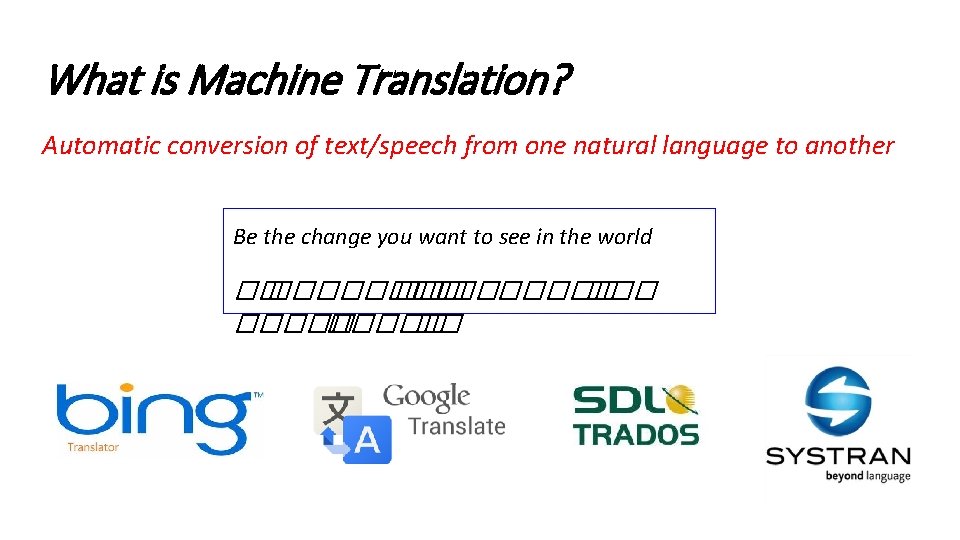
What is Machine Translation? Automatic conversion of text/speech from one natural language to another Be the change you want to see in the world �� ������� ����� ��
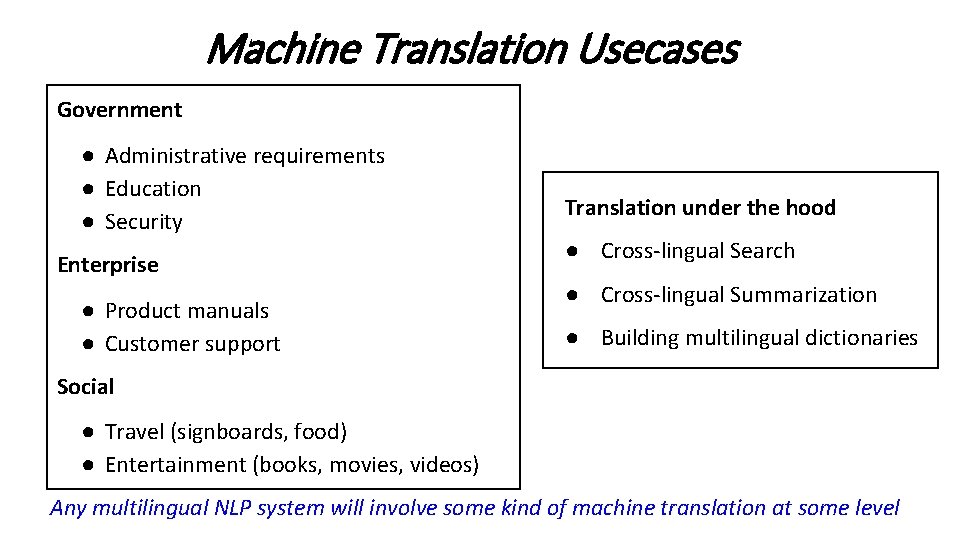
Machine Translation Usecases Government ● Administrative requirements ● Education ● Security Enterprise ● Product manuals ● Customer support Translation under the hood ● Cross-lingual Search ● Cross-lingual Summarization ● Building multilingual dictionaries Social ● Travel (signboards, food) ● Entertainment (books, movies, videos) Any multilingual NLP system will involve some kind of machine translation at some level
Why should you study Machine Translation? ● One of the most challenging problems in Natural Language Processing ● Pushes the boundaries of NLP ● Involves analysis as well as synthesis ● Involves all layers of NLP: morphology, syntax, semantics, pragmatics, discourse ● Theory and techniques in MT are applicable to a wide range of other problems like transliteration, speech recognition and synthesis
Why is Machine Translation interesting? Language Divergence the great diversity among languages of the world The central problem of MT is to bridge this language divergence
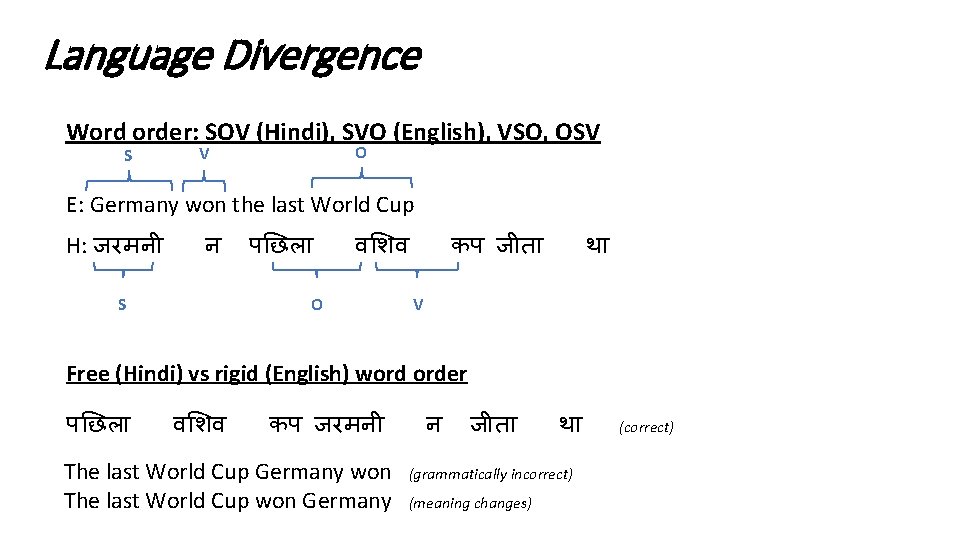
Language Divergence Word order: SOV (Hindi), SVO (English), VSO, OSV S O V E: Germany won the last World Cup H: जरमन न S प छल व शव O कप ज त थ V Free (Hindi) vs rigid (English) word order प छल व शव कप जरमन The last World Cup Germany won The last World Cup won Germany न ज त थ (grammatically incorrect) (meaning changes) (correct)
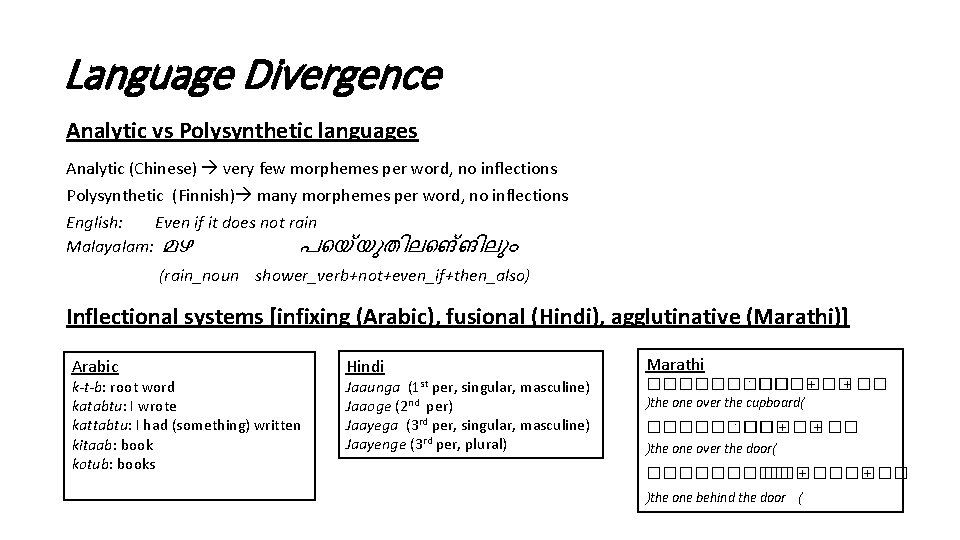
Language Divergence Analytic vs Polysynthetic languages Analytic (Chinese) very few morphemes per word, no inflections Polysynthetic (Finnish) many morphemes per word, no inflections English: Even if it does not rain Malayalam: മഴ പ യ യ ത ല ങ ങ ല (rain_noun shower_verb+not+even_if+then_also) Inflectional systems [infixing (Arabic), fusional (Hindi), agglutinative (Marathi)] Arabic k-t-b: root word katabtu: I wrote kattabtu: I had (something) written kitaab: book kotub: books Hindi Jaaunga (1 st per, singular, masculine) Jaaoge (2 nd per) Jaayega (3 rd per, singular, masculine) Jaayenge (3 rd per, plural) Marathi ����� : ���� + �� )the one over the cupboard( ���� : ��� + �� )the one over the door( ����� : ��� + �� )the one behind the door (
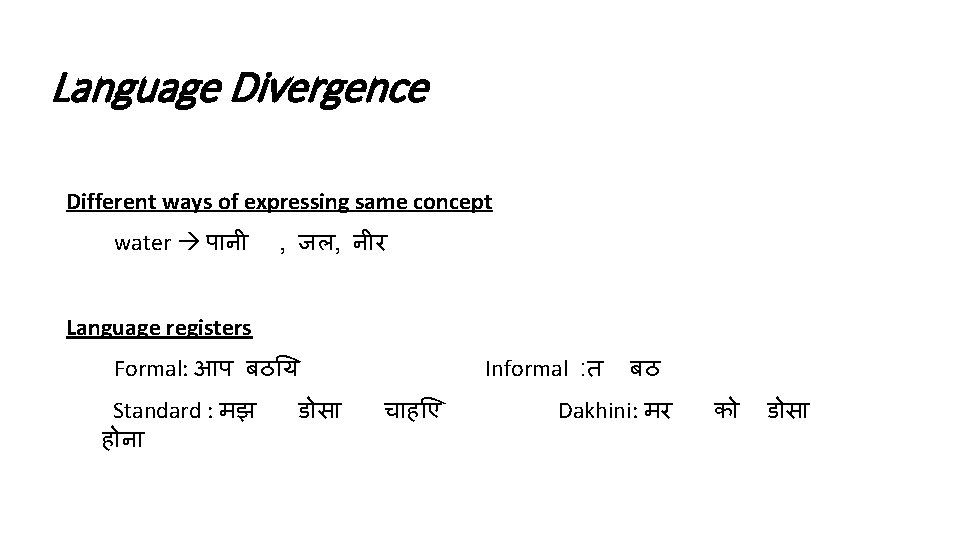
Language Divergence Different ways of expressing same concept water प न , जल, न र Language registers Formal: आप बठ य Standard : मझ ह न ड स Informal : त च ह ए बठ Dakhini: मर क ड स
Language Divergence ● Case marking systems ● Categorical divergence ● Null Subject Divergence ● Pleonastic Divergence … and much more
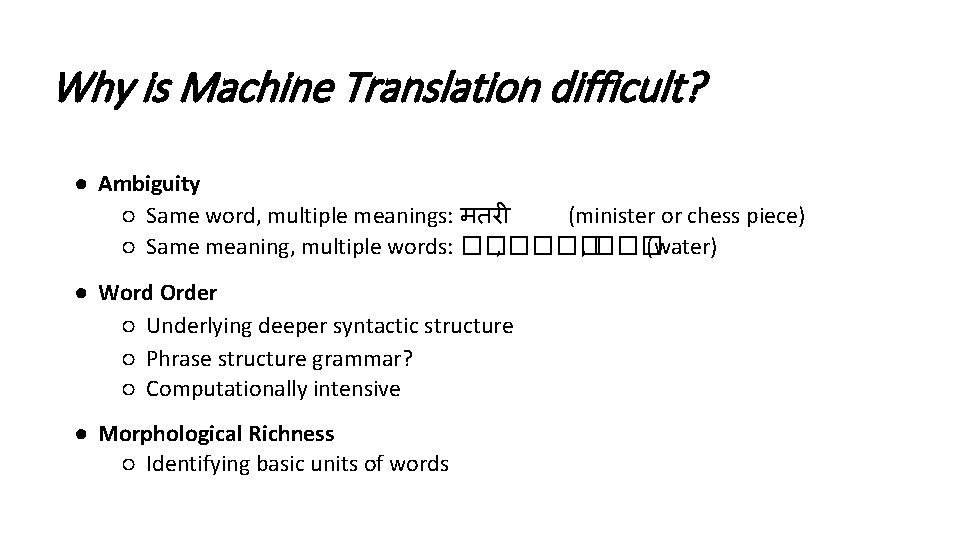
Why is Machine Translation difficult? ● Ambiguity ○ Same word, multiple meanings: मतर (minister or chess piece) ○ Same meaning, multiple words: ��, ���� , ��� (water) ● Word Order ○ Underlying deeper syntactic structure ○ Phrase structure grammar? ○ Computationally intensive ● Morphological Richness ○ Identifying basic units of words
Agenda ● ● ● What is Machine Translation & why is it interesting? Machine Translation Paradigms Word Alignment Phrase-based SMT Extensions to Phrase-based SMT ○ ○ ○ ● ● ● Addressing Word-order Divergence Addressing Morphological Divergence Handling Named Entities Syntax-based SMT Machine Translation Evaluation Summary
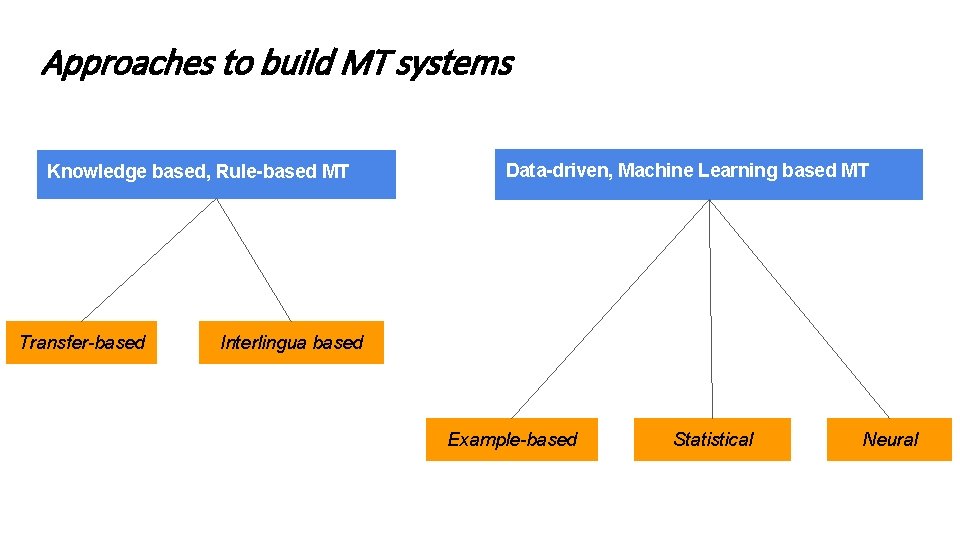
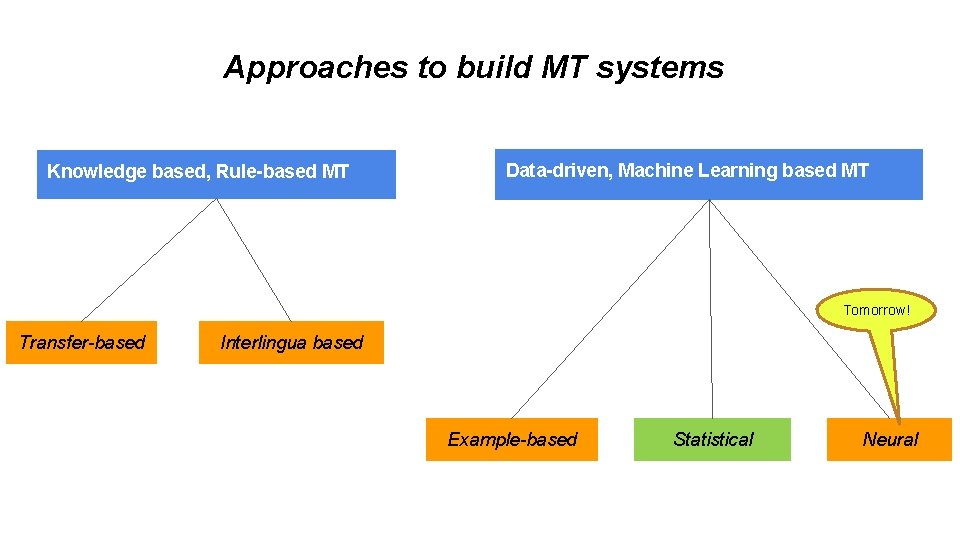
Approaches to build MT systems Knowledge based, Rule-based MT Transfer-based Data-driven, Machine Learning based MT Interlingua based Example-based Statistical Neural
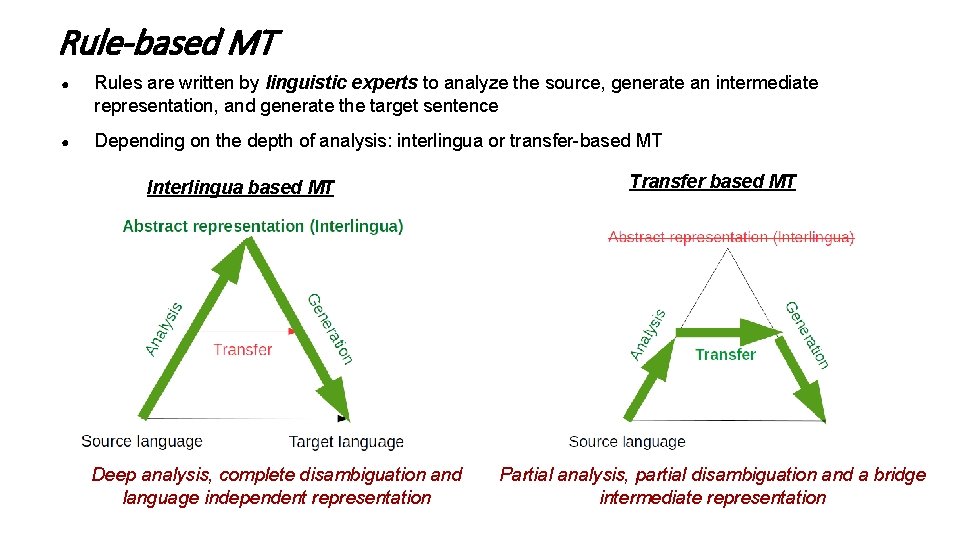
Rule-based MT ● Rules are written by linguistic experts to analyze the source, generate an intermediate representation, and generate the target sentence ● Depending on the depth of analysis: interlingua or transfer-based MT Interlingua based MT Deep analysis, complete disambiguation and language independent representation Transfer based MT Partial analysis, partial disambiguation and a bridge intermediate representation
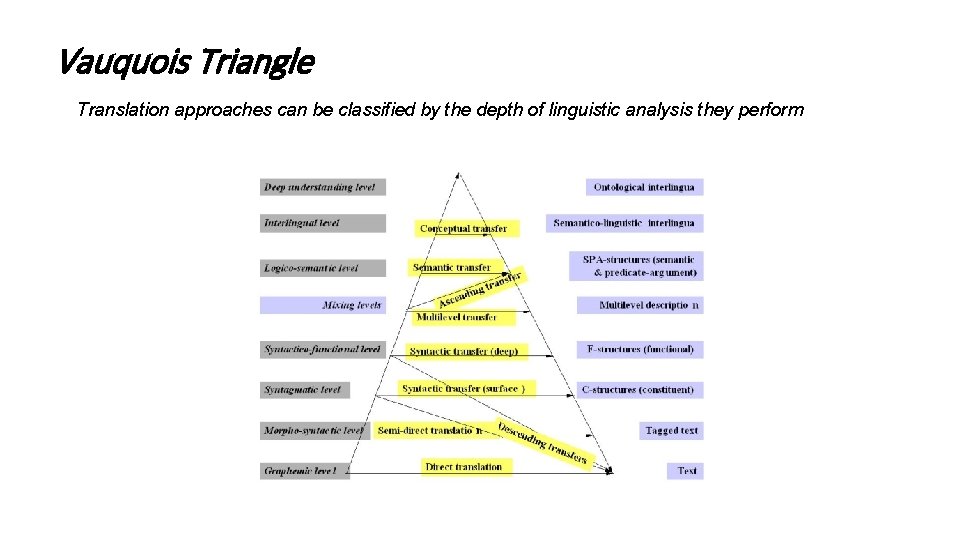
Vauquois Triangle Translation approaches can be classified by the depth of linguistic analysis they perform
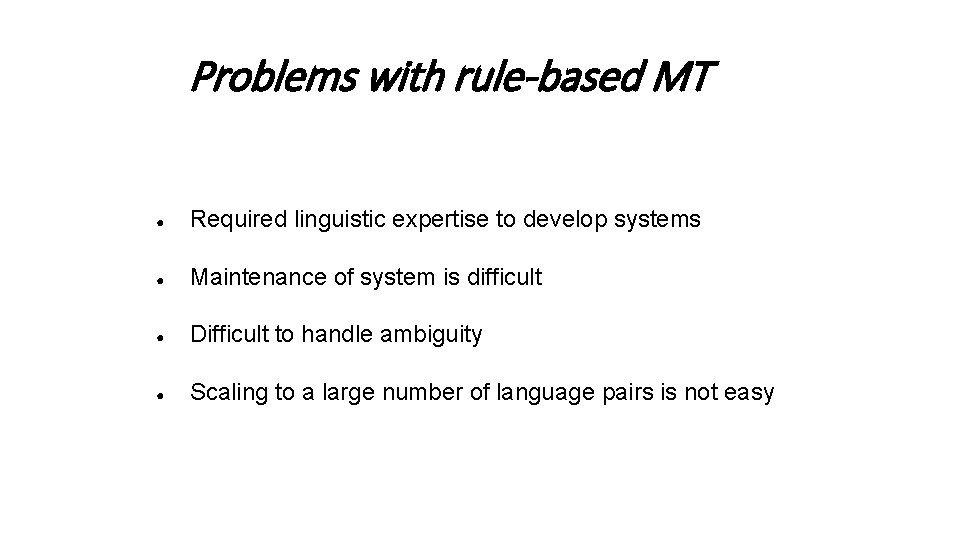
Problems with rule-based MT ● Required linguistic expertise to develop systems ● Maintenance of system is difficult ● Difficult to handle ambiguity ● Scaling to a large number of language pairs is not easy
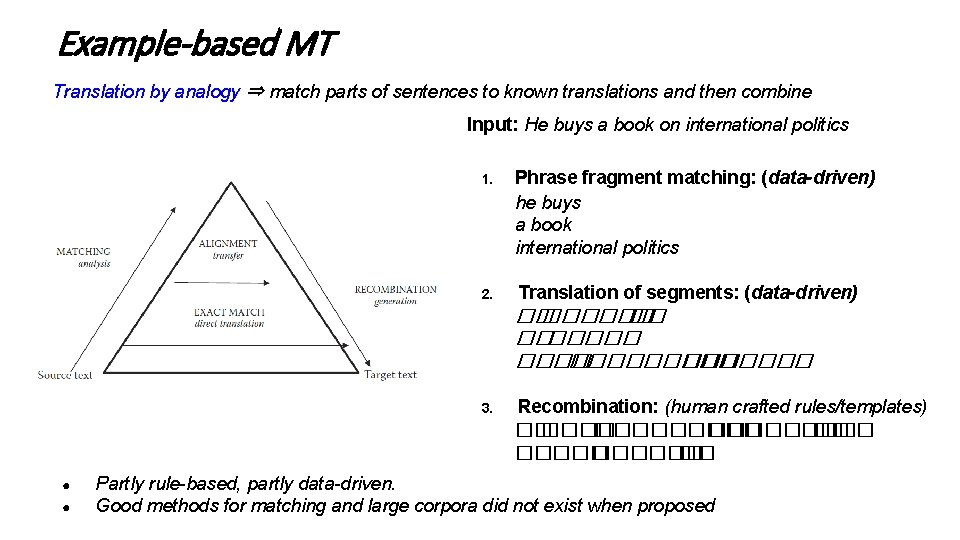
Example-based MT Translation by analogy ⇒ match parts of sentences to known translations and then combine Input: He buys a book on international politics 1. Phrase fragment matching: (data-driven) he buys a book international politics 2. Translation of segments: (data-driven) �� ��������� ������� 3. ● ● Recombination: (human crafted rules/templates) �� ��������� ������ �� Partly rule-based, partly data-driven. Good methods for matching and large corpora did not exist when proposed
Approaches to build MT systems Knowledge based, Rule-based MT Data-driven, Machine Learning based MT Tomorrow! Transfer-based Interlingua based Example-based Statistical Neural
Statistical Machine Translation A Probabilistic Formalism
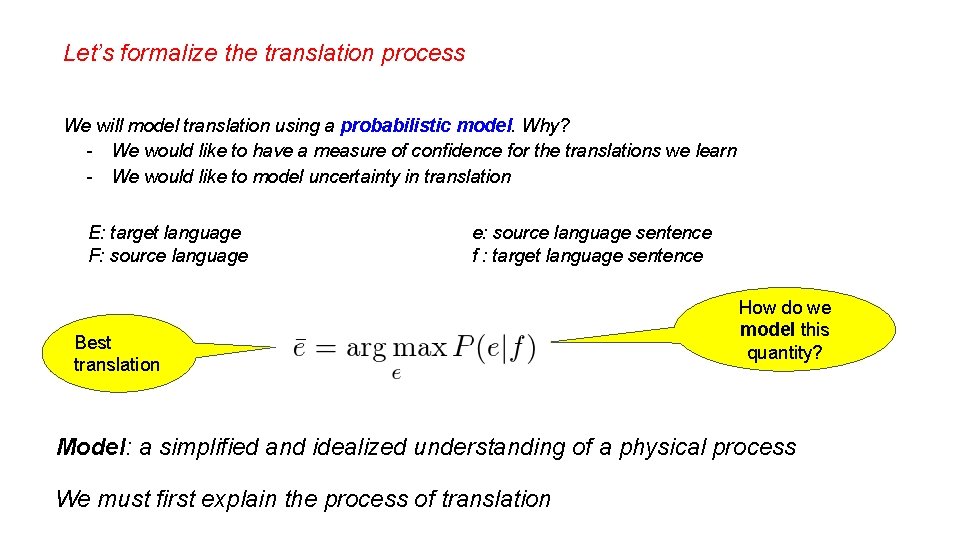
Let’s formalize the translation process We will model translation using a probabilistic model. Why? - We would like to have a measure of confidence for the translations we learn - We would like to model uncertainty in translation E: target language F: source language e: source language sentence f : target language sentence Best translation How do we model this quantity? Model: a simplified and idealized understanding of a physical process We must first explain the process of translation
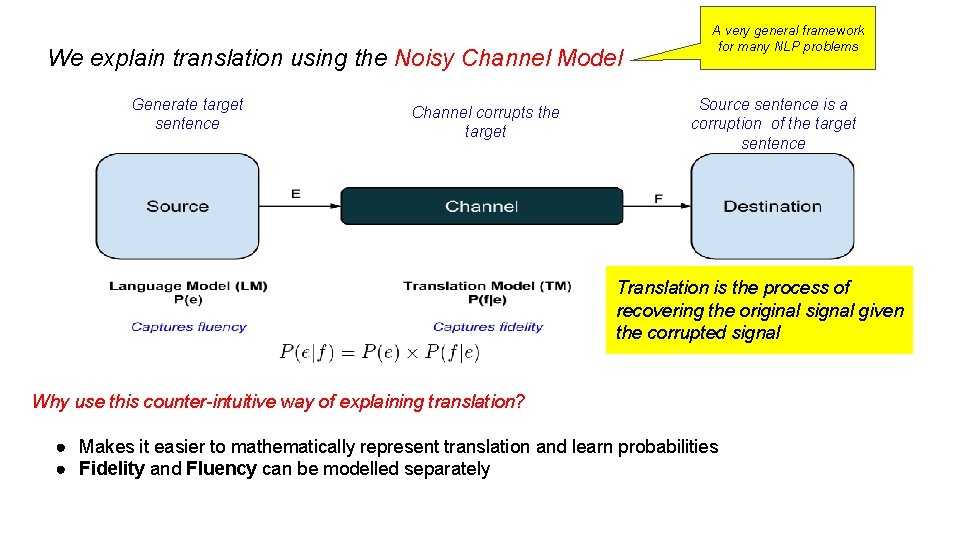
We explain translation using the Noisy Channel Model Generate target sentence Channel corrupts the target A very general framework for many NLP problems Source sentence is a corruption of the target sentence Translation is the process of recovering the original signal given the corrupted signal Why use this counter-intuitive way of explaining translation? ● Makes it easier to mathematically represent translation and learn probabilities ● Fidelity and Fluency can be modelled separately
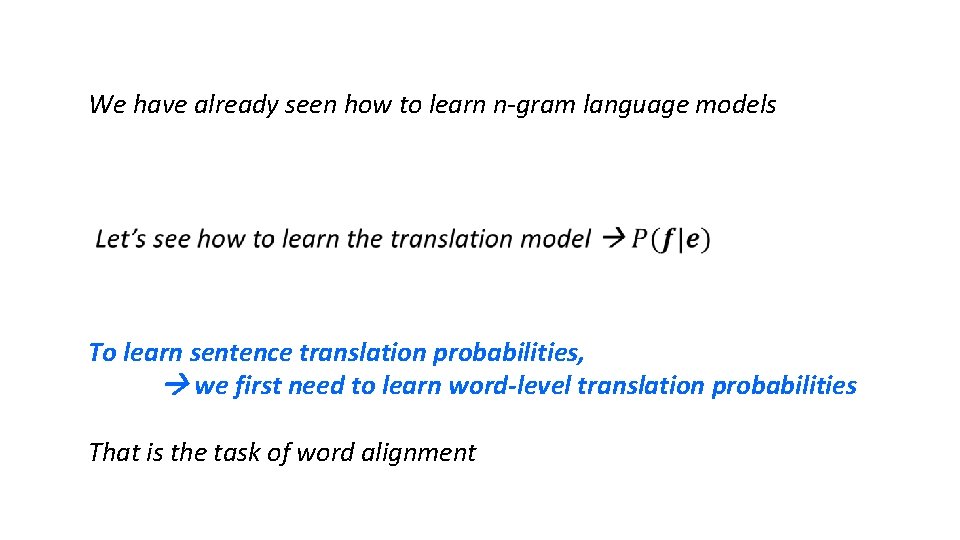
We have already seen how to learn n-gram language models To learn sentence translation probabilities, we first need to learn word-level translation probabilities That is the task of word alignment
Agenda ● ● ● What is Machine Translation & why is it interesting? Machine Translation Paradigms Word Alignment Phrase-based SMT Extensions to Phrase-based SMT ○ ○ ○ ● ● ● Addressing Word-order Divergence Addressing Morphological Divergence Handling Named Entities Syntax-based SMT Machine Translation Evaluation Summary
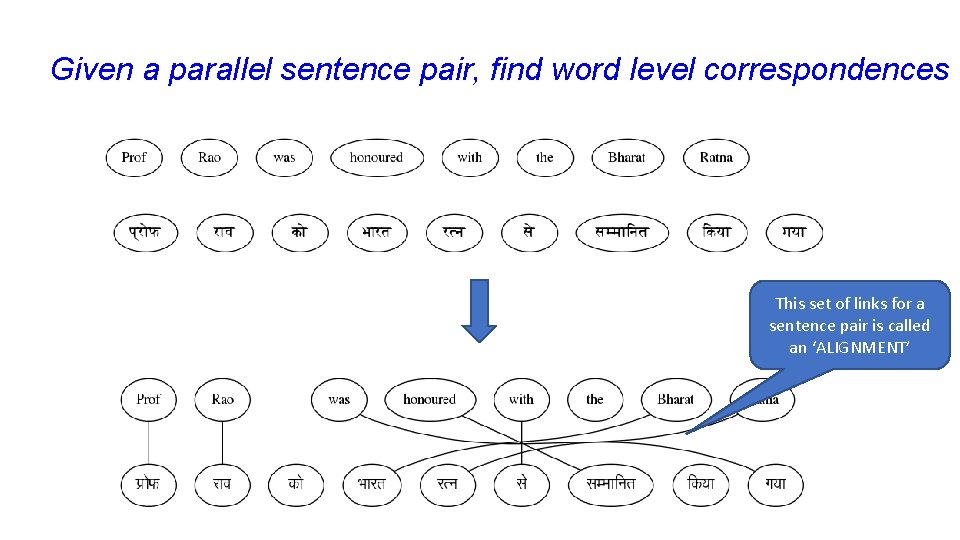
Given a parallel sentence pair, find word level correspondences This set of links for a sentence pair is called an ‘ALIGNMENT’
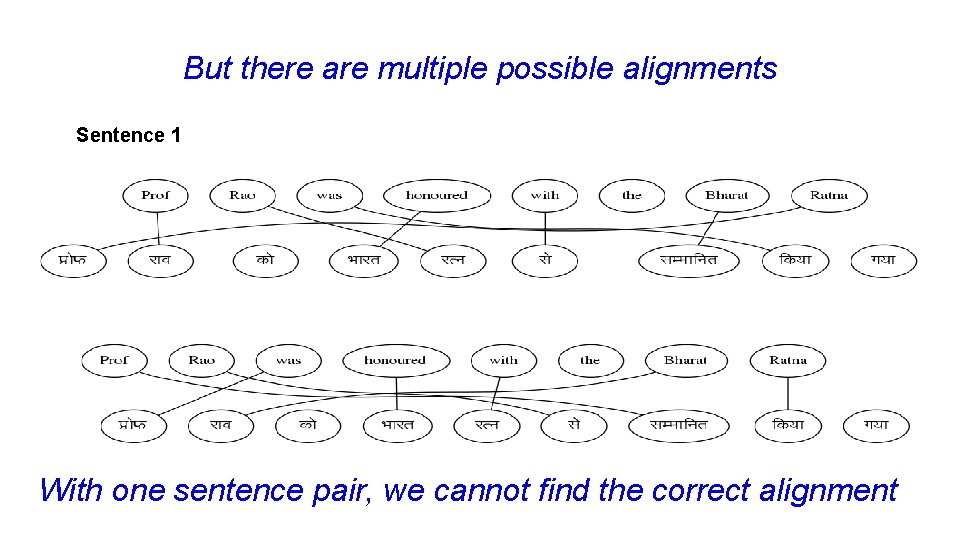
But there are multiple possible alignments Sentence 1 With one sentence pair, we cannot find the correct alignment
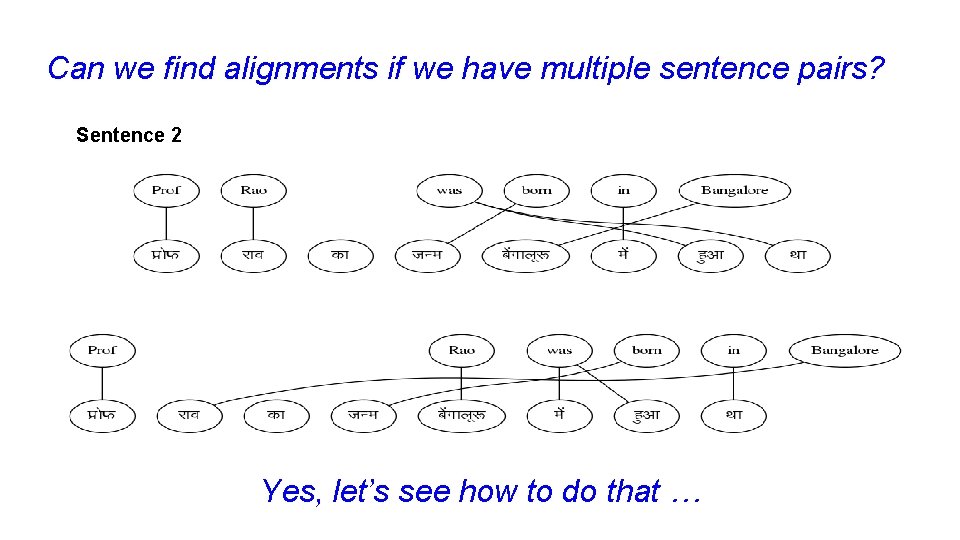
Can we find alignments if we have multiple sentence pairs? Sentence 2 Yes, let’s see how to do that …
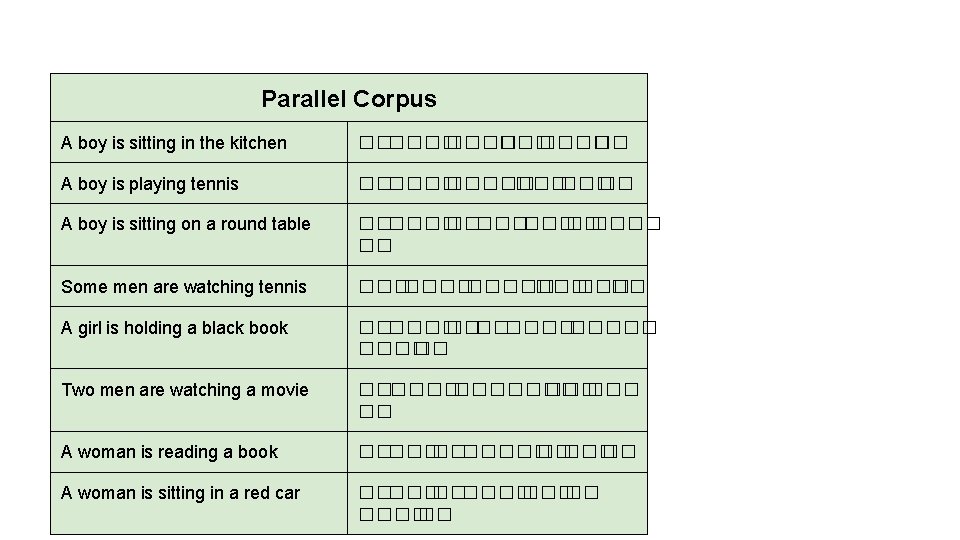
Parallel Corpus A boy is sitting in the kitchen ������ ��� �� A boy is playing tennis ������ ��� �� A boy is sitting on a round table �������� �� �� Some men are watching tennis ��������� ��� �� A girl is holding a black book ������������� �� Two men are watching a movie ������� ��� �� A woman is reading a book ������� �� �� A woman is sitting in a red car ������ ��
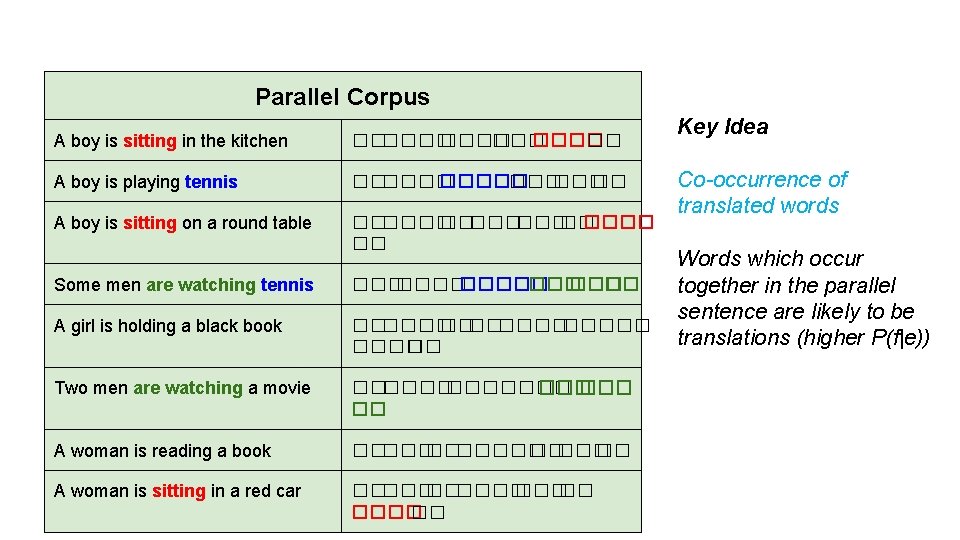
Parallel Corpus A boy is sitting in the kitchen ������ ��� �� A boy is playing tennis ������ ��� �� A boy is sitting on a round table �������� �� �� Some men are watching tennis ��������� ��� �� A girl is holding a black book ������������� �� Two men are watching a movie ������� ��� �� A woman is reading a book ������� �� �� A woman is sitting in a red car ������ �� Key Idea Co-occurrence of translated words Words which occur together in the parallel sentence are likely to be translations (higher P(f|e))
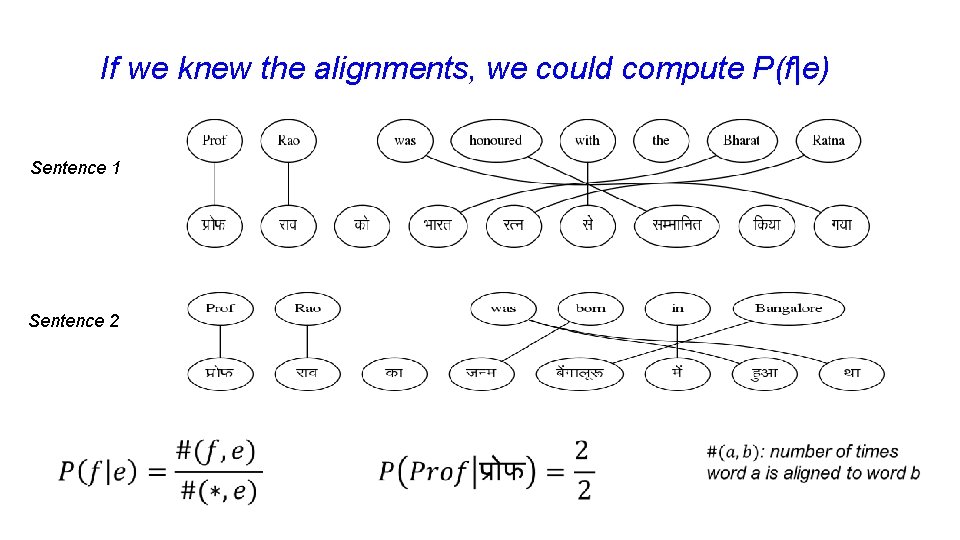
If we knew the alignments, we could compute P(f|e) Sentence 1 Sentence 2
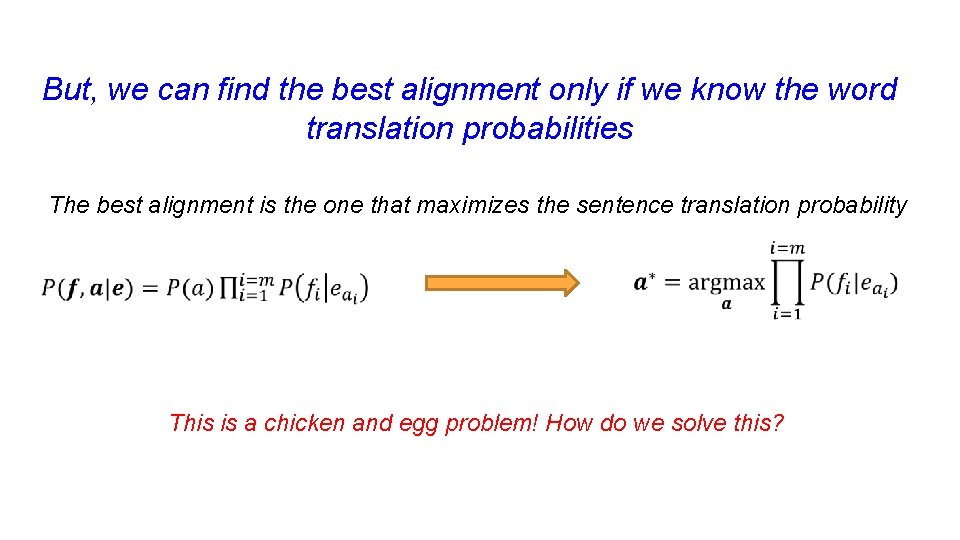
But, we can find the best alignment only if we know the word translation probabilities The best alignment is the one that maximizes the sentence translation probability This is a chicken and egg problem! How do we solve this?
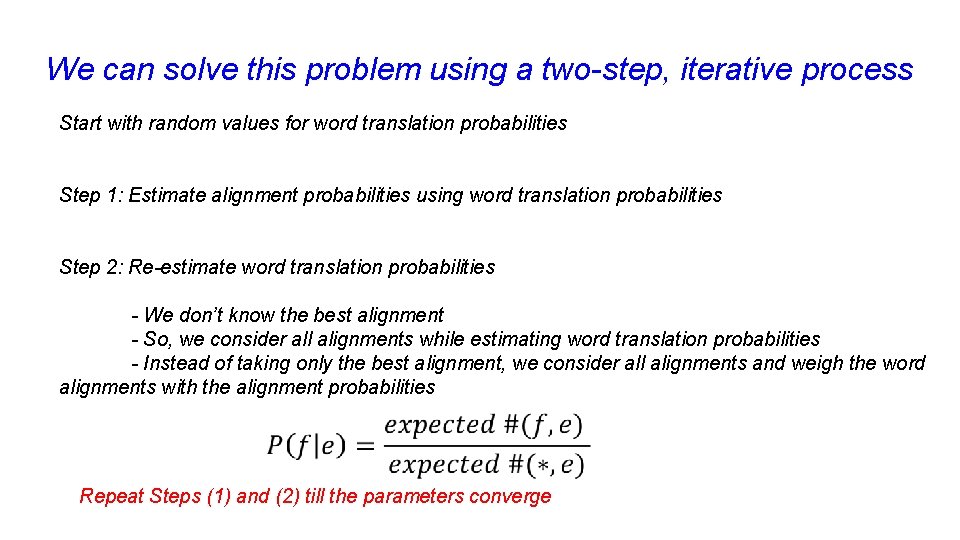
We can solve this problem using a two-step, iterative process Start with random values for word translation probabilities Step 1: Estimate alignment probabilities using word translation probabilities Step 2: Re-estimate word translation probabilities - We don’t know the best alignment - So, we consider all alignments while estimating word translation probabilities - Instead of taking only the best alignment, we consider all alignments and weigh the word alignments with the alignment probabilities Repeat Steps (1) and (2) till the parameters converge
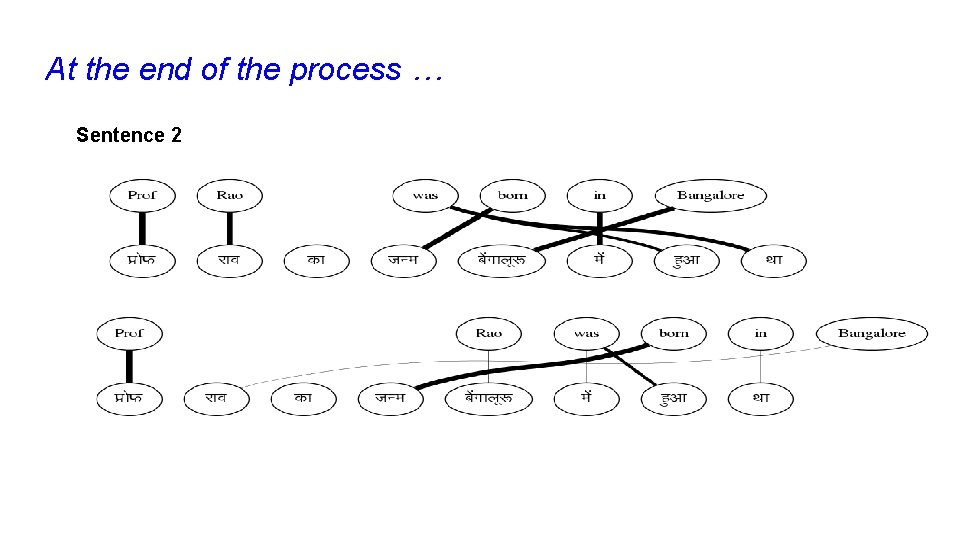
At the end of the process … Sentence 2
Is the algorithm guaranteed to converge? That’s the nice part it is guaranteed to converge This is an example of the well known Expectation-Maximization Algorithm However, the problem is highly non-convex Will lead to local minima Good modelling assumptions necessary to ensure a good solution
IBM Models • IBM came up with a series of increasingly complex models • Called Models 1 to 5 • Differed in assumptions about alignment probability distributions • Simper models are used to initialize the more complex models • This pipelined training helped ensure better solutions
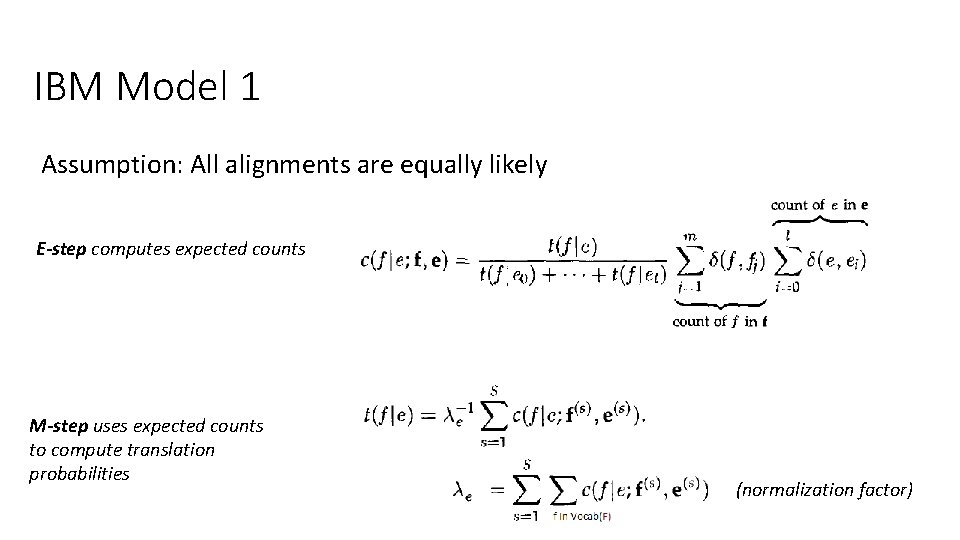
IBM Model 1 Assumption: All alignments are equally likely E-step computes expected counts M-step uses expected counts to compute translation probabilities (normalization factor)
Summary • EM provides a semi-supervised method for learning word alignments and word translation probabilities • Word translation probabilities can be used to extract a bilingual dictionary • Avoids the new for word-aligned corpora • If a few word-aligned sentences are available, discriminative alignment methods can improve upon the EM-based solution • Arbitrary features can be incorporated • Morphological information • Character level edit distance
Agenda ● ● ● What is Machine Translation & why is it interesting? Machine Translation Paradigms Word Alignment Phrase-based SMT Extensions to Phrase-based SMT ○ ○ ○ ● ● ● Addressing Word-order Divergence Addressing Morphological Divergence Handling Named Entities Syntax-based SMT Machine Translation Evaluation Summary
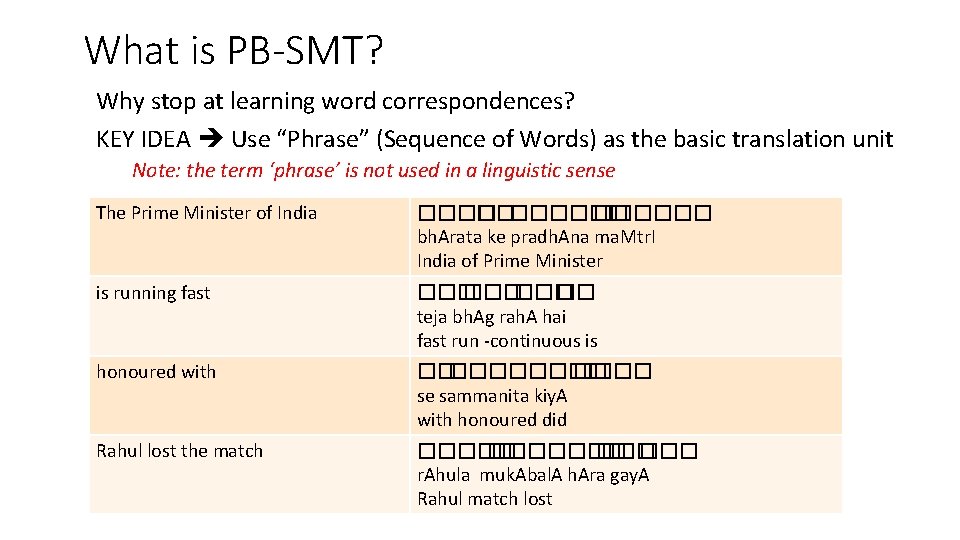
What is PB-SMT? Why stop at learning word correspondences? KEY IDEA Use “Phrase” (Sequence of Words) as the basic translation unit Note: the term ‘phrase’ is not used in a linguistic sense The Prime Minister of India �������� bh. Arata ke pradh. Ana ma. Mtr. I India of Prime Minister is running fast ������ �� teja bh. Ag rah. A hai fast run -continuous is honoured with ����� se sammanita kiy. A with honoured did Rahul lost the match ������� ��� r. Ahula muk. Abal. A h. Ara gay. A Rahul match lost
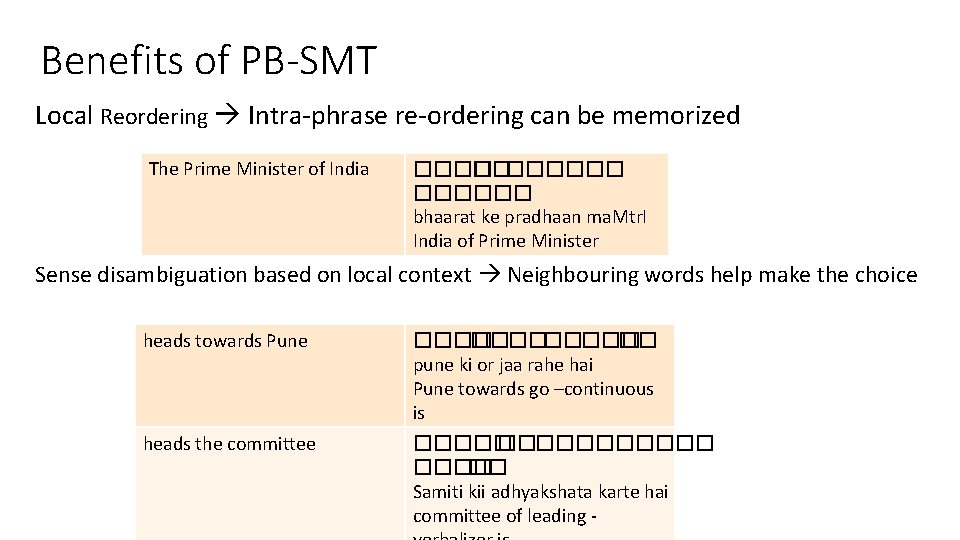
Benefits of PB-SMT Local Reordering Intra-phrase re-ordering can be memorized The Prime Minister of India �������� bhaarat ke pradhaan ma. Mtr. I India of Prime Minister Sense disambiguation based on local context Neighbouring words help make the choice heads towards Pune ��������� �� pune ki or jaa rahe hai Pune towards go –continuous is heads the committee ����������� �� Samiti kii adhyakshata karte hai committee of leading -
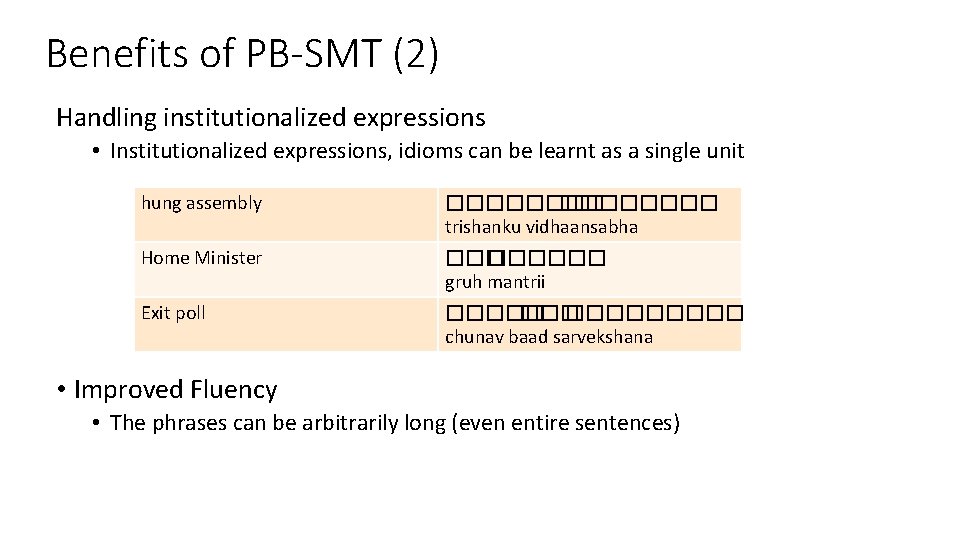
Benefits of PB-SMT (2) Handling institutionalized expressions • Institutionalized expressions, idioms can be learnt as a single unit hung assembly �������� trishanku vidhaansabha Home Minister ������ gruh mantrii Exit poll ����� chunav baad sarvekshana • Improved Fluency • The phrases can be arbitrarily long (even entire sentences)
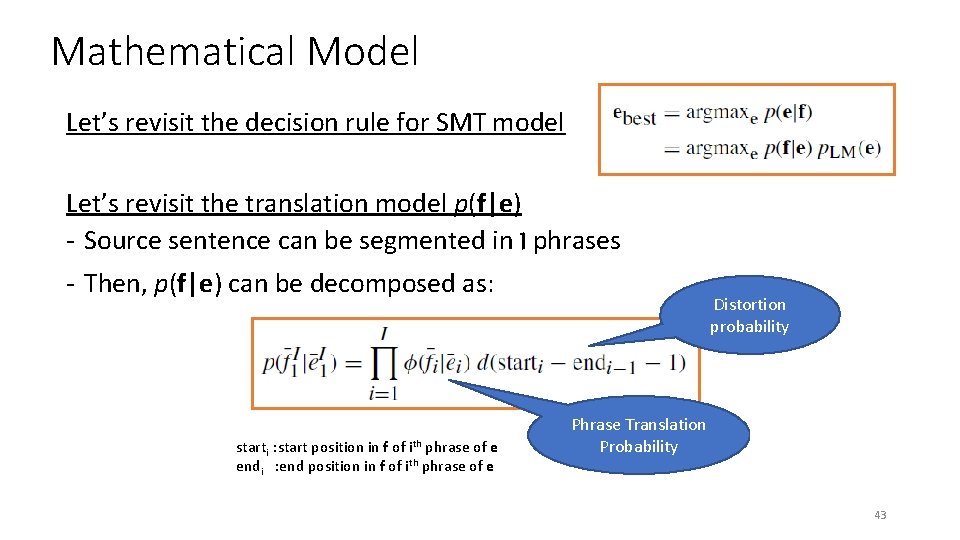
Mathematical Model Let’s revisit the decision rule for SMT model Let’s revisit the translation model p(f|e) - Source sentence can be segmented in I phrases - Then, p(f|e) can be decomposed as: starti : start position in f of ith phrase of e endi : end position in f of ith phrase of e Distortion probability Phrase Translation Probability 43
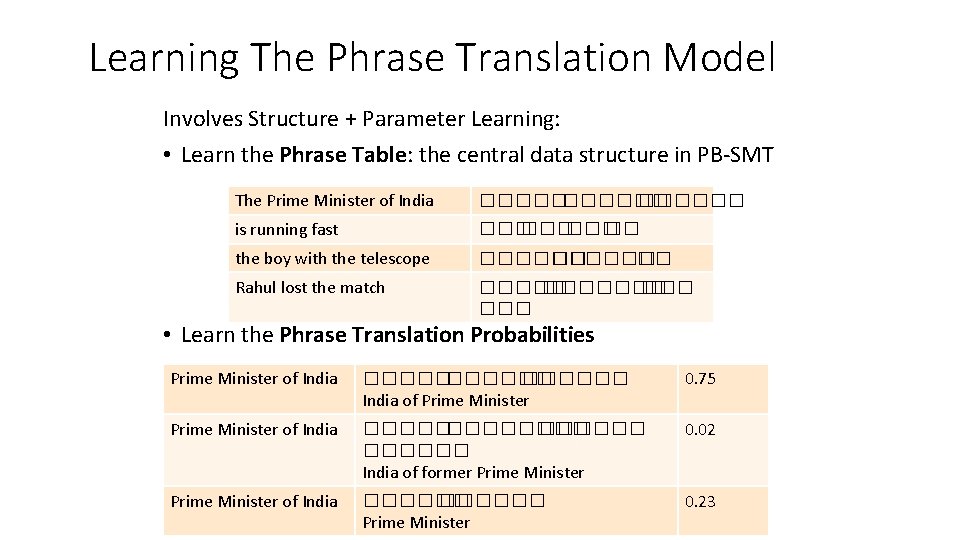
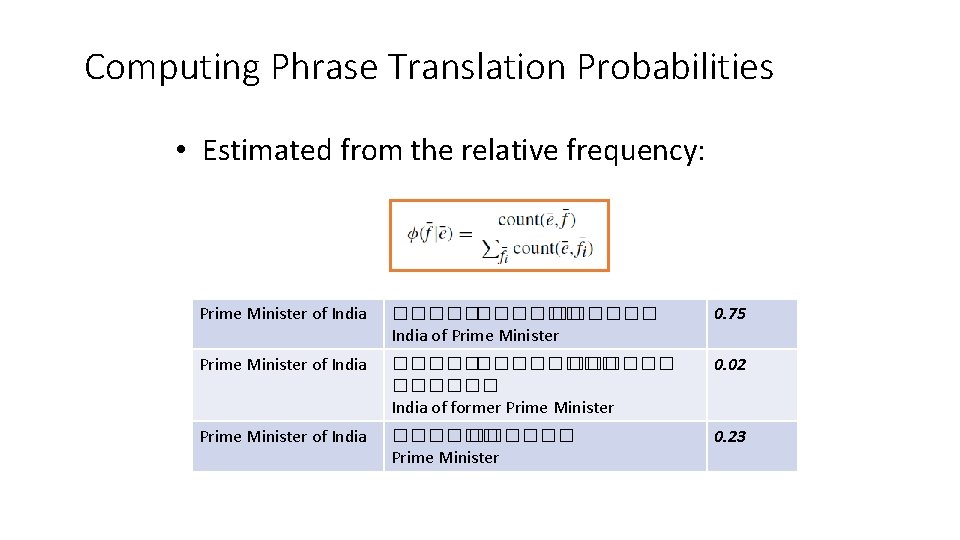
Learning The Phrase Translation Model Involves Structure + Parameter Learning: • Learn the Phrase Table: the central data structure in PB-SMT The Prime Minister of India �������� is running fast ������ �� the boy with the telescope ������ �� Rahul lost the match ������� ��� • Learn the Phrase Translation Probabilities Prime Minister of India �������� India of Prime Minister 0. 75 Prime Minister of India ���������� India of former Prime Minister 0. 02 Prime Minister of India ������ Prime Minister 0. 23
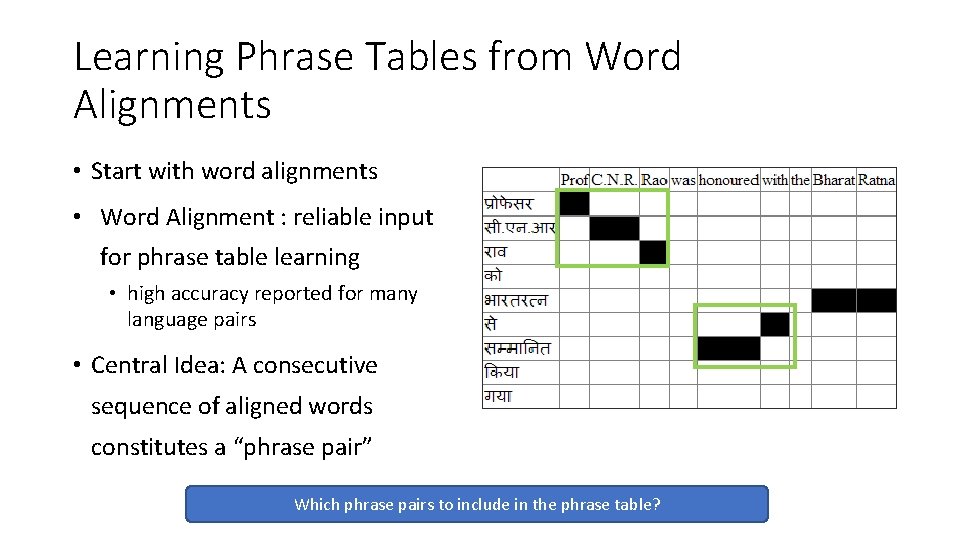
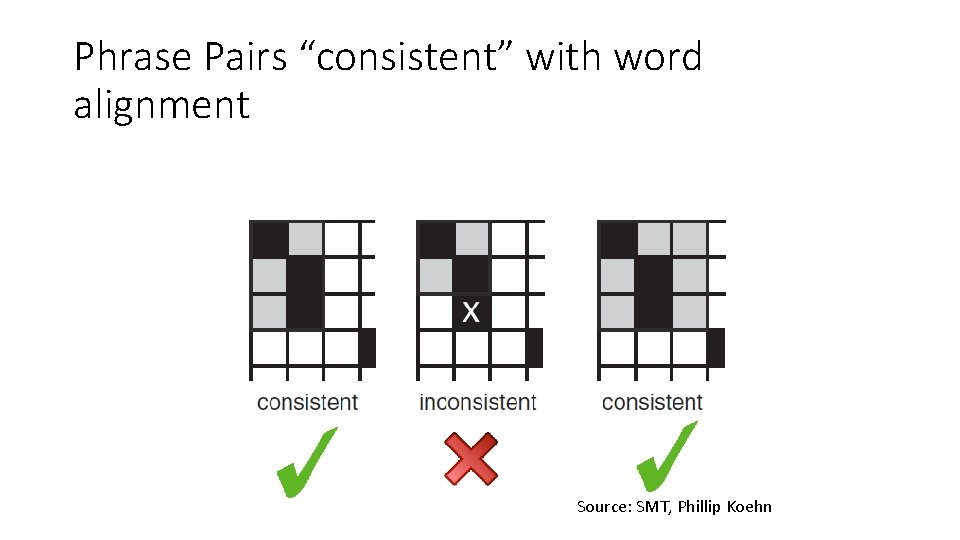
Learning Phrase Tables from Word Alignments • Start with word alignments • Word Alignment : reliable input for phrase table learning • high accuracy reported for many language pairs • Central Idea: A consecutive sequence of aligned words constitutes a “phrase pair” Which phrase pairs to include in the phrase table?
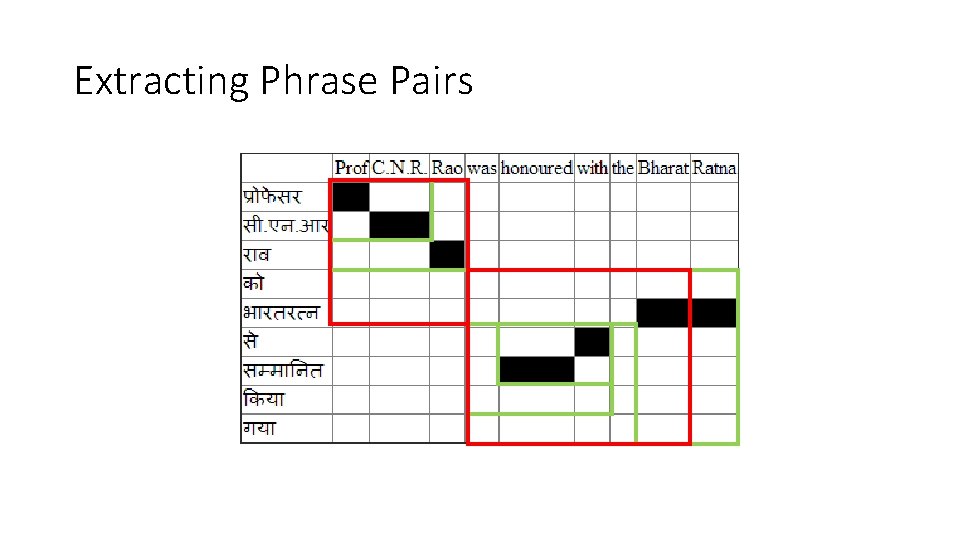
Extracting Phrase Pairs
Phrase Pairs “consistent” with word alignment Source: SMT, Phillip Koehn
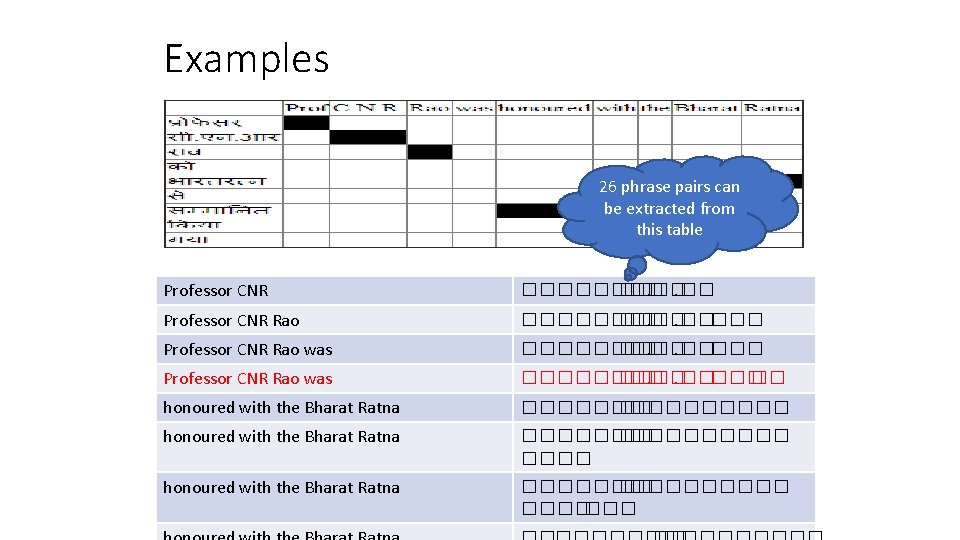
Examples 26 phrase pairs can be extracted from this table Professor CNR ���� ��. �� Professor CNR Rao �������� ��. ��. ����� Professor CNR Rao was ���� ��. ����� �� honoured with the Bharat Ratna ���������� ���� honoured with the Bharat Ratna ����������
Computing Phrase Translation Probabilities • Estimated from the relative frequency: Prime Minister of India �������� India of Prime Minister 0. 75 Prime Minister of India ���������� India of former Prime Minister 0. 02 Prime Minister of India ������ Prime Minister 0. 23
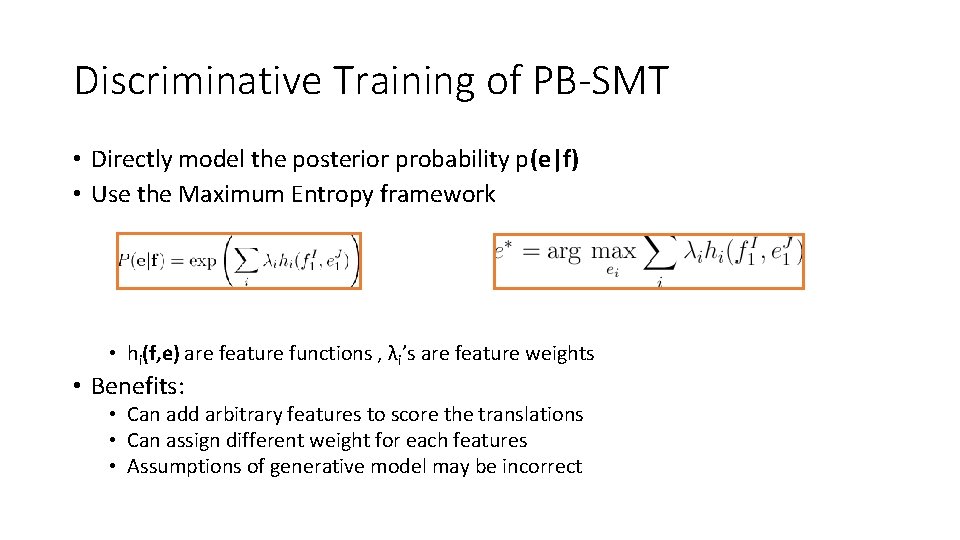
Discriminative Training of PB-SMT • Directly model the posterior probability p(e|f) • Use the Maximum Entropy framework • hi(f, e) are feature functions , λi’s are feature weights • Benefits: • Can add arbitrary features to score the translations • Can assign different weight for each features • Assumptions of generative model may be incorrect
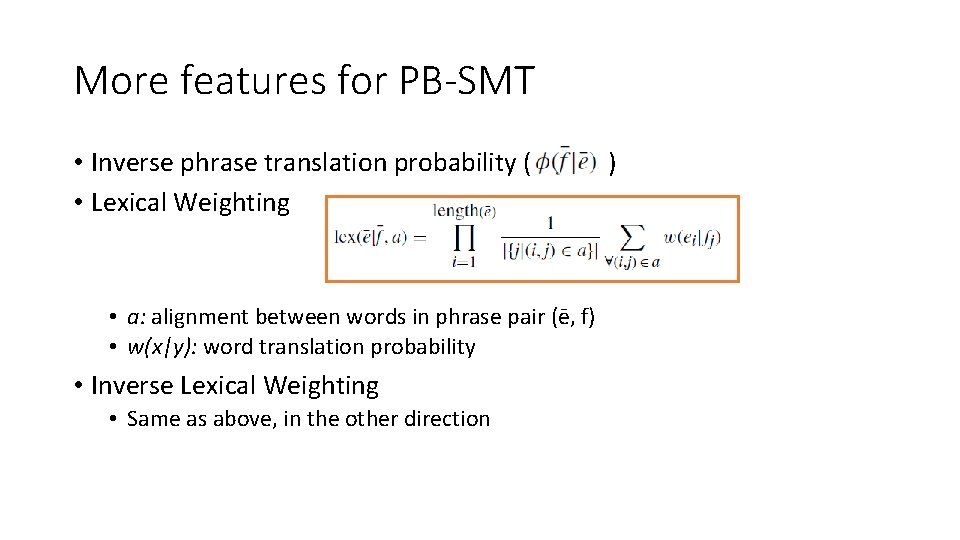
More features for PB-SMT • Inverse phrase translation probability ( • Lexical Weighting • a: alignment between words in phrase pair (ē, f) • w(x|y): word translation probability • Inverse Lexical Weighting • Same as above, in the other direction )
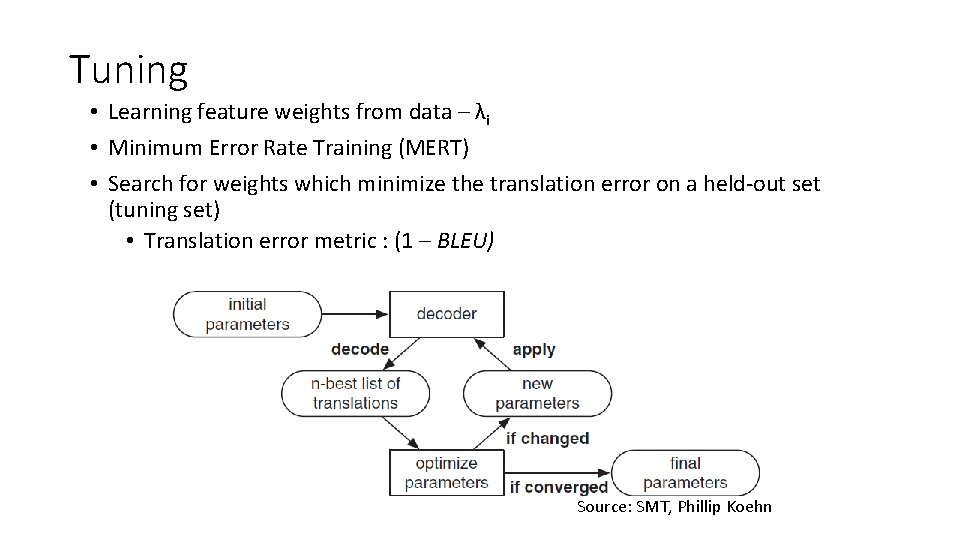
Tuning • Learning feature weights from data – λi • Minimum Error Rate Training (MERT) • Search for weights which minimize the translation error on a held-out set (tuning set) • Translation error metric : (1 – BLEU) Source: SMT, Phillip Koehn
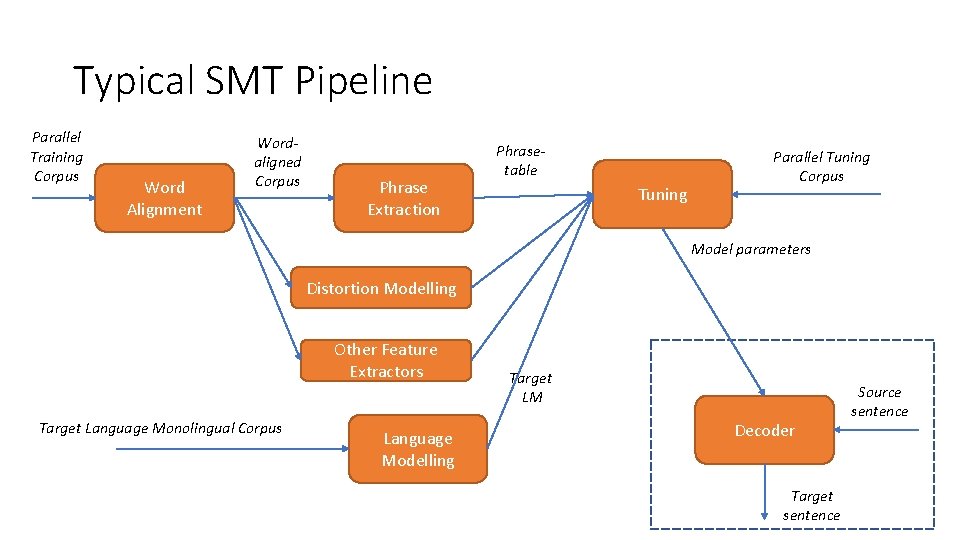
Typical SMT Pipeline Parallel Training Corpus Word Alignment Wordaligned Corpus Phrase Extraction Phrasetable Tuning Parallel Tuning Corpus Model parameters Distortion Modelling Other Feature Extractors Target Language Monolingual Corpus Language Modelling Target LM Decoder Target sentence Source sentence
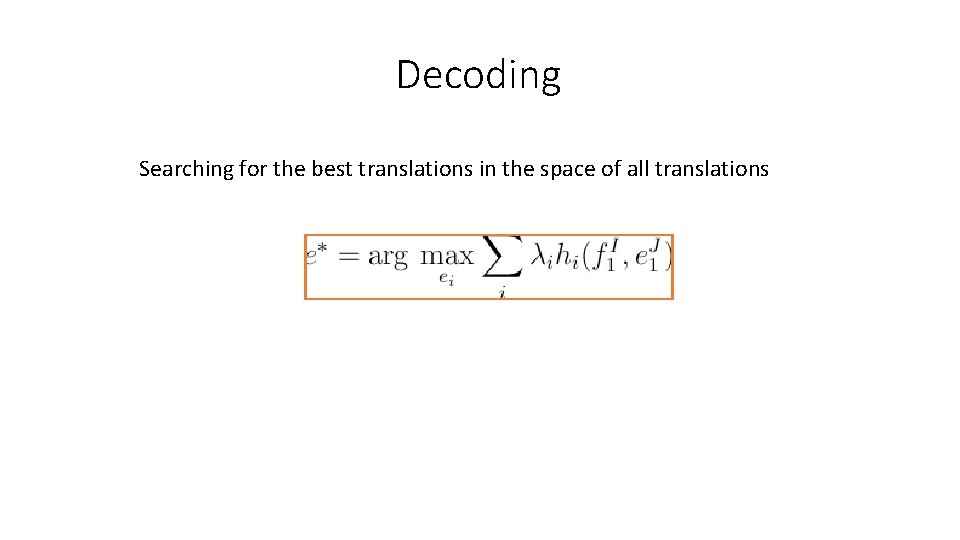
Decoding Searching for the best translations in the space of all translations
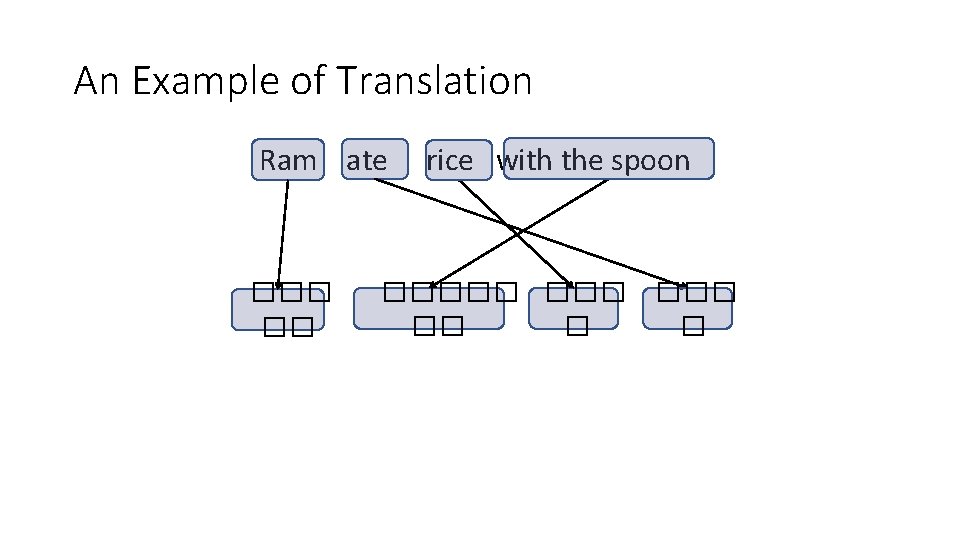
An Example of Translation Ram ate ��� �� rice with the spoon ����� ��� �� � �
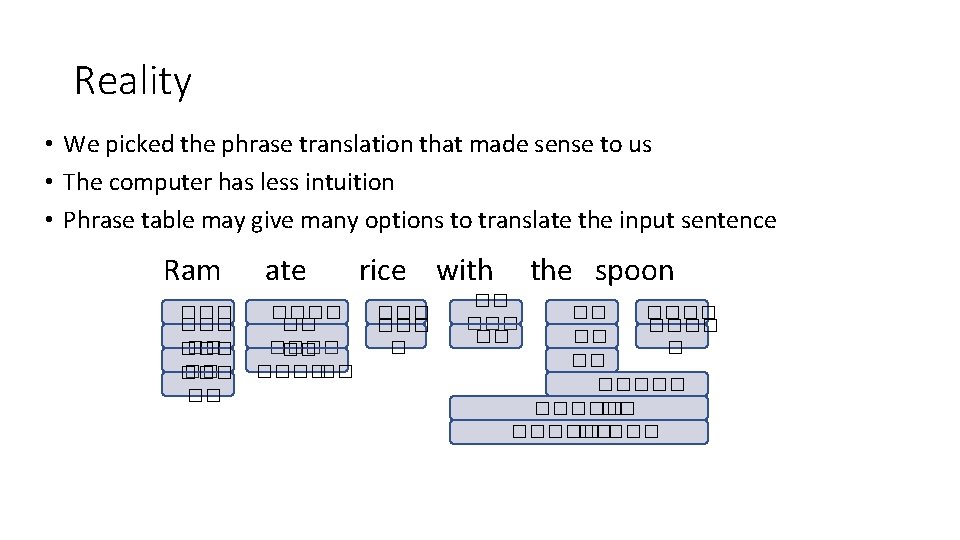
Reality • We picked the phrase translation that made sense to us • The computer has less intuition • Phrase table may give many options to translate the input sentence Ram ��� �� ate ���� �� rice with ��� � the spoon �� ���� �� �����
What is the challenge in decoding? • The task of decoding in machine translation is to find the best scoring translation according to translation models • Hard problem, since there is a exponential number of choices, given a specific input sentence • Shown as an NP complete problem • Need to come up with heuristic search methods • No guarantee of finding the best translation
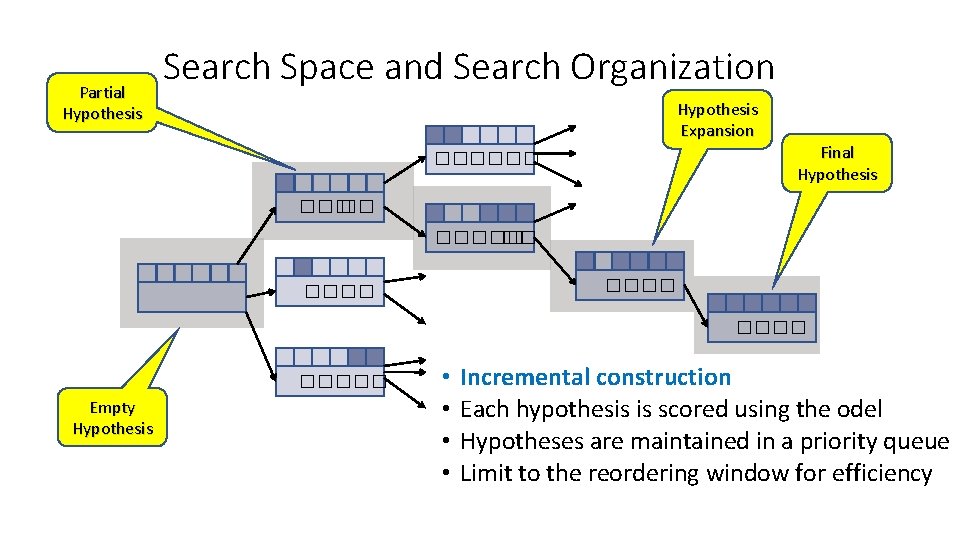
Partial Hypothesis Search Space and Search Organization Hypothesis Expansion ������ Final Hypothesis ��� �� ���� ����� Empty Hypothesis • • Incremental construction Each hypothesis is scored using the odel Hypotheses are maintained in a priority queue Limit to the reordering window for efficiency
Agenda ● ● ● What is Machine Translation & why is it interesting? Machine Translation Paradigms Word Alignment Phrase-based SMT Extensions to Phrase-based SMT ○ ○ ○ ● ● ● Addressing Word-order Divergence Addressing Morphological Divergence Handling Named Entities Syntax-based SMT Machine Translation Evaluation Summary
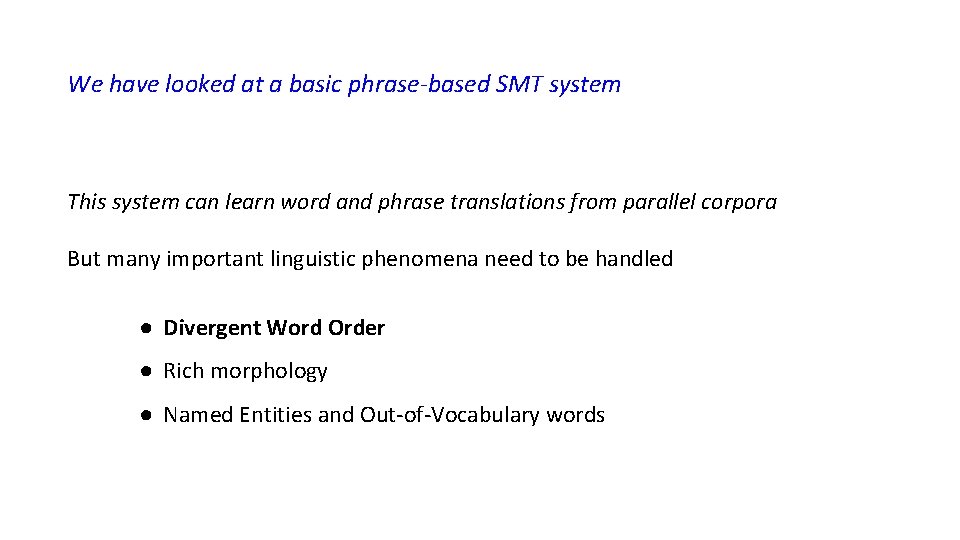
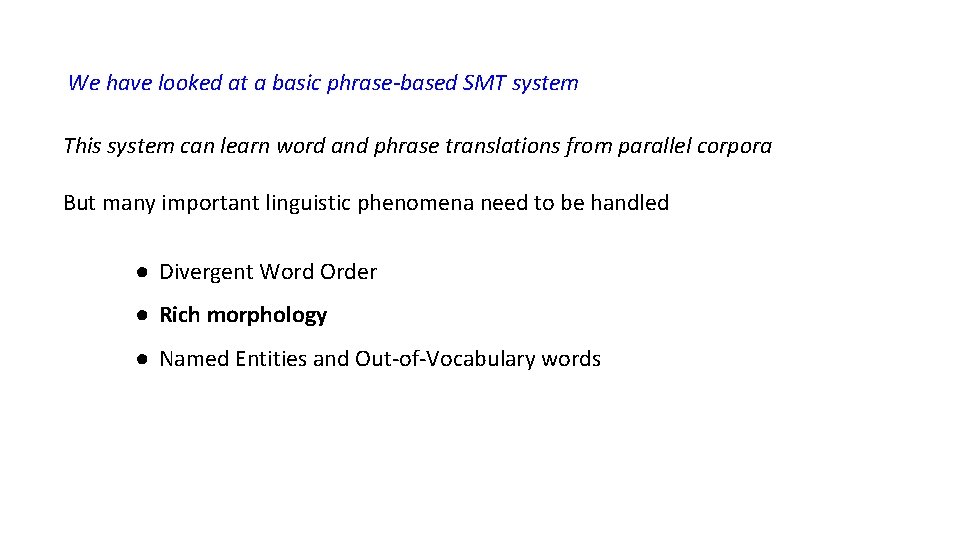
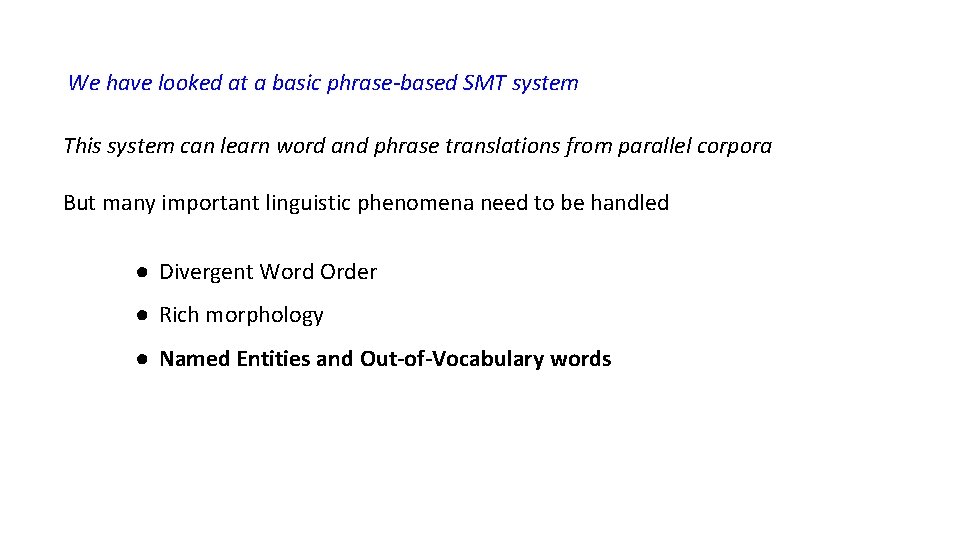
We have looked at a basic phrase-based SMT system This system can learn word and phrase translations from parallel corpora But many important linguistic phenomena need to be handled ● Divergent Word Order ● Rich morphology ● Named Entities and Out-of-Vocabulary words
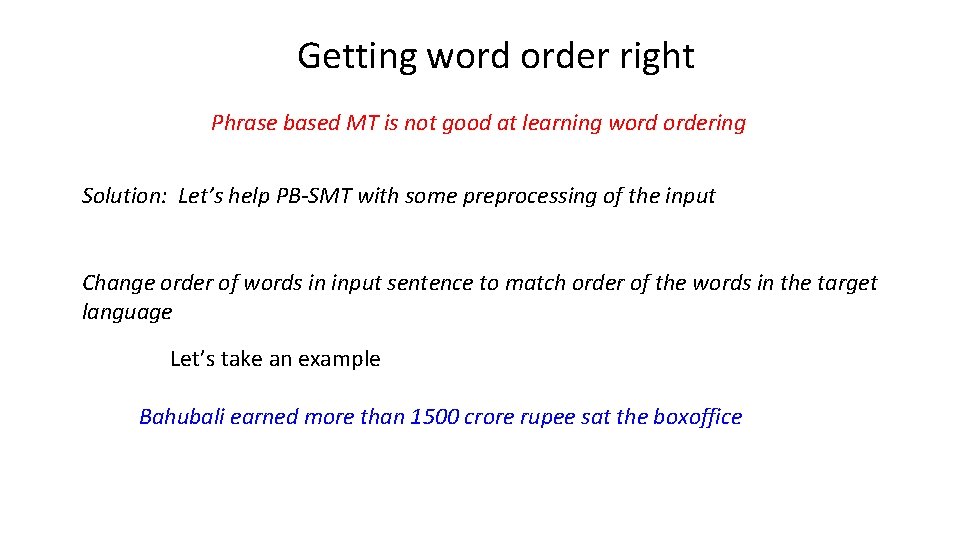
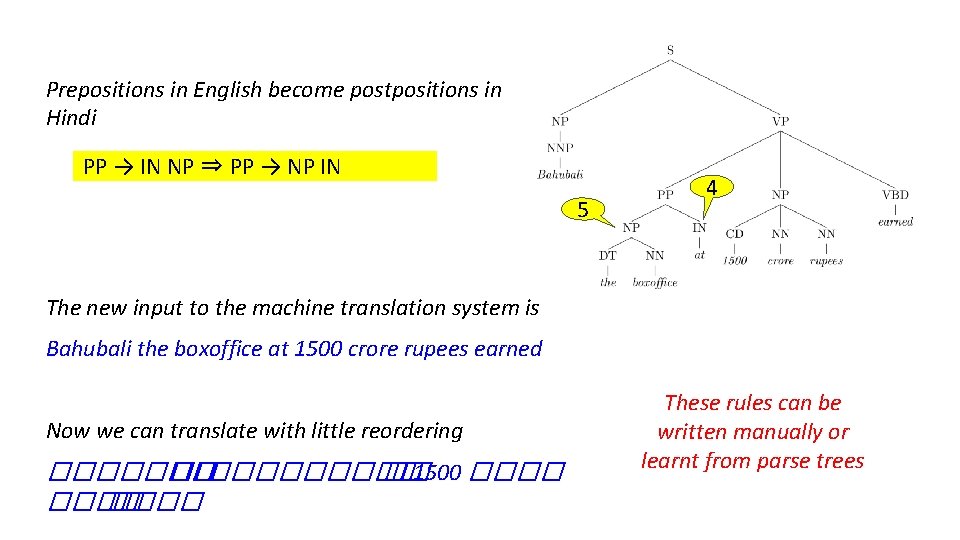
Getting word order right Phrase based MT is not good at learning word ordering Solution: Let’s help PB-SMT with some preprocessing of the input Change order of words in input sentence to match order of the words in the target language Let’s take an example Bahubali earned more than 1500 crore rupee sat the boxoffice
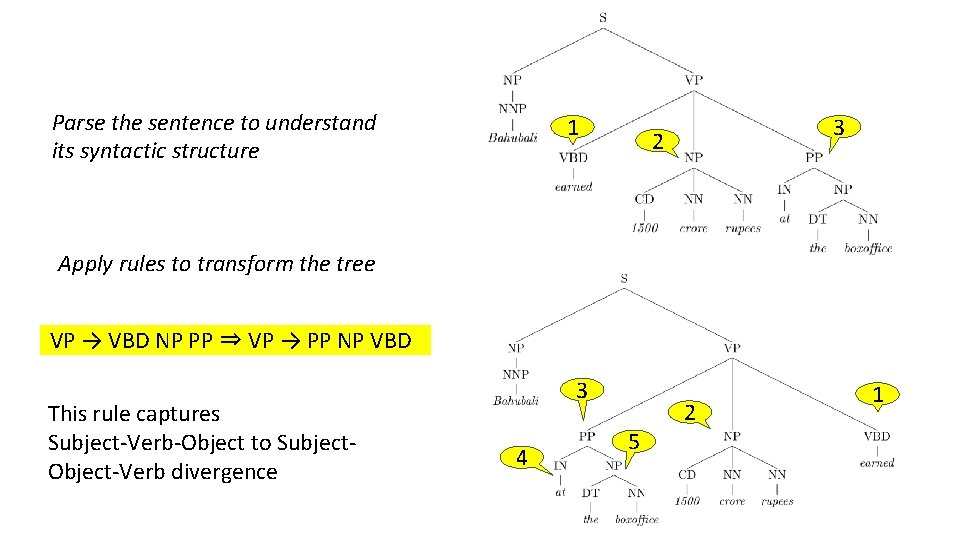
Parse the sentence to understand its syntactic structure 1 3 2 Apply rules to transform the tree VP → VBD NP PP ⇒ VP → PP NP VBD This rule captures Subject-Verb-Object to Subject. Object-Verb divergence 3 4 5 2 1
Prepositions in English become postpositions in Hindi PP → IN NP ⇒ PP → NP IN 5 4 The new input to the machine translation system is Bahubali the boxoffice at 1500 crore rupees earned Now we can translate with little reordering ����������� �� 1500 ���� These rules can be written manually or learnt from parse trees
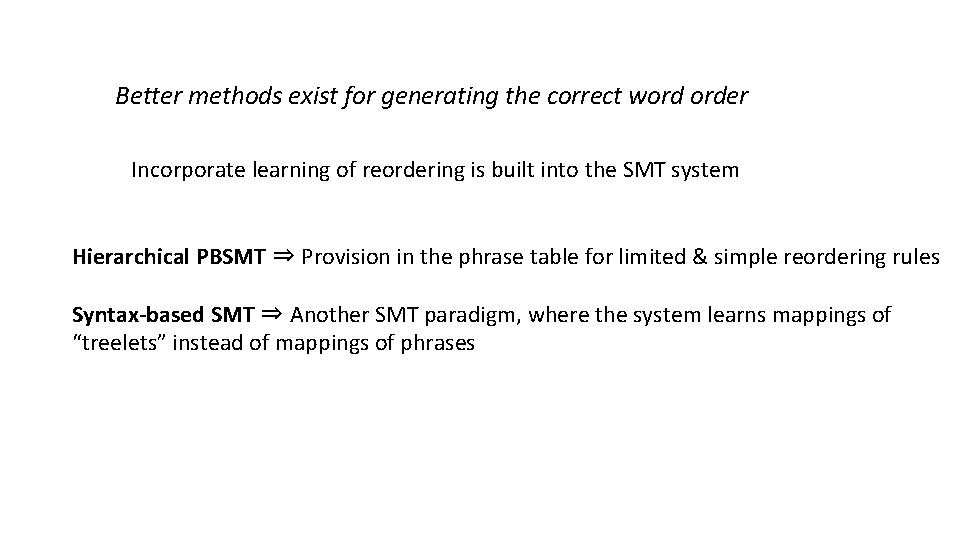
Better methods exist for generating the correct word order Incorporate learning of reordering is built into the SMT system Hierarchical PBSMT ⇒ Provision in the phrase table for limited & simple reordering rules Syntax-based SMT ⇒ Another SMT paradigm, where the system learns mappings of “treelets” instead of mappings of phrases
We have looked at a basic phrase-based SMT system This system can learn word and phrase translations from parallel corpora But many important linguistic phenomena need to be handled ● Divergent Word Order ● Rich morphology ● Named Entities and Out-of-Vocabulary words
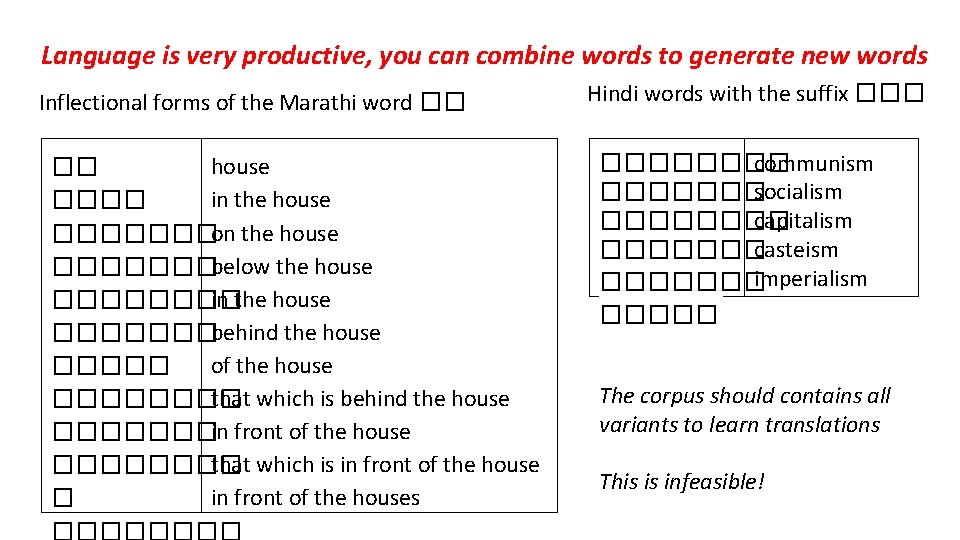
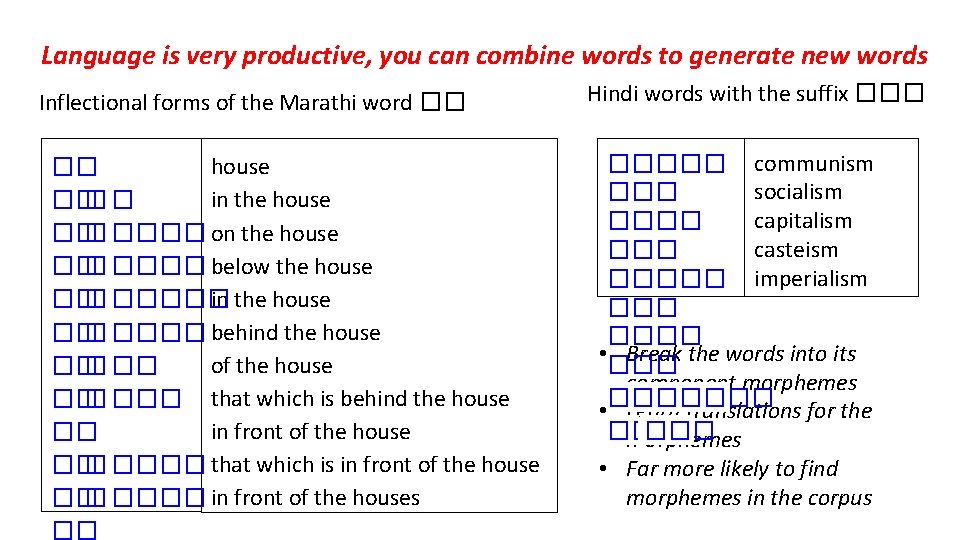
Language is very productive, you can combine words to generate new words Inflectional forms of the Marathi word �� house �� in the house �������on the house �������below the house in the house �������behind the house of the house ����� that which is behind the house �������in front of the house that which is in front of the house ���� in front of the houses � ���� Hindi words with the suffix ��� communism ���� socialism ������� capitalism ���� casteism ������� imperialism ������� The corpus should contains all variants to learn translations This is infeasible!
Language is very productive, you can combine words to generate new words Inflectional forms of the Marathi word �� house �� in the house �� �� ���� on the house �� � ���� below the house in the house �� � ����� ���� behind the house of the house �� � ��� that which is behind the house in front of the house �� ���� that which is in front of the house �� � ���� in front of the houses �� Hindi words with the suffix ����� communism socialism ��� capitalism ���� casteism ����� imperialism ���� • Break the words into its ��� component morphemes ������� • Learn translations for the �� ��� morphemes • Far more likely to find morphemes in the corpus
We have looked at a basic phrase-based SMT system This system can learn word and phrase translations from parallel corpora But many important linguistic phenomena need to be handled ● Divergent Word Order ● Rich morphology ● Named Entities and Out-of-Vocabulary words
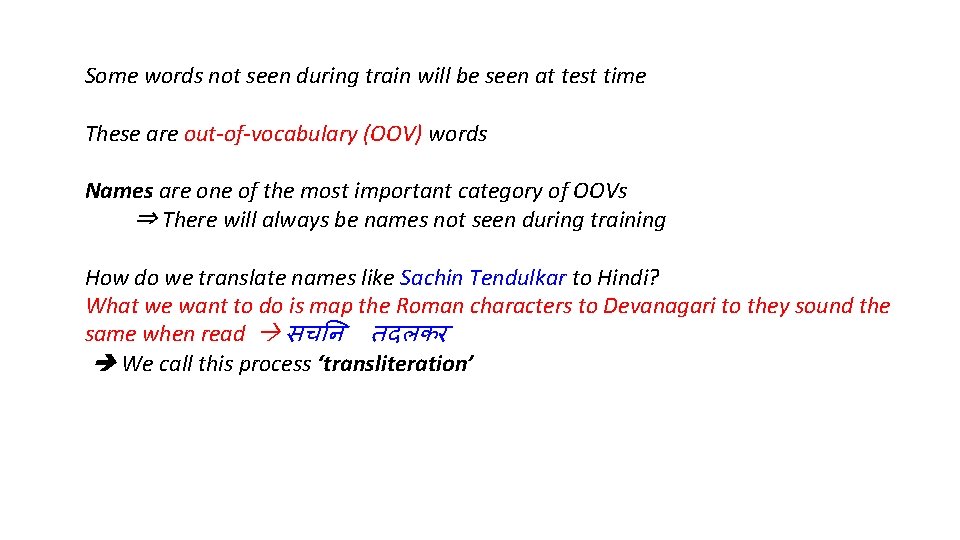
Some words not seen during train will be seen at test time These are out-of-vocabulary (OOV) words Names are one of the most important category of OOVs ⇒ There will always be names not seen during training How do we translate names like Sachin Tendulkar to Hindi? What we want to do is map the Roman characters to Devanagari to they sound the same when read सच न तदलकर We call this process ‘transliteration’
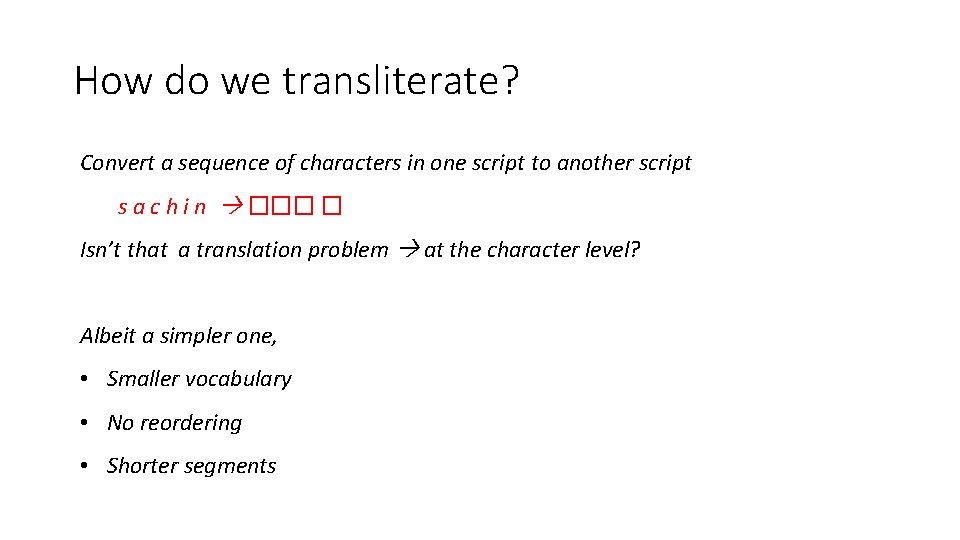
How do we transliterate? Convert a sequence of characters in one script to another script s a c h i n ��� � Isn’t that a translation problem at the character level? Albeit a simpler one, • Smaller vocabulary • No reordering • Shorter segments
Translation between Related Languages
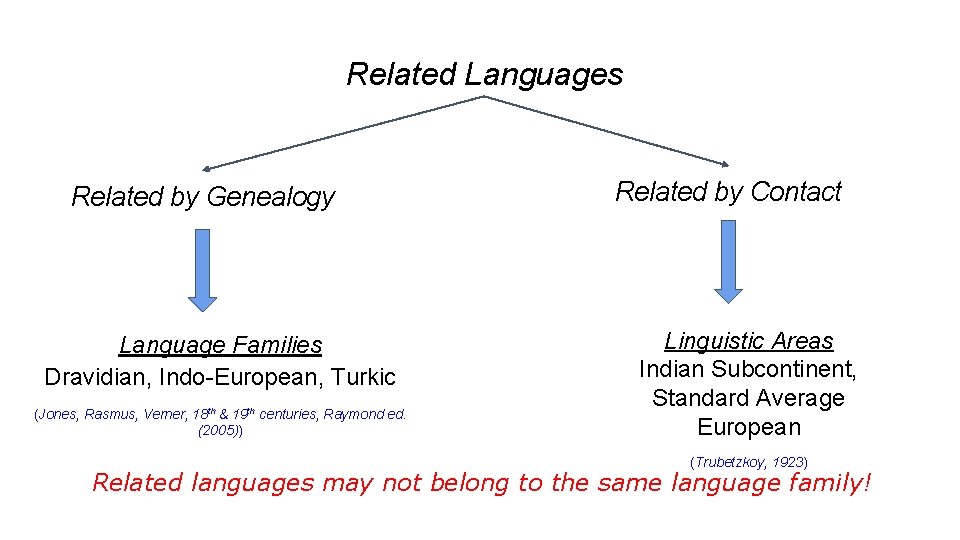
Related Languages Related by Genealogy Language Families Dravidian, Indo-European, Turkic (Jones, Rasmus, Verner, 18 th & 19 th centuries, Raymond ed. (2005)) Related by Contact Linguistic Areas Indian Subcontinent, Standard Average European (Trubetzkoy, 1923) Related languages may not belong to the same language family!
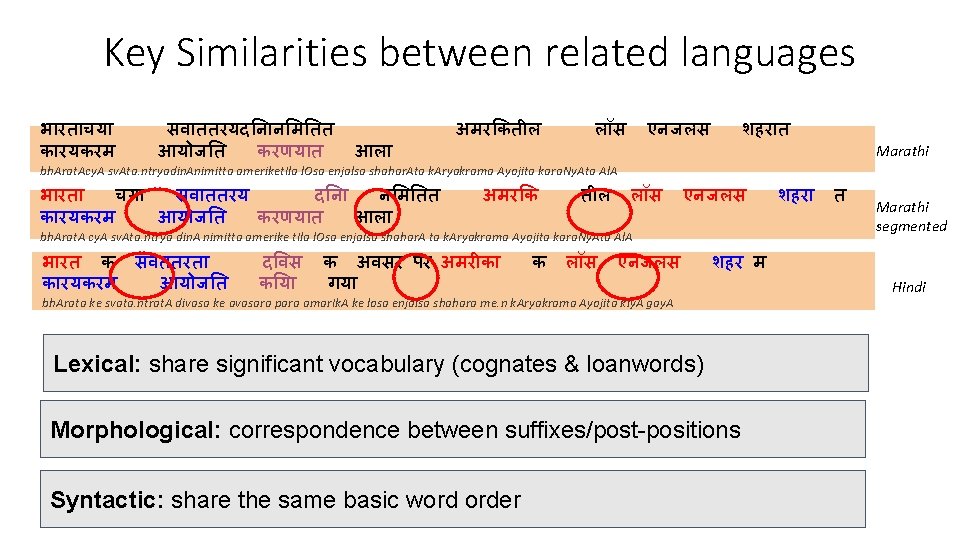
Key Similarities between related languages भ रत चय क रयकरम सव ततरयद न न म तत आय ज त करणय त आल अमर कत ल ल स bh. Arat. Acy. A sv. Ata. ntryadin. Animitta ameriket. Ila l. Osa enjalsa shahar. Ata k. Aryakrama Ayojita kara. Ny. Ata Al. A भ रत चय सव ततरय द न न म तत क रयकरम आय ज त करणय त आल अमर क त ल एनजलस ल स शहर त एनजलस bh. Arat. A cy. A sv. Ata. ntrya din. A nimitta amerike t. Ila l. Osa enjalsa shahar. A ta k. Aryakrama Ayojita kara. Ny. Ata Al. A भ रत क सवततरत क रयकरम आय ज त द वस क य क अवसर पर अमर क गय क ल स एनजलस त Marathi segmented शहर म bh. Arata ke svata. ntrat. A divasa ke avasara para amar. Ik. A ke losa enjalsa shahara me. n k. Aryakrama Ayojita kiy. A gay. A Lexical: share significant vocabulary (cognates & loanwords) Morphological: correspondence between suffixes/post-positions Syntactic: share the same basic word order शहर Marathi Hindi
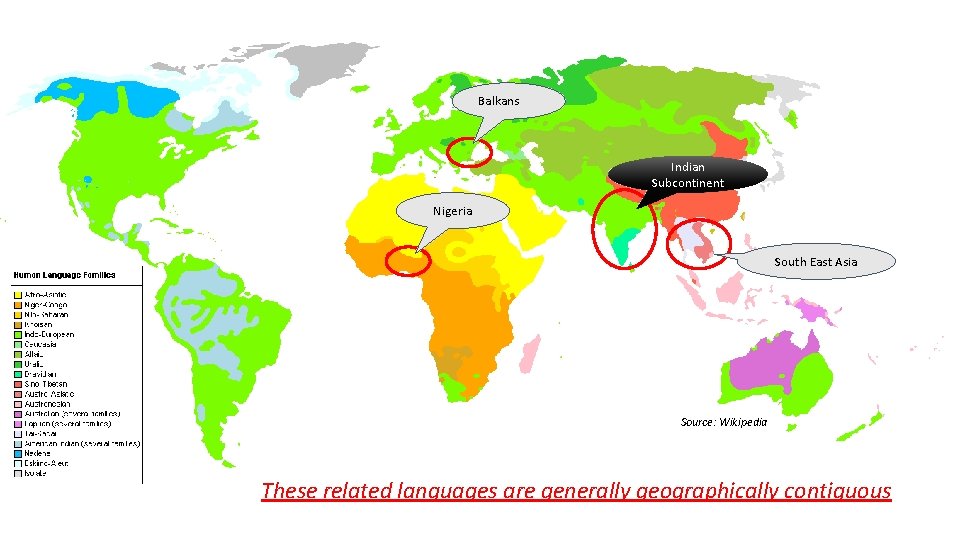
Balkans Indian Subcontinent Nigeria South East Asia Source: Wikipedia These related languages are generally geographically contiguous
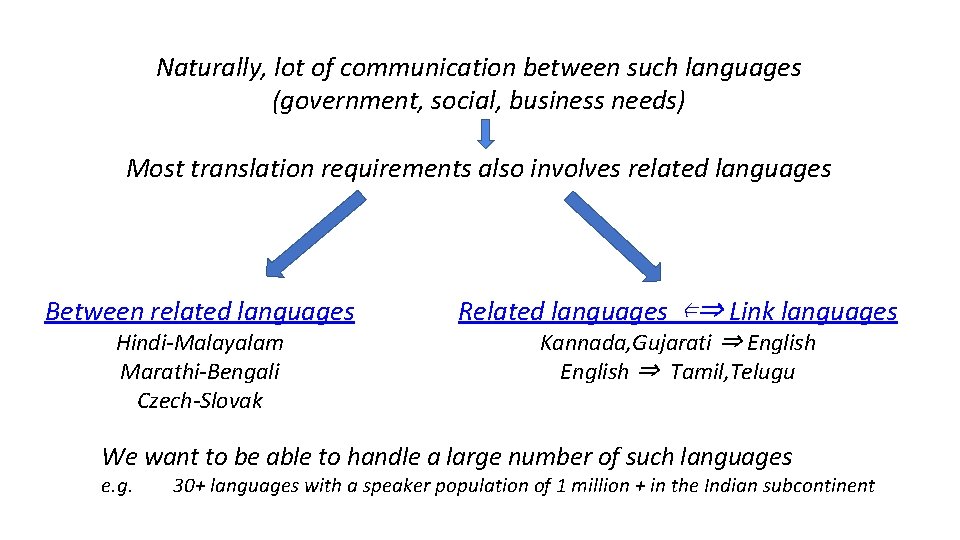
Naturally, lot of communication between such languages (government, social, business needs) Most translation requirements also involves related languages Between related languages Hindi-Malayalam Marathi-Bengali Czech-Slovak Related languages ⇐⇒ Link languages Kannada, Gujarati ⇒ English ⇒ Tamil, Telugu We want to be able to handle a large number of such languages e. g. 30+ languages with a speaker population of 1 million + in the Indian subcontinent
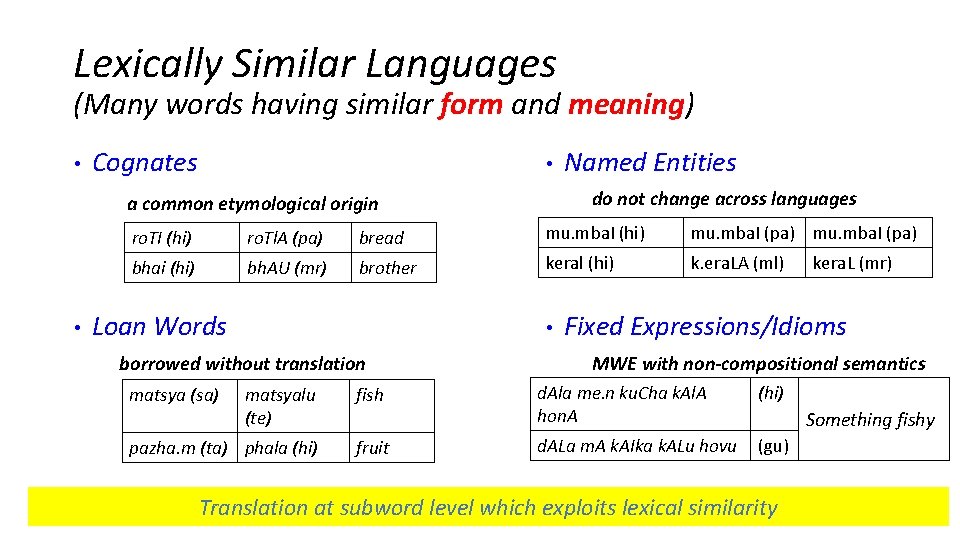
Lexically Similar Languages (Many words having similar form and meaning) • Cognates • do not change across languages a common etymological origin • Named Entities ro. TI (hi) ro. Tl. A (pa) bread mu. mba. I (hi) mu. mba. I (pa) bhai (hi) bh. AU (mr) brother keral (hi) k. era. LA (ml) Loan Words • borrowed without translation matsya (sa) matsyalu (te) fish pazha. m (ta) phala (hi) fruit kera. L (mr) Fixed Expressions/Idioms MWE with non-compositional semantics d. Ala me. n ku. Cha k. Al. A hon. A (hi) d. ALa m. A k. AIka k. ALu hovu (gu) Something fishy Translation at subword level which exploits lexical similarity 79
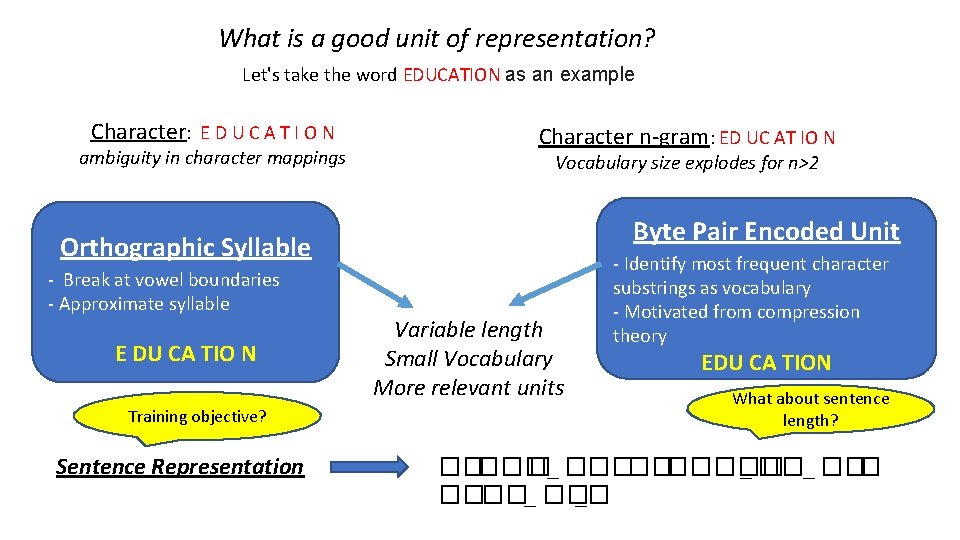
What is a good unit of representation? Let's take the word EDUCATION as an example Character: E D U C A T I O N ambiguity in character mappings Character n-gram: ED UC AT IO N Vocabulary size explodes for n>2 Byte Pair Encoded Unit Orthographic Syllable - Break at vowel boundaries - Approximate syllable E DU CA TIO N Training objective? Sentence Representation Variable length Small Vocabulary More relevant units - Identify most frequent character substrings as vocabulary - Motivated from compression theory EDU CA TION What about sentence length? ����� �_ ����� _ ��� ����_ �� _�
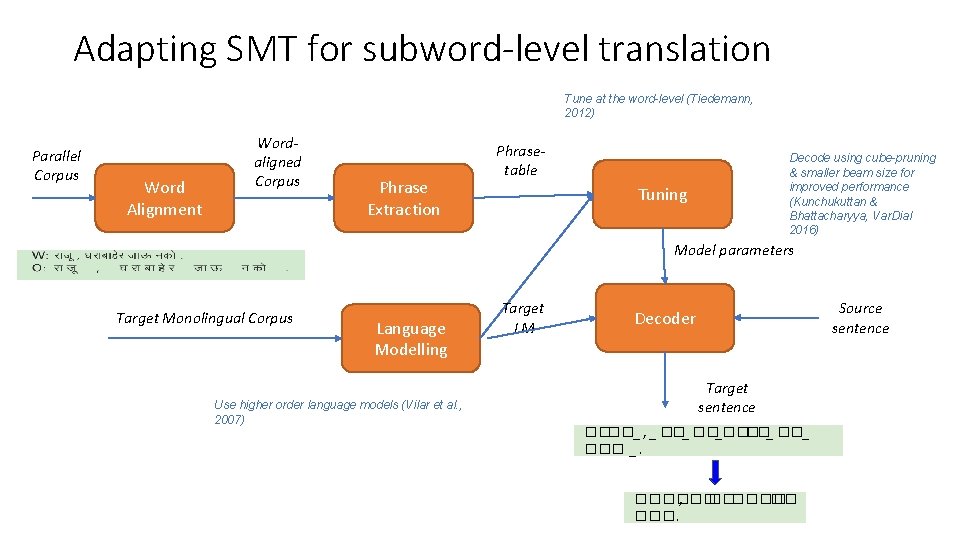
Adapting SMT for subword-level translation Tune at the word-level (Tiedemann, 2012) Parallel Corpus Word Alignment Wordaligned Corpus Phrase Extraction Phrasetable Decode using cube-pruning & smaller beam size for improved performance (Kunchukuttan & Bhattacharyya, Var. Dial 2016) Tuning Model parameters Target Monolingual Corpus Language Modelling Use higher order language models (Vilar et al. , 2007) Target LM Source sentence Decoder Target sentence ����_ , _ ��_����_ ��� _. ���� , �� ������ �� ���.
Agenda ● ● ● What is Machine Translation & why is it interesting? Machine Translation Paradigms Word Alignment Phrase-based SMT Extensions to Phrase-based SMT ○ ○ ○ ● ● ● Addressing Word-order Divergence Addressing Morphological Divergence Handling Named Entities Syntax-based SMT Machine Translation Evaluation Summary
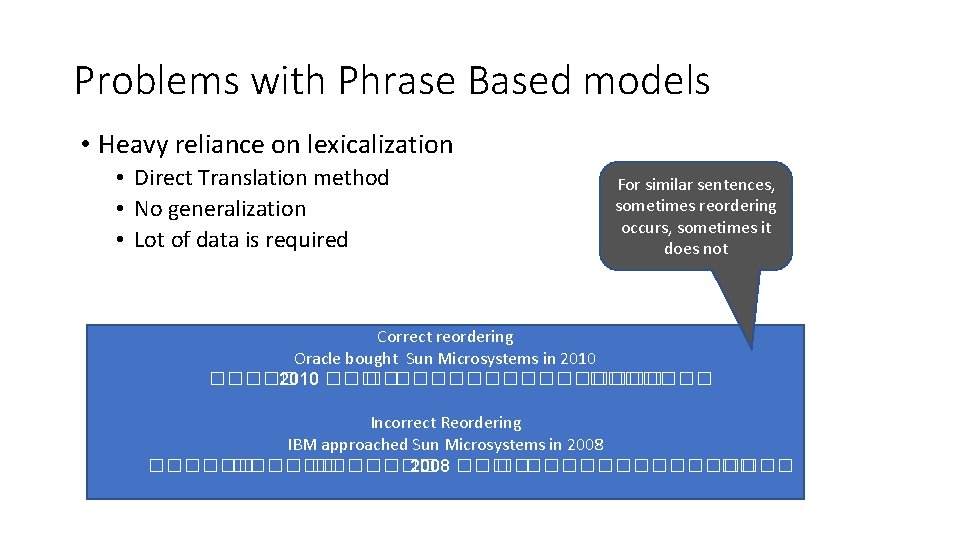
Problems with Phrase Based models • Heavy reliance on lexicalization • Direct Translation method • No generalization • Lot of data is required For similar sentences, sometimes reordering occurs, sometimes it does not Correct reordering Oracle bought Sun Microsystems in 2010 ������������ Incorrect Reordering IBM approached Sun Microsystems in 2008 ������� 2008 ���������� ��
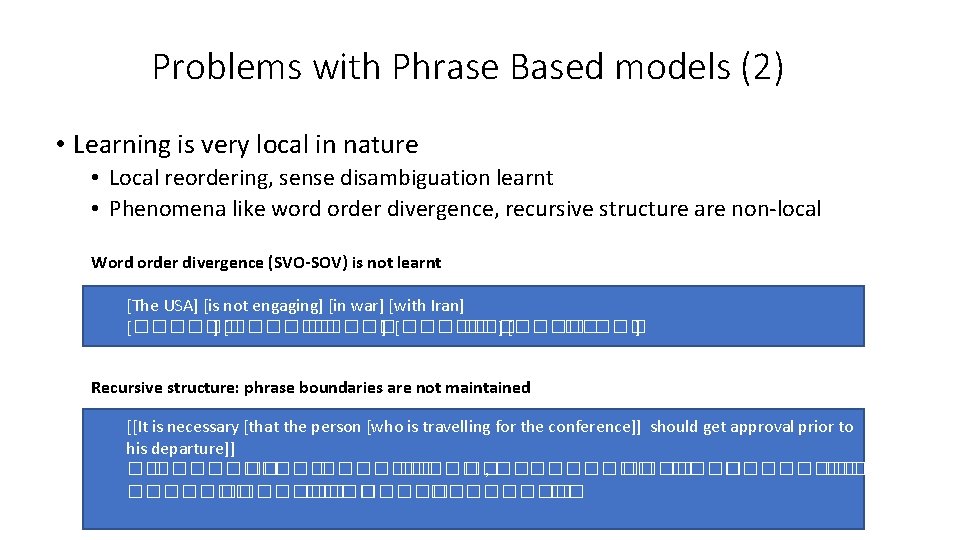
Problems with Phrase Based models (2) • Learning is very local in nature • Local reordering, sense disambiguation learnt • Phenomena like word order divergence, recursive structure are non-local Word order divergence (SVO-SOV) is not learnt [The USA] [is not engaging] [in war] [with Iran] [������ �� ] [����� ] [����� ] Recursive structure: phrase boundaries are not maintained [[It is necessary [that the person [who is travelling for the conference]] should get approval prior to his departure]] �� ������ �� , ����� ���� �� ������� ���� ��
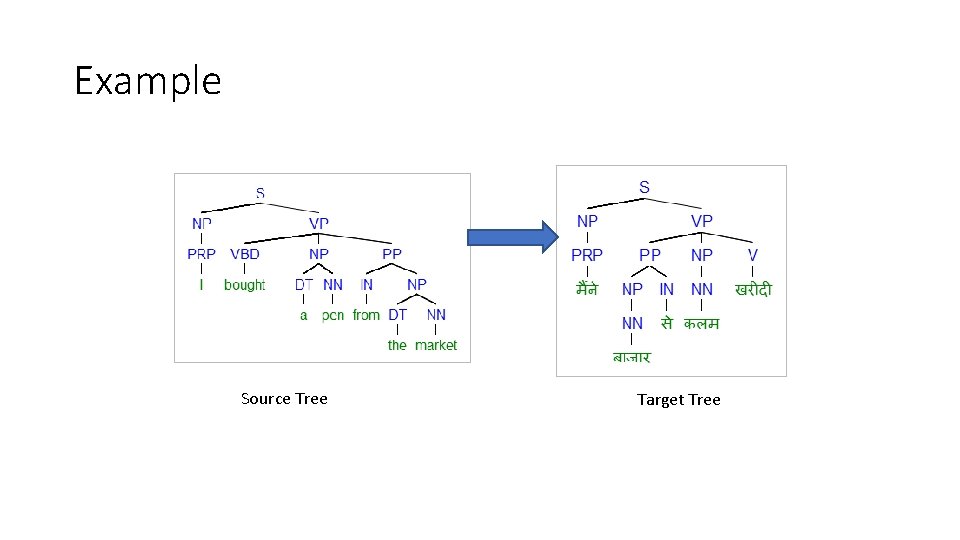
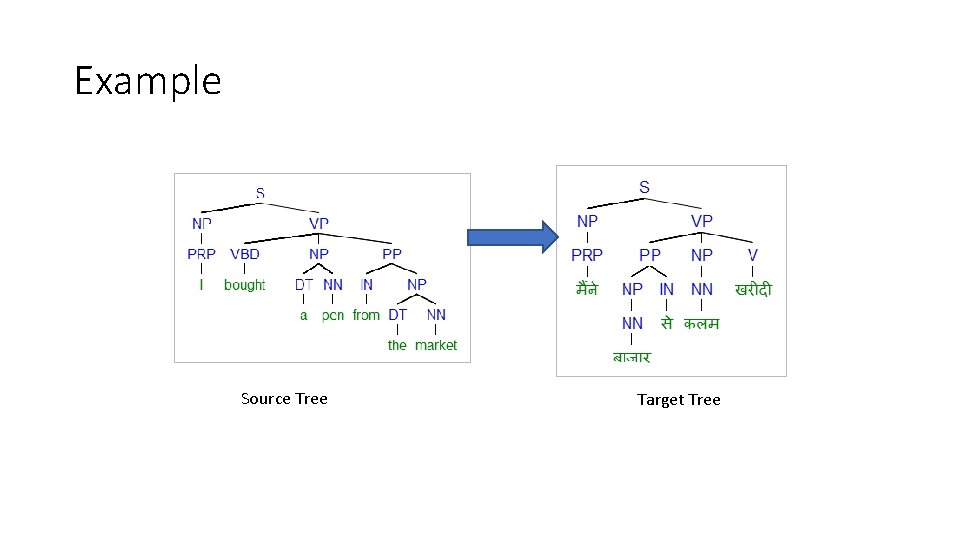
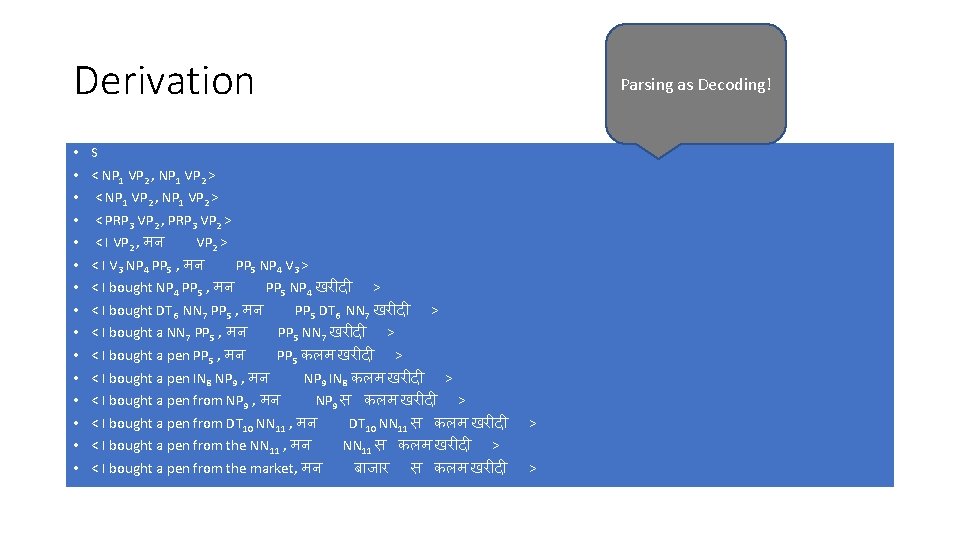
Tree based models • Source and/or Target sentences are represented as trees • Translation as Tree-to-Tree Transduction • As opposed to string-to-string transduction in PB-SMT • Parsing as Decoding • Parsing of the source language sentence produces the target language sentences
Example Source Tree Target Tree
Why tree based model? • Natural language sentences have a tree-like structure • Syntax based Reordering • Source side tree: guides decoding by constraining the possible rules that can be applied • Target side tree ensures grammatically correct output
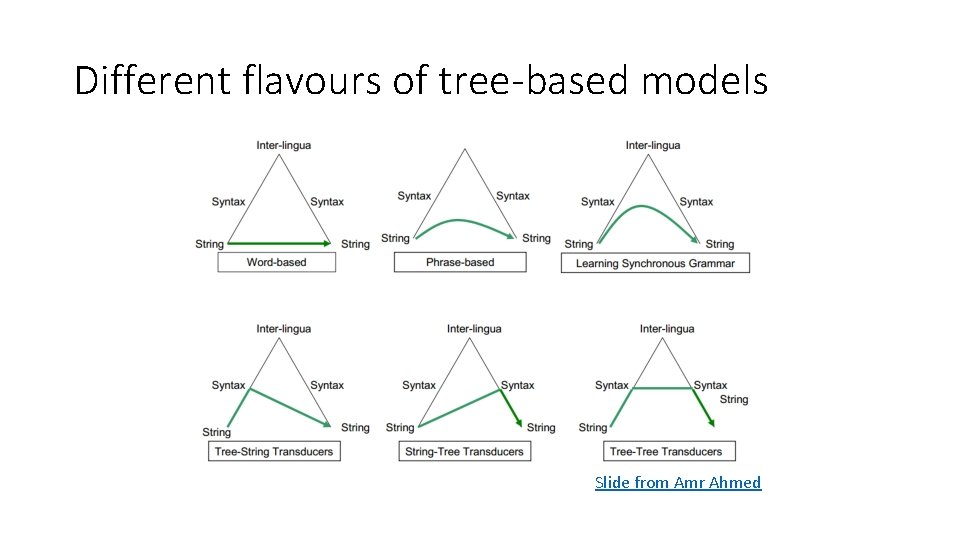
Different flavours of tree-based models Slide from Amr Ahmed
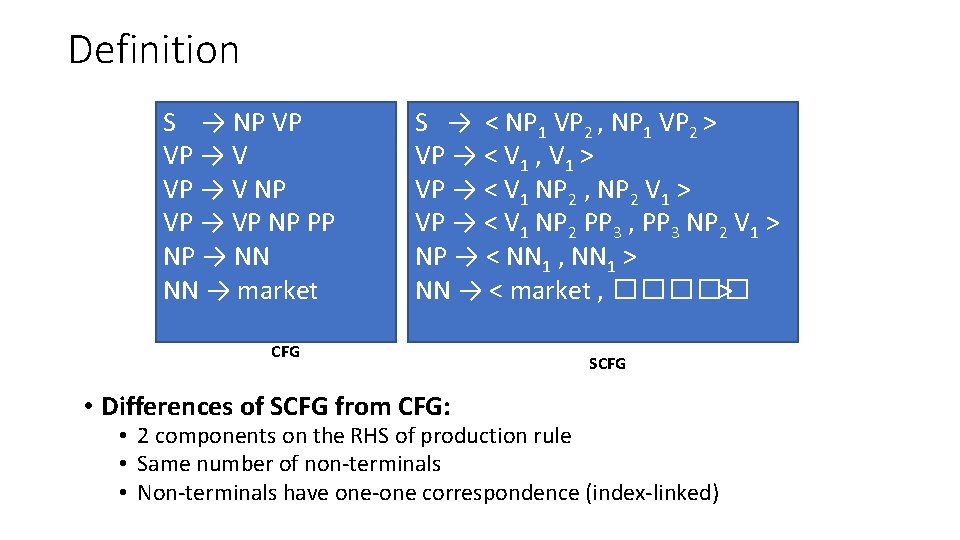
Synchronous Context Free Grammar • Fundamental formal tool for Tree-based translation models • An enhanced Context Free Grammar for generating two related strings instead of one • Alternatively, SCFG defines a tree transducer
Definition S → NP VP VP → V NP VP → VP NP PP NP → NN NN → market S → < NP 1 VP 2 , NP 1 VP 2 > VP → < V 1 , V 1 > VP → < V 1 NP 2 , NP 2 V 1 > VP → < V 1 NP 2 PP 3 , PP 3 NP 2 V 1 > NP → < NN 1 , NN 1 > NN → < market , ����� > CFG • Differences of SCFG from CFG: SCFG • 2 components on the RHS of production rule • Same number of non-terminals • Non-terminals have one-one correspondence (index-linked)
Example Source Tree Target Tree
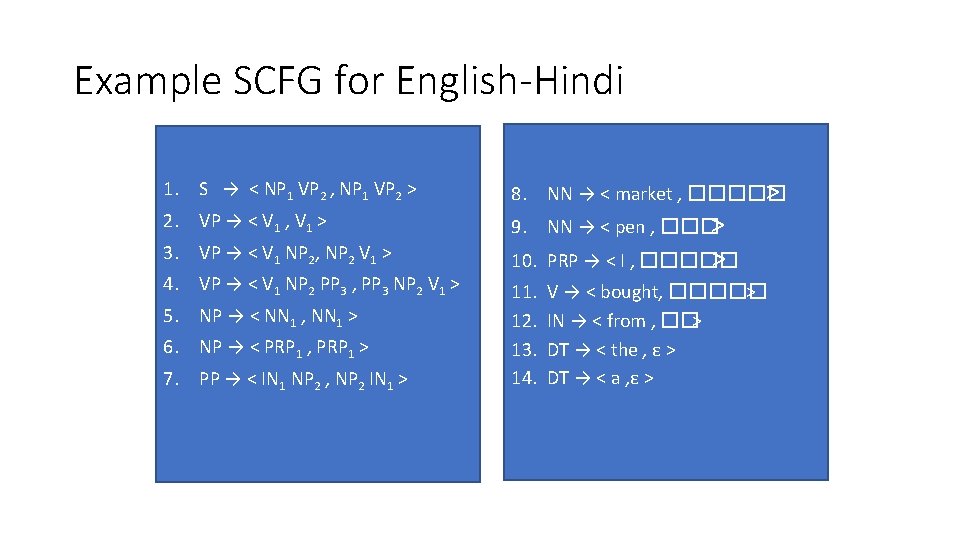
Example SCFG for English-Hindi 1. S → < NP 1 VP 2 , NP 1 VP 2 > 2. VP → < V 1 , V 1 > 3. VP → < V 1 NP 2, NP 2 V 1 > 4. VP → < V 1 NP 2 PP 3 , PP 3 NP 2 V 1 > 5. NP → < NN 1 , NN 1 > 6. NP → < PRP 1 , PRP 1 > 7. PP → < IN 1 NP 2 , NP 2 IN 1 > 8. NN → < market , ����� > 9. NN → < pen , ���> 10. PRP → < I , ����� > 11. 12. 13. 14. V → < bought, ����� > IN → < from , ��> DT → < the , ε > DT → < a , ε >
Derivation • • • • Parsing as Decoding! S < NP 1 VP 2 , NP 1 VP 2 > < PRP 3 VP 2 , PRP 3 VP 2 > < I VP 2 , मन VP 2 > < I V 3 NP 4 PP 5 , मन < I bought NP 4 PP 5 , मन PP 5 NP 4 V 3 > < I bought DT 6 NN 7 PP 5 , मन PP 5 NP 4 खर द < I bought a NN 7 PP 5 , मन < I bought a pen IN 8 NP 9 , मन > PP 5 DT 6 NN 7 खर द PP 5 कलम खर द < I bought a pen from NP 9 , मन > > > NP 9 IN 8 कलम खर द NP 9 स कलम खर द < I bought a pen from DT 10 NN 11 , मन < I bought a pen from the market, मन > > DT 10 NN 11 स कलम खर द ब ज र > > स कलम खर द >
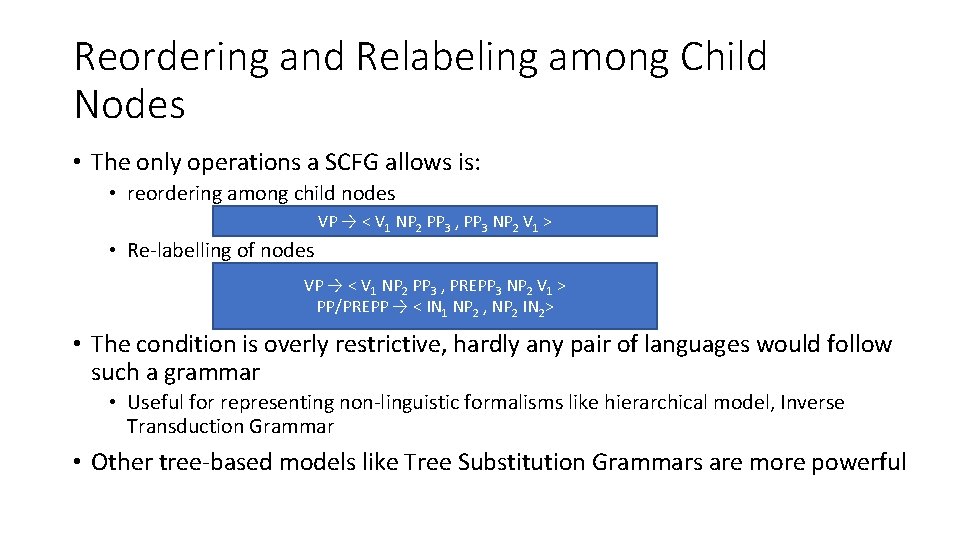
Reordering and Relabeling among Child Nodes • The only operations a SCFG allows is: • reordering among child nodes VP → < V 1 NP 2 PP 3 , PP 3 NP 2 V 1 > • Re-labelling of nodes VP → < V 1 NP 2 PP 3 , PREPP 3 NP 2 V 1 > PP/PREPP → < IN 1 NP 2 , NP 2 IN 2> • The condition is overly restrictive, hardly any pair of languages would follow such a grammar • Useful for representing non-linguistic formalisms like hierarchical model, Inverse Transduction Grammar • Other tree-based models like Tree Substitution Grammars are more powerful
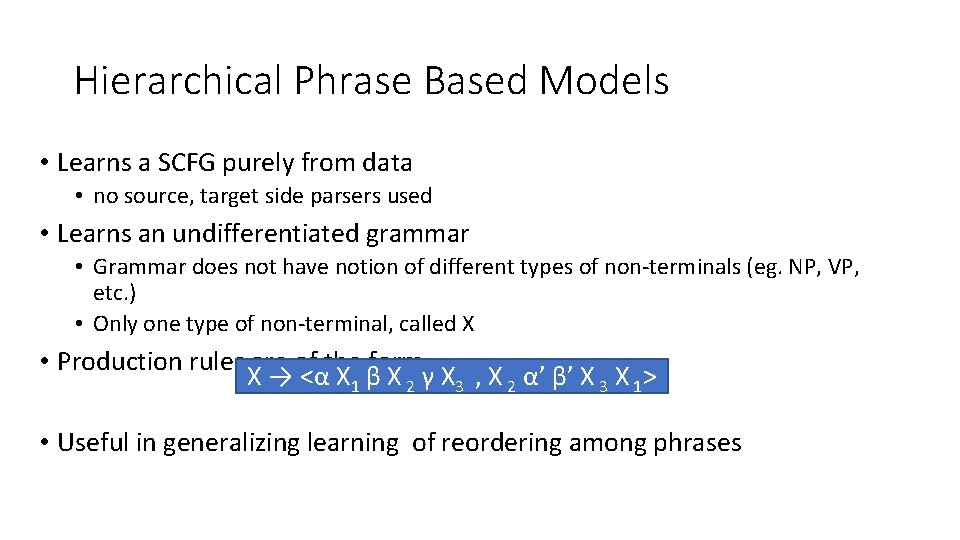
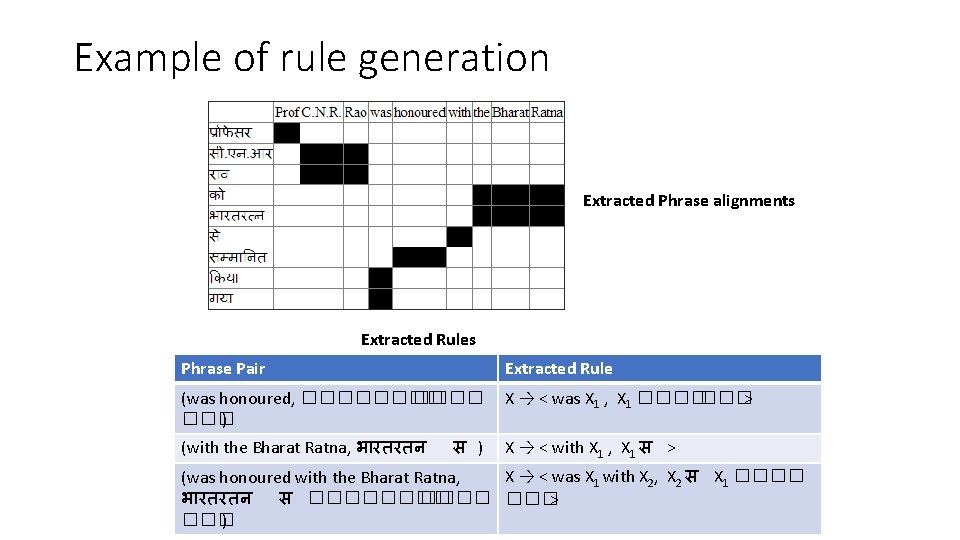
Hierarchical Phrase Based Models • Learns a SCFG purely from data • no source, target side parsers used • Learns an undifferentiated grammar • Grammar does not have notion of different types of non-terminals (eg. NP, VP, etc. ) • Only one type of non-terminal, called X • Production rules are of the form X → <α X 1 β X 2 γ X 3 , X 2 α’ β’ X 3 X 1> • Useful in generalizing learning of reordering among phrases
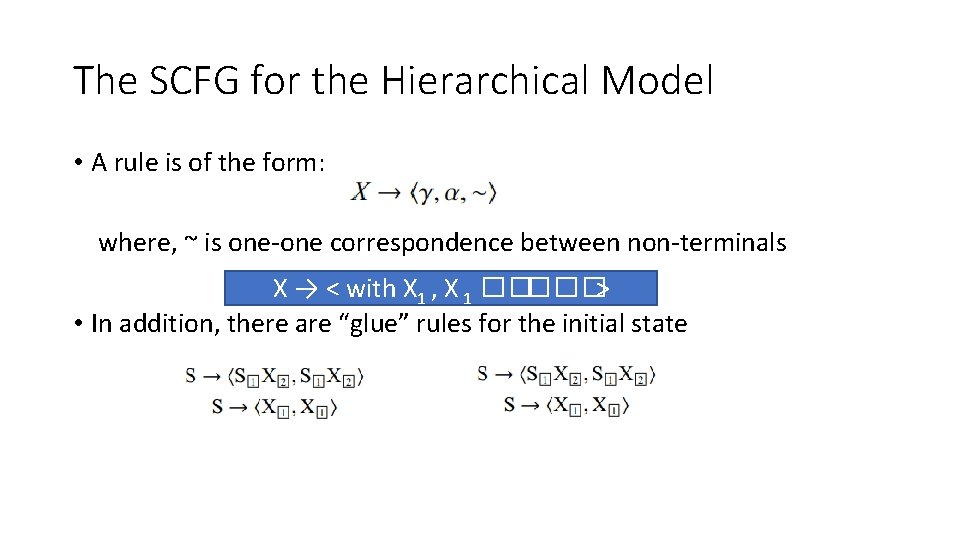
The SCFG for the Hierarchical Model • A rule is of the form: where, ~ is one-one correspondence between non-terminals X → < with X 1 , X 1 �����> • In addition, there are “glue” rules for the initial state
Formal, Not Linguistic • "Formal", but not linguistic • The SCFG grammar does not correspond to any natural language • "non-linguistic" phrases (not words) as basic units • The HPBSMT model defines a formal SCFG model for reordering of these "phrases“ in PBMST • A custom designed engineering solution for a purpose
Example of rule generation Extracted Phrase alignments Extracted Rules Phrase Pair Extracted Rule (was honoured, ���� ) X → < was X 1 , X 1 ������� > (with the Bharat Ratna, भ रतरतन X → < with X 1 , X 1 स > स ) X → < was X 1 with X 2, X 2 स X 1 ���� (was honoured with the Bharat Ratna, भ रतरतन स ���� > ��� )
Summary • Tree based models can better handle syntactic phenomena like reordering, recursion • Basic formalism: Synchronous Context Free Grammar • Decoding: Parsing on the source side • CYK Parsing • Integration of the language model presents challenge • Parsers required for learning syntax transfer • Without parsers, some weak learning is possible with hierarchical PBSMT
Agenda ● ● ● What is Machine Translation & why is it interesting? Machine Translation Paradigms Word Alignment Phrase-based SMT Extensions to Phrase-based SMT ○ ○ ○ ● ● ● Addressing Word-order Divergence Addressing Morphological Divergence Handling Named Entities Syntax-based SMT Machine Translation Evaluation Summary
Motivation • How do we judge a good translation? • Can a machine do this? • Why should a machine do this? • Because human evaluation is time-consuming and expensive! • Not suitable for rapid iteration of feature improvements
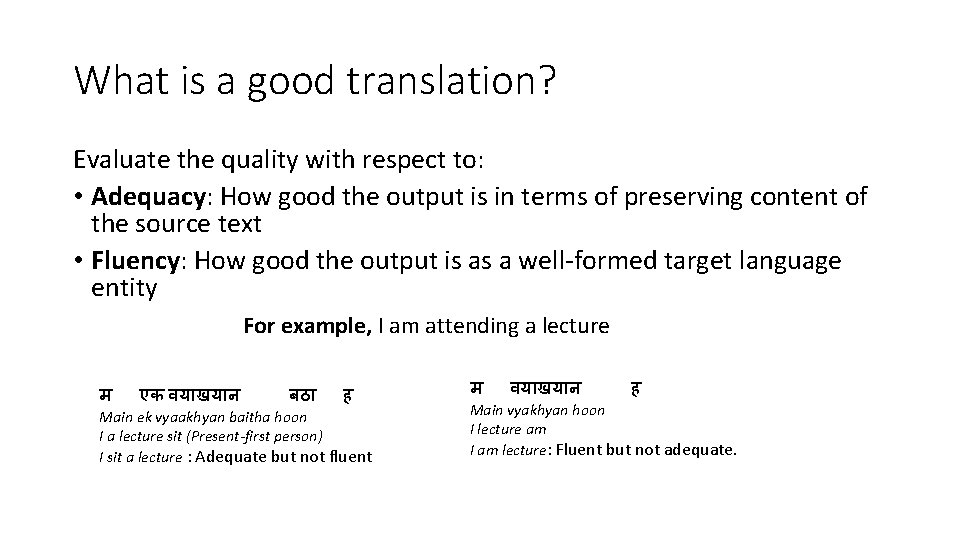
What is a good translation? Evaluate the quality with respect to: • Adequacy: How good the output is in terms of preserving content of the source text • Fluency: How good the output is as a well-formed target language entity For example, I am attending a lecture म एक वय खय न बठ ह Main ek vyaakhyan baitha hoon I a lecture sit (Present-first person) I sit a lecture : Adequate but not fluent म वय खय न ह Main vyakhyan hoon I lecture am I am lecture: Fluent but not adequate.
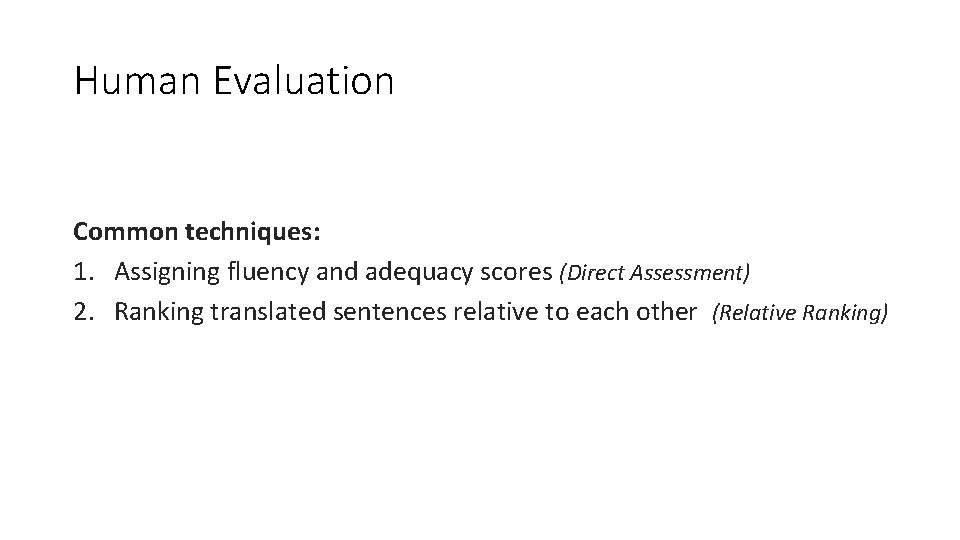
Human Evaluation Common techniques: 1. Assigning fluency and adequacy scores (Direct Assessment) 2. Ranking translated sentences relative to each other (Relative Ranking)
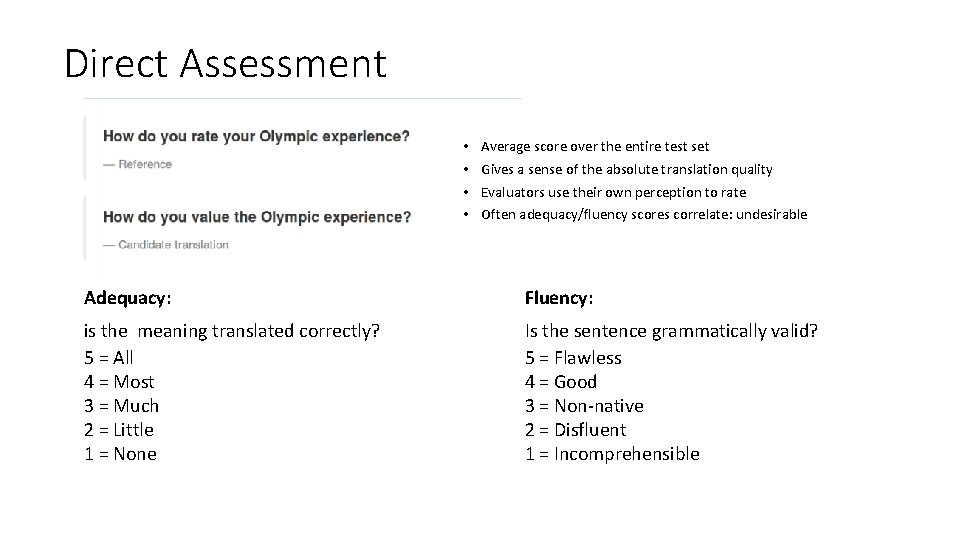
Direct Assessment • • Average score over the entire test set Gives a sense of the absolute translation quality Evaluators use their own perception to rate Often adequacy/fluency scores correlate: undesirable Adequacy: Fluency: is the meaning translated correctly? 5 = All 4 = Most 3 = Much 2 = Little 1 = None Is the sentence grammatically valid? 5 = Flawless 4 = Good 3 = Non-native 2 = Disfluent 1 = Incomprehensible
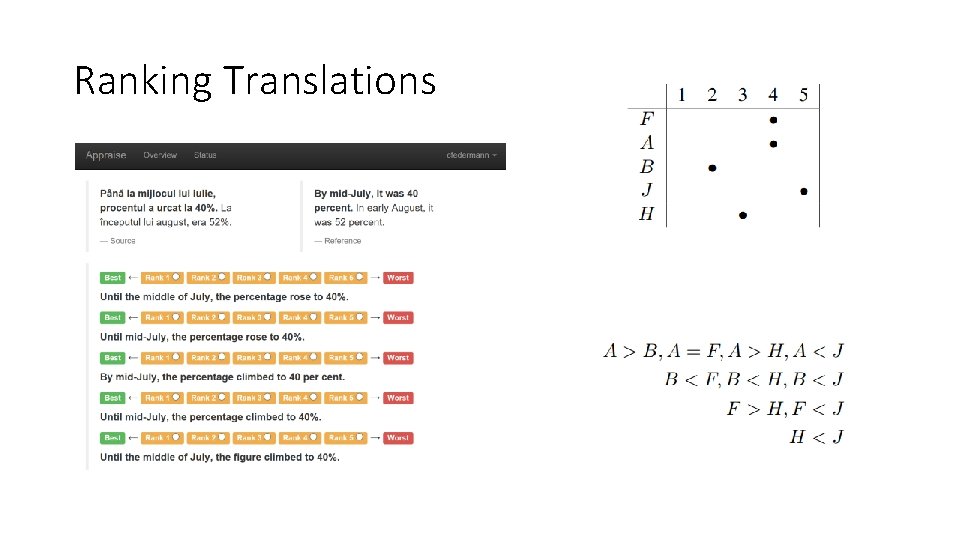
Ranking Translations
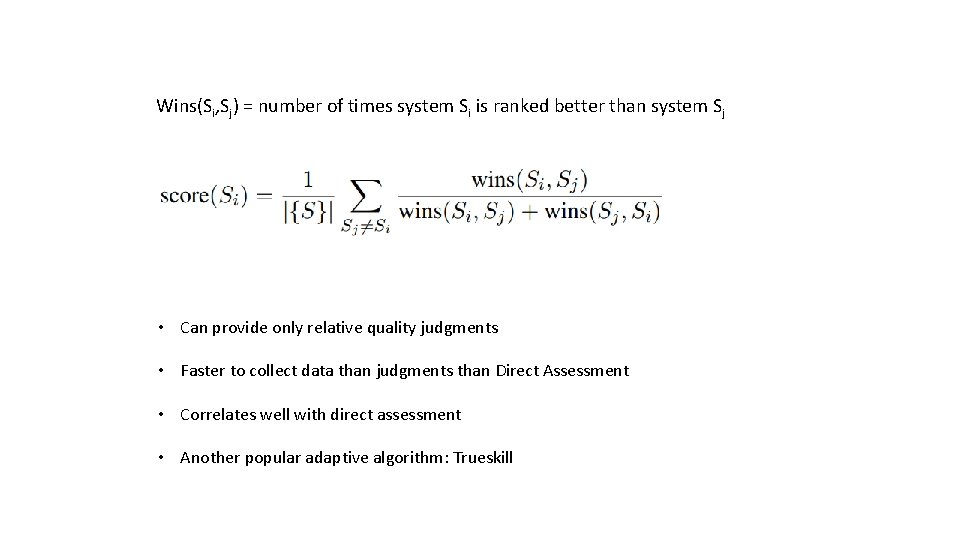
Wins(Si, Sj) = number of times system Si is ranked better than system Sj • Can provide only relative quality judgments • Faster to collect data than judgments than Direct Assessment • Correlates well with direct assessment • Another popular adaptive algorithm: Trueskill
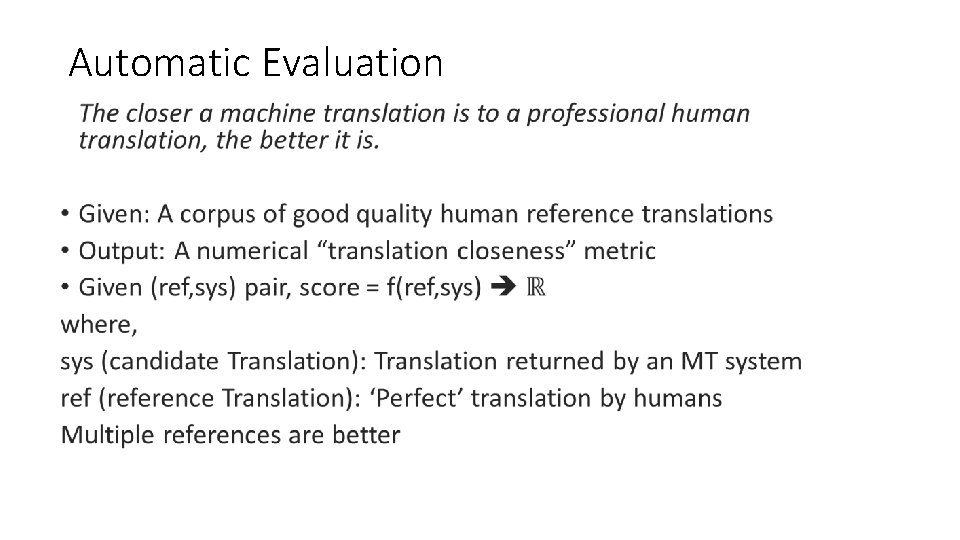
Automatic Evaluation •
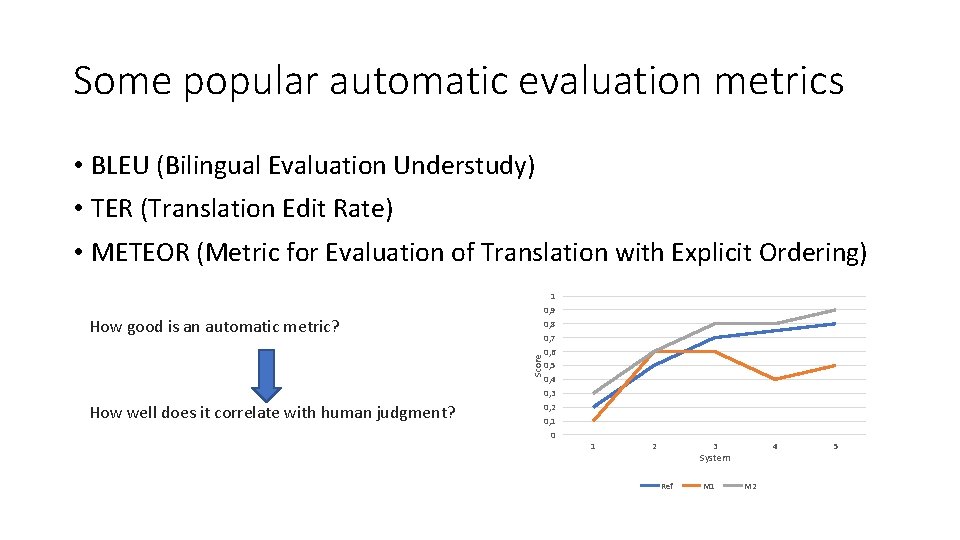
Some popular automatic evaluation metrics • BLEU (Bilingual Evaluation Understudy) • TER (Translation Edit Rate) • METEOR (Metric for Evaluation of Translation with Explicit Ordering) 1 0, 9 How good is an automatic metric? 0, 8 Score 0, 7 0, 6 0, 5 0, 4 0, 3 How well does it correlate with human judgment? 0, 2 0, 1 0 1 2 3 4 System Ref M 1 M 2 5
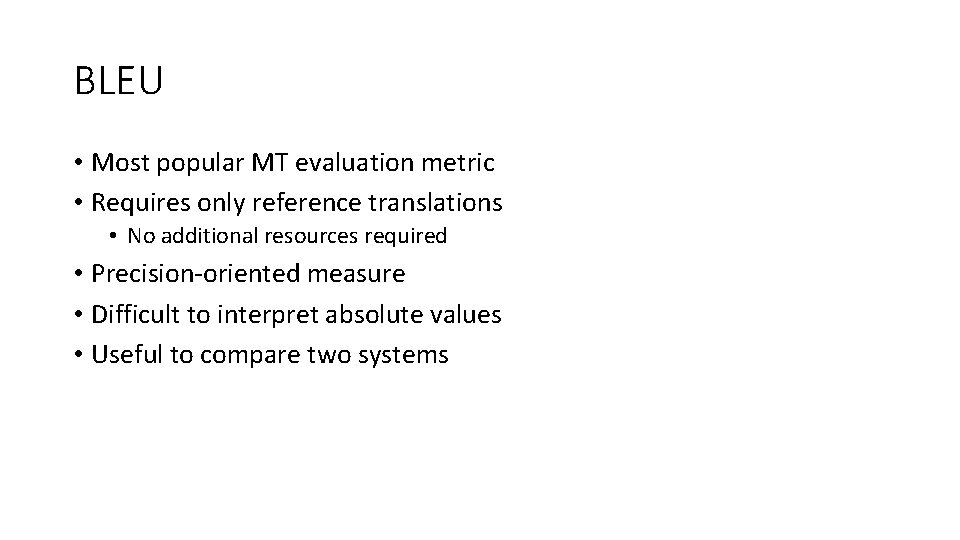
BLEU • Most popular MT evaluation metric • Requires only reference translations • No additional resources required • Precision-oriented measure • Difficult to interpret absolute values • Useful to compare two systems
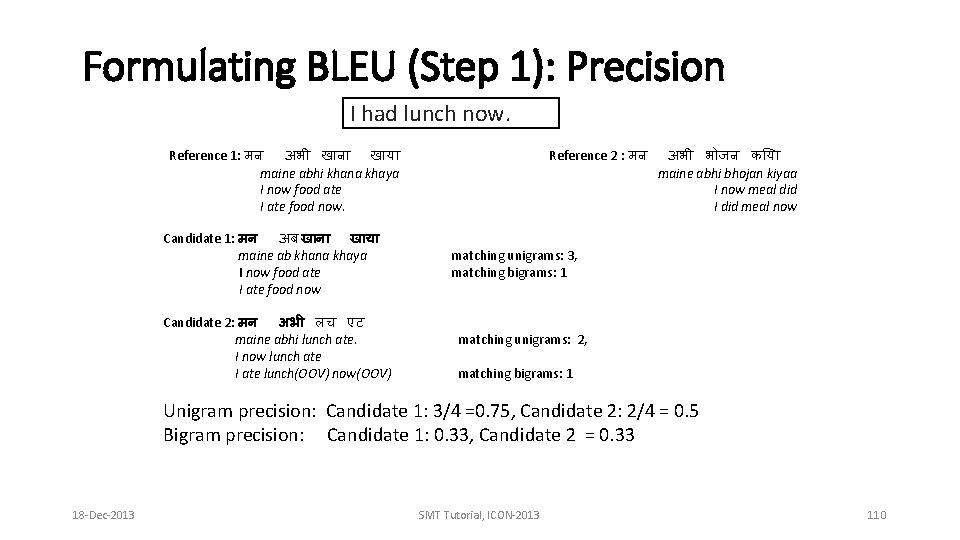
Formulating BLEU (Step 1): Precision I had lunch now. Reference 1: मन अभ ख न ख य maine abhi khana khaya I now food ate I ate food now. Candidate 1: मन अब ख न ख य maine ab khana khaya I now food ate I ate food now Candidate 2: मन अभ लच एट maine abhi lunch ate. I now lunch ate I ate lunch(OOV) now(OOV) Reference 2 : मन अभ भ जन क य maine abhi bhojan kiyaa I now meal did I did meal now matching unigrams: 3, matching bigrams: 1 matching unigrams: 2, matching bigrams: 1 Unigram precision: Candidate 1: 3/4 =0. 75, Candidate 2: 2/4 = 0. 5 Bigram precision: Candidate 1: 0. 33, Candidate 2 = 0. 33 18 -Dec-2013 SMT Tutorial, ICON-2013 110
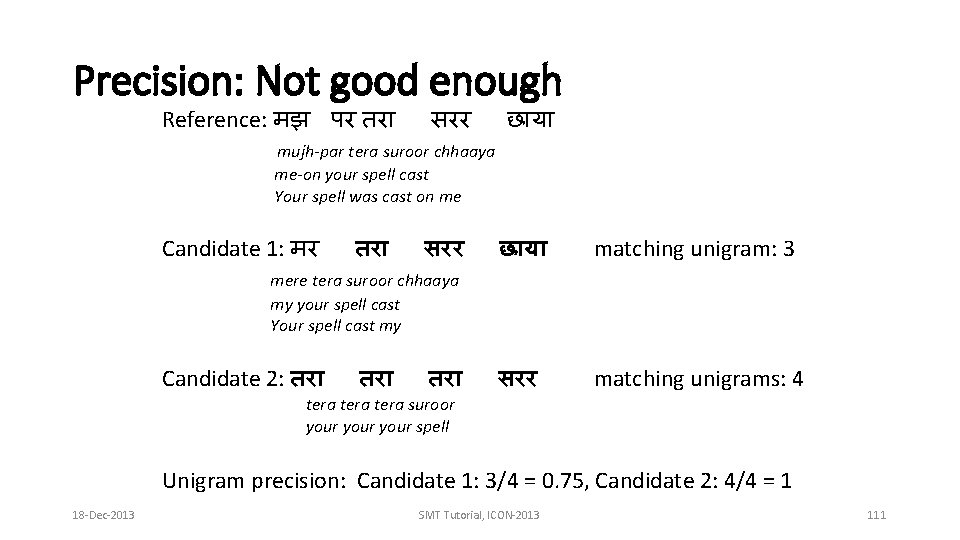
Precision: Not good enough Reference: मझ पर तर सरर छ य mujh-par tera suroor chhaaya me-on your spell cast Your spell was cast on me Candidate 1: मर तर सरर छ य matching unigram: 3 सरर matching unigrams: 4 mere tera suroor chhaaya my your spell cast Your spell cast my Candidate 2: तर तर tera suroor your spell Unigram precision: Candidate 1: 3/4 = 0. 75, Candidate 2: 4/4 = 1 18 -Dec-2013 SMT Tutorial, ICON-2013 111
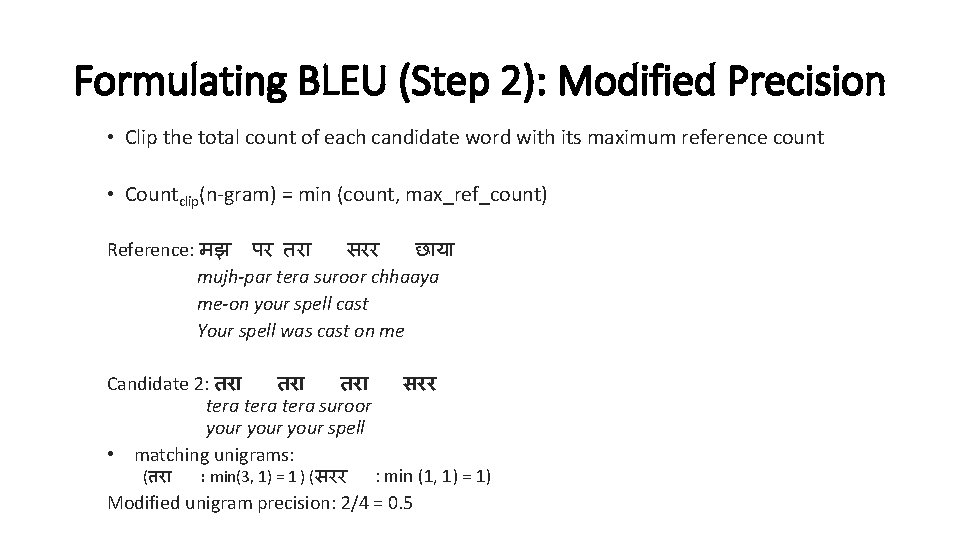
Formulating BLEU (Step 2): Modified Precision • Clip the total count of each candidate word with its maximum reference count • Countclip(n-gram) = min (count, max_ref_count) Reference: मझ पर तर सरर छ य mujh-par tera suroor chhaaya me-on your spell cast Your spell was cast on me Candidate 2: तर तर तर tera suroor your spell • matching unigrams: (तर : min(3, 1) = 1 ) (सरर : min (1, 1) = 1) Modified unigram precision: 2/4 = 0. 5
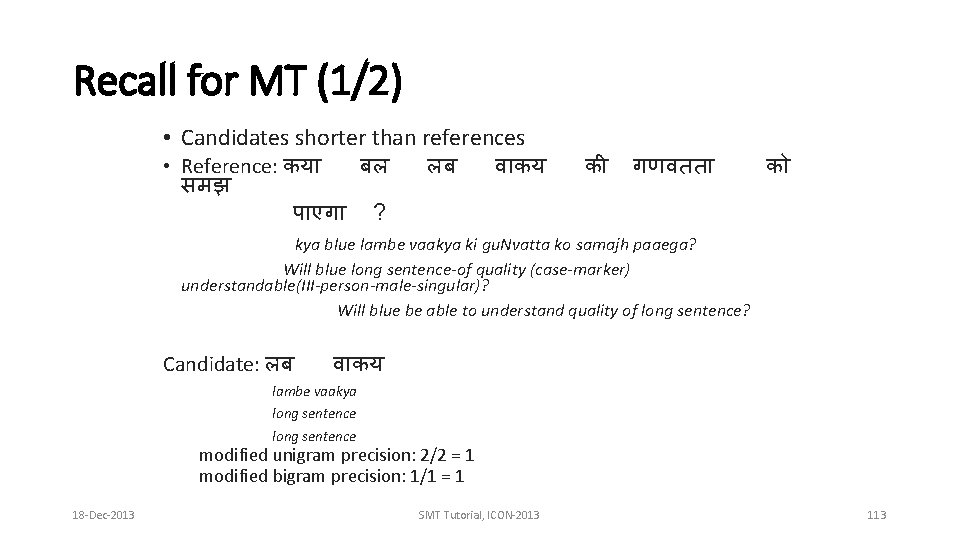
Recall for MT (1/2) • Candidates shorter than references • Reference: कय बल समझ प एग ? लब व कय क गणवतत क kya blue lambe vaakya ki gu. Nvatta ko samajh paaega? Will blue long sentence-of quality (case-marker) understandable(III-person-male-singular)? Will blue be able to understand quality of long sentence? Candidate: लब व कय lambe vaakya long sentence modified unigram precision: 2/2 = 1 modified bigram precision: 1/1 = 1 18 -Dec-2013 SMT Tutorial, ICON-2013 113
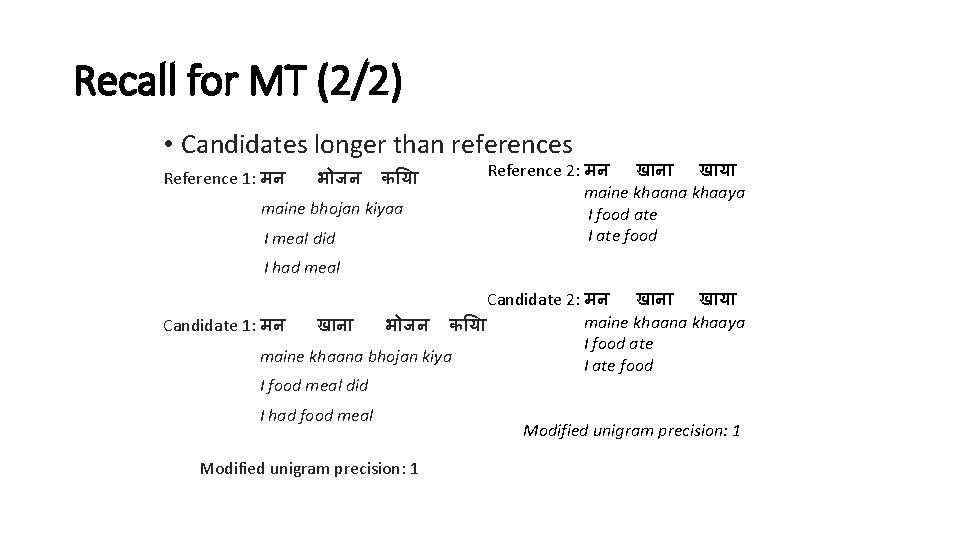
Recall for MT (2/2) • Candidates longer than references Reference 1: मन भ जन क य maine bhojan kiyaa I meal did Reference 2: मन ख य maine khaana khaaya I food ate I ate food I had meal Candidate 2: मन ख य maine khaana khaaya Candidate 1: मन ख न भ जन क य I food ate maine khaana bhojan kiya I ate food I food meal did I had food meal Modified unigram precision: 1
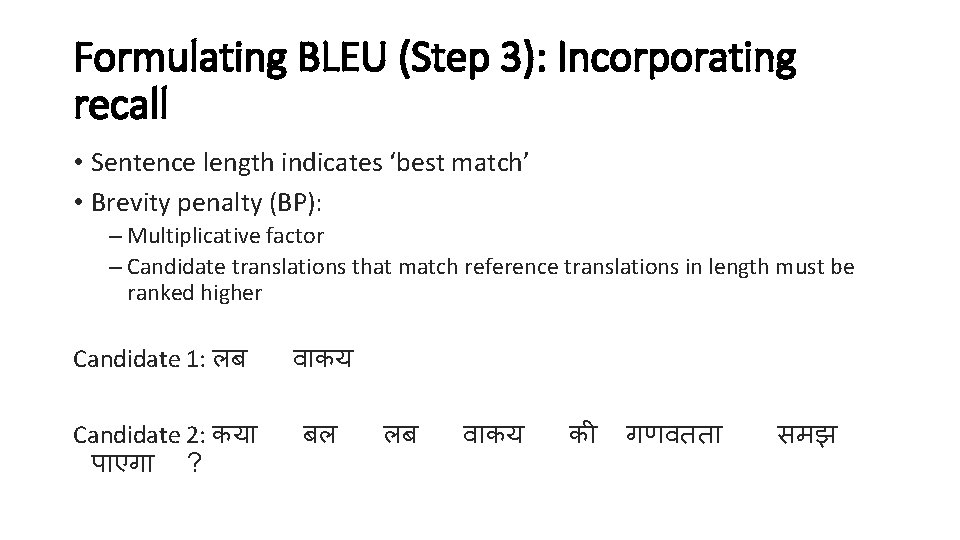
Formulating BLEU (Step 3): Incorporating recall • Sentence length indicates ‘best match’ • Brevity penalty (BP): – Multiplicative factor – Candidate translations that match reference translations in length must be ranked higher Candidate 1: लब व कय Candidate 2: कय प एग ? बल लब व कय क गणवतत समझ
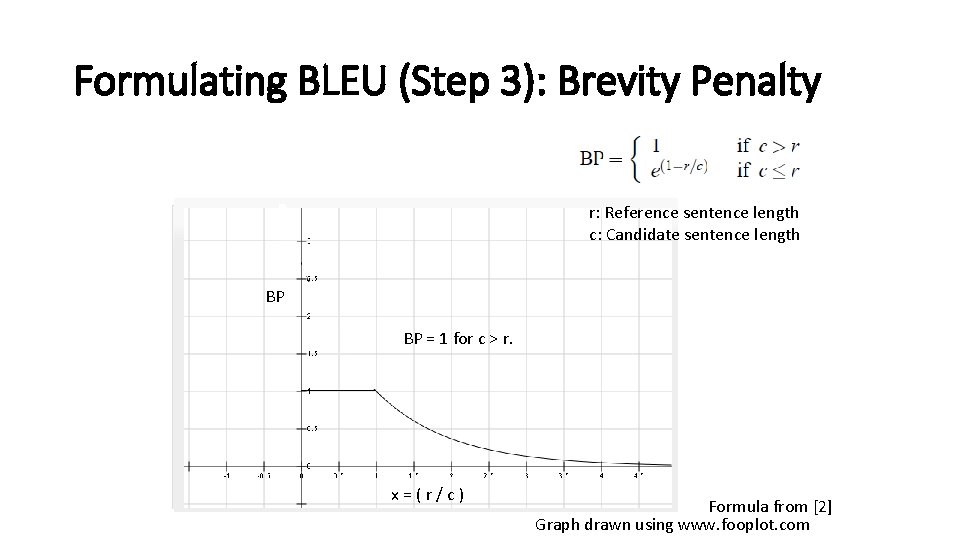
Formulating BLEU (Step 3): Brevity Penalty r: Reference sentence length c: Candidate sentence length BP e^(1 -x) BP = 1 for c > r. x=(r/c) Formula from [2] Graph drawn using www. fooplot. com
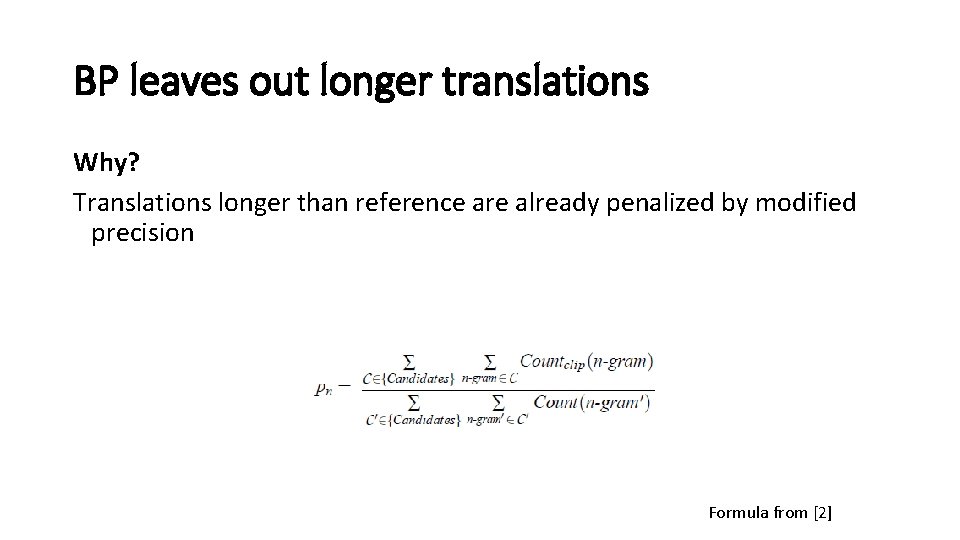
BP leaves out longer translations Why? Translations longer than reference are already penalized by modified precision Formula from [2]
BLEU score Recall -> Brevity Penalty Precision -> Modified ngram precision Formula from [2]
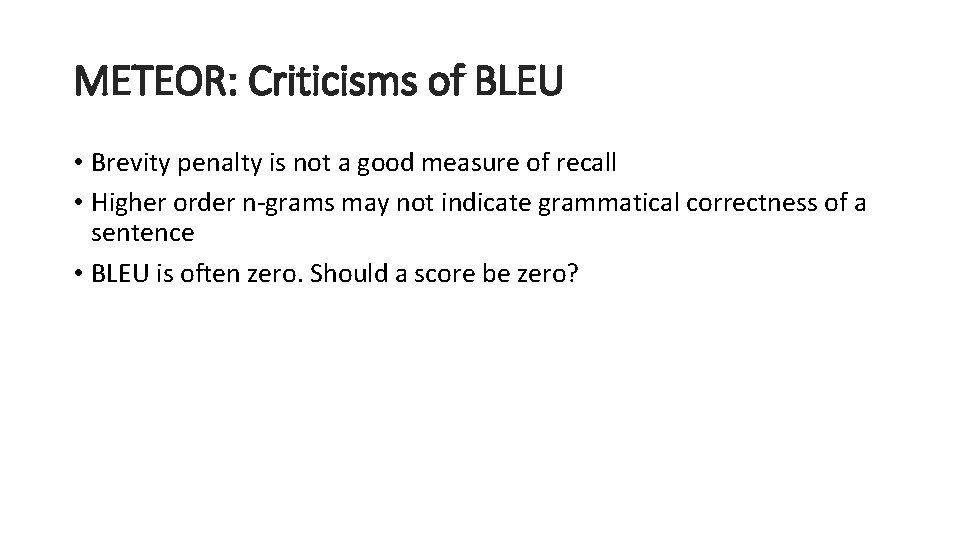
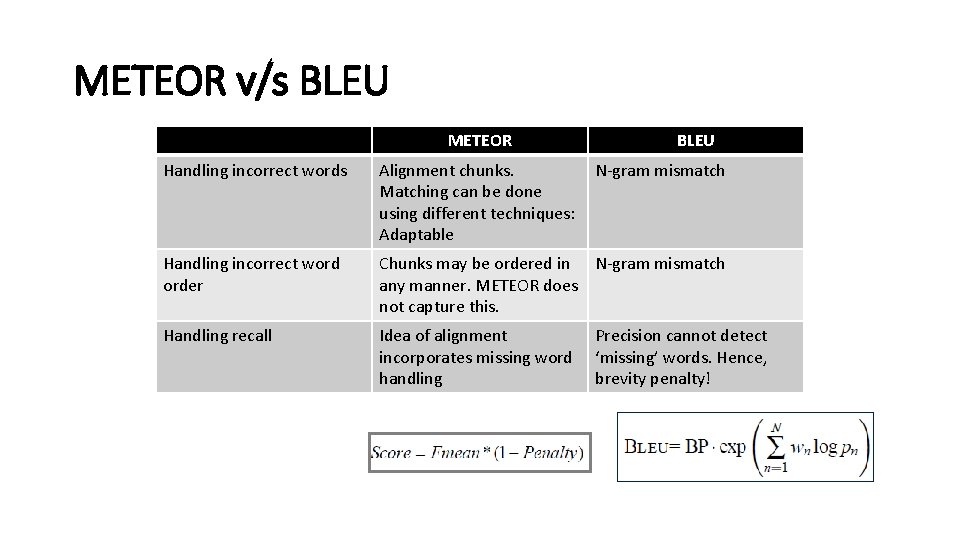
METEOR: Criticisms of BLEU • Brevity penalty is not a good measure of recall • Higher order n-grams may not indicate grammatical correctness of a sentence • BLEU is often zero. Should a score be zero?
METEOR Aims to do better than BLEU Central idea: Have a good unigram matching strategy
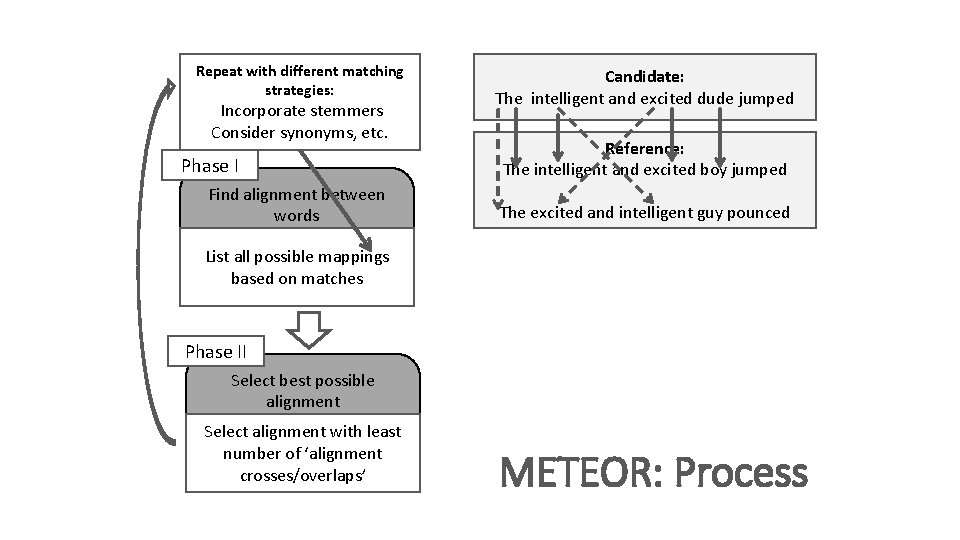
Repeat with different matching strategies: Incorporate stemmers Consider synonyms, etc. Phase I Find alignment between words Candidate: The intelligent and excited dude jumped Reference: The intelligent and excited boy jumped The excited and intelligent guy pounced List all possible mappings based on matches Phase II Select best possible alignment Select alignment with least number of ‘alignment crosses/overlaps’ METEOR: Process
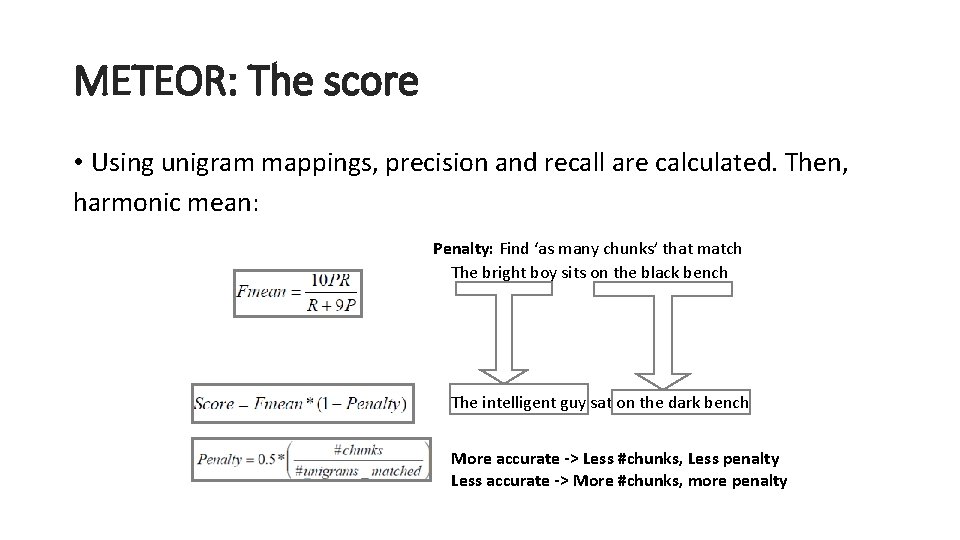
METEOR: The score • Using unigram mappings, precision and recall are calculated. Then, harmonic mean: Penalty: Find ‘as many chunks’ that match The bright boy sits on the black bench The intelligent guy sat on the dark bench More accurate -> Less #chunks, Less penalty Less accurate -> More #chunks, more penalty
METEOR v/s BLEU METEOR BLEU Handling incorrect words Alignment chunks. Matching can be done using different techniques: Adaptable N-gram mismatch Handling incorrect word order Chunks may be ordered in N-gram mismatch any manner. METEOR does not capture this. Handling recall Idea of alignment incorporates missing word handling Precision cannot detect ‘missing’ words. Hence, brevity penalty!
Agenda ● ● ● What is Machine Translation & why is it interesting? Machine Translation Paradigms Word Alignment Phrase-based SMT Extensions to Phrase-based SMT ○ ○ ○ ● ● ● Addressing Word-order Divergence Addressing Morphological Divergence Handling Named Entities Syntax-based SMT Machine Translation Evaluation Summary
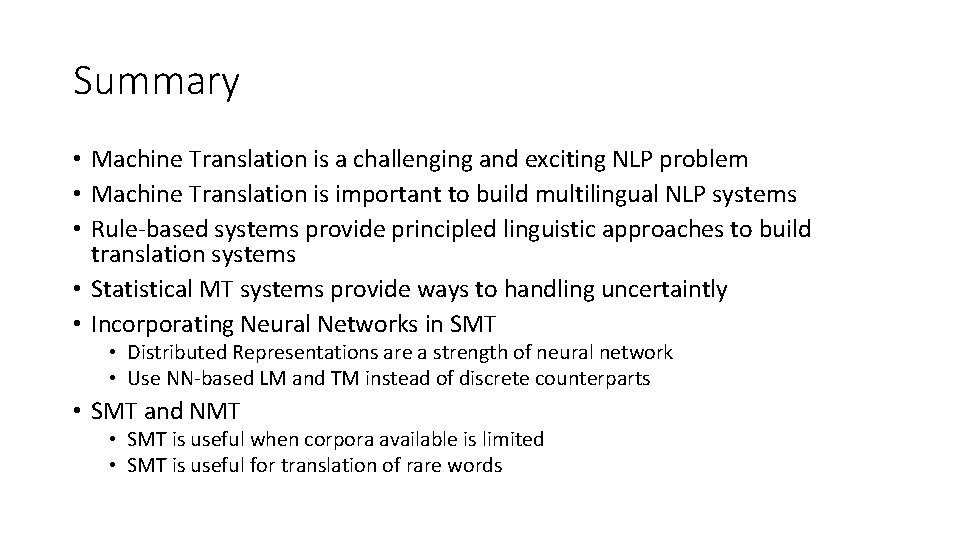
Summary • Machine Translation is a challenging and exciting NLP problem • Machine Translation is important to build multilingual NLP systems • Rule-based systems provide principled linguistic approaches to build translation systems • Statistical MT systems provide ways to handling uncertaintly • Incorporating Neural Networks in SMT • Distributed Representations are a strength of neural network • Use NN-based LM and TM instead of discrete counterparts • SMT and NMT • SMT is useful when corpora available is limited • SMT is useful for translation of rare words
Thank you! anoopk@cse. iitb. ac. in https: //www. cse. iitb. ac. in/~anoopk The material in the presentation draws from an earlier tutorial I was part of. For a more comprehensive treatment of the material please refer to the tutorial on ‘Machine learning for Machine Translation’ at ICON 2013 conducted by Prof. Pushpak Bhattacharyya, Piyush Dungarwal, Shubham Gautam and me. You can find the tutorial slides here: https: //www. cse. iitb. ac. in/~anoopk/publications/presentations/icon_2013_smt_tutorial_slides. pdf Acknowledgments: Thanks to Prof. Pushpak Bhattacharyya, Aditya Joshi, Shubham Gautam and Kashyap Popat for some of the slides and diagrams