
An Introduction to Lakelands Assessment Process Brought to
An Introduction to Lakeland’s Assessment Process Brought to you by the Lakeland Assessment Council
Today’s Topics Who is on the Assessment Council? What is Assessment? Why is Assessment important? How does Assessment work? What does LCC’s Assessment process look like? Lakeland Learning Outcomes (LLOs) Program/Department Student Learning Outcomes (SLOs) Assessment Resource Center information How you can help with LCC’s Assessment process
Who Are We? Deb Hardy, Associate Provost for Teaching and Learning & Dean of Faculty Lynne Gabriel, Assessment Coordinator & Professor of Psychology Natalie Hopper, Assessment Council Member & Associate Professor of English Nichole Dauenhauer, Assessment Council Member & Assistant Professor of Accounting
What is Assessment? Assessment refers to the systematic collection, analysis, and interpretation of student data for the purposes of determining progress in learning and making necessary adjustments. In a higher education setting, it’s the process by which colleges ensure that students are acquiring the knowledge, skills, and behaviors (also called student learning outcomes) that the courses, degrees, and programs are intended to teach.
Why Is Assessment Important? According to the Higher Learning Commission (HLC), “Assessment of student learning is a participatory, iterative process that: Provides data/information you need on your students’ learning Engages you and others in analyzing and using this data/information to confirm and improve teaching and learning Produces evidence that students are learning the outcomes you intended Guides you in making educational and institutional improvements Evaluates whether changes made improve/impact student learning, and documents the learning and your efforts. ”
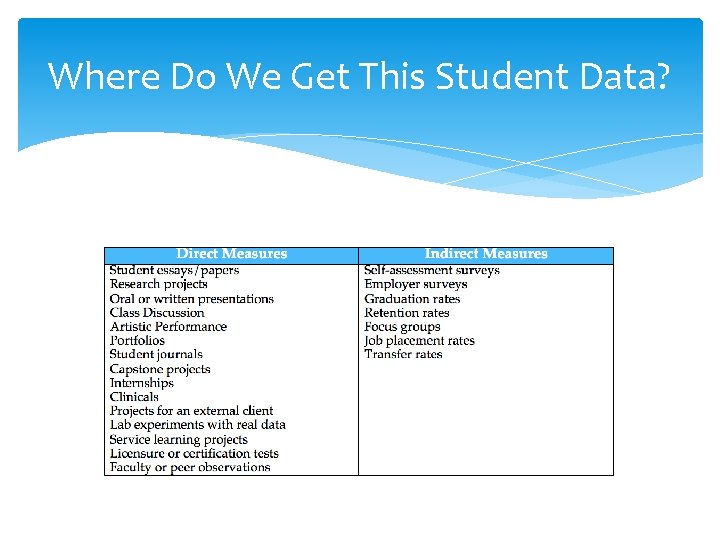
Where Do We Get This Student Data?
How is This Different from the Grades We Already Assign Students? Grades measure the performance of individual students. Assessment measures the performance of the department/program or college. Grades are subjective and vary from instructor to instructor. Individual course outcomes are likely to differ from broader dept/program outcomes and won’t necessarily align. Grades tell us how much students know, not what they know. Grades can only be used for Assessment purposes if the criteria used to grade the assignment directly correlates to the outcome being assessed.
What Does LCC’s Assessment Process Look Like? Here at Lakeland, Assessment is an on-going process and takes place every year on two different levels: 1) college-wide and 2) at the individual dept/program level.
Lakeland Learning Outcomes (LLOs) Each year, the entire college assesses the Lakeland Learning Outcome of the Year via artifacts from graduating students (45+ credits): AY 2018 -19: Learns Actively AY 2019 -20: Thinks Critically AY 2020 -21: Communicates Clearly AY 2021 -22: Uses Information Effectively AY 2022 -23: Interacts in Diverse Environments
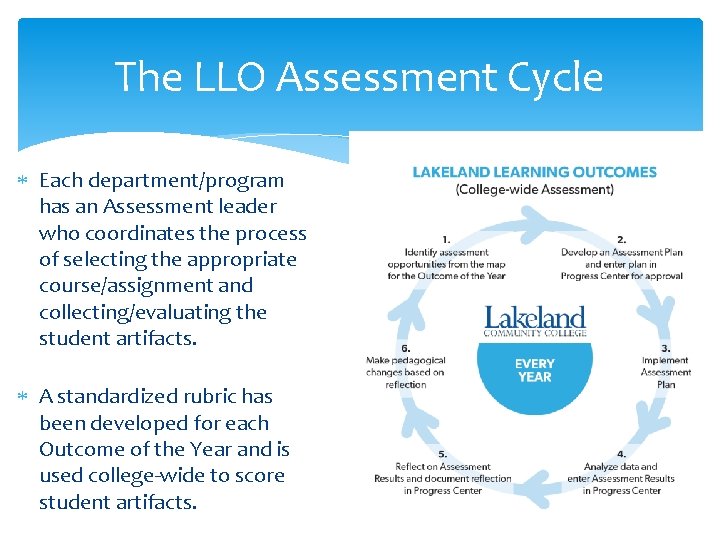
The LLO Assessment Cycle Each department/program has an Assessment leader who coordinates the process of selecting the appropriate course/assignment and collecting/evaluating the student artifacts. A standardized rubric has been developed for each Outcome of the Year and is used college-wide to score student artifacts.
Department/Program Student Learning Outcomes (SLOs) The other level of Assessment at Lakeland takes place within individual departments/programs. Every department/program assesses one or more of their own student learning outcomes each year in addition to the already mentioned Lakeland Learning Outcome (LLO) of the Year.
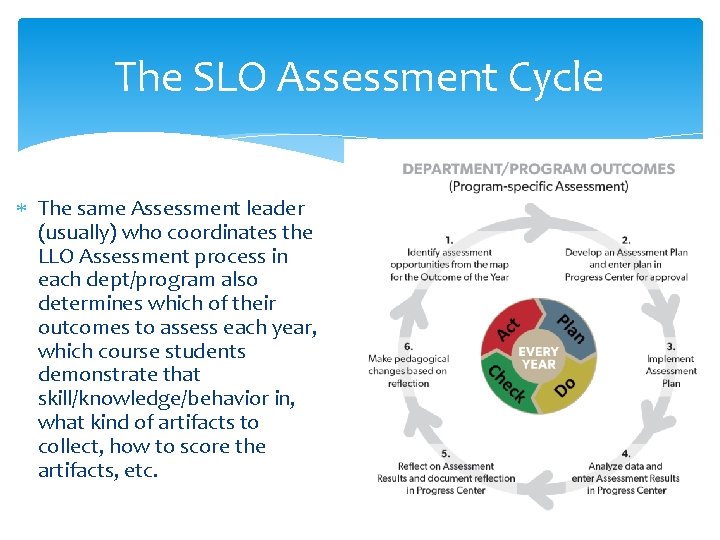
The SLO Assessment Cycle The same Assessment leader (usually) who coordinates the LLO Assessment process in each dept/program also determines which of their outcomes to assess each year, which course students demonstrate that skill/knowledge/behavior in, what kind of artifacts to collect, how to score the artifacts, etc.
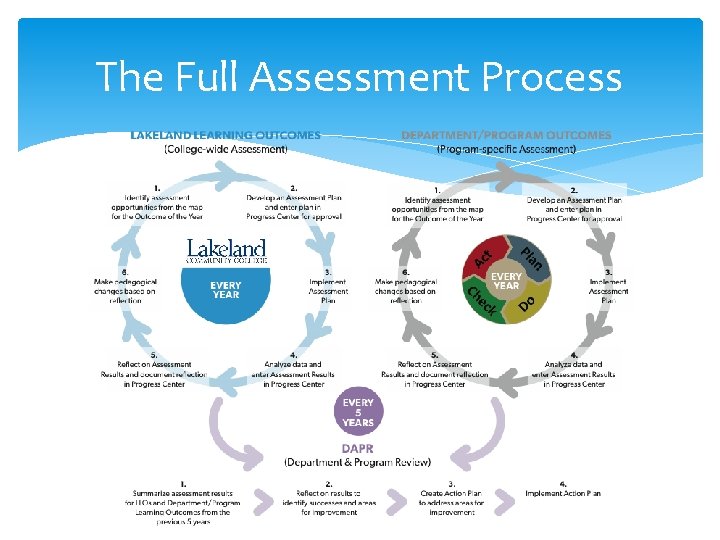
The Full Assessment Process
When Does This Assessment Happen? Each Fall Conference Week, the college provides a block of time for faculty to work on 1) analyzing their LLO and SLO findings from the previous AY and 2) creating their LLO and SLO Assessment plans for the current AY. At Spring Reading Days, the Assessment Council presents information about what will be the next AY’s Lakeland Learning Outcome of the Year, including ideas for how to assess it in various disciplines/environments, giving faculty plenty of time to be thinking ahead.
Where Do You Fit into This Process? Your dept/program assessment leader may decide that the year’s assessment artifacts need to be pulled from an assignment in your course. Your assessment leader may also need help from you and other members of the department to evaluate the artifacts that are collected and/or to decide if curricular changes are needed in light of assessment results.
What Else Can You Do to Support LCC Assessment? Put a copy of the institutional and department/program learning outcomes in your syllabus Use classroom activities that incorporate student demonstration of knowledge, skills, and attitudes When you design classroom activities and assignments, explain that the outcomes are part of the purpose of the assignment Use performance scales that give students specific feedback Participate in assessment activities! Your participation is welcome and critical! Use assessment data to improve the teaching/learning process
Where Can You Get More Information? The LCC Assessment Resource Center includes: Announcements Copy of the college’s Assessment Guide (coming soon!) Checklist for the Assessment cycle/process Rubrics for each Lakeland Learning Outcome (LLO) Examples of assignments related to each year’s Lakeland Learning Outcome (LLO) Contact information for Assessment Council members
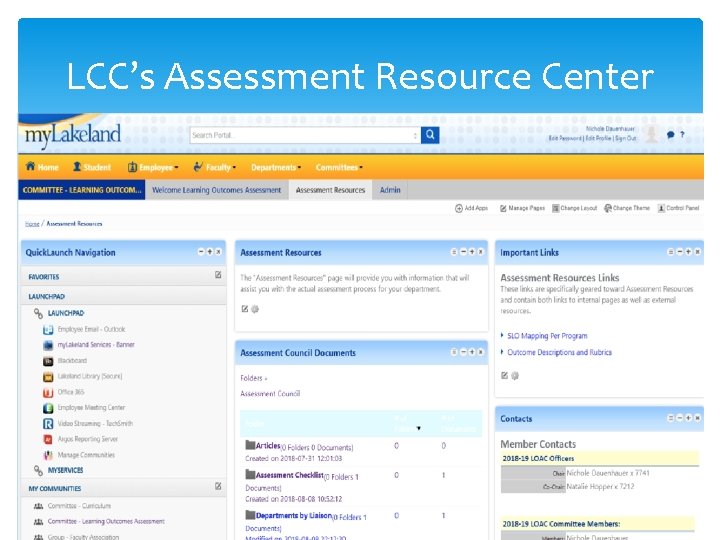
LCC’s Assessment Resource Center
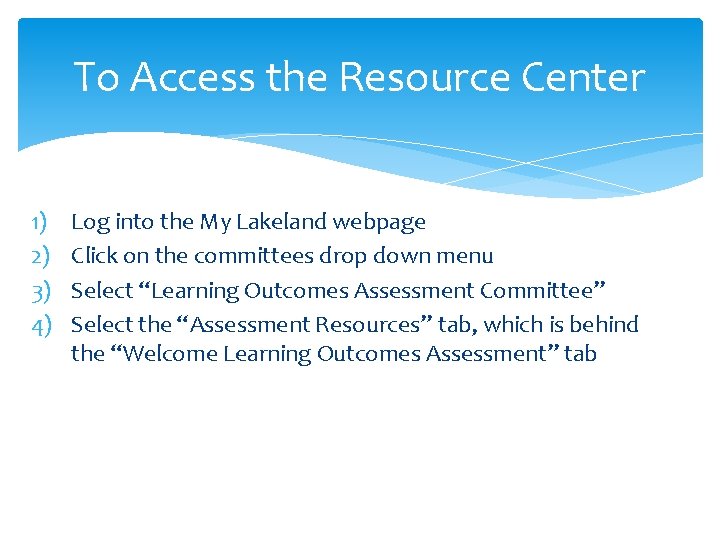
To Access the Resource Center 1) 2) 3) 4) Log into the My Lakeland webpage Click on the committees drop down menu Select “Learning Outcomes Assessment Committee” Select the “Assessment Resources” tab, which is behind the “Welcome Learning Outcomes Assessment” tab

Questions?
- Slides: 20