
AN INTRODUCTION TO INTELLECTUAL PROPERTY Newcastle University October
AN INTRODUCTION TO INTELLECTUAL PROPERTY Newcastle University October 2014 Angela King European Patent Attorney European Design Attorney
Talk Outline What is IP? Examples of IP in Industry Commercialising your IP Ethics of Patents and Other Monopoly Rights
Intellectual Property Patents Trade Marks Designs Copyright Confidential Information
IP Rights Reward research and development and prevent unauthorised exploitation of your rights Very important in competitive marketplace Is the road clear? – Even if you do not want to assert your own rights, you can still be in danger of infringing somebody else’s
Why Secure IP Rights? Monopoly in marketplace Barriers to entry for competition Best return for expenditure
Intellectual Property Patents Trade Marks Designs Copyright Confidential Information
Patents - General Patents granted for ideas and inventions A state granted monopoly – lasts up to 20 years Rewards and encourages research and innovation Prevents unauthorised exploitation of ideas or inventions
Patents - General Patents are not granted merely by filing an application Application is examined by the Patent Office Strict requirements Absolute Novelty – no prior public disclosure Not an obvious solution to the problem the invention overcomes
Application Contains Specification Claims Application stage – sets out scope of protection sought Granted patent – defines scope of enforceable protection
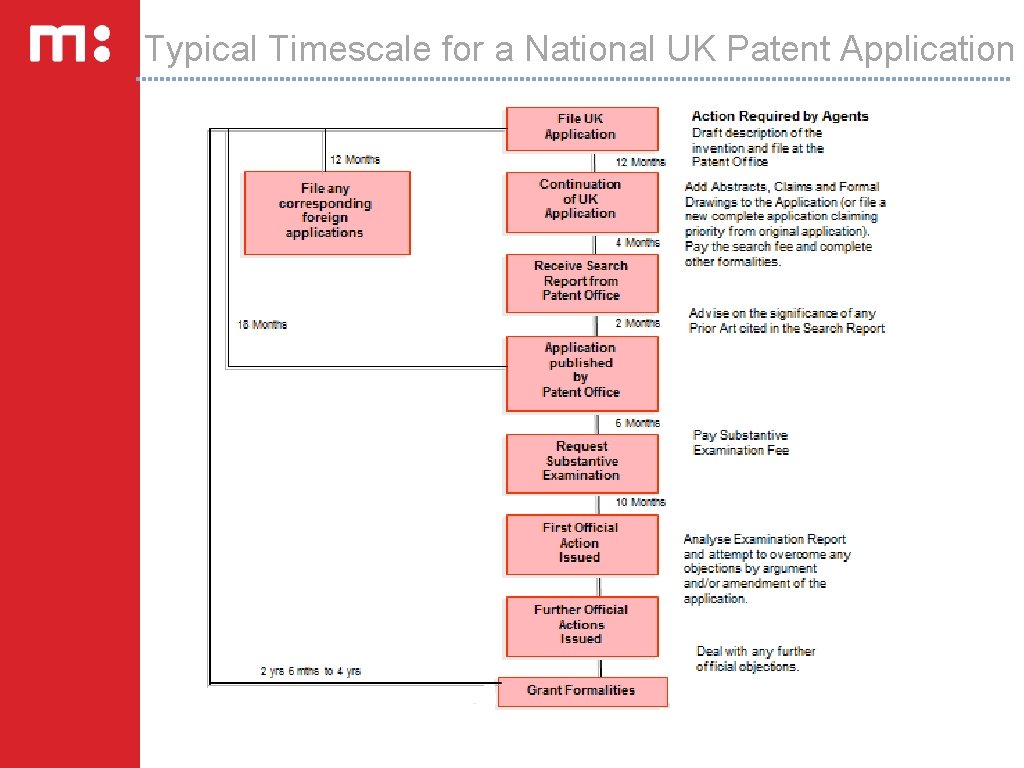
Typical Timescale for a National UK Patent Application
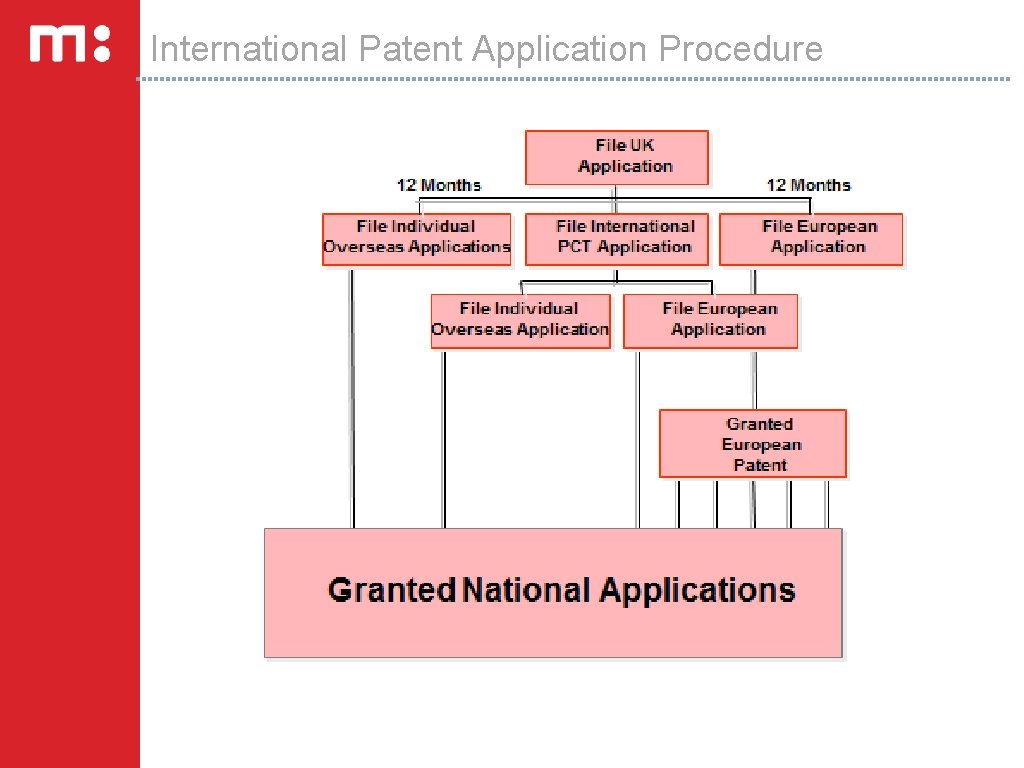
International Patent Application Procedure
Intellectual Property Patents Trade Marks Designs Copyright Confidential Information
Trade Marks are used to distinguish products and services Any sign which is capable of distinguishing the goods and services of one trader from those of another Trade Mark can be: Word Logo Sound Smell
Trade Marks Serves to establish goodwill and reputation in a product or service Adds value to a company Guinness € 2 Billion Coca-Cola Interbrand Value $79. 1 Billion (€ 61. 3 Billion) A good Trade Mark will be: Not descriptive of product Distinctive
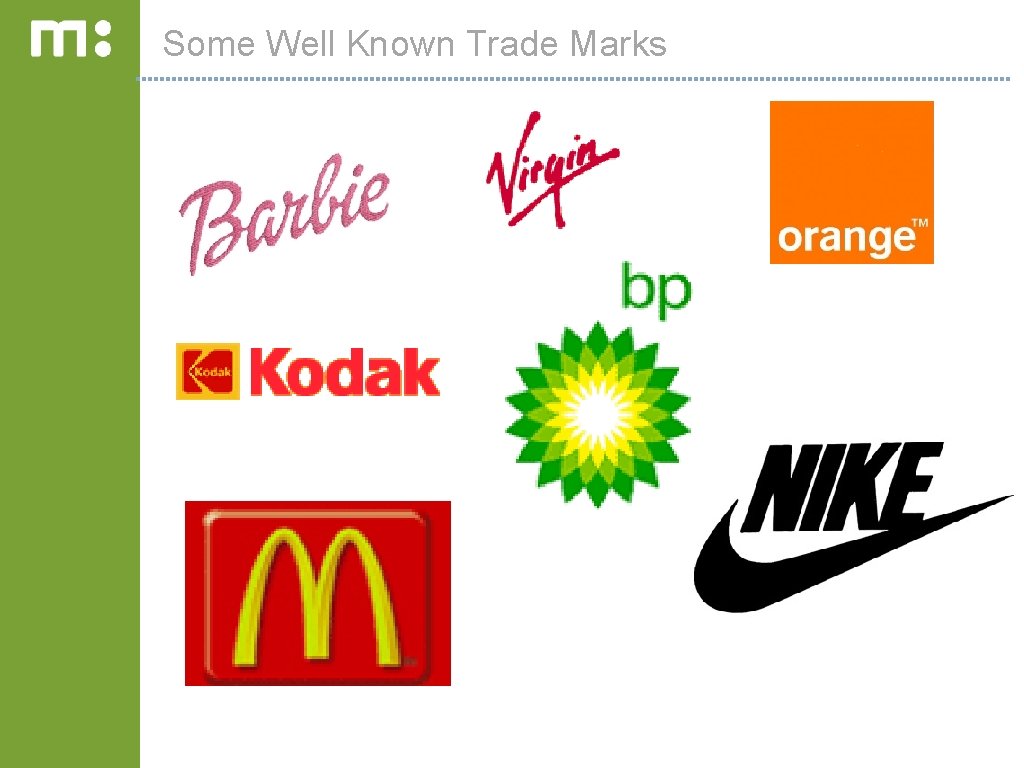
Some Well Known Trade Marks
Intellectual Property Patents Trade Marks Designs Copyright Confidential Information
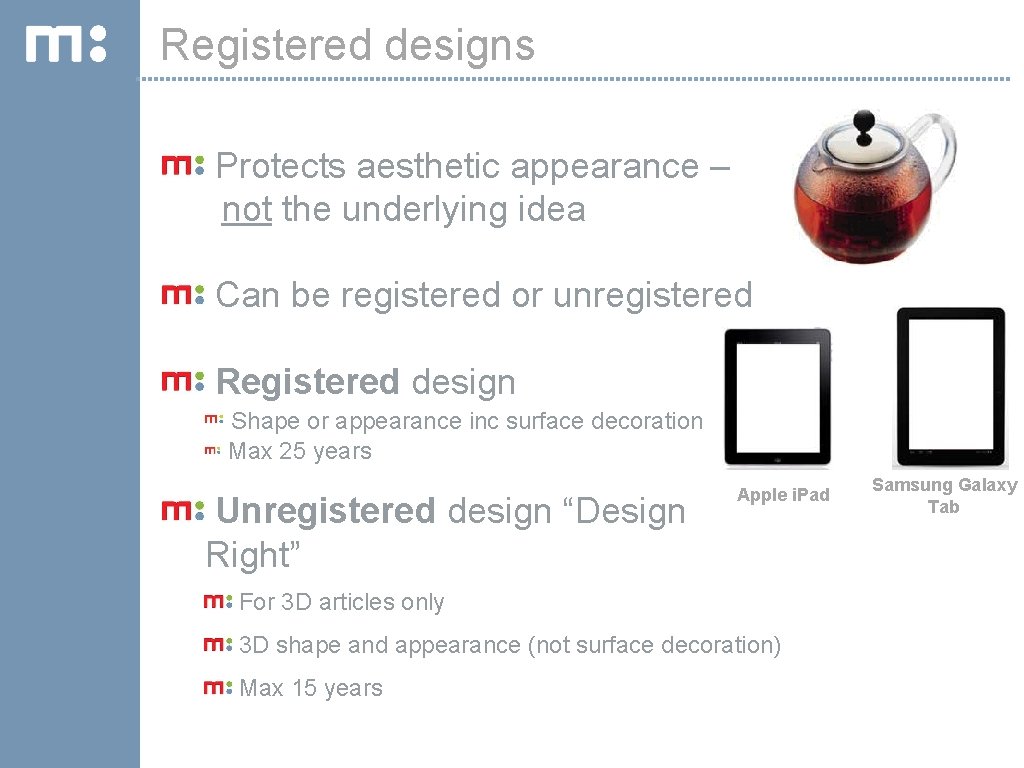
Registered designs Protects aesthetic appearance – not the underlying idea Can be registered or unregistered Registered design Shape or appearance inc surface decoration Max 25 years Unregistered design “Design Right” Apple i. Pad For 3 D articles only 3 D shape and appearance (not surface decoration) Max 15 years Samsung Galaxy Tab
Intellectual Property Patents Trade Marks Designs Copyright Confidential Information
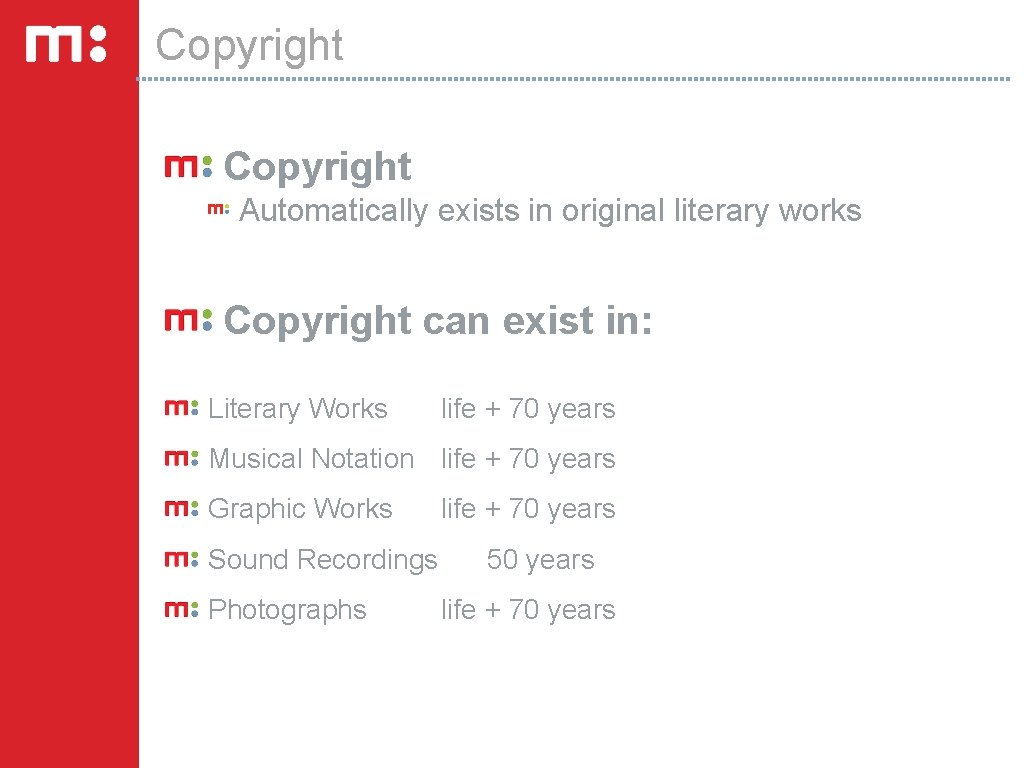
Copyright Automatically exists in original literary works Copyright can exist in: Literary Works life + 70 years Musical Notation life + 70 years Graphic Works Sound Recordings Photographs life + 70 years 50 years life + 70 years
Talk Outline Patents Trade Marks Designs Copyright Confidential Information
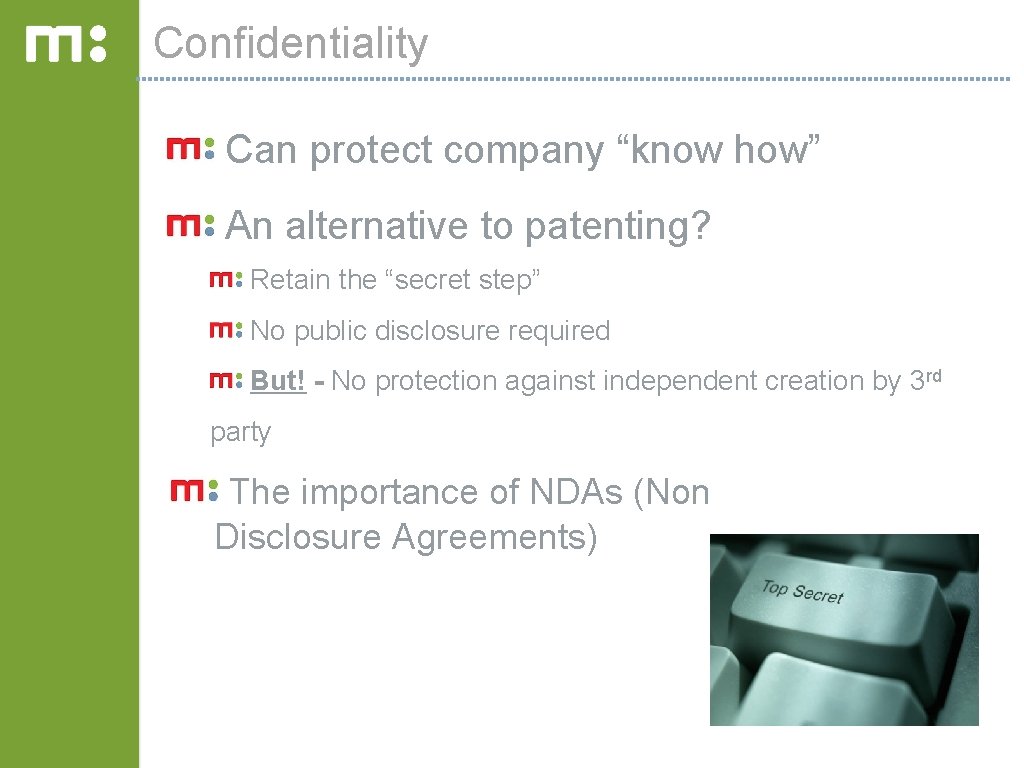
Confidentiality Can protect company “know how” An alternative to patenting? Retain the “secret step” No public disclosure required But! - No protection against independent creation by 3 rd party The importance of NDAs (Non Disclosure Agreements)
Talk Outline What is IP? Examples of IP in Industry Commercialising your IP Ethics of Patents and Other Monopoly Rights
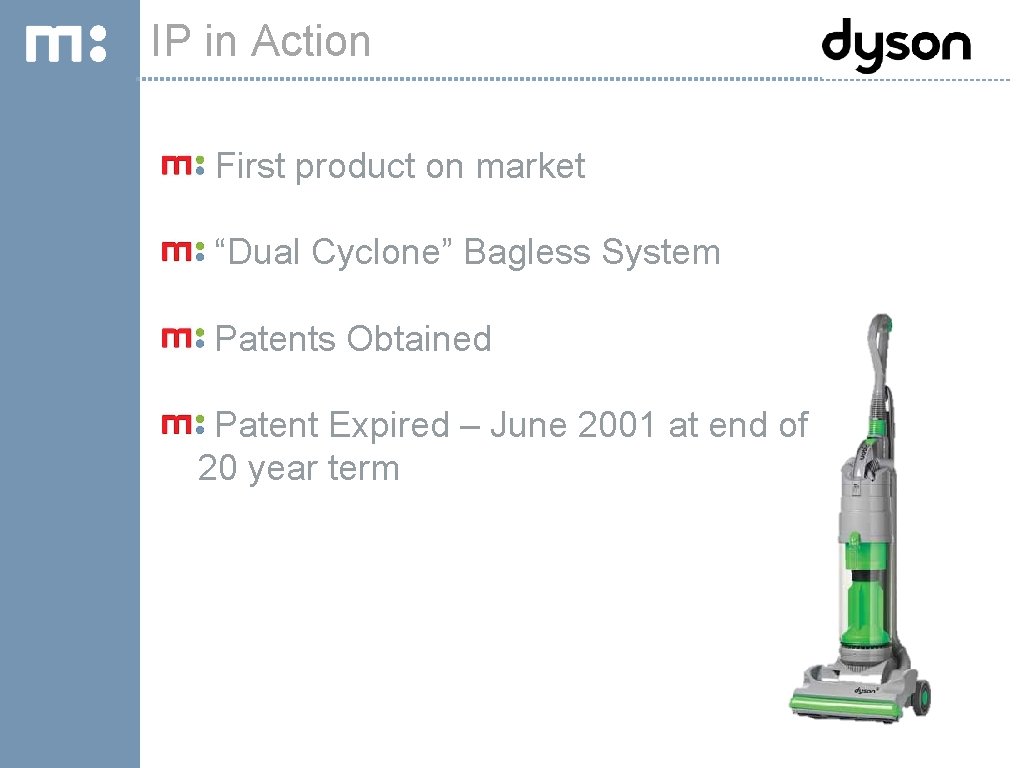
IPIP PORTAL TOUR in Action First product on market “Dual Cyclone” Bagless System Patents Obtained Patent Expired – June 2001 at end of 20 year term
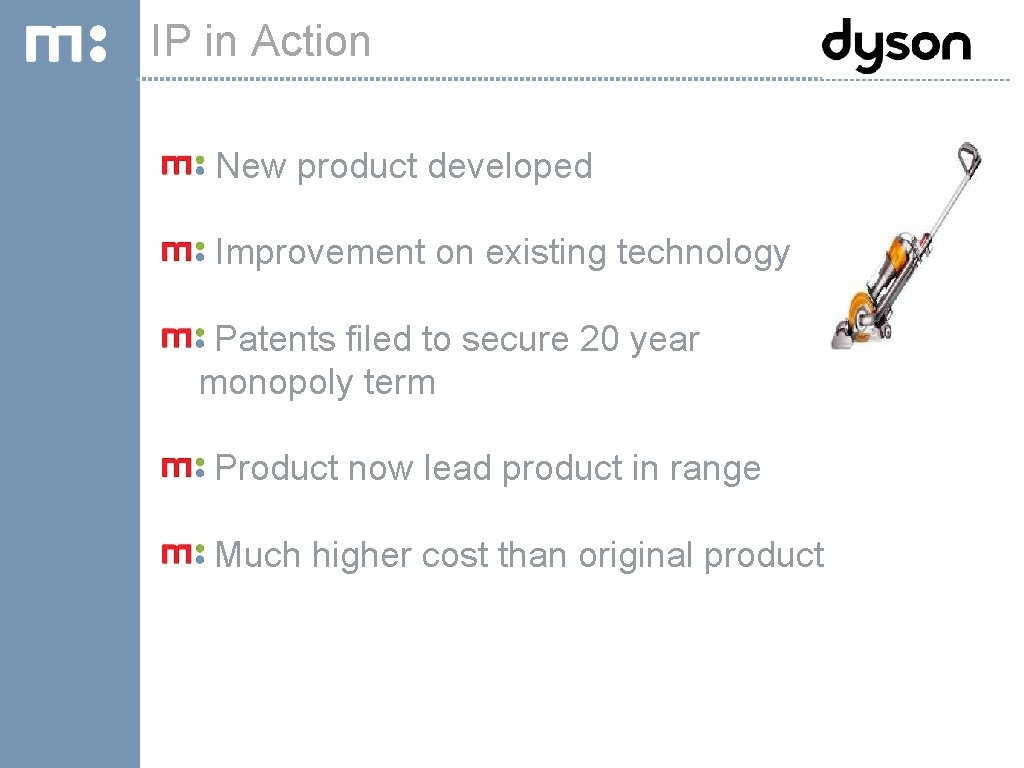
IPIP PORTAL TOUR in Action New product developed Improvement on existing technology Patents filed to secure 20 year monopoly term Product now lead product in range Much higher cost than original product
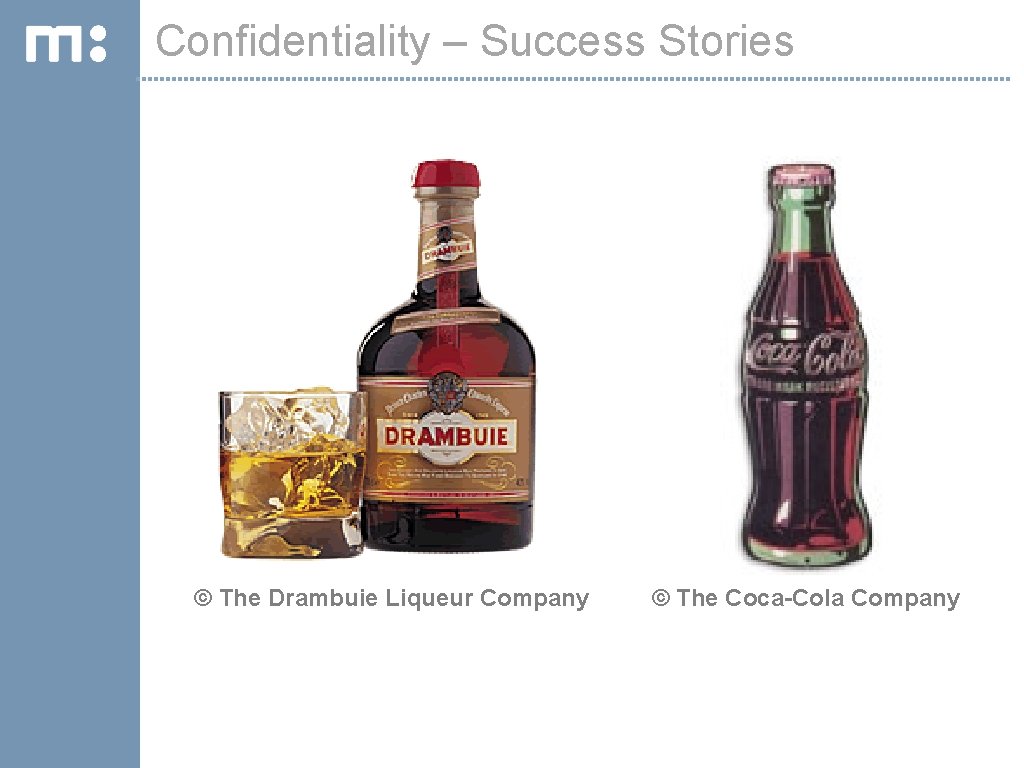
Confidentiality – Success Stories © The Drambuie Liqueur Company © The Coca-Cola Company
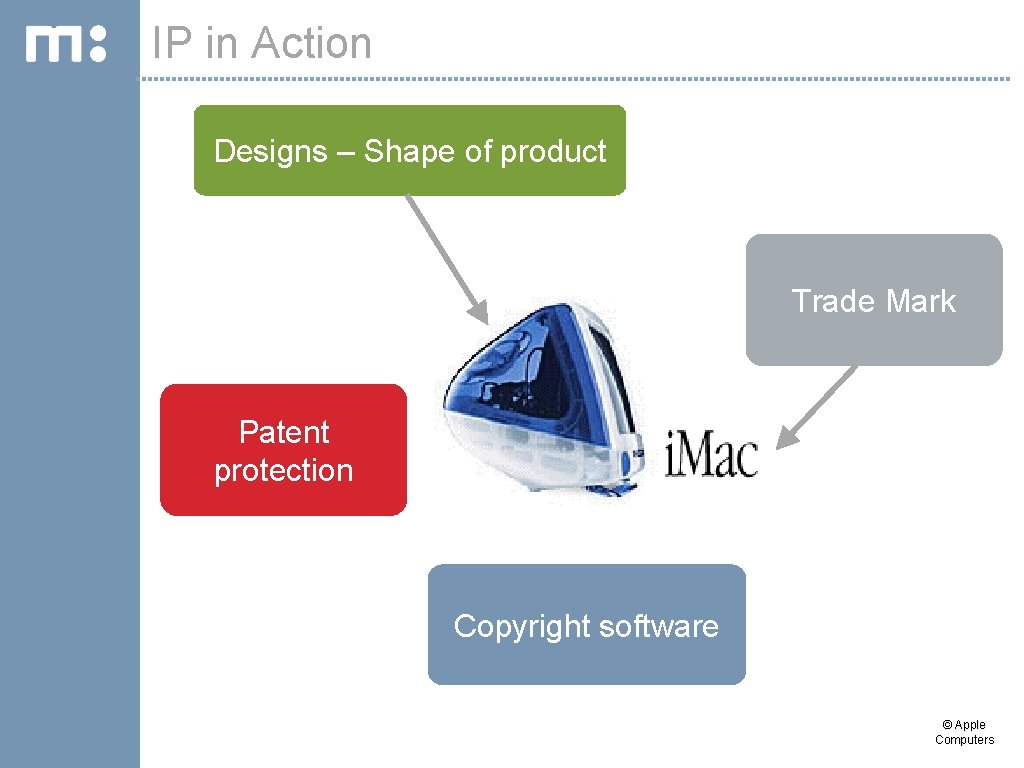
IP in Action Designs – Shape of product Trade Mark Patent protection Copyright software © Apple Computers
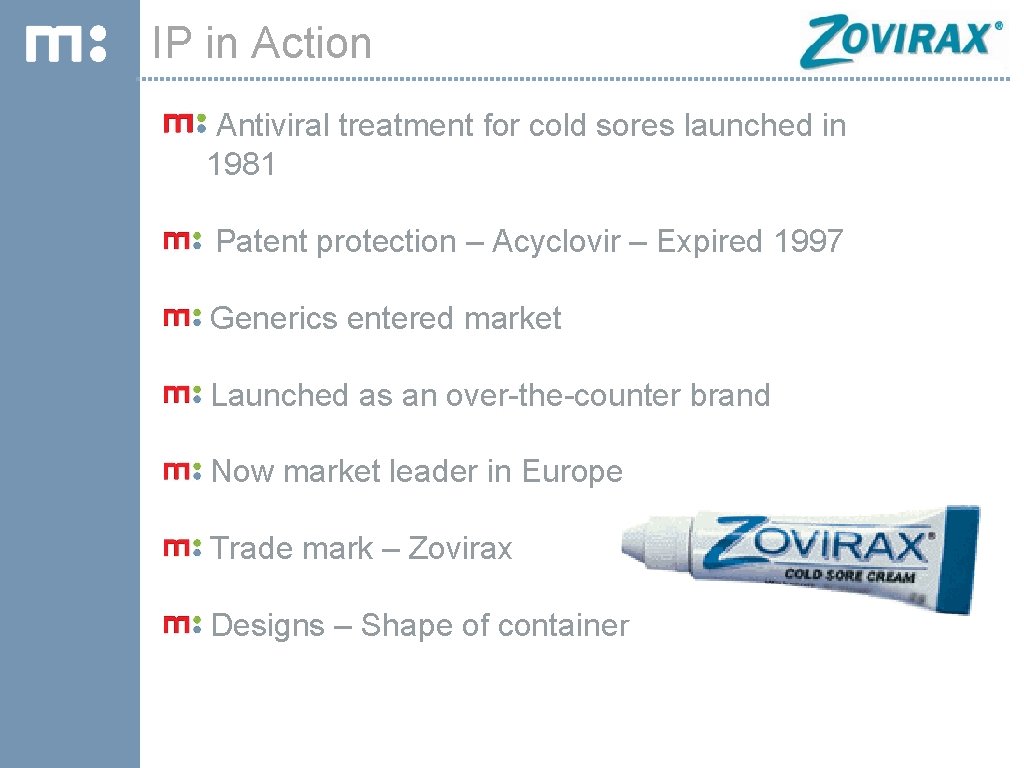
IP in Action Antiviral treatment for cold sores launched in 1981 Patent protection – Acyclovir – Expired 1997 Generics entered market Launched as an over-the-counter brand Now market leader in Europe Trade mark – Zovirax Designs – Shape of container
Talk Outline What is IP? Examples of IP in Industry Commercialising your IP Ethics of Patents and Other Monopoly Rights
Exploiting your IP Keep idea confidential – a patent application can only be filed if the invention is new and has not been publicly disclosed Consult with Research and Innovation service within University for commercialisation advice
Spin Out Companies IP initially owned by University Commercialisation of technology by a separate company Often ownership of IP may or may not be assigned to spin out Agreements very important in this situation
Talk Outline What is IP? Examples of IP in Industry Commercialising your IP Ethics of Patents and Other Monopoly Rights
The Ethical Debate The grant of a patent does not give any positive right to use an invention Many current “ethical debates” in relation to patents
Ethics – Case 1 Opposition to monopoly rights Alternative – so called “copyleft” or “freeware” Information free for all to use and modify Example – Linux computer operating system
Ethics – Case 1 Coca Cola – www. opencola. com “Open source licensing” Recipe provided to consumers Improvements to recipe made freely available to others Current recipe available on Wikipedia
Ethics – Case 1 Debate relates to “Knowledge Ownership” Free circulation of ideas Against protecting ideas as Intellectual Property Standard Licence Agreement termed “Copyleft” allows free use of material GNU Public Licence – Allows freedom to share and change
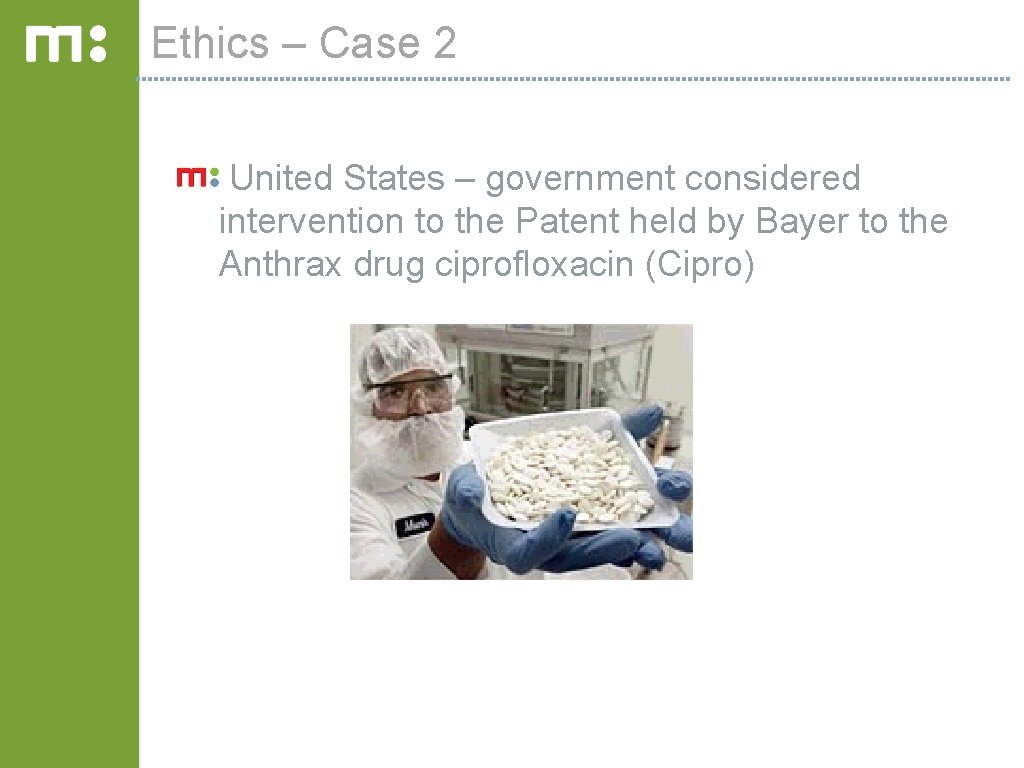
Ethics – Case 2 United States – government considered intervention to the Patent held by Bayer to the Anthrax drug ciprofloxacin (Cipro)
Ethics – Case 2 5 further US companies had FDA approved generic Cipro products, but were precluded from manufacture by the Bayer patent If US government authorised this manufacture, Cipro would effectively be deemed to be “off patent” to allow widespread production and increased availability of generic form of drug
Ethics – Case 2 Unlike in Canada, US government decided to maintain status quo of patent Apotex manufactured Cipro for Canadian government at 63 c a pill (Bayer price $1. 25) Allegation that US government put patents before public health
Ethics – Case 2 South Africa – 40 of the world’s largest drug companies sued the South African government to prevent attempts to reduce the cost of AIDS drugs by up to 90 percent Pharmaceutical Manufacturers’ Association dropped this action in 2001 bowing to mounting public pressure
Ethics – Case 2 In Brazil generic retroviral drugs have been supplied free of charge by the Brazilian government to 105, 000 people Generic forms of retroviral drugs AZT, 3 TC and Nevirapine lower treatment costs per day from $3. 20 to $1. 55
Ethics – Case 3 Various Patents granted for genetically modified organisms (GMOs) GM crops can’t however by planted unless consented to by national law Illustrates point that grant of a patent does not automatically confer “right of use” of invention
Ethics – Case 4 Patents directed to methods of nuclear transfer and cloning “Gene Patenting” The purpose of Patent Law is not to impose restrictions or prohibitions on the requirements of public health, or compliance with certain ethical standards
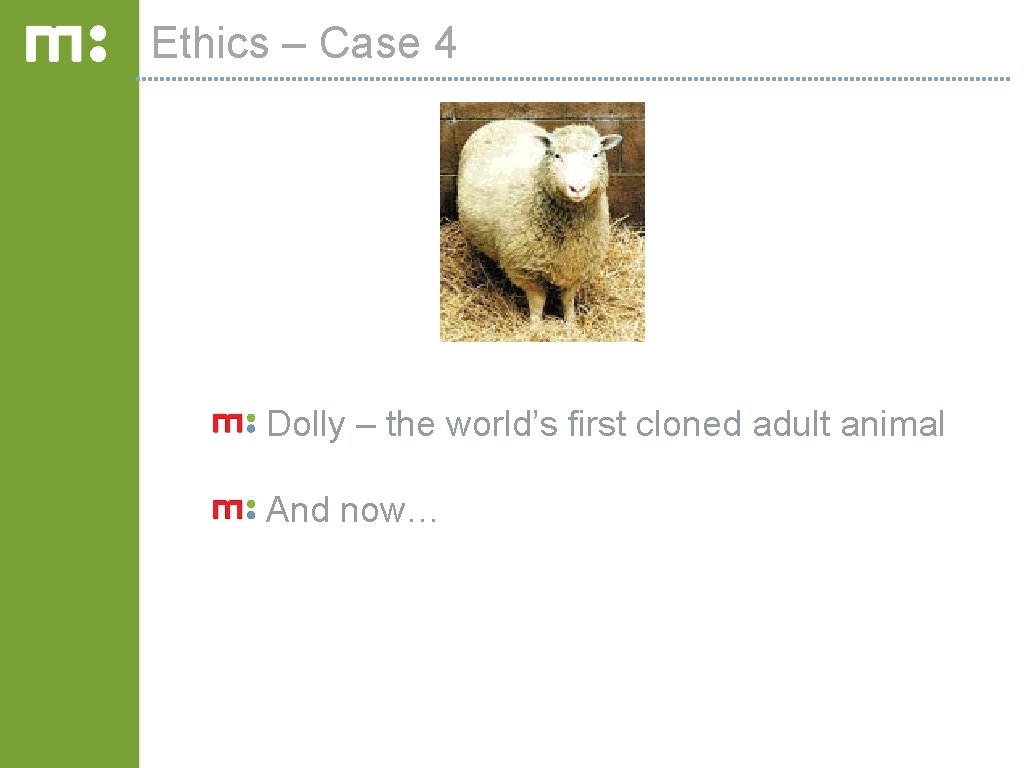
Ethics – Case 4 Dolly – the world’s first cloned adult animal And now…
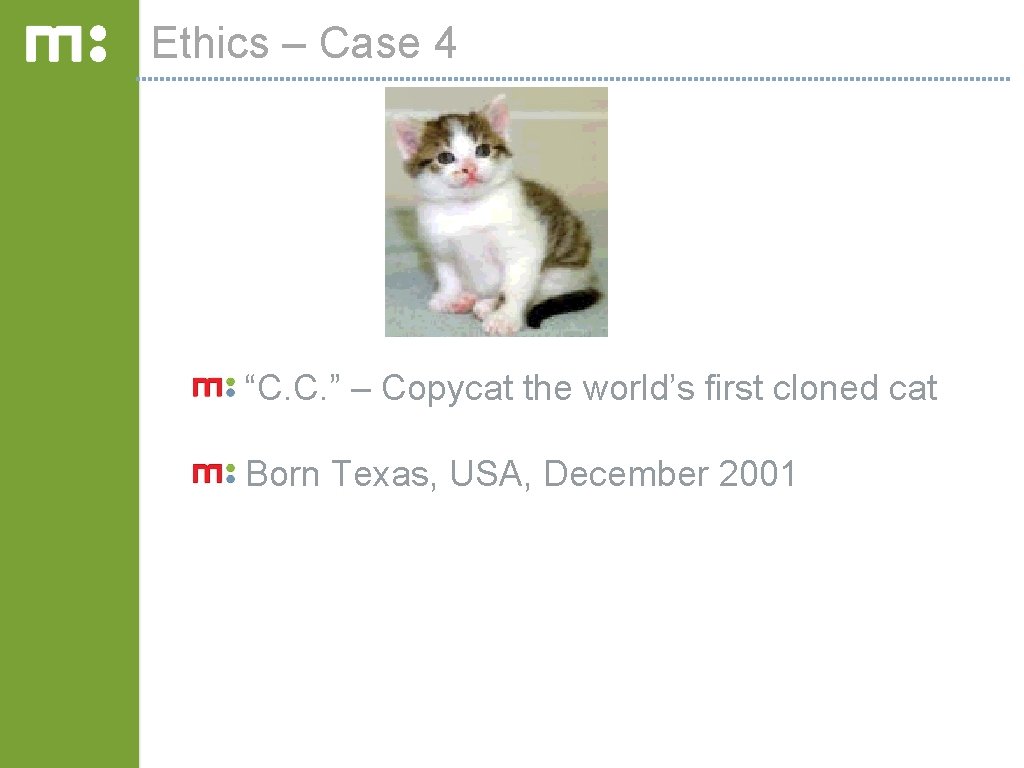
Ethics – Case 4 “C. C. ” – Copycat the world’s first cloned cat Born Texas, USA, December 2001
Ethics – Case 4 Exclusions do exist as to the patentability of: Processes for cloning human beings Modifying germ line identity of humans Modifying genetic identity of animals – if it will cause them suffering – without substantial benefit to man
Ethics – Case 4 Again illustrates that the grant of a patent is not indicative as to whether the use of a technology is permissible
In spite of these, the following arguments stand strong in the case for patenting : Encourages and rewards investment in research and innovation Publication of subject matter leads to dissemination of information Incentives to develop new products
Contact angela. king@murgitroyd. com Murgitroyd Enterprise House Innovation Way Heslington York YO 10 5 NQ Tel: 01904 898 881 Fax: 01904 898 882
- Slides: 48