
An Introduction to Improvement Session Outcomes To develop


- Slides: 25
An Introduction to Improvement
Session Outcomes To develop a basic understanding of: • Service improvement in healthcare • Some of the tools and techniques used To apply process thinking associated with your own practice and patient journey.
What Is Improvement? Definition: Continually working together to improve the experience and outcomes for patients and users; Looking for other ways to provide healthcare, that continuously improves the way it meets the needs of those who depend on it and the working lives of staff who provide it.
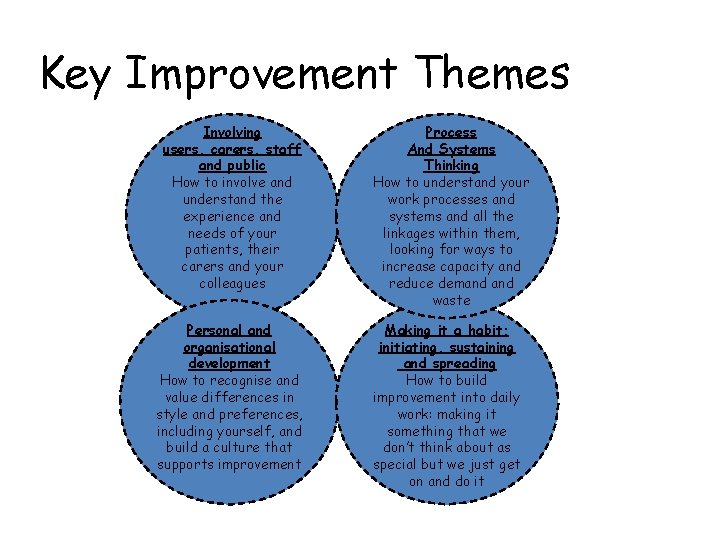
Key Improvement Themes Involving users, carers, staff and public How to involve and understand the experience and needs of your patients, their carers and your colleagues Personal and organisational development How to recognise and value differences in style and preferences, including yourself, and build a culture that supports improvement Process And Systems Thinking How to understand your work processes and systems and all the linkages within them, looking for ways to increase capacity and reduce demand waste Making it a habit; initiating, sustaining and spreading How to build improvement into daily work: making it something that we don’t think about as special but we just get on and do it
Why Do We Need Improvement Science? • Help us to aspire to be the best • Give us the ability and belief to change • ‘Bottom out’ problems not jump to solutions • Evidence, support and prove our ideas If you’re still in doubt ask yourself why not! Shouldn’t we all strive to give better patient care?
What Does Improvement Involve? Improvement is having the VISION to look at the way you work and the CREATIVITY to do things differently “Vision is seeing the potential hidden in the chaos of the moment” William Van Dusen Wishard
What Does Improvement Involve? Having the belief in yourself and others that you have the power to improve and to install an IMPROVEMENT CULTURE that welcomes change! “When building a culture of improvement, you need to work like a farmer, planting seeds and nourishing the ground. ” Marshall 2002
What Does Improvement Involve? Having improvement knowledge, skills, tools and techniques – and knowing how to use them! “Knowing is not enough; we must apply. Willing is not enough; we must do. ” J Wolfgang von Goethe
Tools and Techniques 1. Process and Patient Flow Mapping 2. Model for Improvement 3. Understanding Variation
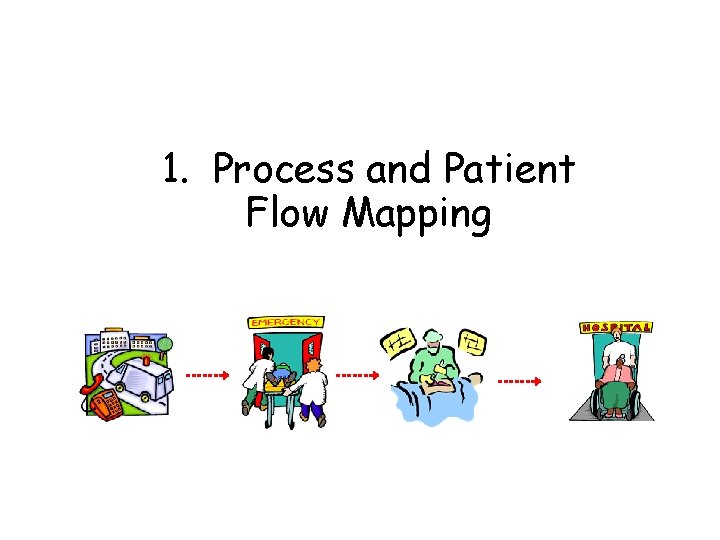
1. Process and Patient Flow Mapping
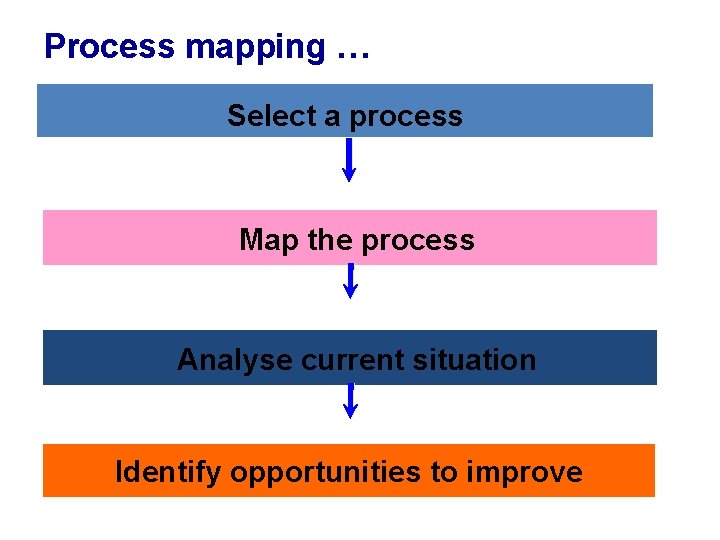
Process mapping … Select a process Map the process Analyse current situation Identify opportunities to improve
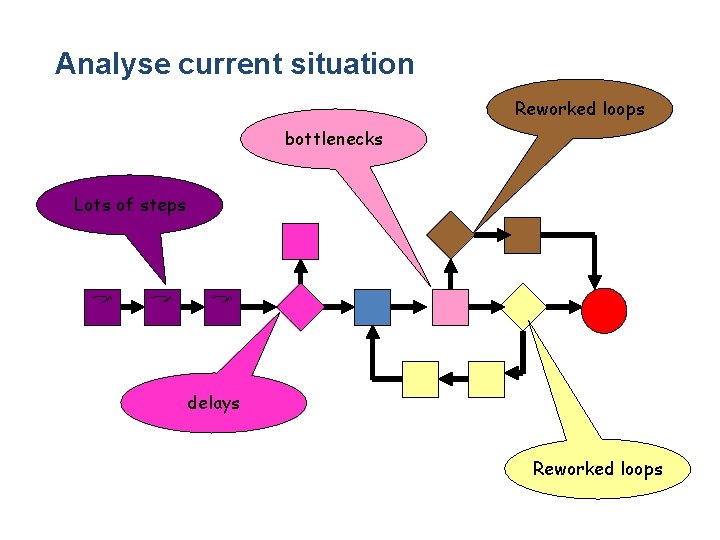
Analyse current situation Reworked loops bottlenecks Lots of steps delays Reworked loops
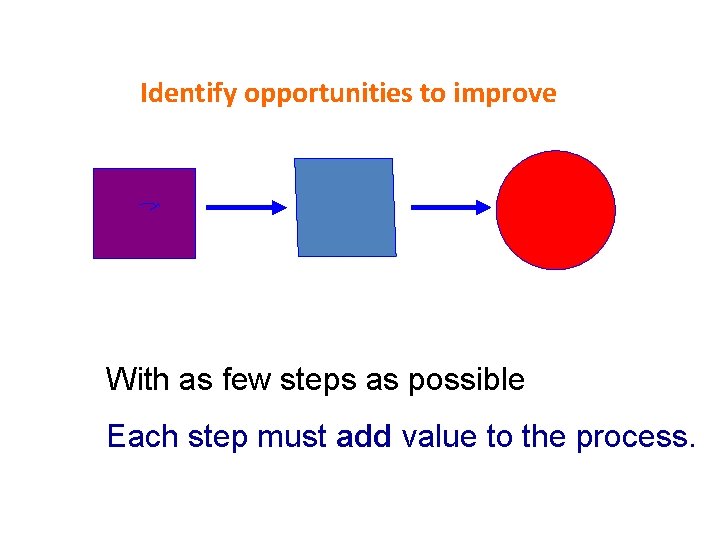
Identify opportunities to improve With as few steps as possible Each step must add value to the process.
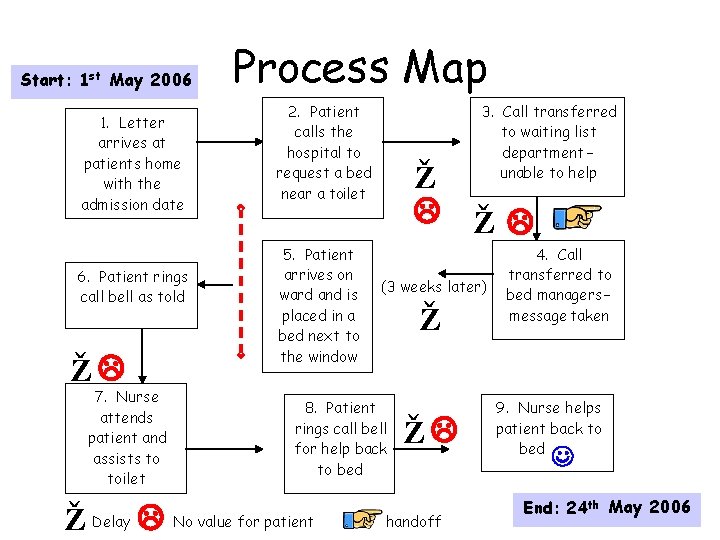
1 Start: st May 2006 1. Letter arrives at patients home with the admission date 6. Patient rings call bell as told Ž L 7. Nurse attends patient and assists to toilet Process Map 2. Patient calls the hospital to request a bed near a toilet 5. Patient arrives on ward and is placed in a bed next to the window 3. Call transferred to waiting list department – unable to help Ž L (3 weeks later) Ž 8. Patient rings call bell for help back to bed Ž Delay L No value for patient Ž L handoff 4. Call transferred to bed managers – message taken 9. Nurse helps patient back to bed J End: 24 th May 2006
2. Model for Improvement
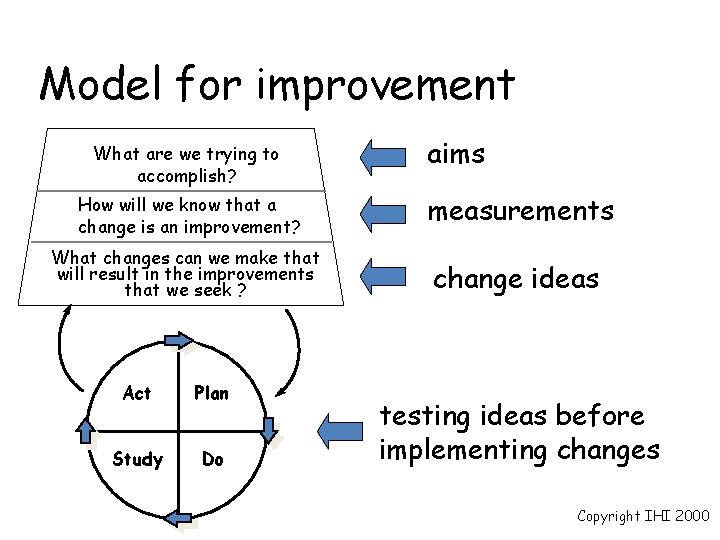
Model for improvement What are we trying to accomplish? aims How will we know that a change is an improvement? measurements What changes can we make that will result in the improvements that we seek ? change ideas Act Plan Study Do testing ideas before implementing changes Copyright IHI 2000
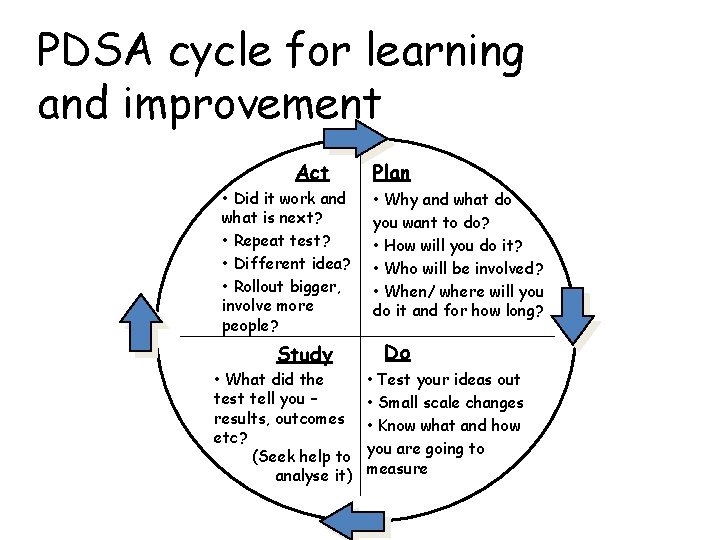
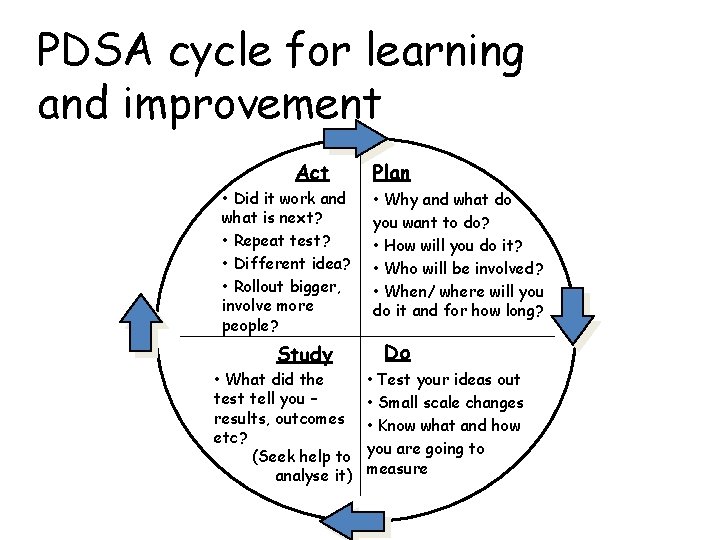
PDSA cycle for learning and improvement Act • Did it work and what is next? • Repeat test? • Different idea? • Rollout bigger, involve more people? Study • What did the test tell you – results, outcomes etc? (Seek help to analyse it) Plan • Why and what do you want to do? • How will you do it? • Who will be involved? • When/ where will you do it and for how long? Do • Test your ideas out • Small scale changes • Know what and how you are going to measure
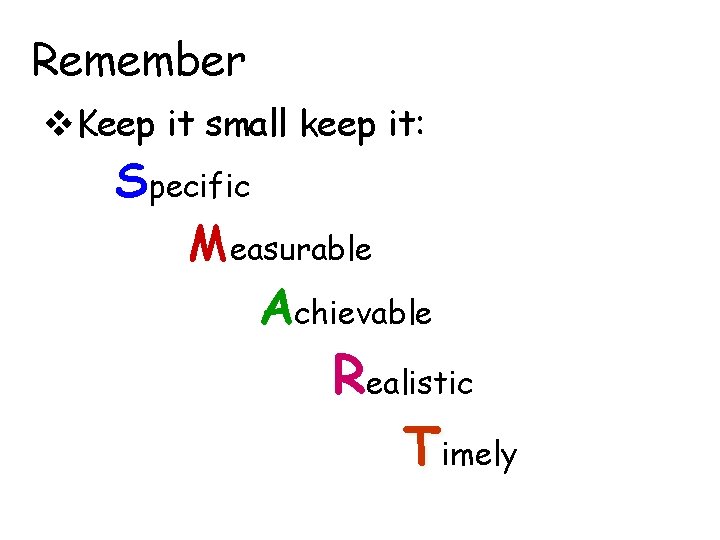
Remember v. Keep it small keep it: Specific Measurable Achievable Realistic Timely
Your Turn! • Based on the scenario, take a couple of minutes to think what could have been done differently. • Ask yourself how the patient’s experience could have been improved • Think of an idea (keep it small and smart!) • Have a go at a PDSA cycle!
PDSA cycle for learning and improvement Act • Did it work and what is next? • Repeat test? • Different idea? • Rollout bigger, involve more people? Study • What did the test tell you – results, outcomes etc? (Seek help to analyse it) Plan • Why and what do you want to do? • How will you do it? • Who will be involved? • When/ where will you do it and for how long? Do • Test your ideas out • Small scale changes • Know what and how you are going to measure
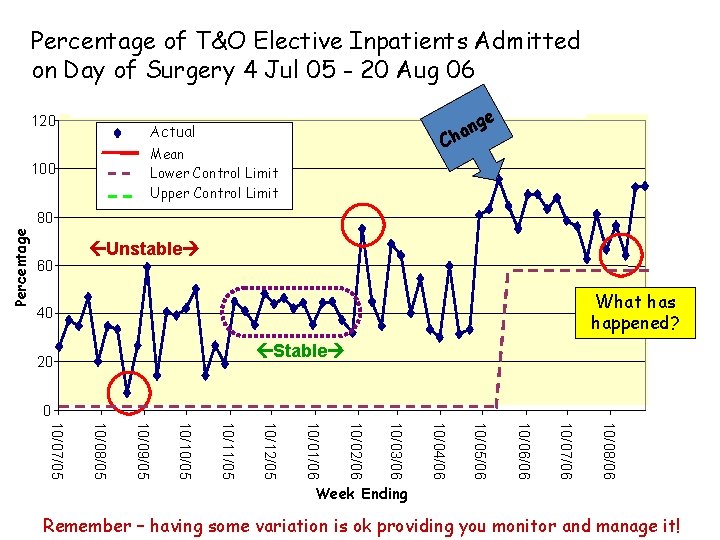
3. Understanding Variation
Percentage of T&O Elective Inpatients Admitted on Day of Surgery 4 Jul 05 - 20 Aug 06 120 ng ha Actual C Mean Lower Control Limit Upper Control Limit 100 e Percentage 80 60 Unstable What has happened? 40 Stable 20 0 10/08/06 10/07/06 10/06/06 10/05/06 10/04/06 10/03/06 10/02/06 10/01/06 10/12/05 10/11/05 10/10/05 10/09/05 10/08/05 10/07/05 Week Ending Remember – having some variation is ok providing you monitor and manage it!
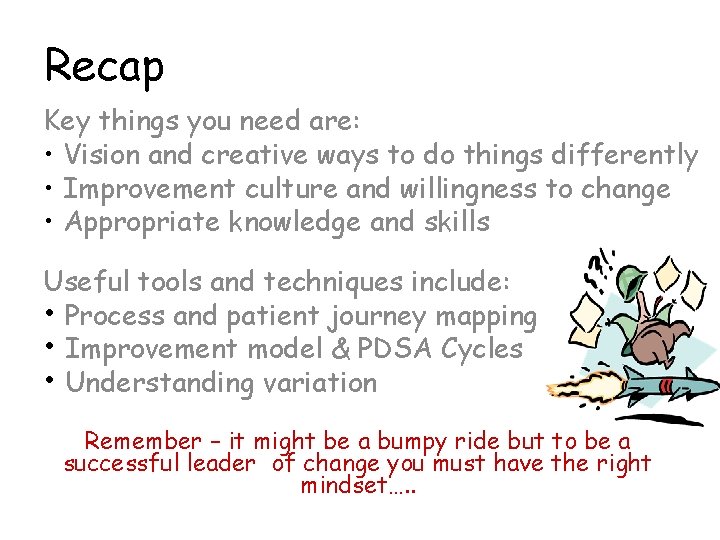
Recap Key things you need are: • Vision and creative ways to do things differently • Improvement culture and willingness to change • Appropriate knowledge and skills Useful tools and techniques include: • Process and patient journey mapping • Improvement model & PDSA Cycles • Understanding variation Remember – it might be a bumpy ride but to be a successful leader of change you must have the right mindset…. .