
An Introduction to Human Trafficking Training for Employees




- Slides: 76
An Introduction to Human Trafficking Training for Employees, Volunteers, and Service Providers of facilities licensed under Chapters 243 and 245, Health and Safety Code Developed by the Texas Human Trafficking Prevention Task Force 1
Training Mandate Pursuant to House Bill 416 (84 th Regular Session), this training has been developed and provided to each person who: • Is employed by, volunteers at, or performs services under contract with: ◦ An abortion facility licensed under Chapter 245, Health and Safety Code; or ◦ An ambulatory surgical center licensed under Chapter 243, Health and Safety Code, that performs more than 50 abortions in any 12 -month period; and • Has direct contact with patients of the facility. 2
Importance of Training • Over the course of completing their normal duties, several types of professionals are likely to encounter potential human trafficking victims. Such professionals may work for: ◦ Social service organizations ◦ Law enforcement organizations ◦ Health care providers • “Health care providers, as one of the few groups of professionals likely to interact with trafficked victims while they are still in captivity, have the opportunity to screen, identify and intervene. ” 3
Purpose of this Training • Empower individuals to: ◦ Recognize risk factors and indicators related to human trafficking ◦ Identify potential human trafficking victims and report as legally required • Provide a foundation to: ◦ Share knowledge with colleagues, parents, and community members ◦ Engage in local prevention efforts 4
Objectives This training is designed to help individuals subject to this training: 1. Understand the realities of human trafficking 2. Understand risk factors and vulnerabilities related to human trafficking 3. Understand child trafficking 4. Understand recruitment 5. Understand human trafficking indicators in the clinical setting 6. Understand how to respond to victims of trafficking and report as appropriate 7. Take next steps 5
Objective 1. Understand the realities of human trafficking 8 percent complete 6
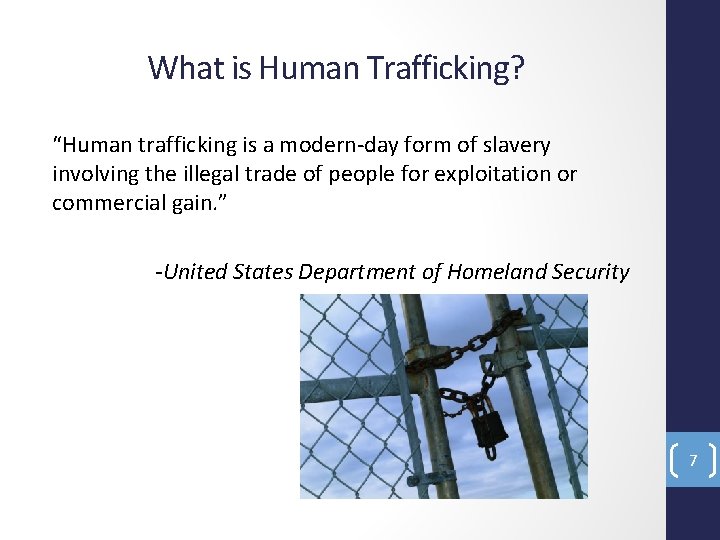
What is Human Trafficking? “Human trafficking is a modern-day form of slavery involving the illegal trade of people for exploitation or commercial gain. ” -United States Department of Homeland Security 7
Understanding Human Trafficking • Human trafficking is categorized as: ◦ Labor trafficking Labor ◦ Sex trafficking Trafficking ◦ A crossover of both labor and sex trafficking Sex Trafficking • Human trafficking can be prosecuted under federal or state law. • Human trafficking is about exploitation and does not have to involve movement of a person. 8
Human Trafficking Victims “Since the passage of the Trafficking Victims Protection Act (TVPA) in 2000, law enforcement investigators, social service providers, and community leaders have reported cases of forced labor, debt bondage, involuntary servitude, and sex trafficking, impacting a diverse range of populations including men, women, and children, who are U. S. citizens, permanent residents, or foreign nationals. ” -U. S. Department of Health and Human Services 9
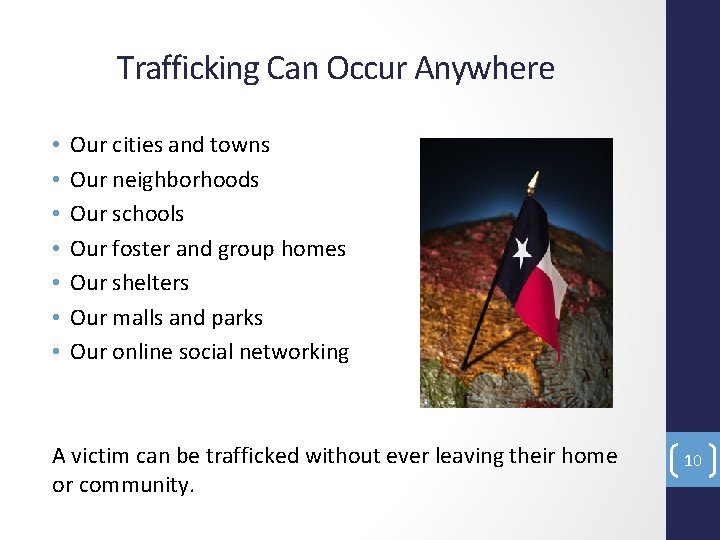
Trafficking Can Occur Anywhere • • Our cities and towns Our neighborhoods Our schools Our foster and group homes Our shelters Our malls and parks Our online social networking A victim can be trafficked without ever leaving their home or community. 10
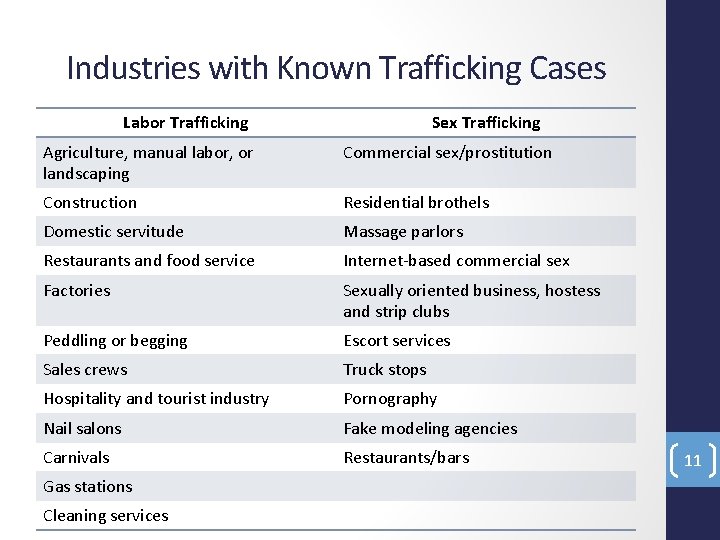
Industries with Known Trafficking Cases Labor Trafficking Sex Trafficking Agriculture, manual labor, or landscaping Commercial sex/prostitution Construction Residential brothels Domestic servitude Massage parlors Restaurants and food service Internet-based commercial sex Factories Sexually oriented business, hostess and strip clubs Peddling or begging Escort services Sales crews Truck stops Hospitality and tourist industry Pornography Nail salons Fake modeling agencies Carnivals Restaurants/bars Gas stations Cleaning services 11
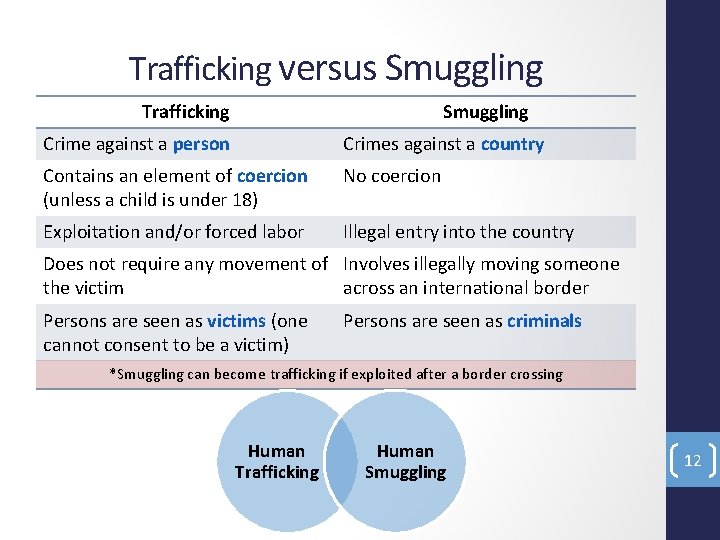
Trafficking versus Smuggling Trafficking Smuggling Crime against a person Crimes against a country Contains an element of coercion (unless a child is under 18) No coercion Exploitation and/or forced labor Illegal entry into the country Does not require any movement of Involves illegally moving someone the victim across an international border Persons are seen as victims (one cannot consent to be a victim) Persons are seen as criminals *Smuggling can become trafficking if exploited after a border crossing Human Trafficking Human Smuggling 12
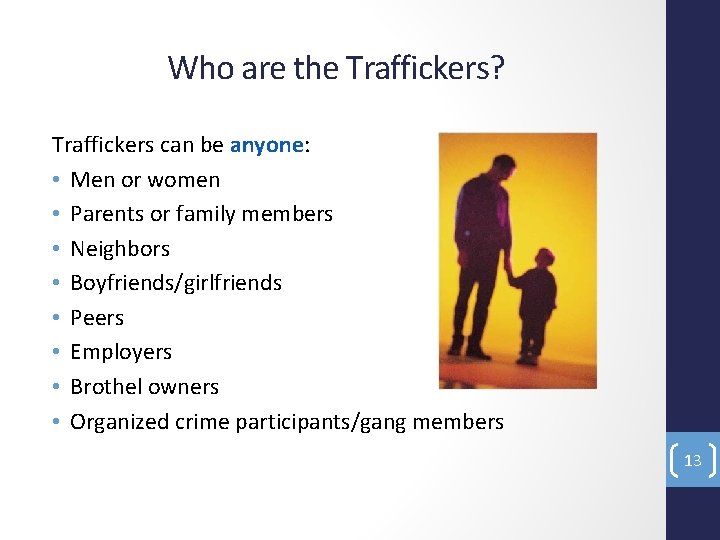
Who are the Traffickers? Traffickers can be anyone: • Men or women • Parents or family members • Neighbors • Boyfriends/girlfriends • Peers • Employers • Brothel owners • Organized crime participants/gang members 13
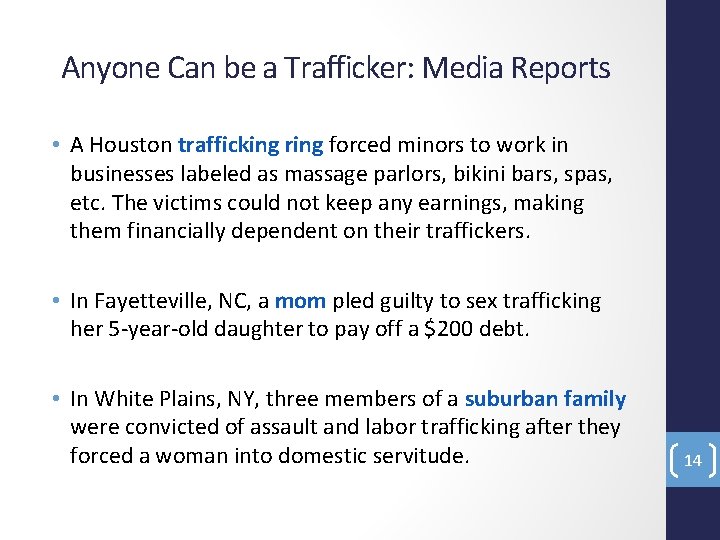
Anyone Can be a Trafficker: Media Reports • A Houston trafficking ring forced minors to work in businesses labeled as massage parlors, bikini bars, spas, etc. The victims could not keep any earnings, making them financially dependent on their traffickers. • In Fayetteville, NC, a mom pled guilty to sex trafficking her 5 -year-old daughter to pay off a $200 debt. • In White Plains, NY, three members of a suburban family were convicted of assault and labor trafficking after they forced a woman into domestic servitude. 14
The Economics of Human Trafficking • There are two primary factors that drive human traffickers: high profits and low risk for the trafficker. • Annual illegal profits worldwide from human trafficking are estimated at $150. 2 billion. 15
Trafficking is Happening in Texas • In a recent report from the National Human Trafficking Resource Center (NHTRC): ◦ Texas was 2 nd to California in the number of calls to the hotline reporting a tip or requesting assistance. ◦ Texas is consistently in the top tier of states in both number of calls to the hotline and potential cases along with states such as California and Florida. ◦ New York and Ohio are also in the top five. 16
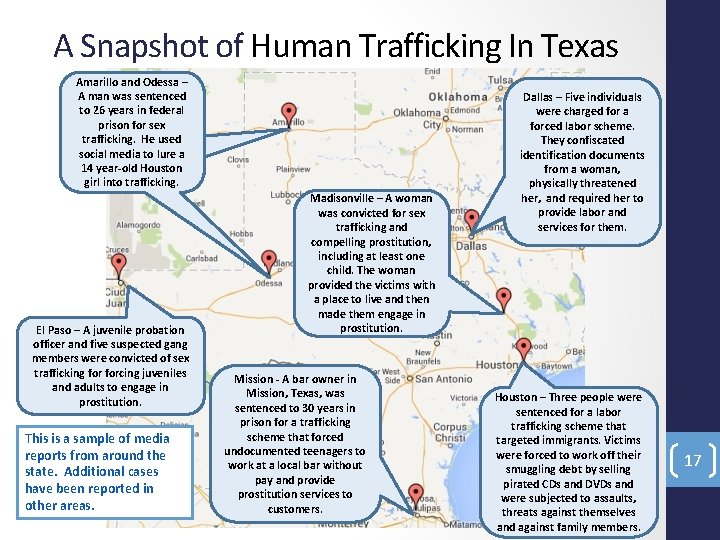
A Snapshot of Human Trafficking In Texas Amarillo and Odessa – A man was sentenced to 26 years in federal prison for sex trafficking. He used social media to lure a 14 year-old Houston girl into trafficking. El Paso – A juvenile probation officer and five suspected gang members were convicted of sex trafficking forcing juveniles and adults to engage in prostitution. This is a sample of media reports from around the state. Additional cases have been reported in other areas. Madisonville – A woman was convicted for sex trafficking and compelling prostitution, including at least one child. The woman provided the victims with a place to live and then made them engage in prostitution. Mission - A bar owner in Mission, Texas, was sentenced to 30 years in prison for a trafficking scheme that forced undocumented teenagers to work at a local bar without pay and provide prostitution services to customers. Dallas – Five individuals were charged for a forced labor scheme. They confiscated identification documents from a woman, physically threatened her, and required her to provide labor and services for them. Houston – Three people were sentenced for a labor trafficking scheme that targeted immigrants. Victims were forced to work off their smuggling debt by selling pirated CDs and DVDs and were subjected to assaults, threats against themselves and against family members. 17
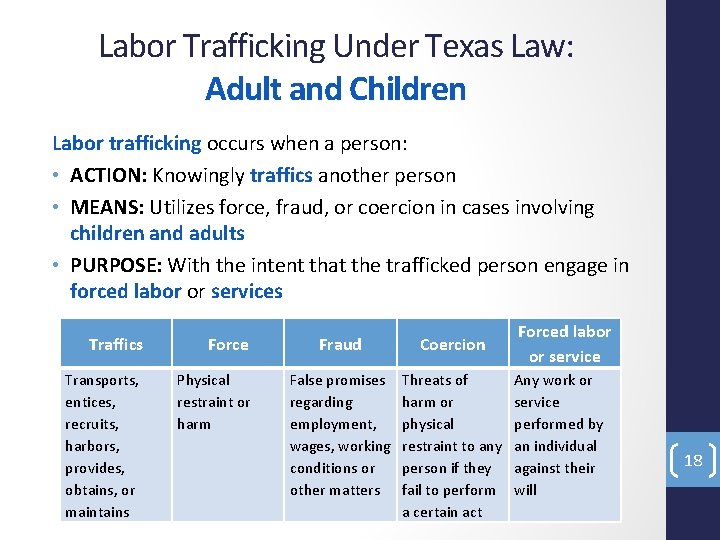
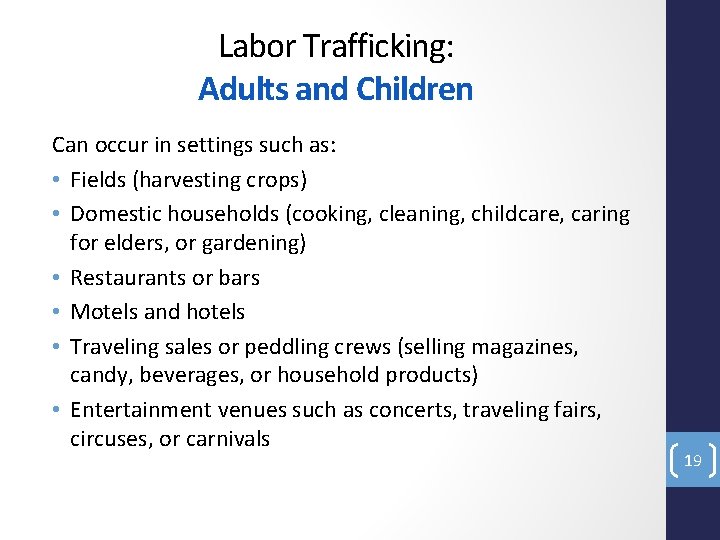
Labor Trafficking Under Texas Law: Adult and Children Labor trafficking occurs when a person: • ACTION: Knowingly traffics another person • MEANS: Utilizes force, fraud, or coercion in cases involving children and adults • PURPOSE: With the intent that the trafficked person engage in forced labor or services Traffics Transports, entices, recruits, harbors, provides, obtains, or maintains Force Physical restraint or harm Fraud Coercion False promises regarding employment, wages, working conditions or other matters Threats of harm or physical restraint to any person if they fail to perform a certain act Forced labor or service Any work or service performed by an individual against their will 18
Labor Trafficking: Adults and Children Can occur in settings such as: • Fields (harvesting crops) • Domestic households (cooking, cleaning, childcare, caring for elders, or gardening) • Restaurants or bars • Motels and hotels • Traveling sales or peddling crews (selling magazines, candy, beverages, or household products) • Entertainment venues such as concerts, traveling fairs, circuses, or carnivals 19
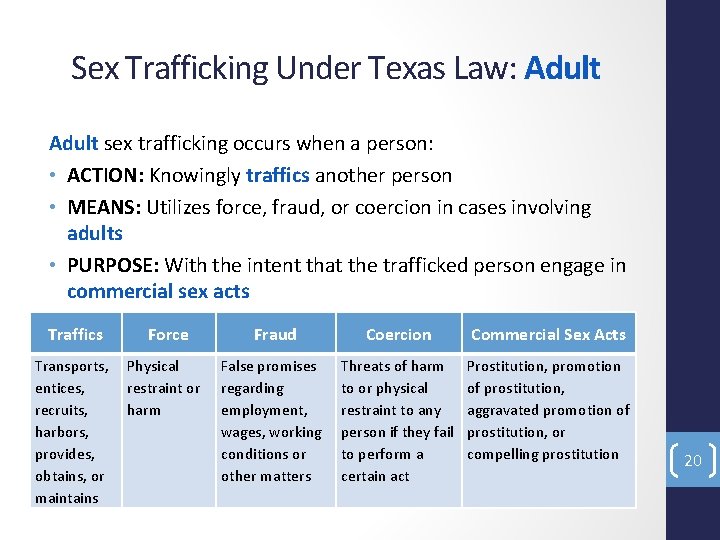
Sex Trafficking Under Texas Law: Adult sex trafficking occurs when a person: • ACTION: Knowingly traffics another person • MEANS: Utilizes force, fraud, or coercion in cases involving adults • PURPOSE: With the intent that the trafficked person engage in commercial sex acts Traffics Force Transports, Physical entices, restraint or recruits, harm harbors, provides, obtains, or maintains Fraud Coercion Commercial Sex Acts False promises regarding employment, wages, working conditions or other matters Threats of harm to or physical restraint to any person if they fail to perform a certain act Prostitution, promotion of prostitution, aggravated promotion of prostitution, or compelling prostitution 20
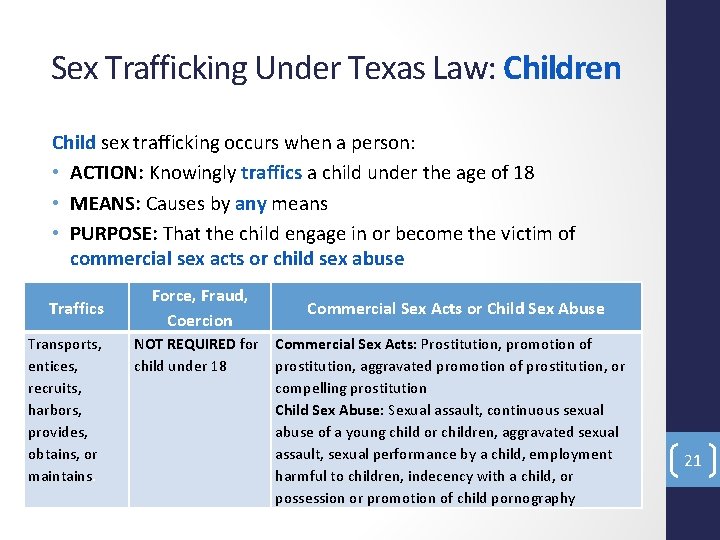
Sex Trafficking Under Texas Law: Children Child sex trafficking occurs when a person: • ACTION: Knowingly traffics a child under the age of 18 • MEANS: Causes by any means • PURPOSE: That the child engage in or become the victim of commercial sex acts or child sex abuse Traffics Transports, entices, recruits, harbors, provides, obtains, or maintains. Force, Fraud, Coercion Commercial Sex Acts or Child Sex Abuse NOT REQUIRED for Commercial Sex Acts: Prostitution, promotion of child under 18 prostitution, aggravated promotion of prostitution, or compelling prostitution Child Sex Abuse: Sexual assault, continuous sexual abuse of a young child or children, aggravated sexual assault, sexual performance by a child, employment harmful to children, indecency with a child, or possession or promotion of child pornography 21
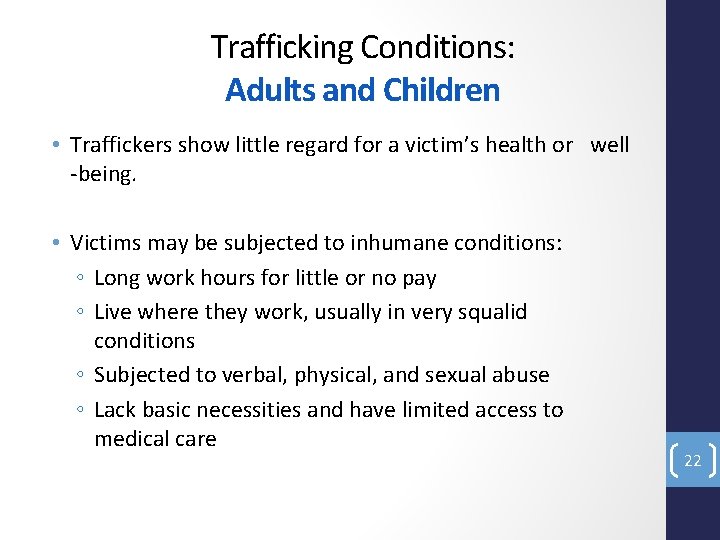
Trafficking Conditions: Adults and Children • Traffickers show little regard for a victim’s health or well -being. • Victims may be subjected to inhumane conditions: ◦ Long work hours for little or no pay ◦ Live where they work, usually in very squalid conditions ◦ Subjected to verbal, physical, and sexual abuse ◦ Lack basic necessities and have limited access to medical care 22
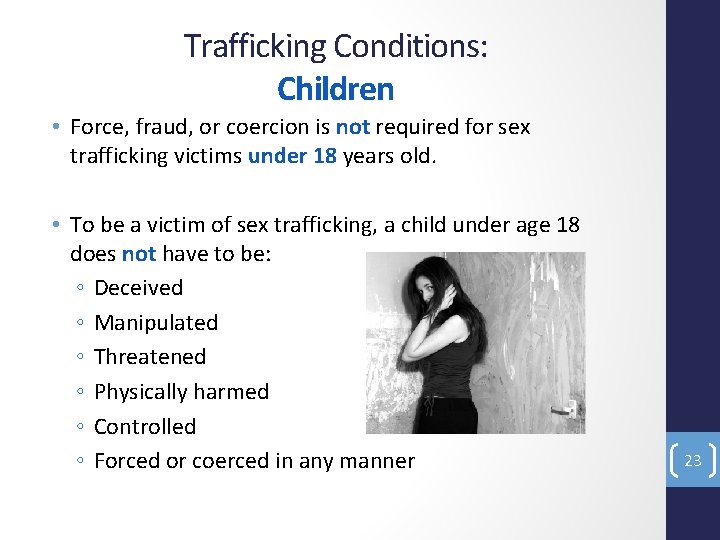
Trafficking Conditions: Children • Force, fraud, or coercion is not required for sex trafficking victims under 18 years old. • To be a victim of sex trafficking, a child under age 18 does not have to be: ◦ Deceived ◦ Manipulated ◦ Threatened ◦ Physically harmed ◦ Controlled ◦ Forced or coerced in any manner 23
Objective 2. Understand risk factors and vulnerabilities related to human trafficking 32 percent complete 24
Risk and Exploitation • While anyone can become a victim of human trafficking, several risk factors leave children and adults vulnerable to exploitation by traffickers. • Risk factors typically fall into 1 of 4 categories: ◦ Individual ◦ Relationship ◦ Community ◦ Societal 25
Individual Factors that Increase Risk Factors for All Victims • In a new unfamiliar country or location • Substance abuse • Stigma and discrimination • Disability • Mental illness/mental health • Homelessness • Low self-esteem • Poverty or limited resources • Language barriers • Distrust of authority Child Specific Risk Factors • History of child abuse, neglect, or exploitation • Runaway or foster care • Adolescent development • Truancy & delinquency 26
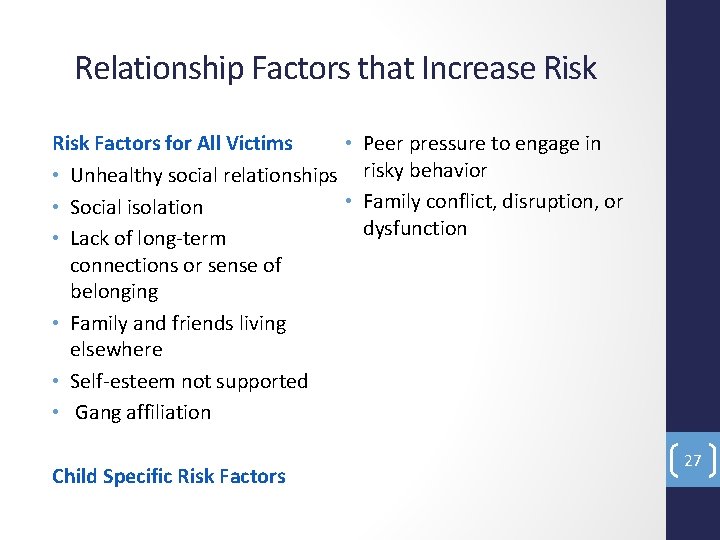
Relationship Factors that Increase Risk Factors for All Victims • Peer pressure to engage in • Unhealthy social relationships risky behavior • Family conflict, disruption, or • Social isolation dysfunction • Lack of long-term connections or sense of belonging • Family and friends living elsewhere • Self-esteem not supported • Gang affiliation Child Specific Risk Factors 27
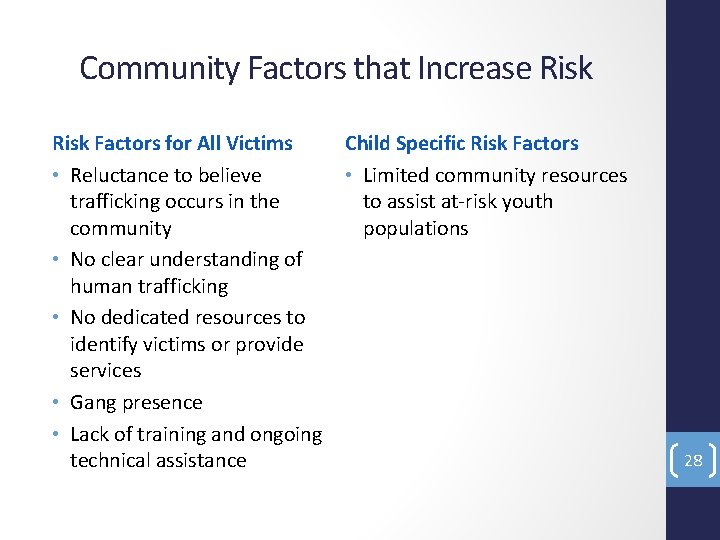
Community Factors that Increase Risk Factors for All Victims Child Specific Risk Factors • Reluctance to believe • Limited community resources trafficking occurs in the to assist at-risk youth community populations • No clear understanding of human trafficking • No dedicated resources to identify victims or provide services • Gang presence • Lack of training and ongoing technical assistance 28
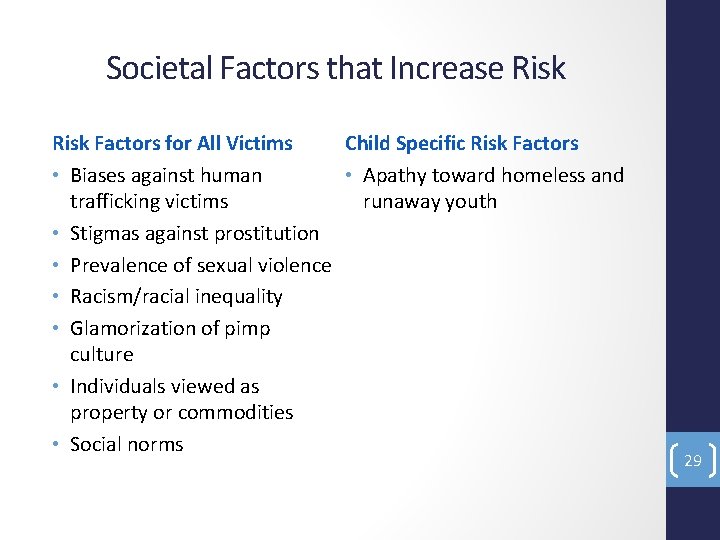
Societal Factors that Increase Risk Factors for All Victims Child Specific Risk Factors • Biases against human • Apathy toward homeless and trafficking victims runaway youth • Stigmas against prostitution • Prevalence of sexual violence • Racism/racial inequality • Glamorization of pimp culture • Individuals viewed as property or commodities • Social norms 29
Objective 3. Understand child trafficking 39 percent complete 30
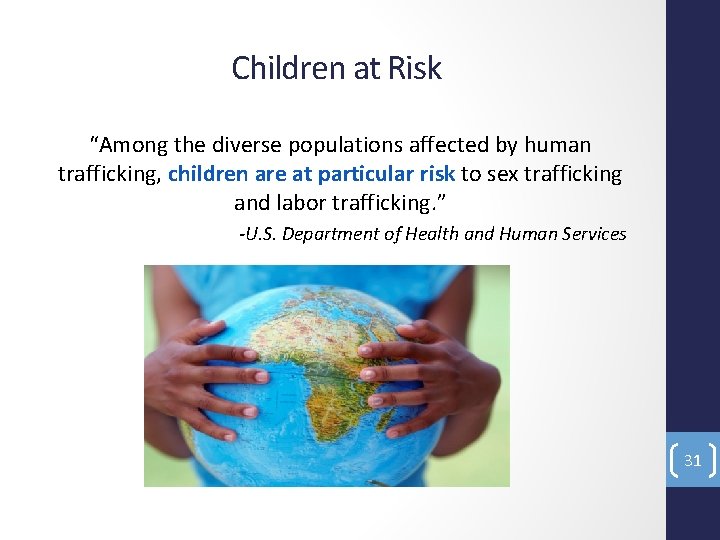
Children at Risk “Among the diverse populations affected by human trafficking, children are at particular risk to sex trafficking and labor trafficking. ” -U. S. Department of Health and Human Services 31
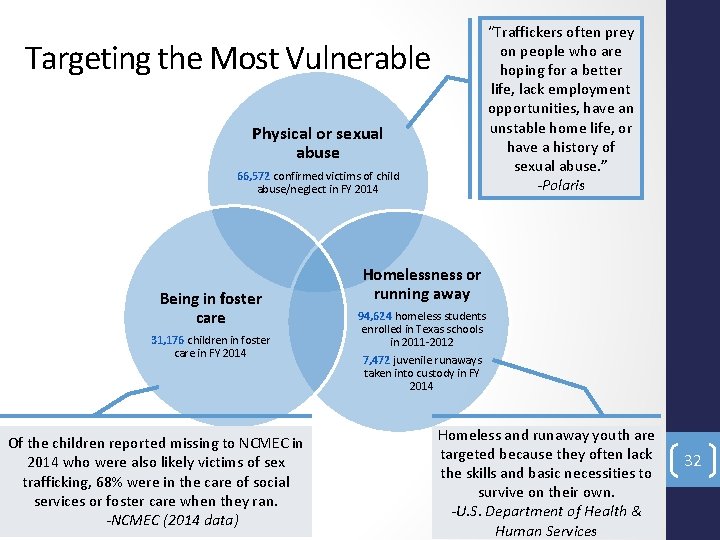
“Traffickers often prey on people who are hoping for a better life, lack employment opportunities, have an unstable home life, or have a history of sexual abuse. ” -Polaris Targeting the Most Vulnerable Physical or sexual abuse 66, 572 confirmed victims of child abuse/neglect in FY 2014 Being in foster care 31, 176 children in foster care in FY 2014 Of the children reported missing to NCMEC in 2014 who were also likely victims of sex trafficking, 68% were in the care of social services or foster care when they ran. -NCMEC (2014 data) Homelessness or running away 94, 624 homeless students enrolled in Texas schools in 2011 -2012 7, 472 juvenile runaways taken into custody in FY 2014 Homeless and runaway youth are targeted because they often lack the skills and basic necessities to survive on their own. -U. S. Department of Health & Human Services 32
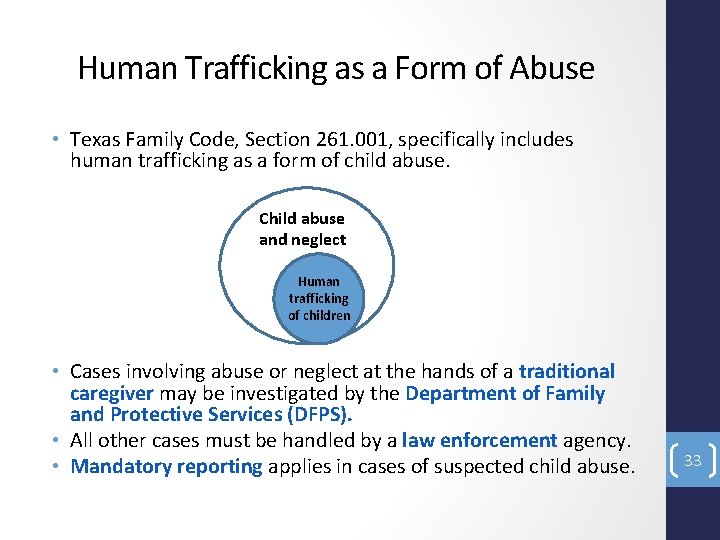
Human Trafficking as a Form of Abuse • Texas Family Code, Section 261. 001, specifically includes human trafficking as a form of child abuse. Child abuse and neglect Human trafficking of children • Cases involving abuse or neglect at the hands of a traditional caregiver may be investigated by the Department of Family and Protective Services (DFPS). • All other cases must be handled by a law enforcement agency. • Mandatory reporting applies in cases of suspected child abuse. 33
Understanding Child Trafficking • Thousands of children in the U. S. are at risk of trafficking. • Children have been trafficked throughout Texas. • Average a child is recruited or forced into prostitution: 11 -14 years old. • By understanding the dynamics of child trafficking, clinic staff will be better able to identify suspected instances of human trafficking and report as required. 34
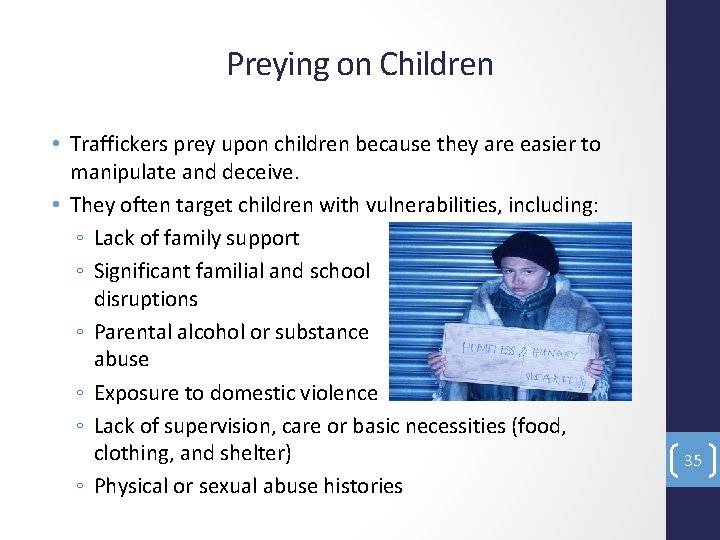
Preying on Children • Traffickers prey upon children because they are easier to manipulate and deceive. • They often target children with vulnerabilities, including: ◦ Lack of family support ◦ Significant familial and school disruptions ◦ Parental alcohol or substance abuse ◦ Exposure to domestic violence ◦ Lack of supervision, care or basic necessities (food, clothing, and shelter) ◦ Physical or sexual abuse histories 35
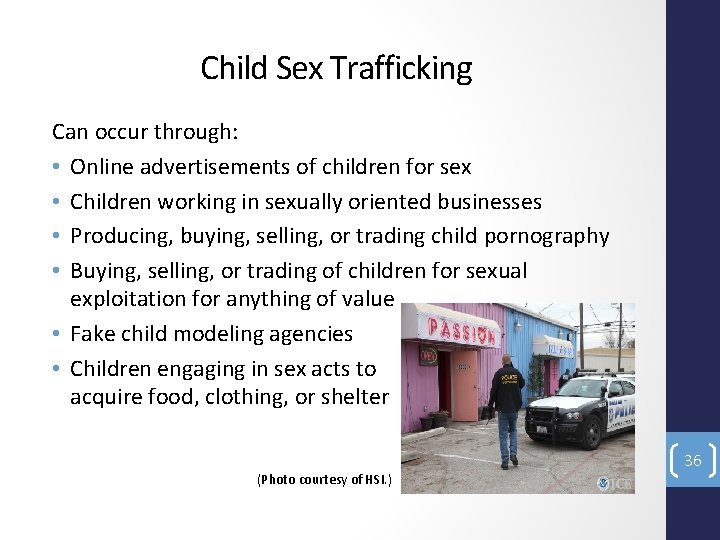
Child Sex Trafficking Can occur through: • Online advertisements of children for sex • Children working in sexually oriented businesses • Producing, buying, selling, or trading child pornography • Buying, selling, or trading of children for sexual exploitation for anything of value • Fake child modeling agencies • Children engaging in sex acts to acquire food, clothing, or shelter (Photo courtesy of HSI. ) 36
Objective 4. Understand recruitment 49 percent complete 37
The Strategy of Recruitment • Regardless of age, sex, or type of trafficking, victims are often recruited in similar ways. • By understanding the methods of traffickers, we can better identify victims and prevent exploitation. 38
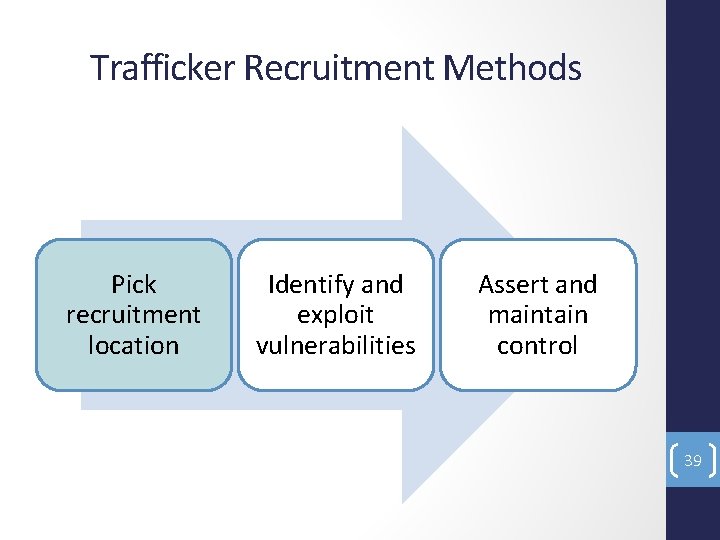
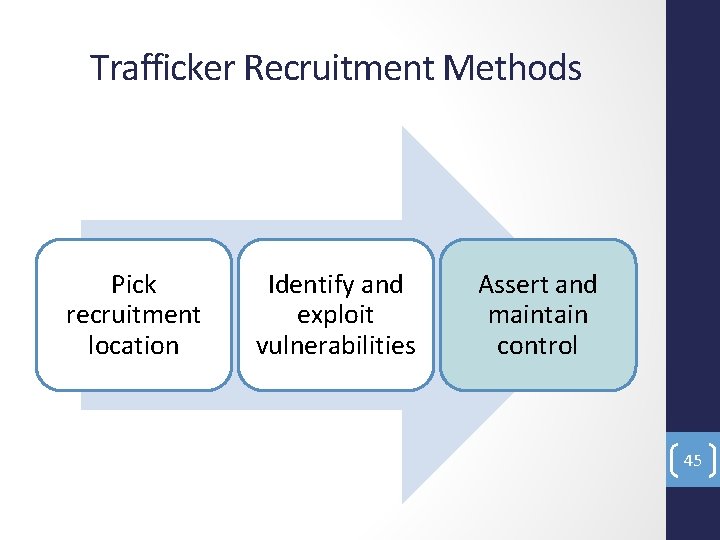
Trafficker Recruitment Methods Pick recruitment location Identify and exploit vulnerabilities Assert and maintain control 39
Recruitment Opportunities Places Internet Street Online job ads Foster homes and residential treatment centers Bus stops Gaming or other electronic devices with internet capabilities Texting apps Train/metro stops Computers/tablets/laptops Shopping centers Smartphones and cell phones Parks/playgrounds Social networks Shelters Concerts/sports/public events Court houses Schools Restaurants and bars Juvenile detention *If a trafficker does not have access to a recruitment location, the trafficker may use other victims to serve as recruiters. 40
Traffickers and Technology allows traffickers to more easily: • Make contact or stalk victims • Groom and recruit victims • Control victims • Employ sexting or sextortion tactics • Advertise and market victims • Connect with potential buyers • Complete transactions • Move victims • Maintain anonymity • Distance the trafficker from the crime 41
Using Technology to Recruit Children • Technology has facilitated exploitation of children, specifically. ◦ 75% of 12 - to 17 -year-olds own cellphones ◦ 93% of 12 - to 17 -year-olds go online • Technology can be used to “reach children anywhere, anytime” and traffickers use it to their advantage. 42
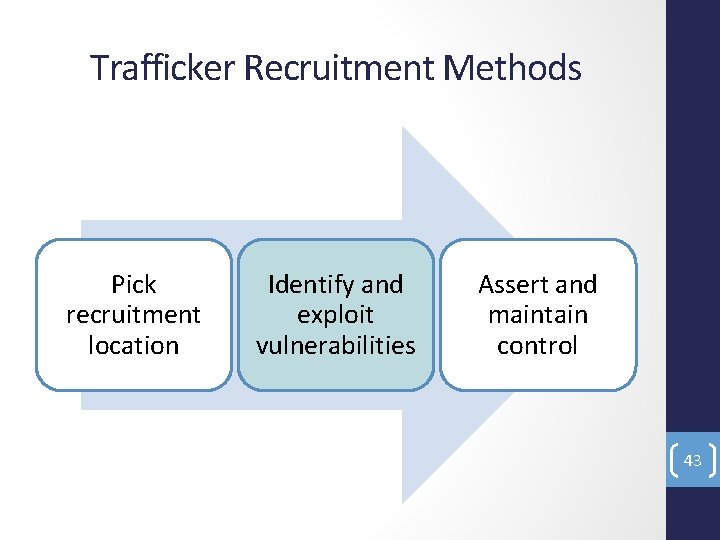
Trafficker Recruitment Methods Pick recruitment location Identify and exploit vulnerabilities Assert and maintain control 43
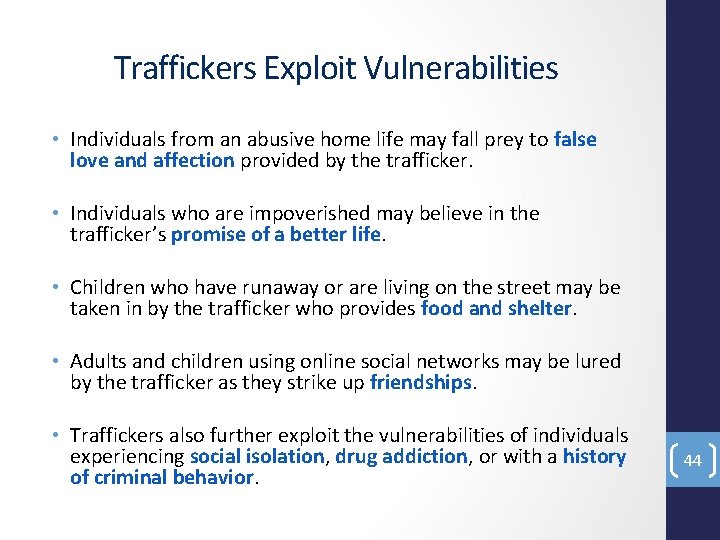
Traffickers Exploit Vulnerabilities • Individuals from an abusive home life may fall prey to false love and affection provided by the trafficker. • Individuals who are impoverished may believe in the trafficker’s promise of a better life. • Children who have runaway or are living on the street may be taken in by the trafficker who provides food and shelter. • Adults and children using online social networks may be lured by the trafficker as they strike up friendships. • Traffickers also further exploit the vulnerabilities of individuals experiencing social isolation, drug addiction, or with a history of criminal behavior. 44
Trafficker Recruitment Methods Pick recruitment location Identify and exploit vulnerabilities Assert and maintain control 45
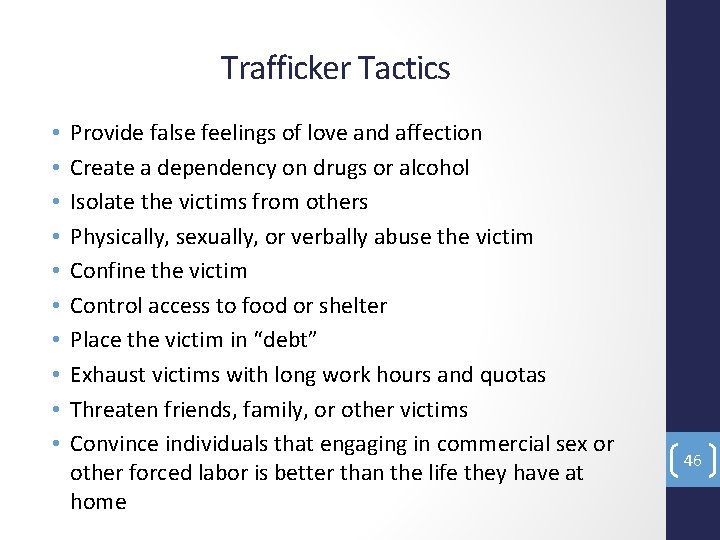
Trafficker Tactics • • • Provide false feelings of love and affection Create a dependency on drugs or alcohol Isolate the victims from others Physically, sexually, or verbally abuse the victim Confine the victim Control access to food or shelter Place the victim in “debt” Exhaust victims with long work hours and quotas Threaten friends, family, or other victims Convince individuals that engaging in commercial sex or other forced labor is better than the life they have at home 46
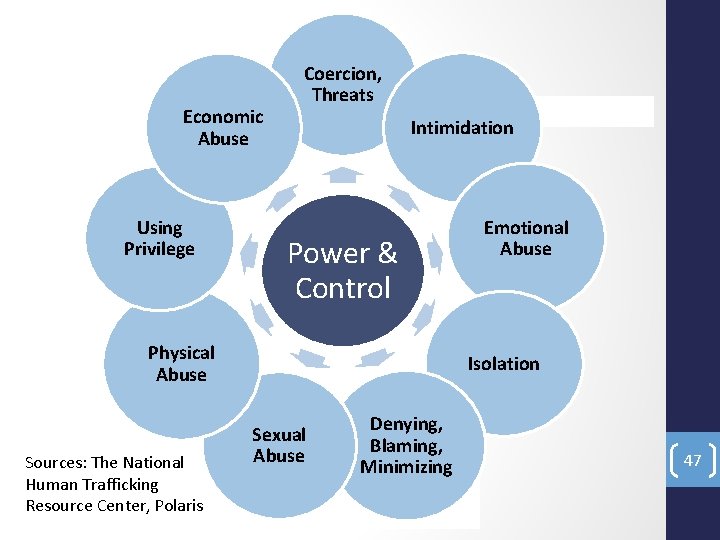
Economic Abuse Using Privilege Coercion, Threats Intimidation Power & Control Physical Abuse Sources: The National Human Trafficking Resource Center, Polaris Emotional Abuse Isolation Sexual Abuse Denying, Blaming, Minimizing 47
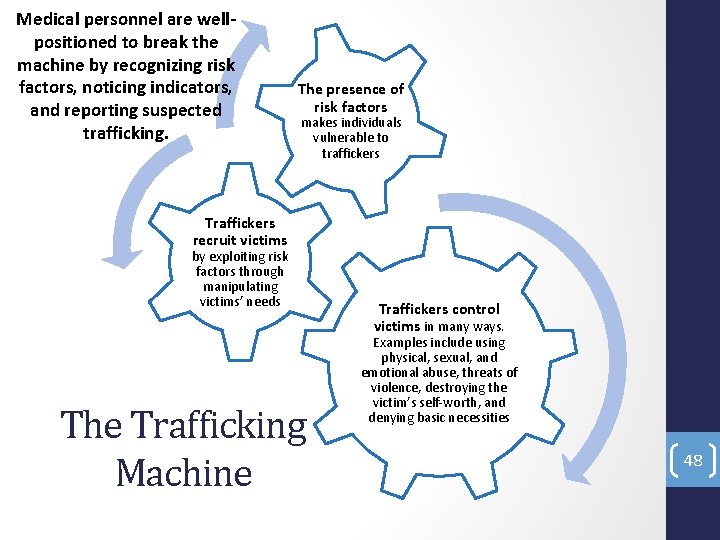
Medical personnel are wellpositioned to break the machine by recognizing risk factors, noticing indicators, and reporting suspected trafficking. The presence of risk factors makes individuals vulnerable to traffickers Traffickers recruit victims by exploiting risk factors through manipulating victims’ needs The Trafficking Machine Traffickers control victims in many ways. Examples include using physical, sexual, and emotional abuse, threats of violence, destroying the victim’s self-worth, and denying basic necessities 48
Objective 5. Understand human trafficking indicators in the clinical setting 64 percent complete 49
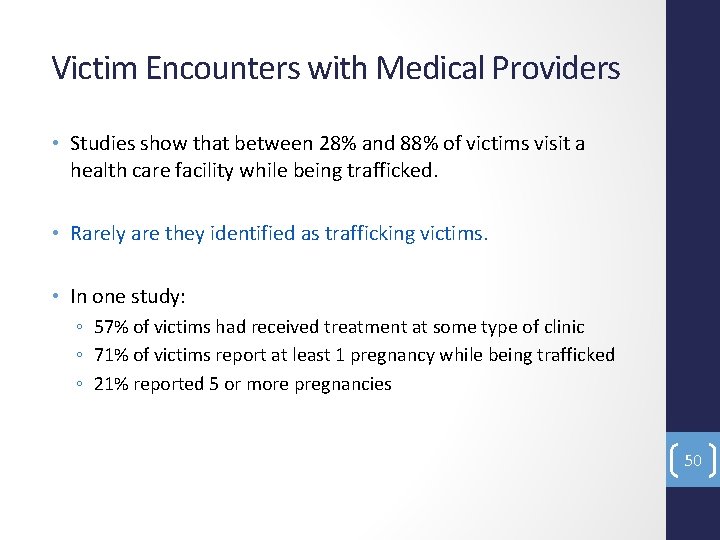
Victim Encounters with Medical Providers • Studies show that between 28% and 88% of victims visit a health care facility while being trafficked. • Rarely are they identified as trafficking victims. • In one study: ◦ 57% of victims had received treatment at some type of clinic ◦ 71% of victims report at least 1 pregnancy while being trafficked ◦ 21% reported 5 or more pregnancies 50
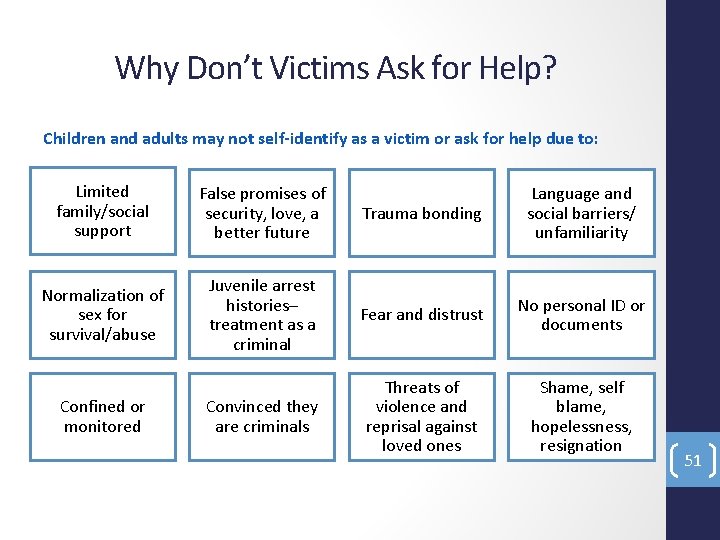
Why Don’t Victims Ask for Help? Children and adults may not self-identify as a victim or ask for help due to: Limited family/social support False promises of security, love, a better future Trauma bonding Language and social barriers/ unfamiliarity Normalization of sex for survival/abuse Juvenile arrest histories– treatment as a criminal Fear and distrust No personal ID or documents Convinced they are criminals Threats of violence and reprisal against loved ones Shame, self blame, hopelessness, resignation Confined or monitored 51
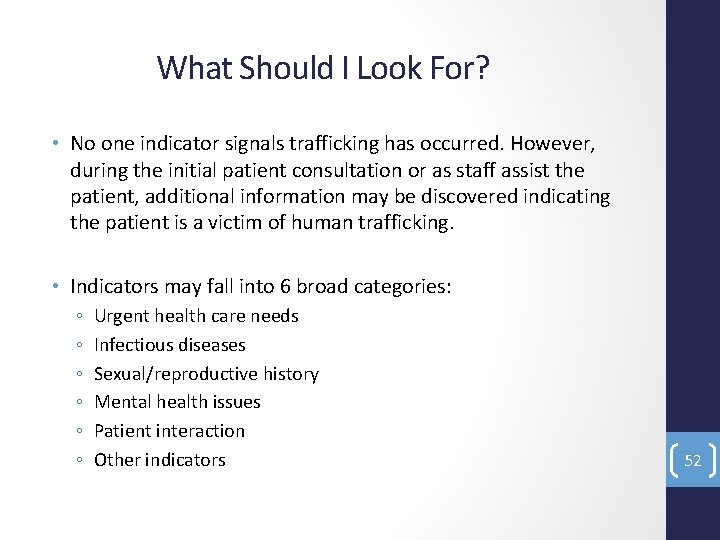
What Should I Look For? • No one indicator signals trafficking has occurred. However, during the initial patient consultation or as staff assist the patient, additional information may be discovered indicating the patient is a victim of human trafficking. • Indicators may fall into 6 broad categories: ◦ ◦ ◦ Urgent health care needs Infectious diseases Sexual/reproductive history Mental health issues Patient interaction Other indicators 52
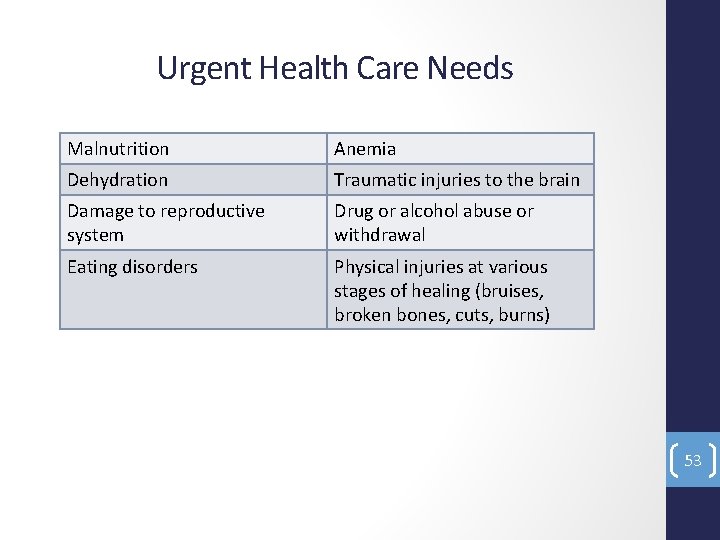
Urgent Health Care Needs Malnutrition Anemia Dehydration Traumatic injuries to the brain Damage to reproductive system Drug or alcohol abuse or withdrawal Eating disorders Physical injuries at various stages of healing (bruises, broken bones, cuts, burns) 53
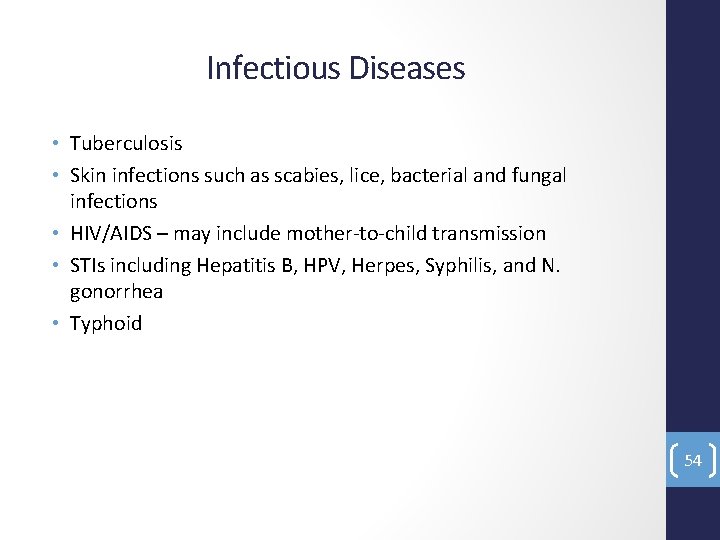
Infectious Diseases • Tuberculosis • Skin infections such as scabies, lice, bacterial and fungal infections • HIV/AIDS – may include mother-to-child transmission • STIs including Hepatitis B, HPV, Herpes, Syphilis, and N. gonorrhea • Typhoid 54
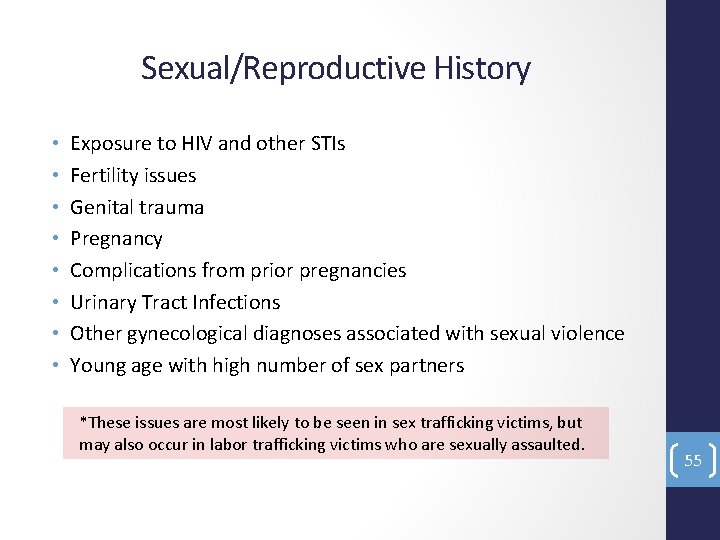
Sexual/Reproductive History • • Exposure to HIV and other STIs Fertility issues Genital trauma Pregnancy Complications from prior pregnancies Urinary Tract Infections Other gynecological diagnoses associated with sexual violence Young age with high number of sex partners *These issues are most likely to be seen in sex trafficking victims, but may also occur in labor trafficking victims who are sexually assaulted. 55
Mental Health Issues Trafficking victims may suffer from mental health issues stemming from their victimization, such as: • Depression • Acute anxiety, stress, paranoia • PTSD • Self-destructive behaviors • Suicidal ideation • Dissociative disorder • Explosive outbursts • Hyper-sexualization • Eating disorders 56
Patient Interaction • Many times, victims: ◦ Have scripted answers or inconsistent stories ◦ Avoid eye contact ◦ Are not allowed to speak for themselves ◦ Are accompanied by another individual (the trafficker) who is providing answers to questions directed at the victim ◦ Person does not leave patient alone with staff, even during examination ◦ Have few or no personal possessions ◦ Do not control own money, ID, or other legal papers 57
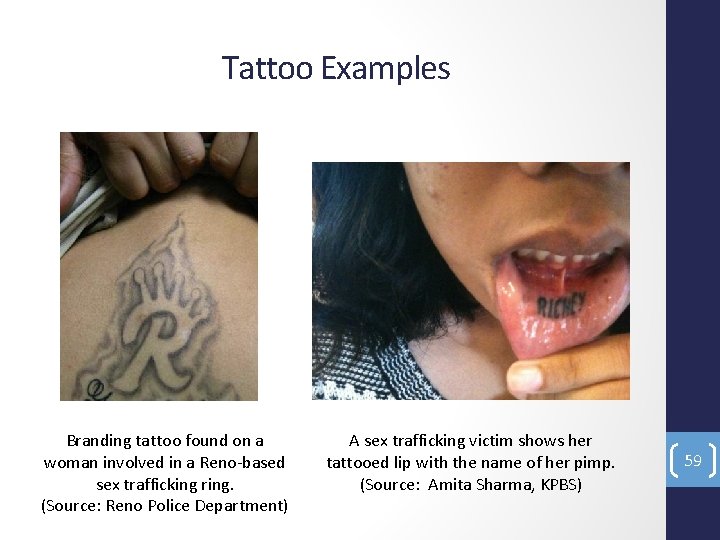
Other Indicators Several other indicators may also be identified when serving trafficking victims. Patient has branding tattoos such as “daddy” or bar code designs Patient reports being a runaway or homeless Patient has bald spots, rotting Patient has large amounts of teeth, or other indicators of poor cash on hand health Patient is dressed in inappropriate or revealing clothing 58
Tattoo Examples Branding tattoo found on a woman involved in a Reno-based sex trafficking ring. (Source: Reno Police Department) A sex trafficking victim shows her tattooed lip with the name of her pimp. (Source: Amita Sharma, KPBS) 59
Objective 6. Understand how to respond to victims of trafficking and report as appropriate 79 percent complete 60
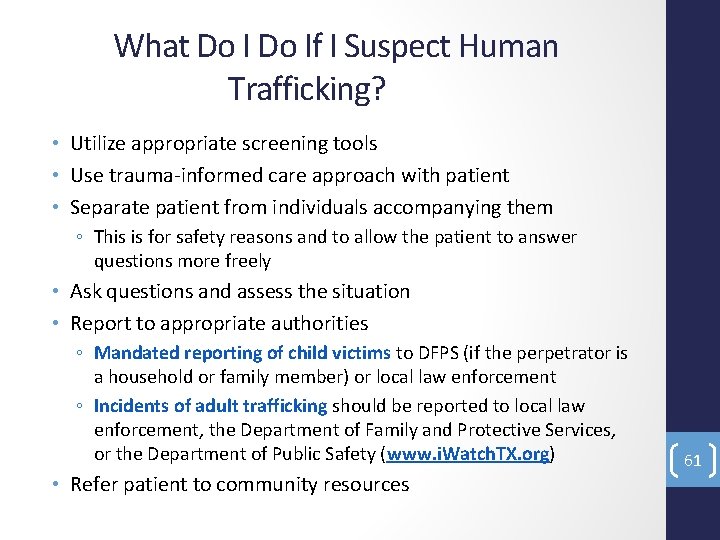
What Do If I Suspect Human Trafficking? • Utilize appropriate screening tools • Use trauma-informed care approach with patient • Separate patient from individuals accompanying them ◦ This is for safety reasons and to allow the patient to answer questions more freely • Ask questions and assess the situation • Report to appropriate authorities ◦ Mandated reporting of child victims to DFPS (if the perpetrator is a household or family member) or local law enforcement ◦ Incidents of adult trafficking should be reported to local law enforcement, the Department of Family and Protective Services, or the Department of Public Safety (www. i. Watch. TX. org) • Refer patient to community resources 61
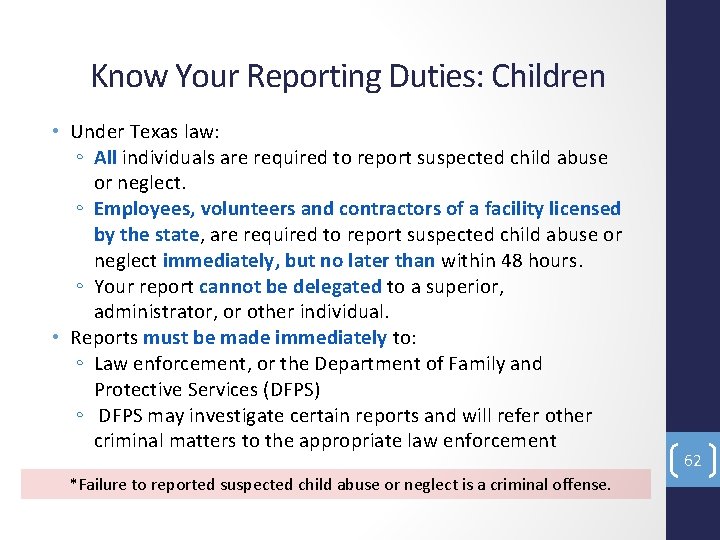
Know Your Reporting Duties: Children • Under Texas law: ◦ All individuals are required to report suspected child abuse or neglect. ◦ Employees, volunteers and contractors of a facility licensed by the state, are required to report suspected child abuse or neglect immediately, but no later than within 48 hours. ◦ Your report cannot be delegated to a superior, administrator, or other individual. • Reports must be made immediately to: ◦ Law enforcement, or the Department of Family and Protective Services (DFPS) ◦ DFPS may investigate certain reports and will refer other criminal matters to the appropriate law enforcement *Failure to reported suspected child abuse or neglect is a criminal offense. 62
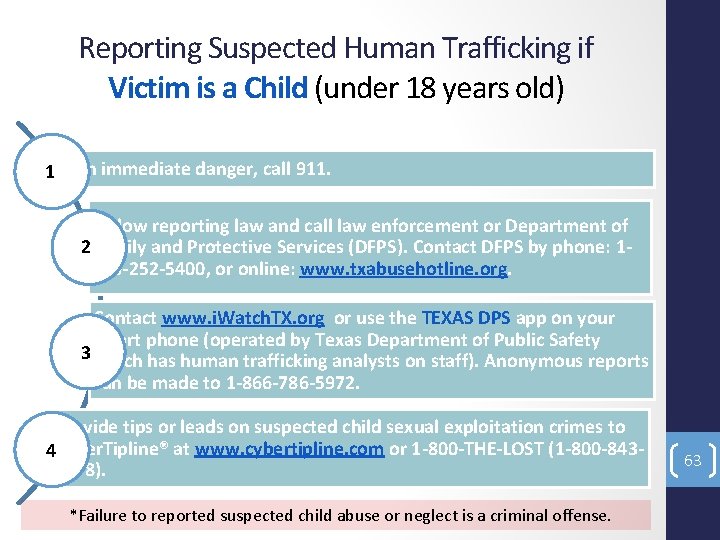
Reporting Suspected Human Trafficking if Victim is a Child (under 18 years old) 1 If an immediate danger, call 911. Follow reporting law and call law enforcement or Department of 2 Family and Protective Services (DFPS). Contact DFPS by phone: 1800 -252 -5400, or online: www. txabusehotline. org. Contact www. i. Watch. TX. org or use the TEXAS DPS app on your smart phone (operated by Texas Department of Public Safety 3 which has human trafficking analysts on staff). Anonymous reports can be made to 1 -866 -786 -5972. Provide tips or leads on suspected child sexual exploitation crimes to 4 Cyber. Tipline® at www. cybertipline. com or 1 -800 -THE-LOST (1 -800 -8435678). *Failure to reported suspected child abuse or neglect is a criminal offense. 63
What to do if a Child Makes an Outcry 1. Make sure you and the victim are safe. 2. Remain calm. 3. Assure the child he or she did the right thing in telling you and that he or she is not to blame for the abuse. 4. Do not make promises about what will happen to them or the trafficker. 5. Let the child tell his or her story, but leave the questioning to the professionals. 6. Never confront the suspected trafficker. 7. Report. Texas law requires reporting to law enforcement or child protective services immediately, but no later than within 48 hours. 64
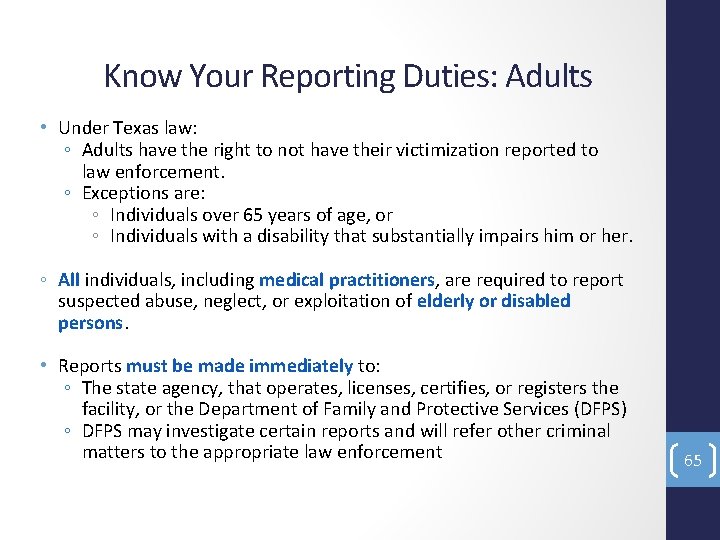
Know Your Reporting Duties: Adults • Under Texas law: ◦ Adults have the right to not have their victimization reported to law enforcement. ◦ Exceptions are: ◦ Individuals over 65 years of age, or ◦ Individuals with a disability that substantially impairs him or her. ◦ All individuals, including medical practitioners, are required to report suspected abuse, neglect, or exploitation of elderly or disabled persons. • Reports must be made immediately to: ◦ The state agency, that operates, licenses, certifies, or registers the facility, or the Department of Family and Protective Services (DFPS) ◦ DFPS may investigate certain reports and will refer other criminal matters to the appropriate law enforcement 65
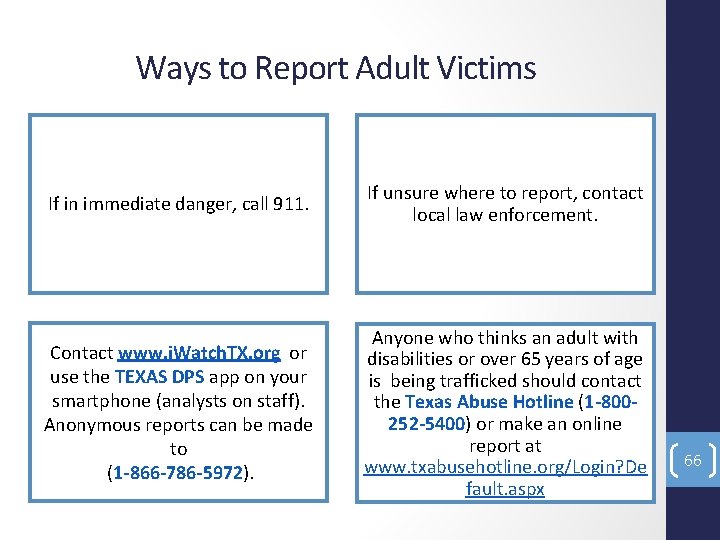
Ways to Report Adult Victims If in immediate danger, call 911. If unsure where to report, contact local law enforcement. Contact www. i. Watch. TX. org or use the TEXAS DPS app on your smartphone (analysts on staff). Anonymous reports can be made to (1 -866 -786 -5972). Anyone who thinks an adult with disabilities or over 65 years of age is being trafficked should contact the Texas Abuse Hotline (1 -800252 -5400) or make an online report at www. txabusehotline. org/Login? De fault. aspx 66
Objective 7. Take next steps 88 percent complete 67
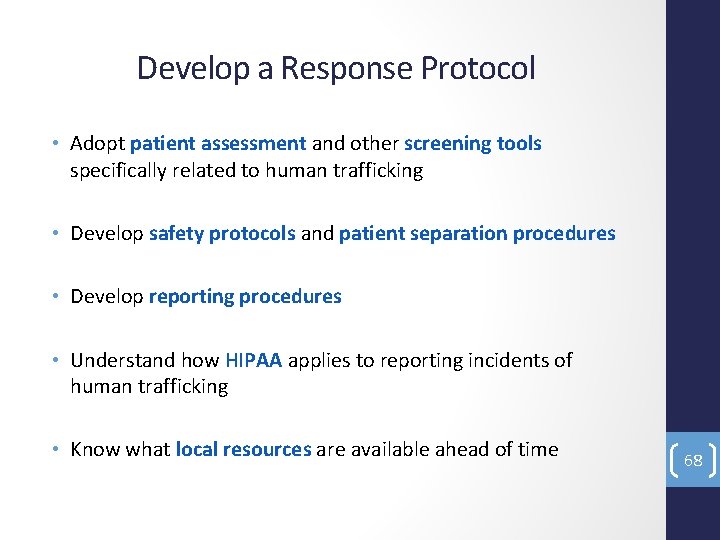
Develop a Response Protocol • Adopt patient assessment and other screening tools specifically related to human trafficking • Develop safety protocols and patient separation procedures • Develop reporting procedures • Understand how HIPAA applies to reporting incidents of human trafficking • Know what local resources are available ahead of time 68
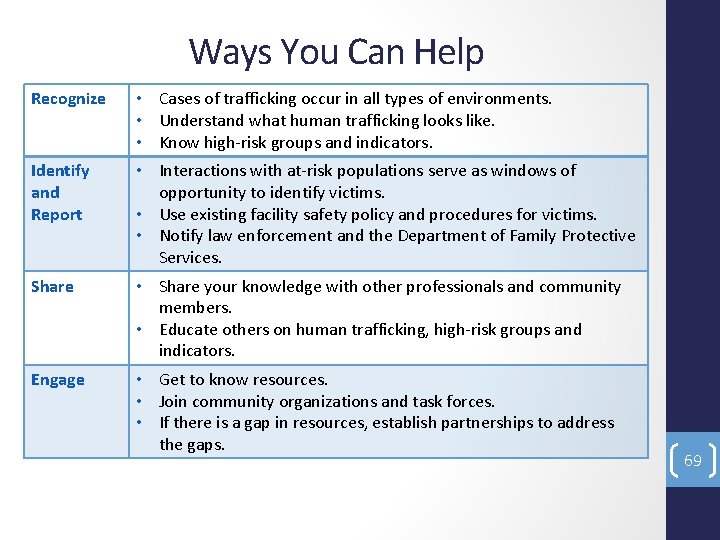
Ways You Can Help Recognize • Cases of trafficking occur in all types of environments. • Understand what human trafficking looks like. • Know high-risk groups and indicators. Identify and Report • Interactions with at-risk populations serve as windows of opportunity to identify victims. • Use existing facility safety policy and procedures for victims. • Notify law enforcement and the Department of Family Protective Services. Share • Share your knowledge with other professionals and community members. • Educate others on human trafficking, high-risk groups and indicators. Engage • Get to know resources. • Join community organizations and task forces. • If there is a gap in resources, establish partnerships to address the gaps. 69
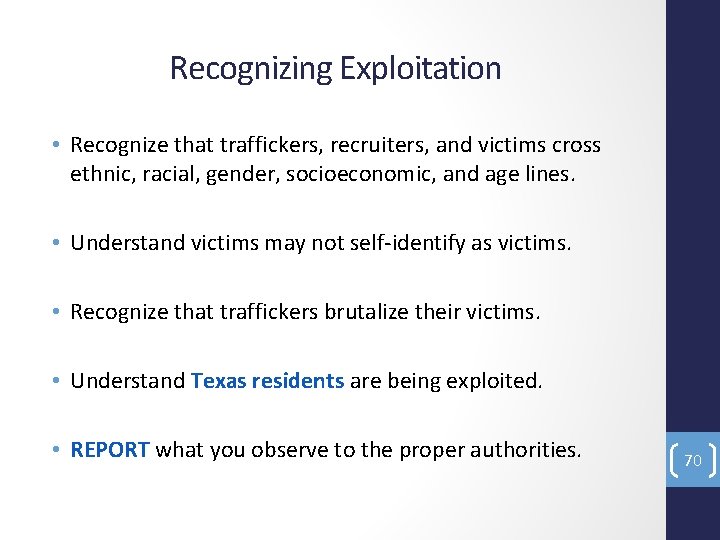
Recognizing Exploitation • Recognize that traffickers, recruiters, and victims cross ethnic, racial, gender, socioeconomic, and age lines. • Understand victims may not self-identify as victims. • Recognize that traffickers brutalize their victims. • Understand Texas residents are being exploited. • REPORT what you observe to the proper authorities. 70
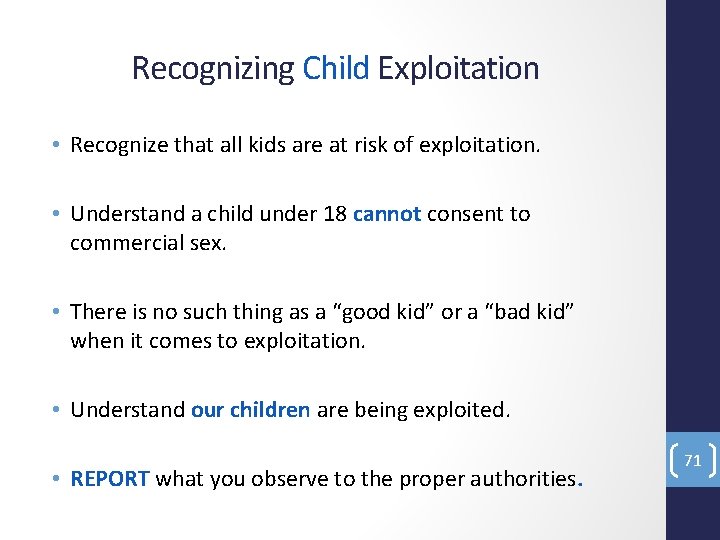
Recognizing Child Exploitation • Recognize that all kids are at risk of exploitation. • Understand a child under 18 cannot consent to commercial sex. • There is no such thing as a “good kid” or a “bad kid” when it comes to exploitation. • Understand our children are being exploited. • REPORT what you observe to the proper authorities. 71
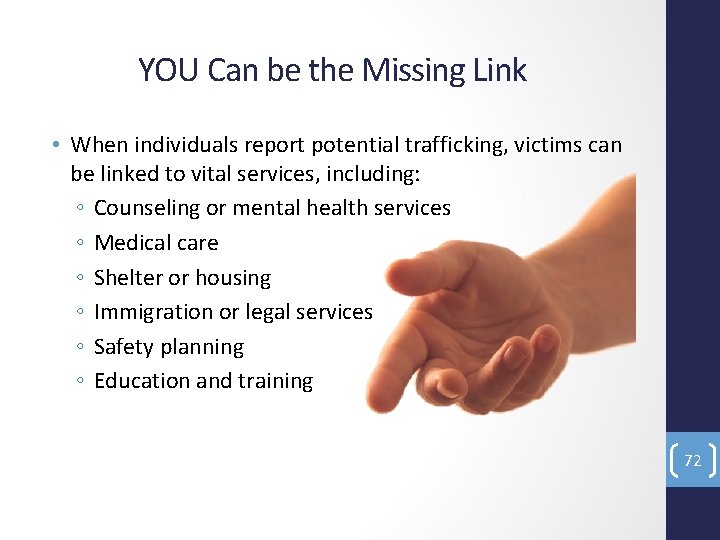
YOU Can be the Missing Link • When individuals report potential trafficking, victims can be linked to vital services, including: ◦ Counseling or mental health services ◦ Medical care ◦ Shelter or housing ◦ Immigration or legal services ◦ Safety planning ◦ Education and training 72
Resources Below are resources to help identify and serve victims of trafficking. The list is not meant to be exhaustive, and your facility may have other preferred tools, resources, or protocols that would apply to incidents of human trafficking • Potential Screening tools ◦ Screening for Human Trafficking: Guidelines for Administering the Trafficking Victim Identification Tool (TVIT). (June 2014). VERA Institute of Justice. Retrieved from http: //www. vera. org/sites/default/files/resources/downloads/humantrafficking-identification-tool-and-user-guidelines. pdf. ◦ Polaris. Medical Assessment Tool. Retrieved from http: //www. traffickingresourcecenter. org/sites/default/files/Assessment%2 0 Tool%20 -%20 Medical%20 Professionals. pdf. ◦ Alpert, E. J, et al. Human Trafficking: Guidebook on Identification, Assessment, and Response in the Health Care Setting. Massachusetts General Hospital and Massachusetts Medical Society. Retrieved from http: //www. massmed. org/Patient-Care/Health-Topics/Violence-Preventionand-Intervention/Human-Trafficking-(pdf)/. 73
Resources • Trauma-informed care ◦ Office for Victims of Crime, Training and Technical Assistance Center. Using a Trauma-Informed Approach. Retrieved from https: //www. ovcttac. gov/taskforceguide/4 -supportingvictims/41 -using-a-trauma-informed-approach/. ◦ National Human Trafficking Resource Center. Trauma-informed Care and FYSB Outcomes for Runaway and Homeless Youth. Retrieved from http: //traffickingresourcecenter. org/resources/trauma-informedcare-and-fysb-outcomes-runaway-and-homeless-youth. ◦ Welch, Katherine, and Gloria Halverson. Christian Medical & Dental Associations. “Physical Health Consequences of Human Trafficking”. http: //cmda. org/library/doclib/tip-module-3 -1. pdf 74
Resources • Other resources ◦ Isaac, Reena, Jennifer Solak, and Angelo P. Giardino. 2011. “Health Care Providers’ Training Needs Related to Human Trafficking: Maximizing the Opportunity to Effectively Screen and Intervene. ” Journal of Applied Research on Children. Vol. 2(1). Article 8. http: //digitalcommons. library. tmc. edu/childrenatrisk/vol 2/iss 1/8/ ◦ Christian Medical & Dental Associations. “Human Trafficking Continuing Education. ” http: //cmda. org/resources/publication/human-traffickingcontinuing-education. 75
National Human Trafficking Resource Center You may also contact the National Human Trafficking Resource Center (1 -888 -373 -7888) to get additional information: • Provide confidential tips. • Connect with anti-trafficking services. • Request training and technical assistance, general information, or specific anti-trafficking resources. 76