
AN INTRODUCTION TO HIGH RESOLUTION COHERENT MULTIDIMENSIONAL SPECTROSCOPY
- Slides: 22
AN INTRODUCTION TO HIGH RESOLUTION COHERENT MULTIDIMENSIONAL SPECTROSCOPY New 2 D and 3 D tools for dealing with severe rotational congestion Peter C. Chen, Thresa A. Wells, and Zuri R. House Spelman College, Atlanta GA Benjamin R. Strangfeld Georgia Institute of Technology, Atlanta GA
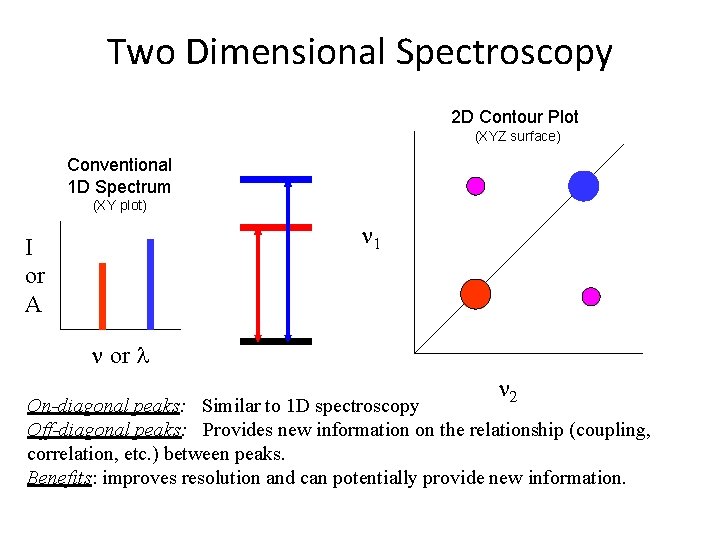
Two Dimensional Spectroscopy 2 D Contour Plot (XYZ surface) Conventional 1 D Spectrum (XY plot) n 1 I or A n or l n 2 On-diagonal peaks: Similar to 1 D spectroscopy Off-diagonal peaks: Provides new information on the relationship (coupling, correlation, etc. ) between peaks. Benefits: improves resolution and can potentially provide new information.
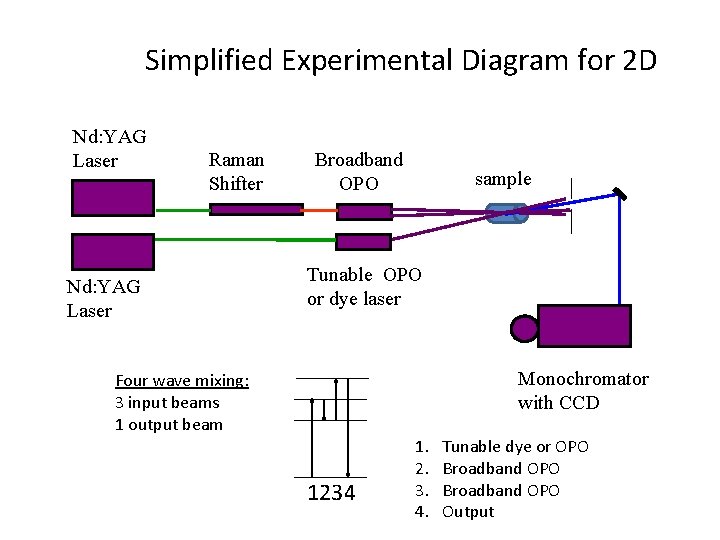
Simplified Experimental Diagram for 2 D Nd: YAG Laser Raman Shifter Nd: YAG Laser Broadband OPO sample Tunable OPO or dye laser Monochromator with CCD Four wave mixing: 3 input beams 1 output beam 1234 1. 2. 3. 4. Tunable dye or OPO Broadband OPO Output
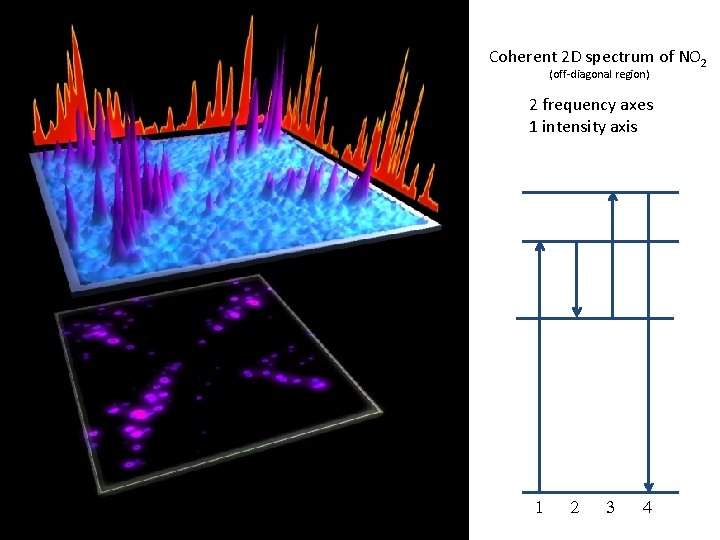
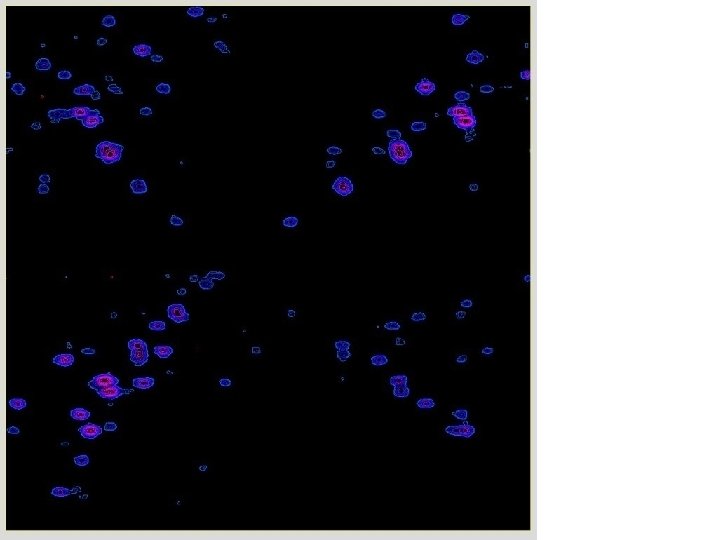
Coherent 2 D spectrum of NO 2 (off-diagonal region) 2 frequency axes 1 intensity axis 1 2 3 4
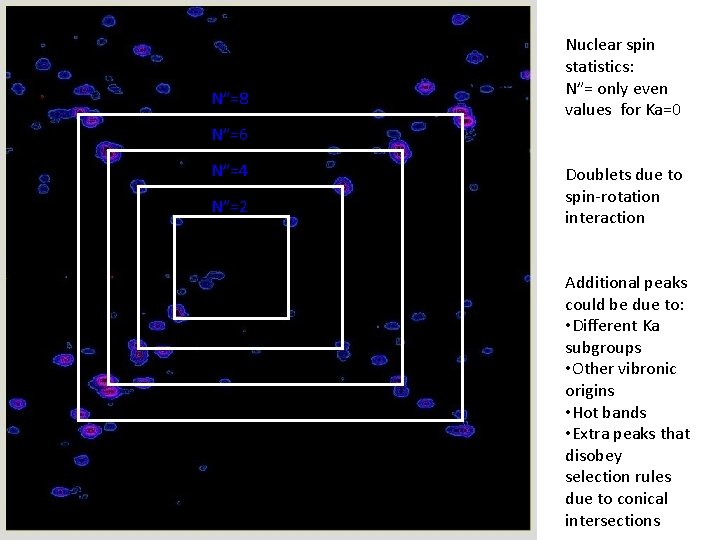
N”=8 Nuclear spin statistics: N”= only even values for Ka=0 N”=6 N”=4 N”=2 Doublets due to spin-rotation interaction Additional peaks could be due to: • Different Ka subgroups • Other vibronic origins • Hot bands • Extra peaks that disobey selection rules due to conical intersections
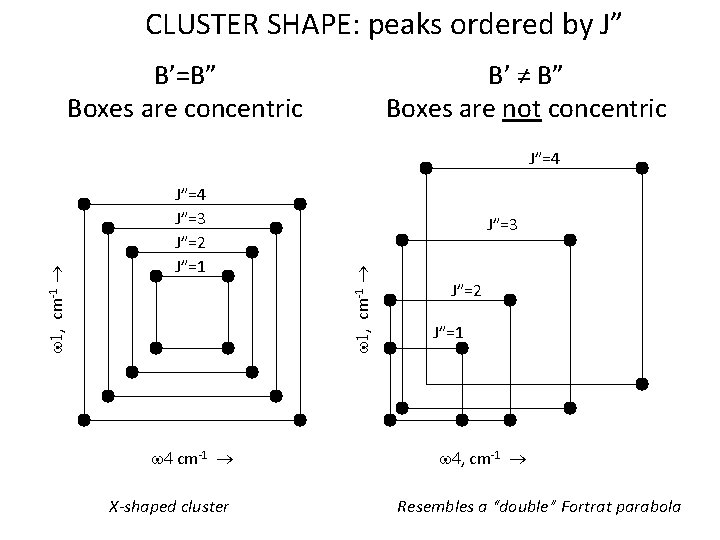
CLUSTER SHAPE: peaks ordered by J” B’=B” Boxes are concentric B’ ≠ B” Boxes are not concentric J”=4 J”=3 J”=2 J”=1 w 4 cm-1 X-shaped cluster J”=3 w 1, cm-1 J”=4 J”=2 J”=1 w 4, cm-1 Resembles a “double” Fortrat parabola
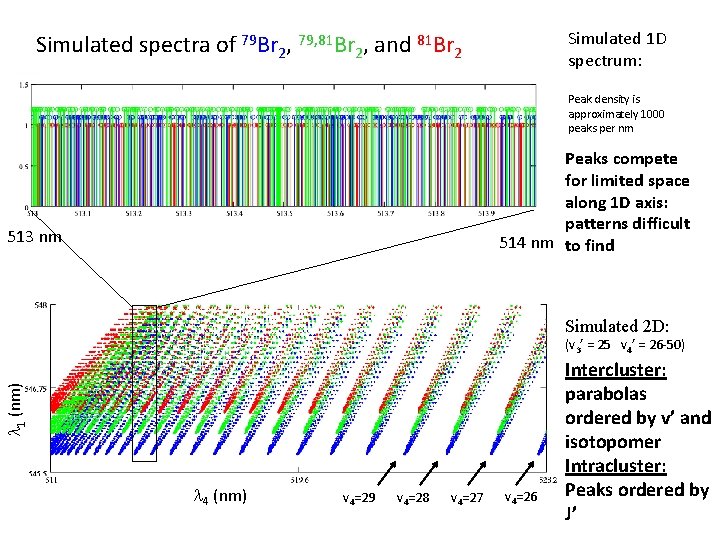
Simulated 1 D spectrum: Simulated spectra of 79 Br 2, 79, 81 Br 2, and 81 Br 2 Peak density is approximately 1000 peaks per nm Peaks compete for limited space along 1 D axis: patterns difficult 514 nm to find 513 nm Simulated 2 D: l 1 (nm) (v 3’ = 25 v 4’ = 26 -50) l 4 (nm) v 4=29 v 4=28 v 4=27 v 4=26 Intercluster: parabolas ordered by v’ and isotopomer Intracluster: Peaks ordered by J’
2 D Clusters / information • Electronic – general location of off-diagonal features • Vibrational – inter-cluster relationships. Spacing between clusters corresponds to spacing between vibrational levels. • Rotational – intra-cluster relationships. Shape and size of each cluster depends upon rotational constants.
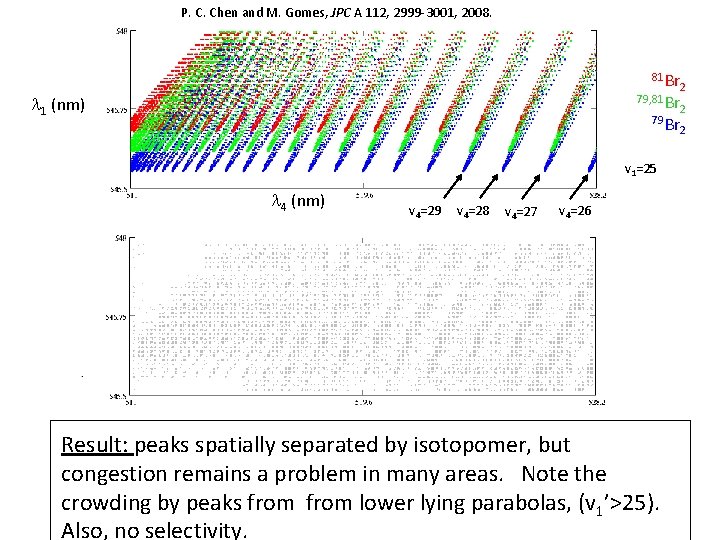
P. C. Chen and M. Gomes, JPC A 112, 2999 -3001, 2008. 81 Br 79, 81 Br l 1 (nm) 79 Br v 1=25 l 4 (nm) v 4=29 v 4=28 v 4=27 v 4=26 Result: peaks spatially separated by isotopomer, but congestion remains a problem in many areas. Note the crowding by peaks from lower lying parabolas, (v 1’>25). Also, no selectivity. 2 2 2
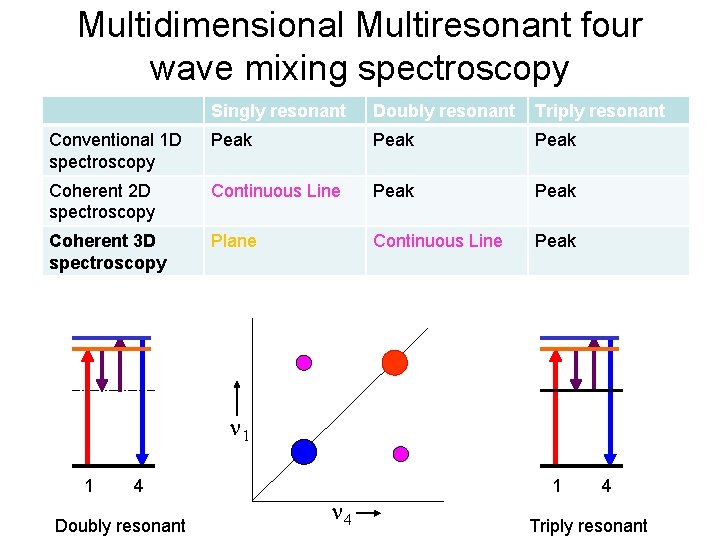
Multidimensional Multiresonant four wave mixing spectroscopy Singly resonant Doubly resonant Triply resonant Conventional 1 D spectroscopy Peak Coherent 2 D spectroscopy Continuous Line Peak Coherent 3 D spectroscopy Plane Continuous Line Peak n 1 1 4 Doubly resonant n 4 1 4 Triply resonant
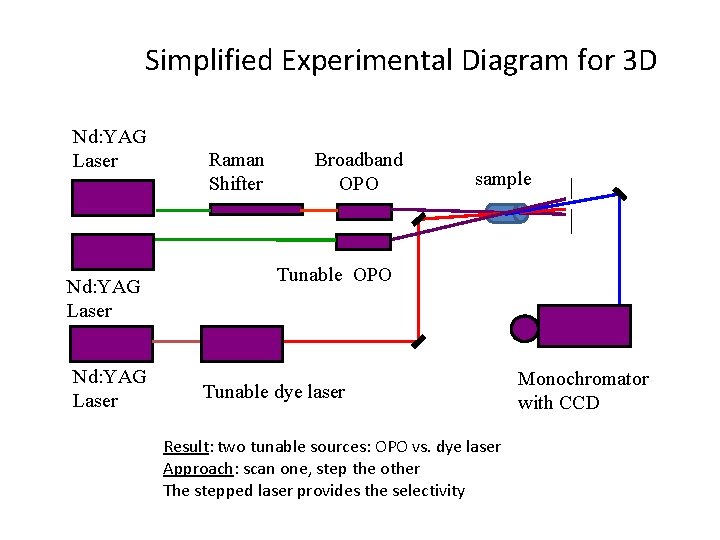
Simplified Experimental Diagram for 3 D Nd: YAG Laser Raman Shifter Broadband OPO sample Tunable OPO Tunable dye laser Result: two tunable sources: OPO vs. dye laser Approach: scan one, step the other The stepped laser provides the selectivity Monochromator with CCD
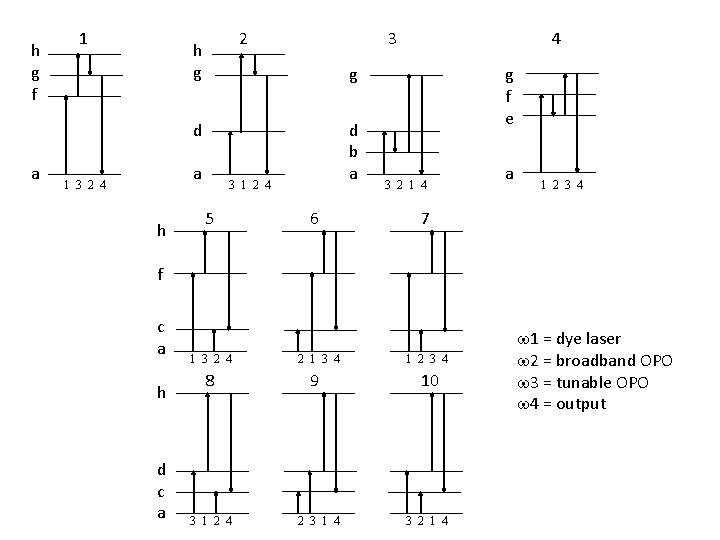
h g f 1 2 h g 3 g d a a 1 3 2 4 h 4 d b a 3 1 2 4 5 6 g f e 3 2 1 4 a 1 2 3 4 7 f c a h d c a 1 3 2 4 8 3 1 2 4 2 1 3 4 9 2 3 1 4 1 2 3 4 10 3 2 1 4 w 1 = dye laser w 2 = broadband OPO w 3 = tunable OPO w 4 = output
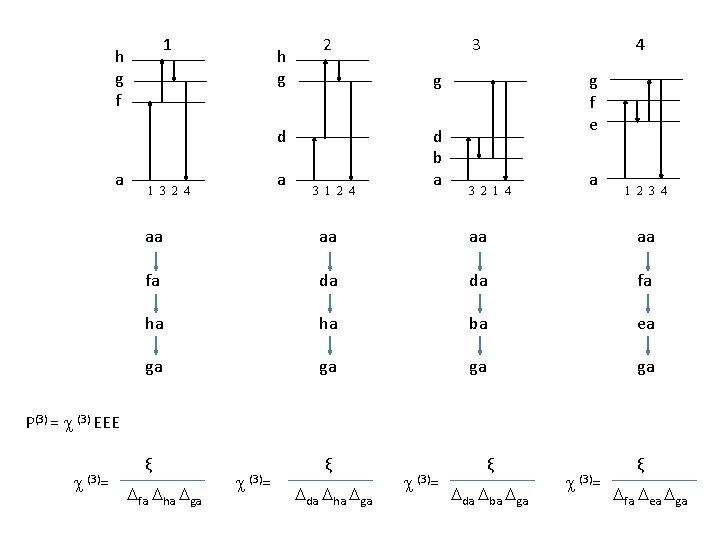
1 h g f h g 2 3 g d a a 1 3 2 4 4 d b a 3 1 2 4 g f e a 3 2 1 4 1 2 3 4 aa aa fa da da fa ha ha ba ea ga ga P(3) = c (3) EEE c (3)= ξ Dfa Dha Dga c (3)= ξ Dda Dba Dga c (3)= ξ Dfa Dea Dga
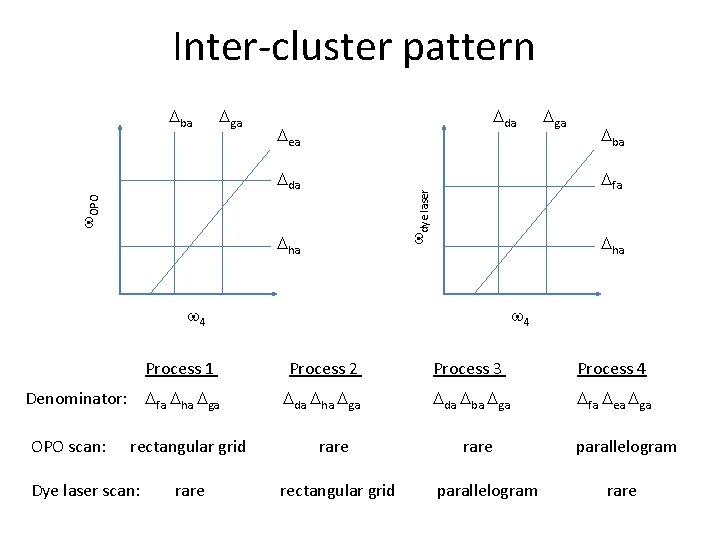
Inter-cluster pattern Dba Dga Dda Dea w. OPO Dha Dba Dfa wdye laser Dda Dga Dha w 4 Process 1 Process 2 Process 3 Process 4 Denominator: Dfa Dha Dga Dda Dba Dga Dfa Dea Dga OPO scan: rectangular grid Dye laser scan: rare rectangular grid rare parallelogram rare
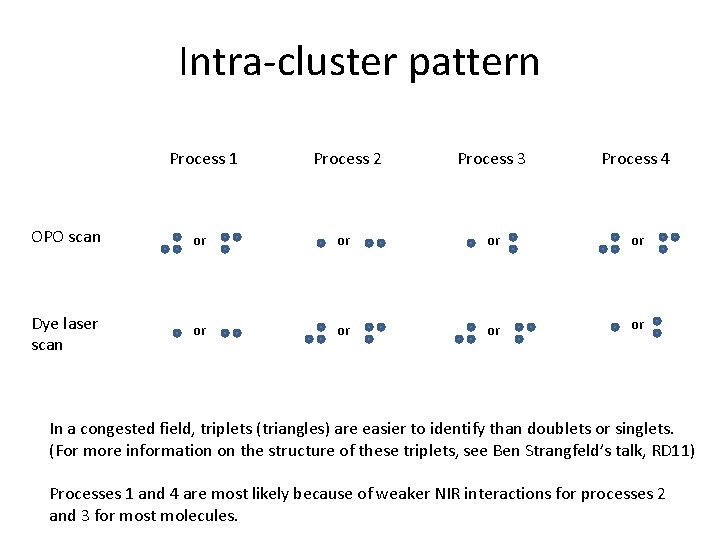
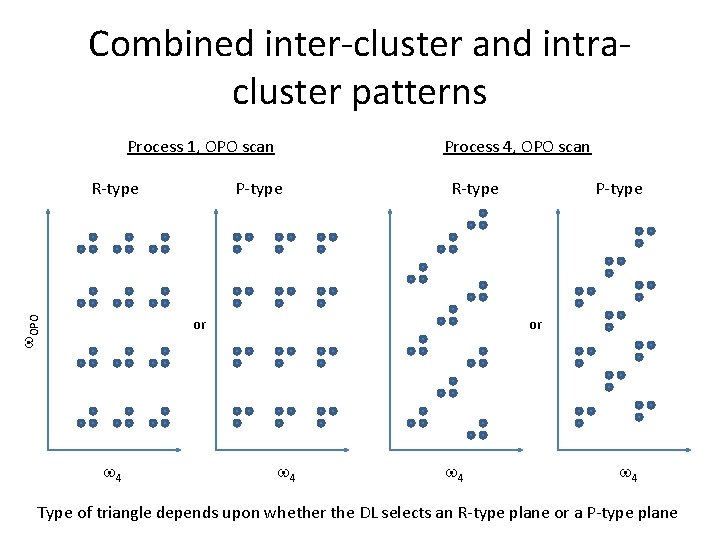
Intra-cluster pattern Process 1 Process 2 Process 3 Process 4 OPO scan or or Dye laser scan or or In a congested field, triplets (triangles) are easier to identify than doublets or singlets. (For more information on the structure of these triplets, see Ben Strangfeld’s talk, RD 11) Processes 1 and 4 are most likely because of weaker NIR interactions for processes 2 and 3 for most molecules.
Combined inter-cluster and intracluster patterns Process 1, OPO scan w. OPO R-type Process 4, OPO scan P-type R-type or w 4 P-type or w 4 w 4 Type of triangle depends upon whether the DL selects an R-type plane or a P-type plane
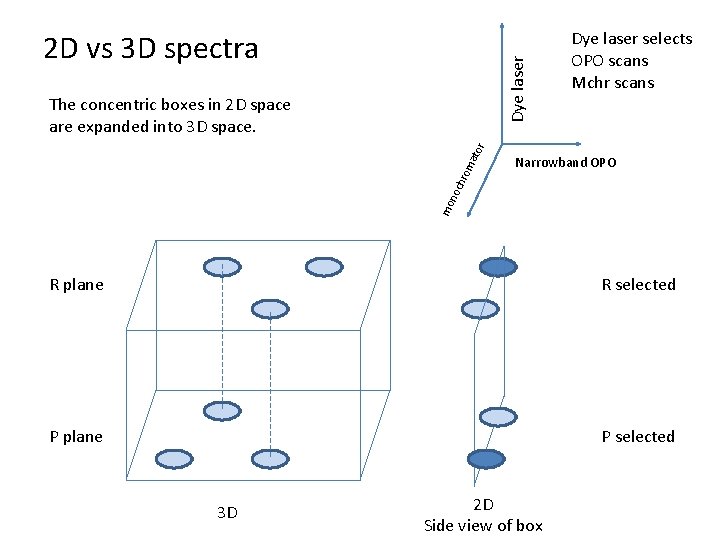
Dye laser 2 D vs 3 D spectra Narrowband OPO mo noc hro ma tor The concentric boxes in 2 D space are expanded into 3 D space. Dye laser selects OPO scans Mchr scans R plane R selected P plane P selected 3 D 2 D Side view of box
Implications • High resolution Coherent 3 D spectroscopy can be thought of as a selective version of its 2 D counterpart. This selectivity is made by fixing one of the input lasers while scanning the other(s). – The 2 D spectrum is expanded into 3 D space; – Fixing one of the narrowband input lasers selects a Ptype or R-type plane – Scanning the other lasers/mchr produces the resulting slice in this 3 D space
Next 3 talks • RD 10 - Thresa A. Wells: NO 2 and intercluster patterns • RD 11 - Benjamin R. Strangfeld: Br 2 and intracluster patterns • RD 12 - Zuri R. House: I 2 and future directions
Summary • High resolution spectroscopy of large or complex molecules suffers from congestion: – Unresolved peaks – Lack of identifiable patterns • Coherent 2 D spectroscopy: – Improves resolution – Provides peak sorting (by v, J, and isotopomer). • Coherent 3 D spectroscopy: – Further improves resolution over 2 D – Provides selectivity.
Current and former group members: • • • • • Candace Joyner Krystle Mc. Bride La. Tasha Amisial Kyndra Cottingham Marcia Gomes Rebecca Massey Lindsai Bland Jaimie Miller Kamilah Mitchell Afrah Boigny Thresa Wells - NO 2 Christa Fields Tyler Sugars Notorious Scott Haviland Forrester Zuri House - I 2 Benjamin Strangfeld - Br 2 Collaborators: • Paul Houston, Georgia Tech. Funding: • NSF grants CHE-0616661 & CHE-0910232